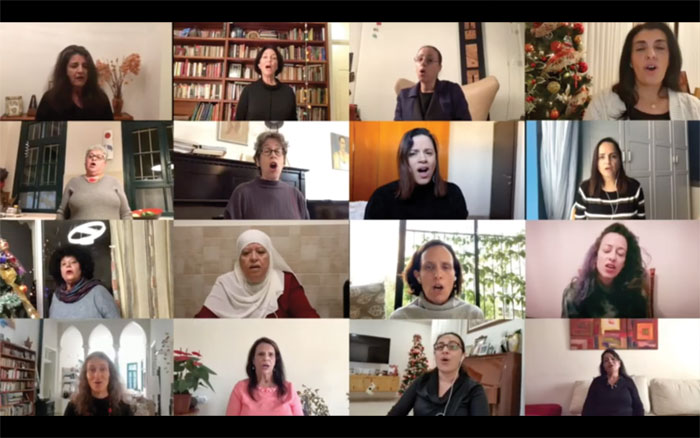
Rana Choir is the only Jewish and Arab women’s choir in Israel. It features singers from Muslim, Jewish and Christian faiths who consider one another family, and their very existence as a group is an anomaly in the Middle East.
Although they’ve performed predominantly cover songs since their inception in 2008, Rana Choir just released an original collaboration with Los Angeles-based indie pop band Distant Cousins. The two groups are 7,000 miles away from each other, yet they managed to write and record a high-quality, professional sounding song, “Omdot B’Yachad / Wakfal Sawa” (“Standing Together”), using iPhones, Androids and Dropbox.
“We were not interested in doing another song about peace and love,” Rana Choir Founder Mika Danny told the Journal. “We were all at a point where we felt very angry about the situation here, very frustrated with the situation between Arab and Jews inside Israel.”
In Danny’s opinion, the prejudice and racism that come between people of different backgrounds in Israel is due to the fact that they don’t know each other personally. She sees Rana Choir as a vector to help people change their perceptions of one another.

The idea for the collaboration came from Ari Ingel, director of the L.A.-based entertainment industry nonprofit organization, Creative Community for Peace. The organization’s mission is to promote the arts for peace and use music to build bridges between diverse communities. Ingel knew of the inspiring story behind Rana Choir and thought they’d be a great fit for with Distant Cousins.
“We’re always looking to find people who are similarly aligned,” Ingel told the Journal. “Distant Cousins sent us a video they had done at the Staples Center with Muslim and Jewish kids here in L.A., and they did this amazing real-time workshop where they made a song with the kids in the room. They shout out different words and they play a chord. I thought it was phenomenal.”
The way Distant Cousins worked with the children, Ingel thought, would be an excellent way to use the arts to showcase common ground between Jews and Arabs within Israel.
Distant Cousins frequently use their musical talents to write marketing jingles for prominent businesses. The trio is adept at making music by committee, as they have been creating music to order for over seven years.
The first songwriting session began with conversations between with Rana Choir members and Distant Cousins about what the women experience daily in regards to what they call “the situation” between Jews and Arabs in Israel. Distant Cousins members Dov Rosenblatt, Duvid Swirsky and Ami Kozak led the women of the choir in a deep discussion, eliciting thoughts and frustrations together—all via Zoom.
“That just makes for the best songs because it comes from a real place.”
– Dov Rosenblatt, Distant Cousins
“These women were ready to share real, important conversations…just different issues that they face, [and] politically, the disappointment they feel,” said Rosenblatt. “That just makes for the best songs because it comes from a real place.”
Towards the end of the sharing session, they asked the choir, “Where do you see the light? Where do you see hope in this situation?”
“One of the things we see over and over again in these workshops is that no matter who the people are, it’s amazing how much we have in common with each other,” Swirsky said of the collaboration process. “Having that shared goal really helps people get closer.”
Distant Cousins had the singers listen to a few songs that would influence the overall tonality, including “Imagine” by John Lennon, “We Shall Overcome” by Joan Baez and “The Times They Are A-Changin” by Bob Dylan.
The conversation was mostly in English; Swirsky, who grew up in Israel, translated for the Hebrew speakers. Distant Cousins learned some new Arabic and Hebrew phrases and expressions in the process.
However, Danny and the choir members insisted that the song must have a Middle Eastern sound, not Western, operatic or classical.
“I found out very quickly when I started working with the choir that the texture of the women’s different voices and accents is not a classical sound,” Danny said. “Their real forte is ethnic music.”
After that first sharing session, Rosenblatt, Swirsky and Kozak created a “word cloud” image of the most popular words Rana Choir members used in their discussion, including “country,” “future,” “cooperation,” “leaders,” “children,” “separatism,” “incitement,” “reality” and “people.”
Danny was impressed with how much the women’s struggles aligned in the challenging discussion. She was quick to point out, though, that the political opinions among the women of the choir are vastly divergent, yet their day-to-day challenges and desires are quite similar.
The guys of Distant Cousins came back with a song with a Middle Eastern tone, and lyrics mostly in English (with some Hebrew and Arabic interspersed throughout). These are the opening lines:
I am worried
I am tired
Where is our country?
Lost in a losing fight
To my children
You are my hope
Tomorrow will be better
Harmonies were written. The tenors, altos and sopranos were each assigned their respective arrangements. Rana Choir members recorded their parts and uploaded them to Dropbox, and Kozak layered and optimized the tracks, like any other song production. Drums and strings were added, and the result, “Omdot B’Yachad / Wakfal Sawa,” can be seen on YouTube.
Looking back, Danny reflected on lessons the world can learn from Rana Choir.
“When you sing in a choir, the most basic thing is [that] you have to always listen carefully to the person on your right and on your left, and be synchronized with them,” Danny said. “I think we all listen much more when we sing than when we talk. Just listening is a good starting point for a dialogue. It creates a great intimacy, hearing each other’s voices, hearing the person next to you expressing at this specific moment.”