fbpx

November 23, 2021

I’m Dreaming of a Corny Thanksgiving

I’m so tired of sarcasm. And snark. And anything hip and ironic. And anything that bashes and divides America. I need a break from all this snark overdose. It’s all so exhausting.

I’m in the mood for something corny, earnest, relaxing, old school.

Something like Thanksgiving.

I can’t wait to go around the family table and hear all the corny things we’re thankful for—like our health, our family, our country.

I can’t wait to go around the family table and hear all the corny things we’re thankful for—like our health, our family, our country.

I love the idea that all Americans celebrate Thanksgiving, whether they come from Korea, China, Mexico, Morocco, Italy, Israel or Afghanistan. I love the simplicity and innocence of feeding the needy at soup kitchens. How great is that? A holiday for the whole country, a holiday that brings out the best in us.

Who would want to spoil that?

Well, it turns out plenty of people, people who can’t shed even for one day their bitterness and anger at this country they live in. They’re so angry at America for being systemically and irredeemably oppressive, that even when corny Thanksgiving comes along to unify us, they must find ways to express that bitterness.

They can’t give their anger a break, even on a day of gratitude.

As just one of many examples, in a Nov. 20 MSNBC segment, “The Thanksgiving History You’ve Never Heard,” Gyasi Ross screams at his audience: “The truth is that pilgrims did not bring turkey, sweet potato pie or cranberries to Thanksgiving. They could not. They were broke! They were broken! Their hands were out! They were begging! They brought nothing of value. But they got fed! They got schooled!

“Instead of bringing stuffing and biscuits, those settlers brought genocide and violence. That genocide and violence is still on the menu! And state sponsored violence against Native and black Americans is commonplace!”

Did you know that genocide and violence is still on the menu in America?

Did you know that genocide and violence is still on the menu in America?

It seems there’s a whole movement out there trying to poison our national day of thanks. A column in The Philadelphia Tribune on Saturday was titled, “Celebrating Thanksgiving is Celebrating Racist Genocide.”

I guess maybe it looks courageous to take on sacred cows, even cows as sacred as a day of gratitude. But let’s be clear: These outcries are not scholarly revisionism or constructive criticism or Martin Luther King dreaming of a better America. This is pure America bashing.

None of this bashing, of course, should surprise us. Among cultural elites today, America bashing is as cool as reading The New Yorker.

But even on Thanksgiving? Can’t we take just one national day off from this insufferable lecturing?

I imagine we’ll see plenty of verbal sword fights on Twitter over the next 48 hours, pitting the “Thanksgiving is genocide” crowd versus the “Shut up and have more stuffing” crowd. It will all be very hip and very snarky.

Meanwhile, I’ll be at our family table, grateful for our blissful moment of pure corniness.

Happy Thanksgiving.

I’m Dreaming of a Corny Thanksgiving Read More »

Jewish and Arab Women’s Choir Shows How Music Builds Bridges

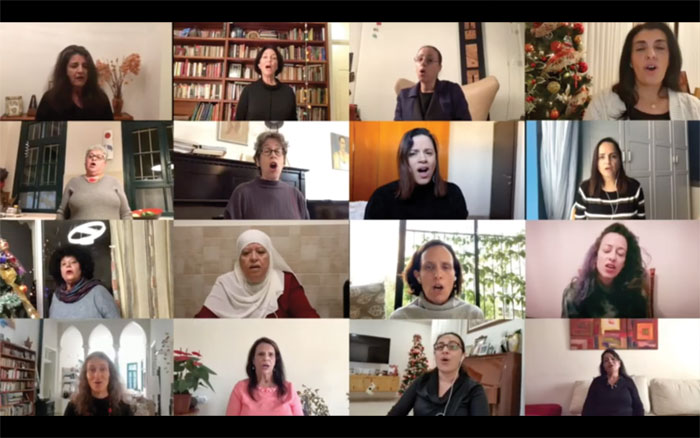
Rana Choir is the only Jewish and Arab women’s choir in Israel. It features singers from Muslim, Jewish and Christian faiths who consider one another family, and their very existence as a group is an anomaly in the Middle East. 

Although they’ve performed predominantly cover songs since their inception in 2008, Rana Choir just released an original collaboration with Los Angeles-based indie pop band Distant Cousins. The two groups are 7,000 miles away from each other, yet they managed to write and record a high-quality, professional sounding song, “Omdot B’Yachad / Wakfal Sawa” (“Standing Together”), using iPhones, Androids and Dropbox. 

“We were not interested in doing another song about peace and love,” Rana Choir Founder Mika Danny told the Journal. “We were all at a point where we felt very angry about the situation here, very frustrated with the situation between Arab and Jews inside Israel.” 

In Danny’s opinion, the prejudice and racism that come between people of different backgrounds in Israel is due to the fact that they don’t know each other personally. She sees Rana Choir as a vector to help people change their perceptions of one another. 

Distant Cousins

The idea for the collaboration came from  Ari Ingel, director of the L.A.-based entertainment industry nonprofit organization, Creative Community for Peace. The organization’s mission is to promote the arts for peace and use music to build bridges between diverse communities. Ingel knew of the inspiring story behind Rana Choir and thought they’d be a great fit for with Distant Cousins.

“We’re always looking to find people who are similarly aligned,” Ingel told the Journal. “Distant Cousins sent us a video they had done at the Staples Center with Muslim and Jewish kids here in L.A., and they did this amazing real-time workshop where they made a song with the kids in the room. They shout out different words and they play a chord. I thought it was phenomenal.” 

The way Distant Cousins worked with the children, Ingel thought, would be an excellent way to use the arts to showcase common ground between Jews and Arabs within Israel.

Distant Cousins frequently use their musical talents to write marketing jingles for prominent businesses. The trio is adept at making music by committee, as they have been creating music to order for over seven years.

The first songwriting session began with conversations between with Rana Choir members and Distant Cousins about what the women experience daily in regards to what they call “the situation” between Jews and Arabs in Israel. Distant Cousins members Dov Rosenblatt, Duvid Swirsky and Ami Kozak led the women of the choir in a deep discussion, eliciting thoughts and frustrations together—all via Zoom.

“That just makes for the best songs because it comes from a real place.”
– Dov Rosenblatt, Distant Cousins

“These women were ready to share real, important conversations…just different issues that they face, [and] politically, the disappointment they feel,” said Rosenblatt. “That just makes for the best songs because it comes from a real place.”

Towards the end of the sharing session, they asked the choir, “Where do you see the light? Where do you see hope in this situation?”

“One of the things we see over and over again in these workshops is that no matter who the people are, it’s amazing how much we have in common with each other,” Swirsky said of the collaboration process. “Having that shared goal really helps people get closer.”

Distant Cousins had the singers listen to a few songs that would influence the overall tonality, including “Imagine” by John Lennon, “We Shall Overcome” by Joan Baez and “The Times They Are A-Changin” by Bob Dylan.

The conversation was mostly in English; Swirsky, who grew up in Israel, translated for the Hebrew speakers. Distant Cousins learned some new Arabic and Hebrew phrases and expressions in the process. 

However, Danny and the choir members insisted that the song must have a Middle Eastern sound, not Western, operatic or classical.

“I found out very quickly when I started working with the choir that the texture of the women’s different voices and accents is not a classical sound,” Danny said. “Their real forte is ethnic music.”

After that first sharing session, Rosenblatt, Swirsky and Kozak created a “word cloud” image of the most popular words Rana Choir members used in their discussion, including “country,” “future,” “cooperation,” “leaders,” “children,” “separatism,” “incitement,” “reality” and “people.”

Danny was impressed with how much the women’s struggles aligned in the challenging discussion. She was quick to point out, though, that the political opinions among the women of the choir are vastly divergent, yet their day-to-day challenges and desires are quite similar.

The guys of Distant Cousins came back with a song with a Middle Eastern tone, and lyrics mostly in English (with some Hebrew and Arabic interspersed throughout). These are the opening lines:

I am worried
I am tired
Where is our country?
Lost in a losing fight
To my children
You are my hope
Tomorrow will be better

Harmonies were written. The tenors, altos and sopranos were each assigned their respective arrangements. Rana Choir members recorded their parts and uploaded them to Dropbox, and Kozak layered and optimized the tracks, like any other song production. Drums and strings were added, and the result, “Omdot B’Yachad / Wakfal Sawa,” can be seen on YouTube. 

Looking back, Danny reflected on lessons the world can learn from Rana Choir.

“When you sing in a choir, the most basic thing is [that] you have to always listen carefully to the person on your right and on your left, and be synchronized with them,” Danny said. “I think we all listen much more when we sing than when we talk. Just listening is a good starting point for a dialogue. It creates a great intimacy, hearing each other’s voices, hearing the person next to you expressing at this specific moment.” 

Jewish and Arab Women’s Choir Shows How Music Builds Bridges Read More »

Palestinian Flags Waved At NYC Rittenhouse Protests

Palestinian flags were waved during protests in New York City against the Kyle Rittenhouse verdict on November 19.

Earlier that day, Rittenhouse, 17, was found not guilty on charges of homicide and use of a deadly weapon after shooting three people during the riots in Kenosha, WI in August 2020; two of the three people were killed. Rittenhouse argued he had acted in self-defense. The verdict sparked protests in various cities around the country.

Footage from protests in New York showed protesters waving Palestinian flags and chants of “Free Palestine,” “Intifada Intifada” and “If Palestine doesn’t get justice, shut the system down!” according to the Jewish Press.

The Institute for Black Solidary with Israel (IBSI) tweeted, “The Rittenhouse trial had nothing to do with the Israeli-Palestinian conflict, but Israel-haters take every opportunity to exploit any cause for their purposes—whether in city streets, in the halls of national governments, or at the United Nations.” They added in a subsequent tweet that the late Palestine Liberation Organization (PLO) leader Yasser Arafat started the “systematic anti-Zionist exploitation” of various causes.

Scottish journalist and Zionist activist Eve Barlow tweeted that the Palestinian flag-waving at these protests is “because the woke community believe Jews and Israel to be the main perpetrators of white supremacy. In case you’re confused, that’s what it means. It is sick.”

Judea Pearl, Chancellor Professor of Computer Science at UCLA, National Academy of Sciences member and Daniel Pearl Foundation President, tweeted in response to Barlow: “Palestinians, unable to promote their victimhood on its own merit, must latch on to other narratives for attention. Who ever heard about a society defining itself by the demise of its neighbor, yet proclaiming itself ‘victim.’”

In a November 22 op-ed for The Jerusalem Post, Social Lite Creative CEO Emily Schrader wrote the Rittenhouse protests were the latest to be hijacked by pro-Palestinian activists, pointing to Palestinian flags appearing at climate change protests and graffiti stating “Free Britney + Palestine” appearing after protests calling for Britney Spears to be freed from her conservatorship.

“The cynical attempts to hijack causes and make them about Palestinians is simply tragedy tourism on the part of anti-Israel activists, not to mention it is disrespectful to the causes they are hijacking,” Schrader wrote. “There’s a difference between showing solidarity and using the publicity of another cause to promote your own propaganda. These anti-Israel activists should not be welcomed in spaces where they cannot show genuine solidarity; these cynical hijackings show their true colors.”

Palestinian Flags Waved At NYC Rittenhouse Protests Read More »

The Ridiculously High Cost of a Kosher Thanksgivukkah

Last November, I discovered one of the silver linings to wearing a face mask: Fewer people can hear you curse like an injured sailor with a mask on than off. 

I didn’t mean to whisper such foul language in the presence of donuts, croissants and tartes, but in my defense, I also hadn’t expected to pay nearly $50 for two pumpkin pies at a local kosher bakery. 

There are two types of Jews who keep kosher: those who were raised with kosher food from birth and have zero frame of reference for what it’s like to lock yourself in the car at 10 p.m. with an In-N-Out Burger and fries, animal-style (with sauce, melted cheese and grilled onions). And then, there are those who used to eat treif, but who now make a conscious choice to keep kosher and are forced to pay exorbitantly high prices. I belong to the second category, hence, the cursing. 

The reality for me and other Jews who now keep kosher is that we remember the lower prices of non-kosher food. This explains why I know that even the fanciest pumpkin pie at a large supermarket, such as Vons, costs no more than $9.99. On Instacart, a pumpkin pie costs $4.79. It has a symbol of kosher certification, but that doesn’t help me, because that symbol comes with a tiny “D,” signifying that it has dairy ingredients. 

As a Jew who has adhered to kosher dietary laws for over a decade, I don’t mix dairy and meat foods, and I can’t eat the former after consuming the latter. In plain terms, this means that I always need a parve (dairy-free) pumpkin pie at the end of that Thanksgiving meal of (kosher) turkey, (kosher) stuffing, and Basmati rice with saffron. Yes, saffron rice. I’m an Iranian American, after all. 

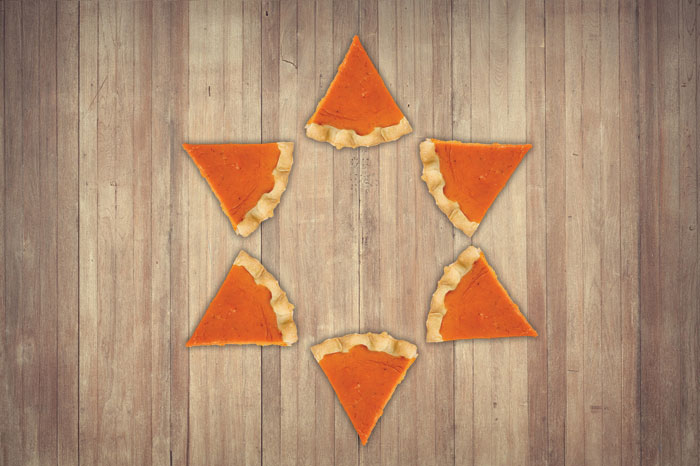
Last year, I paid $23 per pumpkin pie at a kosher bakery. I sliced each pie into six pieces and, to my horror, my son dropped one slice on the floor. That was almost $4 worth of pie. To put things in perspective, one slice of kosher, parve pumpkin pie costs almost as much as an entire dairy pie on Instacart.

And I haven’t even mentioned the turkey yet. Whether at Target or Vons, a 20-pound Butterball turkey costs $1.99 per pound. This year’s price at local kosher markets averages $4.50 per pound. Chances are that there’s a $90 turkey on each kosher Thanksgiving table in Los Angeles this year. Several days ago, I was almost tempted to buy the biggest kosher chicken I could find and pass it off as a malnourished turkey. 

Can I afford a $90 turkey and $50 for two pumpkin pies once a year? I’m blessed to be able to say “yes.” My husband and I will still be able to make mortgage payments and buy 30 pounds of Persian cucumbers for the week. But that doesn’t change the fact that having to pay two-and-a-half times more for a whole kosher turkey is just plain wrong.

And what about families who keep kosher and can’t afford such skyrocketing prices? Sadly, we’re facing a pandemic and unprecedented supply shortages. I’m not entirely blaming kosher businesses, but I draw the line at paying $50 for two pumpkin pies. 

And what about families who keep kosher and can’t afford such skyrocketing prices? Sadly, we’re facing a pandemic and unprecedented supply shortages. I’m not entirely blaming kosher businesses, but I draw the line at paying $50 for two pumpkin pies. 

There’s also the problem of stuffing. I love stuffing. In America, I grew up on Stove Top boxed stuffing. You know, the famous red box that’s addictively delicious and full of preservatives. Once I started keeping kosher, I really missed Stove Top. Most boxes of kosher stuffing taste like celery, onion, and chalk. 

The solution? I make my own stuffing. The only problem is that a loaf of pre-sliced kosher bread costs $11, and a pack of kosher sausage sets me back $10. Fortunately, I’m able to use the excess celery stalks as garnishes for one Bloody Mary after another, all for myself. 

I understand why some kosher foods cost so much. After speaking with several kosher restaurant owners and caterers in Los Angeles, none of whom asked to be named, it’s also apparent that the cost of having a mashgiach (a Jew who is paid to supervise the kosher adherence of a food establishment) in the kitchen is also a huge financial burden. 

Ask most Jews who keep kosher why they’re willing to pay so much more and they’ll respond that you can’t put a price on the importance of keeping kosher for yourself, your family, and your guests. And that’s the problem. Everyone in the kosher food business, whether a restaurant owner or a mashgiach, knows that Jews who keep kosher don’t have a choice. We eat kosher, period. And on Thanksgiving, it’s parve pumpkin pie or a disappointing tray of sliced fruit, at least in my case. I don’t bake.  

Each November, I contemplate vegetarianism (the ethical arguments for not consuming meat also weigh on my mind each year). I wonder whether I could enjoy soy “turkey” meat, followed by a giant slice of dairy pumpkin pie, made with real cream and butter, just as God and Sara Lee intended.

This year, Hanukkah starts three days after Thanksgiving. My poor wallet. My kids don’t get eight-nights’ worth of presents, but I love to buy them, as well as their teachers and my family and friends, little gifts here and there. I’m also forced to buy one dozen kosher Hanukkah donuts for $25. In truth, I buy them for myself and hide the box under my bed. It’s a perfect fit.  

Imagine asking the average non-Jew on the street to pay $25 for a box of donuts. They’d have to be filled with edible gold, rather than jelly or custard, for anyone to agree to such a price. For that matter, imagine asking the same person to pay $24 for a   cheese pizza, without toppings. But the shanda of kosher pizza prices is best left for another column. 

For the record, I love keeping kosher because I feel I’m doing the right thing, and doing the right thing always makes me happy. But it’s not cheap. 

If only Thanksgiving leftovers could be made into Hanukkah foods. Turkey gelt doesn’t sound appetizing, but a creative chef could use leftover mashed potatoes to make latkes. Of course, they would have to have been made in a parve pan to be eaten with sour cream. Yes, my head hurts at the thought of this. 

Maybe this Hanukkah, I’ll attempt to make my own Hanukkah donuts, or sufganiyot. I’d rather do something else, but it looks like I have bigger fish, I mean dough, to fry.


Tabby Refael is a Los Angeles-based writer, speaker, and civic action activist. Follow her on Twitter @RefaelTabby


The Ridiculously High Cost of a Kosher Thanksgivukkah Read More »

Hanukkah Gift Guide: Support Local Artisans and Find the Perfect Gifts for Loved Ones

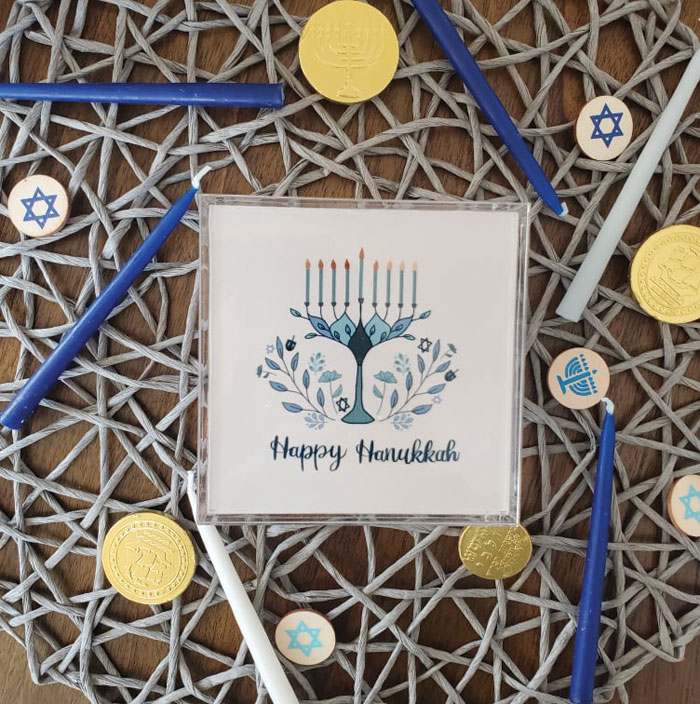
Now that Hanukkah is just around the corner, it’s time to start shopping for your family members and friends. Instead of getting them a gift card or turning to Amazon, you can purchase a unique gift from one of these local artisans instead. You’ll be supporting small businesses while impressing your recipients at the same time. 

Artist Barbara Mendes’ Colorful Creations

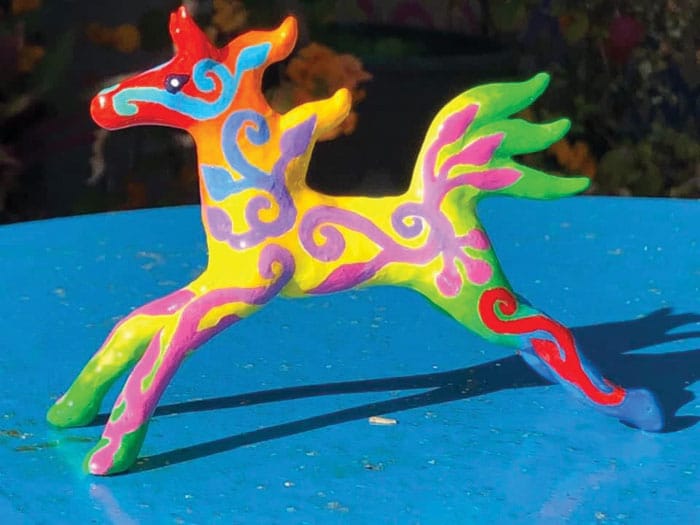
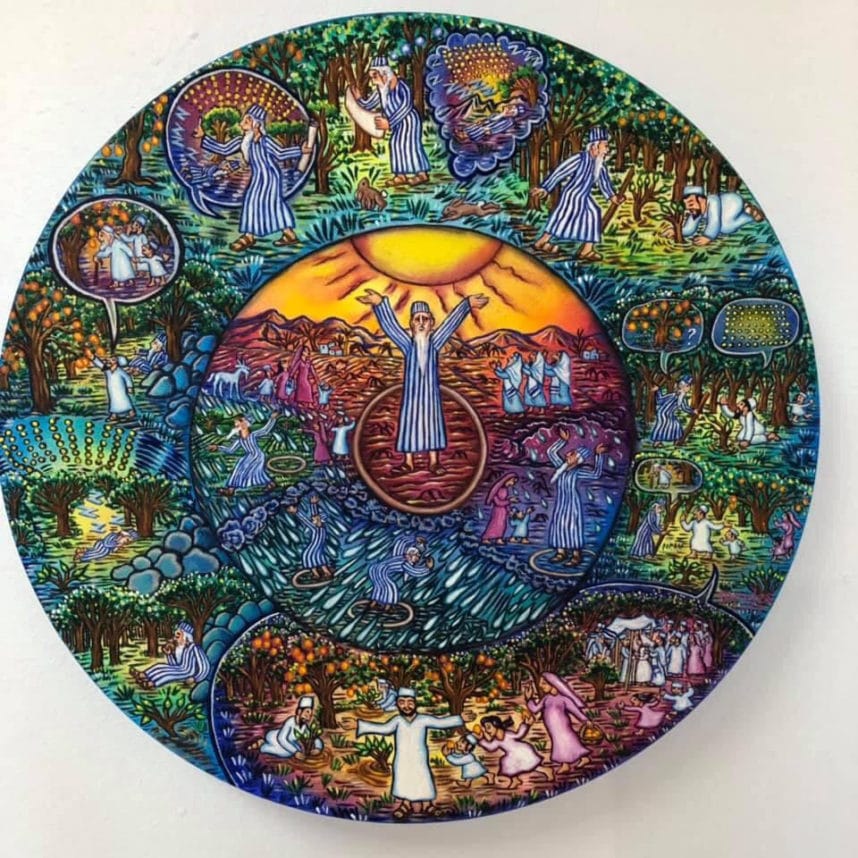
Purchase a Judaic painting or small figurines of horses and birds from artist Barbara Mendes, who is known for her incredibly detailed and colorful Jewish artworks. Art is available at IVAN Gallery at 2701 S. Robertson Blvd. Find out more at BarbaraMendes.org. 

Hanukkah Home Goods by Chen Alyesh 

Pick up holiday-specific presents like Hanukkah placemats, stationary cards, throw pillows and wrapping paper from artist Chen Alyesh. Goods are available at society6.com/cdesignbychen.

Sweet Treats from Chana Netkin

Pico-Robertson-based kosher baker Chana Netkin is offering up hot cocoa bombs for $6 each and small and large DIY Hanukkah cookie kits for $20 and $40, respectively. “[The cookie kit is the] perfect family activity to do after lighting the menorah,” she said. You can order your sweets by emailing thetrustybaker@gmail.com or contacting Netkin on WhatsApp at (310) 929-0851. 

Rae Shagalov’s Hanukkah Activity Book

Want to get creative this holiday? Then check out author and illustrator Rae Shagalov’s, “The Happy Hanukkah Fun Activity Book.” “It’s a fun-filled Hanukkah activity book to keep your children busy for hours,” said Shagalov. “Puzzles include mazes, matching and word search, thoughtful writing and drawing prompts and relaxing coloring pages for children ages four to eight (and their grown-ups will enjoy coloring it, too!).” You can find the book on Amazon, or at https://www.joyfullyjewish.com. 

Beautiful Jewelry From Liza Shtromberg

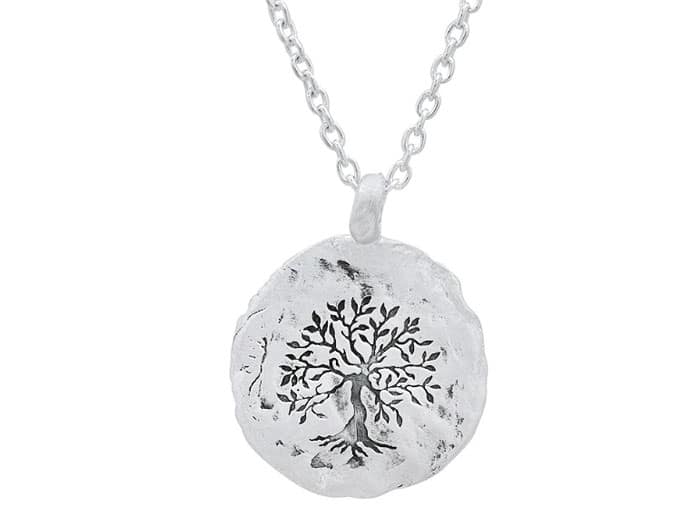
Liza Shtromberg first started making jewelry in her father’s jewelry gallery, which was located in the old quarter of Jaffa in Israel. Today, she works with stylists and celebrities to make pieces, some of which have appeared on “Crazy Ex-Girlfriend” and “The Voice.” Standout jewelry includes a sterling silver tree of life necklace made with the imprint of the Western Wall ($120) and an engraved Shema Israel silver bracelet ($80). You can shop online at JewishJewelryLizaShtromberg.com or go to her store, Western Wall Jewish Jewelry, at 1953 Hillhurst Ave. 

Chef Nina Safar’s Kosher Cookbook 
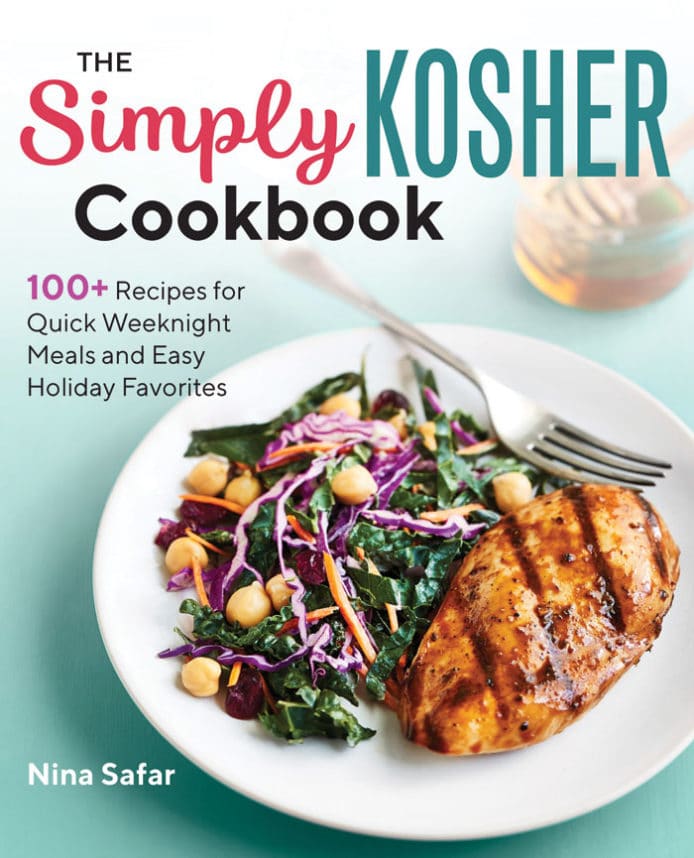
Nina Safar of Kosher in the Kitch is the author of “The Simply Kosher Cookbook,” which contains delectable recipes for Hanukkah. Purchase this book and you’ll learn how to make her signature Reuben stuffed latkes. “When it comes to celebrating Hanukkah, I like to think of everyone’s favorite fried food—latkes—and the exciting nontraditional ways to eat them,” she said. The book is available on KosherintheKitch.com and Amazon.

Delicious Desserts from The Kosher Cookie Company

The Kosher Cookie Company, part of Bibi’s Bakery and Café, is offering up Hanukkah Gift Tins ($29.95) with 20 crispy blue and white sugared dreidel cookies and Paint Your Own Cookie kits for Hanukkah ($17.95), which come with four cookies and four brushes. These sweets are available at KosherCookieCompany.com. You can also pick them up at Bibi’s at 8928 W. Pico Blvd.


Jewelry With Meaning from Ben Lesser at ZACHOR

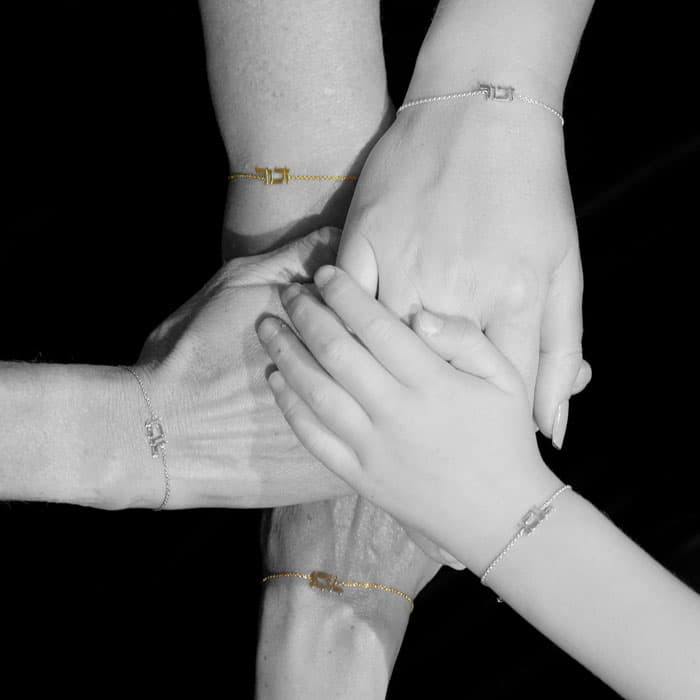
Holocaust survivor Ben Lesser, 93, who lives in Las Vegas, founded ZACHOR, a Holocaust remembrance foundation. Together with his descendants, who are based in Los Angeles, they’ve put out a set of handcrafted jewelry that is etched with the organization’s signature ZACHOR, the Hebrew word for “remember.” You can purchase bracelets for $325, 14k pendants for $220 and pins for $4 at ZachorFoundation.org. 


A Variety of Gifts at GIFTED by Jill Lefferman

Are you unsure about what kind of present to give? Then pop into GIFTED, an experiential brick and mortar boutique at 10590 W. Pico Boulevard. Owner Jill Lefferman recommended gifts like a colorful backgammon game made of vegan leather ($400), a s’mores roasting set gift box ($180) and a lovely oil menorah flower vase ($370). “Every piece in our store is sourced with love and purchased with a purpose,” said Lefferman.


Hanukkah Gift Guide: Support Local Artisans and Find the Perfect Gifts for Loved Ones Read More »

A Delicious Twist on Latkes, and the Perfect Sephardic Donut

Artemisia Gentileschi was a famous Baroque artist who lived in the Florence of the Medici and the Rome of the Popes. Her dramatic paintings are filled with heroines from the Bible. But it is the audacious story of Judith, a young widow and unlikely savior of the Jewish nation in the second-century B.C.E., that Gentileschi depicts in six magnificent paintings.

When her famine-stricken town is besieged by Nebuchadnezzar’s top general, the cruel Holofernes, Judith decides to take action. Accompanied only by her maid-servant, she enters the enemy camp. Enticed by her beauty, Holofernes invites her to a banquet where salty cheese is served. They are alone in his tent when he falls asleep in a drunken stupor. Judith prays to G-d for help, then with great courage and fortitude, she takes Holofernes sword and decapitates him in one bloody stroke. With the Assyrian army in a state of confusion, Judith urges the Israelites to stage a surprise attack. They emerge from the battle victorious.

Nowadays, the Hanukkah celebration centers on the victory of the Maccabees over the Assyrian-Greeks, but in the Middle Ages, the Rabbis placed the story of Judith front and center.

Hanukkah is truly the coziest, most joyous time of the year. Every year, I invite my brothers, my nieces and nephews and my cousins and their children. I set up a latke bar with a huge pile of potato latkes and lots of toppings. The choices include caramelized onions, sautéed herbed mushrooms, Labne, kosher caviar, smoked salmon and whitefish salad. In a nod to Ashkenazi tradition, I include a homemade applesauce.

There’s also a falafel bar with all the fixings—hummus, tahini, Israeli salad, pickles and olives. To add to the commemoration of the little crucible of oil that burned so brightly in the rededicated Temple, I also serve fresh-fried Sephardic style donuts called bumuelos and rosquitas.

We light the big, beautiful menorah that was given to Neil by the Sephardic Educational Center many years ago. Our children light their menorahs, a few more are lighted and then the glow in our home is immense and magnificent. 

—Rachel

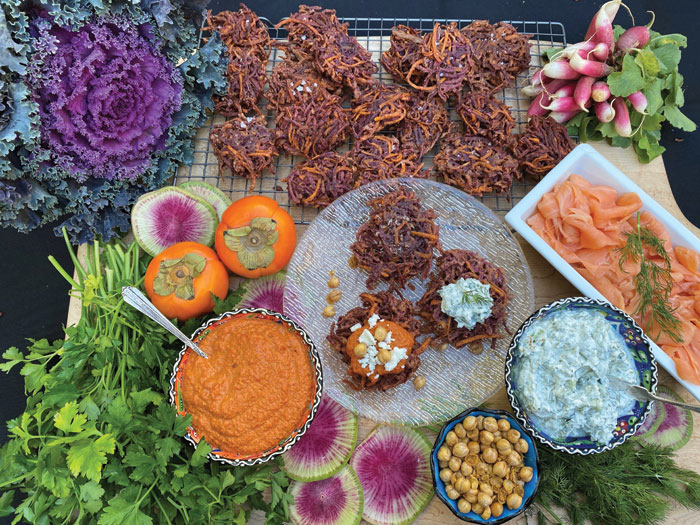
The very talented chef Sam Sheff (yes, Rachel’s son) inspired us to incorporate Japanese yam into our sweet potato latkes this year. The drier, starchier texture and sweet, nutty flavor of Japanese yams makes them the perfect ingredient for latkes. Their deep purple hue combined with the deep orange of the sweet potatoes made these latkes a thing of beauty and so incredibly delicious.

We contrasted the crispy sweetness of the latkes with two dips. One is an addictive Muhammarra sauce, made with jarred roasted bell peppers and walnuts and flavored with pomegranate molasses, fresh garlic and cayenne pepper. The other is a fresh tzatziki dip prepared with strained Greek yogurt, sour cream, finely chopped cucumbers, dill and mint.

We hope you try these recipes and top your latkes with some crumbled Feta Cheese and raise a toast to the indomitable spirit of Judith and the Jewish people.

—Sharon

Sweet potato latkes

1/2 lb sweet potato, peeled and grated
1/2 lb Japanese yam, peeled and grated
1 red onion, grated
1/3 cup all-purpose flour
2 large eggs, lightly beaten
1/2 teaspoon kosher salt
1/2 teaspoon black pepper
1 cup vegetable oil
3 baby carrots

  • In a large bowl, mix together the sweet potato, yam, onion, flour, egg, salt and pepper.
  • In a large deep skillet, warm oil over high heat until oil is boiling. 
  • Add the baby carrots to the oil (to absorb burnt particles in the oil during the frying process).
  • Using an ice cream scooper, scoop the sweet potato mixture and flatten into your palm, then drop into the hot oil.
  • Reduce heat to medium and fry until golden, about 1 1/2 minutes. Flip and fry another 1 1/2 minutes. 
  • Transfer latkes to a plate lined with paper towels or a paper bag.
  • Serve hot.

Muhammara

1 cup walnuts
½ cup breadcrumbs
1 12-14 ounce jar of roasted red bell pepper, drained
3 tablespoons olive oil
2 tablespoons pomegranate molasses
1 clove of garlic
1/2 teaspoon cayenne pepper
¼ teaspoon salt 

  • In a small pan, heat 1 tablespoon of olive oil over medium heat, add walnuts and toast for 3 minutes. Then transfer to a dish and let cool completely.
  • In the same pan, toast the breadcrumbs until they become golden, stirring to make sure they do not burn. Transfer to a plate to cool.
  • Place all the ingredients into a food processor and blend to a smooth paste. 
  • Chill before serving on top of latkes or as a dip.

Tzatziki

1 cup full fat Greek yogurt
1/2 cup sour cream
1 English cucumber or 3 Persian cucumbers, finely diced
2 tablespoons finely chopped dill
1 tablespoon finely chopped mint
1/2 teaspoon kosher salt
¼ teaspoon pepper
1 garlic clove, finely minced (optional)

  • Strain the yogurt through a cloth or coffee filter for an hour. 
  • In a bowl add the yogurt, sour cream, cucumbers, dill, mint, salt and pepper. Add garlic, if desired. 
  • Keep refrigerated until ready to serve.

Photo by Alexandra Gomperts

Larache is an important Atlantic port city in northwest Morocco, located at the mouth of the Loukkos River. Settled successively by the Phoenicians, Carthaginians and Romans, the ruins of ancient Lixus sit on the north bank of the River. The cityscape is dominated by two forts. The ancient Kebibat fortress rises out of the sea and the fort of La Cignogne was built by the Spaniards, who ruled Larache from 1610 to 1689 and from 1912 to 1956. 

Rachel’s paternal grandfather, Salomon Emquies was the proprietor of a successful spice business in Larache. A devout man, he attended Shacharit prayer services every morning. Knowing that his youngest son Albert was loath to leave his warm bed at such an early hour, he would bribe him with the promise of buying freshly prepared sfenj after the prayers. 

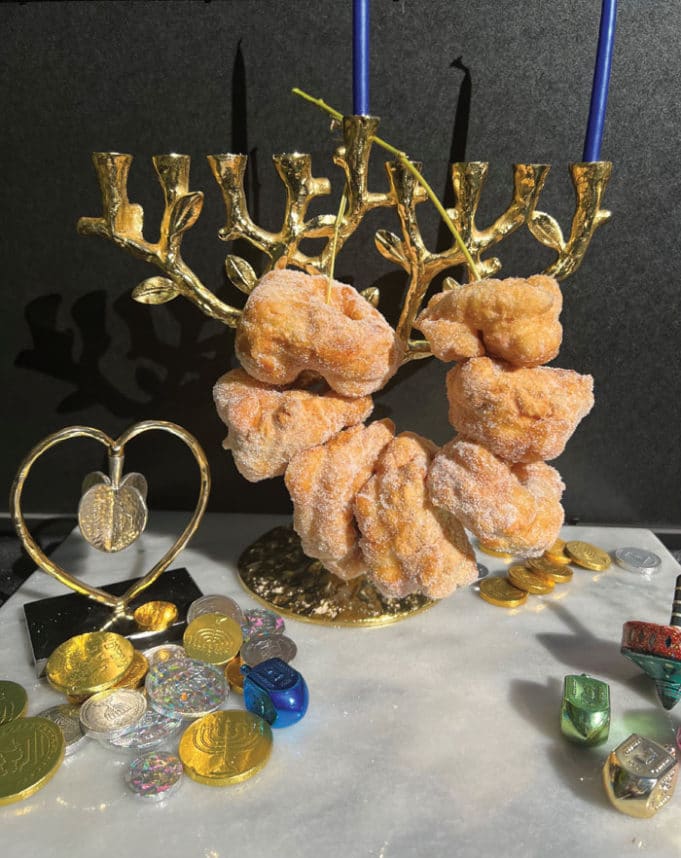
The Berber street vendor would stand in front of a vat of boiling oil; his hands would quickly form rings from the creamy, yeasty dough mix and drop them in the oil. Before young Albert could blink, the dough would puff up and turn a warm amber hue and the vendor would string the sfenj on a palm frond and tie it into a ring. After paying the equivalent of a few pennies, Albert would happily traipse home with the rustic doughnuts. At home for breakfast, the sfenj would be coated with a sprinkling of sugar or a warm honey syrup. 

Sfenj are still a common, very popular street food all over Morocco. The recipe originated in Andalusia, Islamic Spain, where in the 12th century an Arabic poet proclaimed “The bakers of sfenj are worth as much as kings!” The name itself comes for the Arabic word for sponge, likely a reference to the light, airy texture of these irresistibly addictive treats. 

While in Larache sfenj were an everyday affair, we think they are the perfect (pareve) treat for Hanukkah! 

— Sharon

Sfenj

2 teaspoons yeast
1 teaspoon sugar
1 1/4 cup warm water
3 cups all purpose flour
1 teaspoon salt
vegetable or peanut oil for frying
3-6 baby carrots
sugar, for dusting  

  • In a small bowl, add the yeast and sugar, then add the warm water, cover with a tea towel and allow to proof for 5 minutes. 
  • In a large bowl, mix the flour and salt. Add the yeast mixture and knead vigorously until smooth. The dough should be very sticky to knead.
  • Cover the bowl and let the dough to rise for two hours, until it doubles or triples in size.
  • In a wide pot, heat 1-2 inches of oil until piping hot. Add the carrots to absorb the burnt black crumbs and keep the oil clear.
  • Fill a small bowl with water and set to the side. Line up the three prepared bowls: One with the dough, one with water, and a third with sugar.
  • Prepare a cookie sheet with paper towel or a brown paper bag to absorb the oil. 
  • Dip hands in the water, then pull off a piece of dough about the size of a golf ball.
  • Using your fingers make a hole in the dough and stretch into a ring.
  • Drop it into the oil. Repeat with the remaining dough. Be careful not to crowd the pan.
  • Fry them until golden brown, flipping a few times to make sure both sides are cooked well.
  • Remove from oil using two forks, and place on the tray
  • Once the oil has been absorbed, roll them in the sugar mixture before they cool off.
  • Best when eaten right away.

Rachel Sheff and Sharon Gomperts have been friends since high school. They love cooking and sharing recipes. They have collaborated on Sephardic Educational Center projects and community cooking classes. Follow them on Instagram @sephardicspicegirls and on Facebook at Sephardic Spice SEC Food. Website: sephardicspicegirls.com/full-recipes

A Delicious Twist on Latkes, and the Perfect Sephardic Donut Read More »

Oberlin Professor of Religion and Peace Studies Muhammad Jafar Mahallati Must Go

Muhammad Jafar Mahallati, a professor of Religion and Peace Studies at Oberlin College, has been identified by Amnesty International as a senior Iranian regime official who was complicit in crimes against humanity for his cover up of Iran’s 1988 prison massacres of over 5000 political prisoners when he was Iran’s ambassador to the United Nations. The victims were young men and women who had been members of left wing and labor groups.

On November 2, these three authors attended a protest at Oberlin College, organized by the Oberlin Committee for Justice for Mahallati’s Victims. Family members of those who had lost their lives in the mass executions spoke at the protest and called for Mahallati’s removal from the Oberlin faculty, as did Melissa Landa, a member of the committee and a representative of Oberlin alumni supporting the grieving families.

During his tenure as Iran’s U.N. Ambassador, Mahallati also made dehumanizing remarks about Iran’s Baha’i community. Mahallati described the religion of the community, a persecuted minority in Iran, as a cult and referred to its members as child molesters and terrorists. Furthermore, Mahallati delegitimized the State of Israel, celebrated violence against innocent Israelis, and called for a global jihad against Israeli Jews. In a November 1, 2021 letter to Oberlin Dean David Kamitsuka, Mahallati explained that he was merely following orders, stating, “I was doing my job, delivering the official statements of Iran to the U.N. U.N. envoys cannot defy their official mandates to pursue their personal agendas and opinions. In the rare cases that they do, they get fired from their positions if not labeled as political traitors.” However, nowhere did Mahallati retract his statements. Additionally, as we will show, he continues to promote terrorism against Israeli civilians by encouraging support for Hamas among his students. Hamas is a group designated by the United States and the European Union as a terrorist organization and is funded and equipped militarily by Iran.

The Oberlin Review, the college’s student newspaper, demonstrated moral leadership when its editors drew up a critical and courageous article, “Evidence Against Mahallati Irrefutable.” The Oberlin Review also published an op-ed by alumna Azadeh Pourzand, asking the Oberlin administration to engage with the families and be transparent about how they obtained the results of a sham internal investigation. Lawdan Bazargan, the spokesperson for the families, who lost her brother Bijan in the prison massacre, has been seeking a dialogue with the Oberlin College administration since October 2020, but they have, to date, refused to meet with her. Instead, they have presented the following statements about their inquiry:

“The inquiry did not find proof to corroborate the allegations that Professor Mahallati knew of the atrocities at the time he was asked about them during his tenure at the United Nations”; “The review could not identify a pattern of anti-Semitic behavior or ongoing calls for the destruction of Israel”; “His record at Oberlin is exemplary, and includes no instances of anti-Semitic behavior.”

Despite the college’s claims, we have ample evidence to show that Mahallati indoctrinates his students with anti-Israel, antisemitic propaganda, and promotes pro-Hamas views—and, therefore, does indeed endorse the destruction of Israel. While he attempted to delete the files, we retrieved Mahallati’s student blogs from one of his courses, which he had made public before the accusations against him were launched. In several examples, we see a chilling celebration of Hamas, citing Mahallati’s lectures as its source: “Though there is no concrete difference between Hamas or the Irish Republican Army, the combination of religion and politics causes groups like Hamas to be labeled terrorists, while similar groups in Europe or America are thought of as expressions of free speech.” A similar statement is made by another student, who writes, “These groups are usually automatically branded as terrorist groups whereas other ethno-national groups are legitimized by the West.”

Despite the college’s claims, we have ample evidence to show that Mahallati indoctrinates his students with anti-Israel, antisemitic propaganda, and promotes pro-Hamas views—and, therefore, does indeed endorse the destruction of Israel.

Unlike Oberlin students, who have shown honesty and courage in their analysis of Mahallati’s crimes, others have deflected from his actions. Communicating with Frieda Fuchs, Jewish Studies Professor Matt Berkman described our efforts as guided by right-wing political motives. Likewise, in Mahallati’s letter to Dean Kamitsuka, he contended that the families of the victims have started a propaganda smear campaign that is motivated by a right wing agenda and based on questionable documents. Neither Berkman’s nor Mahallati’s claims are true. All three of us are center left regarding the Israel question, while the families represent diverse political leanings. We are here to condemn an anti-Israel advocate who has found himself a safe sinecure behind the walls of academia. We also feel it is our duty to support the victims of human rights abuses. The victims’ families have reached out to Republican as well as Democratic politicians on the belief that human rights are a universal value that transcends partisanship.

Also in contrast to the Oberlin students who rigorously examined the evidence against Mahallati and declared it was overwhelmingly against him, some Oberlin alumni appear to be joining the college’s president Ambar in whitewashing his alleged crimes against humanity, genocidal antisemitism, and anti-Baha’i incitement. The three authors of this article—all members of the Oberlin Committee for Justice for Mahallati’s Victims—have experienced a sharp reaction to our efforts from an online forum of 2,500 members of the Oberlin community. On Tuesday, November 2, the same day that Landa spoke at the protest, she was abruptly “muted” and thus prevented from participating in the “Uncensored Unofficial Oberlin Alumni Discussion Group” in which she had been a long-standing member. Subsequently, Marta Braiterman Tanenbaum and Frieda Fuchs were also prevented from participating in the group soon after Landa’s ousting. The Facebook group is administered by Oberlin alumna Rica Mendes, who formerly administered another online forum with Rachel Roberts, also an Oberlin alumna, and a representative of the Council on American-Islamic Relations (CAIR), a Hamas affiliated organization. Mendes is still in close communication with Roberts, as she recently reported to Braiterman Tanenbaum via voicemail.

The Facebook group had generated a good deal of antisemitic rhetoric since we had begun to share information about Mahallati and the November 2 protest, including accusations that the protest was being funded and organized by AIPAC, rather than by the Iranian families. Upon our expulsion, Robert Hayes, the former administrator of the group, wrote a vicious and arguably antisemitic attack: “None of you have contributed anything of notable value. Nothing. I have not met a single one of you that I care for as a person. Not all of you have lied or misrepresented or broken rules; some of you are just torpedoes for the people who do.” Hayes had recently expressed sympathy for the Iranian families while writing that he had no interest in hearing about Mahallati’s support for Hamas. His vitriolic views about us were warmly applauded by other members, while our arbitrary ousting from the group was celebrated in large numbers.

As Oberlin College faces one of the most pressing human rights crises since its founding, the Oberlin administration, the college Trustees, and many alumni have failed to respond honorably.

As Oberlin College faces one of the most pressing human rights crises since its founding, the Oberlin administration, the college Trustees, and many alumni have failed to respond honorably. The only response to discovering that Mahallati was complicit in crimes against humanity and promotes terrorist ideology in his classroom is to remove him from the Oberlin faculty. We applaud Oberlin student leaders for their moral leadership during this crisis and hope that the Oberlin administration, the Trustees, and Oberlin alumni will act on the students’ intellectual and moral clarity.


Melissa Landa attended Oberlin College, completed her M.A. at Tufts University, and her Ph.D. at the University of Maryland. She has been an educator for thirty years, and runs a non-profit, Alliance for Israel, that addresses anti-Israel forms of antisemitism in education settings. 

Marta Braiterman Tanenbaum attended Oberlin College and holds two Masters degrees. A NYS certified teacher, Marta led classrooms in underfunded minority public elementary, Jewish teen and adult, and prison schools.

Frieda Fuchs has a Ph.D. in Government and European Studies/Civilization from Harvard University.

Oberlin Professor of Religion and Peace Studies Muhammad Jafar Mahallati Must Go Read More »

Reasons to Give Thanks

Whenever I used to thank my Grandpa Joe, he’d reply, “Don’t thank Grandpa!” Then I’d say, “well, thank you anyway,” and we’d both laugh. Here’s what I think he meant: “It’s my pleasure to be able to do something for my grandson—don’t bother with the ‘thanks.’”

The commentator Rabbi Eliezer Davidovits (1878-1942), my cousin of blessed memory, makes a similar point in his interpretation of Psalm 107:8 where we read:

“Let them praise the ETERNAL on account of God’s love; for God’s wondrous deeds for humanity!”

The question Rabbi Davidovits asks is why would God need our words of thanks at all? While we might wish to be thanked for the kindnesses we show others, God is beyond all words of thanksgiving or praise. God doesn’t need our words or our thanks, so why bother? It’s a question that invites us to reflect on the very purpose of prayer itself. For whom are all of our words of thanksgiving, praise, and supplication—for God or ourselves?

It’s for humanity’s own good, that we are instructed to be more grateful people.

Rabbi Davidovits teaches that the purpose of offering words of thanksgiving is for our own spiritual growth. He draws this conclusion by focusing on the last words of the verse from the Psalm: “for humanity.” It’s a clever word-play that suggests we should read the verse as follows: “They should praise the ETERNAL for God’s love and wondrous deeds for their own sake.” It’s for humanity’s own good, that we are instructed to be more grateful people.

Research from the field of positive psychology suggests that this is the case. Study after study demonstrate an association between gratitude and an individual’s sense of well-being. A Harvard study notes that “gratitude is strongly and consistently associated with greater happiness. Gratitude helps people feel more positive emotions, relish good experiences, improve their health, deal with adversity, and build strong relationships.”

The study goes on to suggest a variety of different ways that we can cultivate gratitude in our lives, including keeping a gratitude journal, making the writing of thank you notes (and yes emails and texts) a regular part of our practice, and of course through prayer. 

God might not need our words of praise and thanksgiving but we should offer them anyway—for our own selves and our own good. It will help us to be more grateful, happier people who experience a deeper sense of wholeness, well-being, and shalom—even more reasons to give thanks. 

Reasons to Give Thanks Read More »

Richard Gere, Susan Sarandon, Mark Ruffalo Among Celebs Signing Letter Accusing Israel of “Apartheid Occupation”

More than 100 celebrities signed a letter accusing Israel of “apartheid occupation” and denouncing Israel’s designations of six Palestinian NGOs as terror organizations.

Among those who signed the letter included Richard Gere, Susan Sarandon, Mark Ruffalo and Peter Gabriel, The Jewish Chronicle (JC) reported. The letter lauded the NGOs for holding “Israel accountable for its gross human rights violations and apartheid regime of institutionalised racial discrimination.” Israel has alleged that the six NGOs funnel money for the Popular Front for the Liberation of Palestine (PFLP), which has been designated as a terror organization by both the United States and the European Union, and that the NGOs employ various PFLP members.

Various Jewish and pro-Israel figures weighed in on Twitter.

“This group of ‘celebrities’ is to be the judge & jury for Israel’s decision-making?” American Jewish Committee CEO David Harris tweeted. “They’re to be seen as the last word on threats to Israel’s survival? Pray tell, what exactly qualify Richard Gere, Simon Pegg, Claire Foy, etc., for this exalted life-and-death role?”

Scottish journalist and Zionist activist Eve Barlow tweeted, “The humanitarians are really proud again that they’re singling out the Jews. Look at them go. They hate us. Hate.”

Variety Features Editor Malina Saval tweeted, “Richard Gere has visited Israel at least two times to my personal knowledge. I met him at the Jerusalem film fest. He let Israel put him up in a 5-star hotel. He accepted free meals. Went shopping. What a hypocrite. Then again, the founder of [the Boycott, Divestment and Sanctions movement] lives in Acre, Israel. Typical.”

Human rights lawyer Arsen Ostrovsky, who heads the International Legal Forum, tweeted, “I don’t know which is more pathetic: The likes of has-been actors like Richard Gere commenting on Middle East conflict or @KenRoth using an actor whose claim to fame is ‘Pretty Woman’ as an authority on terror financing and the Middle East.”

Richard Gere, Susan Sarandon, Mark Ruffalo Among Celebs Signing Letter Accusing Israel of “Apartheid Occupation” Read More »

Jewish Big Brothers Big Sisters of Los Angeles (JBBBSLA) is Recruiting “Bigs” and “Littles” for Their Mentoring Program.

Jewish Big Brothers Big Sisters of Los Angeles (JBBBSLA) is committed to connecting Jewish families to an impactful mentorship experience for children and teens. For over 100 years, the staff at JBBBSLA has created, nurtured, and professionally supported one-to-one matches, serving thousands of young people over time. The need for these mentorship connections has never been higher than during the pandemic.

In households across LA, many Jewish children have been isolated in their homes during the pandemic. Mentors at JBBBSLA have the potential to make a life-changing impact on Jewish youth, by building a child’s confidence, increasing their school engagement, and helping them develop stronger social skills.

JBBBSLA matches Bigs and Littles based on compatibility of interests, personalities, strengths, and needs. Matches spend time together twice a month engaging in recreational, cultural, or educational outings. JBBBSLA also sponsors free match activities and agency-wide events throughout the year. While participants commit to the program for at least one year, many remain in each other’s lives for much longer as caring, trusted friends. Additionally, JBBBSLA offers additional opportunities such as access to sleepaway camp experiences, free college guidance counseling, and college scholarships. To learn more about the mentorship program, click here.

Are you a parent looking for a program for your Jewish child?

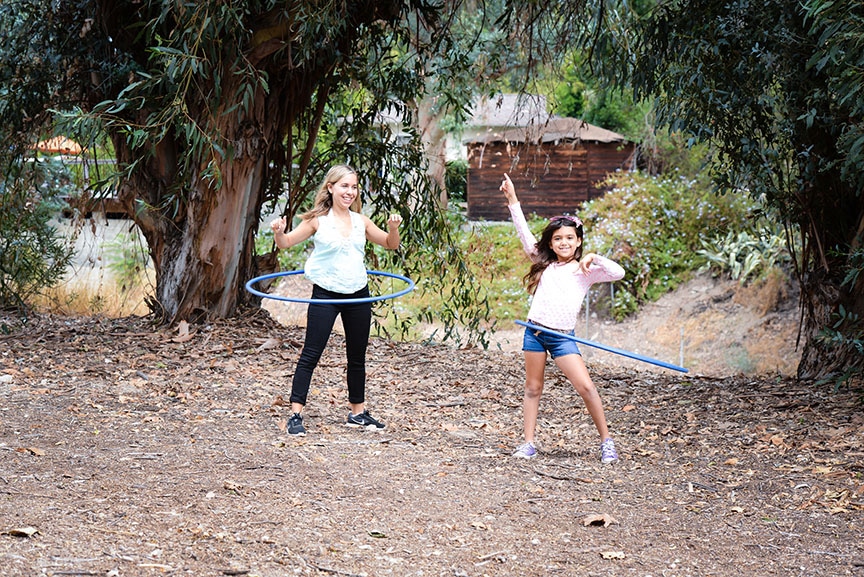
Little Sister Alex hula hoops in a backyard with her Big Sister, Leeron.

“I found someone I could talk to about important things in my life, someone who would listen, and someone who I knew I could look up to.” – Alex, Little Sister, Age 12.

As a parent, you recognize the potential of your child better than anyone. By giving your child the opportunity to be part of Jewish Big Brothers Big Sisters, you’re starting them down a path to an even brighter, more promising future. Having a Big means having an additional friend and advocate who can play a role in your child’s development and success. JBBBSLA staff will pair your child with a Jewish Big over the age of 21 who is caring, trusted, friendly, and has a variety of personal and professional experiences that make them relatable to your child.   Staff at JBBBSLA conduct extensive background checks and interviews to ensure the quality of our mentors and provide the best match possible.

Click here to learn more about signing up your child to be matched with a Big.

The Benefits of a child having a Big

It all starts with the right role models. A Big can help your child be more confident, do better in school, get along better with family and friends, feel better about themselves, and experience new activities that connect them with Los Angeles and the Jewish community.

Who is Eligible?

Littles in our mentorship program come from a range of circumstances, such as single parent homes, or families struggling with severe illness, loss or financial hardship.

Many parents ask to what level does their family need to be “Jewish.” Littles in the mentoring program do not need to belong to a particular sect of Judaism nor be a member of a synagogue. If your child identifies as Jewish, JBBBSLA staff will consider the mentorship application.

Are you a Jewish adult looking to give back?

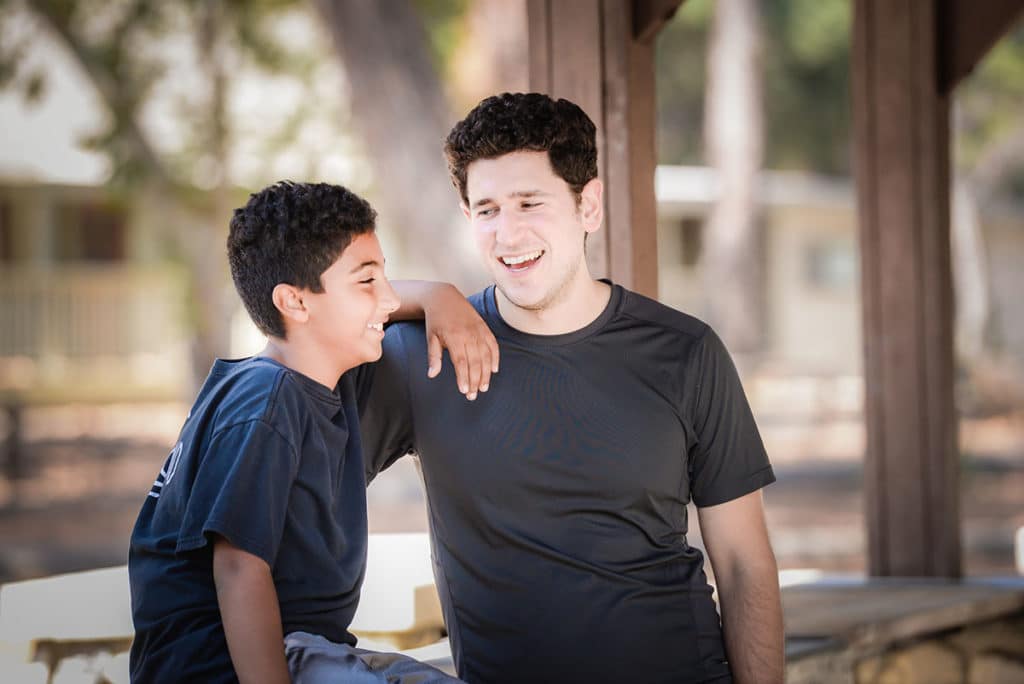
After throwing a football, Big Brother Michael listens to his Little Brother Avi talk about his classes and his friends.

“There are so many ways to give back, but nothing has been as meaningful to me as being a mentor.” – Michael, Big Brother

Becoming a Big is one of the most enjoyable and fulfilling things you’ll ever do. You can help shape a child’s future for the better by empowering them to achieve. And the best part is, it’s actually a lot of fun! You and your Little can share the kinds of activities you already like to do.

“We don’t match for convenience or expedience. We match for quality,” JBBBSLA’s CEO Cari Uslan explained.  “That’s why our success rate is so high and long-lasting. Our average match length is 3-4 years and, although we only ask for a one-year commitment, most matches continue much longer.”

JBBBSLA has 30 kids waiting for a caring, adult role model – the majority are boys and live in the valley.

Click here to learn more about becoming a Big and impacting a child’s life.

The Benefits of Being a Big

Our mentors often say that the mentoring experience brings them happiness, joy, and pride. JBBBSLA offers opportunities for Bigs to network and meet new people, a connection to the Jewish community, and the most rewarding Jewish volunteer experience in Los Angeles. Being a Big will change a child’s life, and YOURS.

Who is Eligible?

Jewish adults age 21 and above are eligible to become Bigs. To be considered for the mentorship program, applicants must identify as Jewish. Bigs must also agree to be matched with their Little for at least one year, and be committed to spending 2-3 hours together twice a month.

Jewish Big Brothers Big Sisters of Los Angeles (JBBBSLA) is Recruiting “Bigs” and “Littles” for Their Mentoring Program. Read More »