While television has never been better, according to veteran actor and two-time Oscar winner Dustin Hoffman, film has never been worse.
The star of the iconic Mike Nichols 1960s film “The Graduate,” who felt he was miscast because the main character, Benjamin Braddock, seemed to him appropriate for a WASP rather than a Jewish actor, observes that Hollywood is too obsessed with their bottom lines and budgets. He noted that “The Graduate” was a labor of love which screenwriters spent three years developing and took 100 days of shooting in a rather simple set.
The typical time for shooting a movie nowadays is only 20 days, which may be partly attributable to advances in digital technology, but may also be because of dwindling budgets per film to ensure that a larger number of movies get churned out.
Hoffman admits that in Los Angeles he felt encouraged to downplay his Jewishness, although he adds his non observant family did not emphasize being Jewish in the first place. He says the first time he became conscious that he was Jewish, about ten, he was tempted to go to a deli, buy bagels and decorate the Chanukkah bush with them.
“There was insidious anti-semitism in Los Angeles,” Hoffman told JC.com, and he looked forward to moving to New York at the age of 21. “New York was a town that had not had a face lift. It had not had a nose job.”
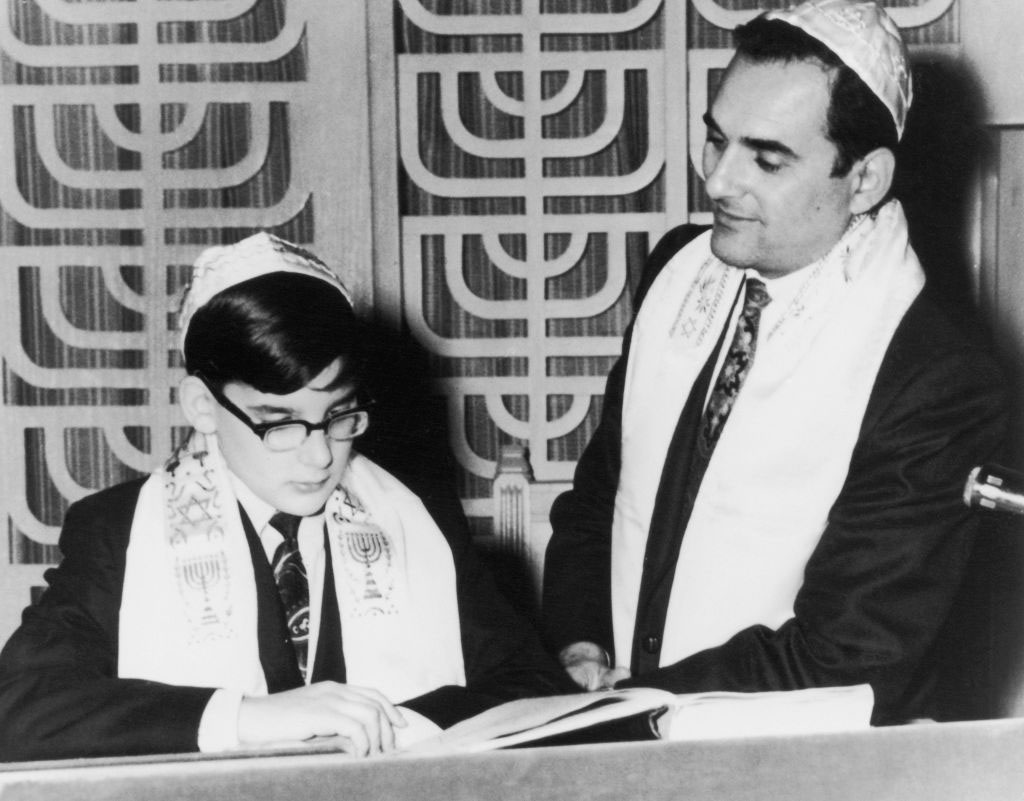
Hoffman’s first wife, Anne Byrne, was a ballerina of Irish Catholic extraction, and his second wife, Lisa Gottsegen, with whom he has been married for 23 years, has emphasized carrying on their Jewish tradition. Hoffman notes that the children have had bar and bat mitzvahs and they celebrate the holidays. He traces his love of herring and vodka to his Russian and Romanian heritage and adds, “I have a strong reaction to any antisemitism.”
He recalls being confronted in an upscale, pastry cafe outside of Hamburg, after visiting Bergen Belsen with a man screaming “Juden! Dostin Hovvman! Juden!” While the man was escorted out, Hoffman says he feels he should have gone up to the man and said, “Yeah? And? And? What of it?”
The dramatic ending of “Marathon Man” that had Dr. Szell, a Nazi dentist played by Laurence Olivier, falling to his death while trying to retrieve his diamonds, resulted from Dustin Hoffman’s refusal to shoot him point blank, as was written in the script.
He told JC.com, “I won’t play a Jew who cold-bloodedly kills another human being. I won’t become a Nazi to kill a Nazi.”
Hoffman hasn’t abandoned film as a pursuit, and recently starred in a film “The Choir,” about a director of a boarding school choir. He feels his having a leading role may be attributable to the fact he is already a big name, and laments that as actors get older, they are usually relegated to supporting roles. He said his role in “The Choir” should really be a supporting one, since it is “really the story of the boy.”
After 50 years in show business, Hoffman is still going strong. He directed “The Quartet” in 2012, about a group of retired musicians. He experienced disappointment when the HBO TV Series “Luck” was cancelled after its second season.
Dustin Hoffman says if he had not been an actor, he would have been happy being a jazz pianist, but he didn’t feel he was skilled enough to play professionally.
His Aunt Pearl told him that he should not try to be an actor because he was “too ugly,” and his mother suggested that he follow her lead and also get a nose job, reassuring him with “you’ll feel better.”
Mike Nichols asked Hoffman to give a screen test for the part of Benjamin Braddock in “The Graduate,” after seeing Hoffman perform on Broadway, even though Hoffman confessed he imagined an actor like Robert Redford getting the role.