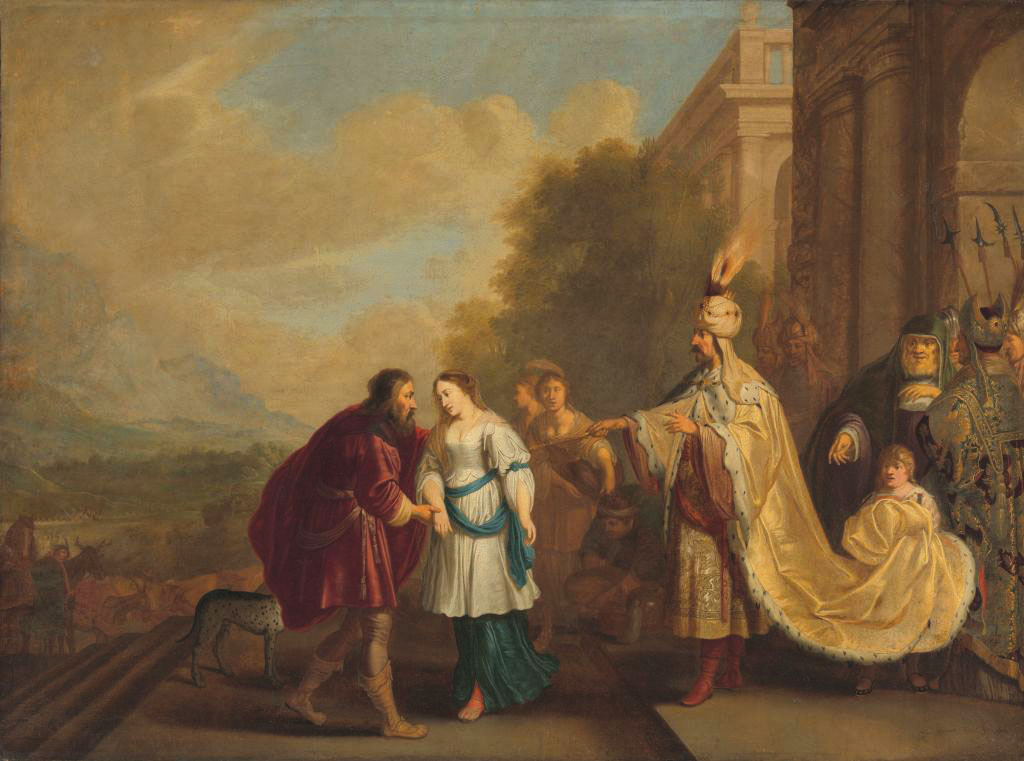
Andrea Hodos cuts a sprightly figure directing 14-year-old Sophie Porter-Zasada, dancing the biblical story of Sarah laughing as she hears of her pregnancy with Isaac.
A dancer by training, Hodos guides Sophie through movements that cause Sophie to curl into herself at Sarah’s shame or joyfully bend her body with Sarah’s happiness, as she recites a story she has written of Sarah’s experience.
“I call it ‘Moving Torah,'” Hodos said. “Its goal is to help you think with your body and move with your mind by using dance and writing together to interpret Jewish stories.”
It may be easy to think of Jews as the People of the Book, but the People of the Dance? For some skeptics, images might spring to mind a Chasidic kickline with tzitzit flying as they read tracts of Talmud. What Hodos is actually doing, however, is using choreography and body movement to unpack layers of meaning in Jewish texts and stories.
It’s an unusual art and one in which Hodos is among the pioneers.
“There’s a bit of a paradox, perhaps, with Jews and movement,” she said. “Words are certainly central to Jews, but Jewish culture is inherently rife with movement. It’s just that a lot of it is unconscious, like hand gestures, davening and dancing at celebrations.”
In her work with textual interpretation, Hodos is trying to use movement in a more conscious way.
“I’m doing very unconventional things with my body, but I have a deep engagement with Jewish text and the culture. I feel that I can say more with words if I move also,” Hodos said. “Gesture gives stereoscopic effect to my words. It magnifies the meaning, and allows me to convey multiple ideas at the same time. It creates richer, more layered meaning, and there’s more space inside of it for the audience to interpret.”
In addition to leading workshops, Hodos is currently performing her own movement/storytelling piece, “Cutting My Hair in Jerusalem,” which will appear at Temple Beth Am on Jan. 9. It chronicles the transformation of how Hodos saw herself as a woman and as a Jew during a pivotal year in Jerusalem. The piece tells the story of her voyage from being the granddaughter of a first-generation American who was swept into the cultural melting pot to an adult immersed in Judaism and struggling with a feminist identity in the religious world. By offering witty and thoughtful choreography to punctuate and play with the situations Hodos finds herself in, it also offers a vivid example of the use of dance in storytelling to offer multiple levels of meaning.
A dancer throughout her childhood, Hodos went to Yale to study English literature. There she found, “the dancers weren’t willing to expand themselves into a more intellectual discourse, and the literary people weren’t willing to use movement as an interpretive tool for understanding text. I felt both were incomplete, but had no idea how to link them.”
Her confusion found a solution in the work of choreographer Liz Lerman, a pioneer in the field of community-based performance. Lerman works with a wide variety of people to help them tell their stories through movement. After taking several workshops with Lerman, it occurred to Hodos there was a way to link her two loves — Jewish text and dance.
Drawing on Lerman’s work, Hodos begins her own workshops by preparing students with a “toolbox” of movements. She will ask the students to find a shape that intrigues them — anything from the rectangle of a book’s spine to the curve of a window arch. She’ll have the student trace the shape with their finger, allowing them to abstract the shape into a physical movement. Hodos then instructs the students to use various parts of the body to retrace that same movement’s arc. They move from basing movements on details they can see to details in the text.
“My ideal workshop is a range of ages, sizes and experiences,” said Hodos, who has led classes for more than 12 years.
For the last eight years Hodos has worked principally with the students at Milken Community High School, where she teaches. This year she’s returned to working with other groups throughout the city. Hodos recognizes that it can be difficult for her non-dancer students to move their bodies in public performance. “The ‘toolbox’ allows the participant to anchor him or herself in the story in interesting and surprising ways.”
It’s certainly worked for student Porter-Zasada’s understanding of Sarah’s story. “When you act the Torah out and feel it with your body, you can really understand things differently,” she said. “Now I see how you can express a whole other story with the movements.”
“Cutting My Hair in Jerusalem,” will be performed on Jan. 9 at 7 p.m at Temple Beth Am, 1039 La Cienega Blvd., Los Angeles. For more information, call (310) 652-7354, ext. 219.