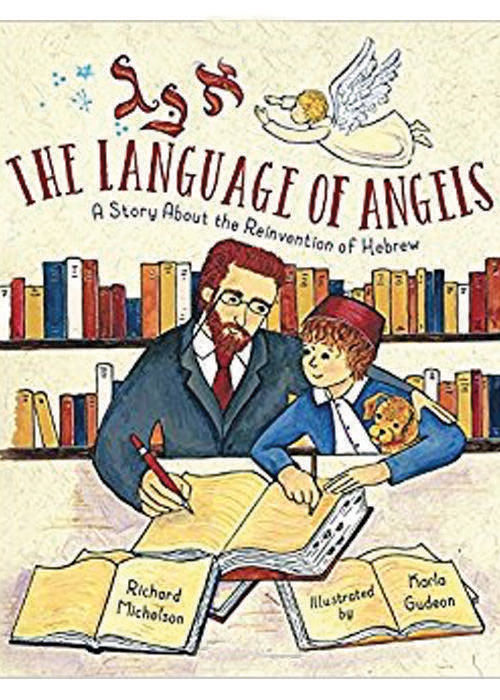
 A new illustrated children’s book tells the story of a Jewish boy who has no friends and whose parents won’t let him play with anyone, fearful that other children actually may talk to him. He doesn’t speak until he’s 4 years old, and when he does, it is in response to his father’s anger at his mother for trying to soothe the boy by singing a soft Russian lullaby.
It’s a true story, and the boy at the center of it grows up to be Itamar Ben-Avi, son of Eliezer Ben-Yeduda, the founder of modern Hebrew.
Prolific children’s author Richard Michelson chooses well in “The Language of Angels” by focusing the story of the reinvention of the Hebrew language on Ben-Yehuda’s young son. At birth in 1882, Itamar was named Ben-Zion (he later changed it), and his parents wanted him to hear and speak Hebrew exclusively. Their intent was to raise the first Hebrew-speaking child in modern history.
When Ben-Yehuda and his wife, Devorah, immigrated to Palestine in 1881, Hebrew was only a written language and recited solely in the synagogue. But it was clear that as Jews from other countries arrived to Eretz Yisrael in large numbers at the end of the 19th century, they would need a common language, and Ben-Yehuda was devoted to making that happen.
Itamar’s family story is fascinating and unique. As an adult, he wrote an autobiography, from which Michelson takes much of his source material, and it translates well to the picture-book format.
Bright, folk-tinged illustrations by Karla Gudeon are enhanced by clever placement of Hebrew words and letters that seem to fly off the page joyously. Children are at first drawn into a possibly sad story of a boy who has no friends, spending much of his younger years fending off bullies who think he is desecrating Hebrew as the holy tongue. But the excitement builds when Itamar wants ice cream but doesn’t know how to ask for it.
“Because ice cream didn’t exist two thousand years ago, no one in history has ever asked for it in Hebrew,” Michelson writes in the book. After a bit of research, Itamar’s abba makes up the word “glida” on the spot, but, by then, the author tells us, “the glida had melted.”
Eventually, Itamar makes many friends and they compete with one another to make up new words for his father’s brilliant Hebrew dictionary. As Hebrew is taught at school to children as a first language, and easy-to-read newspapers help spread the word to adults, the Ben-Yehuda family experiment served as proof that it was possible to achieve the miracle of reviving an ancient language that had not been spoken for centuries.