For me, a third-generation Israeli-American descendant of Holocaust survivors, Yom HaShoah and Yom HaZikaron always have been and always will be inexorably linked. Yom HaShoah, Holocaust Memorial Day, recalls the fate of our grandparents, who died as helpless victims. A week later, we mark Yom HaZikaron, Israeli Memorial Day, and the fate of their children and grandchildren, who fought courageously and died, not as victims but as heroes.
As an Israeli American born in Philadelphia, I went one Wednesday with my grandmother to the synagogue to mourn her loss on Yom HaShoah. And the next Wednesday, I went with my father to the Jewish community center to mourn his loss on Yom HaZikaron. Her loss was her entire family — her husband and child included — murdered by hatred and anti-Semitism of the most vicious kind. His loss was his fellow soldiers in an army of Jews fighting for their cherished homeland.
This year, my 97-year-old grandmother died. As a Holocaust survivor living in the United States, she never saw a contradiction between the Zionism that burned in her soul and the choice she made to live a Jewish life in the United States. As evidence of such, she kept a photo with her at all times of all three of her grandsons proudly dressed in Israel Defense Forces (IDF) uniforms.They were born and raised in America but chose to serve in the IDF.
Imagine her sense of victory as she recalled the helplessness and horror of the Holocaust, and gazed at three young men, strong and passionate, dressed in the uniform of a Jewish country. For my grandmother, every time she saw the Israeli flag waving next to the stars and stripes of the American flag, that was her greatest victory over the Holocaust.
Every year, thousands of people converge at Rancho Park for the Celebrate Israel festival that marks Israel’s Independence Day (Yom HaAtzmaut). I’m one of the organizers of the event. It’s where these different strands of my identity come together, literally. For me, every time I see a little kid sitting on his father’s shoulders at the festival, waving Israeli and American flags, that is the moment when I know who I am as an Israeli, as an American, as a Jew.
Will that kid end up volunteering in the IDF like my brothers and I did? Probably not.
Will that kid become active on his college campus, defending Israel and fighting the Boycott, Divestment and Sanctions movement? Maybe.
Will that kid go on a Birthright trip and fall in love with Israel? I hope so.
Yom HaAtzmaut is our opportunity to say to the young generation, to the boys and girls sitting on our shoulders, “Look at what we did! Not 3,000 years ago, but just two generations ago. Look at what we’ve accomplished together as a nation. We made the desert bloom. We defied the odds. We survived and thrived.”
Hold your head up high. Sing. Dance. Rejoice. You are Jewish.
Im tirtzu ein zo hagaddah. If you will it, it is no dream.
So I hope to see you all, with your kids on your shoulders, waving our flags, on May 7 at the Celebrate Israel festival in Rancho Park.
For me, there is no better place than the Israel Independence Day festival to feel Jewish andIsraeli.
They are, in fact, one and the same.
Erez Goldman is the Los Angeles Regional Director of the Israeli American Council, which produces the annual Celebrate Israel festival at Rancho Park.
Play backgammon with a stranger. Rock out to pulsating Israeli dance music. Meet the faces behind your favorite Jewish communal organization.
The annual Celebrate Israel festival takes place on May 7, and as it does every year, the gathering is expected to draw upward of 15,000 people to experience live music, kosher food, kids’ activities, a market built to resemble Mahane Yehuda in Jerusalem and some pro-Israel solidarity, to boot. This year, the event also celebrates 50 years since the 1967 reunification of Jerusalem.
Naty Saidoff, a board member of the Israeli American Council (IAC), which organizes the event, remembers living in Israel during the momentous historical event half a century ago.
“I was 13 years of age when it happened,” he said. “It was a very scary time and, all of a sudden, instead of being thrown in the sea as Arabs promised us, we pushed them back and we got the glory of reunified Jerusalem, with the old city of Jerusalem.”
Saidoff and his wife, Debbie, are the main underwriters of the event, and he said many of the people at this year’s festival will be a mix of those who experienced the events of 1967 and many who have never been to Israel. That’s the point: The annual festival transforms Cheviot Hills Recreation Center in Rancho Park into a miniature Israel.
“What we do is for the people who cannot go to Israel and the people who went to Israel and want that flavor again, we bring it to you. This is the closest experience you can get to being in Israel,” Saidoff said. “This is Israel, user-friendly.”
The annual festival takes place every year around the time of Israel’s Independence Day, Yom HaAtzmaut, which this year was May 2. It is the largest program of the IAC, an umbrella organization for Israeli Americans that, with help from philanthropists such as Sheldon Adelson, has expanded to cities nationwide since its launch in 2007. Other festivals this year are taking place in New York, Las Vegas and Chicago. The L.A. event (israeliamerican.org/celebrate-israel-festival-la) is the largest.
This year marks the sixth year since the festival was revamped and moved to the Westside of Los Angeles from the San Fernando Valley.
Israeli musician Dudu Aharon is slated to headline the festival’s main stage, with other highlights including a flyover air show by the Tiger Squadron; a bar for 20-somethings; photographs by Tel Aviv-based photographer Noam Chen; and a challah bake where people can learn how to braid the bread.
For the youngsters, a kids’ stage features children’s acts Naama Super Al and Sportuly, and a Jerusalem biblical zoo offers camel rides, pony rides and a giant petting zoo.
For the artistically inclined, the IAC has organized a Jerusalem Moment Instagram competition, seeking submissions of photos that “explore the architecture of Jerusalem, faith, food and the hipster side of Jerusalem.” According to Saidoff, Jerusalem is becoming a destination for millennials seeking great restaurants, culture and art, and organizers want photographs reflecting that. The top 100 photos will be exhibited at the festival.
American Friends of Magen David Adom, which raises funds for Israel’s most active emergency-response organization, will conduct a blood drive. Gift of Life pavilion, in memory of the recently deceased community member Adam Krief, will swab cheeks to help with bone marrow matches.
The glatt-kosher offerings include barbecue, hummus, salads, falafel, baked goods and watermelon.
Channel your inner wandering Jew and explore the grounds of the park. Stumble into the JIMENA (Jews Indigenous to the Middle East and North Africa) pavilion and play backgammon or create a cookbook.
Installations include a 32-foot-long Western Wall replica, where attendees place notes, much as they do when visiting the Kotel; a re-creation of the famous “Ahava” (Hebrew for “love”) statue from the Israel Museum in Jerusalem; and a 28-foot-tall Tower of David, featuring photography by Chen.
The festival begins at 11 a.m. For those who want to celebrate Israel earlier, a “Salute to Israel Walk in Blue and White,” a 1-mile loop sponsored by the pro-Israel organization StandWithUs, starts at 10. Participants will walk from the park to Pico Boulevard and Roxbury Drive, outside the Simon Wiesenthal Center Museum of Tolerance, then return.
“StandWithUs is going to be there with their high spirits, their energy,” Saidoff said.
Saidoff said he believes an event like this is an opportunity for the non-Israeli Jewish community, including Persians, Russians and observant Jews — especially their children — to party Israeli-style in a family-friendly environment.
Many Jewish organizations, including the Jewish Journal and The Jewish Federation of Greater Los Angeles, set up booths at the festival.
The festival ends at 6 p.m. Advanced general admission tickets cost $15; the walk-up cost is $20. There is no charge for children up to age 3. Parking, at $10, is available at Fox Studios Galaxy East Parking Garage, Century Park West Garage and Constellation Park Garage, and the price includes shuttles to and from the park.
The Celebrate Israel festival takes place on May 7. For more information, visit this story at jewishjournal.com.
I remember watching a video with my kids when they were little called “Jonah: A Veggie Tales Adventure.” Jonah is portrayed as a reserved and cautious asparagus, with a whole host of vegetable sidekicks that make up the rest of the story. The story was fairly representative of the story in the Bible, but I was most interested in one scene in particular. After Jonah is tossed overboard and swallowed by the big fish, he has an encounter in the belly of the fish that speaks to the heart of Biblical theology. Remember, all the characters are vegetables and this is animated! Upon asking himself why God is doing this to him, Jonah is uplifted by an entire gospel choir of endless carrots and broccoli telling him “God is a God of second chances.” They were singing it from their hearts and souls (sing a little gospel!), and they reminded Jonah that God is a God of mercy and compassion, one of justice and righteousness, but most importantly, God is a God of second chances.
I have been thinking about that phrase these days, asking myself how that theology applies to our lives and our world today, particularly around the scourge of homelessness in the nation, and in Los Angeles county. ‘God is a God of second chances’ calls us to not be complacent or satisfied when things are not as good as they could be, when we have not reached goals that are attainable, when we continue to make the same mistakes over and over again.
Being in the midst of that spiritual time between Passover and Shavuot, these liminal days between slavery and revelation, I recall that Dr. King and Rabbi Heschel reminded us that the plague of darkness is always lurking; the teaching of Moses and the Exodus is universal and eternal. That is why we tell the story every year. God is a God of second chances: that is the miracle of being human, the immense glory and responsibility of taking life seriously. Heschel said, “We have forgotten the meaning of being human and the deep responsibility involved in just being alive. Shakespeare’s Hamlet said, “To be or not to be, that is the question.” But that is no problem. We all want to be. The real problem, Biblically speaking, is how to be and how not to be; that is our challenge, and it is what makes the difference between the human and the animal.” (“Choose Life,”Moral Grandeur, pg. 252)
Homelessness, poverty and hunger, all problems that can be solved, continue to deprive millions of people in the world, including nearly half a million in the United States, and almost 47,000 in LA county, a better life for lack of commitment of the wealthiest nations. We continue to propose national budgets that increase spending for defense and security, while cutting social services and funds to take care of our most vulnerable citizens. Nobody wants to be homeless or poor or unemployed; yes, there are people who continue to make mistakes and aren’t able to get their lives back on track, even after help, but God is a God of second chances. And, every day, at the agency I lead, Friends in Deed, I see homeless and at-risk men, women and children who are only seeking that second chance to have a home, a job, a life that they see those who walk by them on the streets, ignore them or chastise them, have for themselves. The people we serve want to get back on their feet, and thanks to the work of our partner agencies, amazing congregational volunteers, and our staff, we are helping many people to rise back up into the community. The priorities that we set as a nation, primarily in our budgets and financial commitments, must reflect our highest ideals. At the moment, these ideals appear to be military and defense. When we vote for compassion and caring for the vulnerable, as many other nations do, our priorities might come into line with our highest ideals. Certainly we need to defend our nation, and take care of the men and women who serve, but we can do that while also creating programs and services to support the most vulnerable. A $1 trillion budget should have room for both, no?
We must find a way to raise ourselves above the culture of individualism that has taken hold of our country, reminding ourselves that we are all inter-connected in this life, now more than ever.
I am encouraged by the recent passing of Measure H, a minimal 1/4 cent tax increase, a vote by this community to take care of the most vulnerable. I know that it only passed by a razor thin majority, but now that we have the $355 million for ten years coming to our communities, we have the real opportunity to house many of our homeless neighbors, offer services that will educate, support and track those folks getting back into self-sufficiency. Permanent supportive housing, bridge housing, case management services, navigation through the immense bureaucracy, vocational training, mental health care and other vital needs, are now going to be available to those of us doing this work on the ground, each and every day. I am grateful for the passage of this measure, and I can only pray that the work we do, to better our communities and society, will make the 1/4 cent tax increase seem worth it in the long run. I am proud of LA county residents for taking responsibility to take care of our own.
The Torah of love and compassion, the Torah that commands us to care for those who are less fortunate, this Torah needs to be elevated higher, bringing us higher in the process. I continue to hear that we are ‘one nation under God…” but where are the religious convictions that demand we spend money and time and resources on those who need it most, which is what a compassionate nation is truly about? Jeremiah reminds us, “Woe to those who build their house with unfairness and their upper chambers with injustice; Woe to those who make their fellow human being work without pay and does not give them a fair wage.” (Jer. 22:13) We are in the midst of that “woe,” but you know what? We have the capacity and ability to get out of it. We have the capacity and ability to create a world where everyone has a home, access to food and medical needs, can get a good education and make their way in the world. We must find a way to raise ourselves above the culture of individualism that has taken hold of our country, reminding ourselves that we are all inter-connected in this life, now more than ever.
The most amazing part of this struggle is that we have power to make it happen; God operates through us in this world and God has given us the power of free-will — God is waiting for us to respond. This is the message that Dr. King tried to teach us, if only we would listen. Dr. King called us to be extremists for love, extremists for justice, extremists for hope, extremists for peace. He called for a creative extremism to better our world. But we are stubborn. And as Heschel said, “One of the dreadful aspects of today’s existence is that we seem to be doing things we hate to do.” (Choose Life, pg. 253) I pray that we have the courage to recognize the great potential in this generation, one that, while requiring sacrifice, has the capacity to bring about the world to come right here on Earth. Or at least give it a running start.
God is a God of second chances and it is time to take God up on that offer.
Rabbi Joshua Levine Grater is the Executive Director of Friends in Deed, a faith-based homeless and poverty agency in Pasadena, CA. www.friendsindeedpas.org
Most of us understand the value of words. And those of us who may have forgotten their power have no doubt been reminded of it over the past few months as the new administration in Washington routinely comes under fire for words said and words omitted. It goes without saying that writers, especially fiction writers, have a special proclivity for language — a gift for transforming ideas and emotions into textual images that, hopefully, remain with us.
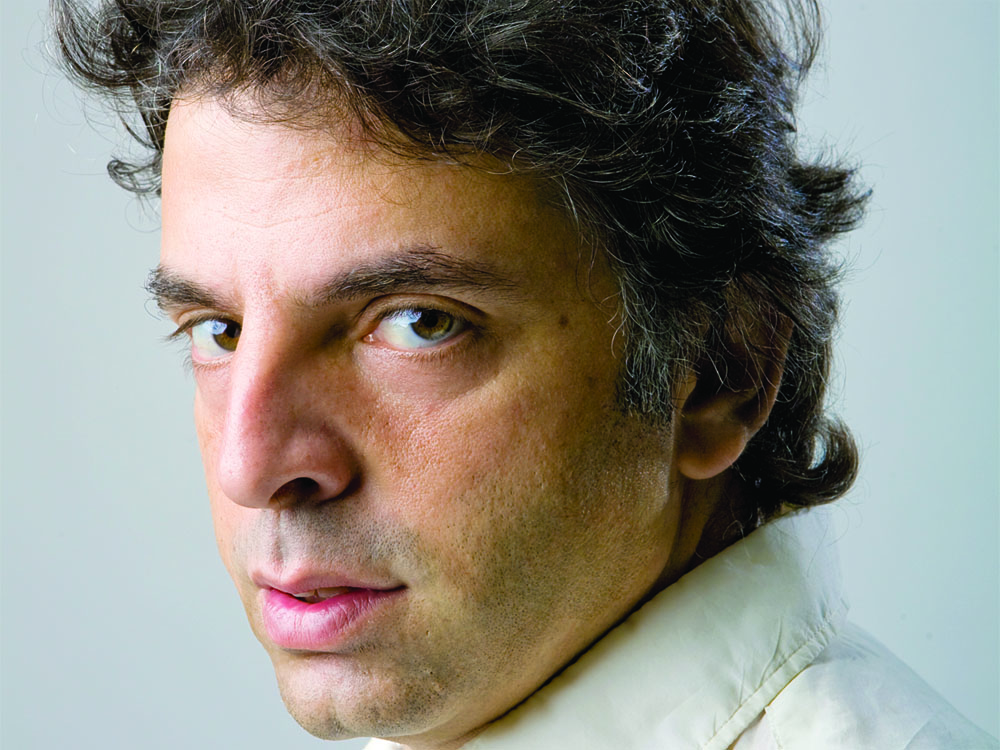
This is a trait shared universally by writers from around the world, with culture and geography generally playing a large role in the way a person writes. Place gives stories their unique character, though good writers know how to ensure that their work is universal despite its particular elements. Israel has given us many great men and women of letters, including writer Etgar Keret.
Born in Ramat Gan in 1967, Keret is known for his short stories, graphic novels and scriptwriting for film and television. He is married to Shira Geffen, an actress and writer with whom he often collaborates on various projects, and together they have a son, Lev.
The popularity of Keret’s work has spilled far beyond Israel’s borders. He has appeared frequently on National Public Radio’s “This American Life” and is credited by many as having helped to revive appreciation for the short-story genre, which many literary critics at least a decade ago suggested was coming to a close.
I discovered Keret 10 years ago after falling in love with other Israeli writers, such as David Grossman, Amos Oz and A.B. Yehoshua, among many others. I already was familiar with Jewish-American literature, but I found there was something unique about Israeli writing, and within that genre I discovered there was something even more distinctive about Keret, who will discuss his writing in a dialogue with Rabbi Sharon Brous on May 10 at American Jewish University. Sponsored by the university’s Whizin Center for Continuing Education and IKAR, the event also will include a dramatic reading of Keret’s stories by actress Lisa Edelstein.
Israeli fiction is heavy and haunted. Despite the young age of the country, the novels produced by its writers are often long, sweeping and epic in nature. It’s as if all of the oldest souls in the world ended up in one place and decided to write. While the region is small, its stories are grand and perhaps unparalleled in their tendency to tease out the nuances of living in a land of ethical and geographic quandaries, always pushing us not toward what is simple, but what is just.
Israeli fiction is almost never not politically aware or engaged with current events either subtly or explicitly. Yet while the work of 20th- and 21st-century Jewish-American writers often demonstrates a meaningful struggle of identity — in many cases what it means to be both American and Jewish, observant or secular — the work of Jewish-Israeli writers reminds us that such struggles are perhaps a luxury.
When you live in a place where nearly everyone knows someone, or someone who knows someone, who was a victim of a suicide bombing or stabbing, you don’t always have time to reflect on the nature of identity. It becomes even more incidental when that place is the most criticized and scrutinized nation in the world, always the eye of some international storm and an enduring subject of heated conversation from the U.N. to the Shabbat dinner table. Instead, you must speak frankly and articulately about what matters now.
Every word counts in such an environment, and reading the heavy-hitting fiction writers of Israel, one gets the sense that there is nothing more critical, now, than understanding our responsibility as Jews and acting on it. And this is no laughing matter.
Israeli fiction is heavy and haunted. Despite the young age of the country, the novels produced by its writers are often long, sweeping and epic in nature. It’s as if all of the oldest souls in the world ended up in one place and decided to write.
But then there’s Keret, the 2016 recipient of the Charles Bronfman Prize, awarded in recognition for conveying Jewish values across cultures in his work. For Keret, this sense of urgency materializes in a different way — most notably in that he is funny. Darkly funny, that is, sometimes achingly and startlingly so. For example, in this excerpt from a 2012 piece for Tablet magazine called “School Isn’t (Always) Jail,” Keret reflects on his anxiety about his son starting elementary school in Tel Aviv:
“The entire week before that, Lev’s mom kept asking his dad to stop watching reruns of “Oz,” claiming that it was having a bad effect on him. And now, as Lev’s dad follows his son down those dark hallways and sees the second-graders, lollipops protruding like toothpicks from the corners of their mouths, eyes arrogantly inspecting the new first-graders as if they were a shipment of fresh meat, he thinks that … there’s no denying that something about schools is reminiscent of prisons. The long corridors. The square, asphalt-paved yard into which the small prisoners are released a few times a day. The unpleasant crowding, the uniforms. And as Lev finds himself a seat in the classroom next to a fat, red-faced boy who looks like a Bavarian farmer who turned in Jews during the Holocaust, his dad is praying that this first day will end peacefully: no solitary and no shanks in the schoolyard.”
One can’t help but laugh at the idea of school as a small replica of prison. But not far beneath the humor, we discover the real and raw fear that a parent can feel when his child enters school. This fear becomes even more deep-seatedgiven Keret’s personal history as the son of Holocaust survivors.
In Keret’s work, the idea that every word counts is taken literally. Living in Israel can be intense. It’s a place that is exhilarating and alive in every sense. It’s no wonder that much of Keret’s work falls into the category of flash fiction, stories that are exceptionally short, sometimes no more than half a page. Consider his story “Asthma Attack,” only one paragraph long, from his 1992 collection “The Girl on the Fridge”:
“When you have an asthma attack, you can’t breathe. When you can’t breathe, you can hardly talk. To make a sentence all you get is the air in your lungs. Which isn’t much. Three to six words, if that. You learn the value of words. You rummage through the jumble in your head. Choose the crucial ones — those cost you too. Let healthy people toss out whatever comes to mind, the way you throw out the garbage. When an asthmatic says ‘I love you,’ and when an asthmatic says ‘I love you madly,’ there’s a difference. The difference of a word. A word’s a lot. It could be stop, or inhaler. It could even be ambulance.”
Writing short stories in general is a profoundly difficult task. There is only so much space, so much time to say what needs to be said. Less is more, and it’s not always easy to do that in a way that works. But this skill is one of the characteristics of Keret’s writing that sets it apart from other Israeli writers.
Despite his fame as a fiction writer, my first encounter with his work was a film called “Jellyfish” he made with his wife. It’s a beautiful and well-written film, and one moment has never left me. Near the end, one woman tells another that her parents were Holocaust survivors. The second woman responds: “You’re second generation?” The first woman shrugs and says, “We’re all second generation of something.”
While the work of many second-generation writers suggests that the inheritance of trauma is the center of their world, Keret’s work transcends such literary blind spots. It’s not that the Holocaust isn’t present in his work. It is, certainly, as we see in his piece about sending his son to school. Some might argue that it haunts all of his writing. But it is simply one of many lenses through which he understands the world.
Humor is another — something we don’t often see from Israeli writers — and yet humor is not disconnected from struggle and tragedy. In fact, the need to laugh is often connected directly to the experience or inheritance of trauma. Given that Keret’s work is often tinged with the presence of something tragic, I asked him to what degree he connects humor to darkness, and whether the Holocaust is the only darkness that impacts his writing.
“Being funny, for me it’s never a goal,” he said, during a recent conversation by phone. “I think it’s always an effect of trying to say something else. We have this expression that my son uses: tickle-funny. When someone tickles you, you laugh. You don’t feel any emotion, you just laugh … [but real] humor is always a side effect of acknowledging some other emotion.”
Keret believes that his cynicism makes him funny, that it enables him to find an outlet, or a release valve, as I put it. Anger, fear, frustration and stress: they all need somewhere to go or we risk implosion. Humor can help manage these sensations. Keret, who grew up on “Monty Python,” described how it provided an incredible release for him. When I asked about contemporary comedians to whom he is drawn, he cited Louis C.K. for “the dialogue that [he] offers,” suggesting that Louis C.K. resolves himself to do “not just what works,” but what he finds “important at the risk of people not getting it.”
But laughter does not come cheaply. There’s a difference between simply being a funny guy who laughs a lot and being someone for whom comedy is a necessary function of survival. Keret described an instance when his young son asked him to “be funny.” He recounted not being able to supply what his son asked for because “I need some kind of catastrophe; there should be some obstacle for humor to present itself.”
An expression of humor is not so different from storytelling. Both are always responses to something else. It’s “always an attempt to complete something that isn’t completed,” he said, reminding me that writing is always only an approximate response, little more than a trace of what we want to communicate.
Despite the numerous books and countless stories and essays Keret has written, including his latest, a memoir called “The Seven Good Years,” the period between the birth of his son and the death of his father, he said he still finds it difficult when it comes to saying that he is a writer.
“When I would fly to the U.S. and fill out those immigration cards, I would always write ‘lecturer’ or ‘professor,’ ” he said. “I would never write ‘writer.’ I always had a problem with this because I think that for someone to say he is a writer is like saying he is lovable or cute … because anybody can write words on a page, but the only person who can say [whether this is] writing or not or that the writing means something is the reader.”
And yet, the fact remains that Keret is indeed a writer — a good one. But in true Keret comedic fashion, he said of finally having to accept the title: “It’s kind of like when you have this mole on your face and … you get used to it.”
“Humor is very much like story,” he continued. “Let’s say you’re living in a 3-D world and you need to get somewhere so you get there, but if this place is also [haunted by war] then you need to go through a fourth dimension to be able to get there. Going there is basically a place where fiction or humor function for me, kind of like using a hammer or can opener.”
I couldn’t help but think of how, much like these common tools of everyday use, humor is for some a basic tenet of survival.
Courtesy of The Lion House Press Agency
And speaking of survival, it’s become culturally hip, at least in America, to question the parameters of comedy in the context of the Holocaust and other tragedies — a natural segue into the issue of anti-Semitism today, which various news outlets say is on the rise.
In Keret’s “Defender of the People,” found in “The Seven Good Years,”the first line reads: “There’s nothing like a few days in eastern Europe to bring out the Jew in you.” The sarcasm of this statement struck me as terrifyingly funny. I remember reading it on a flight to Israel when the memoir came out and knowing exactly what he meant. And laughing. The story describes a misunderstanding he experiences when a German-speaking man drunkenly enters the restaurant where Keret is dining and yells, “Juden raus!” (Jews out!) Keret confronts the man and reveals his Jewish identity before the man is thrown out of the restaurant.
It turns out that the man had actually been yelling “Jeden raus,” which means something along the lines of “everyone out.” The drunk was complaining that a diner’s car was blocking his. But “what can I do?” asks Keret in the story, “Even today, every other word of the German language puts me on the defensive.”
In the same story, Keret talks about how he had come to acquire “superhuman powers when it comes to detecting swastikas” and how he’s experienced a number of anti-Semitic incidents that, unlike the one above, “can’t be explained away by a mistake in understanding.”
I was curious about how someone with such a heightened sensitivity to anti-Semitism views an increase in hate crimes against Jews. Is anti-Semitism really growing, I asked, or is that just an idea peddled by those who enjoy fear-mongering?
InKeret’s view, it can be difficult parsing the differences between a crime and a hate crime. “I’ve been told anti-Semitic jokes because people didn’t know I was a Jew. It’s not discernible,” he said. Jewishness is more mysterious, I suggested, and therefore more threatening or frightening for some people. A Jew is “someone who is different but who looks the same,” he said.
Keret also drew a parallel between anti-Semitism and homophobia: “You can tell a joke about someone who is a homosexual and not know he was a homosexual. So I think this kind of obscureness about identity … that is, the difficulty [in identifying] Jews, is one of the sources of anti-Semitism.”
Keret struggles with the idea that Jews should unconditionally support all policies of the Israeli government. Like most deep thinkers, he understands the nuances and complexities that accompany this scenario.
“It’s tough for me to figure,” he told me. “Many times when I talk with American Jews, I say that I don’t really accept that Israel should be supported unconditionally. … I think that if my brother starts using crack, I wouldn’t say, ‘He’s my brother’ and, ‘Here’s some money [to buy more drugs]’ since he is family.”
As a fierce lover of Israel and its right to exist as a Jewish state, I found what Keret said deeply resonant. I love Israel as I love my friends and family, always poised to give Israel the benefit of the doubt before launching into criticism. But I also have witnessed the destructive effects of disguising, ignoring or enabling bad behavior in a loved one. It doesn’t do that loved one any good. It doesn’t do any of us any good. The issue, of course, is one of balance, which Keret gets intuitively, even if it often seems absent from political discourses.
“Being funny, for me it’s never a goal. I think it’s always an effect of trying to say something else. We have this expression that my son uses: tickle-funny. When someone tickles you, you laugh. You don’t feel any emotion, you just laugh … [but real] humor is always a side effect of acknowledging some other emotion.”
-Etgar Keret
I was curious about how Keret sees himself fitting into the cast of literary greats in Israel. While he is an enormous fan of Oz, he often feels closer to Jewish Diaspora writerssuch as Sholem Aleichem or Isaac Bashevis Singer than to his peers — if for no other reason than the ease with which he transitions between comedy and tragedy.
“Israeli humor is not distinct or special in any way,” he said. “I don’t think for Israeli humor, the foundation is different from Italian humor, for example. … I think [for] many Jewish Diaspora writers and stand-up comedians, it has to do with some kind of complexity or obstacle that doesn’t really exist in the Israeli context. Jewish humor came from a position of weakness.
“Diaspora Jews,” he continued, “being oppressed in many ways, needed humor. We were so weak. We needed that, but when we came to Israel, we became strong enough.”
And now that Israel’s default mode, as we know, is not one of weakness, humor has become an option rather than a necessity.
The dual identity of Diaspora Jews is also a factor in the use of humor in a way it could be and is not used in Israel. As Keret explained, an American Jew has the ability as a Jew to criticize Americans and as an American to criticize Jews. “You can always be inside and outside the community,” he said. “You can always have some kind of exterior perspective.”
Given that humor is almost always a result of some kind of tension, it makes sense that American Jewish writers have a long history of resorting to humor. But “in Israel,” he said, “I don’t think we need [it] anymore.”
Of course, none of these theories explains why Keret, an Israeli Jewish writer, is so comfortable using humor. But it’s a fortunate mystery for readers that distinguishes him from his contemporaries. I can’t help but wonder, however, whether his impulse to blaze his own trail among Israeli fiction writers has something to do with the bedtime stories his father used to tell him, stories he recounts in the short story, “Long View.”
Recalling the plots as an adult, he realizes they were supposed to teach him something “about the almost desperate human need to find good in the least likely places. Something about the desire not to beautify reality but to persist in searching for an angle that would put ugliness in a better light and create affection and empathy for every wart and wrinkle on its scarred face.”
I’d say Keret has found his angle.
Monica Osborne is a writer and scholar of Jewish literature and culture. Her book “The Midrashic Impulse and the Contemporary Literary Response to Trauma” is forthcoming later this year.
One week before Pesach, I sat in a hospital room in a Philadelphia intensive care unit. In that moment, I was not a rabbi. I was a brother.
I was there with my older brother, Eyal, who has been a quadriplegic for the past 32 years as the result of a brain stem tumor and stroke. He is completely broken physically. Over the years, there have been frequent hospitalizations. On this particular visit, we received the news that Eyal would need dialysis.
During times like these, my family has gained the uncanny ability to find Divine sparks outside of synagogue sanctuaries and community centers and inside the walls of hospitals, where the human soul is at its most vulnerable. These sacred moments are Torah study in action.
Someone once asked the Chazon Ish, a leading rabbinic scholar in the first half of the 20th century, if he thought it advisable to seek solitude in order to study Torah, without any distractions and interruptions. The rabbi answered, “My heart cannot believe that by being isolated from everyone you can acquire a true acquisition of Torah. It is quite obvious that society and friends will assist you.”
In fact, the midrash teaches that God commanded Moses to read Parashat Kedoshim in front of the entire assembly of people, because most of the essentials of the Torah are summarized within its holiness code. This includes the commandment to love your fellow human being (Leviticus 19:18), which can be fulfilled at all times, every single second of the day. This commandment can be fulfilled in action but also in thought. When you are happy about the good fortune of another, this is loving your fellow human being. The same applies for suffering. If you feel sad because of another person’s suffering, you fulfill this commandment.
In essence, holiness is a universal language. The Kotzker Rebbe once said, “Don’t only study Torah; be a Torah.” We must live out the prinicples taught to us by our tradition, both in joy and sorrow.
In my brother’s Philadelphia hospital room, we met Eyal’s dialysis nurse, Elaysha. After a brief introduction, she was silent for the next two hours, almost seeming upset at the world. My parents, siblings and I sat impatiently, waiting for the session to conclude.
Thankfully, my mother brought a piano keyboard to the hospital and asked me to lead a sing-along and lift everyone’s spirits. As we started to sing our favorite Jewish camp songs, Elaysha perked up and asked, “What type of music is that?”
“Jewish music,” I replied.
Elaysha told me she is a drummer in her church band, and I proceeded to let her know that she had walked into a room full of rabbis. Like me, my father, my sister and my wife all are rabbis. This fact did not scare her, but brought her closer to our sacred conversation.
Elaysha informed us that she comes from a family of pastors, but that she did not find her calling, as she is only a dialysis nurse. At that moment, as Elaysha administered dialysis to my brother, I told her, “Elaysha, there is no better calling than what you are doing: walking into a room with people who are spiritually and physically low, giving them the hope that they can be lifted up.”
For the next two hours, we spoke in a universal language. We shared our favorite biblical passages, and our best moments growing up as preachers’ kids. As the dialysis session concluded, we even sang a song, one that has been sung from synagogue and church pulpits alike: “Lord, prepare me to be a sanctuary.”
Is this not what Kedoshim teaches us?
Yes, many feel they must enter a sanctuary in order to find holiness, but the truth is that if we each try, we can be our own sanctuary, pure and holy, tried and true.
Elaysha left the room that evening, and my entire family felt blessed by her presence. While we have not seen her since, we have felt that Divine spark that she brought us on that day.
Those hours of holiness were not confined to a synagogue, school or even a home. Rather, that sacred time was the pinnacle of the philosophical thinking of the Chazon Ish — learn holiness in your sacred books, practice holiness in your sacred lives.
Hundreds of years earlier, the prophet Zechariah lived during a tumultuous time of Jewish history and yet preached a message of optimism. He said Jews are assirei tikvah, prisoners of hope. While a prisoner connotes being bound up to something else, Jews are bound with hope.
A hospital can be a scary place. Yet, a hospital is where we constantly see people expressing hope; a place where an angel like Elaysha enters your life for a brief moment, a place where we can fulfill the Torah’s command to strive for holiness today.
We wrote essays and memorized poems about the saintliness of mothers, their selflessness, their sacrifices. Every Mother’s Day in elementary and middle school, we stood up and read to the class a new ode to the person who had given up her youth and good health, her freedom and grand ambitions — her self, really, though in those days women had no “self” outside of motherhood — to give us life and make sure we kept eating and breathing. Thank you, Mother, for relinquishing body and soul.
It made sense in a devastating, heartbreaking way, especially if you were a girl, meaning that your very existence was a detriment to any mother’s value, and more so if you were one of a number of girls, each birth another nail in the poor woman’s coffin, and now she was going to have to love and care for you, anyway, make sure you looked good and behaved well so you, too, could wear a crown of flowers one day in your mid- to late teens, become a wife and, nine months later, a mother.
And if you were a boy? There was a story we read every year, about a son who, in a rage and very self-servingly, beats his mother to death and buries her in a ditch. For reasons that escape me now, he has occasion to dig her up later, long teeth and hair and smooth, fleshless bones, only to find that her heart is still beating with, yes, love for the murderous son. I may be wrong, but I could swear there was even something about the mother being worried that the son was tired and thirsty from the physical exertion of burying and exhuming her.
This was motherhood as martyrdom — which, we know, is always a privilege, more so if the suffering is greater — something that you earned through sacrifice and devotion, that you aspired to knowing how you would end up. Because of how you ended up.
“I was 15 years old when I gave birth to my first child,” my own grandmother once said. “I went home with that baby and didn’t emerge again until I was an old woman with 10 children.”
We do, in fact, turn our backs on life as we knew it once we become parents.
She wasn’t lying, not even exaggerating. To her eternal credit, she also raised a great many orphans and abandoned children, cared for the poor and the sick of all ages, fed and clothed and counseled every stranger who knocked on her door. Later, as an “old woman,” she even found time to buy and sell land, make a good bit of money on her own, jetting between Tehran and Tel Aviv, New York and Los Angeles. Hers was a meaningful and memorable life, the kind of existence that creates lasting good. I know this. I hope she knew this.
But after the day I heard her speak of her — stolen? squandered? perhaps the word is “surrendered” — youth, I’ve never been able to think of her without a quiver of heartache. I keep seeing her as a teenage mother, the girl in those black-and-white pictures in the homes of her children, white skin and dark eyes and that pomegranate-red lipstick so favored by’50s movie stars. I see her turn her back on me and walk through a door. I see the door close.
It wouldn’t be much to celebrate, this Sisyphean practice we mothers engage in, one generation after another, often without question. Forget those of us in the First World who marry late and hire Third World help and have access to health care and technology; we couldn’t fathom the hardships the majority of mothers suffer every day just to keep their children alive. And yet, even we know this is as hard a job as any. I certainly don’t begrudge us the odes or Hallmark cards on Mother’s Day — celebrated this year on May 14 — or any other. But I also know they don’t tell the whole story, and that’s a crime — it perpetuates a sense of victimhood on the part of many mothers and guilt on the part of their children, especially their daughters.
We do, in fact, turn our backs on life as we knew it once we become parents. In many ways, more than any of us would be able to imagine ahead of time, we do surrender our old selves at the door, forfeit the big wide world and the possibilities it may offer, in favor of a small house with walls and a roof.
But these walls we surround ourselves with are covered with vines of Poet’s Jasmine that bloom, delicate as a breath, every morning, releasing into the universe the everlasting scent of youth and beauty and hope. And this roof we capitulate to opens up every night to reveal a flood of stars. And whether we have one or a dozen children, whether they’re our own or others’, sick or healthy, obedient or not, this house they pull us into is called Joy.
One in 5 school-age children in the United States is obese, and many others are overweight, according to the Centers for Disease Control and Prevention. And even children at what is considered a healthy weight aren’t necessarily healthy.
“There is no magic diet, no one diet that is good for everyone,” said Dr. Bahareh Michelle Schweiger, a pediatric endocrinologist at Cedars-Sinai Medical Center in Los Angeles.
Schweiger and Dr. Richard Brucker oversee the Step-Up Kids Weight Management Program at Cedars-Sinai. They and their colleagues, including certified diabetes educators (pre-diabetes and diabetes diagnoses in children are on the rise) work with children and their families to develop customized weight-loss and healthy-eating plans.
The Journal spoke with Schweiger — a Sherman Oaks resident, Valley Beth Shalom congregant and mother of three children — about changes families can make in their diets to improve their health. She offered the following suggestions:
Don’t Play Food Police
Going through the pantry when the kids are at school and tossing out every package of Oreo cookies and Cheez-It crackers may sound like a surefire strategy to prevent your kids from eating junk. But Schweiger advises against it. “Forbidding certain foods and trying to play police can actually be more of a draw for the kid to overeat those foods whenever they get a chance,” she said. Not to mention that it could set up an unhealthy relationship between you and your child. Instead, start with smaller, more manageable steps. And be a good role model.
Make It a Family Affair
Schweiger said she knows families are busier than ever, which often leads to eating on the fly and grabbing whatever is quick and easy. However, when families sit down to eat together, they tend to eat less-processed foods and share food that is higher in fiber. Your family can’t do weekday dinners? Try Saturday breakfast or lunch.
Involve your children, too. Let them choose their favorite fruits and vegetables at the market, or something they are open to trying, and enlist them to help prepare the meal. “They need to be part of the process,” Schweiger said. “Otherwise, there is going to be unwillingness to make any change.”
If your family likes to go out for the occasional treat, don’t go overboard. Everyone in the family can order a kiddie portion of ice cream.
Pay Attention to Portion Size
Portion sizes at some restaurants are four times bigger than what is healthy. So even if you eat only half of a serving, you could be consuming twice the portion size you really need, Schweiger said. So how do you figure out the proper serving of chicken or pasta or broccoli? Use your palm as an approximate measure, she said. And remember, since your child’s palm is likely smaller than yours, their portion size should be smaller, too.
Banish the Clean Plate Rule
Don’t expect children to eat everything on their plates. Conversely, parents should not be short-order cooks. If your child does not like what you make for dinner one night of the week, don’t whip up a special dinner just for them. If children are eating a variety of foods, they will manage. They can grab a piece of fresh fruit if they are famished.
Eat More Fruits and Vegetables
Half of your diet and your kids’ diets should be made up of fruits and vegetables. Research has found the fiber in fruits and vegetables helps to prevent certain cancers. And fruit juice isn’t a replacement. “Often, our brain doesn’t process those calories as food,” which can lead to weight issues, Schweiger said.
It can take 15, 20, even 30 introductions of a food for a child to learn to like it. A strategy to make fruits and vegetables more enticing is to serve them alongside something you know your child likes.
Eat a Healthy Breakfast
If there is one meal where many families go wrong, it is breakfast — or skipping it, Schweiger said. “You’ve already been fasting all night,” she said. “[Breakfast is] an important time to get some good nutrition in, especially before sending your kid to school. Get their metabolism up and going.” There’s research, too, that shows those who skip breakfast have an increased risk of obesity and pre-diabetes.
So what does a healthy breakfast look like? Schweiger suggests a piece of wheat toast with cream cheese, oatmeal, yogurt, or a hard-boiled egg, along with something else. Even some packaged breakfast bars are OK, she said. And cereal merits its own portion-size reminder, since many kids (and grown-ups) are in the habit of filling their bowls nearly to the brim, which could be two or three times the recommended portion, Schweiger said.
Snack Smartly
A quick snack can be healthy. Schweiger suggests a cheese stick or a portion of nuts, yogurt or hummus. Try putting out a plate of fresh fruit or veggies when you know your kids are going to be hungry — like when they get home from school. “They are more likely to grab it, as opposed to going to the cupboard and opening up a processed snack,” Schweiger said. If you are going to provide crackers or something similar, measure out a portion size and put it in a baggie. Eating directly out of a box is an invitation to overeat.
Also, make sure an after-school snack doesn’t turn into a full meal. It’s nice to be hungry come dinnertime.
Ditch the Electronics
Electronics and mealtime are not an ideal pairing. If your child has a smartphone, make sure it’s not part of the dinner party. That goes for Mom and Dad, too. If you are texting or watching YouTube videos at mealtime, you are not paying attention to the food you are eating and “You end up eating a lot more food,” Schweiger said.
Special Considerations for Jewish Kids
Protein should be a part of most meals. “It can help make you feel full longer and keep your blood sugar more stabilized,” Schweiger said. But some Jewish schools don’t allow students to bring meat in their lunches. If a child also has a nut allergy, it could make it difficult to get enough protein during the day. Schweiger recommends hummus and avocado as good sources of protein.
Get Moving
In keeping with the recommendation of the American Academy of Pediatrics, Schweiger said children should get 60 minutes of moderate physical activity a day. The exercise doesn’t need to be done at one time. It can include, for example, walking to school, playing at recess, or participating in a dance class.
Of course, many kids don’t walk to school, and some may spend their recess on their smartphone. If your child loves electronics, Schweiger recommends they do 15 minutes of “Just Dance,” a popular game available for various platforms, or even 20 jumping jacks here and there. She also is a fan of many exercise videos geared for children. One of her favorite series is “Instant Recess,” available on YouTube.
Be Patient
It is important to be patient when looking for weight-loss results.
“This isn’t a quick fix,” Schweiger said. “There are always ways to be healthier and eat healthier.”
For the past six months, the Israel Cancer Research Fund (ICRF) has been collaborating with City of Hope in Duarte to advance understanding of cancer and further develop life-saving treatments and prevention strategies.
The Jacki and Bruce Barron Cancer Research Scholars Program at City of Hope has facilitated the exchange of resources, ideas and knowledge between ICRF’s cancer investigators — who are from four Israeli universities — and top researchers at City of Hope. The joint venture was made possible thanks to a $5 million grant from the Harvey L. Miller Family Foundation, which previously had separate philanthropic ties to both the ICRF and City of Hope.
“This relationship with City of Hope is validating for us,” said Eric Heffler, national executive director of ICRF. “It helps us raise awareness and continue on with our world-class research.”
Founded in 1975, ICRF has supported the work of numerous Nobel Prize winners responsible for milestone discoveries in cancer research. It has awarded more than 2,300 grants to investigators at 24 institutions throughout Israel. The New York-based nonprofit, with offices in six cities, including Los Angeles and Coachella Valley, aims to keep many of Israel’s premier scientists at home instead of having them globetrotting to secure research funding.
City of Hope is a pioneer in the fields of bone marrow transplantation, genetics, and independent research and treatment for cancer and diabetes.
The new program features four key initiatives:
• Three $150,000 collaborative grants awarded annually to support the research of City of Hope and Israeli scientists.
• Two post-doctoral fellowships at City of Hope for promising Israeli scientists selected by ICRF.
• Six-month sabbaticals for established Israeli scientists at City of Hope and for City of Hope researchers in Israel.
• An annual symposium for City of Hope and ICRF researchers to share findings.
The program’s first symposium is scheduled for November on City of Hope’s main campus. The symposium is expected to feature presentations from Israeli and American research partners who will be finishing the first year of their work together, a talk from an Israeli scientist who has been on sabbatical at City of Hope, and keynote addresses from high-profile cancer researchers.
Matthew Ruchin, associate director of administration for City of Hope’s Comprehensive Cancer Center, said both institutions initially were apprehensive about the distance separating their respective researchers.
“We expected to encounter obstacles with that,” Ruchin said. “But that hasn’t been the case.”
Ruchin said that in the past, faculty at the Hebrew University of Jerusalem’s Lautenberg Center for Immunology and Cancer Research could not send massive data files over the internet or ship clinical research samples to City of Hope, and vice versa. Now, he said, “laboratories that are thousands of miles apart can feel like they’re right next door to each other.”
The partnership with ICRF is the only one City of Hope is engaged in that involves formal ties with medical institutions outside the United States. It has similar arrangements with Caltech and the UC Riverside faculty.
For Rob Densen, ICRF president, a central aim of the program is to showcase the ICRF’s mission to the Jewish community of Greater Los Angeles. On a trip to L.A. in early March, Densen told the Journal that many potential donors hadn’t even heard of the organization. He said he hoped to capitalize on the exposure a relationship with City of Hope — whose A-list celebrity support makes it widely known — could bring to ICRF.
“You have a tremendously diverse Jewish community in Los Angeles. You know the one thing they all share? Cancer. It cuts across geography, race, creed and religion,” Densen said. “I think [ICRF] is the perfect charity. It’s Israel and it’s cancer, the scourge of humankind.”
Densen also hopes that more awareness about ICRF will aid in Israel’s fight against the Boycott, Divestment and Sanctions (BDS) movement, as it demonstrates Israel’s impact on a matter of world concern.
“This is a stab right in the eye of BDS,” he said. “And it fits in perfectly with the theme of tikkun olam, repairing not just your neighborhood, your countr, or your religion, but repairing the entire world. That’s what animates my involvement here. Cancer research from Israel benefits everyone.”
Dr. Israel Vlodavsky, a professor in the Cancer and Vascular Biology Research Center at the Technion-Israel Institute of Technology in Haifa, said his groundbreaking research on the curtailing of tumor growth has been funded periodically by ICRF since 1982 and consistently for the last 10 years. Vlodavsky, who traveled to Los Angeles in March with Heffler and Densen, said the partnership with City of Hope should play a key role in furthering ICRF’s efforts to fund Israel’s cancer researchers.
“This type of partnership will continue to allow ICRF to find promising young scientists during the most exciting time in cancer research,” Vlodavsky said.
Although both City of Hope and ICRF have reputations for producing results in cancer research, their collaborative efforts so far have not produced any major breakthroughs.
“Research is a funny thing,” Ruchin said. “It takes time for it to progress. We’ve only been at this for six months now, so we’re really focused on the building of relationships with colleagues in Israel. I’m more excited to see how things progress in the next three to four years.”
Shane Gold Burwick, 31, of Encino, was in the prime of life. She recently had gotten married, had established a successful career licensing wireless content for Sony Pictures and was expecting her first child.
Then, tragedy stuck.
Unbeknownst to Burwick and her family, she had developed a blood-clotting condition called thrombophilia. After a few painful months and an eventual diagnosis, Burwick and her unborn son died in January 2010.
But the story doesn’t end there.
Shane Gold Burwick. Photo courtesy of Robyn Fener
Burwick’s untimely death eventually gave life to a new passion and purpose for her family: educating the public and the medical community about blood-clotting disorders related to contraceptives, pregnancy and post-pregnancy. Led by Burwick’s mother, Roberta Gold, the family launched the Shane Foundation (shanefoundation.org) in October 2013 as a partner of the March of Dimes. Since then, Gold has become a leading expert on blood-clotting disorders affecting women. The foundation also is raising money to fund medical research in Israel that Gold hopes will help prevent women from suffering the same fate as her daughter.
“I felt that if I don’t do something, this anger, if you allow it to be directed inward, it’s extremely destructive on all levels,” Gold said in explaining her decision to start the foundation. “This was my only choice. [This condition] is horrifying, and the deeper I dug, the more horrified I became.”
Gold said that as she pored through medical studies and other information about blood-clotting disorders, she began to realize her daughter’s death was not the anomaly she at first believed. Thousands of other women, she discovered, also had suffered complications from blood clots during pregnancy that, for many, led to premature birth, miscarriage, stillbirth or their own death. In fact, Gold and her family became convinced that Burwick’s death could have been prevented if the medical community had been more knowledgeable about her condition and provided more proactive and effective treatment.
Burwick had shown signs of having a heightened risk for blood clots about 18 months before she conceived, when she survived a life-threatening blood clot in a lung after taking the oral contraceptive Yasmin. Gold believes the contraceptive, which lists blood clots among its possible side effects, initiated Burwick’s blood-clotting disorder. Had Burwick and her doctors been aware of the possible connection between her illness and the drug, Gold believes, her daughter’s subsequent problems could have been identified and treated successfully.
Blood clots are a leading cause of maternal death in the United States, according to the American Congress of Obstetricians and Gynecologists. A blood clot occurs when blood coagulates into a clump that partially or completely clogs a blood vessel. Blood clots can cause life-threatening damage to vital organs, such as the brain or lungs, and can interfere with the development of the fetus in pregnant women.
About 1 in 5 people in the United States has a blood-clotting disorder, which can be inherited or acquired later in life, according to the March of Dimes. Studies show certain contraceptives significantly increase the risk of blood clots, and pregnancy alone can increase a woman’s risk for blood clots because of changes in hormones and blood composition.
Despite the prevalence of blood-clotting disorders and the potential consequences for women and babies, doctors do not routinely test women to see if they are at risk. Burwick’s sister, Robyn Fener, who is the Shane Foundation’s executive director, said blood tests performed before prescribing contraceptives, during pregnancy or before moving forward with a cesarean section can help prevent blood clot-related tragedies. Doctors also should regularly ask women whether they have a family history of blood clots, she said.
To address these issues, the Shane Foundation has produced written materials on the subject for doctors and patients, and Gold and Fener have spoken to medical organizations around the country.
“The issue for us,” Gold said, “is how are these women going to be identified? How do you know if you’re one of those who should not take Yasmin, who should not take all the fourth-generation contraceptives? And, unfortunately, the only way we know now is when you’re suffering a pulmonary embolism and can’t breathe. And all of these things happened to Shane.”
But tests don’t always succeed in identifying women at risk of blood clots. That’s why the Shane Foundation is raising money to fund research at Hadassah Medical Center in Israel that Gold and Fener hope will lead to a better understanding of who is susceptible and ultimately to better treatment and prevention. They will be launching their fundraising efforts at Sinai Temple on May 16, with an initial goal of $40,000.
In recognition of her expertise, Gold recently was appointed a nationwide patient advocate for the Washington, D.C.-based Council on Patient Safety in Women’s Health Care. She also serves as a member of the California Maternal Quality Care Collaborative at Stanford University, which works to improve maternity care and prevent maternal and fetal deaths.
Gold said she’s beginning to see the foundation’s efforts pay off, with more doctors paying attention to the issue of contraceptive- and pregnancy-related blood clotting. Even so, she believes more public awareness of the problem is needed, a goal the foundation continues to pursue.
Gold said her work with the Shane Foundation has helped her channel her anger over her daughter’s death in a positive direction.
“Ultimately, there is no path that can be restorative on the levels that we really want, and that’s the worst thing to try to find a way to face,” she said. “We busy ourselves with this other direction, and because we’ve chosen the other direction, we have seen and are seeing tremendous progress.”
The other day I noticed a jumbled series of telephone wires. They were going in all different directions, and I was somewhat skeptical that communication was actually possible.
It’s like this in life sometimes as well.
Often when we have something difficult to communicate, something that may be upsetting, we go all over the place. We end up talking with everyone. Everyone. that is, except for the person we need to connect with the most.
It’s not always easy to be upfront with others. But when we weave integrity and honesty with menchlakite, we ultimately make things better. And while deciding to take the direct approach may take incredible will, the actuality of doing it will take only a moment in time.