
Even though he’s over 100 years old, Holocaust survivor and Los Angeles resident Joseph Alexander speaks to more people in a week than most people probably do in a month.
Out of his family — his parents, three sisters and two brothers — Alexander was the only one to survive the Holocaust. Alexander was sent to Auschwitz from the Warsaw ghetto. Following the Warsaw uprising, he was sent back to clean up. Next he was sent to Dachau. By the time he was liberated, Alexander had survived 12 concentration camps. Even after the horrors inflicted by the Nazis, Alexander lived in Germany for the next four years before emigrating to California in 1949.
But it wasn’t until 1997, and at the (comparatively) youthful age of 75, that Alexander began to routinely share his story with the masses. “I was with my best friend here in Culver City, he belonged to a club called the Exchange Club, it had Jews and Gentiles,” Alexander said. “They used to meet every Tuesday for lunch. So one day he said, ‘Joe, why don’t you come with me for lunch.’ So I went with him and then when I was there, we had lunch. And then he said, ‘Joe, why don’t you tell the people something about you? So that’s the first time I spoke.”
Over the last 25 years, Alexander made it a point to share his story to as many people as possible. He has spoken to crowds in Rome and Florence, Italy. This past spring, he spoke on Zoom to a group in Scotland, and was interviewed on a show in Ireland. And every time the media covers his story, people contact him from around the world. He recently received an email from a cousin in Israel and phone calls from friends in London and Germany. This week, he did a Zoom with students in Park City, Utah, and received in-person invites from organizations in South Dakota and Tennessee.
“People are willing to hear about it because every time I speak, most of the time a lot of people are interested. They pay money to hear me speak. About a month ago, I went to Spokane, Washington, and 2,000 people came. I was in San Luis Obispo, there were 350 people there. I was in Bakersfield and there were 4,500 people there.”
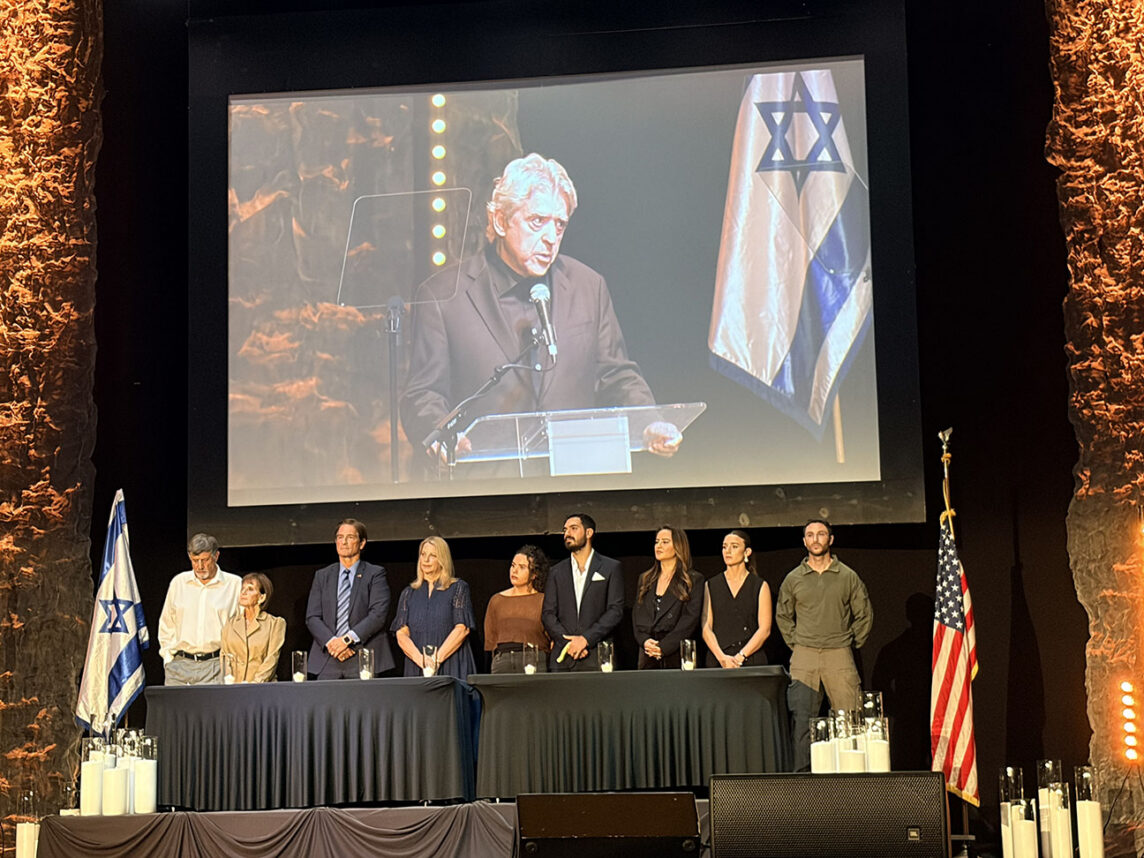
A month after he turned 100, he spoke to a crowd of over 5,000 people at the Grove during their annual Hanukkah Menorah lighting. The revelers stood in stunned silence as Alexander shared an abridged version of his story of survival.
The list keeps on going. He has spoken at schools, synagogues, churches, businesses and other organizations all over the world. And they all seem to amaze Alexander in their own ways. “I was at a church in Bell Garden, but you wouldn’t think when I was there that it was a church because they handed out for all the public little Israeli flags. They played the Israeli National Anthem. Oh, and tonight, I’m going to be in Camarillo.”
“When I talk, I first tell them that there were six million Jews that were murdered. That they were not criminals, nor did they do anything wrong — it was because they were Jews.” – Joseph Alexander
Alexander said that he has been told that 70% of high schoolers in the United States have never heard about the Holocaust. That fact motivates Alexander to keep going. “Most of the people I speak to, more than a half are not Jewish,” Alexander said. Alexander told the Journal that he keeps the story “plain and simple” for the students. “I just talk about myself, what I went through and how I survived,” he said. “When I talk, I first tell them that there were six million Jews that were murdered. That they were not criminals, nor did they do anything wrong — it was because they were Jews.”
When he first shared his story with high school students over two decades ago, Alexander was surprised at how captivated they were by his story. “The students I’ve talked to — high school, middle school, I would say probably hundreds of thousands,” he said. “I get letters from them, all the students. I have thousands of letters. In the beginning, when I started talking to the students, I didn’t think they would pay attention — they’re 16 years old. But when I read their letters, I saw that they do pay attention.”
After Alexander and other Holocaust survivors speak with students, they often receive piles of letters from students filled with words of gratitude and lessons they learned. There was even a ceremony at the LAUSD Balboa Office for handing off over 3,000 letters from students to Holocaust survivors. The event was organized by David Meyerhof who, for the last seven years, has been speaker coordinator for Los Angeles Unified School District, Glendale Unified, and Burbank Unified. Though there were letters for Alexander at that event, he was not in attendance because he was on his way to Germany.
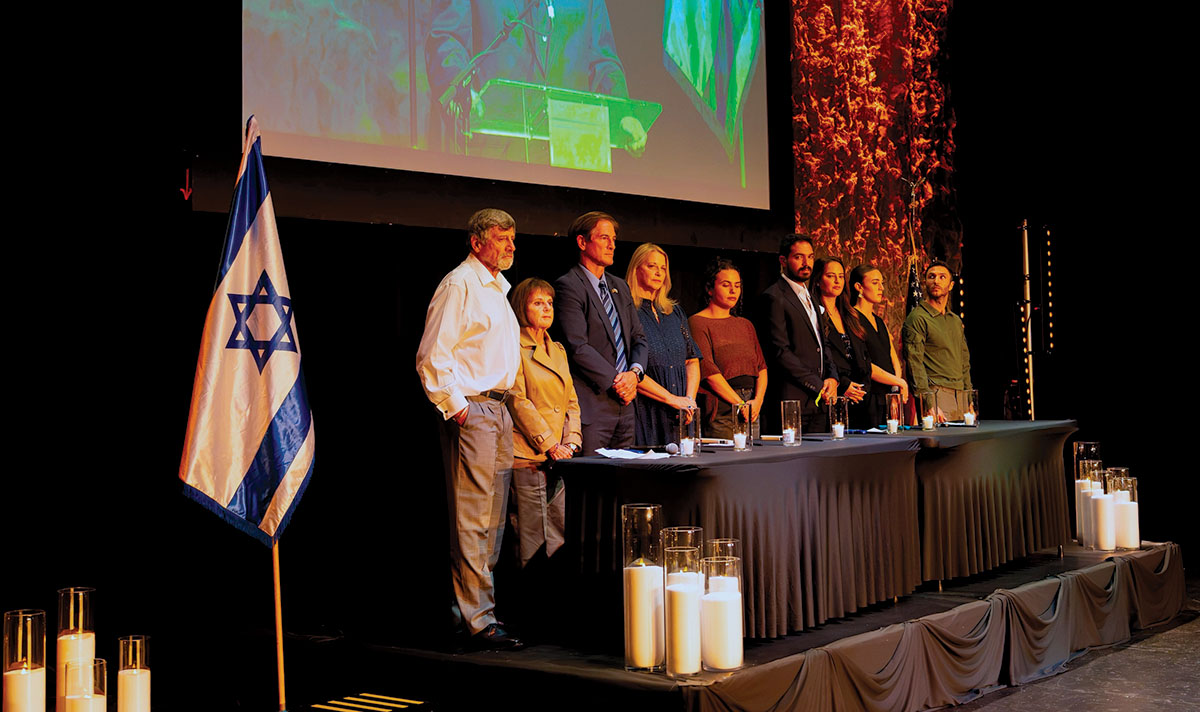
Alexander joined his friend and fellow Holocaust survivor David Lenga, 95, for a ceremony in Germany commemorating the 78th Anniversary of the Liberation of Dachau. The event would be Lenga’s first time back in Germany since 1945. For Alexander, it was his fourth return to Germany since leaving in 1949. Alexander’s first was in 2015, where he met with the then-Chancellor of Germany Angela Merkel.
With the rise of antisemitism, Alexander underscores the importance of not only sharing the story of the Holocaust, but also by encouraging people to see the sites with their own eyes. In interviews, Alexander often takes a jab at Holocaust deniers by saying that every single day there are thousands of people who see the physical remnants of the Holocaust in person. “The evidence is still in existence today: Buchenberg, Auschwitz, Dachau, Treblinka, all the camps,” Alexander said. “People from all over the world come to witness. They’re still there, still in existence today. That’s why I tell the Holocaust deniers that they are crazy.”
Lenga shared a similar sentiment. “We must never allow what happened to fall into the dustbin of history,” Lenga told the Journal after returning from Germany with Alexander. “We must keep it alive and we must remind the world of what it was and what it can be if we do not prevent it.”
Both Alexander and Lenga spoke at schools and at public forums during their visit. They both received a standing ovation after speaking at the solemn ceremony at Dachau. Whether it’s in Glendale or Germany, Alexander told the Journal that he tells the same story every time. But this time, he did notice something different in the crowd at one of the schools he spoke at.
“The only difference was there were high school students that I’ve never saw before — some girls with what you call it, with the Arab cover,” Alexander said, referring to the hijab. “I talked to some schools where there were Muslim kids. That was the first time. It felt good to speak with Muslims. It felt good that I could go [back to Germany] as a free man. How did I go to a place where before, I was a prisoner, a slave. And now, I are there as a free man. And I was treated like a free man.”
The Journal also asked Alexander for some quick thoughts on a few topics.
Love:
“Love is the most important thing. Because if you don’t have any love, then what do you have? Hate?”
Grudges:
“I don’t carry grudges. Don’t carry a grudge. You carry a grudge, you make yourself sick and it doesn’t help anything.”
What’s your first thought every morning?
“I’m still alive!” God wanted to keep me as long as He can so I can tell my story.”
How do you live to be 100?
“By keeping busy and eating the right food. Eat a lot of salad. A lot of salad. Eat fish and chicken. We don’t eat much red meat. And no junk food.”
What is the most common question students ask you?
“‘Did you ever think of giving up?’”
“I never thought of giving up. I never left faith. And I never stopped believing in God. And I tell Him, ‘when I had a bad day today, I hope tomorrow is a better day.’ Never give up.’”
Is there anything else you want the Jewish Journal readers to know?
“Tell them to read my story in the Jewish Journal from 2014.”
That story, written by Jane Ulman, is right here: https://jewishjournal.com/culture/148059/
If you would like to have Joseph Alexander or another Holocaust survivor speak to your organization, contact David Meyerhof at meyerhof.david@yahoo.com