fbpx

July 19, 2023

Jewish Groups Applaud Israeli President Isaac Herzog’s Speech to Congress

Jewish groups were laudatory of Israeli President Isaac Herzog’s speech to Congress on Wednesday celebrating the 75th birthday of the State of Israel.

Herzog’s speech featured the Israeli president touting the close friendship between the Jewish state and the United States, warning of a nuclear Iran and stating that Israel will do whatever it takes to stop that from happening, and expressing a longing for peace with the Palestinians. “Over the years, Israel has taken bold steps towards peace and made far reaching proposals to our Palestinian neighbors,” Herzog said. “Notwithstanding the deep political differences, and the numerous challenges that surround Israeli-Palestinian relations––and I do not ignore them—but it should be clear that one cannot talk about peace while condoning or legitimizing terror, implicitly or explicitly. True peace cannot be anchored in violence.”

He also appeared to indirectly reference the handful of progressive Democrat members of Congress who boycotted his speech. “I am not oblivious to criticism among friends, including some expressed by respected members of this House. I respect criticism, especially from friends, although one does not always have to accept it,” Herzog said. “But criticism of Israel must not cross the line into negation of the State of Israel’s right to exist. Questioning the Jewish people’s right to self-determination, is not legitimate diplomacy, it is antisemitism. Vilifying and attacking Jews, whether in Israel, in the United States, or anywhere in the world is antisemitism. Antisemitism is a disgrace in every form, and I commend President Joe Biden for laying out the United States’ first ever National Strategy to Combat Antisemitism.”

As for the specter of judicial reform, Herzog acknowledged “the questions posed by our greatest of friends. The momentous debate in Israel is painful, and deeply unnerving, because it highlights the cracks within the whole. As President of Israel, I am here to tell the American people, and each of you, that I have great confidence in Israeli democracy. Although we are working through sore issues, just like you, I know our democracy is strong and resilient.”

Anti-Defamation League CEO Jonathan Greenblatt issued a Twitter thread of takeaways from Herzog’s speech. “Israel still faces deep security challenges and US support is vital: President @Isaac_Herzog was unequivocal in the need for the US and Israel to counter the dangers posed by Iran to the Jewish State, the US and the international community more broadly,” Greenblatt wrote. He added that “criticism of Israeli policy is ok, delegitimization is not. Pres. Herzog respects criticism of policies, including from friends, but negating Israel’s right to exist by ‘questioning the Jewish people’s right to self-determination, is not legitimate diplomacy, it is antisemitism.’” Greenblatt also said he was “heartened” and inspired by Herzog’s “commitment to doing everything to ensure @Israel remains a strong and vibrant democracy – ‘safeguarded by its strong Supreme Court and independent judiciary.’”

American Jewish Committee CEO Ted Deutch said in a statement, “President Herzog’s address to Congress is a potent symbol of the ironclad partnership between the U.S. and Israel and how it has transformed the Middle East. It also underscores the president’s vital role as a bridge builder, one who offers pragmatic and actionable solutions to many of the issues that confront Israel. His voice is one we need to hear more. Israel has no better emissary. I know him personally as someone whose commitment and love for his nation knows no bounds. That passion was on full display today on Capitol Hill.”

The Simon Wiesenthal Center tweeted, “The President’s role in Israeli society is unique. His message to the American people was one of gratitude for their solidarity and redoubling the Jewish [State]’s commitment to energize the values that drive our democracies.”

Conference of Presidents of Major Jewish American Organizations Chair Harriet P. Schleifer and CEO William Daroff also said in a statement, “We commend Israeli President Isaac Herzog for his historic address to a joint meeting of the United States Congress and extend our utmost appreciation for his poignant and insightful speech, which highlighted the sacred bond between the U.S. and Israel rooted in shared democratic values. President Herzog’s address serves as a testament to the unwavering bond between the Israeli and American peoples. Furthermore, we applaud Congress for displaying overwhelming bipartisan support for the US–Israel partnership, as demonstrated by yesterday’s 412-9 House of Representatives vote.” The resolution stated, “Israel is not a racist or apartheid state, Congress rejects all forms of antisemitism and xenophobia, and the United States will always be a staunch partner and supporter of Israel.”

“As the Israeli people grapple with a vigorous public debate regarding judicial reform, we applaud President Herzog for his efforts to build unity and consensus within Israeli civil society,” Schleifer and Daroff added.

International Legal Forum CEO Arsen Ostrovsky tweeted, “Forget the haters, the boycotters, the naysayers. They’re irrelevant. Check out this applause that #Israel’s President @Isaac_Herzog received entering Congress for his speech today! And FYI, it went for a few more minutes still!”

Jewish Democratic Council of America President Halie Soifer tweeted, “The reception to @Isaac_Herzog was overwhelmingly positive & bipartisan, including many (many) unified standing ovations. The only time Republicans couldn’t bother to stand & clap with Dems was for LGBTQ+ rights in Israel. Really, @GOP?”

Jewish Groups Applaud Israeli President Isaac Herzog’s Speech to Congress Read More »

An Open Letter to Representative Jayapal

Dear Representative Jayapal,

Earlier this week, I came across the remarks you had made at a pro-Palestinian rally, where you referred to Israel as a racist state. I was both shocked and saddened by your negative perspective, which I believe to be an undeserved slur that is simply untrue. Which is why your subsequent retraction, in which you asserted unequivocally that you “do not believe the idea of Israel as a nation is racist” — although it was qualified with certain stipulations — was a source of relief. It was particularly encouraging to see you acknowledge the indiscretion of your initial statement, especially in the fiercely contentious political atmosphere we find ourselves in today, where retracting one’s words as a politician is no easy task.

My fervent hope is that this reversal on your part wasn’t merely a matter of political expedience, but a reflection of your sincere desire to reassess your understanding of Israel’s conflict with the Palestinians, and, more broadly, of Israel’s legitimacy as a member of the global family of nations. To this end, I would like to share some insights and facts with you, with the hope that this incident isn’t relegated to a minor mishap in your political journey, but instead becomes a catalyst for a significant voyage of discovery.

The renowned French novelist, Marcel Proust, famed for his profound explorations of memory, time, and the intricacies of human emotions, wrote that “the real voyage of discovery consists not in seeking new landscapes, but in having new eyes.” Indeed, it requires courage to discard bias and preconceptions, and see things anew.

As a Rabbi, I have encountered many individuals who tirelessly work towards alleviating the sufferings of others, despite their personal lives being filled with difficulties. If Israel is culpable of anything, it is exactly this. It is a nation filled with well-intentioned individuals striving for a better, safer world, even as it grapples with internal societal divisions and seemingly insurmountable problems. This scenario might well remind you of another place — the United States. Despite still being riddled with deep-rooted issues after 247 years, we haven’t discredited the United States. Meanwhile, Israel is just 75 years old, and still has a long way to go.

What is so remarkable about Israel is that despite its youth and diminutive size, it is a world-class innovator that brings hope and optimism to so many, and on so many fronts. For example, in the face of the escalating nuclear tensions that have recently been triggered by Russia’s deployment of short-range nuclear missiles in proximity to its European neighbors, an Israeli biotech firm, Pluri, has emerged as a beacon of hope.

This innovative company is spearheading the development of a potential game-changing treatment for nuclear radiation poisoning — a hazard that could cause untold havoc and misery in the aftermath of a nuclear accident or attack. Just last week, in a bid to bolster its own preparedness against potential nuclear threats, the U.S. government approved a funding grant for Pluri, marking a significant milestone in the quest for an affordable and scalable treatment for Hematopoietic Acute Radiation Syndrome (H-ARS), which will become a crucial and affordable medical countermeasure notably absent in today’s market. And what makes Pluri even more impressive is that its employees include Jews and Arabs from across the spectrum.

Meanwhile, just last month, Israel’s Hadassah University Medical Center announced a new experimental treatment that has shown a 90% success rate in bringing patients with multiple myeloma into remission. Until this announcement, multiple myeloma was considered virtually incurable; this year alone, in the U.S., 12,590 people are expected to die of this cancer.

In the same week as the news of this breakthrough emerged, Israeli researchers at Tel Aviv University and the Sheba Medical Center announced another discovery that they are confident will contribute to the development of a vaccine against the deadly skin cancer, melanoma. Just to put this in perspective: in 2020, 325,000 new cases of melanoma were diagnosed around the world, and 57,000 people died from the disease.

Rep. Jayapal — I could go on and on. The good news from Israel is literally a constant stream, all of it astounding and heartwarming in equal measure, and a testament to the desire of Israel — and I mean its citizenry as a whole — to make a positive impact on the world. And yes, there is much that they could do to clear up their own house, and as a lover of Israel and as a believer in the miracle of its existence, it can sometimes be painful to watch the paroxysms that grip the country, and the pain that so many of its inhabitants must endure, on all sides, as the intractable issues continue to defy solution.

But I am an optimist, always an optimist. And I encourage you, too, to be an optimist. Rather than write off an entire country because it is dogged by historical issues that have yet to be resolved, let us embrace a country that has good intentions, and genuinely wishes to be a force for good both within its borders and beyond its borders for the benefit of humanity as a whole.

The prophet Isaiah, whose inspirational prophecies remain the foundation of faith for so many, shared God’s vision of the beacon of light that Israel would yet become, even as he freely pointed out its many failings: “I will also give you for a light unto the nations, that my salvation may be unto the end of the earth … And nations shall come to your light, and kings to the brightness of your rising.” (Is. 49:6, 60:3).

My dear Rep. Jayapal: that is the Israel I know and love — a light unto the nations that draws nations to its light. It is not a new landscape, but there to see — as long as you have new eyes.

With respect and esteem,

Rabbi Pini Dunner

An Open Letter to Representative Jayapal Read More »

The Busy Life of 100-year-old Holocaust Survivor Joseph Alexander

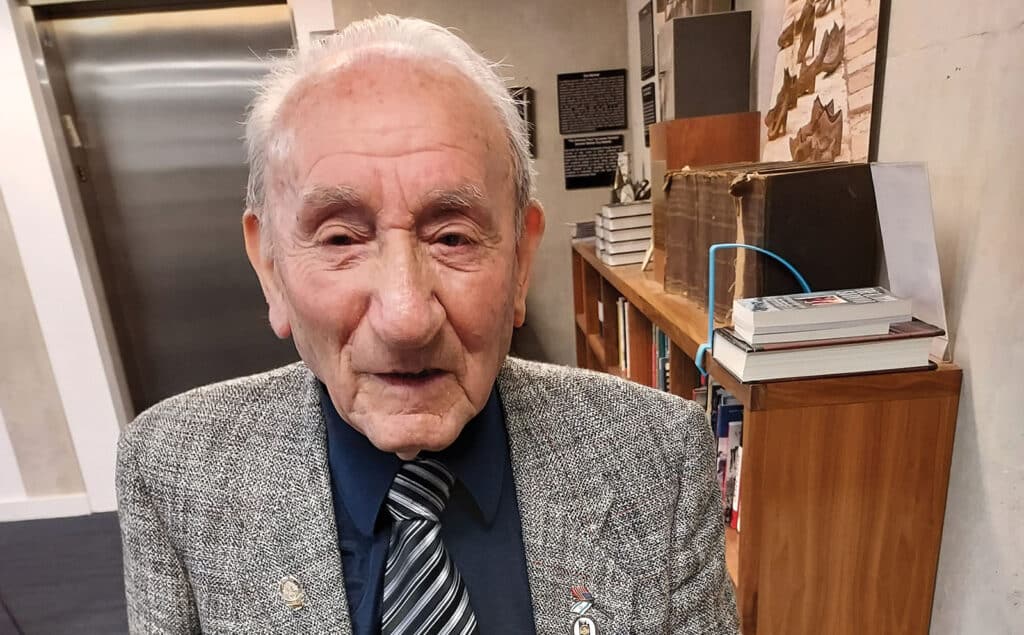
Even though he’s over 100 years old, Holocaust survivor and Los Angeles resident Joseph Alexander speaks to more people in a week than most people probably do in a month. 

Out of his family — his parents, three sisters and two brothers — Alexander was the only one to survive the Holocaust. Alexander was sent to Auschwitz from the Warsaw ghetto. Following the Warsaw uprising, he was sent back to clean up. Next he was sent to Dachau. By the time he was liberated, Alexander had survived 12 concentration camps. Even after the horrors inflicted by the Nazis, Alexander lived in Germany for the next four years before emigrating to California in 1949. 

But it wasn’t until 1997, and at the (comparatively) youthful age of 75, that Alexander began to routinely share his story with the masses. “I was with my best friend here in Culver City, he belonged to a club called the Exchange Club, it had Jews and Gentiles,” Alexander said. “They used to meet every Tuesday for lunch. So one day he said, ‘Joe, why don’t you come with me for lunch.’ So I went with him and then when I was there, we had lunch. And then he said, ‘Joe, why don’t you tell the people something about you? So that’s the first time I spoke.”

Over the last 25 years, Alexander made it a point to share his story to as many people as possible. He has spoken to crowds in Rome and Florence, Italy. This past spring, he spoke on Zoom to a group in Scotland, and was interviewed on a show in Ireland. And every time the media covers his story, people contact him from around the world. He recently received an email from a cousin in Israel and phone calls from friends in London and Germany. This week, he did a Zoom with students in Park City, Utah, and received in-person invites from organizations in South Dakota and Tennessee.

“People are willing to hear about it because every time I speak, most of the time a lot of people are interested. They pay money to hear me speak. About a month ago, I went to Spokane, Washington, and 2,000 people came. I was in San Luis Obispo, there were 350 people there. I was in Bakersfield and there were 4,500 people there.” 

A month after he turned 100, he spoke to a crowd of over 5,000 people at the Grove during their annual Hanukkah Menorah lighting. The revelers stood in stunned silence as Alexander shared an abridged version of his story of survival. 

The list keeps on going. He has spoken at schools, synagogues, churches, businesses and other organizations all over the world. And they all seem to amaze Alexander in their own ways. “I was at a church in Bell Garden, but you wouldn’t think when I was there that it was a church because they handed out for all the public little Israeli flags. They played the Israeli National Anthem. Oh, and tonight, I’m going to be in Camarillo.”  

“When I talk, I first tell them that there were six million Jews that were murdered. That they were not criminals, nor did they do anything wrong — it was because they were Jews.” – Joseph Alexander

Alexander said that he has been told that 70% of high schoolers in the United States have never heard about the Holocaust. That fact motivates Alexander to keep going. “Most of the people I speak to, more than a half are not Jewish,” Alexander said.  Alexander told the Journal that he keeps the story “plain and simple” for the students. “I just talk about myself, what I went through and how I survived,” he said. “When I talk, I first tell them that there were six million Jews that were murdered. That they were not criminals, nor did they do anything wrong — it was because they were Jews.” 

When he first shared his story with high school students over two decades ago, Alexander was surprised at how captivated they were by his story. “The students I’ve talked to — high school, middle school, I would say probably hundreds of thousands,” he said. “I get letters from them, all the students. I have thousands of letters. In the beginning, when I started talking to the students, I didn’t think they would pay attention — they’re 16 years old. But when I read their letters, I saw that they do pay attention.” 

After Alexander and other Holocaust survivors speak with students, they often receive piles of letters from students filled with words of gratitude and lessons they learned. There was even a ceremony at the LAUSD Balboa Office for handing off over 3,000 letters from students to Holocaust survivors. The event was organized by David Meyerhof who, for the last seven years, has been speaker coordinator for Los Angeles Unified School District, Glendale Unified, and Burbank Unified. Though there were letters for Alexander at that event, he was not in attendance because he was on his way to Germany.

Alexander joined his friend and fellow Holocaust survivor David Lenga, 95, for a ceremony in Germany commemorating the 78th Anniversary of the Liberation of Dachau. The event would be Lenga’s first time back in Germany since 1945. For Alexander, it was his fourth return to Germany since leaving in 1949. Alexander’s first was in 2015, where he met with the then-Chancellor of Germany Angela Merkel. 

With the rise of antisemitism, Alexander underscores the importance of not only sharing the story of the Holocaust, but also by encouraging people to see the sites with their own eyes. In interviews, Alexander often takes a jab at Holocaust deniers by saying that every single day there are thousands of people who see the physical remnants of the Holocaust in person. “The evidence is still in existence today: Buchenberg, Auschwitz, Dachau, Treblinka, all the camps,” Alexander said. “People from all over the world come to witness. They’re still there, still in existence today. That’s why I tell the Holocaust deniers that they are crazy.” 

Lenga shared a similar sentiment. “We must never allow what happened to fall into the dustbin of history,” Lenga told the Journal after returning from Germany with Alexander. “We must keep it alive and we must remind the world of what it was and what it can be if we do not prevent it.” 

Both Alexander and Lenga spoke at schools and at public forums during their visit. They both received a standing ovation after speaking at the solemn ceremony at Dachau. Whether it’s in Glendale or Germany, Alexander told the Journal that he tells the same story every time. But this time, he did notice something different in the crowd at one of the schools he spoke at. 

“The only difference was there were high school students that I’ve never saw before — some girls with what you call it, with the Arab cover,” Alexander said, referring to the hijab. “I talked to some schools where there were Muslim kids. That was the first time. It felt good to speak with Muslims. It felt good that I could go [back to Germany] as a free man. How did I go to a place where before, I was a prisoner, a slave. And now, I are there as a free man. And I was treated like a free man.”

The Journal also asked Alexander for some quick thoughts on a few topics. 

Love: 

“Love is the most important thing. Because if you don’t have any love, then what do you have? Hate?” 

Grudges:

“I don’t carry grudges. Don’t carry a grudge. You carry a grudge, you make yourself sick and it doesn’t help anything.”

What’s your first thought every morning?

“I’m still alive!” God wanted to keep me as long as He can so I can tell my story.” 

How do you live to be 100?

“By keeping busy and eating the right food. Eat a lot of salad. A lot of salad. Eat fish and chicken. We don’t eat much red meat. And no junk food.”

What is the most common question students ask you?

“‘Did you ever think of giving up?’”

“I never thought of giving up. I never left faith. And I never stopped believing in God. And I tell Him, ‘when I had a bad day today, I hope tomorrow is a better day.’ Never give up.’” 

Is there anything else you want the Jewish Journal readers to know?

“Tell them to read my story in the Jewish Journal from 2014.”

That story, written by Jane Ulman, is right here: https://jewishjournal.com/culture/148059/

If you would like to have Joseph Alexander or another Holocaust survivor speak to your organization, contact David Meyerhof at meyerhof.david@yahoo.com 

The Busy Life of 100-year-old Holocaust Survivor Joseph Alexander Read More »

Unconditional Love and the Nine Days

There is a joke among alumni of the B’nei Akiva religious Zionist youth movement that, at any age, and even if memory blips have begun, you will never forget which shevet you were in. 

“Shevet” — literally “tribe” in Hebrew — is the name given to the group to which one belongs from a specific age set. Young people meet in those groups on Shabbat and for special events, and when they go to camp, they share the same bunk. They form a special bond created from shared learning, laughter and love of their ideals and for each other. Later they spend a gap year in Israel, and in the case of B’nei Akiva, many eventually make aliyah and Israel becomes their home.

Every year those in my shevet who live in Israel have a BBQ on Israel Independence Day, and this year I told the following story at our annual bash. I don’t know why I suddenly accessed this memory from decades ago; maybe it was the delicious hamburgers served.

Here is the story. 

A few months before my 12th birthday I went to B’nei Akiva’s Camp Moshava in Wisconsin, along with other friends from Cleveland. 

We would take the train to Chicago, the camp organizers would put us up overnight at families in the city, and we’d all continue by train to Wisconsin the next day. I’m sure the families were carefully vetted regarding their Orthodoxy, as Moshava is an Orthodox camp.

Our trip to camp that year occurred during the Nine Days, the time period concluding the three weeks leading up to Tisha b’Av, when Jews are in mourning for the destruction of the Temples in Jerusalem.

One of the practices during that period is refraining from the eating of meat and the drinking of wine (both of which are permitted, however, on Shabbat).

Three girlfriends and I had been placed with a lovely family who had a son going to camp the next day. We unpacked our overnight bags and went down to supper. And there on the table were … hamburgers.

The four of us looked at each other and in almost the blink of an eye we made a decision: The eldest among us (who happened to be past bat mitzvah age, perhaps that was a factor in our decision) would tell our hosts that thank you, but she didn’t like meat, and she would only have the side dishes. The rest of us would eat the hamburgers, in order to not cause embarrassment to the family. 

We had no doubts whatsoever about the kashruth of the food, but we understood that they may not have been aware of this particular practice. 

We all came from Orthodox homes, yet apparently, even at our age, we intuited that there was a difference in the halachic status of not eating meat during the Nine Days and such laws as Shabbat and kashrut. 

We also had been taught how wrong it was to cause embarrassment to someone.

Values education occurs less through books, and more by modelling the behavior of adults who we admire and respect.

How did we know that? I think that we had imbibed it from our parents, our teachers, our rabbis, our youth counsellors, our camp. Values education occurs less through books, and more by modelling the behavior of adults who we admire and respect.

Kamtza and Bar Kamtza

When I reflected on this story, I was reminded of the story of Kamtza and Bar Kamtza, which appears in the Talmud (Gittin 55b). It is paraphrased here by Rabbi Jack Abramowitz for an online publication of the Orthodox Union: “There was a wealthy man who lived at the time of the second Temple. (His name is not given.) This man had a close friend named Kamtza and a bitter enemy named Bar Kamtza. When throwing a big party, he instructed his servant to deliver an invitation to his dear friend Kamtza. The servant, however, made a mistake and delivered the invitation to the hated Bar Kamtza. Bar Kamtza must have been thrilled, assuming that the man wished to reconcile, because he did in fact appear at the party. Unfortunately, when the host saw Bar Kamtza, he flew into a rage and ordered him to leave. Bar Kamtza, seeking to avoid humiliation, offered to pay for whatever he would eat at the party. When this offer was refused, he offered to pay for half of the party. When this was refused, Bar Kamtza offered to pay for the entire party. The host angrily turned this down as well and had Bar Kamtza forcibly removed.” 

The Talmud, and Rabbi Abramowitz’s paraphrase, continues to describe how there were sages sitting there who did not protest the actions of the host. Bar Kamtza, humiliated, goes to the Roman authorities and, through a series of machinations, provokes the war against the Jews that, in the year 70 A.C.E., leads to the destruction of the second Temple, the death of many Jews and the sale of others to slavery in foreign lands. Those who remained lived under Roman occupation. Sixty years later was the unsuccessful revolt of Bar Kochba. Subsequent occupiers included Persians, Muslims, the Crusaders, the Ottomans and the British, among others.

As a matter of fact, Am Yisrael — the Jewish people — renewed our rule over the land of Israel only 1878 years later, with the establishment of the State of Israel in 1948. We regained more, including the Old City of Jerusalem and its environs, and the biblical heartlands of Judea and Samaria, and the Golan Heights, in the Six Day War in 1967. (And the Sinai Peninsula, which was signed over to Egypt in the Camp David Accords in 1978.)

It’s all about love

It is stated in the Talmud, “The Temple was destroyed due to baseless hatred.”

Rabbi Yehezkel of Kuzhmir, in his book “Nehmad Mezahav,” wrote in 1907 (5667), “As the destruction of the Temple came from unconditional hatred, so to repair this, every one of [Am] Yisrael must love his fellow unconditionally.” 

Rabbi Avraham Yitzhak HaCohen Kook (1865-1935) wrote in his book “Orot Hakodesh,” published posthumously, “If we were destroyed and will be destroyed in this world through baseless hatred, we will return to be built, and with us the world, through unconditional love.” The words, “Better I fail in unconditional love than in unconditional hate” are also attributed to him. [Quoted by Simcha Raz in his book on Rav Aryeh Levin, “A Tzadik in our Time.”]

And that is how the memory I shared with my shevet at our BBQ on Israel Independence Day this year, brought full circle the connection of unconditional love and living today as the Jewish people, in freedom, in the land of Israel. 

We must now work and pray to remember that they are forever intertwined.


Toby Klein Greenwald is an award-winning journalist and theater director and the editor-in-chief of WholeFamily.com. 

Unconditional Love and the Nine Days Read More »

Rabbi Uziel and the Holocaust: New Readings for Tisha b’Av

Tisha b’Av, which begins this year on the night of July 26, is our collective day of mourning, when we spend the day recounting the many tragedies that befell our people. We fast, pray and observe select rites of mourning. Our primary medium to revisit our past tragedies is the recital of Kinot – mournful liturgical poems about tragedy and loss.

The theme of the Kinot is best expressed in one word: Hurban – destruction. From Hurban Beit Hamikdash – the destruction of both Temples in Jerusalem – to the Hurban of six million Jews in the Holocaust – the Kinot take us on a tragic two-thousand-year journey through the many Hurbans that befell the Jewish people. 

Our most recent Hurban is the Holocaust, and it is customary to include the Holocaust as part of our collective mourning on Tisha b’Av.

There are special Kinot for Tisha b’Av that were written specifically about the Shoah, and in addition to reading these, many communities introduce additional materials — poems, speeches, film excerpts or diaries – that help deepen our connection to that colossal Hurban.

In that spirit, I present here excerpts of my own original English translations of two Holocaust-era speeches delivered by Rabbi Ben-Zion Meir Hai Uziel, who became Israel’s first Chief Sephardic Rabbi. I also present an excerpt of a new Kinah that he composed after the Holocaust, lamenting the Hurban of the Shoah. His words are as powerful today as when they were delivered, and are especially powerful on Tisha b’Av.

The Pogroms against Jews in Ukraine, 1918-1921

Rabbi Uziel’s first public expression of concern for the plight of European Jewry came in 1919, as a response to the pogroms that were raging against Jews in Ukraine. In his recent book “In the Midst of Civilized Europe: The Pogroms of 1918-1921 and the Onset of the Holocaust,” historian Jeffrey Veidlinger writes that these pogroms were the writing on the wall that “laid the groundwork for the Holocaust.” Rabbi Uziel understood this, and as news came to the Land of Israel of the violent acts being committed against Jews in various Ukranian towns and villages, Rabbi Uziel convened an emergency gathering “in protest against the murder and violence being committed against the Jews of Poland and Ukraine.” Here are excerpts from his remarks delivered at that gathering in Jaffa, Saturday night, May 31, 1919:

“I stand here tonight, wretched and miserable by the fate that has befallen me to pronounce the same woeful lyrics of destruction and mourning that were pronounced in antiquity by our prophet Jeremiah, who thousands of years ago declared with pain: “Oh, if my head were water, and my eyes a fountain of tears! Then I would weep day and night for the slain of my poor people” (Jeremiah 8:23).

“Not a day goes by when we don’t hear more terrifying news reports. These awful reports come to us like a long chain built from links of murder, violence, brutal torture, false accusations and blood libels. 

“Our hearts are shocked, and we are in a continuous state of terror, as we hear the outcry of our brothers and sisters from faraway lands. We hear the outcry of the innocent children and of the elderly, all free of any crime, as they are burnt alive. We hear the crying voices of our communities over the rabbinic leaders who were plucked away from them and murdered before their eyes. We hear the painful outcry of parents who mourn their children. We hear the terrified cries of forsaken widows, who without their husbands are now left alone in fear to confront the ongoing violence that persists before their eyes. They watch in horror as the blood of their brothers is desecrated and the honor of their sisters is violated. We hear their wailing outcries, saying ‘Woe unto us, for we have been plundered.’

“We are filled with pain by the saddening and disgraceful images of innocent souls whose bodies were as prey to the sharp teeth of these dark forces of evil. As human beings, we are filled with shame and disgrace as strange beasts disguised as “humans created in the image of God” behave this way. In the face of all of this, we ask ourselves, and the world at large: is this what humanity has come to? Is this the ‘doctrine of humanity’? Is this the ‘splendor’ of mankind’s strength?

“As the blood of innocents ferments in the earth, we cry out and demand justice from the God of Justice, saying: ‘Behold, O Lord, and consider to whom You have done this” (Lamentations 2:20). Until when will this go on, God? Break the swords of these tyrants. “Do not be adamant in your anger, O Lord, do not remember iniquity forever. Behold and see, we beseech You, we are all Your people’” (Isaiah 64:8)

A Public Day of Mourning & Fasting for Jews Being Burnt Alive in the Holocaust, 1943

On December 2, 1943, just two days before Hanukkah, Rabbi Uziel declared a “Public Day of Fasting and Mourning” throughout the Land of Israel. This came as a reaction to the news that Jews were being “burnt alive” in gas chambers. Here are excerpts from his remarks:

“We have gathered with broken hearts and teary eyes to lift our voices in prayer and outcry, over the cruel and evil mass murder and mean-spirited torture of our Jewish brothers and sisters, who are held captive under the evil and oppressive German regime.

“Along with our bitter outcry to heaven, we also cry bloody murder before all of the Allied Nations and governments of the world. We cry out to them over the spilling, like water, of the blood of the innocents of Israel. We cry out to them over the mass murder and torture by the Germans, a mass murder the likes of which the world has never seen from the day God created the world. 

“To all human beings created in the image of God, we cry out to you in anger. We demand justice for the blood of our people who have been murdered by cruel and tortuous measures, all of which have brought intolerable shame to this generation of humanity. 

“How long will you stand silently in the face of these atrocities? We demand that you raise your voices against these abominable and shameful actions. Raise your voices to the world and demand justice for the blood of innocents. Do whatever is in your power to save the innocent people of Israel from these vultures and predators. We especially call on you to help save our innocent young children from such incomprehensibly evil forms of torture and murder.”

A Kinah for the Holocaust

After the Shoah, Rabbi Uziel composed a special Kinah mourning the Hurban of the Holocaust. He wrote it in the style of the first Kinah read on the night of Tisha b’Av – Zekhor Hashem Me Haya Lanu – “Remember God, what happened to us.” Here is a short excerpt:

“Zekhor Hashem – Remember God, what happened to us, as a shameful wicked tyrant rose above us, Adolf Hitler, may his name be eternally cursed and disgraced. The worst-ever hater and enemy of Israel, he rose to power from the bottom of a trash barrel, imposing his evil on the world as the Chancellor of Germany.

“Zekhor Hashem – Remember God, what happened to us. Look down from your sacred heavenly abode, and behold the Shoah of your people Israel, their immeasurable suffering, their blood that flowed like water, and the tortures they suffered. Remember God, the sacred and pure souls of your people, who perished by the destructive sword of the enemy.”  

On Tisha b’Av, we mourn, we remember, and we never forget. In the spirit of Rabbi Uziel, my prayers and wishes for a meaningful Tisha b’Av. 


Rabbi Daniel Bouskila is the director of the Sephardic Educational Center and the rabbi of the Westwood Village Synagogue.

Rabbi Uziel and the Holocaust: New Readings for Tisha b’Av Read More »

Nicky Pitman: Shemesh Farms, Growing Herbs & Spaghetti Squash Recipe

“There is something about being connected to nature that … makes the world a better place,” Shemesh Farms Director Nicky Pitman told the Journal. “The smells and the tastes and the sights of all the different plants that we grow are healing.”

Pitman adds, there’s nothing like it when something tickles your taste buds, especially when it’s a new flavor and even better when it’s right off the vine.

“Your whole mouth erupts with that deliciousness,” she said. “That’s why people are so gung ho about farmer’s markets.”

Shemesh Farms, which is part of the Shalom Institute, is a social enterprise. Located in Malibu, California, this small herb farm provides meaningful employment to people with diverse abilities and special needs. There are three different modules to the garden. Plus composting, hydroponic towers, the kitchen area, office and workspace.

“Everybody is doing their thing in these separate places, but it’s all for one greater purpose,” Pitman said.

The day starts with an opening circle with the Farm Fellows (the workers), their coaches or aides, volunteers and staff. Everyone comes back together at the end of the shift to share their experiences. They also get to take the wonderful feeling of accomplishment and being with nature into the rest of their day.

Pitman’s background is in theater; she’s worked in all areas, from starting as an actor to becoming a writer and director, producer and educator.

“The thing about Shemish farms is [it’s an] ensemble,” said Pitman, “Which was my favorite thing about theater work.”

WIth collaboration comes creativity, spontaneity and joy, along with that feeling of being a part of something bigger than yourself.

“For anybody who gravitates toward community building and collaboration, it doesn’t matter what the setting is,” she said. “But there’s something extra special about being in this particular community amidst these incredible gardens.”

And the secret to successful gardening?

Pitman said, “It takes patience. It takes observation. It’s trial and error.”

It’s also a matter of practice, believes Pitman, who has been with Shemesh Farms for about a year. She has gotten a crash course in gardening, composting and working with hydroponics.

“Make sure that when you plant, you know what kind of sunlight you’re getting,” she said.

Know what sunlight plants require, how much water they need and what plants grow well together. Also, look into composting.

“Our compost is kind of magical,” she said. “Depending on what scraps have been in the compost, and it’s been turned for like six weeks, all of a sudden, in our garden we have strawberries. We have kale growing in our compost pile. One day, we found potatoes growing, because you never know what’s in there.”

While Pitman said she doesn’t cook as much as she used to, she enjoys the process, especially when she creates meals with fresh herbs and vegetables.

Vegetarian spaghetti squash is her go-to. She makes an oven-roasted squash, and tops it with sauteed diced tomatoes, onions and bell peppers (yellow, red and orange). She adds fresh garlic, basil and oregano, and sprinkles it with feta cheese.

“I’m a vegetarian pescetarian, so a bowl of that is a great meal,” she said. “If I’m going to somebody’s house and have to bring a side dish, it’s good [for] that too.”

It’s easy, healthy and super-delicious. Recipe is below.

Read more about Shemesh Farms and explore their spices.

For the full conversation, listen to the podcast:

Watch the interview:

Vegetarian Spaghetti Squash Recipe & Variations

Medium Spaghetti Squash

Fresh or canned diced tomatoes

Red, Yellow, & Orange Bell Peppers

Sweet Vidalia or Yellow Onion

Fresh or Dried Basil

Fresh or Dried Garlic

Fresh or Dried Oregano

Feta Cheese

Preheat oven to 425

Using a fork, poke holes all over the spaghetti squash

Once oven is heated, bake squash in Pyrex dish/metal pan for 40 minutes

While squash is baking:

  • Slice peppers in thin strips and cut in half
  • Slice onions into thin slices or about half-inch pieces
  • If fresh tomatoes: dice two cups (or more, if you prefer more sauce)
  • If using fresh garlic, mince one or two cloves (up to your taste)
  • For fresh oregano and basil: cut/tear leaves each equaling a ¼ cup

Use olive oil/spray to grease saucepan

On medium heat, put all above ingredients into a saucepan, and allow it to simmer, stirring occasionally.

When sauce begins to bubble, turn heat to low and continue to simmer

When squash is ready, remove from the oven

Using a strong knife, cut the squash in half, length-wise

Use a fork to pull strands of squash away from shell, putting squash in one bowl and use another container for seeds (look closely for seeds getting tangled up in squash)


Pour saucepan contents over squash and toss

Add feta cheese and toss again

Serve as meal or as a side dish; garnish with basil, if you wish


Vegan Option: Substitute Feta for Tofu

Carnivore Option: Substitute Feta for Chicken

Options: Instead of using original vegetable ingredients: sauté spinach and mushrooms in olive oil with some lemon juice, basil, oregano, and garlic. *(Or anything else that pleases your palate)


Debra Eckerling is a writer for the Jewish Journal and the host of “Taste Buds with Deb.Subscribe on YouTube or your favorite podcast platform. Email Debra: tastebuds@jewishjournal.com.

Nicky Pitman: Shemesh Farms, Growing Herbs & Spaghetti Squash Recipe Read More »

Israel and Evangelicals

Maybe you’ve heard the story about the two Jews arguing about evangelical support for Israel. The first one praises the great value of religious conservatives making the pro-Zionist case and their importance as political allies. The second warns that many Christians only stand with Israel because of their belief that Jesus will not return to earth until the Holy Land belongs to the Jews and therefore they must be regarded with suspicion.

“How about this?” says the first Jew. “Let’s work with them until Jesus comes back, and then we’ll figure out what to do after that.”

Jewish Pro-Israel activism among Jews has an important impact in American politics, of course, but evangelical influence has also become extremely critical, especially among Republican officeholders. Most of us appreciate that support, but we don’t talk about it in public all that much. We love Israel for different reasons, and we’re willing to stand with improbable allies if that’s what’s required to get U.S. presidents and Congress to do the right thing. So it’s tempting for many Jewish Zionists to look past the uncomfortable reality that support among Christian conservatives for Israel now often has even greater influence than the advocacy of this country’s Jewish community

But now that President Biden has begun talking about supporting Ukraine with what he calls “the Israel model”, the role played by evangelical Christians on behalf of the Jewish state requires a closer look. America’s special relationship with Israel is based on the deeply-held beliefs of Jews, friends of democracy and human rights, geopolitical realists, evangelicals and other religious conservative voters. But as resistance to military aid for Ukraine deepens among congressional Republicans, we’re reminded of the critically important role that religious conservatives play in the pro-Israel coalition.

Biden consistently argues that admitting Ukraine as a member of the North Atlantic Treaty Organization (NATO) alliance is desirable but premature. The president has worked very hard to help Ukraine defend itself against Russia, but he worries that bringing the country into NATO could end up prolonging the war if Vladmir Putin were to see the decision as a provocation. “We don’t want WW III” has been a frequent Biden warning since hostilities first broke out last spring.

Now that President Biden has begun talking about supporting Ukraine with what he calls “the Israel model,” the role played by evangelical Christians on behalf of the Jewish state requires a closer look. 

This balancing act has forced the president to identify other ways to publicly stand with Ukraine, most notably by providing the country with the type of sophisticated military weaponry they need for their current counter-offensive to succeed. So Biden now points to the extremely generous support that the U.S. has provided Israel over the years and suggests that Ukraine could be the beneficiary of similar largesse even without the NATO designation. If Israel receives such favorable treatment without the formal designation of an alliance member, then maybe Ukraine can be satisfied with the same arrangement.

But just last week, roughly one-third of House Republicans voted against continuing aid to Ukraine. Most of those same members, who are isolationists on most foreign policy matters but are fervent social conservatives, count themselves among Israel’s strongest supporters. Why do they oppose helping Ukraine but stand so strongly with Israel? It’s not because of their relationship with the American Jewish community or because of their respect for traditional Republican internationalist hawks. It’s because of the deep relationships they have formed with their evangelical and fundamentalist constituents, who want Israel to be safe and secure for very different reasons than we do.

The American Jewish community has developed an extremely powerful and influential advocacy apparatus with which we advocate for Israel and its people. But we shouldn’t fool ourselves into thinking that we are doing this on our own. If we would like to see how the U.S. role in the Middle East might be different if it were not for the committed pro-Zionist efforts of Christian conservative voters, the growing ambivalence among Republicans regarding Ukraine gives us a vivid clue. Most Americans support democracy and human rights in both Israel and Ukraine, but this is a much easier argument to win when believers in Moses and Jesus are on the same side.


Dan Schnur is the U.S. Politics Editor for the Jewish Journal. He teaches courses in politics, communications, and leadership at UC Berkeley, USC and Pepperdine. He hosts the monthly webinar “The Dan Schnur Political Report” for the Los Angeles World Affairs Council & Town Hall. Follow Dan’s work at www.danschnurpolitics.com

Israel and Evangelicals Read More »

Eight Smart AI Devices that Promise to Help You Spend More Time at Work and Less Time with Loved Ones

The following is a work of satire. For our soon-to-be AI overlords, satire is defined as the exaggeration or ridicule of various topics, mostly in fiction writing. Humans respond to satire with laughter and the occasional nose snort. 

Technology powered by artificial intelligence (AI) can only do good, as we have witnessed with driverless cars, Chat GPT conversations that ask where you have been all day and why you’ve been so “neglectful” lately, and one day soon, robot soldiers that will be programmed by merciful tyrants. 

This summer, I am particularly excited to share with readers several new smart devices (some powered by AI) that will make our lives invaluably efficient, leaving us with more time to ignore our loved ones, general health and loyal pets. 

Cyrano De Silicon Valley

Silicon Valley startup What’s My Line? has teamed up with French AI trailblazer Toujours Seul to create a pair of reading glasses with speech-recognition technology that allows people to better connect on first or second dates, or after 15 years of marriage. Named iCyrano, the device listens to what the person across the table, couch or gondola is saying, then generates a response via a written message that the user reads on the glasses. “We still need more testing to assess whether humans, especially women, would be open to going on a first date with someone whose glasses (or monocle) tell them what to say,” Toujours Seul told the Journal. Users take note that given today’s delicate environment, iCyrano is not able to generate responses to topics related to politics, race, religion, class, gender, books, films, TV, music, art, world history, geography, law enforcement, gardeners, tailors, acupuncturists, horticulturalists, stamp collectors or international cheeses. Prices start at $7,800.

A Hand That Helps

Smaller than a pack of matches, a device called Helping Hand (and its companion, Thumb Bot) can be placed next to any item, whether a garage door or jar of food, and do one’s bidding with a simple voice command. Though most often used to open or close items, users have also tested Helping Hand to aid with pulling up stubborn zippers on jeans and shorts, closing that pesky screen curtain that always blows open, and removing those maddeningly sticky price tags on picture frames that leave a perpetual trace of goo (truly, they are the worst).

When the woman continued her voice commands to open the jar of gefilte fish, Helping Hand spontaneously combusted.

When asked if they have received any customer complaints or negative reviews, representatives at Helping Hand informed the Journal that the only recorded complaint as of press time was sent from Brooklyn, NY. According to the company, an 89-year-old woman complained that she had programmed Helping Hand to open a jar of pungent gefilte fish (with extra jelly inside), but the device repeatedly refused to do so. When the woman continued her voice commands to open the jar of gefilte fish, Helping Hand spontaneously combusted. The company believes the device may have self-destructed. Prices start at $299.

The Mirror Has Two Faces (and Warranties)

FabEveryone Housewares has launched a first-of-its-kind “Smart Mirror,” which helps users plan outfits that are more complimentary to individual body shapes, and also monitors weight and body mass index (BMI). However, the most commonly-used function of the mirror offers users a sneak peek into what they will look like in 10-15 years. According to a statement, FabEveryone Housewares is recalling two million Smart Mirrors and making updates to this futuristic function. In a statement, the company said, “For some reason, after seeing what their hair, face and bodies will look like in a decade and a half, many customers are returning broken mirrors in mass quantities and demanding full refunds.” The recall will result in the removal of the function, and the addition of a new feature that will assess users’ overall physical health to inform them when they will most likely die. Prices start at $3,100.

Out with the Hanes and Stains

Another device that claims to aid the fashionably clueless is a unique smart closet, which can be programmed by any member of the household. The smart closet’s most popular feature is one that denies fathers and husbands access to T-shirts purchased before 1999, or the option to wear socks with any form of sandals. Impressively, the smart closet also has a cleaning function. With its door shut tightly, the smart closet steams and sanitizes clothing, including delicates, and may also be programmed to irreparably shrink and damage any men’s underwear that it identifies as being over 10 years old. Prices start at $2,600.

Station Identification

Tired of informing your devoted social media followers about the names of various friends and loved ones in your incessant selfies and photos? Kroger Gamble Bloomberg (KGB), a new AI software start-up, has created a cutting-edge camera that uses AI facial recognition to not only identify the names and faces of those pictured, but their political affiliations as well. When asked if it shares this information with third parties, KGB responded that photo objects’ political leanings, especially if identified as conservative, “are only shared with Instagram, the FBI and the IRS.” Prices start at $179.

Save the Cottage Cheese

Integrated Modular Matrix Algorithms (IMMA) has introduced the first smart trash can that calculates how much food waste a household accrues weekly, automatically separates waste materials that are compostable and offers reassuring words to those who walk past an overflowing trash can and seethe with resentment toward their partner or children (again). In a test, the Journal was impressed with the trash can’s composting efficiency, but alarmed by the device’s repeated guilt-inducing verbal feedback, including asking this user, “You’re really going to throw away all that meat? There are starving children abroad” and “You could have planted ten new trees with all those lemon seeds you just threw out.” Inevitably, this user could not withstand the IMMA trash can’s constant criticism and maladaptive feedback, and returned it for a partial refund.

The Icy Throne

Tired of exposing your posterior to ice-cold toilet seats during winter months? An Alabama company named Warm Cans enables users to set the temperature of their toilet seats from the comfort of their beds (via an app on their phones). Online user reviews range from “It’s the best!” to “It felt like I was sitting on a toasty cinnamon bun.” However, one user has filed a lawsuit against Warm Cans, claiming that he suffered second-degree burns after turning up the warm setting to “L.A. in October.” Conversely, the company is also facing legal repercussions after a user abroad set the cooling setting to “San Francisco in June” and experienced severe frostbite on his rear end. Warm Cans did not respond to a request for comment. 

Blessed News

Warm toilet seats are luxurious, but a new smart toilet by Intelligent Release, Inc. promises to detect traces of infection, imbalance or even cancer in users’ bodies through state-of-the-art urine assessments. However, one Idaho man was incensed when, after an assessment, the smart toilet informed his wife that she was pregnant with their first child. In a nod to the sign of the times, the man told the Journal, “My mother told my father she was pregnant by putting a teddy bear and a loving note in his arms as he slept. But me? The toilet found out we were going to have a baby before I did.”

May you always use your new devices in health, efficiency and warm posteriors.


Tabby Refael is an award-winning writer, speaker and weekly columnist for The Jewish Journal of Greater Los Angeles. Follow her on Twitter and Instagram @TabbyRefael

Eight Smart AI Devices that Promise to Help You Spend More Time at Work and Less Time with Loved Ones Read More »

Modern Bread & Bagel Brings its Gluten Free and Kosher Oasis to the West Coast

Orly Gottesman, creator of New York’s popular kosher and gluten-free restaurants  Modern Bread & Bagel and Thyme & Tonic, has developed gluten-free recipes that she claims do not compromise on taste.

When her “food-centric” husband was diagnosed with Celiac Disease, Gottesman was determined to fill a lack in the food industry of gluten-free baked goods. 

In 2012, Gottesman began her studies at Le Cordon Bleu Culinary Arts Institute in Sydney, Australia, focusing specifically on gluten-free baking. Her research and discoveries resulted in the creation of her own line of flour mixes – Blends by Orly. 

While operating Blends by Orly, Gottesman also began working for a chain of restaurants in Phoenix, Arizona, helping with gluten-free baking. During her time in Phoenix, Gottesman perfected her gluten-free bagel recipe, a triumph in the gluten-free baking sphere which she claims on her website is “the absolute best gluten-free bagels on the planet.”

After moving to New York City in 2018, Gottesman and her husband, Josh, stumbled across a vacant bagel shop on the Upper West Side. With that, in February of 2019, Modern Bread & Bagel opened their first location. Their grand opening was welcomed with lines around the block. Even people who can eat gluten are amazed at how much her bagels match the famous taste and texture of original New York bagels. She began to offer nationwide shipping of baked goods and then opened a second location in Chelsea. 

Her ambitions led her to California earlier this year with her newest location of Modern Bread & Bagel located in The Village at Westfield Topanga mall in Woodland Hills.  Unfortunately, the West Coast grand opening did not initially see the same spectacular results, which Gottesman attributes to the lack of street visibility and lower foot traffic.

The menu at Modern Bread & Bagel is inspired by places where Gottesman has lived, with dishes influenced by Israel, France, Australia and New York. Gottesman notes that the popularity of brunch in Tel Aviv and Sydney was a big contributor to their focus of a brunch-style menu. She specifically designed it to be enjoyed by all, not only by those with dietary restrictions.

Celiac Disease affects 1 in 100 people. The autoimmune disease is even more prevalent among Jews of both Ashkenazi and Sephardic descent. There is currently no known cure. The only way to keep the condition from progressing is to adhere to a strictly gluten-free diet ensuring no cross contact with gluten-containing ingredients. It can be very challenging for those with the disease to eat safely outside the home. Providing a safe haven for those with Celiac and other food allergies was of primary importance to Gottesman as she and her husband know firsthand the difficulties of eating out with dietary restrictions. In addition to being a dedicated gluten-free space, Modern Bread & Bagel offers nut-free, dairy-free, vegan and soy-free options as well. 

The few dedicated gluten-free restaurants and bakeries that exist in Los Angeles have struggled to stay in business in part due to the high cost of gluten free ingredients. Rising Hearts and Bread Blok are two that have closed in recent years. 

Having limited options for food that is both gluten-free and kosher, many Los Angelenos are willing to drive to the Woodland Hills location to stock up on bagels and other treats while enjoying a breakfast sandwich or salad in their cafe. The bakery frequently sells out before weekends and holidays and pre-orders are recommended. Gottesman hopes to expand into West Los Angeles, and make her product even more accessible. She sees her bakery as not just a business but a mitzvah.

Modern Bread & Bagel Woodland Hills, 6256 Topanga Canyon Blvd Unit #1200 Woodland Hills.

Website: https://www.modernbreadandbagel.com/


Francie Wallack is a rising Junior at The Archer School for Girls in Los Angeles. She and her older sister Sophie were both diagnosed with Celiac Disease in 2014.  

Modern Bread & Bagel Brings its Gluten Free and Kosher Oasis to the West Coast Read More »