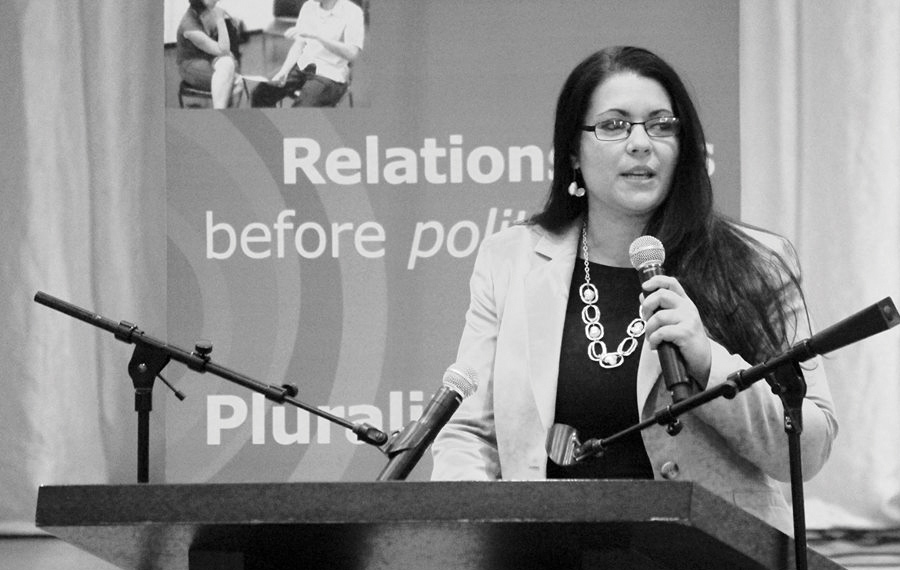
In an effort to help people navigate conflict and debate contentious issues, Aziza Hasan is eager to share her ideas. The executive director of NewGround: A Muslim-Jewish Partnership for Change drew around 50 people at a talk she gave on that subject on Aug. 17.
The event was hosted by Jeff and Naomi Selick in their Beverlywood home’s backyard as part of B’nai David-Judea Congregation’s Shabbat afternoon “Nosh N’ Drosh” series. Hasan, accompanied by three alumni of NewGround’s MAJIC (Muslims and Jews Inspiring Change) program, spoke about how to “create a space to have meaningful conversations. It’s not rocket science,” she said, “but it’s very difficult.”
The hardest part, she explained, is “to actually hear and see one another,” and that everyone has “different stories, different truths.” In order to achieve that, she said, the most important skill is to learn how to listen and how to ask questions without coming off as aggressive or judgmental.
The alumni — Cindy Kaplan, Serra Demircii and Yael Rubin — spoke about how they have used the skills they learned in the program in their personal life.
“There’s a hunger and thirst for having constructive conversation, to really be willing to work in a process that might lead down a constructive path.” — Aziza Hasan
Demircii, a Muslim, said she found herself in a similar situation discussing the Armenian genocide with another Muslim girl. She too managed to keep the conversation from turning into a fight. What she learned, she said, is “how to talk without breaking anybody’s heart. You have to respect the point of view of the other person. People get triggered. You have to separate the person from the belief.”
To put these ideas in action, Hasan had attendees pair up with someone they didn’t know well. Each person had two minutes to tell their partner a problem they were having, either at work, at home or with themselves. After waiting a minute, the partner could ask just two questions, the simpler the better.
“Don’t answer the questions,” Hasan instructed. “Just tell the person if the question was helpful or not.” The exercise, she explained, was not about problem-solving; it was to help focus on listening with intent and asking productive questions.
In one example, a man starting a new project couldn’t decide between hiring someone younger or going with a more experienced candidate. He was asked who would bring more passion to the job and whether he would prefer to train a new employee or work with someone who already had set ideas about the job. The man said he found both questions helpful.
In the Q&A session following the exercise, Marvin Epstein said he found the experience surprising. Being face to face with the other person, looking them in the eye, made him feel listened to. It was, he said, “intense.”
Asked how these tools can be used in the real world, especially when discussing thorny issues regarding Israel and the Middle East, Hasan said, “In those cases, you have to agree to disagree. We have the best of intentions but we all have our blind spots.”
Hasan told the Journal she was pleased with how the event went.
“It felt like a breath of fresh air,” she said. “People were willing to bring themselves to the table and see other people.” The large turnout and willingness of people to take part in the exercise, she said, showed “there’s a hunger and thirst for having constructive conversation, to really be willing to work in a process that might lead down a constructive path.
“I know there’s a future that’s different,” she concluded. “This is how we build community.”
CORRECTION: Cindy Kaplan was identified as a Shalhevet High School student. She is a B’nai David member and an alumna of the Professional Fellowship for adults. Yael Rubin is still a student at Shalhevet High School.