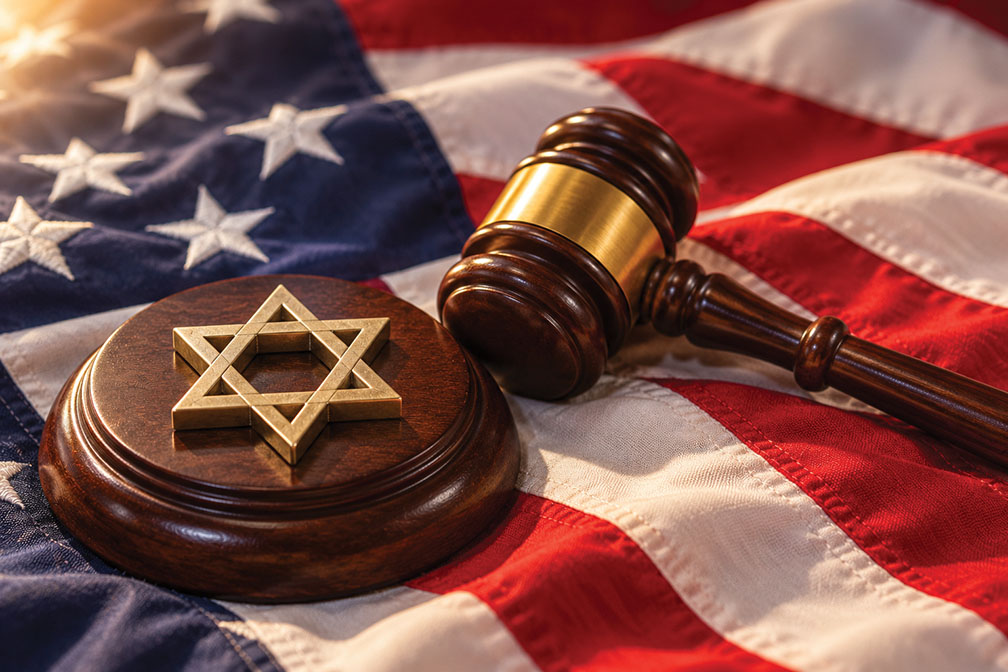
Two communities on opposite sides of the Hollywood Hills, one Jewish, one Latino, are engaged in remarkably similar efforts to ensure fairness in redistricting.
In the West Los Angeles area, Jewish residents are participating in public meetings, seeking to have their voices heard as the process for redrawing City Council districts begins. In the Northeast San Fernando Valley, Latino residents are in federal court, seeking to have their voting rights affirmed as the process for redrawing congressional districts comes to an end.
The Los Angeles City Council Redistricting Commission, created by the voter-approved reforms to the city charter, recently held its first public hearing to receive community input with regard to boundary changes. This hearing focused on City Council Districts 4, 5, 6, 8 and 10.
One of the major themes that emerged at this hearing was that an Orthodox Jewish community of interest exists in the region that now is fragmented, and should be unified into one council district. A "community of interest" is broadly defined as a population that has particular interests and needs in common that should be taken into consideration when drawing electoral districts.
Witness after witness urged the commission to retain the heavily Orthodox Jewish communities they identified as Pico-Robertson and Beverly-Fairfax in Council District 5. Other witnesses pointed out that another significant Orthodox Jewish neighborhood, located east of La Brea and north of Wilshire, is presently in Council District 4, and implored the commission to unite all these neighborhoods into one district.
One witness in particular, recalling a 1972 incident involving the Los Angeles Police Department and an Orthodox Jew walking to synagogue, reminded the commission members about the importance of having a community of interest kept together, so that it could receive fair and meaningful representation.
In the Northeast San Fernando Valley, Latino residents have filed a federal voting rights lawsuit, because their unified community of interest in Congressional district 26 was purposefully fragmented into two new separate districts by the Legislature, in order to protect the incumbents.
The Legislature swapped population between Congressional District 26 and Congressional District 24. In so doing, District 26 held by Congressman Howard Berman lost Latinos — and thus thousands of faithful Democrat voters in this working class region — to the adjacent District 24 held by Congressman Brad Sherman, who constantly faced credible Republican challenge in this marginally Democratic district.
This plan was designed to achieve two objectives. First, Berman, who was visibly irked when San Fernando Mayor Raul Godinez II challenged him in a Democratic primary — is now much safer from another intraparty challenge from a Latino in his new District 27. While there are Republicans in the population introduced into the new district, there are not enough to encourage a serious Republican challenge. Second, Sherman will now have an easier time winning reelection over a Republican challenger because of the infusion of Latinos and Democrat voters in his new District 28. His previous constituents, who may have favored a GOP candidate, are now safely neutralized in the still heavily Democratic District 27.
The result, however, is that the new districts fragment a Latino community of interest, thus denying them the kind of fair and meaningful representation they once enjoyed, and that their fellow Angelenos in West Los Angeles now understandably seek.
The struggle for fairness in redistricting continues on both sides of the Hollywood Hills. Hopefully, the struggle in West Los Angeles will not require the court litigation the residents of the Northeast San Fernando Valley have been forced to pursue.