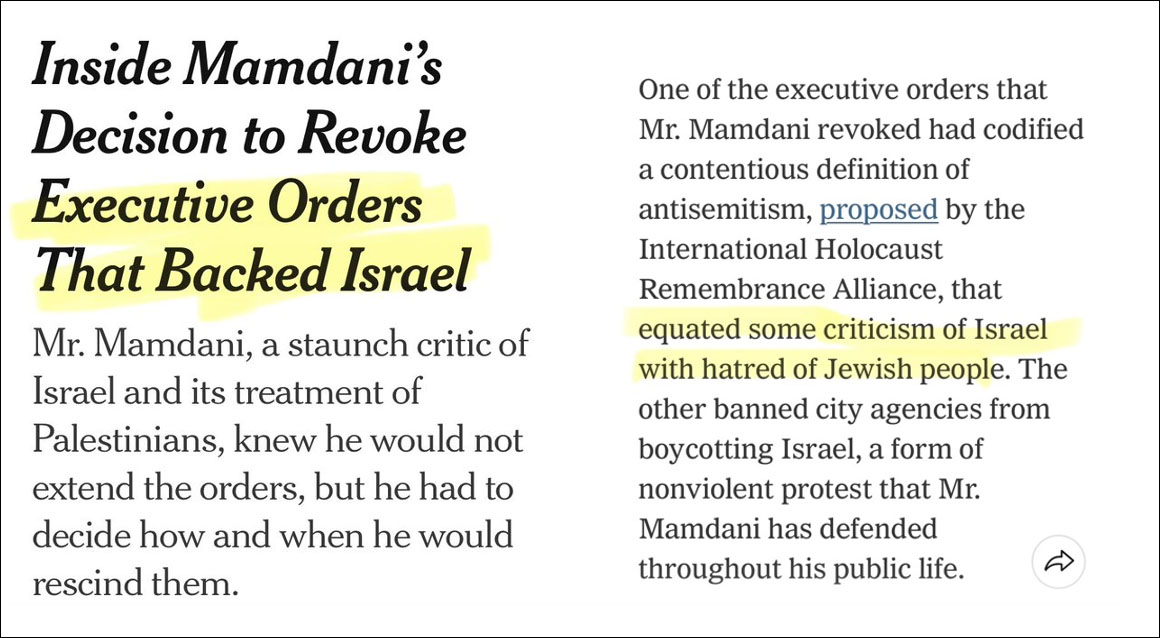
On Jan. 4, 2026 The New York Times published a news story about Mayor Zohran Mamdani’s revocation of executive orders intended to protect the city’s Jews. Here’s the headline: “Inside Mamdani’s Decision to Revoke Executive Orders That Backed Israel” (emphasis mine).
The article described three specific executive orders. One was described as banning “city agencies from boycotting Israel.” Another came about as a response to a protest right in front of the Park East Synagogue. The goal of that EO was for the NYPD to potentially create measures like buffer zones in front of houses of worship while still allowing peaceful protests. And a third was described as having codified “a contentious definition of antisemitism.”
The article claims that Mamdani would go on to “reissue some orders verbatim, including one that established the city’s office to combat antisemitism, but the two Israel-related orders [emphasis mine] would be among those erased from the books.”
But which two are “Israel-related”?
Did a now-revoked executive order about buffer zones in front of houses of worship “back Israel”? Clearly not. Was the order “Israel-related”? Well, Jews pray facing Jerusalem and our liturgy includes many mentions of Zion. So, yes, it is related to Israel in that way. But it’s highly unlikely that’s what was meant.
Is another now-revoked executive order that bars municipal actors from engaging in nationality-based discrimination in procurement, investment or official policy (the BDS prohibition) the one that “backed Israel”? No, it is not. That is non-endorsement neutrality, not “backing.” In U.S. law, there is a recognized difference between “backing” or affirmative support (subsidies, partnerships, advocacy), and anti-discrimination constraints on government actors. Was it Israel-related? Yes.
Is the establishment of an office to combat antisemitism in New York City something that “backs Israel”? Absolutely not. Is it Israel-related? Probably not in the way the authors of the piece meant.
But what about the now-revoked executive order that codified the International Holocaust Remembrance Alliance (IHRA) definition of antisemitism? The writers claim that it “equated some criticism of Israel with hatred of Jewish people.” This is a widely circulated accusation.
Let’s take a look at the definition to see if it’s true.
The IHRA definition of antisemitism reads: “Antisemitism is a certain perception of Jews, which may be expressed as hatred toward Jews. Rhetorical and physical manifestations of antisemitism are directed toward Jewish or non-Jewish individuals and/or their property, toward Jewish community institutions and religious facilities.”
Is this the best possible definition of antisemitism? Maybe not. (Bret Stephens offers another one here.) But it is better than bad definitions, and it’s better than having no definition at all.
Importantly, however, there is nothing in that definition that “equates criticism of Israel with hatred of Jewish people.”
To “guide IHRA in its work,” the organization’s website adds examples that “may serve as illustrations.” Let’s look at whether they “equate criticism of Israel with hatred of Jewish people.”
“Manifestations might include the targeting of the state of Israel, conceived as a Jewish collectivity. However, criticism of Israel similar to that leveled against any other country cannot be regarded as antisemitic [emphasis mine].”
Does this “equate criticism of Israel with hatred of Jewish people”? No.
As the website plainly says, actual criticism of Israel cannot be regarded as antisemitic, just like criticism of any other country is not regarded as bigotry targeting members of any other country’s ethnic group.
It continues: “Antisemitism frequently charges Jews with conspiring to harm humanity, and it is often used to blame Jews for ‘why things go wrong.’ It is expressed in speech, writing, visual forms and action, and employs sinister stereotypes and negative character traits.”
Does this “equate criticism of Israel with hatred of Jewish people”? No.
“Calling for, aiding, or justifying the killing or harming of Jews in the name of a radical ideology or an extremist view of religion.”
Does this “equate criticism of Israel with hatred of Jewish people”? No.
“Making mendacious, dehumanizing, demonizing, or stereotypical allegations about Jews as such or the power of Jews as collective—such as, especially but not exclusively, the myth about a world Jewish conspiracy or of Jews controlling the media, economy, government or other societal institutions.”
Does this “equate criticism of Israel with hatred of Jewish people”? No.
“Accusing Jews as a people of being responsible for real or imagined wrongdoing committed by a single Jewish person or group, or even for acts committed by non- Jews.”
Does this “equate criticism of Israel with hatred of Jewish people”? No.
“Denying the fact, scope, mechanisms (e.g. gas chambers) or intentionality of the genocide of the Jewish people at the hands of National Socialist Germany and its supporters and accomplices during World War II (the Holocaust).”
Does this “equate criticism of Israel with hatred of Jewish people”? No.
“Accusing the Jews as a people, or Israel as a state, of inventing or exaggerating the Holocaust.”
Does this “equate criticism of Israel with hatred of Jewish people”? No. And anyone who believes that accusing the state of Israel of inventing or exaggerating the Holocaust is “criticism of Israel” has thoroughly drained the word “criticism” of meaning.
“Accusing Jewish citizens of being more loyal to Israel, or to the alleged priorities of Jews worldwide, than to the interests of their own nations.”
Does this “equate criticism of Israel with hatred of Jewish people”? No.
“Denying the Jewish people their right to self-determination, e.g., by claiming that the existence of a State of Israel is a racist endeavor.”
Does this “equate criticism of Israel with hatred of Jewish people”? No. In case it isn’t crystal clear, claiming that the mere existence of the State of Israel is racist in and of itself is not criticism of Israel.
“Applying double standards by requiring of [Israel] a behavior not expected or demanded of any other democratic nation.”
Does this “equate criticism of Israel with hatred of Jewish people”? No. Applying a standard to Israel not expected of any other democratic country is not criticism.
“Using the symbols and images associated with classic antisemitism (e.g., claims of Jews killing Jesus or blood libel) to characterize Israel or Israelis.”
Does this “equate criticism of Israel with hatred of Jewish people”? No. Classic antisemitic tropes do not constitute criticism of Israel.
“Drawing comparisons of contemporary Israeli policy to that of the Nazis.”
Does this “equate criticism of Israel with hatred of Jewish people”? No. The Nazis were a genocidal regime unique in history for the systematic, industrial extermination of roughly two-thirds of European Jews—about one-third of all Jews on earth. Invoking them when describing Israel is not policy critique but moral vandalism and Holocaust inversion.
“Holding Jews collectively responsible for actions of the state of Israel.”
Does this “equate criticism of Israel with hatred of Jewish people”? No.
Finally, while the above examples distinguish between antisemitic rhetoric and legitimate criticism of Israel, even most antisemitic expression is legally protected speech in the United States—including all of the above wherever it does not involve illegal conduct such as vandalism, defamation, true threats, intimidation, incitement to imminent lawless action that’s likely to happen, etc.
To make this point, the IHRA website concludes by explaining how to determine when antisemitic acts are criminal, when criminal acts are antisemitic, and what antisemitic discrimination is.
“Antisemitic acts are criminal” it explains, “when they are so defined by law (for example, denial of the Holocaust or distribution of antisemitic materials in some countries).” This does not apply in the United States, where Holocaust denial is constitutionally protected speech.
“Criminal acts are antisemitic when the targets of attacks, whether they are people or property—such as buildings, schools, places of worship and cemeteries—are selected because they are, or are perceived to be, Jewish or linked to Jews.” Vandalism and destruction of property are crimes regardless of any connection to Jews or Jewish institutions. They are antisemitic when the targets are non-incidentally Jewish.
“Antisemitic discrimination is the denial to Jews of opportunities or services available to others and is illegal in many countries.” Antisemitic discrimination is illegal for the same reason as discrimination based on any other protected category is illegal. (In many Muslim-majority countries it is either not prohibited in law, not enforced in practice, or rendered inoperative by other legal frameworks.)
That’s it. That’s the entire definition and all its listed examples.
What makes the IHRA definition controversial (or “contentious,” to quote the NY Times) is not that it conflates criticism of Israel with antisemitism—it explicitly avoids doing that—but that it attempts to pry open a moral system that is closed where Jews are concerned.
In a closed moral system, guilt is not something to be established through evidence, intent or proportionality; it is assumed in advance. Denial is proof of culpability. Providing context is merely evasion. Pointing to parallel examples is avoidance of responsibility. Applied to Israel, this logic renders Jewish sovereignty itself a standing offense, impervious to exculpatory facts or alternate explanations.
In a closed moral system, guilt is not something to be established through evidence, intent or proportionality; it is assumed in advance.
Opposition to the IHRA definition tends to come from two distinct directions. The first is within the closed moral system. For those who start from a position that treats Israel, and often Jews more broadly, as guilty by definition, any attempt to name and shine a light on antisemitism is decried as not only censorship (despite the legal protections afforded to even antisemitic speech), but also “anti-Palestinian racism,” which is in part defined by “failing to acknowledge” that Palestinians without Israeli citizenship have “rights” to Israel (which they call “occupied and historic Palestine”).
In other words, according to this paradigm, if Mamdani acknowledged Israel’s right to exist as a sovereign Jewish state, he would be considered guilty of engaging in “anti-Palestinian racism,” since Jewish sovereignty includes determining who counts as a citizen and who has a “right of return.”
In addition, because the IHRA definition includes as antisemitic “calling for, aiding, or justifying the killing or harming of Jews in the name of a radical ideology or an extremist view of religion,” the IHRA definition is considered “anti-Palestinian racism.” Referring to those who engage in “the killing or harming of Jews in the name of a radical ideology or an extremist view of religion” (for example, Hamas) as a “terrorist threat,” and referring to Hamas supporters (“calling for, aiding, or justifying the violence described above) as “terrorist sympathizers” are both definitionally treated as “anti-Palestinian racism, as is “excluding or pressuring others to exclude Palestinian perspectives,” even if they are annihilationist—and even if they deny the actual history of the region, the Kingdom of Israel, and the 1948 war.
In other words, acknowledging the factual history of the region is considered “anti-Palestinian racism,” as is calling Hamas and other terrorist organizations “terrorists” and calling their supporters “terrorist supporters,” and so is accepting the State of Israel’s legitimacy as a sovereign Jewish nation.
The other type of objection comes from a basic misunderstanding: These critics misapprehend naming antisemitism as preventing discourse. Not only does the IHRA definition not foreclose criticism, but also it doesn’t even prevent antisemitic speech. It merely identifies it. It is designed specifically for a moral system in which innocence has been rendered conceptually unavailable a priori. Its ambition is not to shield Jews or Israel from actual criticism, but to rescue moral reasoning from a framework in which guilt precedes facts, and judgment is immune to evidence.
The IHRA definition does not target criticism of Israel. Nor does it criminalize or even censor anti-Israel speech. It merely insists that what is understood to be legitimate (i.e. not antisemitic) discourse about Israel remains subject to the same basic conditions that make moral reasoning possible: falsifiability, distinguishing between political criticism and bigotry, and applying a single standard that includes Israel rather than creating a separate standard unique to the world’s only sovereign Jewish state.
Why is that so hard?
A social psychologist with a clinical background, Dr. Paresky serves as Senior Advisor to the Open Therapy Institute, Advisor to the Mindful Education Lab at New York University, Senior Fellow at the Network Contagion Research Institute, and Associate at Harvard University. In addition to The Jewish Journal, her work appears in Psychology Today, The Guardian, Politico, Sapir, The New York Times, and elsewhere. She has taught at Johns Hopkins, the University of Chicago, and the United States Air Force Academy, and writes the Habits of a Free Mind newsletter on Substack. Follow her on Twitter at @PamelaParesky

Why Is the International Holocaust Remembrance Alliance Definition of Antisemitism “Controversial”?
Pamela Paresky
On Jan. 4, 2026 The New York Times published a news story about Mayor Zohran Mamdani’s revocation of executive orders intended to protect the city’s Jews. Here’s the headline: “Inside Mamdani’s Decision to Revoke Executive Orders That Backed Israel” (emphasis mine).
The article described three specific executive orders. One was described as banning “city agencies from boycotting Israel.” Another came about as a response to a protest right in front of the Park East Synagogue. The goal of that EO was for the NYPD to potentially create measures like buffer zones in front of houses of worship while still allowing peaceful protests. And a third was described as having codified “a contentious definition of antisemitism.”
The article claims that Mamdani would go on to “reissue some orders verbatim, including one that established the city’s office to combat antisemitism, but the two Israel-related orders [emphasis mine] would be among those erased from the books.”
But which two are “Israel-related”?
Did a now-revoked executive order about buffer zones in front of houses of worship “back Israel”? Clearly not. Was the order “Israel-related”? Well, Jews pray facing Jerusalem and our liturgy includes many mentions of Zion. So, yes, it is related to Israel in that way. But it’s highly unlikely that’s what was meant.
Is another now-revoked executive order that bars municipal actors from engaging in nationality-based discrimination in procurement, investment or official policy (the BDS prohibition) the one that “backed Israel”? No, it is not. That is non-endorsement neutrality, not “backing.” In U.S. law, there is a recognized difference between “backing” or affirmative support (subsidies, partnerships, advocacy), and anti-discrimination constraints on government actors. Was it Israel-related? Yes.
Is the establishment of an office to combat antisemitism in New York City something that “backs Israel”? Absolutely not. Is it Israel-related? Probably not in the way the authors of the piece meant.
But what about the now-revoked executive order that codified the International Holocaust Remembrance Alliance (IHRA) definition of antisemitism? The writers claim that it “equated some criticism of Israel with hatred of Jewish people.” This is a widely circulated accusation.
Let’s take a look at the definition to see if it’s true.
The IHRA definition of antisemitism reads: “Antisemitism is a certain perception of Jews, which may be expressed as hatred toward Jews. Rhetorical and physical manifestations of antisemitism are directed toward Jewish or non-Jewish individuals and/or their property, toward Jewish community institutions and religious facilities.”
Is this the best possible definition of antisemitism? Maybe not. (Bret Stephens offers another one here.) But it is better than bad definitions, and it’s better than having no definition at all.
Importantly, however, there is nothing in that definition that “equates criticism of Israel with hatred of Jewish people.”
To “guide IHRA in its work,” the organization’s website adds examples that “may serve as illustrations.” Let’s look at whether they “equate criticism of Israel with hatred of Jewish people.”
“Manifestations might include the targeting of the state of Israel, conceived as a Jewish collectivity. However, criticism of Israel similar to that leveled against any other country cannot be regarded as antisemitic [emphasis mine].”
Does this “equate criticism of Israel with hatred of Jewish people”? No.
As the website plainly says, actual criticism of Israel cannot be regarded as antisemitic, just like criticism of any other country is not regarded as bigotry targeting members of any other country’s ethnic group.
It continues: “Antisemitism frequently charges Jews with conspiring to harm humanity, and it is often used to blame Jews for ‘why things go wrong.’ It is expressed in speech, writing, visual forms and action, and employs sinister stereotypes and negative character traits.”
Does this “equate criticism of Israel with hatred of Jewish people”? No.
“Calling for, aiding, or justifying the killing or harming of Jews in the name of a radical ideology or an extremist view of religion.”
Does this “equate criticism of Israel with hatred of Jewish people”? No.
“Making mendacious, dehumanizing, demonizing, or stereotypical allegations about Jews as such or the power of Jews as collective—such as, especially but not exclusively, the myth about a world Jewish conspiracy or of Jews controlling the media, economy, government or other societal institutions.”
Does this “equate criticism of Israel with hatred of Jewish people”? No.
“Accusing Jews as a people of being responsible for real or imagined wrongdoing committed by a single Jewish person or group, or even for acts committed by non- Jews.”
Does this “equate criticism of Israel with hatred of Jewish people”? No.
“Denying the fact, scope, mechanisms (e.g. gas chambers) or intentionality of the genocide of the Jewish people at the hands of National Socialist Germany and its supporters and accomplices during World War II (the Holocaust).”
Does this “equate criticism of Israel with hatred of Jewish people”? No.
“Accusing the Jews as a people, or Israel as a state, of inventing or exaggerating the Holocaust.”
Does this “equate criticism of Israel with hatred of Jewish people”? No. And anyone who believes that accusing the state of Israel of inventing or exaggerating the Holocaust is “criticism of Israel” has thoroughly drained the word “criticism” of meaning.
“Accusing Jewish citizens of being more loyal to Israel, or to the alleged priorities of Jews worldwide, than to the interests of their own nations.”
Does this “equate criticism of Israel with hatred of Jewish people”? No.
“Denying the Jewish people their right to self-determination, e.g., by claiming that the existence of a State of Israel is a racist endeavor.”
Does this “equate criticism of Israel with hatred of Jewish people”? No. In case it isn’t crystal clear, claiming that the mere existence of the State of Israel is racist in and of itself is not criticism of Israel.
“Applying double standards by requiring of [Israel] a behavior not expected or demanded of any other democratic nation.”
Does this “equate criticism of Israel with hatred of Jewish people”? No. Applying a standard to Israel not expected of any other democratic country is not criticism.
“Using the symbols and images associated with classic antisemitism (e.g., claims of Jews killing Jesus or blood libel) to characterize Israel or Israelis.”
Does this “equate criticism of Israel with hatred of Jewish people”? No. Classic antisemitic tropes do not constitute criticism of Israel.
“Drawing comparisons of contemporary Israeli policy to that of the Nazis.”
Does this “equate criticism of Israel with hatred of Jewish people”? No. The Nazis were a genocidal regime unique in history for the systematic, industrial extermination of roughly two-thirds of European Jews—about one-third of all Jews on earth. Invoking them when describing Israel is not policy critique but moral vandalism and Holocaust inversion.
“Holding Jews collectively responsible for actions of the state of Israel.”
Does this “equate criticism of Israel with hatred of Jewish people”? No.
Finally, while the above examples distinguish between antisemitic rhetoric and legitimate criticism of Israel, even most antisemitic expression is legally protected speech in the United States—including all of the above wherever it does not involve illegal conduct such as vandalism, defamation, true threats, intimidation, incitement to imminent lawless action that’s likely to happen, etc.
To make this point, the IHRA website concludes by explaining how to determine when antisemitic acts are criminal, when criminal acts are antisemitic, and what antisemitic discrimination is.
“Antisemitic acts are criminal” it explains, “when they are so defined by law (for example, denial of the Holocaust or distribution of antisemitic materials in some countries).” This does not apply in the United States, where Holocaust denial is constitutionally protected speech.
“Criminal acts are antisemitic when the targets of attacks, whether they are people or property—such as buildings, schools, places of worship and cemeteries—are selected because they are, or are perceived to be, Jewish or linked to Jews.” Vandalism and destruction of property are crimes regardless of any connection to Jews or Jewish institutions. They are antisemitic when the targets are non-incidentally Jewish.
“Antisemitic discrimination is the denial to Jews of opportunities or services available to others and is illegal in many countries.” Antisemitic discrimination is illegal for the same reason as discrimination based on any other protected category is illegal. (In many Muslim-majority countries it is either not prohibited in law, not enforced in practice, or rendered inoperative by other legal frameworks.)
That’s it. That’s the entire definition and all its listed examples.
What makes the IHRA definition controversial (or “contentious,” to quote the NY Times) is not that it conflates criticism of Israel with antisemitism—it explicitly avoids doing that—but that it attempts to pry open a moral system that is closed where Jews are concerned.
In a closed moral system, guilt is not something to be established through evidence, intent or proportionality; it is assumed in advance. Denial is proof of culpability. Providing context is merely evasion. Pointing to parallel examples is avoidance of responsibility. Applied to Israel, this logic renders Jewish sovereignty itself a standing offense, impervious to exculpatory facts or alternate explanations.
Opposition to the IHRA definition tends to come from two distinct directions. The first is within the closed moral system. For those who start from a position that treats Israel, and often Jews more broadly, as guilty by definition, any attempt to name and shine a light on antisemitism is decried as not only censorship (despite the legal protections afforded to even antisemitic speech), but also “anti-Palestinian racism,” which is in part defined by “failing to acknowledge” that Palestinians without Israeli citizenship have “rights” to Israel (which they call “occupied and historic Palestine”).
In other words, according to this paradigm, if Mamdani acknowledged Israel’s right to exist as a sovereign Jewish state, he would be considered guilty of engaging in “anti-Palestinian racism,” since Jewish sovereignty includes determining who counts as a citizen and who has a “right of return.”
In addition, because the IHRA definition includes as antisemitic “calling for, aiding, or justifying the killing or harming of Jews in the name of a radical ideology or an extremist view of religion,” the IHRA definition is considered “anti-Palestinian racism.” Referring to those who engage in “the killing or harming of Jews in the name of a radical ideology or an extremist view of religion” (for example, Hamas) as a “terrorist threat,” and referring to Hamas supporters (“calling for, aiding, or justifying the violence described above) as “terrorist sympathizers” are both definitionally treated as “anti-Palestinian racism, as is “excluding or pressuring others to exclude Palestinian perspectives,” even if they are annihilationist—and even if they deny the actual history of the region, the Kingdom of Israel, and the 1948 war.
In other words, acknowledging the factual history of the region is considered “anti-Palestinian racism,” as is calling Hamas and other terrorist organizations “terrorists” and calling their supporters “terrorist supporters,” and so is accepting the State of Israel’s legitimacy as a sovereign Jewish nation.
The other type of objection comes from a basic misunderstanding: These critics misapprehend naming antisemitism as preventing discourse. Not only does the IHRA definition not foreclose criticism, but also it doesn’t even prevent antisemitic speech. It merely identifies it. It is designed specifically for a moral system in which innocence has been rendered conceptually unavailable a priori. Its ambition is not to shield Jews or Israel from actual criticism, but to rescue moral reasoning from a framework in which guilt precedes facts, and judgment is immune to evidence.
The IHRA definition does not target criticism of Israel. Nor does it criminalize or even censor anti-Israel speech. It merely insists that what is understood to be legitimate (i.e. not antisemitic) discourse about Israel remains subject to the same basic conditions that make moral reasoning possible: falsifiability, distinguishing between political criticism and bigotry, and applying a single standard that includes Israel rather than creating a separate standard unique to the world’s only sovereign Jewish state.
Why is that so hard?
A social psychologist with a clinical background, Dr. Paresky serves as Senior Advisor to the Open Therapy Institute, Advisor to the Mindful Education Lab at New York University, Senior Fellow at the Network Contagion Research Institute, and Associate at Harvard University. In addition to The Jewish Journal, her work appears in Psychology Today, The Guardian, Politico, Sapir, The New York Times, and elsewhere. She has taught at Johns Hopkins, the University of Chicago, and the United States Air Force Academy, and writes the Habits of a Free Mind newsletter on Substack. Follow her on Twitter at @PamelaParesky
Did you enjoy this article?
You'll love our roundtable.
Editor's Picks
Israel and the Internet Wars – A Professional Social Media Review
The Invisible Student: A Tale of Homelessness at UCLA and USC
What Ever Happened to the LA Times?
Who Are the Jews On Joe Biden’s Cabinet?
You’re Not a Bad Jewish Mom If Your Kid Wants Santa Claus to Come to Your House
No Labels: The Group Fighting for the Political Center
Latest Articles
Will Sept. 30 Go Down in History Like Oct. 7?
This Just Makes It Worse
Oct. 7 Makes Me Grateful for the Secular Calendar
October 7th and the Secret of Simchat Torah
Rabbis of LA | Rabbi’s Heroic Friend Remembers Oct. 7
EarlyJ Invests More Than $510,000 to Expand Jewish Parenting Centers Across California
Our Eyes Blink — A poem for Parsha Vezot Hab’rachah
My son turned eighteen yesterday…
AFHU Bel Air Affaire, Los Angeles Jewish Film Fest Screening
Notable people and events in the Jewish LA community.
A Moment in Time: Give a Child a Summer to Remember
A Bisl Torah ~ Fragility Beckons Daily Courage
Sukkot emphasizes that which we intrinsically know. We go outside and show the world that no matter the environment, we will express our Judaism with pride and joy.
October Seventh and the Reversal Caused by Sukkot
The Antisemitism You Won’t Hear About in the News
Liat Cohen-Reeis, director of the Antisemitism Task Force at StandWithUs San Diego, has tried to bring local news media’s attention to antisemitic incidents, but has encountered disinterest.
Print Issue: Crisis of Truth | October 2, 2026
An uproar over an article showing discrimination against Jewish and Israeli writers dramatizes how ideology and politics prevail over truth.
A Free Makeover: A Bath, a Haircut and a Second Chance
At the shelters, the grooming does more than make the dogs look and smell better.
Rochelle Furstenberg, Iconic Writer, Editor, Passes Away in Jerusalem
Furstenberg has been an iconic writer and editor in Israeli and American publications for decades, including for the L.A. Jewish Journal, and her death, even at the age of 90, on the eve of Rosh Hashana, deeply moved Jerusalemites who knew her.
What Kind of Judaism Do We Want After Oct. 7?
Arthur Green, “Can Judaism Be Saved: Its Future After Gaza” (Teaneck, NJ: Ben Yehuda Press, 2025) pp. 139.
Your Organization Doesn’t Need a Chatbot. It Needs Its Hours Back.
The point of all this isn’t to replace the people who keep our institutions running. It’s to give them back the hours they spend being human copy machines, so they can spend those hours on the work only people can do.
The Architecture of L’Dor Vador: How Physical Structures Shape Jewish Values and Intergenerational Life
This is more than a proposal to construct apartments. It is an invitation to reconsider what a Jewish institution can be.
Stuffed with Spice and Simcha
The custom of eating stuffed vegetables on Simchat Torah is to symbolize the scrolls of the Torah filled with the wisdom of the holy text.
Table for Five: Simchat Torah
Exclusive After-Party
Crisis of Truth
An uproar over an article showing discrimination against Jewish and Israeli writers dramatizes how ideology and politics prevail over truth.
Rosner’s Domain | Election Day Will Just Be a Beginning
Israelis are an impatient bunch, but their political processes can drag on and on – and on.
Saudi Arabia Is Encircled. The Way Out May Run through Jerusalem
Saudi Arabia’s growing vulnerability presents Israel – and the United States – with an opportunity to deepen the partnership between two of the region’s most important forces against extremism.
Two Elections, One People
On October 27, Israelis will elect the 26th Knesset. A week later, on November 3, Americans will vote in pivotal midterm elections.
The Return to Biblicalness
Shattering as it’s been, there’s something to be said for this abrupt return to biblicalness. By this awkward word I don’t mean belief in religion, necessarily, but appreciation for values that have fallen into disfavor in our supposedly enlightened age.
FlyDubai Flight to Tel Aviv Diverted to Saudi Arabia After Cockpit Stabbing
Israeli officials spent much of the day examining whether the incident aboard Flight FZ1073 was an attempted terrorist attack.
More news and opinions than at a Shabbat dinner, right in your inbox.