My daughter-in-law recently asked me what I looked forward to during the upcoming Jewish holidays. “Nothing!” I replied, “I dread them.”
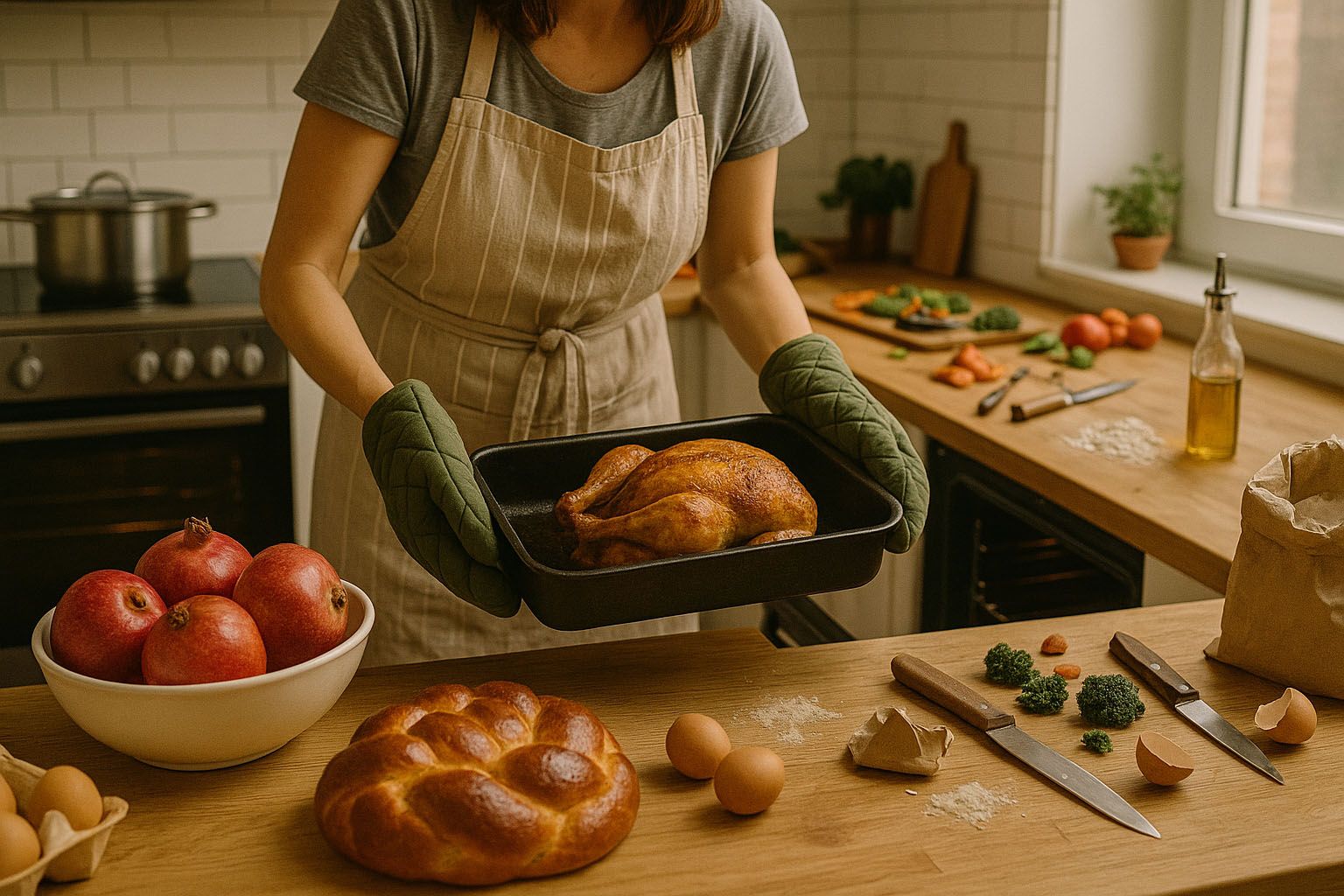
When I think about any Jewish holiday, all I can think about is cooking – and cooking – and serving and clearing and cooking some more. I’ve been doing this for nearly 40 years.
Every year, when the holidays begin, I realize that I’ve done nothing to prepare for them spiritually. All I did was cook. I tell myself that cooking for family and guests is a kind of avodat Hashem, or divine service, but the fact remains that I was making roast chicken and noodle kugel and mango avocado salad; I was not thinking about the inner meaning of the holiday. I felt that I was at the effect of my own beliefs about what it meant to be a Jewish homemaker. So I kept on sweating over the stove.
If I can pull myself away from the kitchen, I choose one trait to work on every Elul. I find something that does not serve me or God, and that I need go let go of. In previous years, I have focused on anger, blame, gossip, and other less than delectable habits. I do this because a teacher once told me that we should not go into Rosh Hashanah “empty-handed,” that is, without showing Hashem that when the time comes, we will return to Him a soul that is a little more refined than when He popped us into this sphere.
This year, instead of choosing one of the Seven Deadly Sins, I chose something closer to home: Victimhood. I will no longer play the victim card when the holidays approach.
When I got married 40 years ago, it was fun to plan menus, cook and have Shabbat and holiday guests. However, the grind grows old, and long ago, I started to chafe under the burden. But I kept on cooking, making a martyr of myself and exasperating my husband.
A few weeks ago, my husband saw me leaning on the sink, sweat pouring down my face, as I prepared to make yet another side dish for Shabbat. He exclaimed, “Why didn’t you buy takeout?” He keeps telling me that, living in a sea of kosher restaurants, I really don’t have to cook at all if I’m willing to pay the price.
Yet I slog on.
The only reason to do this is my need to be a martyr to the cause of Jewish wifehood. I see now that these needs are ridiculous. Sure, there is a price to having someone else prepare the food, but the price of my preparing it is greater: Not experiencing the joy of the holiday, not delving into Torah learning about the holiday and not fully enjoying my guests. This year, I’ve decided that the price is not worth the cost.
That’s why this year, I’m going to do one of four things:
1. Buy prepared food from one of the multitudes of kosher sources in the city.
2. Make meals pot-luck. When cooking responsibilities are shared, the burden on everyone is reduced.
3. Simplify menus. One Sukkot, I bought a ten-pound brisket and baked it overnight at a low temperature. In the morning, voila! A treasure trove of tasty meat. I divided the brisket into different-sized bags and thus had a main course for every meal. Granted, my husband got tired of eating brisket, but he much preferred repeating meals if it meant having a relaxed wife.
4. Choose to make a meal because I want to, not to make a good impression on others or make a martyr of myself.
So that’s it: If I don’t want to cook or do anything that seems like a burden, I will either delegate it, simplify it or accept it with grace.
And if you come to my house on Yom Tov, don’t ask me to give you the recipe for that delicious kugel. I won’t know it because I didn’t make it.
Elizabeth Danziger is the author of four books, including “Get to the Point,” 2nd edition, which was originally published by Random House. She lives in Venice, California.