For millions of Americans, one of the hallmarks of Thanksgiving is attending, or watching the Macy’s Thanksgiving Day Parade in New York City. But few Americans realize that the idea for the procession came from a grateful and generous American Jewish family in Philadelphia.
Born in 1817 in Bavaria in what is now Germany, Adam Gimbel moved to America in 1835. He began working as a dock hand and a travelling peddler. Gimbel saved up enough to start a store in Indiana where he sold nails, gunpowder, harnesses, shawls, shoes, cloth and pelts.
An honest businessman with a good reputation, his store’s motto was “Fairness and Equality to All Patrons.” He was particularly appreciated by Native Americans, who were often charged higher prices for goods in other stores.
As Adam became more successful, he moved to Milwaukee and founded Gimbels Department Store.
His family grew – he and his wife had 14 children, 11 of whom survived into adulthood. He expanded to Philadelphia, involving seven of his sons in the business while emphasizing to them the verse in Proverbs “a good name is better than riches” (22:1).
He passed away in 1896.
Meanwhile, Gimbels became the largest department store retail corporation in the world.
The sons launched branches in Milwaukee, Philadelphia, New York, and Pittsburgh, and the chain peaked with 36 locations in 1987, the year of its closing.
The company also owned Saks and built its flagship Fifth Avenue store, and the Philly branch was the first department store to have an escalator.
In 1920, Adam’s son Ellis (born in 1865) had an idea.
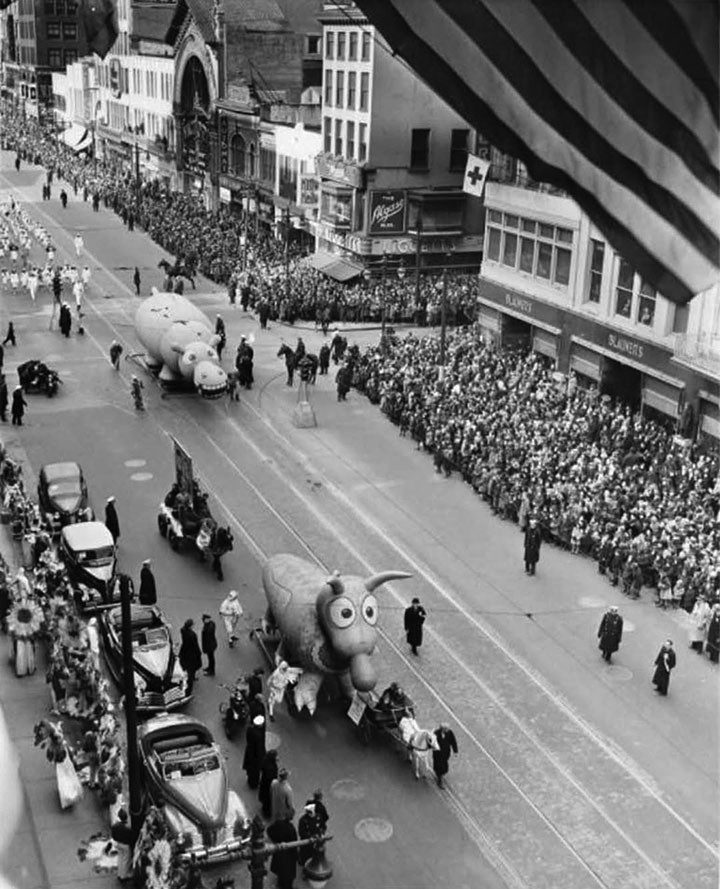
He had store employees dress in clown costumes and march down Philly’s Market Street on Thanksgiving to promote the store’s “Toyland.”
The modest inaugural procession featured about 50 employees, a small motorcade of roughly 15 cars and a firefighter dressed as Santa Claus.
It was the first Thanksgiving Day Parade.
Four years later, Macy’s stole the idea and held its first parade in NYC.
Until 40 years ago, Gimbels sponsored Philadelphia’s annual Thanksgiving Day Parade. (A local news station and Dunkin’ have since picked up the tab.)
Claire Pingel, a curator at the Weitzman National Museum of American Jewish History, has noted that in addition to the parade, philanthropy and helping others was an important part of Ellis Gimbel’s legacy. “Ellis’ philanthropy was very important to him, and he gave to a lot of causes, including the elderly, disabled people and, especially, disadvantaged children,” she said. “He spent time working with orphans, helping them with homework and donated a lot of money. He also brought 10,000 orphaned children to the circus every year on Orphans Day.”
Of course Gimbels’ parade also brought cheer to millions over the years. As one advertisement put it in the mid-1920s, “Planned to delight children and all who have young hearts, the event was enthusiastically received, Thanksgiving Day. And we were as happy as the upwards of 200,000 who thronged the line of march – happy in giving pleasure unalloyed.”
In Ellis’ obituary, The New York Times noted a breathtaking range of his involvements. “He was a member of the Historical Society of Pennsylvania, the Pennsylvania Society in New York, the Bankers Club of America, the Locust, the Poor Richard, the Midday and Town Clubs. A vice president of the Pennsylvania Home Teaching Society and Free Circulating Library for the Blind and of the Philadelphia Metabolic Association, Mr. Gimbel also was a director of the Association for Jewish Children of Philadelphia and a director of the Federation of Jewish Charities.”
The Gimbel family had benefitted greatly from America, and for that they were grateful. A Jewish family, thankful for the freedom to pursue the American Dream, gifted the country, among its many contributions, its quintessential Thanksgiving public celebration.
Rabbi Dr. Stuart Halpern is Associate Provost for Strategic Initiatives at Yeshiva University and Deputy Director of Y.U.’s Straus Center for Torah and Western Thought. His books include the newly released “Jewish Roots of American Liberty,” “The Promise of Liberty: A Passover Haggada,” “Esther in America,” “Gleanings: Reflections on Ruth” and “Proclaim Liberty Throughout the Land: The Hebrew Bible in the United States.”