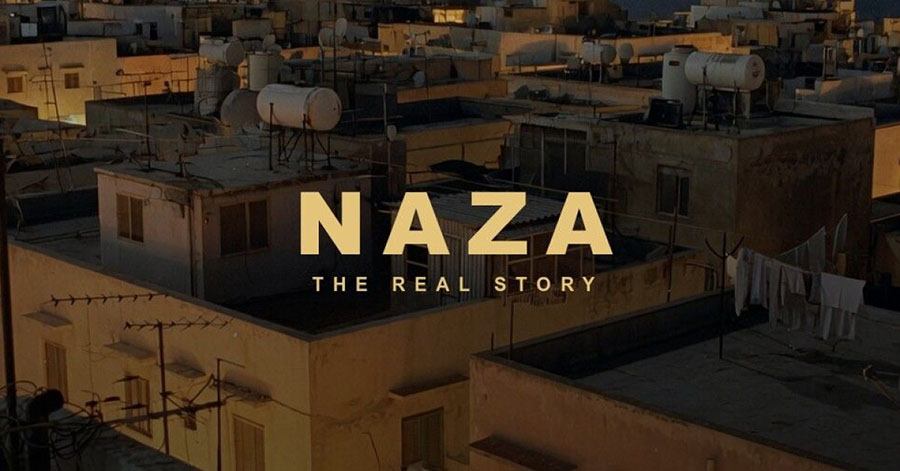
As “NAZA” begins its U.S. theatrical release, opening at Laemmle theaters in Los Angeles this weekend, another film is gaining momentum: “NAZA: The Real Story,” made in response to the controversial documentary that has angered many people in Israel.
The new film challenges the accusations against the IDF by directors Yuval Abraham and Rachel Szor. It offers a dramatically different account of the war in Gaza, featuring interviews with IDF commanders and intelligence officers who describe what they say they witnessed and experienced during the war: tunnels beneath children’s beds and cribs, weapons and ammunition hidden inside huge teddy bears, and Hamas training rooms inside mosques stocked with weapons. The film also features operational footage and materials collected during the war.
“NAZA: The Real Story” focuses on the IDF’s efforts to avoid civilian casualties while fighting Hamas, portraying an army that takes extensive precautions before carrying out strikes. It argues that this is particularly challenging because Hamas operatives wear civilian clothing and operate from within civilian areas, making it difficult for Israeli forces to distinguish between combatants and civilians.
Behind the 48-minute film are three friends: Lt. Col. (res.) Roi Danino, Israel advocacy activist Ariel Averbuch and Hagay Gutman.
Gutman, who directed and edited the film, worked on it for only 12 days before its release. He said he could not simply sit by and do nothing while “NAZA” defamed what he called the most moral army in the world.
“The film makes blood libels,” he said in an interview with Channel 14 in Israel. “It drives me crazy that there are people who are tarnishing the reputation of our soldiers who sacrificed their lives. The people who went out on Oct. 8, put their lives aside, fought and did everything so that we could sit here now. We wanted to show the truth, to show it without apologizing.”
Gutman said he wanted to show what Gaza really looks like — “a hornet’s nest of terrorists” where, he said, everywhere you turn, you find terrorists and ammunition: in schools, kindergartens, mosques, hospitals and private homes.
One of the film’s central messages is that the IDF operates under strict rules designed to minimize civilian casualties. The commanders interviewed describe a lengthy process behind every strike, involving intelligence gathering, legal review and multiple levels of authorization. When a potential target is located near a school, hospital, clinic or mosque, they say, commanders cannot simply order an attack. There must be evidence that the site is being used for military purposes, and strikes in sensitive areas require additional approvals that can take hours or even days. At times, they say, a military unit had already left the area by the time approval was obtained, making the strike irrelevant.
The film also documents what it presents as the extraordinary difficulty of identifying Hamas operatives on the battlefield. Its commanders describe Hamas fighters moving through neighborhoods in jeans, T-shirts and baseball caps, usually pulled low to hide their faces, deliberately blending into the population. One commander explained that soldiers can sometimes suspect that a person is a Hamas operative but still be unable to fire until that individual actually opens fire.
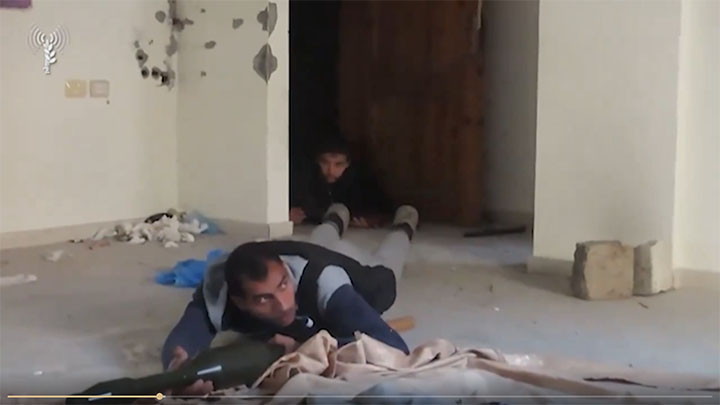
The film backs up those accounts with footage showing weapons and Hamas infrastructure hidden in civilian settings. Among the examples are anti-tank missiles found in a children’s room under a Smurfs rug, a kindergarten filled with weapons and covered with photos of children wearing Hamas uniforms. Hamas training compound located next to a kindergarten, and a shaft in the middle of the kindergarten’s yard. According to one of the commanders interviewed for the film, when IDF forces entered the area, two Hamas terrorists emerged from the shaft and fired an RPG, wounding five soldiers. Nearby, a playground funded by UNRWA is shown with a Hamas flag, while bags of rice and flour bearing U.N. markings were allegedly used as makeshift protection.
The commanders also describe Hamas as exploiting humanitarian aid and civilian areas. The interviewees said that Hamas seized supplies intended for civilians by force and prevented people from leaving combat zones, while embedding its fighters among the population. The result, they say, is an almost impossible dilemma for Israeli forces: determining who is genuinely a civilian, who is pretending to be one, who is acting as a proxy and who is a Hamas operative.
But the bigger question is whether “NAZA: The Real Story” will actually reach the audiences it is trying to influence. The film was released for free online and has already received over 30 million views, but there is no way of knowing exactly who those viewers are — whether they include people unfamiliar with Israel’s side of the story, journalists and opinion leaders, or primarily viewers who already support Israel and want some reassurance that Israel is on the right side.
That challenge is particularly significant given the extraordinary reception “NAZA” has received in Italy. Following its theatrical release there, the film topped the Italian box office, even surpassing the rerelease of Marvel’s “Avengers: Endgame.” It grossed approximately $1.2 million in theaters on Monday and Tuesday alone, compared with about $400,000 for “Avengers: Endgame” during the same period. Its Italian distributor, I Wonder Pictures, initially planned only a three-day theatrical run, but extended it after strong advance sales and high demand.
The creators of “NAZA: The Real Story” made the film using their own resources. Some may dismiss it as Israeli propaganda simply because it presents Israel’s side of the story. But the film was not funded by the Israeli government, and its creators say their goal was not to produce a rebuttal for its own sake, but to put forward evidence and testimony that were missing from “NAZA.”
People often assume that a documentary tells the truth simply because it is presented as one, but every documentary is shaped by the choices of its creators — what they include, what they leave out and how they frame the material. That is the central challenge that Gutman, Averbuch and Danino pose to Abraham and Szor’s film – that there is another story that they simply chose not to tell.
“When you make a film in air-conditioned studios, far from the front line, it is very easy to arrange reality in black and white,” the narrator says in Gutman’s film. “It is easy to edit, easy to omit, and easy to create a false narrative about the most moral army in the world. But the truth is not found in editing rooms — it is found in the alleys, inside children’s rooms that were turned into rocket storage facilities, behind shafts dug beneath beds and inside the pit at the Kirya — the place where every operational decision is weighed against the scales of law and morality, even when facing the most brutal enemy.”