
Why is there antisemitism? It is a question that has filled countless volumes, a question that has yielded answers of all kinds and a question that has one forbidden answer: the Jews are to blame.
Obviously, the Jews are not to blame. Obviously, blaming the Jews is victim-blaming. And yet, from time to time, there are those who do just that. Naturally, quite a few antisemites blame the Jews (they blame the Jews for so many things, so why not blame them for the very fact that they are blamed for everything else?). Somewhat less naturally, quite a few Jews blame the Jews – which is to say, themselves. Not personally, of course, but collectively. We beat our chests and say: Ashamnu (we have sinned)!
In what way have we sinned? Some will say: it is because Jews do not fulfill their obligation to be God-fearing. Antisemitism is their divine punishment. Others will say: it is because Jews are unwilling to live like any normal nation. At the dawn of Zionism, some believed this was the primary driver of antisemitism. Let the Jews normalize their condition, take a piece of land, establish a state and antisemitism will vanish.
You can still hear the “divine punishment” argument among Jews today. The “normalcy” argument can still be heard as well, but it has undergone a shift. One can no longer say, “Let the Jews take a piece of land and antisemitism will disappear” – because they have already done that. What one can certainly say is: “Let the Jews change their conduct and policies on that piece of land they took, and antisemitism will disappear.” In other words: one can blame Israel, its leadership, its society and its policies for antisemitism, or for some of it, or for its sudden outbreaks.
Who blames Israel for the rise in antisemitism? We do, too – we Israelis.
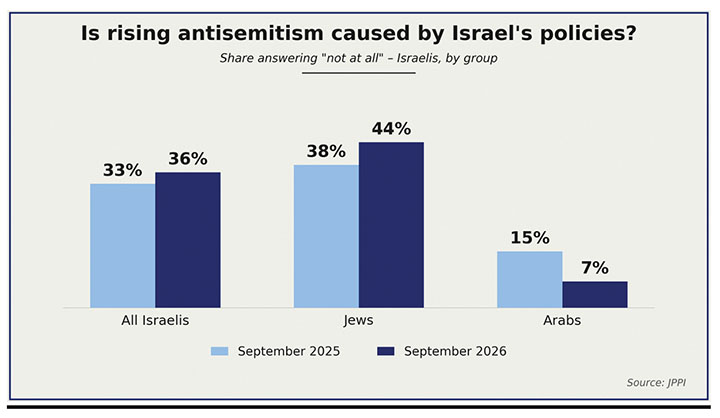
True, a third of us believe the surge in antisemitism is “not at all due to Israel’s policies.” There is no connection. This marks a slight increase in those distancing from the discourse of responsibility – or blame – compared to last year. And if you look not at all Israelis, but only at Israeli Jews, the share of those who reject casting any blame on Israel has risen from 38% to 44%. On the other hand, a third of Israelis do believe that antisemitism – worldwide – is rising “to a large extent” because of Israel’s policies. By the way, it is primarily among Arab Israelis that we see a significant jump in those attributing antisemitism “to a large extent” to Israeli policies (from 42% to 58%).
The question of whether Israel bears some responsibility for antisemitism carries psychological weight. There is a difference between a state of victimhood and a state of taking responsibility. Victimhood leads Israelis to the conclusion that nothing can be done. It’s not our fault, and it’s not in our hands to fix it. Victimhood is not a desirable state. It breeds fatalism. On the other hand, taking responsibility – which is a desirable state – can lead to illusion, or megalomania. If Jews come to believe that they are responsible for the existence of antisemitism, and that changing their policies is the key to fixing it, they are likely in for bitter disappointment after a series of failed attempts. Just as Zionism did not eradicate antisemitism, updating our policies will not eradicate it either.
And, of course, the greatest danger is the danger of sweeping conclusions. The conclusion that there is absolutely nothing we can do, versus the conclusion that we have the power to fix the glitch. The practical question probably requires a more moderate response: change what needs changing, in order to fix what can be fixed; stand firm on things that are too dangerous to change, even if doing so contributes to the deterioration.
Is this how Israelis respond? No. In a world of polarized, binary choices, most give a definitive answer. A majority (57%) say that nothing should be changed (perhaps because there is no point in changing if policy isn’t what generates the antisemitism to begin with; or perhaps because it is too dangerous to change, even if sticking to current policies contributes to it).
Moreover, Israelis hold an expansive interpretation of what constitutes the very “antisemitism” that must either be corrected or accepted as unfixable. For example: A large majority of Israelis believe that an academic boycott of Israel is not merely an “anti-Israel” action, but an “antisemitic” one (I agree with them). Most believe that international pressure on Israel, including punitive measures over the humanitarian situation in Gaza, is also an expression of antisemitism.
Where are they divided? On the question of whether a foreign nation’s recognition of a Palestinian state is an expression of antisemitism. Just like last year, roughly four-in -10 believe it is. These are, naturally, the Israelis whose stance on the Palestinian state question is one of absolute rejection — not only now, under prevailing circumstances, but in any future, hypothetical, optimistic scenario. This, too, must be said: the question of “who is an antisemite” elicits many kinds of answers. With some, it is easy to agree; over others, one can argue; and some simply reflect the less plausible notion: “An antisemite is anyone who disagrees with me.”
Something I wrote in Hebrew
The prize-winning documentary “NAZA” by Israeli filmmakers makes the case that Israel’s operations in Gaza are much too brutal and fail to consider the lives of civilians. I thought that Israel’s response to the release of the film was, well …
A state confident that it is right is not supposed to go into an emotional tailspin bordering on hysteria just because two directors made a defamatory film about it. A state confident that it is right is capable of absorbing such a blow, even from within, without considering far-reaching measures like revoking citizenship, and without being dragged into statements bordering on incitement to violence against the filmmakers (for, naturally, it is tempting to say they somewhat deserve it). A righteous, level-headed state must recognize that the applause in a Venice Festival cannot be drowned out by cries of outrage in Jerusalem. A state confident that it is right operates cautiously in the international arena to improve its image; it does not respond to a blow to its image with conduct whose guaranteed outcome is further damage to its image.
A week’s numbers
See the column above.
A reader’s response
Sara asks: “Shmuel, do people still ride their bikes in Israel on Yom Kippur?” My response: Yes, but the presence of electric bikes is making the experience less bucolic than before.
Shmuel Rosner is senior political editor. For more analysis of Israeli and international politics, visit Rosner’s Domain at jewishjournal.com/rosnersdomain.