Editor’s note: This is a quick take on the Tikvah conference. A longer piece will follow.
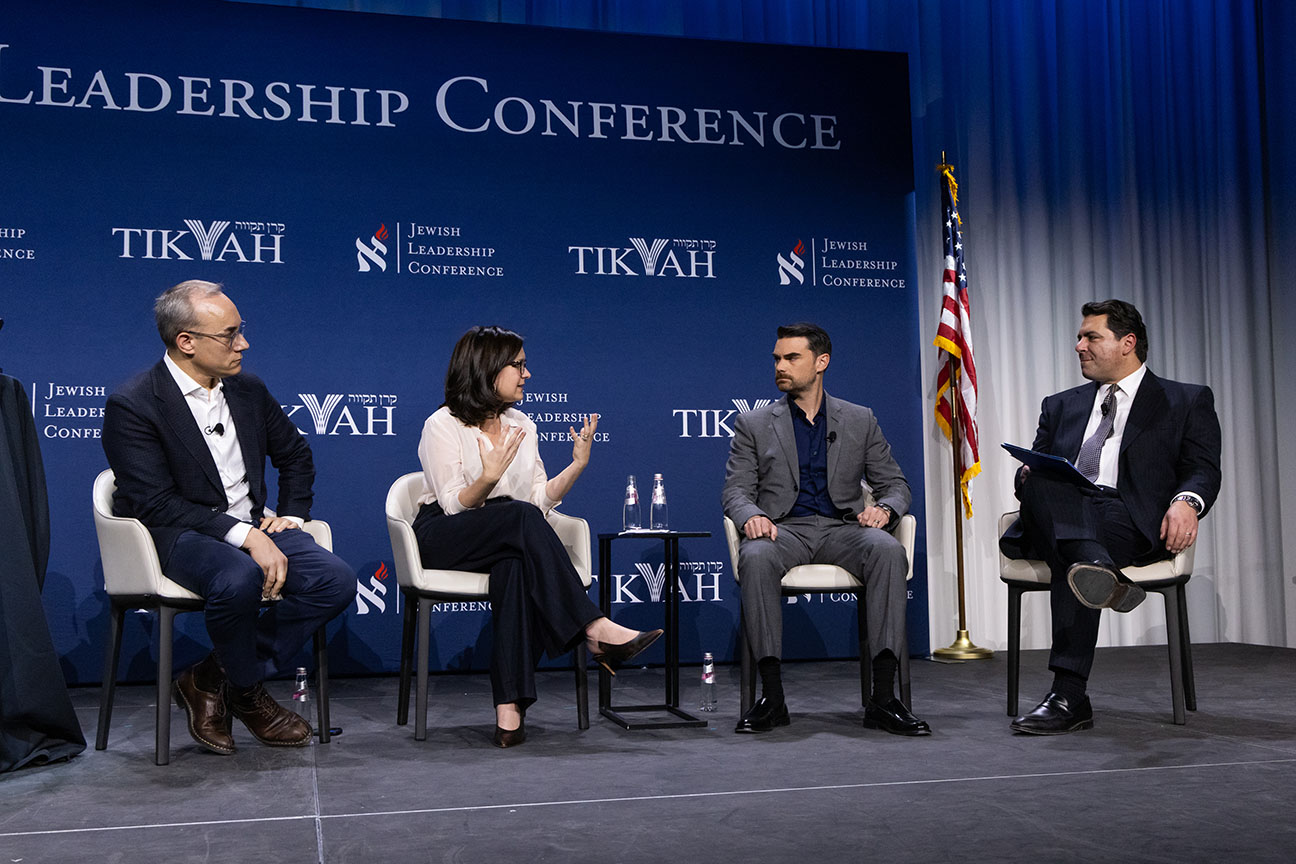
Three days after I saw Ben Shapiro, Bari Weiss and Dan Senor wrap up the Tikvah Jewish Leadership Conference last Sunday in Manhattan, another happening took place not far away in front of the Park East Synagogue.
A mob of Jew-haters were engaging in their favorite activity—damaging their vocal cords while chanting “globalize the intifada.”
I’ve watched so many of these screaming clips the past two years I usually end up feeling bad for the screamers. Where do they go after the screaming? For a late-night coffee to discuss a new book on Fanon? To Tribeca for an after-screaming party?
The contrast between the Jewish wisdom on display at the Tikvah conference and the screaming hatefest in front of the synagogue was instructive for anyone interested in building the Jewish future.
Of course, the odds of me capturing in one short column all the wisdom I heard at the conference—from speakers like Eric Cohen, Ruth Wisse, Walter Russell Mead, Elliot Abrams, Rabbi Meir Soloveichik, Leil Liebovitz, Jonathan Silver, not to mention Weiss, Shapiro and Senor—are equal to the odds of Jews no longer arguing.
So please indulge me in my attempt to find an overall idea to everything I heard and saw at the conference.
In a word, it was confidence. Jewish confidence. Jews should stop acting like victims. We have too much to offer to the world, and to ourselves. Why look weak on the outside when we are so strong on the inside?
The conference was titled, “Can the Jews Save the West?” In his opening remarks, Eric Cohen, Executive Director of the Tikvah Fund, planted the seed of self-confidence.
The West is being poisoned by what he called a “supervirus of resentment.” That idea stuck with me. People resent success, not failure. Resentment is a deep and dark emotion that does a lot of heavy lifting, maybe two thousand years’ worth in the case of the Jews.
Resentment conveys both light and darkness– the darkness that comes from haters who resent those who bring light.
The conference in general was an unapologetic, though not triumphalist, depiction of that light from several angles. Among other talks, Wisse weighed in on “The Meaning of Jewish Sovereignty”; Soloveichik on the “Christian-Jewish Alliance and its Enemies”; and Leibovitz on “The Meaning of America at 250.”
After a full day of intellectual enlightenment, including the crucial connection between Jewish and Western values, the conference stuck their landing with the concluding panel of Weiss, Shapiro and Senor. I’m especially grateful for this ending because it helped me crystalize a theme for this column.
The panel, led by Jonathan Silver, was an electric free flow of insights and observations on the challenges facing the Jewish world, Israel and the West. It lasted about an hour, and I highly recommend you watch it when it comes online.
But beyond the insights, what I also took away was a certain swagger, a winning body language. We have a lot going for us. We shouldn’t settle for quick fixes. We should double down on fundamental ideas like Jewish education and raising Jewish kids.
Maybe because the panelists were all winners, we shouldn’t be surprised by that body language. But they were also very Jewish. These were winners who showed how much they love their Judaism.
In short, what came across at the panel and at the conference was that Judaism itself is a winning idea.
That’s why I was struck by the contrast with the Jew-hating screamers who showed up in front of the Park East synagogue. One group was trying to share light, while the other was trying to turn it off.
The screamers, it turns out, were protesting an event by Nefesh B’nefesh, an organization that helps Jews immigrate to Israel.
“It is our duty to make them think twice before holding these events,” one protest leader told the crowd, according to a press report. “We need to make them scared. We need to make them scared. We need to make them scared,” the agitator kept repeating.
It must drive these haters nuts that no matter how much screaming they’ve done these past two years, the Jewish events just keep coming, even conferences that aim to save the West. These Jew-haters have surely been infected by the supervirus of resentment. The bloody Jews just never go away.
That may well be a winning message to Jew-haters everywhere: Jews are never going away, and they will continue to do great things.
While the haters continue to damage their vocal cords expressing their resentment, Jews will continue to share their wisdom with one another and the world, and maybe one day, even help save the West.