fbpx

November 20, 2025

Sephardic Film Festival Gala, TEBH Charity Poker Tournament

The 16th annual Los Angeles Sephardic Film Festival gala was a sold-out event, with 450 people attending at Paramount Studios on Nov. 9. Attorney Neil Sheff, who founded the festival, was very pleased with the community’s response.

“People called at the last minute and asked to attend,” he told the Journal.

Moroccan music greeted the guests, who enjoyed delicious Moroccan dishes and a screening of the French-Canadian comedy-drama, “Once Upon My Mother.” The film was adapted from the 2021 autobiographical novel “Ma mère, Dieu et Sylvie Vartan” written by French lawyer and broadcaster Roland Perez, which centers on his experiences growing up with a clubfoot and a Sephardic Jewish mother determined not to let her son’s disability stop him from leading a full and successful life.
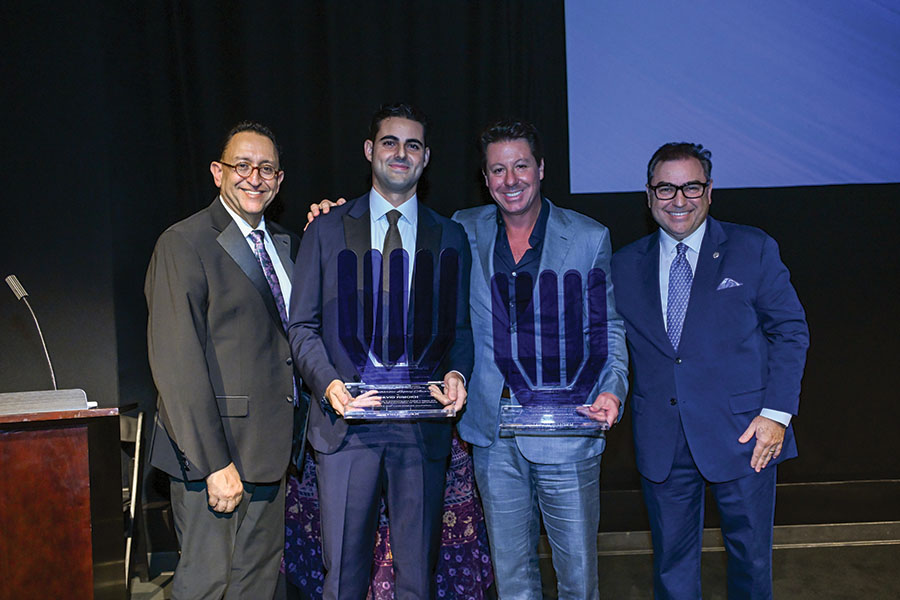
From left: Sephardic Educational Center (SEC) Director Rabbi Daniel Bouskila; gala honorees David and Jason Rimokh; and SEC President Neil Sheff. Courtesy of Sephardic Film Festival

The film was selected to open several Jewish film festivals and participated in many others. Sheff, who created the festival in the late 1990s, said he wanted to offer an alternative to the typical fundraising events with long speeches.

“We wanted to make something more like a cultural and fun evening,” he said.

After enjoying the food and silent auction, which included lots of artwork, guests were

invited to the portion of the event that honored David and Jason Rimokh, whose parents, Jack and Joelle, were great supporters of the Sephardic Educational Center (SEC) in Jerusalem. Also attending the event was the family of one of the hostages, Yair Yaakov, who was kidnapped with his sons Or and Yagil. Yair was murdered and his body was returned to Israel in June this year after 614 days in Gaza.

By Ayala Or-El, Contributing Writer


About 60 people turned out for this year’s charity poker event at Temple Emanuel of Beverly Hills. Courtesy of Temple Emanuel of Beverly Hills

Temple Emanuel of Beverly Hills (TEBH) held its 22nd annual Texas Hold’em poker tournament on Nov. 9, raising approximately $15,000 for the Reform synagogue’s schools.

“For me and my two co-chairs, this was our 22nd year doing this event,” TEBH congregant Lew Rudzki told the Journal. “It started when our kids were at Temple Emanuel Day school. We’ve tried to keep the event haimish, where the community can come and enjoy year after year. While it is a fundraiser—we never worry or focus solely about the money. It’s kind of like ‘Build it and they will come’ over the years. We have two and three generations playing—both male and female. It’s become many people’s regular poker game, once a year.”

Gathering in the synagogue’s social hall, the approximately 60 players in attendance, including TEBH Senior Rabbi Jonathan Aaron, schmoozed over a deli spread, soft drinks, whisky and scotch before sitting down for the hours-long tournament, which kicked off around 6 p.m. and lasted until 10:15 p.m. The evening also included raffles for items such as bottles of wine, large bottles of sake, half cases of wine, multiple wine assortments, aviator sunglasses and much more.

At 6 p.m., with a full room, the evening started with the call to all tables to “Shuffle Up and Deal.” Over the course of the evening, “The blinds started to increase, the stakes started to rise, and a few players started to have better luck at the buffet table than the poker table,” Rudzki said.

The players who made it to the final table were John Adler, Ken Dreshfield, Tom Fouladi, Jordan Tuchin, Abrahan ArouestyRobert Silverman, Greg Proper, Grace Deukmejian, Karl Thurmond and Rudzki.Ultimately, Adler took home first place, Dreshfield came in second and Fouladi finished in third.  
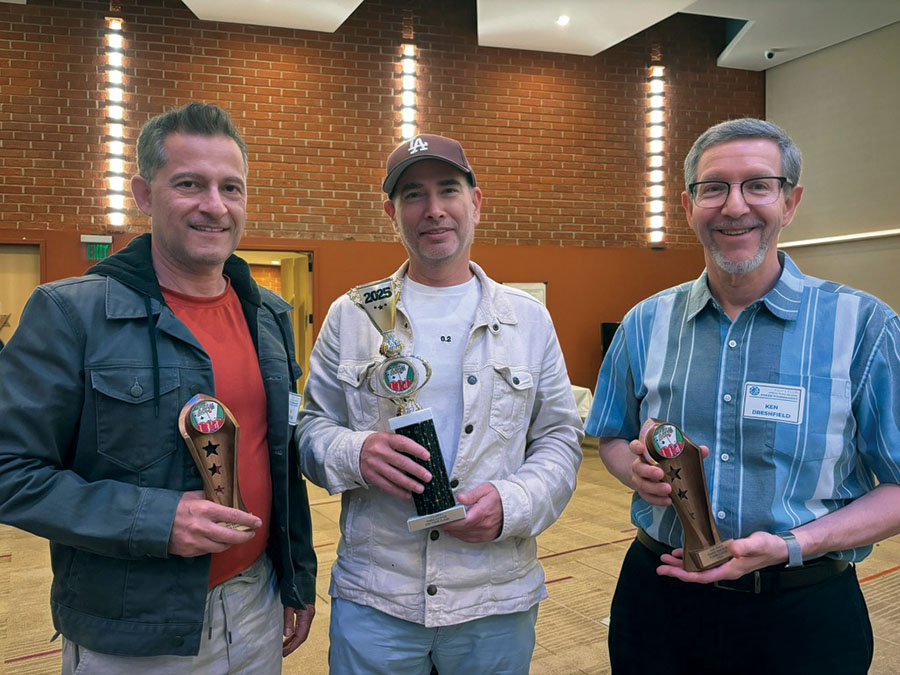
From left: This year’s Temple Emanuel Texas Hold’em poker tournament winners were (from left) Tom Fouladi, 3rd place; John Adler, 1st place; and Ken Dreshfield, 2nd place. Courtesy of Temple Emanuel of Beverly Hills

As the card-playing protagonist says in the poker novel, “Shut Up and Deal,” “People think mastering the skill part is hard, but they’re wrong. The trick to poker is mastering luck.” At Emanuel, it was Adler—also the tournament’s 2016 champ—who was the game’s master and became the 2025 Temple Emanuel No Limit Texas Hold’em champ.

Those involved with organizing the evening included Susan Jackson, Holiday Products, Stone Construction, Lee Ziff, Canon Equity Partners, Jeff Pop, Scott Schlechter, Brian Fortman, Rabbi Aaron and TEBH Co-President Farhad Novian.

Rudzki, for his part, led a committee that consisted of John Stone and Brad Kesner, and Fortman curated the eight bottles of scotches, bourbons and ryes that comprised the inaugural scotch and whiskey tasting experience.

The poker tournaments at TEBH are for a worthy cause. Past tournaments have raised funds for hostage families and for an ambulance provided to Israel through American Friends of Magen David Adom. This year, the funds benefited TEBH’s religious school and early childhood center.

Sephardic Film Festival Gala, TEBH Charity Poker Tournament Read More »

Rabbis of LA | At K.I., Bringing a Stricken Community Back

Like her Kehillat Israel community, Rabbi Amy Bernstein’s life was upended by the Palisades Fire. About one-third of the congregation lost their homes. And everyone was displaced. 

As the leader of the community for 15 years, how does Bernstein manage to both keep up with the changes happening both personally and to her congregation? “Having a lot of really good friends has been incredibly important,” she said. “I have an incredible staff. They are very stable. Our turnover is, thank God, really low. We’ve become friends.” She noted that, in some ways, working out of the 16th floor of an office building had the effect of making them even closer. “We were all over the building before. Now we are on one floor with glass walls and doors.” Ironically, “we see each other more than ever.”

There’s also a conference room for them to gather, she said. As for programming, K.I.  is relying heavily on Zoom until they are back in their building. She thinks it’s “going to take years until we are not relying on Zoom to have people participate. Some people never will come back in person. They always will be on Zoom.”

One thing that hasn’t really changed is her schedule. “Friday mornings I still teach Torah study. I’m just doing it on Zoom. At 11:30, we still do Jewish Meditation. It’s just on Zoom now. We gather for Friday night services (often at the Cayton Children’s Museum, at the Santa Monica Promenade). So that’s the rhythm of the week, and Saturdays we do bar and bat mitzvah services, one in the morning and one in the afternoon.” What’s different are the locations, which change frequently. “I have to check my schedule an insane amount of times in a week now to make sure I know where I am supposed to be at the right time.”

Kehillat Israel’s experience during the COVID lockdown made this transition easier. It taught them “a lot about what it means not to be in the building and to keep your people engaged for those groups, to make sure we are doing enough for each of those groups,” the rabbi said. “For Sukkot, we had people learning in Virginia Park [Santa Monica]. We had over 200 people at a family event in the park.” 

She gives much of the credit to K.I.’s “incredible” programming staff. “Our Executive Director has a Google Map with a pin identifying where every single household has told us they are. Within three days, we had reached out to every single family after the fire – to find out how are you, where are you, what do you need, and then we keep asking them, please update your information when you move (because you probably will), and we want to know where you are. We watch that map change all the time.”

As a large congregation, Rabbi Bernstein has to find a way to stay in touch with the different groups that make up the community. “We are trying hard to conscientiously program for those groups, to make sure we are doing enough for each so they have an opportunity to come back together.”

One of the hardest things for the congregation to deal with was having their home routines interrupted. For the rabbi, some remained unchanged: mindfulness, meditation practice, yoga practice. There was also a new addition to the rabbi’s household. A month before the fire, she adopted a seven-month-old German Shepherd puppy. “She was too big, too young, but they were going to kill her the next day. I couldn’t leave her there; she was so smart and so happy.”

Luna is now over a year old, and for Rabbi Bernstein, “she’s going to be the light in our dark sky” during this difficult time for her family. They’re now staying in the home of Kehillat Israel members who are frequent travelers. She needed to find a place that would also accept Luna, and the homeowners have been “very gracious.” 

She said Luna has “been a “lifesaver. I joined a dog club that’s for people, and they have rufferees who watch the dogs. They help with the inner actions while people can sit and do their work, their emails and visit if they want. It actually gets me out of the house. It has been a social boon for me to have a dog.”

But not even a new pet could replace being with her congregation. “I really, really, really miss my people. Most of all my seniors. They are gone now because their children came and got them. I understand this. I am not faulting anybody. But a whole swath of my seniors, whose houses burned, are not coming back. It’s hard for them to get to a lot of what we are doing. Many moved away to be with their adult children who said ‘You are coming to live with us.’”

From Rabbi Bernstein’s language, one immediately can understand how painful, how intensely personal she takes these fire-induced disappearances.

“A whole swath of my people is gone,” she said. “I don’t see them anymore. That’s really hard. I was going to be with them for the rest of their lives. I was the one who was going to be there when they were sick – when they were afraid, when they were failing, when they were grieving. It’s very hard that I am not going to be with them now.”

When her community is scattered, Rabbi Bernstein noted there are so many touchpoints where people don’t have accurate information, causing a lag on the system.

“The world moves on,” she said. “We still are impacted every day by the fact it’s all gone. Our town, our homes are gone. Anyone who thought this was going to take less than three to five years was dreaming.”

Rabbis of LA | At K.I., Bringing a Stricken Community Back Read More »

A Bisl Torah — Evolving Purpose

After struggling with her fertility, Biblical matriarch Rebekah learns that she is pregnant with twins. The pregnancy is difficult; the fetuses push up against each other, and Rebekah famously asks, “If so, why do I exist?”

Rashi seems to think that faced with pain and worry over the twins fighting for space, Rebekah wonders whether it was worth getting pregnant at all.

But this time, it is difficult agreeing with Rashi.

Here is a woman, once infertile, pregnant with twins. It’s a dream come true. Even in pain, her question doesn’t seem to be one in which she wishes away the pregnancy. Instead, perhaps her inquiry is a wonderment of her future role in the lives of her fighting children. Her title of mother will be multi-layered: nurturer, provider, and constant reconciler. Her purpose in this world evolves, even as her twins struggle in her womb.

A lesson for each of us: our purpose is multi-layered and ever evolving, lest we think there is only one goal we are meant to achieve or story we are meant to write. Through both pain and joy, our purpose continues to take shape: turning, twisting, changing, and growing. Some moments are ones of struggle, and others are paved with smoother paths.

But through it all, like our matriarch Rebekah, we should be asking, “If so, why do I exist?”

God wants more and more from each of us. Souls are meant to expand in ways we can’t possibly imagine. Purposes evolve, and dreams certainly still in formation.

Shabbat Shalom


Rabbi Nicole Guzik is senior rabbi at Sinai Temple. She can be reached at her Facebook page at Rabbi Nicole Guzik or on Instagram @rabbiguzik. For more writings, visit Rabbi Guzik’s blog section from Sinai Temple’s website.

A Bisl Torah — Evolving Purpose Read More »

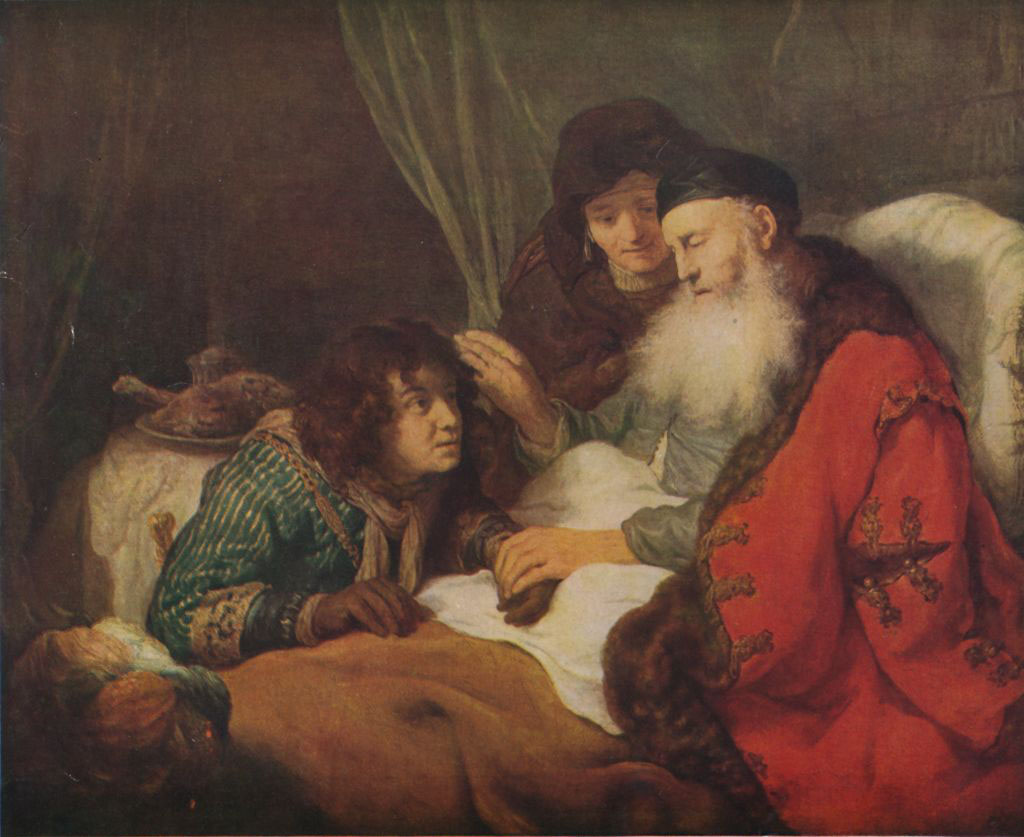
Isaac the Invisible

At the beginning of my rabbinical career, I often officiated at funerals for members of “the greatest generation.” The eulogies told the dramatic story of immigrants and survivors who arrived in North America and started over again, of young men who fought courageously in World War II, of dedicated volunteers who fought for Israel’s independence, Soviet Jewry, and more.

After one funeral, a younger member of my synagogue approached me. He thanked me for the eulogy, which was the inspiring story of a Holocaust survivor; then he paused, and asked, “Rabbi, what will they say at my funeral?”

It’s an excellent question. Ordinary times yield ordinary biographies. Hegel observed that “happiness is written on the blank pages of history”; and the same is true of biographies. Those of us blessed to live in uneventful times will receive very different eulogies at our funerals. And this reality is true of the characters in the Tanakh as well.

Isaac is the invisible patriarch. Both his father and son overshadow him. When the prophet Micah declares, “You will give truth to Jacob and mercy to Abraham,” he somehow omits Isaac. In Psalms, the leader calls out to the “offspring of Abraham, His servant, the descendants of Jacob, His chosen ones.” Isaac is simply skipped over.

During the most dramatic moments of his life, Isaac is little more than a supporting character. The Akedah casts his father Abraham as the hero. In the story of the blessings, he is a mere object in the tug of war between his sons.

Very little else is mentioned about Isaac. In his lifetime, there are no wars, migrations, or major revelations; he lives in the same country with the same wife.

It is easy to overlook Isaac.

Some see hidden virtue in Isaac’s unassuming demeanor. One verse is seen as defining his life’s work: “And Isaac dug again the wells of water which they had dug in the days of Abraham his father, for the Philistines had stopped them up after the death of Abraham. He called them by the names which his father had called them.” Jonathan Sacks explains that:

“Isaac is the least original of the three patriarchs. His life lacks the drama of Abraham or the struggles of Jacob. We see in this passage that Isaac himself did not strive to be original.‌ … He was content to be a link in the chain of generations, faithful to what his father had started. Isaac represents the faith of persistence, the courage of continuity.”

Rabbi Adin Steinsaltz takes this idea a step further:

“The saying goes that all beginnings are difficult. As true as this may be, it is not nearly as difficult to begin as it is to continue … What is truly difficult is to continue after the enthusiasm of the beginning has passed. … The ability to persist, to continue, is what distinguishes one person from another and, on a larger scale, between one people and another.”

Isaac is a greater hero than Abraham because it is more difficult to continue than to create.

Isaac is a greater hero than Abraham because it is more difficult to continue than to create.

Sacks’ and Steinsaltz’ perspective is undoubtedly correct, but they neglect to mention how complex continuity is, both on a psychological and religious level. Psychologists discuss issues such as identity foreclosure and identity diffusion, where the child wonders, “Who am I apart from my parent’s accomplishments?” Religious thinkers worry when religious practice is irrelevant, when traditions are performed for tradition’s sake. It is too easy to become a hollow copy of previous generations, performing “commandments of men learned by rote.” Continuity cannot be sustained by imitation; and figuring out the riddle of continuity is Isaac’s challenge.

As a child, Isaac was virtually identical to Abraham. The Radak offers this comment about the redundant words “Abraham begot Isaac”:

“The Rabbis of the Talmud said that the facial features of Isaac resembled Abraham’s, so that everyone would say, ‘Abraham begot Isaac,’ … And it may further be explained: he was upright and faithful, and walked on the proper path, and loved people just like his father did; so much so that everyone would say, ‘Abraham begot Isaac.’”

From day one, Isaac was a mini-Abraham.

What is fascinating is that the Torah makes it clear that Isaac must find his own path. When there is a famine, just like the one in Abraham’s time, Isaac gets ready to follow in his father’s footsteps and go to Egypt. However, this is not Isaac’s destiny.

God tells Isaac not to go to Egypt. He is not to repeat Abraham’s trip there.

After this, Isaac tells the local people that Rebecca is his sister. Abraham had done this with his wife Sarah on two different occasions; he was worried that the local people would take his wife and murder him. In Abraham’s case, that almost happens; the local kings abduct Sarah, and God has to intervene to return her home.

But in Isaac’s case, the story becomes a farce. Nothing happens. Eventually, the local king discovers they are married, and rebukes Isaac for lying. Isaac just imitated his father, even though he didn’t need to do so.

In his pursuit of imitation, Isaac fails to recognize his own unique abilities.

Rashi explains God told Isaac not to go to Egypt because “you are a pure sacrifice without blemish, and being outside the Holy Land is not befitting for you.” At the Akedah, Isaac is consecrated to God, much like a sacrifice. Because of this, Isaac is too holy to leave the holy land.

This description of Isaac as “a pure sacrifice” fits in multiple ways. God names Isaac. Rebecca, Isaac’s wife, is chosen for him by a divine sign. Isaac is an exemplary husband; he loves Rebecca, prays for her, and is the only patriarch to remain monogamous. His business dealings are beyond reproach. Isaac, the holy one, achieves an ideal his father could only aspire to.

Carl Jung wrote that “the greatest burden a child must bear is the unlived life of its parents.” Every generation leaves behind unfinished business for the next generation to pursue. The Talmud challenges all of us to go a step beyond what our ancestors previously did; it tells us that, “Our ancestors left us room wherein we can achieve our own greatness.” And that requires an appreciation of our own unique perspective.

Imitation fails because it is static. True continuity builds upon the work of previous generations.

Isaac eventually recognizes this. He fights to hold on to his father’s wells and digs multiple new wells of his own. Abraham remained a shepherd; Isaac is the one who finally fulfills the biblical dream of farming the land. And unlike Abraham, Isaac works actively to transmit his legacy by blessing his son, Esau. Yes, in Isaac’s case the plan fails; but later Jacob, inspired by his father’s example, will introduce blessings that we continue to repeat every Friday night.

Isaac, who looks just like his father, carries Abraham’s legacy wherever he goes. But he isn’t Abraham. He finds greatness by blending continuity and individuality, legacy and authenticity.

It is told that when the Hasidic master Reb Zusha of Anipoli was on his deathbed, he trembled with fright. One student asked him, “Why are you afraid of the day of judgment? You were a truly righteous man, almost as wise as Moses and as kind as Abraham.” Reb Zusha explained. “I am not afraid of being asked why I was not Moses or Abraham. After all, God already has an Abraham and a Moses. I am afraid, however, of being asked, ‘Zusha, why weren’t you Zusha?’”

This was precisely Isaac’s challenge; how could he be Abraham’s son without being a mere copy of Abraham? How could he find his own inner “Zusha”?

In the end, Isaac met this challenge and found his own path.

Then, Isaac was invisible no more.


Rabbi Chaim Steinmetz is the Senior Rabbi of Congregation Kehilath Jeshurun in New York.  

Isaac the Invisible Read More »

Russ & Daughters Share 100 Years of Food and Culture in New Cookbook

On a chilly Tuesday evening at the Stavros Niarchos Foundation Library on Fifth Avenue, the seventh floor community room was filled with the kind of New Yorkers who arrive early and defend their seats like rent stabilized apartments. Late fall sniffles punctuated the Sade and Bee Gees background music as audience members negotiated seats with the quiet intensity of regulars staking out their usual tables.

One man sat squarely in the middle of the sixth row and refused to move when an usher politely asked if he would slide down to the aisle. He looked her straight in the eye and said, “Are you trying to evict me? I won’t go!” The usher backed gently away.

A woman beside me arrived with two bulging bags and a schmatte coat piled so high on the chair there was nowhere to sit. Moments before the lights dimmed, she grabbed her schleppy stuff and darted for an open seat in the front row as if she was grabbing the only free counter seat on a Sunday morning. Russ & Daughters is a cultural landmark, and it felt like everyone in this crowd had a stake in the place.

Fourth generation co owners Niki Russ Federman and Josh Russ Tupper were joined by writer Joshua David Stein to discuss their new cookbook Russ & Daughters, 100 Years of Appetizing. Fresh of the press, published by Flat Iron, it is 342 pages with appetizing photographs by Gentl & Hyers of lox and bagels, matzoh ball soup, and other delights.

The book tells the Russ family story and everything that grew from it. Their great grandpa arrived in 1907 to help his sister sell herring from a single barrel on the Lower East Side. By 1914 they had a shop. Apparently, he wasn’t much of a people person, but when his three charming daughters started working for him, that’s when the business started to take off. In the 1930s he renamed it Russ & Daughters. Josh said, “It was the first business in the country with and daughters [in the name] instead of and sons.” Niki added that even now, “It is still incredibly rare to see a business that is and daughters.”

Almost immediately, that lady who grabbed the front row seat interrupted to ask if it was the first and daughters business in the whole world. It was a classic Lower East Side kibbitz, in its purest form.

Much of the conversation centered on continuity which Niki described as “the through line.” It meant “maintaining the history but modernizing in a way that does not disrupt it.” Stein slipped once and called Russ & Daughters a brandbefore correcting himself, as if the word cheapened something that has survived four generations.

The idea of continuity came up again when they talked about nearly signing a restaurant lease in Chelsea. Niki remembered feeling uneasy the night before. “I was starting to feel very uncomfortable,” she said. “I was just starting to feel that this was the wrong idea.” When she called Josh, he was having the same reaction. “It became crystal clear,” she said, “that the cafe had to be on the Lower East Side.” They stayed committed to the neighborhood just as their father did.

Josh talked about growing up in an ashram up state with his hippie mom before rejecting her lifestyle to study chemical engineering in college, before coming back to New York to join the family business. He told the audience that when he arrived “everyone gasped in horror” because he was left handed. The narrow counter requires that all knives be slicing in the same direction. It’s a tight space. One wrong move and you’re liable to take out an eye. Josh said he had no choice but to learn to slice with his right hand. “I cannot even sign my name with my right hand,” he said, “but I slice beautifully.”

Niki remembered childhood errands when the Lower East Side was still rough. “I was a scared kid,” she said. “Walking down Houston Street in the early eighties with the punk scene and burning trash cans.” In spite of the mean streets, she sensed “something magical happening in this space.” It was where people came “to connect to who they are and where they come from.”

Stein asked them to explain the difference between an appetizing store and a deli. Niki broke it down. “The delicatessen is where you go for your pastrami and corned beef. The appetizing store is where you go for fish and dairy,” she said. Bagels and lox, herring in cream sauce, pickled fish. Ready to eat foods rooted in Jewish dietary laws and New York immigrant life. “You are now inducted into the appetizing club,” she told the audience. Translation: you no longer have an excuse to call it a deli.

The Recipes

The cookbook section of the evening gave shape to the stories. Niki talked about recreating Aunt Ida’s stuffed cabbage, a recipe that never existed on paper. She contacted Ida’s eighty year old son in California and searched through community cookbooks like the one from Rochester Hadassah at the American Jewish Historical Society. Niki shipped version after version of stuffed cabbage to the West Coast until it tasted like Ida’s.

Josh’s favorite recipe is for the kasha varnishkes. He also likes the blintzes because they’re easy to make at home. The smoked salmon, herring and caviar sections are expert buyer’s guides for decoding the many varieties at the appetizing counter.

Jewish Museum Closure

During the Q and A, someone asked why the Russ & Daughters cafe at the Jewish Museum closed down. Niki explained that their agreement with the museum was up for renewal during COVID, when the business had shrunk from 150 employees to 50. “At one point we projected that if things kept imploding the way they were, Russ & Daughters had maybe six months to live,” she said. Closing the cafe was not symbolic. It was survival.

After the last question, the event wrapped. People gathered their personal belongings and drifted toward the exit, where a table had been set with Russ & Daughters black and white cookies and there was a line forming for the book signing. The moment carried the feel of the OG appetizing shop. On this night, they were still doing exactly that. Personally, as the writer of this story, I knew I had to own this cookbook.


Eric Schwartzman is an author, journalist, and AI visibility consultant.

Russ & Daughters Share 100 Years of Food and Culture in New Cookbook Read More »

Cornell Graduate Student Union Advancing a BDS Referendum Calling for “Armed Resistance”

From November 21 to 25, the Cornell Graduate Student Union is advancing a BDS referendum to a full vote and demanding the union refuse research grants and collaboration with institutions tied to the U.S. or Israeli militaries.

A document put out by the union about the referendum, titled, “International Solidarity with the Palestinian Liberation Struggle,” states, “CGSU-UE recognizes that solidarity with Palestine is both a moral imperative and the most effective means of defending Cornell graduate workers against escalating attacks. The ruling class that invests in the genocide of Palestinians also profits from the erosion of our rights as workers. But we know silence is not safety. Therefore, we must go on the offensive.”

The document also says it will “undertake political education about the Palestinian struggle,” and claims that Cornell is “implicated in the Israeli genocide of Palestinians through research, recruitment, and financial ties.” It concludes: “Standing with the strength of Palestinians resisting a genocide, and their unequivocal UN-backed human rights to resist oppression by any means necessary including armed resistance, workers around the world are building power through the belief that we free Palestine, and Palestine frees us.”

According to David Rubinstein, a History Ph.D. candidate at Cornell University and an alumnus of the U.S.-Poland Fulbright Program, “This vote is merely the latest chapter of escalating antisemitic harassment by the union – which has been emboldened by a lack of response from Cornell’s administration. Calling for ‘armed resistance’ not only goes against advocating for peace, it tells Jews that our existence is up for debate. Depicting ‘Zionist interests’ as undercutting the working class has nothing to do with wages or benefits. Rather, it reveals an antisemitic, conspiracy-tinged worldview.”

“Calling for ‘armed resistance’ not only goes against advocating for peace, it tells Jews that our existence is up for debate.” – David Rubinstein

A graduate student at Cornell, who asked to remain anonymous because of a fear of retaliation from the union, said, “The current referendum, which centers violence against Jews and Israelis in every graduate student’s contract with Cornell, has been honestly the stuff of science fiction. Instead of advocating for student rights—the mission it claimed to serve—this overly politicized organization still chooses to push another agenda which has dominated all other union discourse over the past few years: setting up Palestine, and recent terror attacks, as the heroic mascot of the working class. Even after the war has ended, and amid countless other dominating urgent global crises, every resource available to the union is once again directed towards making campus more hostile for Jewish students, calling for resistance ‘by any means necessary, even armed resistance.’”

As for Rubinstein, he’s frustrated that his school is allowing the referendum to go ahead.

“Even as CGSU-UE urges violence against my relatives in Israel, Cornell makes me fund them unless my harassers grant an exemption,” he said. “It is wrong to force graduate students to financially support a pro-Hamas union as a condition of earning a degree. When Jewish students report a hostile environment on campus, the university must act to hold the union accountable.”

Cornell Graduate Student Union Advancing a BDS Referendum Calling for “Armed Resistance” Read More »

The Union Behind California’s Ethnic Studies Antisemitism Problem

California’s AB 715 was a well-intentioned effort to curb antisemitism in K–12 classrooms, especially ethnic studies. But the bill passed only after teachers’ unions, including the California Faculty Association (CFA) — a politically powerful union representing faculty on all 23 California State University campuses — pressed for changes that stripped key safeguards, reducing it to one broad standard: that instruction be “factually accurate…rather than advocacy, personal opinion, bias, or partisanship”.

An early sign that AB 715 would face serious obstacles came just days after the governor signed it. That’s when the CFA sent politicians a questionnaire asking whether they had received donations or endorsements from the American Israel Public Affairs Committee (AIPAC) or the Jewish Public Affairs Committee of California (JPAC), insinuating these groups “harm working people” and that the union would not support any candidate who had accepted their backing.

Framed as a way to “get to the bottom” of whether politicians supported AB 715 — and to punish those who did — the CFA’s questionnaire not only echoed familiar antisemitic tropes about Jewish money and influence, it revealed something even more telling: a strategy for using the union’s political muscle to promote a “liberated” ethnic studies hostile to Israel and its Jewish supporters, and to block any effort to restrain it.

That strategy is being driven by three CSU ethnic-studies faculty who sit atop the CFA’s most consequential levers and the state’s ethnic-studies infrastructure. They also lead influential movements that center anti-Zionism and can supply the grassroots mobilization needed to keep “liberated” ethnic studies in California classrooms. A closer look at who they are and how they operate underscores the significant challenges awaiting AB 715.

Start with Melina Abdullah, professor of Pan-African Studies at CSU Los Angeles and chair of CFA’s Political Action & Legislative Affairs committee, which sets the union’s legislative agenda and was responsible for circulating the controversial questionnaire. In a September class, Abdullah called AB 715 a “terrible” and “racist” bill and its supporters “antisemites.” She falsely accused JPAC of heavily funding the bill’s “Zionist” authors and buying legislators’ votes in its favor, and she directed students to sign a “veto AB 715” petition. Abdullah is also co-founder of Black Lives Matter and leader of its LA chapter, which mounted an aligned campaign opposing AB 715.

Then there is Theresa Montaño, professor of Chicano Studies at CSU Northridge, former CFA executive board member and a leader of CFA’s Teacher Education Caucus, key advocates within the union for an activist-oriented approach to K-12 teaching, particularly in ethnic studies. Her “commitment to union activism” in opposing AB 715 was recently commended by the CFA. Montaño co-founded the Liberated Ethnic Studies Model Curriculum Consortium after the State Board of Education rejected the model curriculum she helped draft, which was considered antisemitic by state legislators and the governor. Her group has produced curricular materials that smear Israel, vilify Jewish organizations and mobilize K–12 educators to fight “Zionist backlash.” It also spawned a national movement – the Coalition for Liberated Ethnic Studies – that launched its own campaign in opposition to AB 715.

Finally, consider Rabab Abdulhadi, founding director of the Arab and Muslim Ethnicities and Diasporas program at San Francisco State’s College of Ethnic Studies. She heads the union’s Palestine, Arab and Muslim Caucus, which drives the union’s anti-Israel positions, including its adoption of an academic boycott of Israel, and actively opposed AB 715. Abdulhadi’s university program runs a steady stream of classes and events that promote anti-Israel activism and platform individuals tied to U.S.-designated terrorist organizations. Abdulhadi is also a co-founder of the U.S. Campaign for the Academic and Cultural Boycott of Israel, a branch of the international BDS movement that aims to delegitimize Israel and its supporters on American campuses.

It is the intersection of union influence, university authority, and grassroots political organizing that has made CFA a driving force behind every major piece of ethnic studies legislation in the state, including the development of a model curriculum, the establishment of high school and college graduation requirements, and setting teacher certification standards. Though presented as critical for students, these legislative campaigns have been undeniably self-serving — preserving and expanding ethnic-studies departments and jobs by building a guaranteed K-12 pipeline for coursework, teacher training, and professional development.

In the face of CFA’s entrenched campaign to institutionalize “liberated” ethnic studies and resist all efforts to curb the antisemitism it engenders, the real issue isn’t the strength of AB 715’s safeguards; it’s the state-mandated high school graduation requirement, AB 101, that made such safeguards necessary in the first place. That law was enacted in 2021 without any state standards or clear definition of the subject, and without any reliable evidence of academic benefit. Most legislators couldn’t say what the course was or why it should be required. Passing a costly, polarizing mandate under those conditions wasn’t just irresponsible. It handed control to the same union activists that now train teachers, develop curricula, and shape how ethnic studies is taught in K-12 classrooms.

California still has choices. Districts can offer ethnic-studies electives that families select and communities evaluate on their merits. What the state cannot do is maintain a mandate with no standards or clear definition and entrust its implementation to a union–department–movement alliance committed to a “liberated” ethnic studies. AB 101 is currently unfunded and inoperative. It should remain that way — and be repealed as soon as possible.


Rossman-Benjamin is the executive director of AMCHA Initiative, a non-profit organization that combats antisemitism on college campuses across North America.  She was also faculty at the University of California for nearly two decades. 

The Union Behind California’s Ethnic Studies Antisemitism Problem Read More »

Generations – A poem for Parsha Toldot

Toldot — Generations (Genesis 25:19–28:9)

Although I can’t scientifically prove it
if you follow my lineage back far enough
I was in Rebecca’s womb.

A child of the wholesome man, Jacob
who came out second and had to vote against
his own party to get what he got.

It’s just two generations above him
to get to who it all started, unless you count
all the pre and post-flood begetting.

According to my sources, a hundred and four
generations have come and gone since then
though ancestry dot com refuses

to draw a straight line between me and them.
All I can do is believe, and who am I not to?
I hope this keeps going.

It seems like that’s been the main idea
since we were promised stars in the sky.
But I can barely pay for health insurance

let alone steer a course for the one
generation I was able to make.
I can offer advice and suggestions.

I can point to the weight of history
but once he turns eighteen, it’s up to him
to crunch his own numbers.

I’m the distant descendant of one of two
brothers who came out fighting.
I’m an entire generation.


Rick Lupert, a poet, songleader and graphic designer, is the author of 29 books including “God Wrestler: A Poem for Every Torah Portion.” Visit him at www.JewishPoetry.net

Generations – A poem for Parsha Toldot Read More »

Confronting the “Supervirus of Resentment”: Jewish Wisdom Strikes Back at Tikvah Conference

Editor’s note: This is a quick take on the Tikvah conference. A longer piece will follow.

Three days after I saw Ben Shapiro, Bari Weiss and Dan Senor wrap up the Tikvah Jewish Leadership Conference last Sunday in Manhattan, another happening took place not far away in front of the Park East Synagogue.

A mob of Jew-haters were engaging in their favorite activity—damaging their vocal cords while chanting “globalize the intifada.”

I’ve watched so many of these screaming clips the past two years I usually end up feeling bad for the screamers. Where do they go after the screaming? For a late-night coffee to discuss a new book on Fanon? To Tribeca for an after-screaming party?

The contrast between the Jewish wisdom on display at the Tikvah conference and the screaming hatefest in front of the synagogue was instructive for anyone interested in building the Jewish future.

Of course, the odds of me capturing in one short column all the wisdom I heard at the conference—from speakers like Eric Cohen, Ruth Wisse, Walter Russell Mead, Elliot Abrams, Rabbi Meir Soloveichik, Leil Liebovitz, Jonathan Silver, not to mention Weiss, Shapiro and Senor—are equal to the odds of Jews no longer arguing.

So please indulge me in my attempt to find an overall idea to everything I heard and saw at the conference.

In a word, it was confidence. Jewish confidence. Jews should stop acting like victims. We have too much to offer to the world, and to ourselves. Why look weak on the outside when we are so strong on the inside?

The conference was titled, “Can the Jews Save the West?” In his opening remarks, Eric Cohen, Executive Director of the Tikvah Fund, planted the seed of self-confidence.

The West is being poisoned by what he called a “supervirus of resentment.” That idea stuck with me. People resent success, not failure. Resentment is a deep and dark emotion that does a lot of heavy lifting, maybe two thousand years’ worth in the case of the Jews.

Resentment conveys both light and darkness– the darkness that comes from haters who resent those who bring light.

The conference in general was an unapologetic, though not triumphalist, depiction of that light from several angles. Among other talks, Wisse weighed in on “The Meaning of Jewish Sovereignty”; Soloveichik on the “Christian-Jewish Alliance and its Enemies”; and Leibovitz on “The Meaning of America at 250.”

After a full day of intellectual enlightenment, including the crucial connection between Jewish and Western values, the conference stuck their landing with the concluding panel of Weiss, Shapiro and Senor. I’m especially grateful for this ending because it helped me crystalize a theme for this column.

The panel, led by Jonathan Silver, was an electric free flow of insights and observations on the challenges facing the Jewish world, Israel and the West. It lasted about an hour, and I highly recommend you watch it when it comes online.

But beyond the insights, what I also took away was a certain swagger, a winning body language. We have a lot going for us. We shouldn’t settle for quick fixes. We should double down on fundamental ideas like Jewish education and raising Jewish kids.

Maybe because the panelists were all winners, we shouldn’t be surprised by that body language. But they were also very Jewish. These were winners who showed how much they love their Judaism.

In short, what came across at the panel and at the conference was that Judaism itself is a winning idea.

That’s why I was struck by the contrast with the Jew-hating screamers who showed up in front of the Park East synagogue. One group was trying to share light, while the other was trying to turn it off.

The screamers, it turns out, were protesting an event by Nefesh B’nefesh, an organization that helps Jews immigrate to Israel.

“It is our duty to make them think twice before holding these events,” one protest leader told the crowd, according to a press report. “We need to make them scared. We need to make them scared. We need to make them scared,” the agitator kept repeating.

It must drive these haters nuts that no matter how much screaming they’ve done these past two years, the Jewish events just keep coming, even conferences that aim to save the West. These Jew-haters have surely been infected by the supervirus of resentment. The bloody Jews just never go away.

That may well be a winning message to Jew-haters everywhere: Jews are never going away, and they will continue to do great things.

While the haters continue to damage their vocal cords expressing their resentment, Jews will continue to share their wisdom with one another and the world, and maybe one day, even help save the West.

Confronting the “Supervirus of Resentment”: Jewish Wisdom Strikes Back at Tikvah Conference Read More »

Print Issue: Jonah Platt Is Being Jewish | November 21, 2025

CLICK HERE FOR FULLSCREEN VERSION

Print Issue: Jonah Platt Is Being Jewish | November 21, 2025 Read More »