

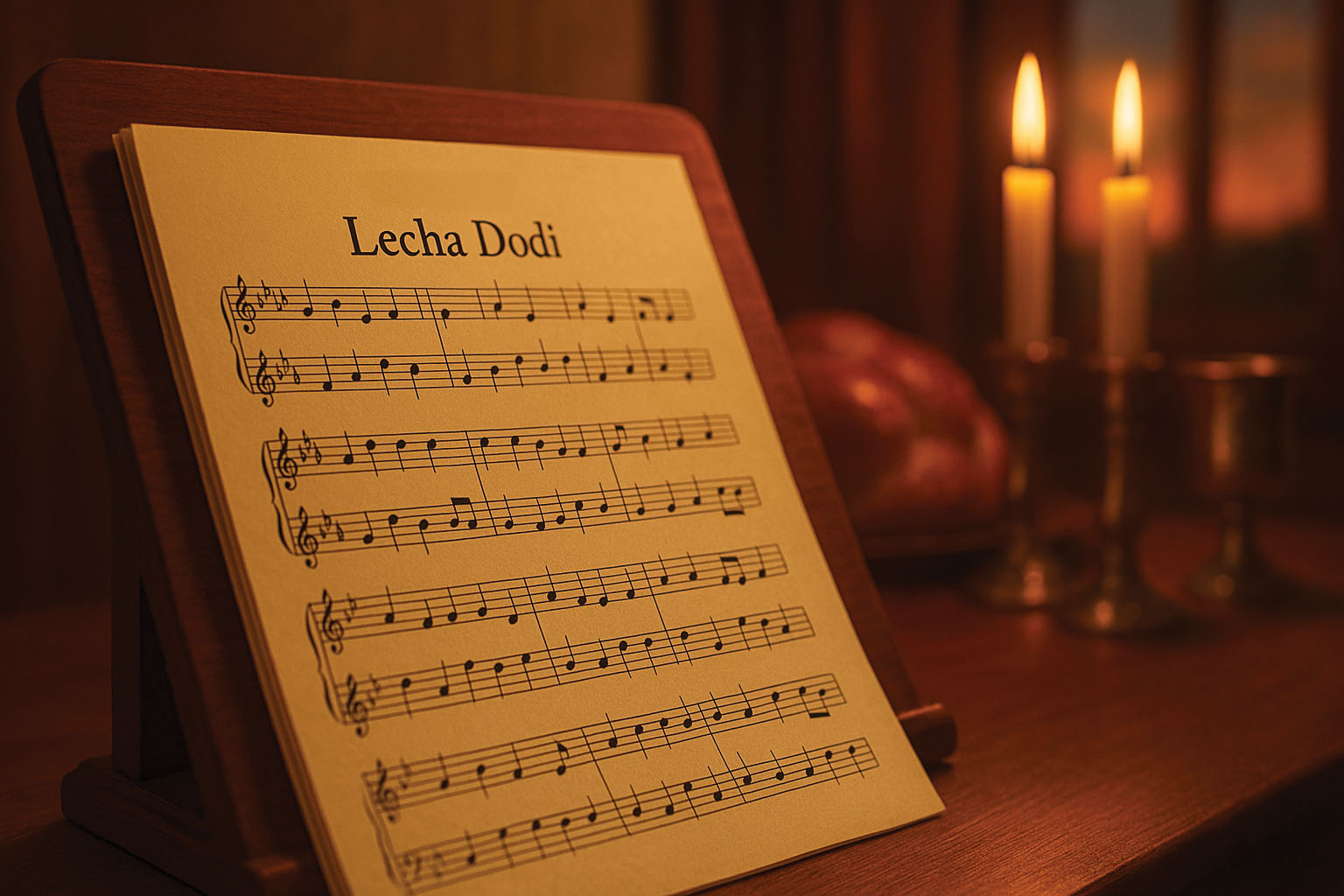
It’s the weekly tonal shift that somehow still catches many synagogue-goers by surprise. I’m speaking of course of the tune-switch that the Friday night hazan pulls for the last few stanzas of “Lecha Dodi,” everyone’s favorite shul showstopper.
Where did this quirky cantorial custom come from and how did it become so popular?
In his learned Hebrew-language tome “Seder Ba-Siddur,” the Israeli scholar Shlomo Barak notes that like so much else in Jewish practice, the details are subject to debate.
Some communities switch melodies at the fifth stanza, which begins “Hitoriri hitoriri,” “awaken, awaken,” and contains the line “arise, arise, speak a song.” It’s possible, comes the suggestion, that the line is a hint to the prayer leader that he should mix in a new song [i.e. tune] to revitalize enthusiasm for the congregation singing along to the hymn.
Others give a more thematic explanation. The first four stanzas describe despair – with lines like “enough dwelling in the valley of tears” and “arise from the dust.” In the fifth, the content reflects a more redemptive resonance — “the Glory of God has been revealed,” “your God will rejoice with you.”
Another possible support for the switch at this juncture is that it marks a natural break in the acrostic. The first letters of the prayer’s initial eight stanzas spell out Shlomo HaLevi, Lecha Dodi’s 16th century Kabbalistic composer. The fifth stanza starts the second part of his name.
The contemporary rabbi Ari Enkin has noted that the earliest sources that mention the tune switching are from Frankfurt am Main. There it is recorded they would switch at “Awaken, awaken,” but then switch back to the first tune for the “Lecha Dodi”’s last stanza, “Bo’i be-shalom,” “Come in peace,” a practice that has lost its popularity.
In fact, the most widespread iteration today is to switch at the sixth stanza, “lo teivoshi,” “do not be ashamed,” not the fifth.
Why? Well, no one quite knows.
Some posit that it’s a way to refocus a congregation whose collective mind might have wandered during the lengthy prayers and jar them into noticing what part the prayer-leader is up to. But of course, that could by right come at any point, and is not tied specifically to the sixth stanza.
The journalist and part-time musician Yair Rosenberg once interviewed the renowned musicologist Velvel Pasternak about this exact question. Pasternak’s response was:
“I spent a year researching this … got all kinds of explanations. The only one that was plausible was given to me by the Pittsburgher Rebbe of blessed memory. He said in Yiddish: ‘Shoyn genug genidzet mit dem ershtn nigun’ [they got tired of the first tune]. This is most probably the correct reason.”
Rosenberg himself, in turn, writing for The Atlantic, suggested a historical impetus. He notes that the lyrics of the sixth verse “Do not be ashamed, do not be despondent, why are you downcast, why be confounded? In you, the poor of my nation will find shelter, the city [Jerusalem] shall be rebuilt on its foundations” can be read as a somber sliver of comfort or an uplifting affirmation of hope amidst centuries of persecution.
“‘Do not be ashamed,’” Rosenberg notes, “wasn’t just recited in synagogues; it was mumbled in concentration camps, while fleeing expulsions, and in the aftermath of pogroms. I can only imagine the strength it took for these Jews to stand up each Friday night and tell themselves not to despair, and insist that they still had a future to claim. But they did.”
Perhaps then, the current custom arose as a folk custom, which, like so many other traditional practices, has attained the status of law. The shift from the fifth stanza to the sixth emerged as internal psychological and spiritual affirmation — “do not be ashamed, do not be despondent” recited by countless persecuted Jews, oppressed by hate-filled enemies across the globe. The line became the natural place not to lament but to sing anew, as these congregations expressed their confidence that they would eventually have reason to rejoice with God, in a city whose dust would be brushed off, rebuilt on its foundation. The time for such rejoicing was indeed claimed, of course, 77 years ago, when the State of Israel was reborn.
Rabbi Dr. Stuart Halpern is Senior Adviser to the Provost of Yeshiva University and Deputy Director of Y.U.’s Straus Center for Torah and Western Thought. His books include “The Promise of Liberty: A Passover Haggada,” which examines the Exodus story’s impact on the United States, “Esther in America,” “Gleanings: Reflections on Ruth” and “Proclaim Liberty Throughout the Land: The Hebrew Bible in the United States.”

































