At four a.m. on the morning of Oct. 7, Eli Wininger awoke in Los Angeles feeling anxious. Something felt strange.
The LA-born lone soldier reservist who enlisted in the Israel Defense Forces (IDF) in 2016 scrolled his phone and found text messages from friends, asking him if he was going to war.
At first, Wininger thought it was an exaggeration. “I hadn’t seen any videos or news articles yet,” he told the Journal. “After a quick search, I saw the famous white pickup truck of Hamas soldiers and a big headline, ‘Bibi Declares War on Gaza.’” Wininger’s commanding officer confirmed that reservists in his elite unit, Sayeret Egoz, had been called to serve, but that he had a choice whether to enlist or not, because he was based in America.
That choice took Wininger “two seconds.”
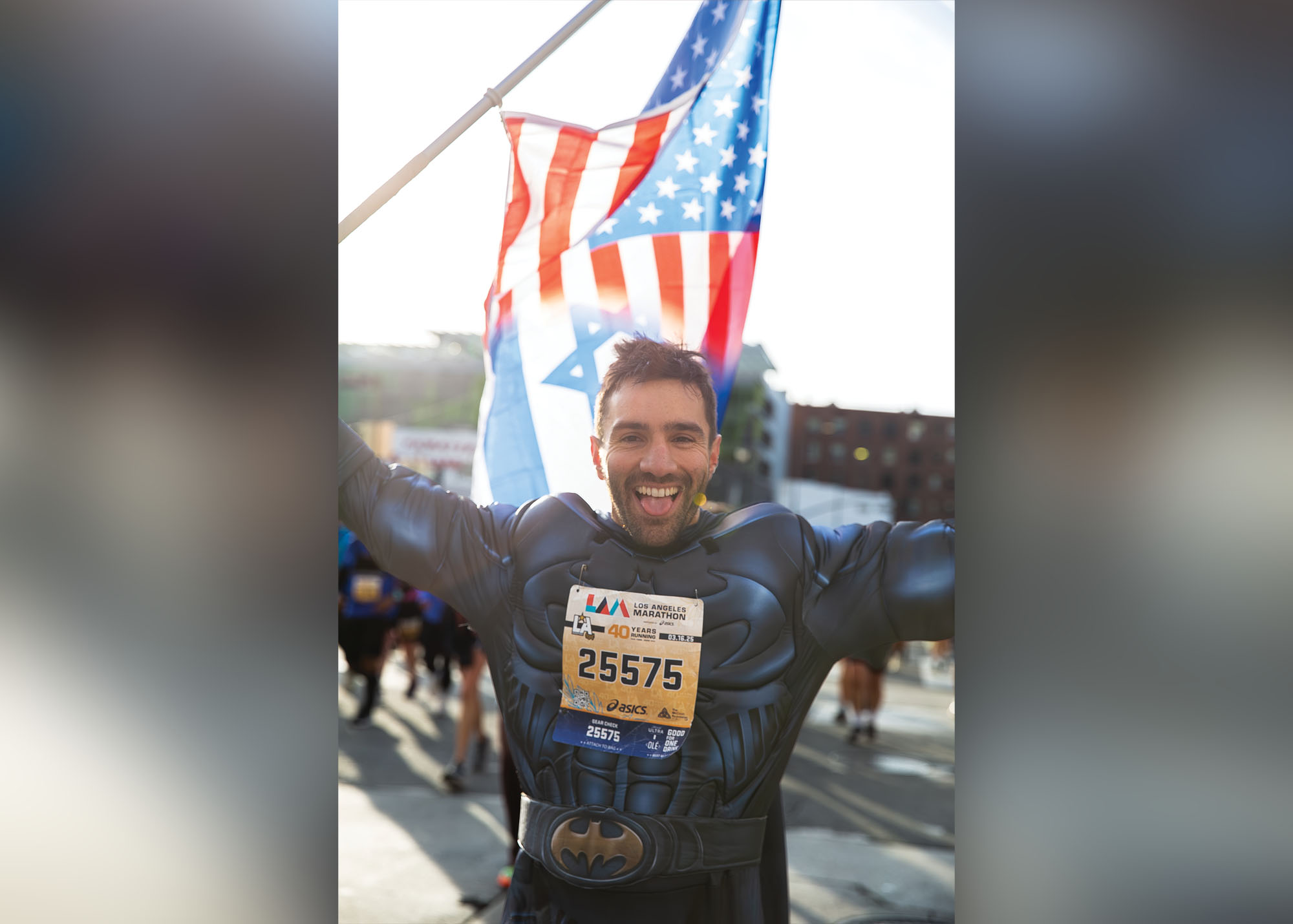
Wininger, a dedicated athlete and founder of Concierge Health Co., never misses an opportunity to express his unwavering love for Israel and the Jewish people. On Sunday, March 16, he ran the annual Los Angeles Marathon dressed as Batman, in honor of the Bibas family (4-year-old Ariel Bibas loved Batman), and waved Israel and American flags. In October 2024, he ran an astounding 251 miles consecutively over the course of four days. Each mile was dedicated to another Israeli hostage in Gaza in commemoration of the one-year anniversary of Oct. 7. Only stopping to sleep for one hour each day, he partnered with Hostages and Missing Families to raise over $40,000 in support of Israeli hostages.
Now, Wininger has been appointed president of the Young Leadership Los Angeles division of the nonprofit Friends of the IDF (FIDF).
In 2014, when Wininger was enrolled at the University of Southern California (USC), he spent the entire duration of the First Israel-Gaza War “arguing with anti-Zionists on Facebook, raising money for soldiers, attending rallies and more. As I sat at my comfortable real estate internship, I knew that I could do more for something that was so important to me, my family, and the Jewish people. I knew I wanted to be on the front lines to physically defend my people,” he said.
He had been raised in a Zionist home and was especially impacted by his late grandfather, a Holocaust survivor who had taught him the importance of “a positive demeanor and mindset geared toward hard work.” His Jewish community in the San Fernando Valley was also deeply pro-Israel. Wininger attended Adat Ari El day school and later, Harvard Westlake.
In 2016, after graduating USC the previous year with degrees from the Marshall School of Business and the Leventhal School of Accounting, Wininger informed his family of his plans to enlist in the IDF. In response, his Israeli mother offered to buy him a car if he stayed in LA.
According to Wininger, two of his mother’s brothers suffered from post-traumatic stress disorder (PTSD) after having served in the First Lebanon War. “I understood her worry, but I told her [that] I am a 22-year-old adult who could make these major life decisions for myself,” he said. “I didn’t need their financial support or permission. But the decision would be much better and nicer with her blessing. In the end, my family was incredibly proud of my decision and still are to this day.”
Wininger was no stranger to Israel; he had his bar mitzvah at the Western Wall and his family visited the country every two or three years. “Every single time my feet touched Israeli soil, I felt at home,” he said.
At Adat Ari El day school, he and an Israeli pen pal grew so close that when Wininger grew up and enlisted in the IDF for the first time as a lone soldier, his pen pal’s family became his host family. The address on his Israeli ID is their address; their home is the home he returns to while on leave from the army. “It is such a powerful and meaningful relationship to me, and they are truly like family,” he said.
In April 2016, Wininger enlisted in the IDF’s Sayeret Egoz unit. Seven years later, on Oct. 8, 2023, he reenlisted to serve the Jewish state in the aftermath of the largest massacre of Jews since the Holocaust. This time, he said, his mother “went through every emotional stage of grief. The news of Oct. 7 was hard enough for her and everyone, but knowing that she will have to send her son to war was beyond difficult.”
Every member of Wininger’s family tried to convince him not to go, but he made a bold declaration: “As a soldier, I have a duty to my country, and I have a duty to my teammates. I once again couldn’t imagine being in America while they were out there. Something deep inside was telling me this is one of the reasons I was here on this earth,” he said. Wininger also recognized the significance of the moment: “I explained to my family that this would 100% lead to a major war, and I needed to get to Israel as fast as possible to be with my team. Every second mattered.”
“As a soldier, I have a duty to my country, and I have a duty to my teammates. I once again couldn’t imagine being in America while they were out there. Something deep inside was telling me this is one of the reasons I was here on this earth.” – Eli Wininger
I asked Wininger to offer more insights into his decisions to enlist (and reenlist) in the IDF, as well as what he witnessed in Gaza, and how much has changed in the span of the past nine years. The following has been edited for clarity and length.
Jewish Journal: How did your service in 2016 compare to your service in 2023?
Eli Wininger: The differences were massive. In 2016, I was a soldier during peacetime. We went on several dangerous missions, but nothing compares to going into a war zone where you hear explosions all around you and are constantly under threat of IEDs, sniper rifles and ambushes. During our training before entering Gaza, we knew that every session could be our last before going into war, and we better make it count. In addition, during my full-time service in 2016, we received all the best gear because we were amongst Israel’s most elite soldiers.
However, when I returned in 2023, we were reservists and Israel was not ready to properly equip its soldiers. That meant we received extremely outdated equipment and no bulletproof gear.
JJ: How had you changed in the seven years between your first and your second reenlistment?
EW: During the years between leaving and reenlisting, I matured a lot. My whole team did. We prepared for missions more intensely, we took less risk, and we also allowed ourselves to properly rest and recover.
JJ: Barring classified information, please help readers understand what you witnessed in Gaza during your service.
EW: During the two months I served in Gaza, I witnessed tunnels inside of UNRWA schools, terrorists taking shelter inside Red Crescent hospitals, rockets stored underneath a little girl’s pink twin-sized bed, and Hamas soldiers walking amongst women and children so that we would not shoot.
I went in with the mindset that Gaza would be like an Indian shanty village, since that is how the media has portrayed it for years. I was shocked to see that Gaza was very built-up and many homes we went into were incredibly nice. The miserable lives that they described weren’t that bad; they were actually better than many homes I’ve seen in America.
Nevertheless, walking through the streets of Gaza was scary. I was constantly on high alert and my nervous system never got a chance to settle. I was always looking over my shoulder and through windows and around corners, because I never knew when a Hamas soldier would pop out. Concentration was literally a matter of life and death.
JJ: Did you come into close contact with Hamas terrorists?
EW: Most soldiers never had close quarters combat with Hamas terrorists, because they often stayed in tunnels and then jumped out for quick ambushes. In addition, we would generally see them while we were on guard duty in our compounds, and then we’d fire to defend ourselves. The only time I would get up close with them is when we’d search their corpses for weapons and intelligence.
The only time we came truly face-to-face with a Hamas operative, we did not actually know he was Hamas. We assumed they were an innocent Palestinian family that was too scared or simply refused to evacuate after weeks of Israel warnings. When we discovered the father and his family in a building, we were extremely gentle and understanding. We wanted to help lead them to the safe zone in the South. We sent them to Israel’s field intelligence unit for a protocol interview and examination, and that’s when they discovered the father was a Hamas soldier who had online video footage of himself killing Israelis on Oct. 7. In addition, the family had held hostages until just two weeks prior.
JJ: After your return to the U.S., you witnessed how Western media was rampant with misinformation about Israel’s fight in Gaza. What were some of the biggest lies, and why is misinformation against Israel so ubiquitous?
EW: The two biggest lies were that Israel was ruthlessly murdering Palestinians, and that Gaza was a massive prison or refugee camp where people were starving. My team and I risked our lives several times to protect Palestinians, and we had strict rules of engagement to minimize the risk of civilian casualty.
From our perspective, their lives and homes were perfectly adequate and much better than any Third World country that I’ve visited. Lastly, 90% of homes that we entered had some association with Hamas. That meant that somewhere in the home or apartment there were Hamas uniforms, guns, rockets, intelligence, flags or occasionally tunnels.
Israel is losing the media battle for two reasons: First, it refuses to play into any form of victimhood which humans love to get behind. We are no longer the underdog the way we were in the early part of our history, and, just as in Hollywood, people love getting behind the underdog.
The Palestinians have artfully portrayed themselves as all innocent victims. Israel portrays itself as a strong and mighty country that is fighting for honorable values and its existence.
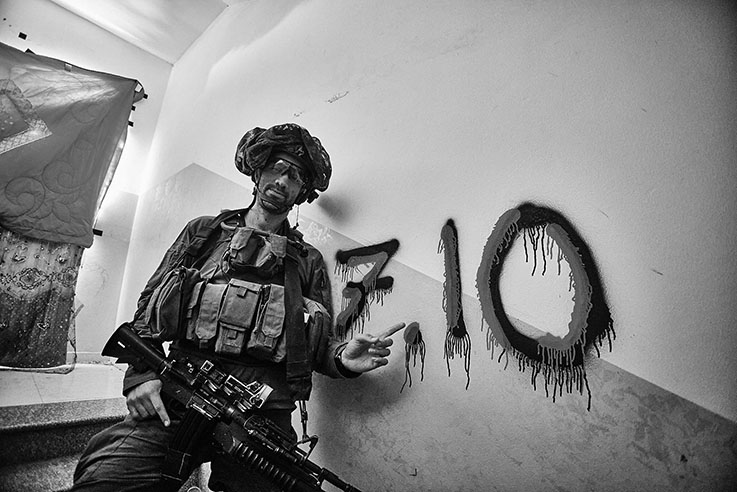
Second, a major mistake that Israel made was not publicizing all the graphic and horrific images of Oct. 7. The Hamas media genius fills the internet with graphic images of murdered children, women and civilians. Humans in general don’t think with their heads, but rather their hearts. These images tug at our heart strings. While Israel was protecting the peoples’ privacy and honor, they missed the opportunity to win over the hearts of billions of people around the world.
JJ: Upon returning to LA after serving in Gaza, you spoke at a Friends of the IDF gala event. Was it cathartic to have been embraced by those who, like you, love Israel, as opposed to the currently inescapable sense that the world inherently rejects Jews and the Jewish state?
EW: It was one of the most healing experiences I’ve had in my life. I was not able to truly enjoy myself in a public setting or large gathering after leaving Gaza, because I saw how normally everyone was living their lives, while I knew what was happening on the other side of the world. The people in that [gala] room had also suffered for the past year and had worked tirelessly to help Israel. Everyone was healing together that night and it was beautiful. I felt seen by strangers. It prompted me to continue speaking all across the world in over 12 cities to Jews and non-Jews to spread the truth about the war and the threat of antisemitism.
JJ: Do you have a particular vision for FIDF as the incoming Young Leadership-Los Angeles President?
EW: The main goal of Young Leadership is to create a leadership pipeline for the organization and the LA Jewish community as a whole. Our focus is building leaders for tomorrow within the community. A personal goal I have for Young Leadership is to engage more demographics so they can find their place within the organization. For example, our most common demographic is currently singles, ages 27-35. We’d like to widen that to reach the 21-27-year-olds that may get priced out of certain events, while also catering to other gatherings toward newlyweds in their early-mid-30s that would like a more sophisticated night out with like-minded Zionists. In addition, we will be creating young professional meetups for real estate, finance, tech and entertainment.
JJ: You are an elite endurance athlete and fitness professional. How have you combined your love for fitness and Israel?
EW: Both fitness/health and Israel are core to my identity and incredibly important to me. I always aim to find unique ways to help wherever I can. In October this year, I ran 251 consecutive miles over the course of four days. In addition, I raced the LA Marathon dressed as Batman and raised an Israel and American flag in commemoration of the hostages, and to showcase the unity and strength between our nations.
JJ: How have you cared for your mental health upon returning from the frontlines in Gaza?
EW: My mental health has definitely suffered since returning and continuously following the news. However, my daily meditation, family, friends, positive affirmations and belief that everything will be okay help me get through it. While I worry for Israel and the Jewish people, I remind myself that we are stronger now than any other time in history, and that is a major blessing. I’m blessed to have the opportunity to defend Israel. We’ve made it through the last 4,000 years and all our enemies have perished. It is our generation’s turn to overcome our current enemies. History and Jewish genetics are in our favor.
JJ: Will you reenlist in the IDF again, if you feel it is necessary?
EW: Absolutely. Anything to protect our homeland. As history has shown, even when Jews are doing well in a country, they are eventually exiled and need a place to go. It is my duty and honor to fight for Israel, so that Jews worldwide always have a home.
For more information on Eli Wininger, visit conciergehealthco.com or follow him on Instagram @eliwinning.
Tabby Refael is an award-winning writer, speaker, and weekly columnist for The Jewish Journal of Greater Los Angeles. Follow her on X and Instagram @TabbyRefael