

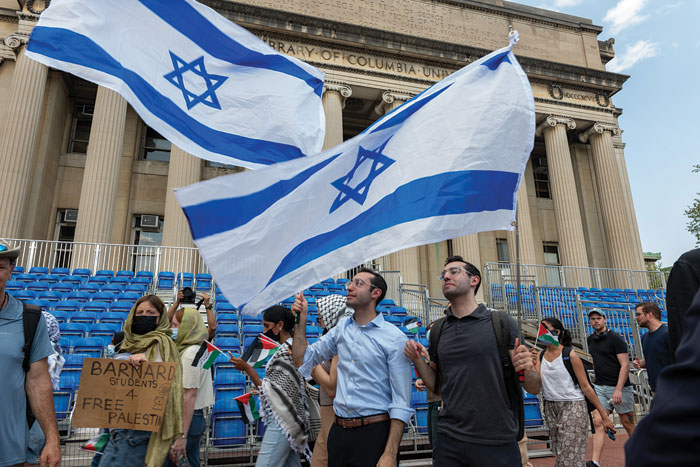
I have no reason to write about American students who raise Hezbollah flags in their pathetic attempt to be woke, or whatever. They are America’s problem. Or about American students dressed as if for a gay pride parade, in support of a movement that would throw them off rooftops had they danced in such a manner in Gaza. Such silliness can be rarely cured by words of reason. And I am not quite motivated to mock university administrations whose response to anti-Jewish protest is weak and confused. My mockery will have zero impact on their behavior.
As an Israeli I look at American universities with a mix of puzzlement, amusement and sadness. And I look at them to figure out what this all means for me – and my fellow Israelis and Jews. Of course, Israelis and Jews can try to moderate the impact of the protest movement and to assemble coalitions against hateful acts and language, and they can use their resources to resist the perpetrators of violent demonstrations. But ultimately – and this is as bad as it sounds – Israel and the Jews aren’t always powerful enough to divert a tide of hate away from them. I am not inclined, as some commentators did, to compare what happens in American universities to 1934 Germany. Not all things in life are either OK or Nazi. There are shades of grey in between. And yet, anti-Jewish forces were able, time and again, to prove their agility and durability. They might have their moment now.
So Jews must fight against the hate movement, and also must be prepared for a future in which American universities become less hospitable than before. They must think about alternative methods for dealing with a new reality that doesn’t bend itself to their needs or wishes. And they must do it in three ways:
By readying themselves to identify their more dangerous enemies.
By sticking together and bracing themselves for a fight without fear.
By making themselves better, more essential, irreplaceable.
Identifying enemies is going to be difficult for many Jewish Americans who have strong liberal tendencies. Their growing inability to be both outwardly Zionist and outwardly progressive is understandably heartbreaking. For some of them, it is an identity crisis.
Identifying enemies is going to be difficult for many Jewish Americans who have strong liberal tendencies. Their growing inability to be both outwardly Zionist and outwardly progressive is understandably heartbreaking. For some of them, it is an identity crisis. For a while, they dealt with it by comforting themselves that the “right” is still more of an enemy than the “left” – as if having enemies on both sides of the political spectrum is some kind of consolation.
It is not. Moreover, it is not relevant, because most of their social and professional circles are impacted by what happens on the left much more than by what happens on the right. If they are shunned by a bigot in Oklahoma, they would rarely notice it. If they are shunned by a Hezbollah-flag waver at Columbia University, they would.
So for now, the more dangerous enemies are those who make it harder for Jews to live peacefully where they live, and work peacefully where they work, and hang out peacefully where they tend to hang out. And no parallel hateful trend in other places could somehow make this fact more tolerable.
Hence, they need to come together, and defend themselves without being apologetic about their need to do it, and without relying on obviously reluctant authorities to do it. Jewish students can also form groups, project power, intimidate their haters. They did it in the past, they can do it again. Dealing with bullies is not easy, but there is one language they understand. A language that many Jews in America might need to relearn (Israelis, for good and bad, are well practiced in this language of bullyism).
The third “must” is important and difficult to achieve. If American universities become less hospitable, what could be the remedy? One option is to still attend them, and deal with the hostility by lowering one’s profile, or by fighting back as a group. Another option is to attend those universities that make sure to have safe environments for Jewish students and faculty. Those universities ought to be identified and encouraged, and benefit intellectually and materially for making the right choice. If Jews can contribute to making these institutions greater than the institutions that became inhospitable – that would be a proper reward for our friends. Another option is to strengthen Jewish institutions of study, in the U.S. and in Israel. Some Israeli officials have already hinted at such an option as their choice, but this depends, among other things, on Israel going back to its senses and being a place in which excellence in science and pursuit of intellectual achievement is encouraged and respected.
Is there a bottom line? I think there is. In Israel and the U.S. Jews are facing a crisis, and a crisis is an opportunity for improvement and for growth. Let us not miss it.
Something I wrote in Hebrew
Identifying enemies is going to be difficult for many Jewish Americans who have strong liberal tendencies. Their growing inability to be both outwardly Zionist and outwardly progressive is understandably heartbreaking. For some of them, it is an identity crisis.
A week’s numbers
Pesach is over, but this question is always relevant, and the response of Arab Israelis is troubling. Only one in ten acknowledges that a Jewish temple ever existed in Jerusalem (from JPPI’s survey of Israeli Arabs).

A reader’s response:
Moshe Krause asks: “Are you going to write about the scandalous behavior of American universities’ administrations?” My response: I think I just did.
Shmuel Rosner is senior political editor. For more analysis of Israeli and international politics, visit Rosner’s Domain at jewishjournal.com/rosnersdomain.

































