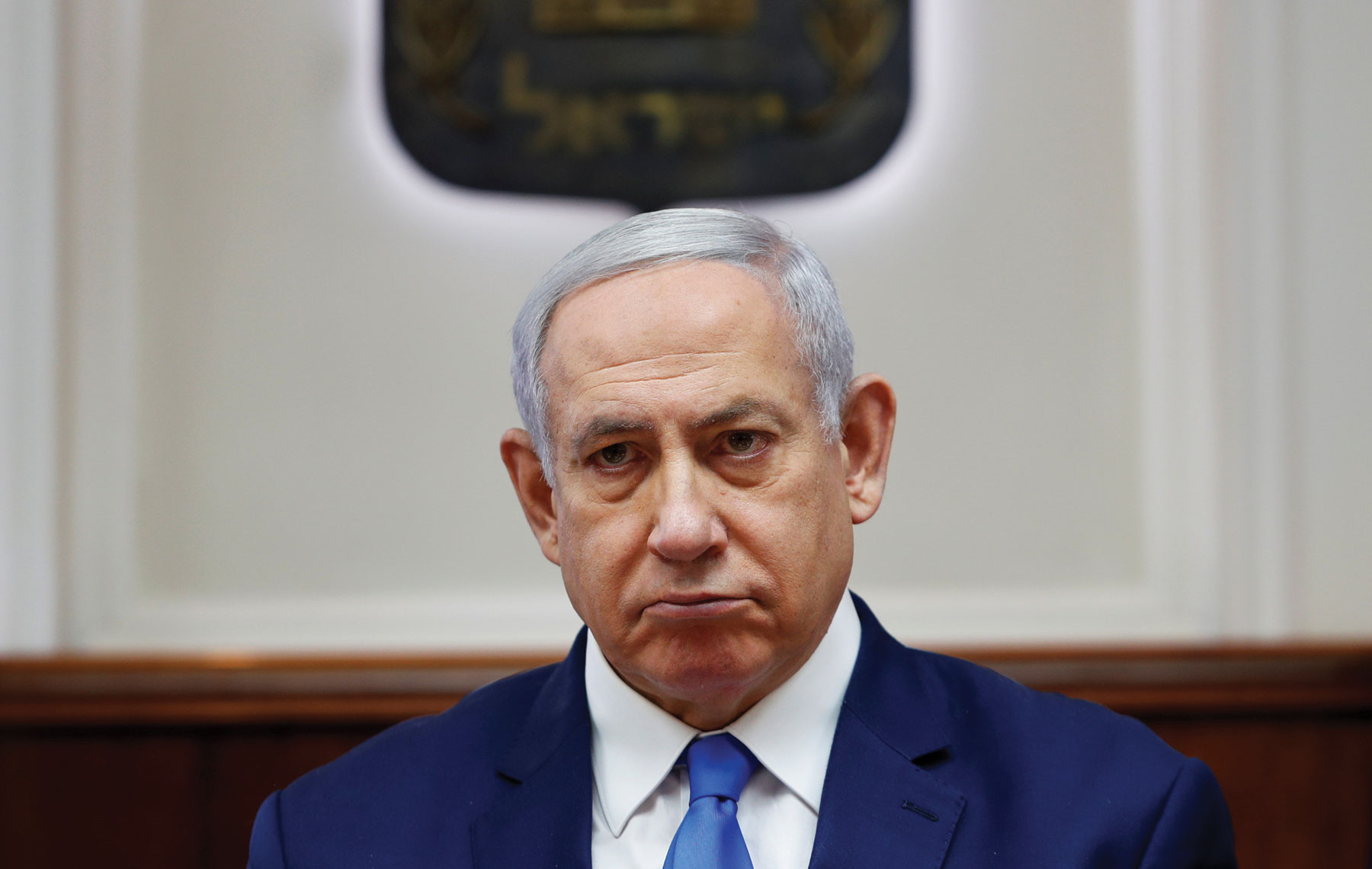
It’s less than two months to Israel’s election, so maybe it’s time to play the game “How Benjamin Netanyahu Loses.” Last week, he surpassed David Ben-Gurion to become Israel’s longest-serving prime minister. In two months, it could be all over. Well, could it?
The goal of this column isn’t to make a prediction. The goal is to draw a map that leads to a certain result: Netanyahu loses — somebody else takes his place. It’s the map at the core of many political calculations by the prime minister and his rivals. For him, it’s the map to avoid. For them, it’s the map to follow.
It begins with a simple number: 61. If the parties Likud, United Torah Judaism, Shas, the New Right and the United Right (or a merged party of both) get 61 or more seats — you can toss the map into the garbage can. Netanyahu will be prime minister. In fact, the main effort of the prime minister today is directed at getting to this magic number. How far is he from it? About five seats.
Two months before the last election in April, Likud was about five seats short in the polls compared with what it ultimately won. So, overcoming such a difference isn’t necessarily impossible. There is still time. There is still a campaign to run — most parties reserve the ammunition for the final three weeks of the campaign, when summer vacations end. But to keep drawing our map, we must assume that the “natural allies” — Likud and the rest — don’t get 61 seats. They just come close. Maybe 57, maybe even 60. What happens then?
Then the president must decide who gets a first shot at forming a coalition. If Likud is much larger than the second-largest party, this will probably be Blue and White — the case for denying it the chance to form a coalition will be weaker. If Likud isn’t much larger, or if it’s smaller, or if there’s a clear majority of new Members of Knesset (MKs) who support someone else, the president could task this non-Netanyahu person with forming a new government.
Let’s examine both scenarios.
If Netanyahu forms a coalition but doesn’t have 61 seats, he’ll have to do one of two things. One: find a few MKs who agree to join his coalition in return for power. A current candidate is the leader of the Labor Party, Amir Peretz. In exchange for the Finance Ministry, or a deal that makes him the next president of Israel, he might calculate that joining Netanyahu is the best option for him and his party. Two: form a unity government with Blue and White, if they agree to do such a thing. Well, would they? Maybe, if the other option is to accept a Netanyahu-Peretz government that sends their party to the opposition for a few long years.
If the president decides to task someone else with forming a coalition, the question becomes: Does this person, say Benny Gantz, have a path to 61 seats? One way to get there is to convince some of the “natural allies” of Likud to abandon their traditional alliance and join in — say, the ultra-Orthodox parties (in exchange for accepting their political and budgetary demands). Another way is to convince Likud to send Netanyahu home and join a unity government. The prospect of four years in the opposition might be a hard one for Likud leaders to swallow. Maybe even hard enough to make them break with Likud’s tradition of loyalty to the leader.
Any scenario that ends with Netanyahu’s departure must include a two-pronged punch. First: blocking a majority that prevents Netanyahu’s easy coalition. Second: the disintegration of Netanyahu’s bloc. The first step is necessary but
insufficient, because while blocking a coalition is simple, forming a coalition is complicated. Gantz and the Arab parties can agree that Netanyahu must go. This doesn’t mean that they could jointly run a government. Lieberman and Meretz
could agree that Netanyahu’s policies are outdated. This doesn’t mean they can agree on what policies ought to come
instead.
Hence, a disintegration of Netanyahu’s solid bloc is essential. Can it happen? If the bloc does not have 61, it definitely can.
Shmuel Rosner is senior political editor. For more analysis of Israeli and international politics, visit Rosner’s Domain.