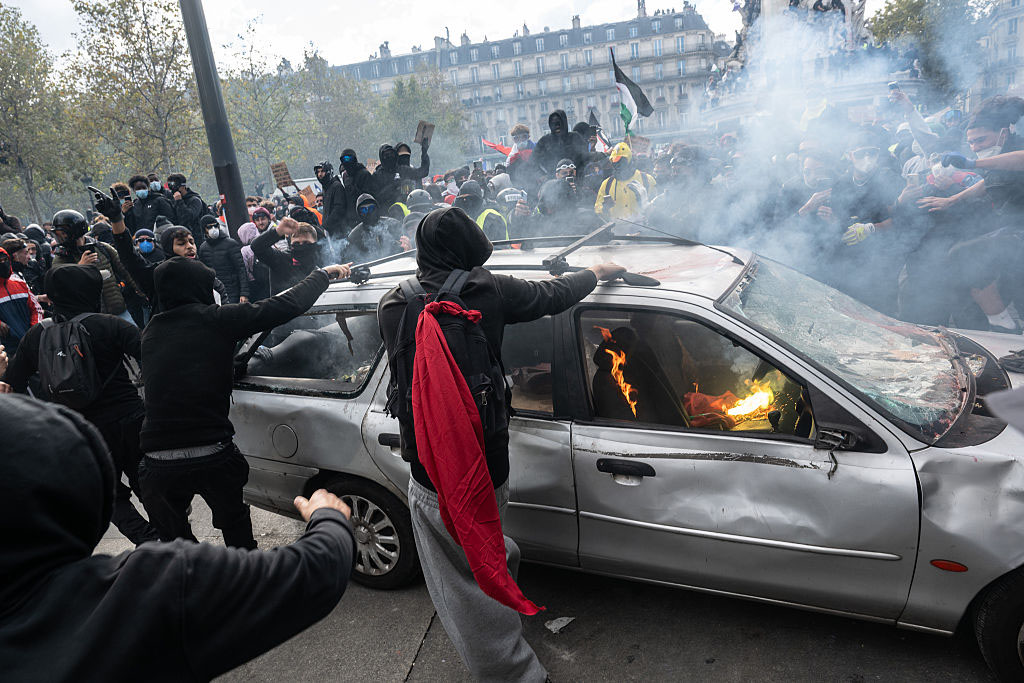
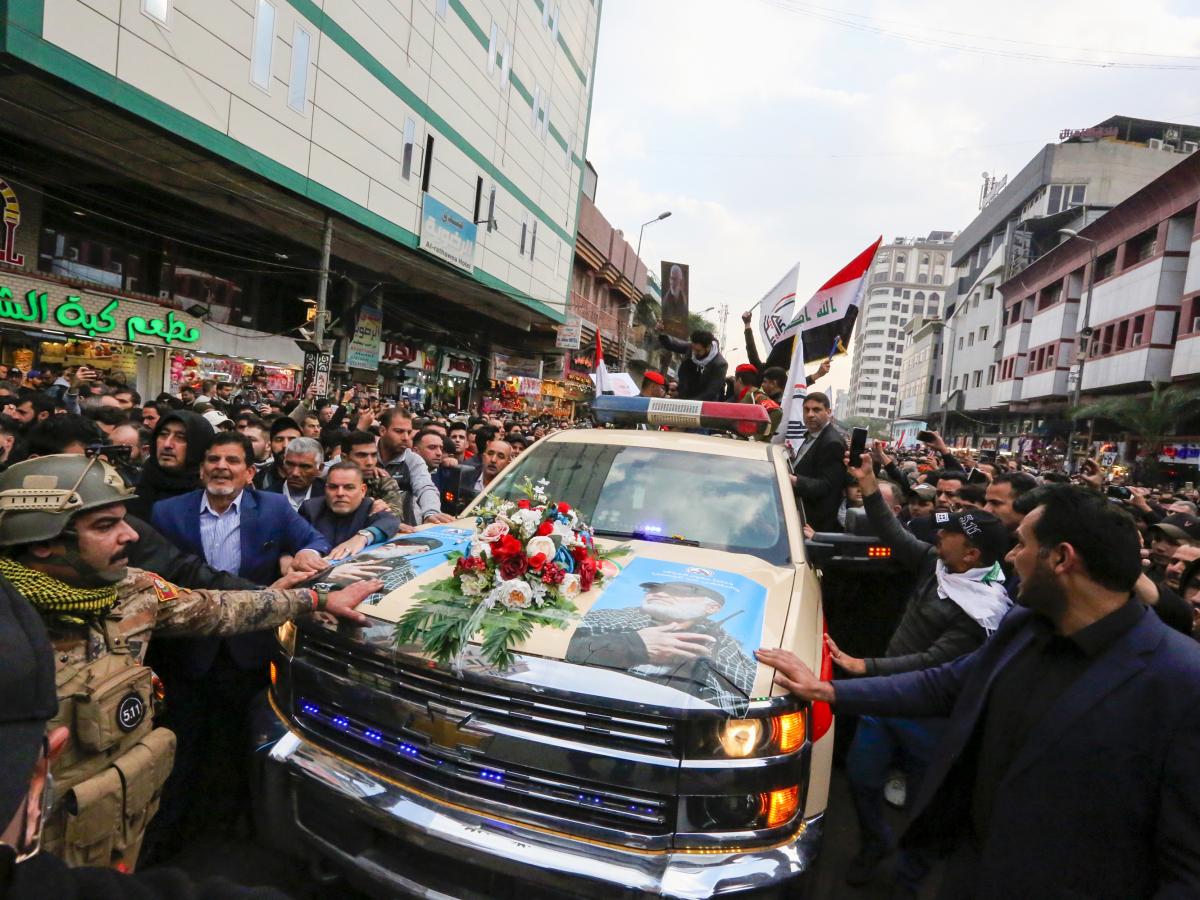
The United States may have delivered the hellfire blow in Iraq that eliminated Quds Force chief Qasem Soleimani but in subsequent anti-Trump protests in pro-Iranian satrapies, perhaps more prominent than the charred American flags were those of Israel in flames. In fact, refrains of “Death to America” and “Death to Israel” were virtually interchangeable on streets spanning from Tehran to Baghdad, Damascus to Gaza City. One senior Iranian official went so far as to include Tel Aviv on a list of ostensible US targets that could be retaliated against.
This “indivisibility” is also manifest in endless expressions of support emanating to and from Washington and Jerusalem. Following a phone call this week with Israeli Prime Minister Binyamin Netanyahu, US Secretary of State Mike Pompeo described the countries’ alliance as “unbreakable.” For his part, Netanyahu on Sunday reiterated that “Israel stands totally with the US in its just struggle for security, peace and self-defense.” He further lauded President Donald Trump for “acting determinedly, powerfully and swiftly” against Soleimani, the composer and conductor of Iran’s hegemonic Mideast policies and thus the symbol of the regime’s expansionist, radical Islamic ideology.
Given the close diplomatic and military cooperation between the “Big Satan” and “Little Satan” – in addition to their shared value system which is antithetical to Iran’s theocracy – it is understandable that Jerusalem would be concerned. Indeed, many have speculated that the mullahs might try to avoid direct escalation with the world’s lone superpower and instead lash out at the world’s lone Jewish state. As a result, the government has placed the Israel Defense Forces on high alert and increased security at Israeli diplomatic missions and well-known Jewish sites across the globe.
“We have to be prepared in accordance with Iran’s capabilities rather than its intentions, which we cannot presently know,” Maj. Gen. (res.) Uzi Dayan, a former IDF deputy chief of staff and national security adviser to past Israeli prime ministers Ehud Barak and Ariel Sharon, told The Media Line. “While doubtful, it is possible that Iran could fire cruise missiles at Israel from another territory” – not unlike September’s coordinated strikes on critical Saudi oil infrastructure.
“During the First Gulf War,” Dayan elaborated, “I said we [Israel] should assume the Iraqis would attack us [with Scud missiles]. When people asked me why and questioned my reasoning, I answered: ‘Because they can.’”
While experts near-unanimously agree that Israel must be prepared for worst-case scenarios, a debate is raging within the defense establishment over whether the Islamic Republic will, in fact, target the home front.
“If the Iranians are [rational] like some people claim, the last thing they need right now is to provoke Israel,” Maj. Gen. (res.) Yaakov Amidror, a fellow at both the Jerusalem Institute for Strategy and Security and the Washington-based Jewish Institute for National Security of America, told The Media Line. “If the [regime] is already under pressure and doesn’t have a good answer to the American threat, then what is the logic of dragging Israel [into the equation]?”
According to Amidror, previously the chairman of Israel’s National Security Council, engaging the IDF would be a “huge mistake” on Iran’s part, even though he acknowledges the possibility. “The military is ready if it needs to react,” he said. “Unlike Saudi Arabia and other [Iranian foes in the Middle East], Israel has very good capabilities and has proven its determination and willingness to take risks.”
Case in point: The thousands of Israeli strikes over the past two-plus years against Iranian-linked military infrastructure in Syria and, more recently, in Iraq as well.
Even so, Brig. Gen. (ret.) Hanan Gefen, a former commander of the IDF’s renowned 8200 intelligence unit, highlighted the fact that Iran has, in most instances, hit back at Israel through its proxies. “In this case [of Soleimani],” he qualified to The Media Line, “it might be different because the blow has been so significant. But I still doubt there will be direct retaliation.”
Gefen’s reasoning is twofold: While the Iranians want to strike a “high-magnitude target,” they fear a major attack on either US or Israeli assets – or, for that matter, those belonging to Sunni Gulf states –would encourage President Trump to fulfill his pledge on Saturday to respond by targeting 52 Iranian sites. Moreover, Gefen does not believe that Israel had a direct hand in Soleimani’s assassination. “If you look at Yemen,” he said, “the Americans have targeted terrorist figures there by the same method [drone strikes]. So, the Pentagon’s capabilities are very strong and the US likely tracked Soleimani’s whereabouts.”
Nevertheless, the IDF will remain on guard, mindful of previous attempts by Iran to infiltrate Israeli airspace using missile-laden drones. There was also last February’s downing of an Israeli F-16 and, most notably, the May 2018 firing of a barrage of 20 projectiles toward northern Israel – most of which were intercepted and none of which caused damage or injuries – by members of the same Quds Force that was recently beheaded.
That rare, direct Iranian attack upped the ante and prompted the beating of war drums by both sides. Another such incident, while hypothetical, is liable to result not in a similar beat, but, rather, in the message’s actualization.