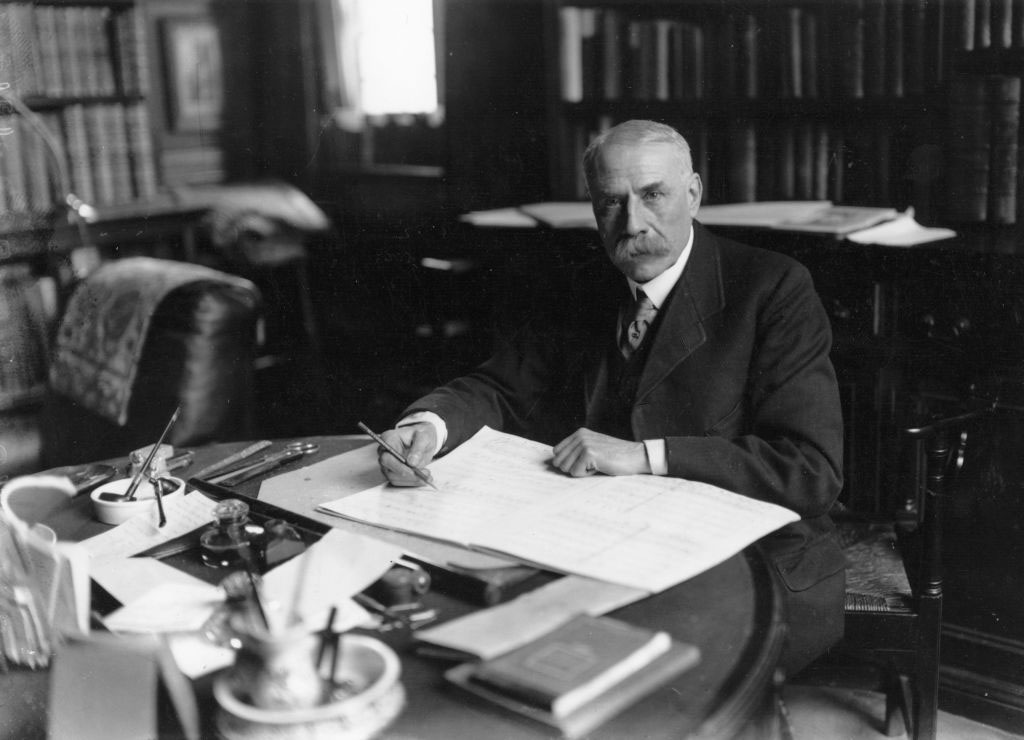
In an ironic twist that Bertolt Brecht would have appreciated, his legendary Berliner Ensemble will make its American debut at UCLA July 7 to 11, and then lower the curtain permanently.
Brecht founded the ensemble in East Berlin in 1949 to direct and present the playwright’s own works, and it quickly gained an international reputation and the wary support of the Communist regime.
After its West Coast tour, the troupe will dissolve itself permanently, reappearing later under a new name, management and direction.
For its finale, the ensemble will present “Arturo Ui” (shortened from its full title, “The Resistible Rise of Arturo Ui”), written by Brecht in 1941, during his Los Angeles exile. It is a mordant satire and morality play on Adolf Hitler’s Nazis, and how their power grab could have been nipped if good men had stood up.
The play’s jobless Ui leaves his native Bronx and arrives in Chicago with seven thugs and soon brings “peace” to the city’s vegetable market through a protection racket, dubbed The Cauliflower Trust.
Under the pose of a law-abiding family man, Ui obtains and consolidates his power through gang violence, bribery, police corruption, demagoguery, political manipulation and intimidation of the press.
The analogy to the rise of the super-gangster Hitler was obvious in 1941, and remains applicable today.
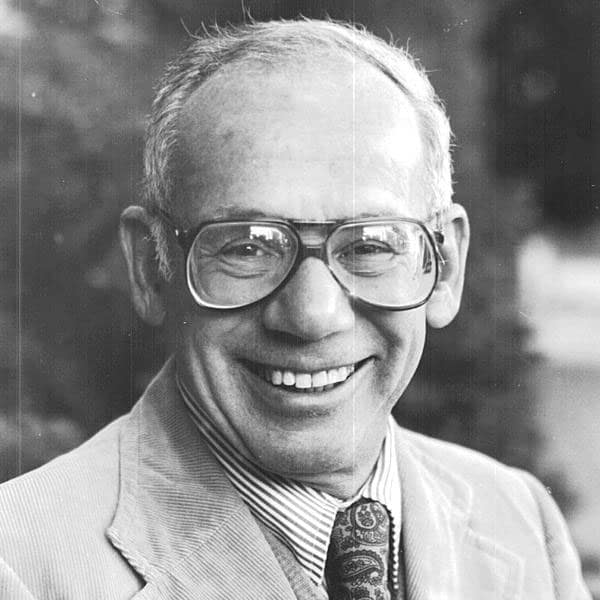
“We need only look at the tactics of Yugoslavia’s Slobodan Milosevic and the mafia-like structure of ruling parties in many countries to see the point,” says Stephan Suschke, the Berliner Ensemble’s artistic director, speaking by phone from his home in East Berlin.
Although Brecht’s “theater of alienation” seeks to appeal to the audience’s reason rather than to its emotions, Ui is cast as a superb showman, and his appeal “is similar to that of a movie idol or rock star,” Suschke says.
Though not Jewish, Brecht was high on Hitler’s hit list for his “subversive” plays and Marxist ideology. He fled Germany in 1933 and, after living in Scandinavia, arrived in the United States in 1941.
A prolific playwright, poet and essayist, whose most popular hit was “The Threepenny Opera,” created with composer Kurt Weill, Brecht packed up again in 1947, when, one day after being interrogated by the House Un-American Activities Committee, he fled to Switzerland.
“Brecht was fascinated by American technology, but, as a left-wing intellectual, he questioned the country’s politics,” says Suschke. Also, unlike many other exiles, the playwright never felt at home in brash Los Angeles.
He founded the Berliner Ensemble in 1949 and remained at its head until his death in 1956.
The upcoming dissolution of the troupe marks the end of an era, Suschke notes.
“The Berliner Ensemble was closely tied to the history of Communist East Germany,” he says. “Its end stands as an epilogue to that period in German history and means that East Germany has truly ceased to exist.”
Performances of “Arturo Ui” are in German, with running English supertitles projected on a screen on top of the stage.
The arrangement may be novel to most American audiences, but has worked effectively during performances in Russia, Turkey and Latin America, says Suschke.
“You can really understand the play without knowing German,” he says.
The four performances, co-sponsored by Germany’s Goethe Institut, will be on July 7, 9 and 10 (at 8 p.m.) and on July 11 (at 4 p.m.) in the Freud Theatre on the UCLA campus. Ticket prices are $49 and $69. For information, call (310) 825-2101.