For more articles from The Media Line, click here.
In the 13th episode of The Media Line’s Spanish-language podcast, Medio Oriente 123, host Debbie Mohnblatt is joined by Ariel Gelblung, director of the Simon Wiesenthal Center’s Latin American branch.
German scientists and engineers who once worked for the Nazi war machine later powered some of the world’s leading post-war achievements, says Ariel Gelblung, director of the Simon Wiesenthal Center’s Latin American branch.
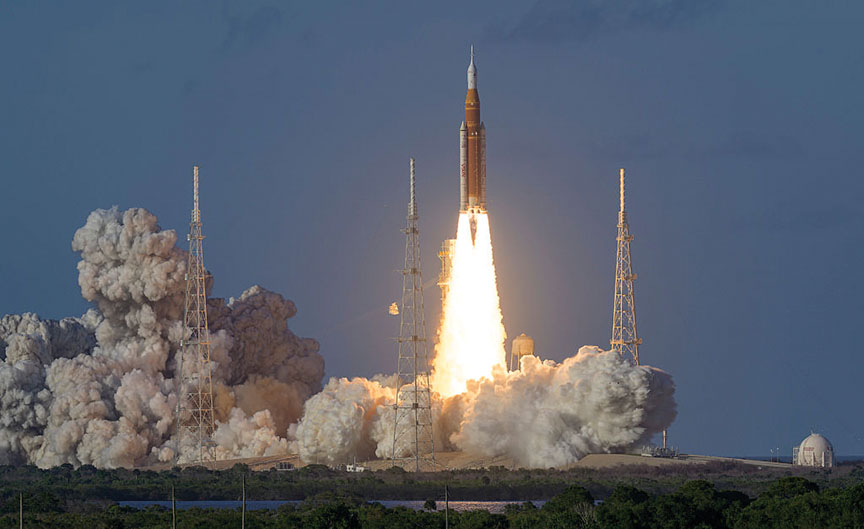
“We cannot understand the arrival of man to the moon and the development of NASA without persons like von Braun being ‘recycled,'” Gelblung told The Media Line.
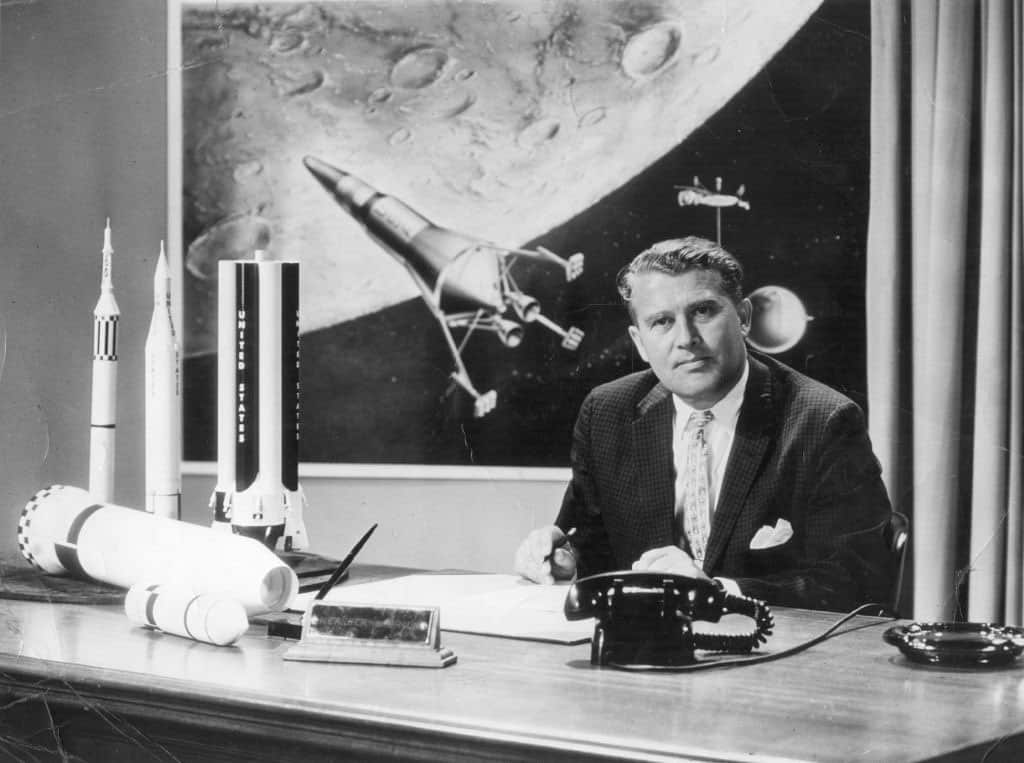
Wernher von Braun was an aerospace engineer and space architect and a member of the Nazi party and Allgemeine SS. He led Nazi Germany’s rocket development program before the Second World War and helped develop its V-2 rocket, the world’s first long-range guided ballistic missile, during the war.
After the war, von Braun was among 1,600 German scientists, engineers, and technicians who were secretly moved to the United States for government employment. He worked on a ballistic missile project for the US Army and developed the rockets that launched the US’s first space satellite in 1958. Two years later, his group was merged into NASA and he became director of the new Marshall Space Flight Center and the chief architect of the Saturn V launch vehicle that sent the Apollo spaceship to the moon.
Gelblung said that after Germany’s defeat in the war, an entire cohort of Nazi scientists, doctors, and engineers remained, and, rather than face war crimes trials for their activities during the war, many searched for new homes, identities, and professions. The developing US-Soviet rivalry gave them a golden opportunity.
“The Cold War’s biggest winners were the Nazis,” Gelblung said, citing the Nazi hunter Simon Wiesenthal.
The US and the Soviets both sought German expertise.
The Americans justified this by saying it was necessary to combat a new enemy, the Soviet Union. US recruiters often distinguished between German scientists and engineers and the German soldiers and administrative staff who worked in concentration and extermination camps.
As the Americans and the Soviets quietly opened their doors to Nazi minds, Latin America also proved to be a popular haven for thousands of Nazis, especially Argentina.
Influential people in Latin America often had “similar ideologies” to the Nazis, Gelblung said.
In 1946, right-wing populist politician Juan Domingo Perón became Argentina’s president. Soon afterward, members of Perón’s government, including his secretary, Rodolfo Freude, and his director of migration, Santiago Peralta, facilitated Nazi resettlement in Argentina. The so-called “ratlines” enabled thousands of Nazi party members to be smuggled out through ports in Spain and Italy to Argentina.
Perón was ideologically opposed to the Nuremberg war crimes trials, believing that the Allies’ victory did not entitle them to judge the losers.
However, Perón was mostly interested in taking advantage of Nazi skills, Gelblung said.
He said Perón had contacts with someone he called “the doctor,” likely to be Josef Mengele, the Nazi physician who conducted infamous experiments on people at the Auschwitz concentration and death camp.
Perón’s government also found resources in Kurt Tank, a Nazi engineer who helped develop Argentina’s aerospace industry, and Ronald Richter, an Austrian-born German scientist who promised Perón he could help Argentina develop nuclear energy.
Perón constructed an entire complex near the city of San Carlos de Bariloche and gave Richter “all the money he needed,” Gelblung said. Still, Richter never produced anything of value.
Perón’s health minister hired Carl Peter Vaernet, a Danish doctor and Nazi party member who conducted medical experiments on men at the Buchenwald concentration camp, attempting to “cure” homosexuality by injecting them with hormones. He continued his hormone research work in Argentina with funding from the country’s health ministry.
Another infamous Nazi who arrived in Buenos Aires was Adolf Eichmann, the notorious architect of Hitler’s “Final Solution” for the Jews.
Simon Wiesenthal, a Holocaust survivor and famed Nazi hunter who passed away in 2005, helped locate Eichmann, who was living on the outskirts of Buenos Aires under the name “Ricardo Klement.”
The Argentinian government had consistently refused to extradite Nazis to Israel. In 1960, Israel’s intelligence agency, in a daring raid, the Mossad kidnapped Eichmann and brought him to Israel for trial. He was found guilty and was sentenced to death in 1962, the only judicial death sentence ever carried out in Israel.
Eichmann’s prosecution had a huge impact in Israel and around the world, mainly because his trial offered Holocaust survivors an unprecedented opportunity to voice their testimonies in public. The broad international coverage of the trial helped counter efforts at Holocaust denial.
But in Argentina, it sparked a neo-Nazi resurgence focused on Israel’s violation of Argentina’s sovereignty.
Some sympathizers even created neo-Nazi para-police units that valorized the Nazis as heroes.
Today, the Wiesenthal Center in Latin America is continuing Wiesenthal’s work and adapting it to modern issues, including fighting racism, anti-Semitism, discrimination, xenophobia, and terrorism.
Gelblung said this is what Wiesenthal would have wanted.