fbpx

September 7, 2023

Wine Tasting, Magen Am Grads, Local Sponsors Magen David Adom Ambulance, Screening

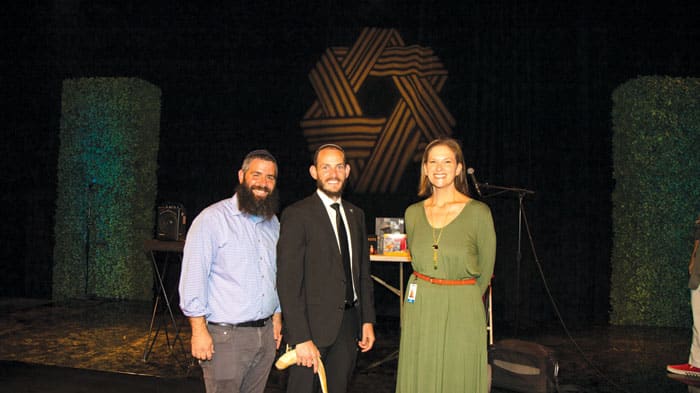
An Israeli wine tasting event at Kahal Joseph Congregation on Aug. 24 was a great success. (Photo above)


From left: Magen Am Community Organizer Levi Benjaminson; Magen Am President Rabbi Yossi Eilfort; and Adeena Bleich, vice president of community relations at Television City. Courtesy of Television City

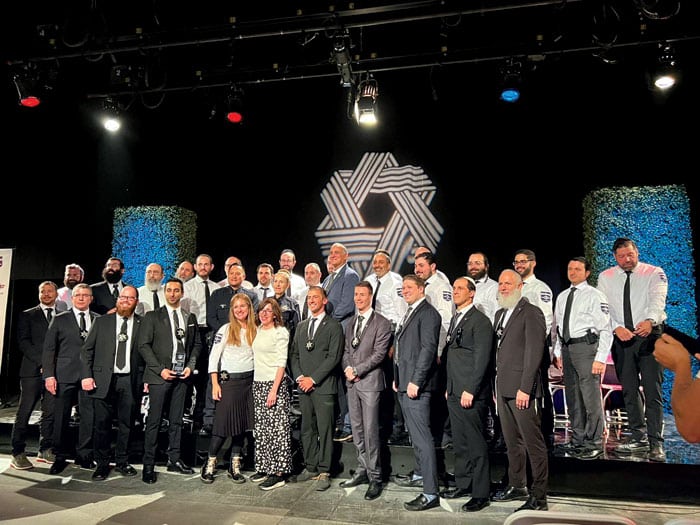
On Aug. 27, Television City hosted a graduation ceremony for Magen Am, a non-profit organization that provides security services to protect and empower the Jewish community in Los Angeles.

Magen Am graduates. Courtesy of Magen Am

More than 300 people, including local law enforcement professionals and residents of all ages, attended the ceremony held on Studio 36 at the iconic studio. As crime and antisemitism have continued to rise in Los Angeles — nearly 75% of all religiously motivated hate crimes target the Jewish people — Magen Am operates several training and awareness programs to empower communities to feel protected and secure.

The event celebrated members of the Jewish community who completed more than 100 hours of training and state licensing. The event also honored Assistant Commanding Officer of Operations-West Bureau Jonathan Tom and Josh Emrani, a local member of the Jewish community, with the Community Shield Award.

“We give it to people who have gone above and beyond for our community,” Magen Am Founder Rabbi Yossi Eilfort said.

Following the ceremony, there was a family fun day with a moon bounce, balloon sculpting, face painting and a BBQ for those in attendance.


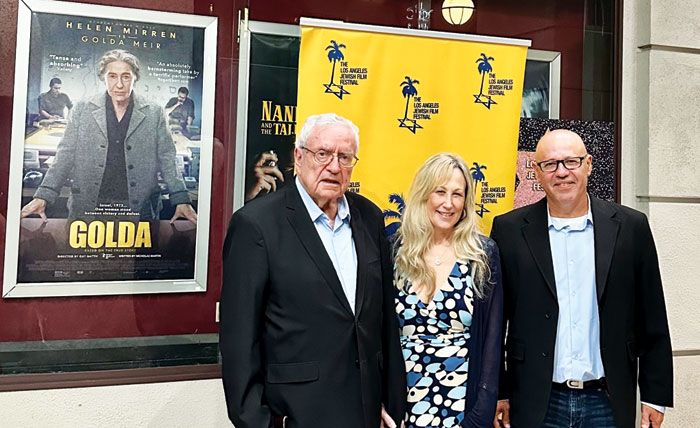
From left: Meron Medzini; L.A. Jewish Film Festival Director Hilary Helstein; and Mickey Medzini, son of Meron and his manager for public speaking engagements. Courtesy of LAJFF

The Los Angeles Jewish Film Festival (LAJFF) held a Aug. 31 screening for the film, “Golda,” at Laemmle Town Center. 

The evening included a rare Q&A session featuring 91-year-old Meron Medzini, who was director of the Israel Government Press Office and Golda Meir’s spokesperson, from 1973–1974. As Meir’s confidante, Medzini was also the consultant on the recently released film about the prime minister’s private affairs.


Miriam Wagmeister is joined by her sons, grandchildren and their partners on Aug. 27 at Chabad of Beverly Hills. Photo by Vince Bucci Photography

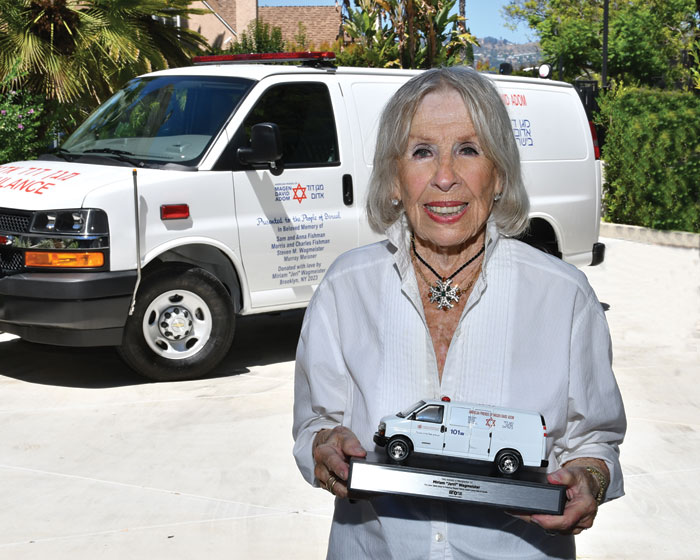
American Friends of Magen David Adom held an intimate celebration for Miriam “Jerri” Wagmeister, who sponsored a Life Support ambulance for Magen David Adom (MDA). Her sons, grandchildren and their partners gathered on Aug. 27 at Chabad of Beverly Hills to celebrate this meaningful donation.

Miriam Wagmeister receives an award presented by American Friends of Magen David Adom.
Photo by Vince Bucci Photography

Wagmeister has always been a supporter of Israel. For her, this ambulance serves as a loving tribute to the memory of her late parents, brothers, son, and husband. Her parents, Sam and Anna Fishman, emigrated to America from Russia in the early 1900s and raised a family of devout Jews. Although very poor, her family lived a life of hard work coupled with contentment and support for family and friends, and with the belief that “Jews should always try to help Jews.”

Her parents rejoiced at Israel’s independence. Sadly, they passed away young and never had the opportunity to visit Israel.

Wagmeister decided that the perfect, most meaningful way she could honor them would be to sponsor an ambulance. She is proud to know that her beloved family will always be a part of Israel, and to help Israelis in their time of emergency and need.

This gift comes during a vital period, as Magen David Adom is expanding its fleet of 1,400 ambulances with an additional 300 to prepare for a potential conflict between Israel and Hezbollah. The sponsored ambulance will be used as a mobile emergency room, where MDA EMTs frequently perform vital procedures from treating those injured in terror attacks, to performing CPR for those who need it, and helping new mothers welcome their babies into the world. Wagmeister hopes to inspire others through her philanthropy.

Wine Tasting, Magen Am Grads, Local Sponsors Magen David Adom Ambulance, Screening Read More »

Challah for the High Holidays

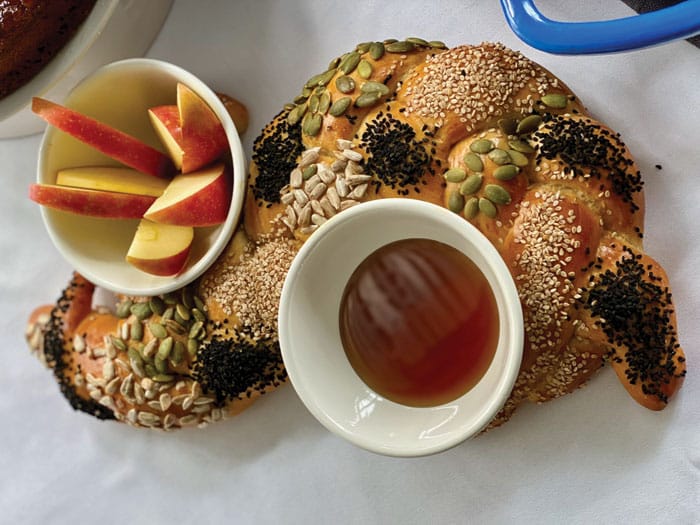
While many enjoy challah year-round, it’s a special part of the Rosh Hashanah celebration. We dip pieces of round challah, and apples, in honey for a sweet new year.

“This holiday challah was inspired by the beautiful loaves crafted by master Israeli baker Uri Scheft with a special, flavorful twist utilizing La Boîte spices,” Lior Lev Sercarz, owner of La Boîte, a global brand with a storefront in New York City and author of “A Middle Eastern Pantry,” told the Journal. Bowls of apples and honey complete the presentation.

“The challah is great for a crowd and the bowls can also be filled with tahini and other delicious condiments, as an alternative,” Lev Sercarz said. “You can change up the seeds to your favorite seeds, chopped nuts and bakeable spices.”

Holiday Challah

cup lukewarm water
1 Tbsp active dry yeast
¼ cup sugar
3 ¾ cups all-purpose flour
1 Tbsp extra-virgin olive oil, plus more for the bowl
1 tsp kosher salt
2 large eggs, at room temperature

The Toppings
¼ cup white sesame seeds
¼ cup nigella seeds
¼ cup sunflower seeds
¼ cup pumpkin seeds

Whisk the warm water, yeast and 1 teaspoon of the sugar (5 grams) in a medium bowl. Let stand until foamy, about 10 minutes.
Combine the flour, oil, salt, one of the eggs, yeast mixture, and the remaining sugar (45 grams) in the bowl of a stand mixer fitted with the dough hook. Mix on low speed, scraping the bowl occasionally, until the dough comes together in a firm, stretchy mass; about 7 minutes.
Turn out onto a clean work surface and knead to form a tight ball; about 2 minutes. Lightly oil the mixing bowl, return the dough to it, and cover with a clean kitchen towel. Let rise in a warm spot for about 1 hour until doubled in size.
Line a half sheet pan with parchment paper. Turn the dough out onto a clean un-floured work surface and divide it into 3 equal pieces (about 216 grams each). Roll each into a 20” long rope, pressing and rolling the ends to taper them.
Place two ropes parallel to each other, spacing them 3 inches apart. Cross the ropes once, leaving an inch free at the ends. Lay a third rope over the point at which the others cross.
Continue braiding the three ropes, tucking in the ends, then transfer the braid to the prepared pan.
Curl the two ends of the braid into an S-shape. Set a small bowl into each curve of the “S” and curl the ends around the bowls to secure.
Cover with a clean kitchen towel and let rise in a warm place until the volume increases by about one-third; about 45 minutes.
Meanwhile, position a rack in the center of the oven and preheat the oven to 400°F.
Beat the remaining egg with a few drops of water and gently brush it over the loaf to lightly coat.
Sprinkle sections with the sesame, nigella, sunflower and pumpkin seeds.
Bake until browned and well risen, 19 to 20 minutes. Cool completely on the tray.
Note: When removing the baked bread from the tray, be very careful as the bowl and bread will be heavy. Take care to support the ends to prevent breaking the bread and prevent the bowls from detaching.


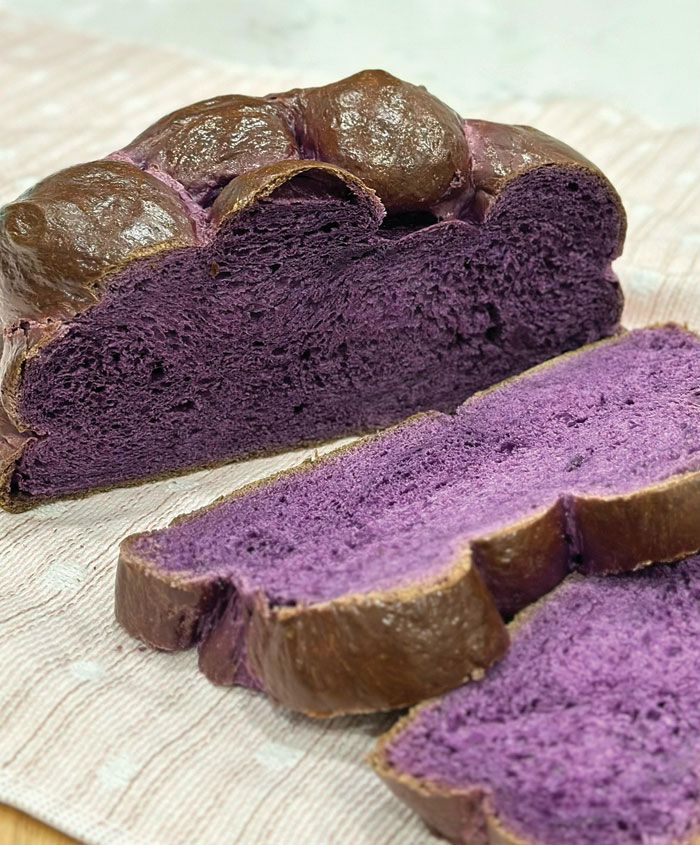
For another unique twist on the classic challah, try Bea’s Bakery’s Ube challah. Ube is a purple yam, originally from the Philippines, which turns the challah purple.

“It makes for a sweet and different flavor for the New Year,” Lenny Rosenberg and Adaeze Nwanonyiri, co-owners of Bea’s Bakery, told the Journal. 

Ube Challah
Photo courtesy of Bea’s Bakery

Ube Challah

The Challah:
1 ½ Tbsp dry active yeast
½ cup + 2 Tbsp + ½ tsp sugar
1 ¼ cup lukewarm water
4½ -5 cups unbleached bread flour
4 oz dehydrated ube powder
½ tsp sea salt
¼ cup vegetable oil
2 large eggs
2 tsp ube extract

The Topping:
2 egg yolks
1 tsp water

For the dough:
Place yeast, ½ tsp sugar and lukewarm water in a large mixing bowl. Stir and allow to bloom for 5 minutes.
Add sugar, oil, eggs and ube extract to the yeast mixture; mix until incorporated.
Add the flour, salt and ube powder to the wet mixture. Knead using the dough hook attachment of your mixer for about 10 minutes, until the dough is smooth and elastic.
Place dough in a greased bowl and cover with a damp towel. Allow to rise for about 2 hours.
Divide the dough into two. Then divide each half into three long strands. Braid the challahs and form into the desired shape. (Round for Rosh Hashanah.)
Place challahs on a baking sheet, lined with parchment paper. Allow the dough to rise (proof) for another 45 minutes.
Preheat the oven to 375°F while proofing.
For the topping: Beat the egg yolks and add 1 tsp water. Brush the egg wash over challah before you put it in the oven.
Bake for 25 to 30 minutes.


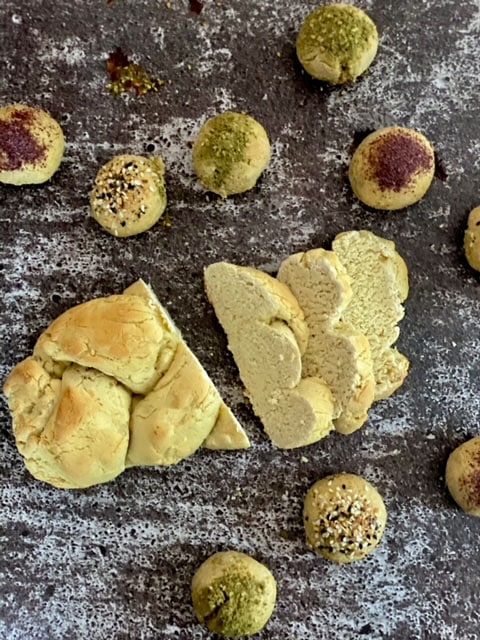
“Just because you can’t have gluten does not mean you can’t have some challah fun this holiday season,” Mandy Silverman, challah baker and founder of Mandylicious, told the Journal.

All of the ingredients in Silverman’s gluten-free challah are easy-to-find, so it is a great starter recipe. “While this dough does not taste the same as gluten full challah, it is still delicious,” Silverman said.  She added, “Please note gluten-free dough behaves very differently from traditional dough. This dough is shapeable and braidable, but it can be a challenge. Some people prefer using molds to bake their gluten-free challahs in and they work great.”

Gluten Free Challah courtesy of Mandylicious

Mandylicious Gluten Free Challah

Yeast Mixture:
1 ½ tsp instant or active dry yeast
¼ cup warm water (105 degrees … so pretty much should feel warm but not burn)
Pinch of sugar

Dry Ingredients:
160 grams gluten-free oat flour, plus more for kneading
130 grams measure-for-measure gluten-free flour, plus more for kneading
120 grams sugar (1/2 cup is fine)
3-4 Tbsp potato starch
1 ¼ tsp table salt
1 tsp baking powder

Wet Ingredients:
1/4 cup seltzer
2 Tbsp melted margarine or butter
1 Tbsp mayo
1 whole large egg, at room temperature
1 large egg yolk, at room temperature
1 1/2 tsp apple cider vinegar

Mix the ingredients for the yeast mixture and set aside.
Blend the dry ingredients together and slowly add the wet ingredients. If the yeast mixture is bubbly, you have successfully proofed your yeast! Add to mix.
Knead together gently until combined. Add more flour as necessary. (Using more measure-for-measure flour instead of oat flour will be better for the texture, as it is less heavy).
Divide into three equal sized pieces, roll out, and braid gently and carefully. Place in a greased loaf pan or lined cookie sheet.
Cover and rise in a warm place for 90 minutes.
Preheat the oven to 350°F.
Cover in egg wash, top as desired, and bake for 30-35 minutes.
Note: For extra moist challah, place a pan of water on the rack beneath the rack with your challah.
While this makes one challah, the dough can also be made into 12 rolls. For rolls, bake at 350°F for 20 minutes.


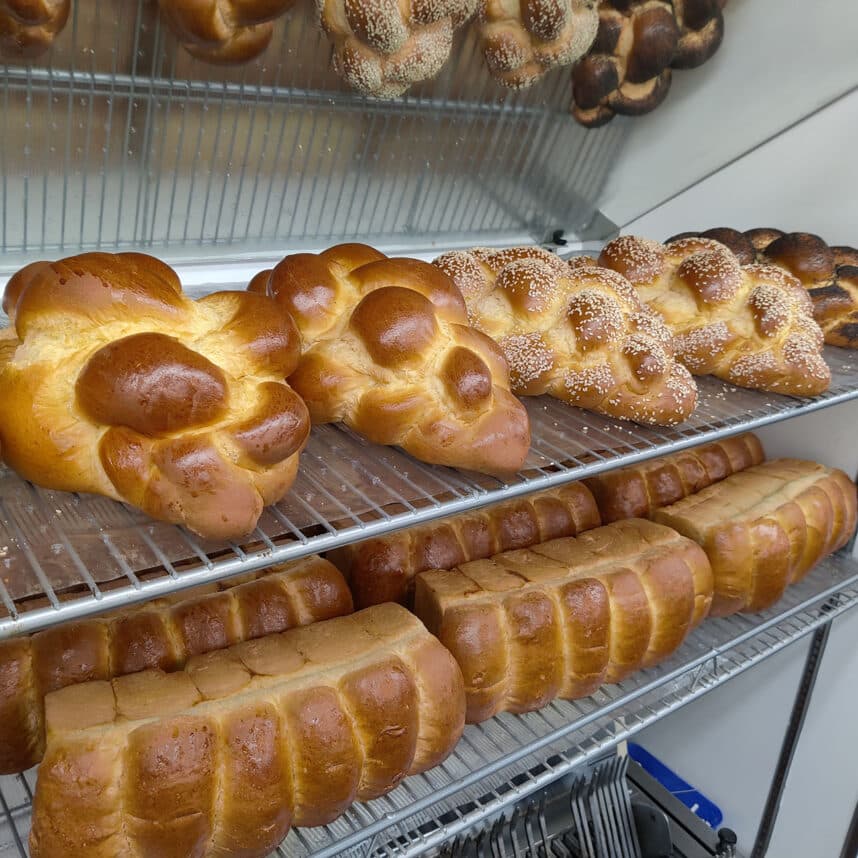
For a traditional challah, check out this recipe from Doug Weinstein, owner/steward of Diamond Bakery.

Challah, Chef Weinstein said, is his favorite thing to bake.


“When it comes out and it comes out well, it’s just beautiful and delicious,” he told the Journal.

Challah from Diamond Bakery

Chef Doug Weinstein’s Challah Recipe

8 cups all-purpose flour (if you use bread flour start with 7 ½ cups)

3 teaspoons salt

4 tsp dry yeast (2 packages)

5 eggs (4 for dough, 1 for brushing before baking)

½ cup vegetable oil

½ cup sugar

2 Tbsp honey

1 3/4 cup warm water

Mix flour and salt in a large bowl.

Combine water, eggs, oil and honey in a bowl, sprinkle the yeast on top and let the mixture sit for 5 minutes.

Add liquid to flour and mix into dough. Knead until smooth. It may feel sticky at first; allow time for the flour to fully absorb the water.  Once the dough comes together you can “rest” it in a lightly oiled bowl covered with plastic or a towel for 15 minutes then continue kneading.

Let the dough sit covered for 1 hour or until it has doubled in size.

Remove the dough from the bowl, de-gas (push out the air) and divide into 3, 4, or 6 equal parts, depending on what you know how to braid. Shape the parts into loose balls and let them sit for 15 – 20  minutes.

De-gas the dough again and shape it into strands. Braid into shape.

Brush the dough with an egg wash and let sit in an unlit oven until it has doubled in size again.

Remove from the oven and apply another egg wash. Turn on the oven to 375°F. When the oven is hot, put the shaped challah into the oven and bake until the internal temperature reaches 200°F when inserting a thermometer or until the challah is hazelnut brown.

Let cool and enjoy!

Challah for the High Holidays Read More »

Community Prepares for High Holy Days

Synagogues are turning to creative ways to attract community members to its High Holy Days services. 

The Reform congregation, Temple Judea, recently published a video that successfully parodies the infamous AMC promotional clip featuring actor Nicole Kidman discussing the merits of returning to in-person moviegoing.

In the approximately one-minute video, available for viewing on YouTube as well as the synagogue’s Instagram page, the congregation’s spiritual leader, Rabbi Joshua Aaronson, walks into the temple’s sanctuary, sits down at one of the many empty pews. A screen is lowered from the bimah, and clips of vibrant synagogue life are shown before his widening eyes. There’s dancing in the synagogue courtyard, a bar mitzvah reading from the Torah, a rabbi delivering a sermon, children in a religious school setting, a Purim spiel.

“Rituals [here] feel perfect and powerful,” the rabbi says. Then, looking into the camera, he adds, “because here—they are.”

While the Temple Judea video parodying the AMC video is intended to be playful, it conveys a serious message, Aaronson said.

“After the pandemic, we noticed that our synagogue had entered a period of growth. We realized that the impact of the pandemic had presented us with a unique opportunity: People who might not otherwise have sought out a synagogue have come to us looking for connection, for fellowship—for the kind of support you can only find in an established spiritual community.”

Synagogues across Los Angeles are busy with preparations for the High Holy Days, and, with the pandemic behind us, shul leaders are excited to welcome people back to in person services.

“After the pandemic and all the turbulence, we’ve been making moves to reinvigorate and shake off the dust of the past and shine in a productive way for the community and the synagogue,” Mishkon Tephilo Rabbi Joshua Katzan told the Journal in a recent phone interview. “We’re investing in our future by upgrading and updating, and we’re excited about trying to be more aligned with the 21st century, addressing the evolving needs of the Jewish community.”

Mishkon Tephilo is a Conservative congregation, based out of a 75-year-old, mid-century building in Venice, CA. Katzan was hired two-and-a-half years ago, during the pandemic, and he’s experienced the challenge of keeping people engaged in their spiritual communities with much competition vying for their attention. 

While he supports a person’s decision to tune in virtually to services, particularly if they have medical reasons for doing so, he believes there’s no replacement to connecting with others in person.

“Being in touch with people in person is more healing than being in touch with people over social media.” – Rabbi Joshua Katzan 

“Being in touch with people in person is more healing than being in touch with people over social media,” he said. “While online platforms certainly have their benefits and help us feel more connected, the goal ought to be moderating how much we turn to the app, the Instagram feed or TikTok video.”

“That’s the essence of Judaism, learning to self-regulate so we spiritually, ethically and emotionally flourish,” Katzan said.

Temple of the Arts was one of the few non-Orthodox congregations to continue holding in-person services during the pandemic. This year, in a continued effort to make its services accessible to as many as possible, the synagogue is providing complimentary entry to its High Holy Days services for members of Writers Guild of America and the Screen Actors Guild. Many of the people involved with congregation work in the entertainment industry, so it was important to consider financial challenges industry professionals are facing as they continue to be on strike, Temple of the Arts Rabbi David Baron told the Journal.

Additionally, as it does each year, the synagogue will be welcoming special in-person guests to its Yom Kippur services to share inspiring stories of heroism. This year’s speakers include Cristiano Zeledón, a former U.S. marine wounded in Ukraine while providing humanitarian aid, and 96-year-old Aron Bell, who was involved with an armed partisan detachment that rescued Jews during the Holocaust.

“I try to bring people who demonstrated in small and big ways acts of personal heroism in a dark hour,” Baron said. “To me they’re exemplars of the best of our selves.”

Community Prepares for High Holy Days Read More »

The Things We Know – A poem for Parsha Nitzavim-Vayelech

And their children, who did not know, will hear and learn…
          Deuteronomy 31:13

If you ask my child, he will confidently
tell you all the things he thinks you have
no possibility of knowing

as if knowledge began when he
came into the world, and he is
the very first person to hear about it.

It happens a lot when he discovers
a new delicacy, such as Doritos,
and then proceeds to extol its glories.

Have you tried Doritos, Dad he might ask
and then I’ll, for some reason, feel obligated
to launch into an explanation of how

snack foods existed when I was a child
and I have, indeed, tried all of them.
And then I’ll feel guilty that I hadn’t

previously taught him about Doritos
and wonder what other gaps in
parenting, I may be guilty of.

Does he even know what Twinkies are?
The word Twinkie, as far as I can remember
hasn’t come up once since he was born.

I managed to get him to like the Beastie Boys
which felt like an important parenting milestone.
So much of what I know, if not all of it

was given to me by someone who knew it
before I did, and I suspect those people
weren’t the first to know it either.

This is what we do – take the things
we were told, and tell them to the next ones.
This is what makes the planet

spin in a circle
and twirl around the sun
as I was told it does.


Rick Lupert, a poet, songleader and graphic designer, is the author of 27 books including “God Wrestler: A Poem for Every Torah Portion.

The Things We Know – A poem for Parsha Nitzavim-Vayelech Read More »

A Bisl Torah – Shipwrecked

I am rereading my favorite High Holy Day books. Fortuitously, I came across a beautiful passage in Judah Goldin’s introduction to Agnon’s High Holy Day anthology: Days of Awe. Here I share a treasure with all of you:

“But to be perfectly honest, we are all shipwrecked, and ultimately it has little to do with Hebrew or English or Esperanto for that matter. Start thinking of the mess we so frequently make of our lives, and words fail: no words seem to express exactly the deep regrets we want to feel and all the heartache we must learn to put up with. Suddenly we envy the originality of that brilliant countryman who, lost in the woods on Yom Kippur, without a prayer book to his name, recites the alphabet and directs it skyward: it’s beyond me God; You combine these letters into the right words and sentences, for You know what I want to say.”

Sometimes passages choose you. Our lives are filled with tragedy and joy, uncertainty driving each waking minute. Some hopes feel irrevocably lost. Some accomplishments are beyond imagination. Our hearts burst, shatter, break and heal. And through it all, we search for ways to remain connected to the Divine. Revealing our purpose and holding us close.

In this new year, we share in the commonality of being shipwrecked. We all feel a little lost, frozen, unable to call for help. But God hears you. Rest assured; your words pierce the heavens.

Pray. Cry. Shout. Laugh. Sing. Or be silent. God is listening to every word.

Shana tovah


Rabbi Nicole Guzik is senior rabbi at Sinai Temple. She can be reached at her Facebook page at Rabbi Nicole Guzik or on Instagram @rabbiguzik. For more writings, visit Rabbi Guzik’s blog section from Sinai Temple’s website.

A Bisl Torah – Shipwrecked Read More »

Recycled Minds: How Doors Opened for Nazi Scientists Around the World

For more articles from The Media Line, click here.

In the 13th episode of The Media Line’s Spanish-language podcast, Medio Oriente 123, host Debbie Mohnblatt is joined by Ariel Gelblung, director of the Simon Wiesenthal Center’s Latin American branch.

German scientists and engineers who once worked for the Nazi war machine later powered some of the world’s leading post-war achievements, says Ariel Gelblung, director of the Simon Wiesenthal Center’s Latin American branch.

“We cannot understand the arrival of man to the moon and the development of NASA without persons like von Braun being ‘recycled,'” Gelblung told The Media Line.

Wernher von Braun was an aerospace engineer and space architect and a member of the Nazi party and Allgemeine SS. He led Nazi Germany’s rocket development program before the Second World War and helped develop its V-2 rocket, the world’s first long-range guided ballistic missile, during the war.

After the war, von Braun was among 1,600 German scientists, engineers, and technicians who were secretly moved to the United States for government employment. He worked on a ballistic missile project for the US Army and developed the rockets that launched the US’s first space satellite in 1958. Two years later, his group was merged into NASA and he became director of the new Marshall Space Flight Center and the chief architect of the Saturn V launch vehicle that sent the Apollo spaceship to the moon.

Gelblung said that after Germany’s defeat in the war, an entire cohort of Nazi scientists, doctors, and engineers remained, and, rather than face war crimes trials for their activities during the war, many searched for new homes, identities, and professions. The developing US-Soviet rivalry gave them a golden opportunity.

“The Cold War’s biggest winners were the Nazis,” Gelblung said, citing the Nazi hunter Simon Wiesenthal.

The US and the Soviets both sought German expertise.

The Americans justified this by saying it was necessary to combat a new enemy, the Soviet Union. US recruiters often distinguished between German scientists and engineers and the German soldiers and administrative staff who worked in concentration and extermination camps.

As the Americans and the Soviets quietly opened their doors to Nazi minds, Latin America also proved to be a popular haven for thousands of Nazis, especially Argentina.

Influential people in Latin America often had “similar ideologies” to the Nazis, Gelblung said.

In 1946, right-wing populist politician Juan Domingo Perón became Argentina’s president. Soon afterward, members of Perón’s government, including his secretary, Rodolfo Freude, and his director of migration, Santiago Peralta, facilitated Nazi resettlement in Argentina. The so-called “ratlines” enabled thousands of Nazi party members to be smuggled out through ports in Spain and Italy to Argentina.

Perón was ideologically opposed to the Nuremberg war crimes trials, believing that the Allies’ victory did not entitle them to judge the losers.

However, Perón was mostly interested in taking advantage of Nazi skills, Gelblung said.

He said Perón had contacts with someone he called “the doctor,” likely to be Josef Mengele, the Nazi physician who conducted infamous experiments on people at the Auschwitz concentration and death camp.

Perón’s government also found resources in Kurt Tank, a Nazi engineer who helped develop Argentina’s aerospace industry, and Ronald Richter, an Austrian-born German scientist who promised Perón he could help Argentina develop nuclear energy.

Perón constructed an entire complex near the city of San Carlos de Bariloche and gave Richter “all the money he needed,” Gelblung said. Still, Richter never produced anything of value.

Perón’s health minister hired Carl Peter Vaernet, a Danish doctor and Nazi party member who conducted medical experiments on men at the Buchenwald concentration camp, attempting to “cure” homosexuality by injecting them with hormones. He continued his hormone research work in Argentina with funding from the country’s health ministry.

Another infamous Nazi who arrived in Buenos Aires was Adolf Eichmann, the notorious architect of Hitler’s “Final Solution” for the Jews.

Simon Wiesenthal, a Holocaust survivor and famed Nazi hunter who passed away in 2005, helped locate Eichmann, who was living on the outskirts of Buenos Aires under the name “Ricardo Klement.”

The Argentinian government had consistently refused to extradite Nazis to Israel. In 1960, Israel’s intelligence agency, in a daring raid, the Mossad kidnapped Eichmann and brought him to Israel for trial. He was found guilty and was sentenced to death in 1962, the only judicial death sentence ever carried out in Israel.

Eichmann’s prosecution had a huge impact in Israel and around the world, mainly because his trial offered Holocaust survivors an unprecedented opportunity to voice their testimonies in public. The broad international coverage of the trial helped counter efforts at Holocaust denial.

But in Argentina, it sparked a neo-Nazi resurgence focused on Israel’s violation of Argentina’s sovereignty.

Some sympathizers even created neo-Nazi para-police units that valorized the Nazis as heroes.

Today, the Wiesenthal Center in Latin America is continuing Wiesenthal’s work and adapting it to modern issues, including fighting racism, anti-Semitism, discrimination, xenophobia, and terrorism.

Gelblung said this is what Wiesenthal would have wanted.

Recycled Minds: How Doors Opened for Nazi Scientists Around the World Read More »

Troop 360’s Orthodox Jewish Scouts Develop Essential Life Skills

Troop 360 offers the opportunity for Orthodox Jewish boys and girls, ages 11 to 17, to develop life skills while having a good time.

“Scouts don’t come in with that mindset of, ‘I’m going to become a better person, a more moral person, a more trustworthy person,” said Dr. Noah Blumofe, leader of girls troop 360. “But it happens, because that is just the overall superstructure of scouting.”

“You’re learning practical skills, fun skills and skills about respect for others,” Hall Schloss, who has been leading the boys troop for 20 years, told the Journal.

A Shomer Shabbat/Kashrut scout troop, 360 has been around since 2001.

When Schloss was growing up, his Scout opportunities were limited. He joined a Boy Scout Troop based out of a public school in Beverly Hills, where nobody was shomer Shabbat or kept kosher.

“As a religious Jewish kid, advancing in Scouts wasn’t possible,” Schloss said. “When my son became interested in Scouts, I got involved. I stay involved because I like camping, and I want other people — young adults or children — who want to become Scouts to get the opportunity I didn’t have.”

In 2019, when Boy Scouts became BSA and admitted girls, Blumofe, whose son was working toward Eagle Scout, was “voluntold” to be scout master of the girls’ troop.

“When Hal mentioned to me that scouts were allowing girls to enter in 2019, my wife, Sandy [overheard and] said, ‘You’re going to be the scoutmaster,’” Blumofe said. “I had one more daughter who was eligible, who would have been interested. She joined and was the fourth Eagle Scout in the troop.”

Troop 360 has had six young women make Eagle Scout, including the first Orthodox Jewish female Eagle Scout in history, Gabbi Stein.

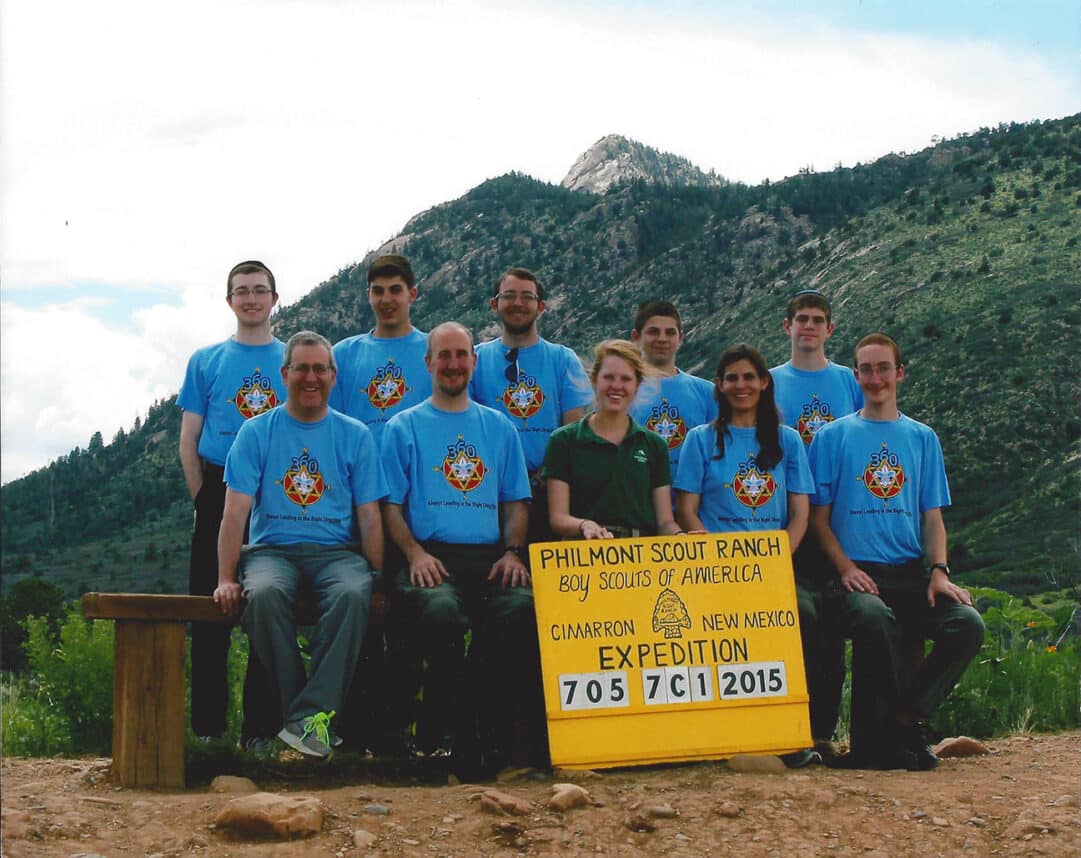
Trip to the Philmont Scout Ranch in New Mexico in July 2015. Front row, Left to Right: Hal Schloss, Sanford Weinberg, Philmont Ranger, Sheila Keiter, Chaim Weinberg
Back Row: Left to Right: Eli Gross, Adin Keiter, Jacob Elspas, Ben Tarko, Yaakov Sobel

“Being part of BSA has changed my life,” Stein told the Journal. “My time with Troop 360 gave me opportunities for growth and leadership, which has definitely made me feel prepared and confident for adulthood.”

Added Rachel Blumofe, “Scouting taught me to be proud of my religion. It helped me thrive as a Jew, while also testing my own faith.”

To become an Eagle, a scout must complete the requirements for several earlier ranks and earn a number of merit badges in a variety of subjects, and then decide on a project to benefit a nonprofit or other public entity. They must submit a project plan, get it approved and recruit others to help. After supervising the project through completion, the prospective Eagle Scout must present a written report on the project to a group of adults.

“The Eagle Scout project is really a lesson in project management for these young people,” Schloss said. “It’s the sort of thing that is taught in business school. It’s not really necessarily taught in college or high school; these people are learning to organize others, to plan a project that benefits some organization.”

He adds, “These are real skills that these kids are learning. It may not be what motivates them to join, but when they complete the program, they’ve learned some real life skills along the way.”

“These are real skills that these kids are learning. It may not be what motivates them to join, but when they complete the program, they’ve learned some real life skills along the way.” – Hal Schloss

While Eagle Scout is the highest rank a scout can achieve, the scoutmasters believe it’s really the middle of their journey.

“I tell my Scouts this is not the end; this is only the next step,” Blumofe said. “Eagle Scout just says, ‘I made it to a point where I demonstrated my reliability and my trustworthiness. … You are going to use this to help others grow in life, whether it’s within the troop or beyond the troop.”

Schloss says they are mainly looking for 11- to 15-year-olds to join, since 16- and 17-year-olds have a limited window to make Eagle Scout. Scouts is an opportunity to have an adventure, while stepping outside your comfort zone.

“These kids get to do fun things and meet interesting people and have experiences they’re not going to have in an Orthodox day school,” Schloss said.

As an observant troop, the girls and boys of Troop 360 meet separately, but many events are together and supervised.

“I enjoyed my time in scouting because of the friends I’ve made and the fun opportunities it’s given me,” Hannah Grinblat told the Journal. “From learning to scuba diving to sailing a boat, scouting taught me skills I never would have learned otherwise.”

Jacob Elspas said that scouting was the highlight of his teen years and helped him grow socially and physically.

“Even though we were shomer shabbat and shomer kashrut, we got to experience all the same things other scouts did including Boy Scout camp and even a week long backpacking group in Philmont New Mexico,” he said. “Troop 360 imbued Jewish values, community responsibility and a love of nature that I carry with me till today.”

Scouting and Judaism seem to go hand in hand.

“Scouting in general believes that we have a higher power above us at all times, and that’s incorporated into how you live your life,” Blumofe said. “In Judaism, our religion is every law you can possibly think of plus three more laws. It does go hand in hand. If you want to live a moral life, follow these rules. If you want to live, become a good person, follow the rules of scouting. They do go together.”

Troop 360 will be hosting an open house on September 10 from 4 to 6 p.m. If you’re interested in learning more about the boys’ or girls’ troop, email scoutmaster@bhtroop360.org.

Troop 360’s Orthodox Jewish Scouts Develop Essential Life Skills Read More »

Print Issue: Bringing Back the Truth | Sep 8, 2023

CLICK HERE FOR FULLSCREEN VERSION

Print Issue: Bringing Back the Truth | Sep 8, 2023 Read More »

Healthy High Holiday Recipes

While High Holy Day meals tend to feel overwhelmingly rich, they don’t have to be. 

Here are some options for a lighter Rosh Hashanah meal.

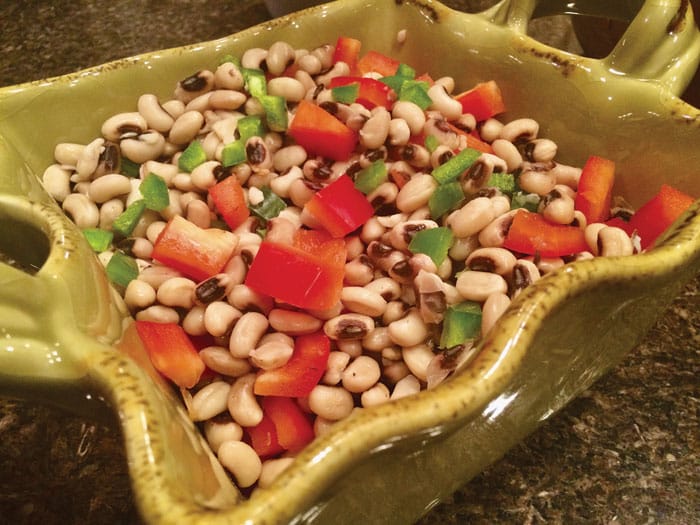
Chef Judi Leib’s Hoppin’ John recipe incorporates her southern heritage into the Jewish holidays.

“Black-eyed peas are in fact mentioned in the Talmud as a symbol of prosperity.” – Judi Leib

“I found out that black-eyed peas are in fact mentioned in the Talmud as a symbol of prosperity,” Leib, founder of Whisk in the Southern, told the Journal. “That is certainly what they are used for at the secular New Year’s, so I think it’s really nice to be able to incorporate that into the Jewish calendar as well.”

While Leib’s recipe is on the healthier side, you can lighten up the meal even more by serving it over greens instead of rice. “You could also use chicken instead of brisket,” she said.

Hoppin’ John

1 cup dried black eyed peas, soaked overnight
4 cups chicken broth
1 ½ lb smoked brisket, cut into medium chunks
½ large onion, diced
1/2 large green or red pepper, diced
2 cloves garlic, minced
2 tsp Old Bay seasoning or Cajun blend
2 Tbsp neutral oil, like canola
½ tsp kosher salt
½ tsp fresh ground pepper
2 cups long grain rice, cooked

Soak black eyed peas in 2 cups of chicken broth, overnight, in the refrigerator.
Let come back to room temperature when ready to cook.
While bringing peas back to room temperature; heat one tablespoon of oil in a skillet and cook onion, bell pepper and garlic until just soft.
Add this to the pot with the peas. Stir in Old Bay seasoning.
Add brisket pieces and remaining liquid and bring to a boil.
Cook for 30-45 minutes. You want to make sure peas don’t get mushy, they should be al dente.
Wash rice thoroughly. You want to release all the starches. Then cook rice until just tender.
Stir rice into peas and taste. Add salt and pepper, if needed.
Cover pot with a piece of aluminum foil and then lid.
Cook for an additional 15 minutes. Test rice for doneness and remove from heat.
Allow to rest, covered for 10 minutes.
Fluff with a fork and serve alongside challah and greens.


Faith Kramer’s Roast Salmon with Citrus-Honey Sauce is a great choice for High Holiday meals. It’s a lighter, satisfying dish that can easily be prepared ahead of time. 

“Since the marinade and sauce include honey, symbolic of our wish for a sweet New Year, the dish adds flavor and meaning to the Rosh Hashanah table,” Kramer, author of “52 Shabbats,” told the Journal. “And fish is eaten during the holiday as a symbol of luck, innocence and fertility.” She added, “For the best taste and to support the environment, choose wild or sustainably raised salmon. Try using the optional Sichuan peppercorns, the dried husks of prickly ash seeds, to add a mild, pleasant tingle. Crush them lightly in a mortar and pestle or with a meat tenderizer mallet before using. If you are worried about their intensity, start with 1/2 teaspoon and add more if desired.” 

Roast Salmon
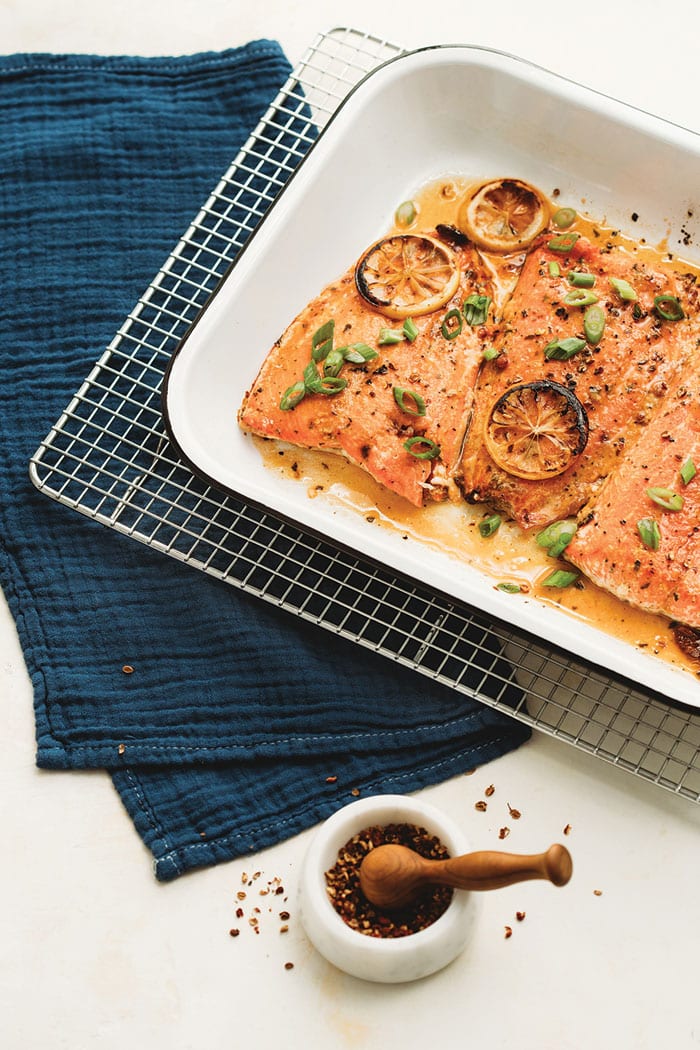
Photo by Clara Rice from 52 Shabbats

Roast Salmon with Citrus-Honey Sauce 
Adapted from “52 Shabbats: Friday Night Dinners Inspired by a Global Jewish Kitchen” (The Collective Book Studio)
Serves 4 to 6 as a main course, or 8 to 10 as a starter

1/3 cup fresh orange juice, blood orange juice, or tangerine juice
½ cup honey (see notes)
½ tsp dried mint
¼ tsp salt
¼ tsp cayenne pepper or paprika
¼ tsp ground black pepper
½ to 1 tsp Sichuan peppercorns, lightly crushed, optional (they are available in spice stores, Asian and specialty markets, as well as online)
Vegetable oil for the baking sheet
1 ½ to 2 pounds salmon filet
6 Tbsp thinly sliced green onions

In a small bowl, mix together the orange juice, honey, mint, salt, cayenne, black pepper and crushed Sichuan peppercorns (if using) to make a marinade. Set aside half of the marinade to use later for the sauce.
Grease a rimmed baking sheet with oil. Place the salmon, skin side down, in the pan and brush the top of the salmon with some of the marinade. Let sit for at least 30 minutes or up to 60 minutes, brushing often with the marinade.
Preheat the oven to 350°F.
While the fish is marinating, pour the reserved marinade into a small saucepan over medium heat and bring to a boil. Lower the heat and simmer, uncovered, stirring occasionally, until the liquid is reduced by two-thirds, 15 to 20 minutes. Taste, and adjust the salt and other seasonings, if desired. Set the sauce aside for serving.
Brush the fish again with its marinade. Roast salmon for 15 to 20 minutes, basting with the pan juices after 10 minutes, until the salmon is cooked to the desired doneness. For fully cooked fish, it should read 145°F when an instant-read thermometer is placed in the thickest part of the filet. The flesh should be opaque all the way through but still be very moist.
To serve, transfer the salmon to a platter and spoon the sauce over the fish. Sprinkle with green onions and serve warm, at room temperature, or chilled.
Note: Choose a mild-tasting, light-colored honey.
The fish and sauce can be made up to 2 days ahead and refrigerated separately in airtight containers.


“Rosh Hashanah is a time of renewal, as well as setting intentions for the new year,” Dawn Lerman, author of “My Fat Dad,” told the Journal. 

Lerman’s almond flour honey cake is a nutritious and delicious alternative to those oh so rich holiday desserts.

“By adding a modern twist to traditional favorites, we continue to honor our ancestry while also modeling elevated habits for the ones we love,” she said. “In the words of my beloved grandmother, Beauty, ‘Our body is the only temple we live in full time, so let the foods we love love us back.’”

Honey Love Photo by Dawn Lerman

Honey Love for a Sweet New Year

½ Tbsp butter for pan (or coconut oil spray)
4 large eggs
1/3 cup honey
1 Tbsp vanilla extract
¼ cup orange juice
1 ½ cups almond flour
¼ tsp salt
½ tsp baking soda

Preheat your oven to 350°F.
Generously grease an 8-inch nonstick cake pan.
In a large bowl, lightly whisk the eggs.
One by one, gradually whisk in the honey, vanilla, orange juice, almond flour, salt and baking soda.
Transfer the batter into the prepared pan.
Bake until golden and set, and a toothpick inserted in the center comes out clean, approximately 25 minutes.
Cool the cake in the pan on a cooling rack for 10 minutes. Then invert it onto the cooling rack and cool before slicing and serving.
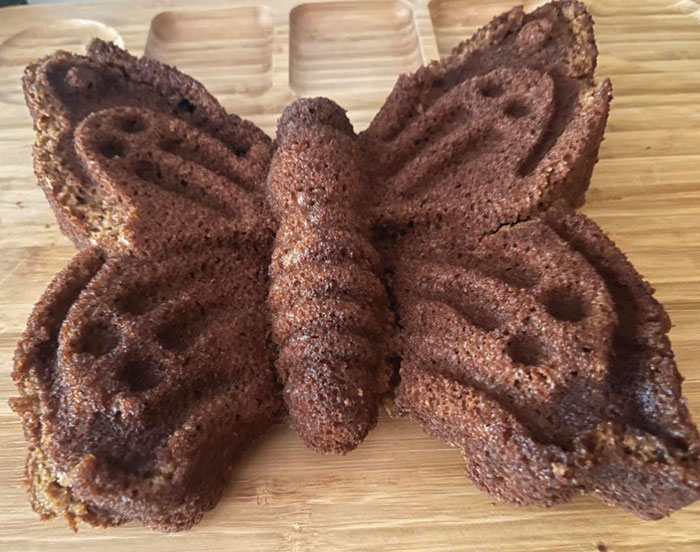
Feel free to use a fun mold – like the butterfly mold pictured — especially when you are having kids at your gathering.
You can serve with baked apples or crushed pistachios.

Shana Tova!

Healthy High Holiday Recipes Read More »

The Sweetness of Remembrance

The holiness of Rosh Hashanah permeates the air. The candles burn brightly. We are all dressed in white. The table is covered with a white tablecloth, bedecked with flowers, apples and pomegranates and set with my mother’s beautiful pink and green floral English fine bone china. Each person has their own “seder” plate on which the blessings will be recited. First in Judeo-Arabic (an ancient language that predates Muslim rule in Babylonia), second in Hebrew and finally in English. The “Iraqit” reminds me of my great-grandparents and my grandparents whose ancestors lived for centuries in Baghdad and Al-Azair (where the tomb of Ezra the Scribe is located). The ancient Talmudists, who composed the Yehi Ratzon prayers and centered them around the foods that grow in abundance at that time of the year, lived in that region too. 

On our plates are kar’a (stewed squash) and lubiyah (very long green beans), ruby red pomegranate and apple jam flavored with cardamom. There are spinach and leeks that will be ferociously ripped, to symbolize the tearing of any bad decrees and the destruction of our enemies. There are fresh yellow dates (bittersweet because they are my fathers favorite and this year will be our first Rosh Hashanah without him). 

There will be a beef neck bone to symbolize “Akeidat Yitzchak” (sacrifice of Isaac). There will be red wine and round challah and lots of honey for a sweet New Year!

—Sharon 

Every Rosh Hashanah we look ahead to a new year filled with blessings and good health. But for me when the high holidays arrive, all I can do is look back. Perhaps it is age. Perhaps it is because I write about food and history every week. Perhaps because I lost my mother this last year, I want to hold onto every memory possible. I think back on what I grew up eating, on the lessons my parents taught me and what I want my children to carry forward. 

Tradition and memory influence my cooking and my way of life. But I’m not the only one who feels this way. Whenever Sharon and I post a typical, traditional old school Sephardic recipe on social media, we always get a huge reaction. So many people thank us for recording these recipes and keeping these memories alive. For many of our readers and followers, food transports them to the kitchens of their mothers and grandmothers. 

Food is what connects us to our past, to our roots, to our traditions. There’s pure joy in the memory of tasting something that reminds us of something our mothers or grandmothers made when we were little. Many of us come from families that only one or two generations ago were displaced from their homes in the Middle East, in North Africa, in Europe, so food is a direct connection to the past, a direct line to the soul. 

I feel blessed to share some of my family’s Spanish Moroccan culinary traditions for Roshana, (as Sephardim call it), as well as the flavors of my husband’s Rodesli background.

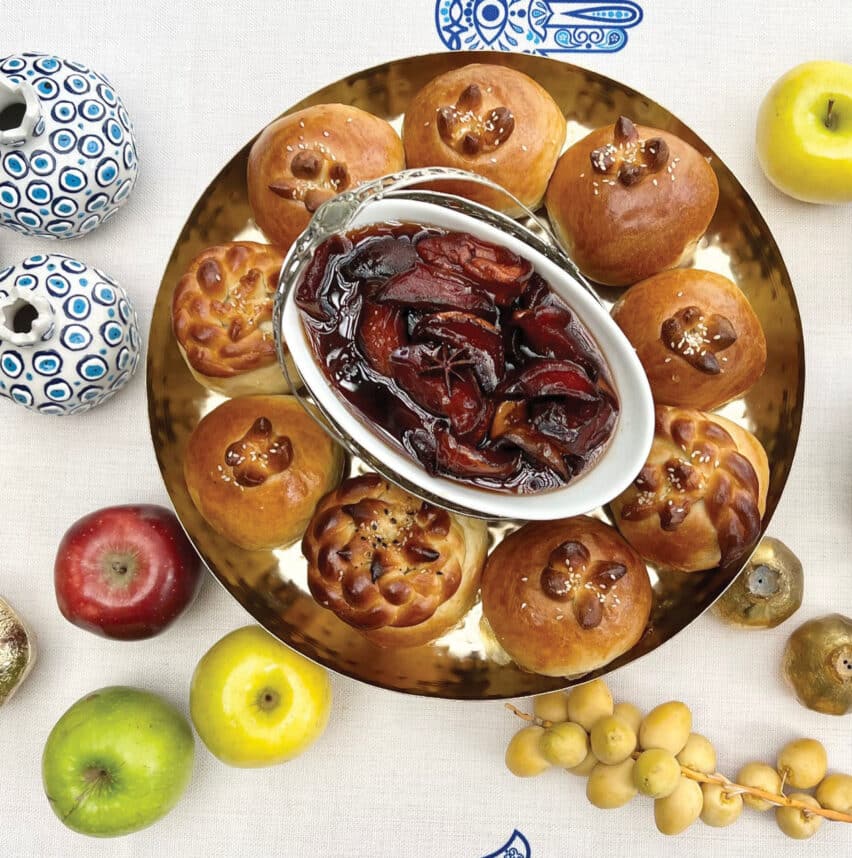
I always make “Dulce de Membrillo” (candied quince).  Candied fruits and jams were a huge part of the “sweet table” in Morocco. My grandmothers made all sorts of preserves: fig, orange, quince, raisin, grapefruit. My mother would also make preserved fruits but as life in America became busier and health became a focus, she only made jams for the holidays. Candied quince was always on the table. The slices of exquisitely sweet fruit (which resembles an apple) were used as part of the blessings for the “simanim,” or “bocados” (bites) as they are called in Spanish.

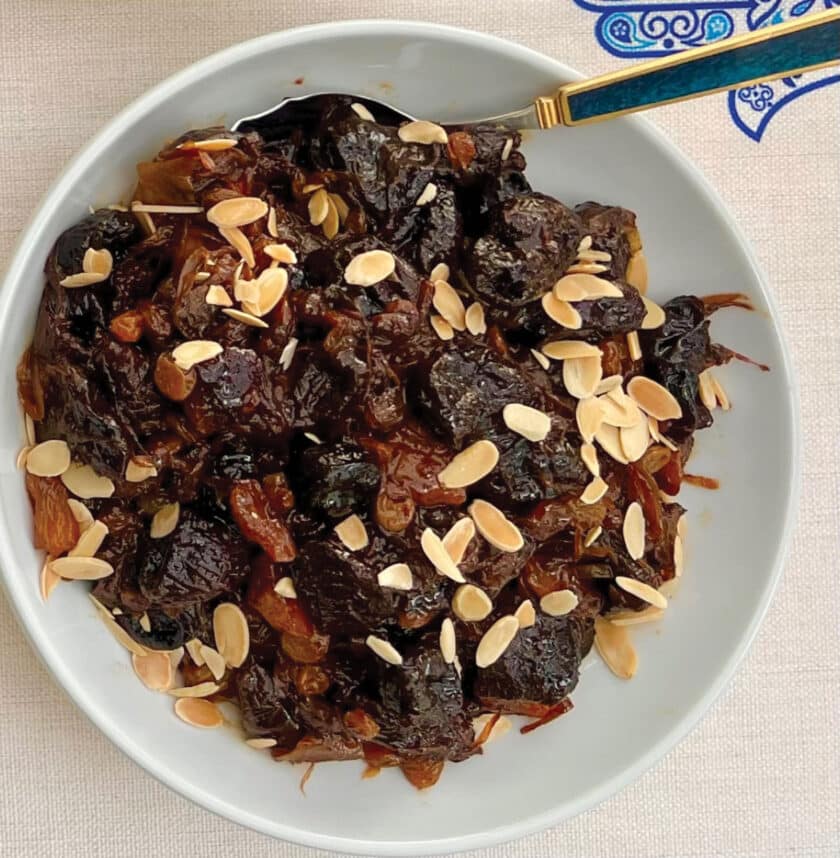
Another sweet dish that was always on the table for special occasions and High Holy Days was made with prunes, caramelized onions, raisins and chopped up apricots. The apricot was my mother’s innovation, and this sweet and savory compote usually topped the festive couscous. This dish also serves as a fabulous accompaniment to brisket, roast beef, chicken and rice (and is amazing with lamb on Passover). While Moroccans do have a sweet tooth, this is a dish that everyone will love. I fondly remember packing a box  every Roshana for Neil’s aunt Sylvia (who came from Rhodes)

When I married Neil, his Rodesli traditions became entwined with those of my family. 

On the second night of Roshana, Neil reads all the “Yehi Ratsones” (blessings) in Hebrew, English and Ladino. He goes around the table, calling on each of the children to read. This lightens up the evening, giving our guests many laughs, as each one reads the unfamiliar Ladino words, struggling to pronounce them correctly. Even if our kids only learn a few words, it’s a precious way to keep the Ladino language alive in our family. It’s a memory they will always recall with a smile.

Both our families have the tradition of placing a small bowl of sugar on the table. On Roshana, we  dip the “ha’motzi” in salt (to commemorate our eternal bond with G-d), then we dip the bread in sugar (for a sweet year). My mother always added anise (fennel seeds) on top of the sugar to add a beautiful aroma. Rodeslis save this sugar all year and if, G-d forbid someone has a bad scare or injury, you give the person a glass of water with a spoonful of the Roshana sugar stirred in to drink. “Agua kon asucar para quitar espantos” water to take away the effects of scares. Neil is always pushing this “potion” on us all, whether we want it or not, after any scare. Whether it be an earthquake, witnessing an accident, or any myriad of surprises life throws our way during the year — the Roshana sugar with water will make it all better. And so that’s what we’ve done since our very first Roshana together.

So while you look forward to your hopes and prayers for a sweet new year, take a moment to reflect on your past. What are the traditions that your family celebrated and passed on to you. I hope you preserve the sweetness of those memories and that they will carry you and your family into a wonderful year ahead and for always. 

Shana Tova U’Metuka! Anyada Buena y dulse! To a good and sweet year!

—Rachel

Many of us come from families that only one or two generations ago were displaced from their homes in the Middle East, in North Africa, in Europe, so food is a direct connection to the past, a direct line to the soul. 

Silan Stovetop Brisket

Traditional Babylonian dishes for the holidays would include semolina kubbah stuffed with ground lamb in a sweet and sour broth with okra and ma’hasha, a colorful array of meat and rice stuffed grape leaves, zucchini, tomatoes and onions. There would be moist chicken slow simmered in a fresh broth and pilau b’jij, a chicken and red rice dish garnished with crispy caramelized onion, slivered almonds and golden sultanas.

These dishes still grace my family table. But there is nothing easier and more delicious and crowd-pleasing than a brisket slow cooked with onions and potatoes. 

This recipe gets great flavor from the spice rub and is really easy to prepare. In a nod to the simanim, I added Silan, a pure date honey, which lends just the right sweet, smoky notes to the meat. 

Best of all it’s cooked on the stovetop, saving that precious oven real estate for your other dishes. 

—Sharon 

1 (4lb) brisket

Spice Rub

2 Tbsp sweet paprika

1 Tbsp smoked paprika

1 Tbsp mustard powder

1 Tbsp garlic powder

1 Tbsp coarsely ground black pepper

1 Tbsp brown sugar 

1 Tbsp chicken consommé powder

Meat

2 Tbsp avocado or vegetable oil

2 large onions, peeled and chopped into eight wedges

10 cloves garlic, chopped

6 large potatoes, peeled and chopped into long wedges

2 cups red wine

2 cups water 

2 Tbsp Silan (pure date syrup)

2 teaspoons salt 

Preheat oven to 300°F.

In a bowl, combine spices, brown sugar and consommé to form a rub.

Sprinkle spice rub on both sides of the brisket.

Heat a wide, heavy bottomed pot over medium heat and add oil. Add the brisket and sear for five minutes. Flip the brisket and sear the other side.

Add the onions, garlic and potatoes around the brisket, then sauté for another five minutes.

Add the wine, water, Silan and salt and bring to a boil.

Lower the heat to a gentle simmer, cover the pot and cook for 3 to 4 hours until the meat is fork tender. 

Let meat rest, then remove from the pot and slice. 

Return the sliced meat to the pot and serve with juices. 


MEMBRILLO-CANDIED QUINCE
10-12 small quinces

1 lemon, sliced

3-4 cups sugar

Juice of 1 lemon

Cinnamon stick or 2 tsp ground cinnamon (optional, to taste)

10-12 cloves (optional, to taste)

2 star anise (optional, to taste)

Juice of a small lemon


Wash quinces well, cut into slices, leaving skin on.

Place in large bowl with cold water and 1 lemon cut into slices.

 In heavy-bottom pot, place sugar and juice of 1 lemon.

 Discard water and place cut quinces into pot on top of sugar, stir to coat all slices.

 Add cinnamon, cloves and star anise, cover pot, cook over medium heat.

 As sugar and juices combine, stir from bottom up every 10 minutes.

 After 30 minutes, reduce to simmer and cook 2 hours.

 Uncover and cook additional 30 minutes so liquid starts to evaporate and thicken into syrup. Quinces will be dark red. (If there’s leftover syrup, it can be added to dafina (cholent), cocktails or atop ice cream.)

 Refrigerate up to 1 month.


Sopa de Roshana – Simanim Soup 
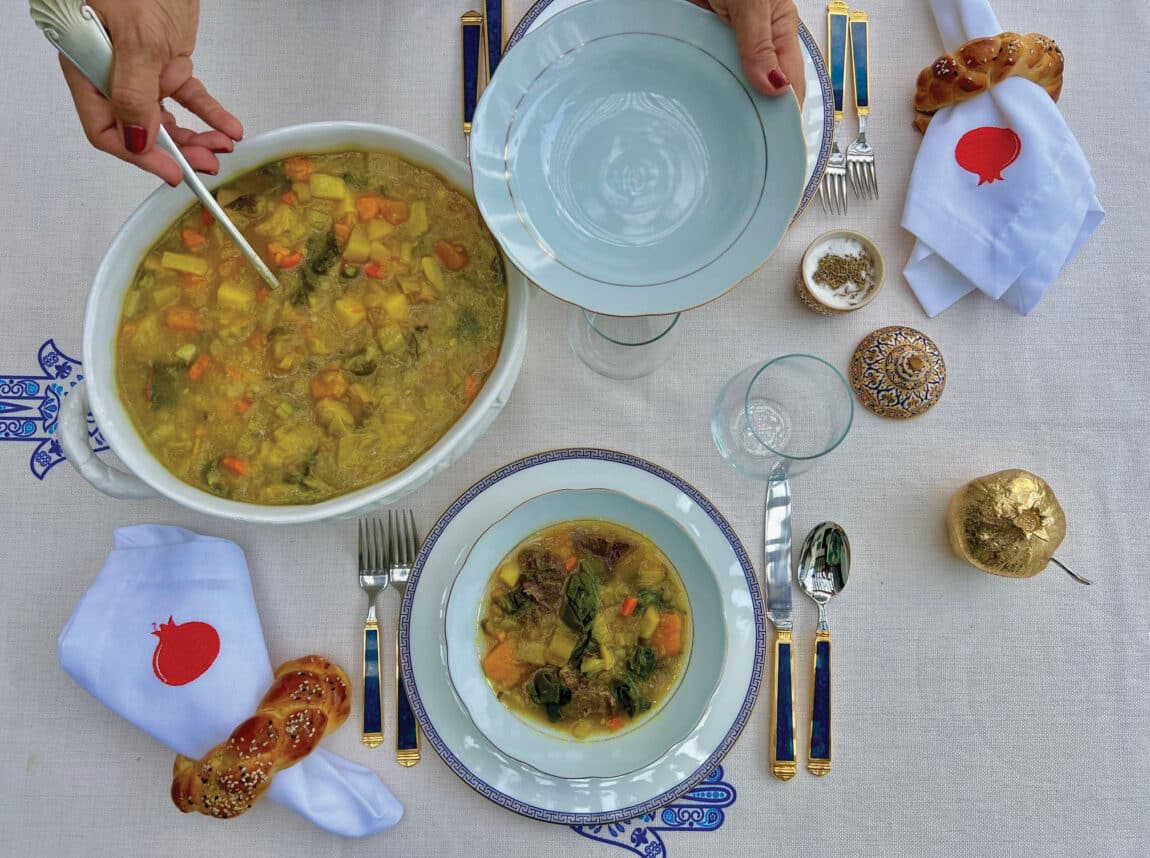
My mother Rica always made the most delicious, most nourishing and most satisfying soups. But for Rosh Hashana there was a special soup. This soup contained all the vegetables of the “simanim” on which one needs to say blessings. This is a Spanish Moroccan custom. Not only are all the vegetables in there but there’s also cheek meat or neck bones to symbolize the sheep’s head. My mother would chop up the vegetables and leave part of them in bigger pieces. Then she would simmer all the vegetables and meat together. She would serve the larger pieces with honey on top for the blessings and the soup would be served as the first course. As a child, this was definitely not one of my favorite things to eat. My brothers and cousins all made faces but we ate it anyways. We knew you had to eat it if you wanted this to be a good year for you.

With time, this soup became vegetarian as my brothers didn’t eat meat. And over time we became more creative in serving the simanim, so we didn’t have to swallow the boiled veggies with honey anymore. 

This year I am all about honoring my mother’s recipes. I have decided to make this very delicious soup from my youth. I will cook the meat cheeks in my pressure cooker separately and will add it for those who wish to have meat in their bowl. This way everyone will be able to have Maman’s Roshana soup.

This recipe makes a very large pot, so you should have enough to serve for the two nights.

—Rachel

Meat:

3-4 lb cheek meat

¼ cup olive oil

One large onion finely diced

2 bay leaves

1 tsp salt

½ tsp white pepper

Pinch of saffron (optional)

1 cup water


Soup:

¼ cup olive oil

4 leeks, washed thoroughly and sliced thinly

1 bunch Swiss Chard, with stem removed and chopped thinly

2 cups butternut squash, cubed 

1 large green apple or quince, peeled and cubed

2 large zucchini, peeled and diced

2 small sweet potatoes, peeled and cubed

4 medium Yukon gold potatoes, peeled and cubed

1 large turnip, peeled and cubed

4 celery stalks, diced

3 large carrots, peeled and diced

2 parsnip, peeled and diced

½ small cabbage, thinly sliced

2 Tbsp chicken consommé powder

½ tsp white pepper

1 teaspoon turmeric

Salt to taste


Meat:

In pressure cooker or large pot, add oil and warm over medium heat. Add onion and sauté for 5 minutes. 

Add meat, bay leaf and spices. Cook for one hour in pressure cooker or until tender in the pot.

 Soup:

In a very large pot warm oil over medium heat, then add sliced leeks. Sauté for 5 minutes until they start to soften.

Add all the ingredients, except Swiss chard, zucchini and butternut squash. Set aside the Swiss chard, zucchini, and butternut squash.

Pour enough water to cover the top of the vegetables. Cover the pot and simmer on medium heat. 

Bring to a boil, then lower heat to a simmer. 

Cook vegetables for an hour. Add the zucchini and butternut squash. Simmer for another half hour and add the Swiss chard , continue to cook on a simmer for an additional 30 minutes.

Taste and adjust seasoning.


MOROCCAN CARAMELIZED ONIONS, PRUNES, RAISINS, APRICOTS
4 large yellow onions

1/4 cup avocado or vegetable oil

3-4 cups soft pitted prunes

1 cup of dark or golden raisins

½ cup chopped dried apricots.

Rind of one orange

¼ cup orange juice

1 tsp of cinnamon

3 cloves (optional)

¼ cup Silan (pure date syrup)

¼ cup honey

¼ cup of toasted almond slices, for garnish


Using a food processor or mandolin, slice onions thinly.

Warm oil in a large casserole pot over medium heat and add onions. Sauté the onions and stir continually until soft and golden. 

Add the prunes, raisins, apricots, orange rind, orange juice, cinnamon, silan and honey and stir well. 

Cover pot, lower heat and simmer for 30 to 40 minutes, making sure not to burn the mixture on the bottom of the pot. If mixture appears too dry, add a little water.

Garnish with toasted, sliced or slivered almonds.


Let’s Break Bread
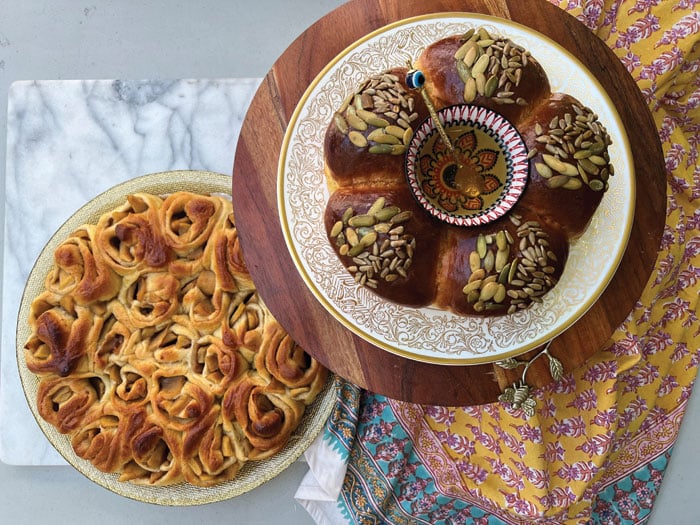
Nicole Saghian has always had an affinity for challah and its symbolism of peace, family, and tradition. But it wasn’t until the pandemic hit that she felt inspired to begin baking it myself. While she was lucky enough to be able to continue working her full-time job as an assistant Speech Language Pathologist via Zoom, she had spare time on her hands. She decided to play around with various challah recipes. She found that the process of kneading dough enhanced her spiritual connection and provided a therapeutic escape. Soon enough, baking homemade challah for Shabbat became a weekly tradition. She started delivering them to the doorsteps of friends and family each week. They encouraged her and soon enough, Nicole turned her creative outlet into a small business selling baked goods to the greater Los Angeles community. Breaking Bread with Nic was born.

What started out as a single traditional challah recipe has turned into a menu of over 15 variations of stuffed challah (some popular flavors include green olive and rosemary, grilled onions with jalapeño and Kalamata olives, Nutella oreo, and spinach with feta). During the high holidays, she introduces cakes to her menu, with the apple tart, gluten-free lemon olive oil cake, and Persian love cake being in high demand.

“The interactions I’m able to have within my client base through my small business has been such a blessing for me. Having people send in names to pray for during Hafrashat challah has given me such a sense of purpose and connectedness to the community, and it feeds my soul in ways I didn’t know I needed,” she told us. “Most of all, it brings me much joy knowing that something I made with my bare hands, out of pure love, is sitting on so many Shabbat tables as friends and family break bread together.”

Her favorite Rosh Hashanah tradition is their family Seder. “Each blessing is read in Hebrew, English, and Farsi, extracting from all our family’s roots and instilling our culture in the younger generation.” 

Nicole adds “In recent years, my dad has begun reading his own version of the blessings in a Farsi rhyming poetry song. Everybody claps and sings along, and it truly adds so much laughter, joy and sweetness to our Rosh Hashanah table.”

In an effort to pay it forward, each month Nicole donates a portion of her proceeds to a different charity. Her September charity of the month is Lovengroceries, a local organization geared towards raising funds to help support widows and children in our community.

We met Nicole as part of a Los Angeles foodie Instagram bloggers that united around Ellie’s Great Big Challah Bake. A unique project bringing people together to pray for the speedy recovery of a young sick girl Ellie Ruby.

We’re so pleased to share Nicole’s delicious recipe for Apple Blossom Rolls. So pretty and so yummy, you’ll make them again and again. 

We’re so pleased to share her delicious recipe for Apple Blossom Rolls. So pretty and so yummy, you’ll make them again and again. 

To order simply follow Nicole on Instagram @breakingbreadwithnic and send her a message.

Apple Blossom Rolls 

Dough
2 Tbsp yeast + 1 tsp sugar
6 cups flour
½ cups sugar
2 eggs
½ cup oil
1 tsp salt
1 ½ cups water

Combine dry yeast, warm (120°F) water, 1 teaspoon sugar in a glass bowl and set aside to proof 10 minutes.
In a large bowl, combine all of the flour with remaining sugar and salt, the proofed yeast water. Add the eggs, and oil. Mix well, cover and let rise for an hour.

Apple filing:
Peel and slice 3-4 large apples, sprinkle cinnamon and brown sugar and cook for about 20 minutes on medium until apples are brown in color and soft.
Once dough is proofed, roll it out to make a rectangle. Sprinkle with cinnamon brown sugar and layer 2 rows of apple filling. Roll up the dough into a log and cut into 20 even pieces. Place in a 12-inch round aluminum pan and bake at 350°F for 38-40 minutes.


Sharon Gomperts and Rachel Emquies Sheff have been friends since high school. The Sephardic Spice Girls project has grown from their collaboration on events for the Sephardic Educational Center in Jerusalem. Follow them
on Instagram @sephardicspicegirls and on Facebook at Sephardic Spice SEC Food. Website sephardicspicegirls.com/full-recipes.


The Sweetness of Remembrance Read More »