At the crossroads of four Miami Beach communities is a thriving Chabad synagogue that welcomes Jews of all stripes. The Shul of Bal Harbour — locally known as The Shul — is a thriving community, which draws an unusual blend of Jews from around the world.
A significant number of people who attend its services are first- and second-generation Sephardic immigrants. So many Latin Americans attend services that Shabbat announcements are made in Spanish as well as English. Like many of the more than 2,000 Chabad centers worldwide, a share of the community is not Lubavitch but “Chabad friendly.”
Even with its immense and striking architecture, the palpable sense of achdut, or unity, is perhaps what most distinguishes The Shul, which serves the communities of Bal Harbour, Bay Harbor Islands, Surfside and Indian Creek Village.
Rabbi Sholom Lipskar has served as The Shul’s spiritual leader for more than 20 years, and his sermons clearly reflect a Chabad perspective. Likewise, he and his wife, Chani, teach classes with that same outlook. Yet in what is also traditional Chabad fashion, they welcome all, as evidenced by a Sunday evening barbecue I attended during my weekend stay.
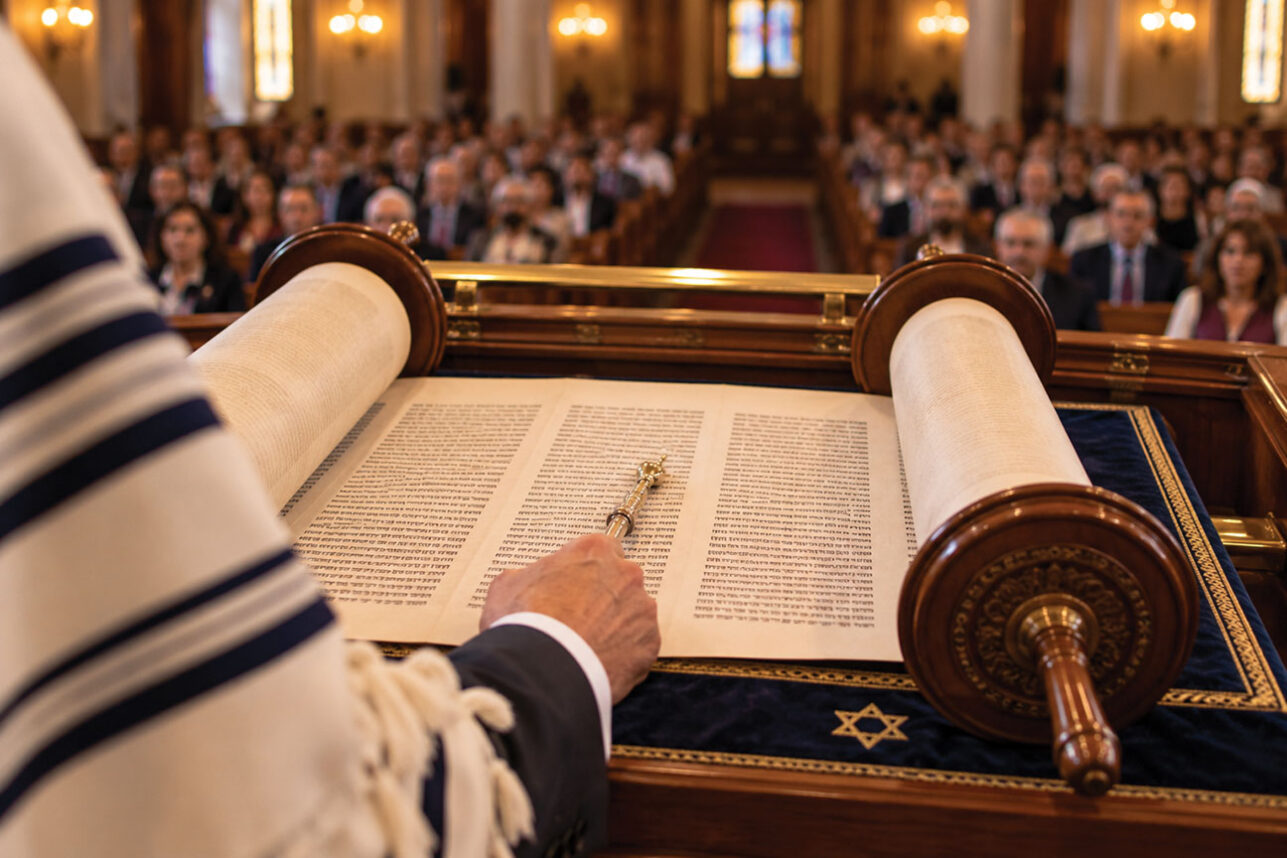
The Shabbat Torah service underscored this tangible sense of unity. A “calling gabbai” with a Galitzianer accent (along the lines of “baruch elokeni”) preceded a beautiful Torah reading by a Mizrachi member. Services in the cavernous main sanctuary were momentarily suspended while members of the Sephardic Hashem’s Minyan next door recited a resounding blessing over Kiddush.
Rabbi Joseph Oziel, who leads the minyan, also conducts classes in English and Spanish.
The Shul’s powerful sense of Jewish solidarity is well-documented. In May 1995, it hosted a meeting of the annual Sephardic Rabbis Convention, which featured an address by Rabbi Eliahu Bakshi-Doron, then the the Sephardic chief rabbi of Israel.
Similarly, The Shul’s architecture integrates diverse elements from various Jewish communities. Three great old-world synagogues inspired its unique design.
The majestic, gothic cage-like bimah was inspired by the Old Synagogue of Kazimierz, Poland. The first 12 letters of the Hebrew alphabet surround the cage, recalling the ingathering of the 12 tribes of Israel with the Torah as their unifying force.
The picturesque arches and courtyard echo the Rema Synagogue of Krakow. The ark, whose triangular design draws from the Rema’s entrance, holds a Torah scroll dedicated in February that was penned in Florida.
The Shul’s twin domes, hanging lamps and open women’s balcony are reminiscent of the Great Synagogue in Warsaw.
Also of note are the more than 100 glass mezuzot created by sculptor Donnie el Berman, a congregant who also designed its evocative Wall of Souls that greets guests as they enter the building. Constructed in 1997 from 9 tons of Jerusalem stone, the 18-by-36-foot piece features cantilevered asymmetric rock outcroppings.
Within the stone itself, nine natural earth tones create a “mosaic of complementary textures and color,” Berman said. Together, they suggest a “natural landscape painting of the hills of Jerusalem.”
A large cavelike alcove is adorned with asymmetric, bent carved panels of pale-green glass that feature the names of Shul members’ departed relatives. In two side alcoves, dedication plaques memorialize the loss of life during the Holocaust and conflicts in Israel.
A wealth of fascinating, subtle details is also found throughout the wall. The word zachor (remember) is etched above. Thirty-six autumnal colored leaves from around the world appear to fall as the memorialized souls ascend toward heaven.
Scattered within its inner archways, Berman faintly carved text and images — icons of Jewish faith and continuity, including Torah passages, rabbinic teachings and a fragment of a Dead Sea Scroll.
The words “Ani ma’amin/I believe” appear in one arch. In another, tiny images recall the Tomb of Rachel the Matriarch and the ancient harps played in the Temple. Replicas of ancient Canaanite graffiti describe the Jewish people as the “foundation of the world,” a reference echoed in the biblical book of Jeremiah.
Observers recognize Maimonides 13 Principles of Faith, as well as a map depicting both the historical inheritances allotted to the biblical tribes and sites in contemporary Israel. Musical notes signify what Berman described as “souls murdered in the Holocaust who continue to sing in perpetuity.”
When asked about his choice of materials, Berman said he incorporates glass in his work, because as compressed sand, it comes from the earth.
“Jerusalem limestone is our holy stone where our forefathers walked,” he said.
The entire structure is held up by steel, which Berman pointed out translates to barzel in Hebrew. Barzel, he said, is an acronym for Bilchah, Rachel, Zilpah and Leah — Jacob’s wives and their handmaidens, who gave birth to the ancestors of the 12 tribes.
“Those are our mothers. That’s who we come from,” Berman said. “These carvings are faded in to represent our heritage, our origination thousands of years ago.”
The Shul of Bal Harbour is at 9540 Collins Ave. (305) 868-1411;