Ablack lattice of metal piping spreads in front of a dark, curved wall holding a large cluster of television screens. About 20 people stand or sit transfixed beneath this Tree of Testimony, watching the faces of about 70 Holocaust survivors as they laugh, cry, gesticulate and often just sit solemnly while speaking to the camera.
“These people have … shown through their stories what it means to be human,” said Stephen Smith, executive director of the USC Shoah Foundation Institute, describing the videos. “These are stories about overcoming and living in spite of the evil that lives in the world.”
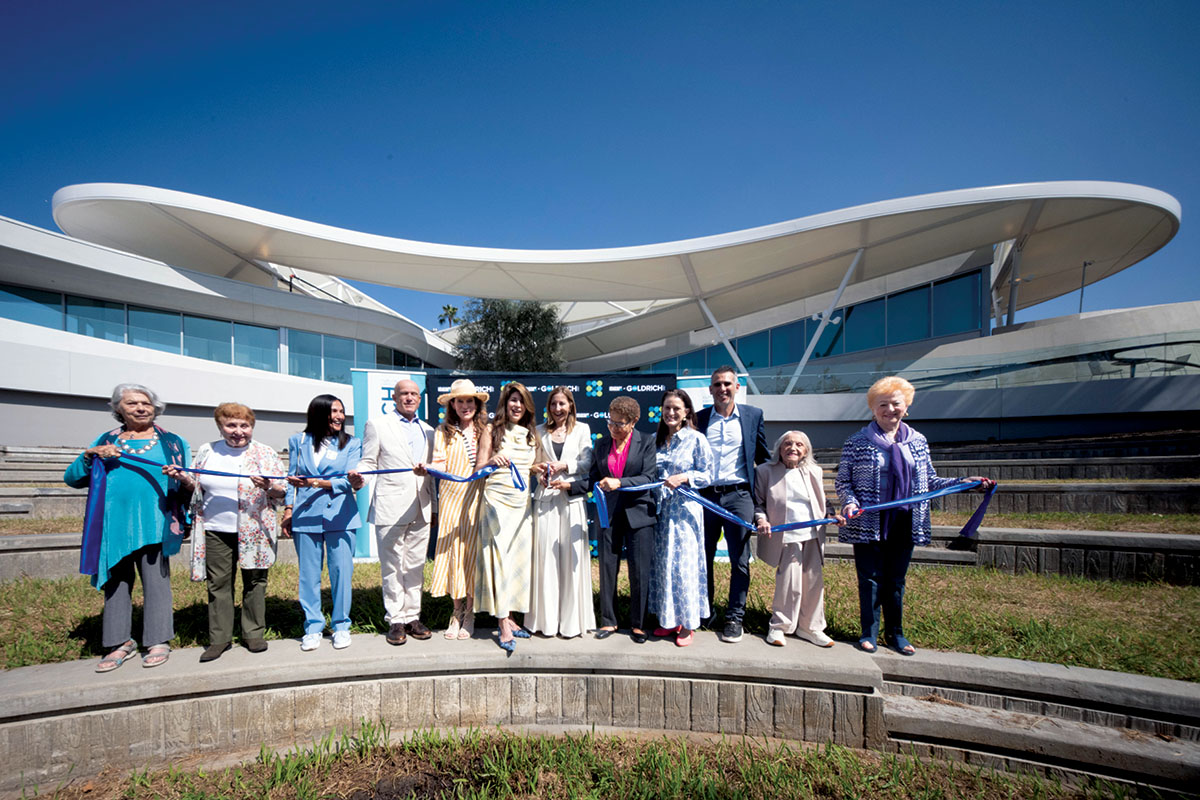
The Aug. 2 dedication of the “Tree of Testimony: USC Shoah Foundation Institute Survivor Interviews” at the Los Angeles Museum of the Holocaust (LAMOTH), also marks what organizers are calling the end of construction for the museum, which moved into its current facility in Pan Pacific Park in October 2010.
“Our final idea is that this is not only an informational and aesthetic experience, but also a memorial,” said E. Randol Schoenberg, the museum’s president, referring to its newest permanent exhibition.
The Tree of Testimony, a collaboration between LAMOTH and the USC Shoah Foundation Institute, was completed in April, just before Yom HaShoah, after about two years of planning, according to Mark Rothman, the museum’s executive director. Architect Hagy Belzberg, who designed the museum building, also created the $1-million Tree of Testimony. Funding for the project came primarily from the Wilf Family Foundation.
The museum, which is dedicated to using evidence of the Holocaust to educate the public, is organized into a series of rooms that roughly echo the chronology of the Shoah. The rooms contain exhibitions on Jewish life in Europe before the Holocaust, through Kristallnacht, the concentration camps, and the response to the Holocaust and World War II. The Tree of Testimony now marks the end of the museum’s tour.
Visitors use headphones and an iPod Touch instead of ambient audio, which is intended to provide a more personalized experience. At the Tree of Testimony, visitors can listen to a particular interview by typing in a screen’s number.
Schoenberg said his inspirations for this project included the video art of Nam June Paik as well as exhibitions at other Holocaust museums.
“Many museums use survivors’ testimony for this [final] space, but one of the principles of this museum is showing the enormity of the Holocaust, and it is hard to show large numbers of things to people in a way that is intelligible,” Schoenberg said. “So instead of selecting one or two videos to represent it, we come up with a way of showing them … the entire universe of survivor videos.”
The 51,000 interviews, which were originally archived by the Shoah Foundation, are in 32 languages, but do not include English subtitles, and were recorded in 56 different countries. About half of the interviews are in English. It takes an entire year for all the interviews to be played on the 70 screens, and it would take 12 years for a single person to watch all the videos if they were played nonstop.
Many of the people attending the dedication ceremony had participated in the filming of the interviews as either survivors or helpers for the Shoah Foundation.
Survivor Jona Goldrich happened to see his own interview playing on one of the screens and felt compelled to speak.
Standing in front of the Tree, facing other survivors, their families and supporters, Goldrich reminded those present of the importance of facing the truth of who the Nazis were and what they did. The people who perpetrated such crimes against humanity, he said, were considered the most educated and sophisticated of their time.
“When I was 10, they said God would never let these people do the things they said they were going to do,” he said.
Goldrich said he sometimes still cannot believe that he ran away from the Nazis at the age of 14, and that all of his friends from school and his family were killed.
Dana Schwartz, a survivor who has worked extensively for both the Shoah Foundation and LAMOTH, told one of the stories she had heard from a survivor interview. The interviewee was a doctor who had hidden with his wife and two other couples in the narrow space between two walls. When asked by the interviewer whether he and the others had ever quarreled during their two years in such stressful conditions, the doctor said, “Only about millimeters.”
During the dedication ceremony, Schwartz said her “heart trembled” when listening to these stories, but she emphasized hope for the survivors and for the future generations who would visit the museum.
“They [the survivors] became scientists who changed the world, teachers, builders, writers and healers,” she told the audience. “Will you send people here? Will you tell people about this place?”