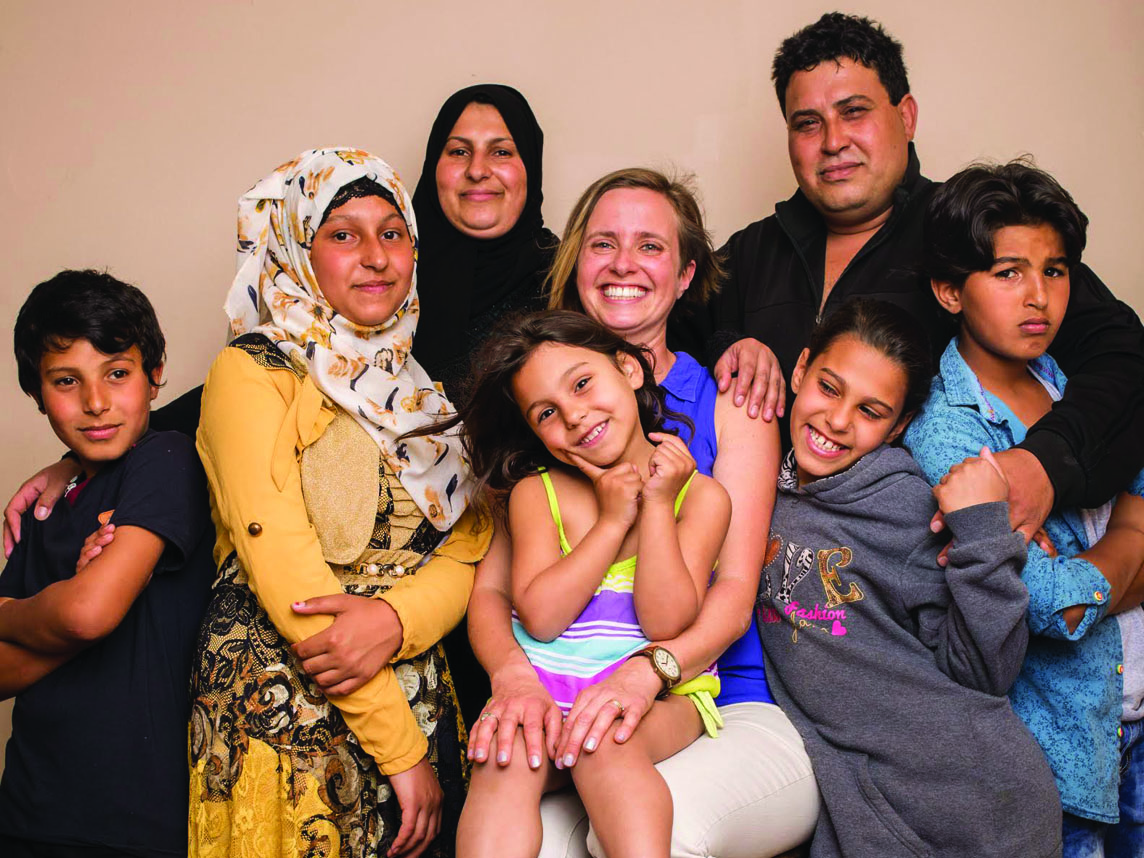
When Miry Whitehill-Ben Atar visited a Syrian family newly arrived to Los Angeles about a year ago, with a friend who knew them through church, the 31-year-old mother of two noticed that the refugee family shared much in common with hers: The Syrian woman was her age with a baby her son’s age. But she also noticed a striking difference in their home — the apartment was almost empty.
Whitehill-Ben Atar drove home, pulled a crib from her garage and stuffed it into the trunk of her car.
“Why did I have two cribs when their family had none?” the Eagle Rock resident said. “I felt like I could help them.”
The refugee family members didn’t speak English, but when they saw Whitehill-Ben Atar pushing a crib into their apartment, they couldn’t hide their smiles.
Shortly after setting up the crib in the couple’s bedroom, Whitehill-Ben Atar and the young parents developed a list of missing household supplies they would need, including an iron, blender, clothes and books in Arabic and English.
That list became the first of many that Whitehill-Ben Atar and her team, known as Miry’s List, composed in the following months. Since then, the group has grown into a nonprofit organization with a network of friends, neighbors and volunteers that helps resettle newly arrived immigrants.
Whitehill-Ben Atar grew up in an Orthodox Jewish family in Potomac, Md. But despite her religious upbringing, she struggled to connect with Judaism.
That changed after she moved to Israel in 2008 to work for a technology company. A few months later, she left the job but stayed in Tel Aviv.
She leased an apartment near the beach and spent her days learning Hebrew, exploring her neighborhood and chatting with market vendors. She also started dating an Israeli.
Back then, she learned that being a stranger in a foreign country could be either terrifying or rewarding, depending on whether one has a support system. She eventually got a job in L.A., married her Israeli boyfriend and move to California.
When Whitehill-Ben Atar met the Syrian family last summer, she shared the list of needed clothes, furniture and household supplies with her Facebook friends. A wave of responses popped up on her computer screen from people offering help.
“There are a lot of things that [refugee]families were missing,” she said. “We have a surplus of those things. It was that simple.”
In the next few weeks, Whitehill-Ben Atar visited the family every other day with a trunk packed with furniture, electronics and food. She didn’t speak Arabic and the Syrian family didn’t understand English, but they found a way to communicate, cooking a meal together and watching their children play.
“It was inspirational to be involved with them,” Whitehill-Ben Atar said. “It opened my eyes to reality with families when they move here from Iraq and Afghanistan.”
After Whitehill-Ben Atar delivered the first supplies, she reached out to immigration case workers and asked them to connect her with other recent arrivals. At first, she worked with one family a month; then two. Within a few months, she was working with six.
Soon, the formula Whitehill-Ben Atar discovered with the first Syrian refugees became a model. Her team met a family, determined their needs, created a list and shared it with donors. Team members also shared a dinner with the refugee family.
At first, Whitehill-Ben Atar felt awkward sitting at a dinner table with strangers, unable to communicate in their native language. But she learned to embrace frustration.
“For these families, coming here with no English forces them to deal with awkwardness all the time,” she said. “That’s just their reality, but they don’t have to be in that awkwardness alone.”
When families arrive, the team gives them a few days to relax and get accustomed to their new lives. Then volunteers come and bring the newcomers a Department of Motor Vehicles book in their native language, educate them about apartment prices in their neighborhood and help them navigate public transportation.
One of Miry’s List’s recent arrivals was Bashir Kashefi, 45, who moved from Afghanistan, where he worked as a translator with the United States Army units that handled bomb detonation.
Kashefi arrived in March with his 2-year-old daughter and a pregnant wife. They stayed with a former colleague’s family, nine people in a one-bedroom apartment. A few days later, the colleague asked Kashefi and his family to leave.
The Kashefis spent three nights sleeping on the street, their young daughter curled up in her father’s lap.
One afternoon, Kashefi started a conversation with a woman who happened to be one of Whitehill-Ben Atar’s volunteers, who spoke Pashto, his native language. The woman offered help.
A few days later, Miry’s List’s team placed the family into a hotel room where they spent two days. Whitehill-Ben Atar brought them breakfast and lunch until the family was transferred to her friend’s house in Pasadena. A month later, the family moved into an apartment in Anaheim.
“If not for Miry, it was impossible for us to live here,” Kashefi said. “We didn’t have money to live here.”
Since last June, Whitehill-Ben Atar and her team have worked with more than 100 families, helping them with household supplies, emotional support and housing. Miry’s List has expanded into a network of three full-time employees, 40 volunteers and 12 translators, who speak several languages, including Arabic, Pashto and Farsi.
Earlier this month, the Los Angeles City Council honored Whitehill-Ben Atar for her work.
“I don’t have millions of dollars,” she said. “I don’t have connections, but I use my network of moms and families to solve those problems.”
Whitehill-Ben Atar says dealing with recent arrivals might be difficult and frustrating, but she never doubts the importance of her work.
“Those families need to know that someone would stand by them no matter what,” she said. “We are here to serve them. We don’t want them to wonder if they should go back to Aleppo.”