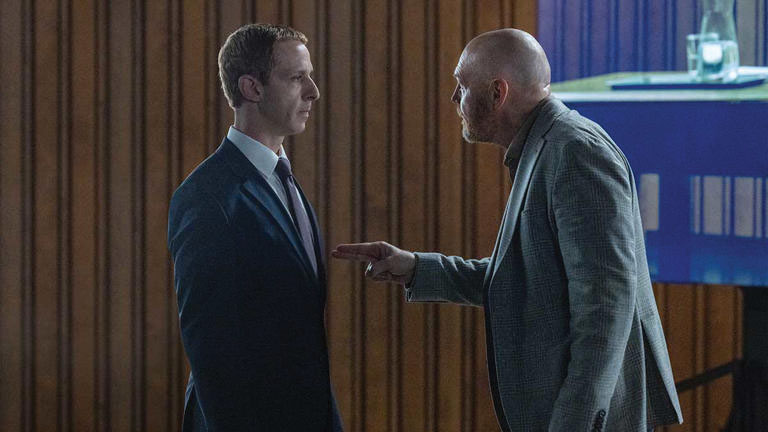
Aaron Sorkin has opened his mind to Jewish culture. It’s evidenced in the recent Yiddish-language opener of the Dec. 11 Christmas episode of the "The West Wing," with a 1950s scene of three men in topcoats — who belonged to the Jewish mob.
"I’m not in the community enough," said the creator-writer of the Emmy Award-winning drama, "but there is something in the Jewish faith and the Jewish community that is very good."
Sorkin was being interviewed by Rabbi David Wolpe at Sinai Temple on Sunday night Dec. 15, at its inaugural ATID program — an effort to involve unaffiliated teens, college students and young professionals — which drew some 600 20- to 39-year-olds.
At times, the boyish 41-year-old wunderkind seemed at a loss for words during his hour-long conversation with Wolpe, who challenged Sorkin with probing questions related to Judaism, Israel and Sorkin’s responsibility as an influential Hollywood Jew.
"In the Hollywood community you’re perceived as racist if you support Israel," Sorkin said in response to why there’s no groundswell of support for Israel in Tinseltown.
Up until now, Sorkin has never been to Israel.
"My reason for not going? I’m just chicken," he said.
But he also has not visited Europe since he was 5. Both will change when Sorkin debuts a new play at the Abbey Theatre in Dublin, Ireland, in 2004. And he said he will visit Israel after his show enters hiatus.
Sorkin threw Wolpe off track with his admission that he is not really interested in politics as much as good storytelling on his NBC White House drama. He said he taps into controversial issues to make up for the fact that he can’t come up with enough jokes to fill his hour-long episodes.
"I find, for instance, the gun lobby to be a treasure trove of punch lines," he said, adding that such issues fill and fuel his episodes. Sorkin said he finds the pro and con such issues evoke rewarding.
"That’s exactly how the Talmud works," Wolpe said. "It’s constant give and take."
Sorkin was as honest about his lack of connection to Judaism as he was with his struggle with alcoholism. "I was turned off on religion," he said.
Wolpe ended his discussion by asking Sorkin, in effect, if he believed in God. Sorkin said he viewed the myriad religions as "many fairy tales" that "seem hardly to be doing what they intended."
For Sorkin, spirituality is "a meditative thing that has to do with helping others and not waiting for it to come from a divine source."
For more information on ATID, call (310) 481-3243.