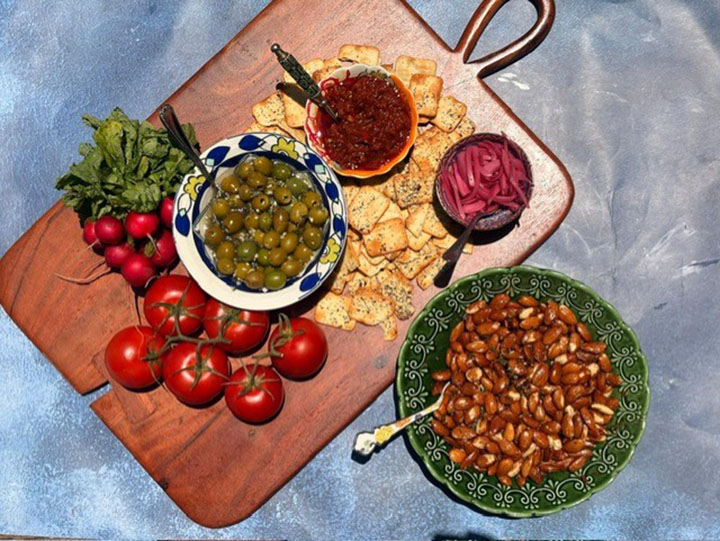
My family recently moved into a smaller house. A lot of work went into trying to reduce the chaos of the big day, but it was, after all,a move. Unpacking took much longer, as we determined what would be needed and what to put into storage. We got our new place fixed up, and we settled in. Last week, we invited family and our new neighbors over for a chanukat habayit (new home dedication), a housewarming and Sukkot party.
At what point would you say the change happened?
It’s easy to say it happened the first day we slept in the new house, but in many ways we weren’t there yet. We couldn’t cook or e-mail. Our mail hadn’t found us. I didn’t have a driving-home routine or know which grocery store we would be using.
Maybe the change happened before that — when we found the new place and gave our landlords notice or when we decided to start looking and subscribed to Westside Rentals. Or maybe it was even before that, as the end of my temporary job appeared on the horizon without another prospect having gelled, and the possibility of a budget gap in a terrible job market loomed.
We can all agree, however, that now that our mezuzah is up, and with the blessing of our loved ones, we have moved. And we like it in our new place, which is not far from our old place, still in West Los Angeles, but which features lower rent, lovely neighbors, a vegetable garden and a grassy backyard big enough for a sukkah. It’s good.
Before the Bet that begins the Torah, the first letter of the word Bereshit, “In the beginning,” there was God, of course. God had to have been there to do the creating of Heaven and Earth.
And the earth was already there, although it was tohu v’vohu, formless. There was darkness on the surface of the depths, and a Ruach Elohim, a spirit or wind of God, hovering on the surface of the waters. So already there were solids, liquids and gases. God didn’t start creating Heaven and Earth without matter, although it seems like God could have. It’s just that the stuff is all chaotic, indistinct.
The Torah doesn’t say, “There was nothing, and then there was the time of creation.” That’s the problem with the old warhorse translation “In the beginning,” as if “the beginning” is itself a time and place. More recent translations suggest, “In a beginning,” or “At the beginning of God’s creating.” God had been around for untold eternities, possibly creating the depths and the waters, the land and the darkness. Or maybe those had always been there, too.
With all this in place, we start to get God in action. “God said, let there be light, and there was light, and God saw that the light was good.” The same Hebrew word, yehee, appears twice — both as “let there be” and “there was.” So we could just as easily translate this as, “God said there will be light, and there will be,” Or maybe, “God said there was already light, and there had been.”
Next, God distinguishes (yavdel) between the light and the darkness, calling the light Day and the darkness Night. Thus, the creating process is four-fold: Bring something into being, experience its character, organize it, and name it. Only after these steps could there be erev v’boker, yom echad — evening and morning, one day.
The kabbalists taught that there was a fifth stage of creation, too, and perhaps the most important one: the unspoken one at the beginning, ratzon, God’s will. God wanted to create, to differentiate, to name, to begin history. God saw a need for change and decided to take action.
At what point did God declare the light good? When it was still all mixed with darkness. God could see the light and experience it as a blessing before it was separated out into a distinct entity.
It’s so tempting to crave the Bet, the second letter in the Hebrew alphabet, the active place of Bereshit, and especially, of yavdel, differentiation. The whole Torah is within that Bet, the kabbalists taught — a bayit, a house, unfurling with blessings and curses, questions and answers, the place where the other shoe drops.
In this Bet place, not having an answer, being in transition, feels like an answer — a not having. Here, not having a job, a home, a relationship today, has a certainty, even a finality.
Life, however, is in the Aleph. Aleph is the letter before creation, the place of oneness and silence and nonduality, of ratzon, God’s intent.
There is no knowing when things have begun, and what’s on tap; what God has in store for our lives, and what has already been labeled “good.” We can’t see the distinctions coming our way until things are well along, maybe not until after they’re already done.
Make some Aleph time today. Take a walk. Meditate. Pray. Meet God where God is — not in the answers of tomorrow, but in the chaos and not knowing of today. It’s good.
Shanah Tovah.
Rabbi Avivah Winocur Erlick serves as a spiritual counselor for Skirball Hospice, and teaches Gentle Jewish Yoga (www.gentlejewishyoga.com), a combination of non-strenuous yoga movement and kabbalistic meditation. She was ordained by the Academy for Jewish Religion, California, in 2009.