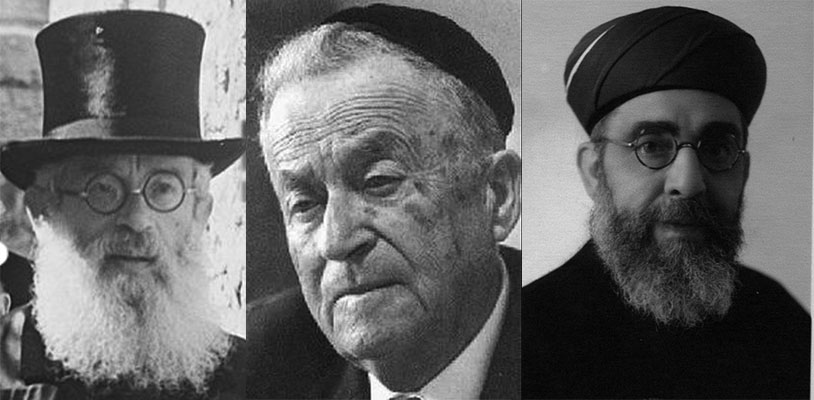
What happens when “an Ashkenazi Chief Rabbi, a Sephardic Chief Rabbi and a future Nobel Prize winning author walk into a café?”
While such a dream meeting never took place, what we do know is that Rabbi Isaac Herzog (Ashkenazi Chief Rabbi), Rabbi Benzion Uziel (Sephardic Chief Rabbi) and S.Y. Agnon (Nobel Prize Winning Author) had a powerful “meeting of the minds” in 1948.
Two of the three – Rabbi Herzog and Rabbi Uziel – were present at the historic ceremony on May 14, 1948, when David Ben-Gurion declared the first independent Jewish state in over 2000 years – Medinat Yisrael, the State of Israel. The traditional Jewish blessing over something new – Shehechiyanu – was recited, but there was no formal prayer for the new Jewish state.
Pirkei Avot teaches us to “pray for the welfare of the government” (Avot 3:2), and for over 2000 years, in most places we lived throughout the diaspora, that’s what we did. We asked God to “bless the leaders of the government,” some versions prayed that “they be blessed with wisdom and understanding,” and all versions prayed that “God put into their hearts to deal kindly with us and all of Israel.”
May 14, 1948 – the 5th of Iyar, 5708 – marked a new era in Jewish history. Jews would now be blessing our own Jewish government in our own state and homeland. Rabbis Herzog and Uziel agreed that this new reality required a new prayer, and shortly after attending Ben-Gurion’s historic declaration, they went to work in composing something new and different.
For months, they each worked on different versions of the prayer, and once a suggested draft was complete, Rabbi Herzog sent it to Israeli author S.Y. Agnon for his literary and poetic revisions. Agnon sent back a slightly revised version, written in his own iconic cursive (see photograph).
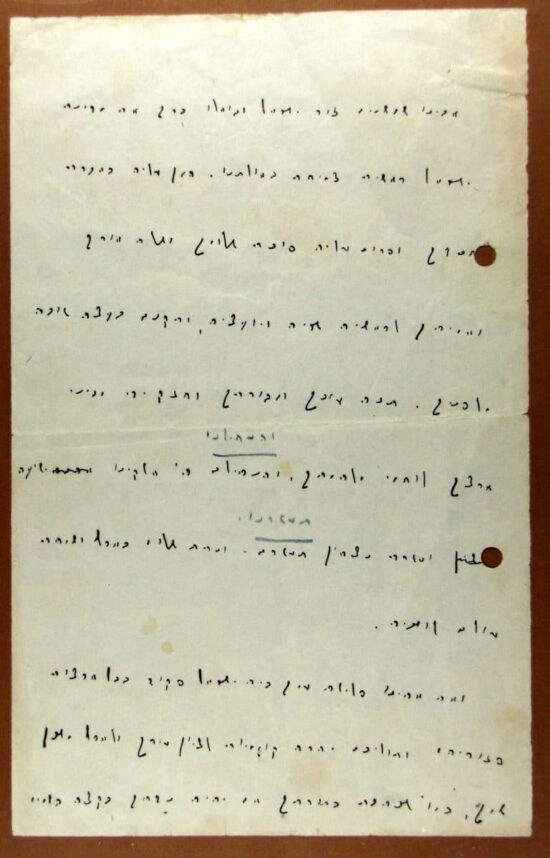
On September 20, 1948, the new “Tefillah L’Shalom Medinat Yisrael” – “Prayer for the Peace of the State of Israel” – was printed in two Israeli newspapers: the religious Ha’Tzofeh and the secular Ha’aretz. This new prayer – perhaps the first-ever liturgical collaboration between an Ashkenazi and Sephardic rabbi, along with a genius novelist – belonged to all Israelis and Jews: religious and secular, Ashkenazi and Sephardic. The two chief rabbis proudly issued this historic prayer together, also noting Agnon’s literary contributions.
“Our Father in heaven, rock and redeemer of Israel, bless the State of Israel…shield it…spread over it the Tabernacle of Your peace…send Your light to its leaders…strengthen the defenders of our Holy Land.”
As of this writing, the results of this week’s presidential election are not yet known. What I do know is that no matter the outcome, I will no longer limit my recitation of this prayer to Shabbat. For the next four years, I will recite this prayer for Israel every single day.
Shabbat Shalom
Rabbi Daniel Bouskila is the international director of the Sephardic Educational Center.