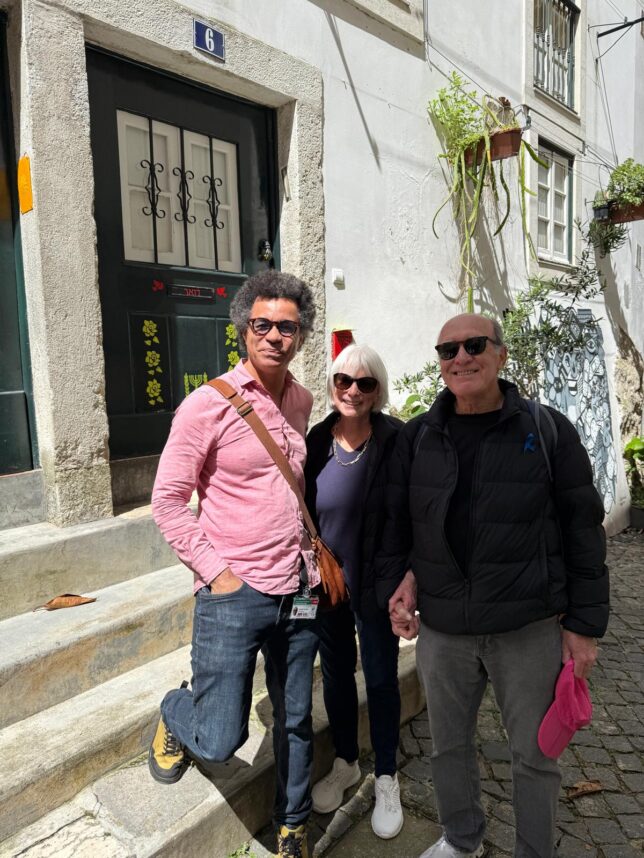
Rabbi David Forman, the founder of Rabbis for Human Rights who fought for religious pluralism in Israel, has died.
Forman died Monday in Dallas while awaiting a liver transplant. He was 10 days shy of his 66th birthday.
The rabbi founded Rabbis for Human Rights in 1988 and served as its chairman from to 1992, and again in 2002-03. The organization, which calls itself “the rabbinic voice of conscience in Israel, giving voice to the Jewish tradition of human rights,” has a membership of rabbis and rabbinic students from all streams of Judaism. It is primarily concerned with the plight of Palestinians living in the West Bank and Gaza.
“Rabbi Forman will be sorely missed,” said Rabbi Arik Ascherman, executive director of Rabbis For Human Rights. “Not only was he our founder, but he was a moral compass for several generations of Jews, particularly regarding Israel.”
Forman, who made aliyah in 1972, served as the director of the Israel office of the Union of American Hebrew Congregations, where he led the effort for religious pluralism in Israel. Prior to that he was the chairman of Interns for Peace from 1984 to 1986, and the founding chairman of both the Jerusalem Council for Soviet Jewry in 1973 and the Cincinnati Council for Soviet Jewry in 1970.
Forman keynoted the Nobel Institute conference on “The Role of Religion in Middle East Peacemaking.” In 1994, he was a member of the Israeli delegation to the Nobel Peace Prize ceremony for laureates Yasser Arafat, Shimon Peres and Yitzhak Rabin
He wrote four books and was a regular contributor to many newspapers and magazines in Israel and in the Anglo-Jewish press.
Forman was ordained in 1972, and received a doctorate in 1997 from Hebrew Union College-Jewish Institute of Religion. Between 1977 and 1991 he was a deputy commanding officer in the Israeli army, receiving a citation for meritorious service in 1990.