At the trials of the International Military Tribunal following World War II, many of the defendants argued their actions were legal. In Nazi Germany, Hitler was Germany’s highest authority; his command had the force of law. Following Hitler’s orders meant the defendants were following the laws of Germany. Joachim von Ribbentrop, Hitler’s Minister of Foreign Affairs, explained that “I was always loyal to Hitler, carried through his orders, differed frequently in opinion from him, had serious disputes with him, repeatedly tendered my resignation, but when Hitler gave an order, I always carried out his instructions in accordance with the principles of our authoritarian state.” These arguments became known as the “Nuremberg defense.” The defendants argued that if the laws of Germany sanctioned their actions, they had done nothing wrong.
These arguments were rejected by judges. They demanded that the defendants recognize their larger moral obligations and not hide behind German law.
Law is not identical to morality. One can create a system of laws and use them as tools of oppression, just as Nazi Germany did.
Legalized evil begins in the biblical city of Sodom.
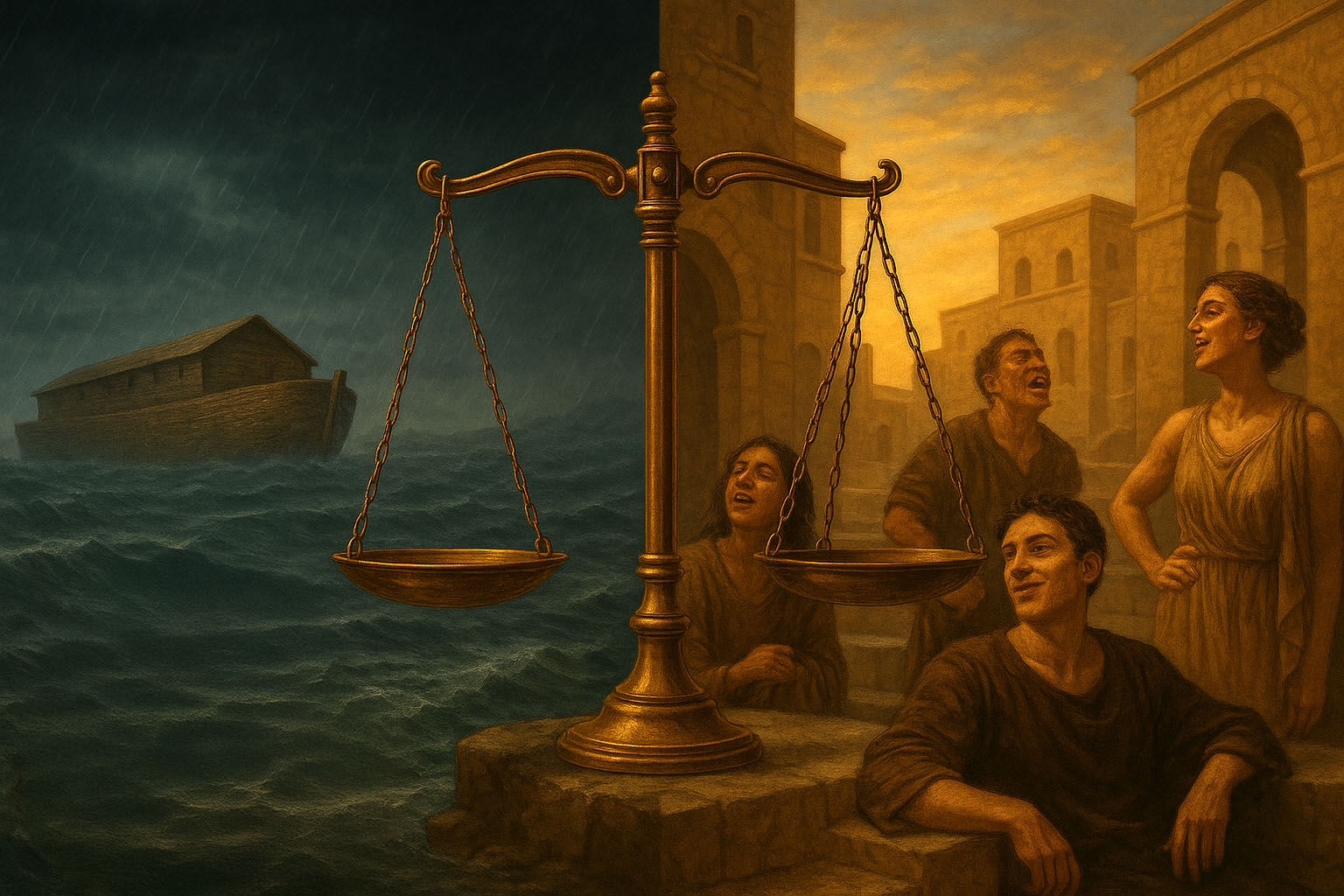
The parallels between the stories of Sodom and the Flood jump out at the reader. Both involve the destruction of a civilization gone bad. In both stories, God saves an individual family from the destruction. In both stories, the survivor drinks too much and their children humiliate them. Linguistic plays reinforce these thematic parallels; several keywords such as ra “evil,” shachet “destruction,” and vayare, “and they saw,” are repeated in both stories.
Meir Sternberg, in his book “The Poetics of Biblical Narrative,” analyzes how the Tanakh often connects two narratives to make them sound like they repeat. He makes a compelling argument that the repetition of these “twice-told tales” is to force the reader to notice the differences.
Sodom and the Flood are twice-told tales. Perhaps the most important difference between them is that the Flood came first. With Sodom, one must realize that God had already destroyed the world because of injustice. So why did the people of Sodom ignore the lessons of the past?
After the Flood, God makes a covenant with Noah. As part of the covenant, murder is forbidden because man is created in the image of God. The Talmud expands on this and says Noah and his descendants received seven laws: establishing courts of judgment, and prohibitions against cursing God, idol worship, forbidden sexual relations, murder, robbery, and tearing a limb from a living animal.
The Talmud further discusses whether God also gave these laws to Adam. Rabbi Yehuda holds the fascinating opinion that Adam received only one commandment, not to worship idols. Rabbi Yehuda’s view raises an obvious question: If there were no commandments at the time, why was the generation of the Flood punished for their sins?
Rabbi Yehuda’s view assumes that man is bound by morality, with or without commands. Our moral intuitions should be authoritative enough. And that is why Adam didn’t need to be commanded.
Yet those moral intuitions failed during the Flood. Because of this, God establishes a covenant of law with Noah after the Flood.
Here we can see the crux of the difference between the Flood and Sodom: The people of Sodom live in an age of law, and are corrupt anyway. One can detect this in the Torah’s language. The text accuses the Flood generation of committing chamas, a general term for injustice. The people of Sodom are the first in the Tanakh to be referred to as having sinned and being sinners; the term “sin” implies the knowledge of a command. When Lot tries to protect his guests, the people of Sodom declare, “This one came to dwell here, and he now wants to act like a judge!” The people of Sodom know of laws and judges, but are evil anyway.
This verse inspires the following remark in the Talmud. “There were four judges in Sodom: Shakrai, (liar) and Shakrurai, (habitual liar) Zayfai, (forger) and Matzlei Dina, (perverter of justice).” Sodom’s judges were not at all like Lot; they simply reinforced the system of corruption.
Sodom had laws but no justice.
Law was the remedy for the sin of the Flood. Yet in Sodom, law fails; and the question is why this is so.
Law was the remedy for the sin of the Flood. Yet in Sodom, law fails; and the question is why this is so.
Here, we must note a strange discrepancy in the Jewish tradition. In the Torah, Sodom is the very epitome of evil. God declares that “the outcry against Sodom and Gomorrah is great, and their sin is very grave.” The Torah had previously noted that “the people of Sodom were exceedingly wicked and sinful against the Lord.” This is why God vows to destroy these cities. The evil of the city is on display when the angels visit Lot’s home. We are told the “men of the city, the men of Sodom, from young to old, every person from every corner” demanded Lot surrender his guests so they could rape them. Sodom is a city of monsters, without exception.
Yet in the Book of Ezekiel (16:49) we get a very different picture. It tells us, “Only this was the sin of your sister Sodom: arrogance. She and her daughters had plenty of bread and untroubled tranquility; yet she did not support the poor and the needy.”
Pirkei Avot offers a similar account. In it we read that “one who says: ‘mine is mine, and yours is yours’ … some say this is the attitude of Sodom.” In the Talmud, a court is empowered to compel people not to act “in the manner of Sodom,” and refuse to be flexible about the terms of a transaction when it has no cost or difficulty. Rav Aharon Lichtenstein offers one contemporary example of the “manner of Sodom”: “A person moves to a new apartment and throws the extra set of keys to his old apartment into the sewer rather than passing them on to the next tenant.”
These texts portray Sodom as callous and selfish. But that is a far cry from the depraved city described in the Torah.
But it is here that we have to bring the two questions together. Law fails in Sodom—not because law is useless, but because one cannot live on law alone. For law to be effective, one needs a society where people care for one another.
For law to be effective, one needs a society where people care for one another.
Sodom lost respect for the law after its people lost all sense of compassion. Ezekiel and Pirkei Avot are referring to the first stage in Sodom’s descent.
The Maharal of Prague explains:
“How great is the sin of one who insists on standing by the strict letter of the law in all matters.
Ultimately, this leads to many evils. For a person who refuses to yield in anything becomes so exacting that he eventually comes to outright theft and violence. At first, he merely refuses to forgo what is his, but in the end, when he sees something that he can plausibly claim as his in any way, he takes it by force. Once he becomes accustomed to this, he descends into violent wrongdoing.
….You can see this in the people of Sodom, whose defining trait was their refusal to yield. As our Sages taught (Avot 5), ‘Mine is mine, and yours is yours’—this is the trait of Sodom … One might ask: Was their only sin that they refused to yield? Surely, Scripture says (Genesis 13) that the people of Sodom were wicked and sinful in every way.
Rather, because they possessed this quality of refusing to yield, it led them to all the other corrupt traits.”
He adds:
“Such behavior leads to destruction, for God built the world with kindness; therefore, the opposite of kindness—strict judgment without compassion—is the destruction of the world.”
Sticking to the letter of the law drains humanity of compassion, and without compassion, law is useless. Kindness is part of the world’s DNA; without it, society falls apart.
The story of the Flood teaches that we need law to reinforce our values. The story of Sodom teaches us that law is only effective when a society has values.
One of the critical insights about democracy is that, much like law, it must be built on community. Without interpersonal connections, all the laws regarding who gets chosen to lead are useless. Alexis de Tocqueville, after visiting the United States and England in the 1830s, wrote that in “democratic countries the science of association is the mother of science; the progress of all the rest depends upon the progress it has made … If men are to remain civilized, or to become so, the art of associating together must grow and improve.”
If we don’t care for each other, democracy won’t work. No matter how many laws we pass, we will fail to become civilized. Like the Nazis, we will become monsters who hide behind legalities.
This is the lesson of Sodom. One cannot live by law alone.
Rabbi Chaim Steinmetz is the Senior Rabbi of Congregation Kehilath Jeshurun in New York.