fbpx

July 29, 2026

A Rabbi Explains What’s Jewish About ‘The Odyssey’

Watching Christopher Nolan’s “The Odyssey” in a packed AMC theater in Century City, I found myself wondering how a rabbi might interpret one of the foundational works of Western civilization.

What would a rabbi think about how the gods are depicted in the Greek epic poem?

To what extent does the Greek concept of hospitality recall the Jewish commandment of Hachnasat orchim (“welcoming guests”)?

Rabbi Brad Artson, an author, theologian and the Goldstine Distinguished Scholar at American Jewish University, hadn’t yet seen Nolan’s film adaptation as of press time. But two years ago, the self-described lover of ancient literature reread Homer’s “The Odyssey” and “The Iliad,” two of antiquity’s most influential works. With Nolan’s film introducing the ancient story to a new generation of moviegoers, Artson was eager to discuss how “The Odyssey” both resembles and diverges from the values of the Hebrew Bible.

Despite their differences, Homer and the Hebrew Bible share more common ground than many readers might expect, Artson said.

“So, in both, there’s sacrifices, there’s tribal identity, there’s a concern for honor and dignity. And then there are these huge, glaring differences that make the Torah and the Hebrew Bible of eternal worth on a different level.”

One of the major differences, Artson said, stems from what’s driving the gods — Poseidon, Zeus and others — of the Greek epics.

In Homer’s texts, “the gods are fickle, and they don’t have standards. And what standards they have, have to do with their own popularity and their fragile egos, rather than any sense of righteousness or justice or loyalty,” he said. “And the God of Israel is portrayed very differently. The God of Israel is constantly calling people to care for the widow and the orphan, and to live lives of righteousness and to honor their friendships and their business dealings and the Sabbath. And that’s a very different choice.”

Artson also underlined an intriguing point of convergence between the Greek and Jewish traditions: hospitality.

One of the central values in “The Odyssey” is xenia, the sacred obligation to welcome strangers. Entire episodes turn on whether hosts extend generosity or cruelty to travelers — which immediately reminds one of Abraham, who, in Genesis, rushes to welcome three strangers into his tent, offering them food, water and rest before he even knows they’re not ordinary people but angels.

In other words, the motivations are different — Greek hospitality is rooted in honor and custom, while Abraham’s is rooted in covenant and ethical responsibility — but both traditions recognize that how we treat the vulnerable says something essential about who we are.

Another major difference between the Hebrew Bible and Homer’s “The Odyssey” is to what extent everyday people factor into the narratives. Unlike Homer’s heroes, the central figures of the Hebrew Bible are generally not born into royalty.

“In Homer’s texts, no commoner ever speaks — even the slaves who speak are kidnapped royalty,” Artson said. “So, there’s a pervasive notion not only in Homer, but in all ancient literature, that no commoner is worthy of any attention, which just highlights how radical the Hebrew Bible is. The God of Israel speaks to a whole people, and none of our leaders are royal until we get to the house of [Kings] Saul and David, and then they’re quite flawed, right? But the prophets don’t come from any lineage; they’re just inspired people.”

In Homer’s world, greatness is inherited. In the Torah, it’s often bestowed.

“Moses doesn’t come from lineage,” Artson says. “He’s an inspired person. And what moves him to leadership is again his commitment to compassion and love and justice and righteousness, and that makes him worthy of God’s concern. And that God chooses a whole people, including the widows and the orphans and the children and the women — everybody is a child of God, and that would strike ancient ears as completely radical and unexpected.”

Nolan’s film will undoubtedly introduce millions of people to “The Odyssey.” But for some, it will prompt a different kind of journey: a return to a familiar story albeit with the habits of Jewish learning.

A Rabbi Explains What’s Jewish About ‘The Odyssey’ Read More »

Tu b’Av and Redemption

This past week’s parsha of Ve’etchanan opens up with the words “And Moshe — at that moment — began to plead with Hashem”

Commentators are struck by this timestamp: “at that moment.” Moshe’s heartfelt plea to enter the Land of Israel wasn’t spontaneous, but awakened by something specific, something deeply embedded in the contours of time. Early sources debate the precise moment this refers to. What stirred Moshe to begin praying again, after years of accepting the decree that he would never cross the Jordan?

The Pnei Yehoshua does the math. He works backwards from Moshe’s death, eliminating all the days on which personal requests are traditionally avoided. His conclusion is that “that moment” was none other than the 15th of Av, the holiday of Tu b’Av.

So what is it about Tu b’Av that stirs the soul, even one as weary and noble as Moshe’s?

The Gemara hails Tu b’Av as one of the happiest days of the Jewish calendar. Yet unlike other festivals, whose significance is tied to a single defining event, Tu b’Av commemorates a remarkable collection of seemingly unrelated moments spread across centuries of Jewish history.

Tu b’Av:

1) It marks the day the fallen of Beitar were finally granted burial after the crushing defeat of the Bar Kochba revolt.

2) It commemorates the lifting of the ban on intermarriage with the tribe of Binyamin following the devastating civil war sparked by the episode of Pilegesh b’Givah, allowing Binyamin to rejoin the fabric of the nation after a generation of isolation.

3) It remembers the day King Hoshea ben Elah removed the guards that had prevented the inhabitants of the Northern Kingdom from making pilgrimage to the Beit HaMikdash in Jerusalem.

4) It celebrates the completion of the annual collection of wood for the altar, ensuring that the communal offerings could continue throughout the winter months.

5) It marks the lifting of the temporary restriction requiring the tribes to marry only within their own tribal boundaries after the Land had been apportioned.

6) Most famously, it recalls the custom of the young women of Jerusalem borrowing white garments from one another and dancing in the vineyards in the hope of finding a spouse.

7) Finally, and perhaps more pertinent to Moshe, it was on Tu b’Av that the generation condemned to die in the wilderness realized that the decree had come to an end, signaling that the nation was finally ready to enter the Land of Israel.

At first glance, these commemorations seem to share little beyond a date on the calendar. They span different eras, leaders, crises and kinds of celebration. Yet the Gemara’s treatment of these episodes reveals a consistent theme, as each marks a moment when the Jewish people chose renewed solidarity over enduring division.

1) When Beitar, the final Judean stronghold, fell to the Romans, the devastation was immense. Tens of thousands were massacred, and the Romans prohibited the bodies from being buried for years. These fallen were soldiers of Bar Kochba’s, a figure as divisive as he was impressive, whose rebellion had left a nation bitterly divided. His movement had splintered loyalties and shaken faith. He was, to many, a dangerous false messiah. And yet, when burial was finally granted, the Rabbis instituted an entire new blessing into our Grace After Meals- HaTov VeHaMeitiv. Despite deep and fundamental differences, the nation had been holding its collective breath, and could not be fully at peace until it could ensure this dignity even to the politically and religiously “othered.”

2) The same pattern emerges after the episode of Pilegesh b’Givah. What began as a horrific act of violence escalated into a civil war that nearly annihilated the tribe of Binyamin. In the aftermath, the remaining tribes swore not to allow their daughters to marry members of Binyamin, effectively threatening the tribe’s future. Tu b’Av marks the day that prohibition was lifted, as the nation realized that it simply could not go on like this. Not all was forgiven. Not everything could be. Rather, it was a sober acknowledgment that the fate of our people demands a conscious choice to embrace responsibility for one another despite divisions, blame and even for those we might have once cast aside for what we thought was good reason.

3) The removal of the guards separating the Northern and Southern Kingdoms reflects the same principle, uniting competing kingdoms and rival religious centers. This didn’t unify the nation overnight, but it did reject the permanence of the divide, and a refusal to give up on a shared destiny.

4) Even the completion of the wood collection for the altar, a detail that seems to mark only a seasonal shift fits the theme. The Lubavitcher Rebbe reminds us that typically, offerings are individual responsibilities yet here, before the rainy season rendered fresh wood unsuitable, the people gathered together to secure the fuel that would sustain the service of the Beit HaMikdash for months to come. This signified collective investment in each other’s spiritual well-being. The fire on the altar would not go out, because we would commit to carrying each other’s offerings.

If Tisha b’Av is a time where we lament our divisions, Tu b’Av recognizes the moments when we realized as a nation that despite deep and justified grievances, division remains something that we cannot afford. We do not survive divided, and our salvation requires active investment in our brothers and our sisters.

But we are not simply on the heels of Tisha b’Av, we also find ourselves at another threshold, that of the month of Elul, a time associated with introspection and repentance, deeply personal enterprises. Perhaps among the greatest temptation of Elul is the belief that spiritual work requires solitude. That the journey inward demands we shut others out. It is in this vein that we can understand the two remaining events commemorated on Tu b’Av – the intermarriage of the tribes, and the practice of the young women dancing in the fields. While not moments of overcoming grievance, these represent moments in time when we might have thought that the stakes were so high, we would have been absolved, even temporarily, from communal responsibility.

When the Jewish people first entered the Land of Israel, daughters who inherited land were required to marry within their own tribe so that each tribe’s inheritance would remain intact. Once the Land had been fully apportioned, that restriction was lifted, allowing the tribes to intermarry.

The tribes may have assumed that they were righteously invested in the important task of establishing roots in the right places. They certainly could not afford the distractions and complications of becoming involved with Jews who were not of their own tribe – and yet Tu b’Av demands otherwise. That even the securing of personal and family legacies does not happen in isolation. Finally, when the young women would go out to dance in the fields in search of prospective matches, the Talmud tells us they would dance only in borrowed dresses, so as not to embarrass those who had less.

We often imagine finding a spouse as one of life’s most deeply personal endeavors, perhaps even the arena in which we are most entitled to distinguish ourselves from those around us. Yet the Rabbis frame the search for marriage differently. Before anyone sought to build a home, they first ensured that no one else’s dignity would be sacrificed in the process. Even our most intimate blessings, Tu b’Av teaches, are bound up with our participation and facilitation of the blessings of others.

While Elul invites introspection and preparation, suggesting a time to retreat inward and prepare individually, Tu b’Av reminds us that spiritual renewal demands that we carry others with us on the journey. Our teshuva is collective, and the path forward is one we walk together.

And so we arrive at the final event of this holy day: According to Chazal, Tu b’Av also marks the day the generation of the wilderness realized that the decree condemning them to die in the desert had come to an end. For nearly 40 years, the nation had lived beneath the shadow of that sentence. Now, at last, a new generation stood poised to enter the Land.

It is against this backdrop that Moshe’s prayer can be understood.

Standing on the plains of Moav, Moshe looked toward a future he himself would never inhabit. No leader had sacrificed more for his people. No one had carried their burdens more faithfully. And yet he would remain outside the Land toward which every step of his life had been directed.

Why, then, did Tu b’Av move him to pray?

Perhaps because Tu b’Av revealed something profound about what it means to belong to Klal Yisrael. If every victory belongs to the nation, then no individual is ever entirely absent from its future. Moshe would not cross the Jordan, but the people he had shaped would. The Land would be entered by a nation whose very existence bore his imprint.

The responsibility of belonging to the Jewish people is immense. Our failures affect one another; our divisions weaken us all. But Tu b’Av reminds us that the opposite is equally true. Our acts of kindness, our reconciliation, our growth, and our faithfulness are never ours alone. They ripple outward, becoming part of the inheritance of generations we may never meet.

Perhaps this is why Moshe’s final recorded prayer is not simply a plea to enter a particular place, but a plea to belong to the future of his people within that place.

There is a striking halachic parallel to this idea. The Rambam rules that the blessing recited upon seeing 600,000 Jews — Baruch Chacham HaRazim — is said only in the Land of Israel. Rav Eliezer Waldenberg, the Tzitz Eliezer, describes the land of Israel as the “tziruf” of the Jewish people, the crucible which fuses us into a single nation. Perhaps because it is only in a society of Jews that we see most clearly that we will simply have to work together if we wish to see that society function. There we are bound, if not comfortably, then inevitably.

Perhaps that is what Moshe longed to see.

Not simply the hills and valleys of Eretz Yisrael, but a people learning, however imperfectly, to become one.

Just one week ago, we sat on the floor and mourned every exile, every fracture, every senseless loss. If Tisha b’Av is the cry of estrangement, Tu b’Av is the night when we realized again and again that we cannot afford to be strangers. On Tu b’Av, the full moon rises. The same people who mourned begin to dance. The same nation who splintered begins to seek one another out again in the vineyards, in the fields, in the moments of vulnerability and return. On Tu b’Av Moshe revealed what he dared to dream, not just to enter the Land, but that we, his flock, would commit to walk in it together.

Tu b’Av does not imagine a world without disagreement. Nearly every event it commemorates comes precisely because disagreement existed. What it rejects is the notion that disagreement must become estrangement. Again and again throughout our history, this day marks the moments when the Jewish people chose shared destiny over permanent fracture.

Redemption does not begin when we finally agree with one another. It begins when we decide that our covenant with one another is more enduring than the arguments that divide us.

A lesson so powerful, is perhaps what inspired Moshe to pray.


Adina Feldman is a Straus Scholar at Yeshiva University.

Tu b’Av and Redemption Read More »

Mission to the Jewish Community of Ethiopia

This summer, I spent a week in Ethiopia visiting the remaining Jewish communities there with a small group of American rabbis. To say it was an eye-opening and transformative experience would be quite an understatement. I had never experienced anything like this before. The poverty is overwhelming, the culture and diversity are exhilarating, and the warmth and kindness are deeply moving and humbling. I didn’t even know that there were still Jews left in Ethiopia, but what I encountered there firsthand was a thriving Jewish community, with some very significant struggles.

Especially profound were the two days we spent in Gondar, one of the poorest regions of Ethiopia and home to a Jewish community 14,000 strong. We prayed with them, visited their homes (many of which are literally made out of mud and twigs, consist of one small room with one bed, yet house very large families), visited their free health clinic (which functions all day despite frequent power outages), and met with community leadership. We visited a cramped classroom with a dirt floor and tarp walls, where they learn without electricity, yet they seemed completely content and engaged in their studies.

I found it very moving how distant my life is from these individuals, both geographically and culturally, and yet how close and connected I felt to them as mutual members of the Jewish family.

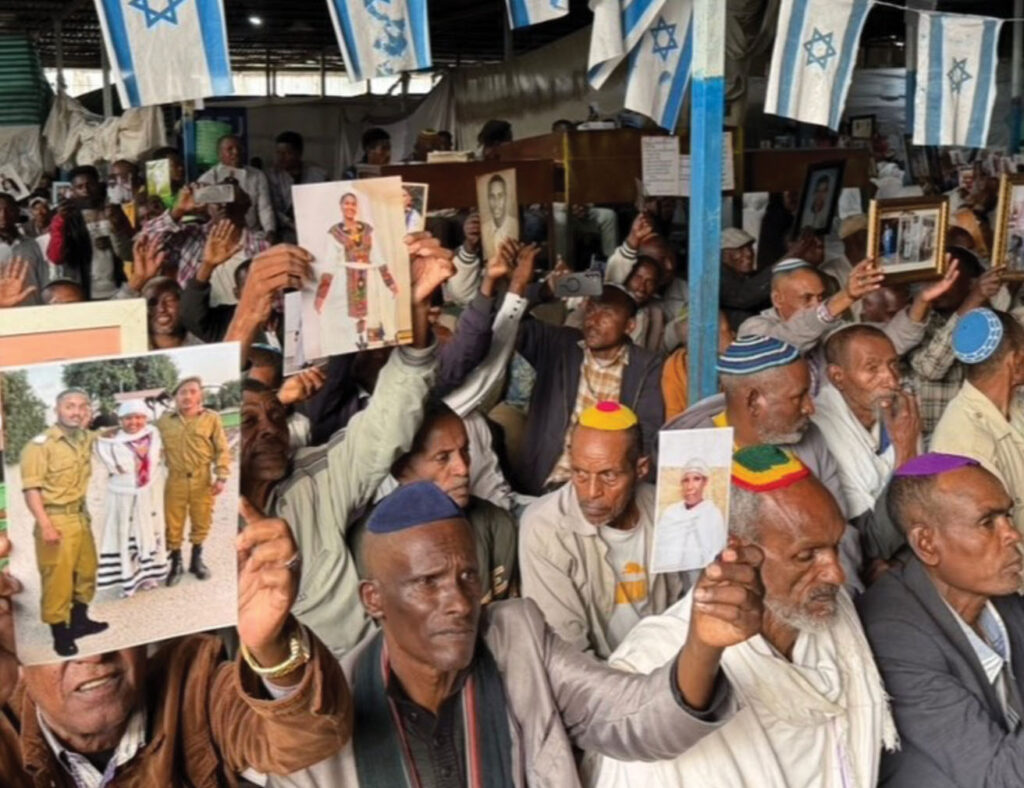
Praying with them was especially meaningful. They pack into their synagogue in rotations of over a thousand at a time. They don’t say a word during the entire prayer service but focus intently on the hazzan, who recites all of the prayers out loud, first in Amharic and then in Hebrew. They have only a few siddurim for their entire community. But they were all clutching onto something as they prayed. Only after we finished over an hour-and-a-half of prayers did we ask them to show us what they had been holding. In one of the most moving moments of the trip, they showed us photos of family members who had moved to Israel and from whom they’ve been separated (many of whom have since died serving in the IDF), and they asked that we share this moment with our communities.

They then began to spontaneously sing Am Yisrael Chai. Despite all they endure, their hope is much stronger than their pain. What especially moved me was how gently and sweetly they sing, which is exactly the type of people they are.

A consistent message we heard from the Jews there is how badly they want to go to Israel. Correction: how desperately they yearn to go to Israel.

And while they suffer from severe poverty, when we asked them what they need from us, what do you think their other requests were? Money? Their first request was assistance with education: how to write mezuzot, perform shechita, brit milah, etc. (though, as we saw firsthand, they know how to make their own matzah, talleisim, and yarmulkes).

We also got to see one of their food distribution programs, after which we toured the facility where they employ members of their own community to produce the food they distribute.

Giving is indeed a theme in this community. They lack so many material necessities, yet they give so much. They spontaneously began clapping once again as they presented us with some of the beautiful shawls they make in their community.

And what about those helping them, SSEJ (Struggle to Save Ethiopian Jewry, https://ssej.org/)? Is it just about providing basic needs? It’s much more complex, and in fact somewhat similar to some of the dilemmas we debate in the hospital: there is a limited number of resources, so how do they make the best use of their funds? The mothers are begging for soap (the children use cloth diapers that they must reuse). But if that is provided, there are fewer funds to feed the children, the majority of whom already suffer from malnutrition. They need a new cemetery for the staggering number of children who die there, but if that is funded, they can’t expand their health clinic, which is already buckling under the pressure. They currently can only provide healthcare to those under 18 and over 50. They used to feed everyone under five, but can now only afford to feed those under three. And whenever a new need arises in the community, they must ask themselves: feed 100 children or help this individual?

These dilemmas, not to mention the frequent kidnappings that members of their community endure, which somehow don’t make the press in the broader Jewish world, left me with a lot to reflect on and struggle with.

Discussing their struggle with the Israeli Ambassador to Ethiopia and the African Union, Dr. Avraham Neguise, also really helped us appreciate some of the many challenges this community and those advocating for them face. The struggles they deal with are very significant, the dilemmas in figuring out how to best help them are intensely challenging, and yet the privilege of getting to meet and interact with these precious Jews was an unforgettable and life-changing experience.

May all of their prayers be fulfilled, and may we all be able to find some of the kindness, resilience, generosity, and genuine warmth that is demonstrated by this precious part of the Jewish people.


Rabbi Dr. Jason Weiner, BCC, is the senior rabbi and executive director of the Spiritual Care Department at Cedars-Sinai in Los Angeles, rabbi of Knesset Israel Synagogue of Beverlywood and senior consultant to Ematai.

Mission to the Jewish Community of Ethiopia Read More »

LA28: Inside the Race to Host One of the World’s Biggest Sporting Events

The Los Angeles 2028 (LA28) Olympic Games are still two years away, but in the City of Angels, the Olympic pulse is already being felt. As the countdown continues toward one of the world’s largest sporting events, dozens of journalists from around the globe received a rare behind-the-scenes look at the preparations — and the venues where the world’s top athletes will compete.

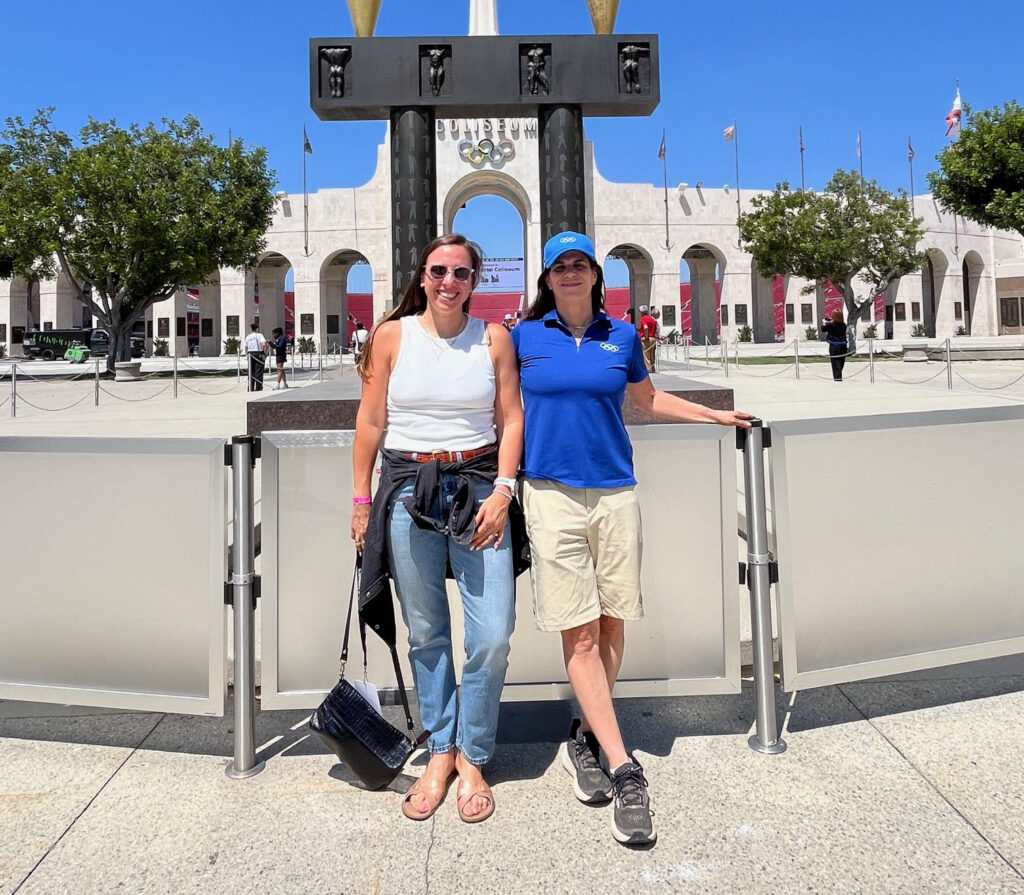
As part of a special media week organized by the LA28 Organizing Committee, I had the opportunity to tour the venues alongside Yael Arad, Chairwoman of the Israeli Olympic Committee and a member of the International Olympic Committee, and Adi Bichman, CEO of the Israeli Olympic Committee.

Los Angeles is one of only three cities to host the Olympic Games three times, joining London and Paris. The city first hosted the Games in 1932, during the Great Depression, and returned as host in 1984.

Unlike many previous host cities that built new stadiums and facilities costing billions of dollars only to see them abandoned afterward, Los Angeles will not build a single new permanent venue for the Games. Instead, it will rely on more than 40 existing stadiums, arenas and sports complexes, which will undergo upgrades and adaptations ahead of an event featuring 36 sports.

The first stop on the tour was one of the symbols of the new Los Angeles: SoFi Stadium in Inglewood. The spectacular venue will host part of the Olympic opening ceremony, along with the historic Los Angeles Memorial Coliseum, which hosted the Games during the city’s previous two Olympic.

For the first time in Olympic history, the opening ceremony will take place at two separate venues — a decision meant to symbolize the connection between Los Angeles’ Olympic legacy and its future. The Coliseum represents the city’s historic Olympic heritage, while SoFi Stadium represents its modern transformation.

SoFi Stadium, the home of Los Angeles’ two NFL teams, the Rams and the Chargers, has hosted the 2022 Super Bowl and matches of this year’s FIFA World Cup. It will undergo one of the most dramatic transformations in Olympic history, converting from an American football field into an Olympic swimming venue. A temporary competition pool will be installed specifically for the Games and removed afterward, with seating for 40,000 spectators.

Nearby, at Exposition Park, BMO Stadium will host flag football as well as lacrosse, which returns to the Games for the first time since 1908. The close proximity of the venues will create a walkable Olympic hub for fans.

For the first time, the Olympic Games will also come to the San Fernando Valley. At the Sepulveda Basin and Lake Balboa complex, athletes will compete in BMX (freestyle and racing), skateboarding, modern pentathlon and 3×3 basketball — the fast-paced street version of the sport featuring three players per team.

Other venues across Los Angeles are also preparing for the Games. Dodger Stadium will host baseball; the Rose Bowl in Pasadena will host the soccer finals; Long Beach will become one of the largest Olympic hubs, featuring 11 Olympic sports and seven Paralympic sports, including handball and beach volleyball. Venice Beach will host the triathlon, marathon and road cycling events — and will award the first medals of the Games just hours after the opening ceremony.

The next stops on the tour were the Intuit Dome, the new home of the Los Angeles Clippers, which will host Olympic basketball, and the Peacock Theater at LA Live, which will host weightlifting, boxing and Paralympic competitions before returning to its entertainment programming after the Games.

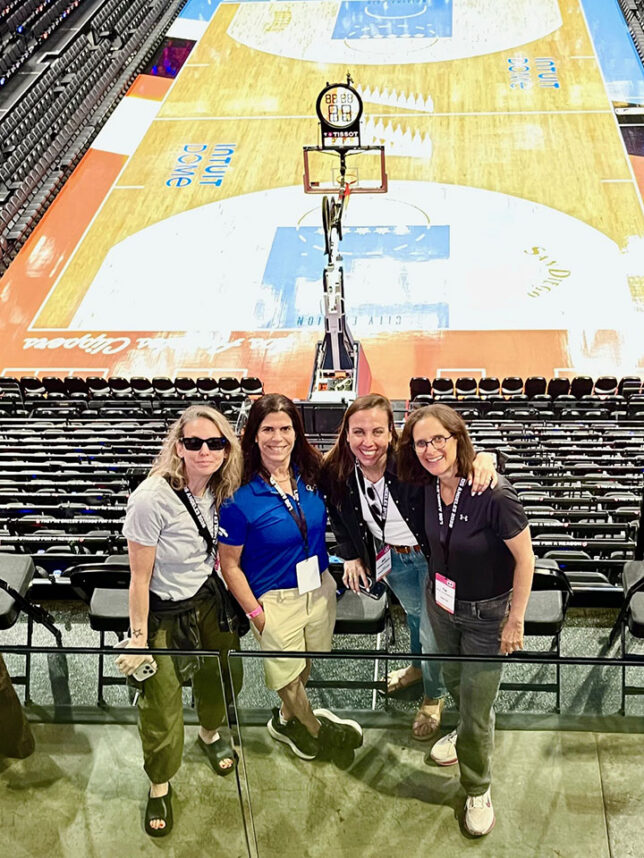
From Left: VP business development at Olympic Committee Sivan Fishler, chairman of the Olympic committee Yael Arad, CEO of the Olympic committee in Israel Adi Bichman and Tal Alexandrovich at the Intuit Dome

The tour continued to another iconic Los Angeles sports landmark — Crypto.com Arena, home of the Lakers. We entered through the Kobe Bryant entrance, dedicated in memory of the Lakers’ legend who was killed in a helicopter crash, and stepped onto the court where some of basketball’s greatest moments have taken place.

The biggest challenge facing Los Angeles will not only be hosting the Olympics but also managing the massive transportation demands created by an estimated 5 million visitors arriving in a city already known for its traffic congestion.

In recent years, Los Angeles has accelerated efforts to expand its rail and public transportation networks, connecting LAX, Downtown Los Angeles, Inglewood, Pasadena and other areas throughout the region. While many of these projects began before the Olympic bid was awarded, the Games have increased the urgency to complete them.

The city plans to introduce dedicated shuttle systems, special transportation lanes, and priority access for public transportation. LA28 also partnered with Uber, which will serve as the official ridesharing and delivery partner of the Games, providing transportation options through cars, bicycles and scooters as part of a flexible system designed to help visitors move between dozens of venues.

Even with these preparations, avoiding major congestion entirely may be impossible. During peak Olympic days, hundreds of thousands of visitors — including fans, journalists, staff and volunteers — are expected to arrive daily, in addition to Los Angeles County’s 10 million residents continuing their normal routines.

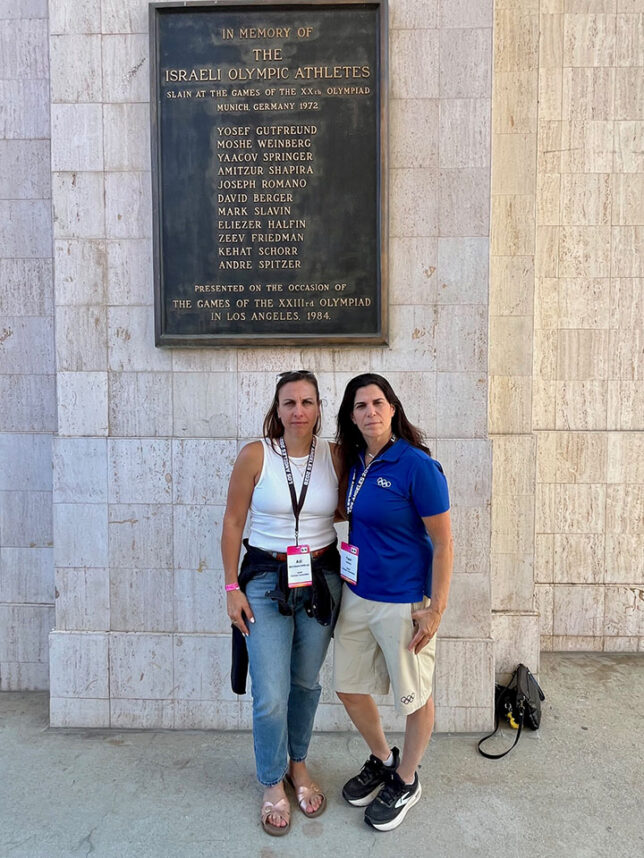
Our next stop was the historic Los Angeles Memorial Coliseum, built in 1923 and recognized for the Olympic flame that rises above it and its iconic view of Downtown Los Angeles. The visit was especially meaningful for Arad and Bichman, who paused when they noticed a large memorial honoring the 11 Israeli athletes murdered at the 1972 Munich Olympics.

For LA28, the Coliseum will be adapted to host Olympic athletics competitions. A special surface will be installed above the existing field, and after the Games, the temporary changes will be removed and the venue will return to its role as the home of the University of Southern California (USC) Trojans football.

Arad, the first Israeli judoka to win an Olympic medal — a silver medal at the 1992 Barcelona Games — told The Journal during the tour that the Games represent a unique opportunity to strengthen the connection between American Jewry and Israel.

In recent years, Arad has worked to build support for Israeli Olympic sports within the American Jewish community. Following the 2024 Paris Games, the Friends of the Israeli Olympic Committee in the United States was reestablished with the goal of creating a strong support network ahead of Los Angeles 2028.

The support generated through these efforts is not intended to cover existing gaps, but rather to provide long-term investment in Israeli athletes — strengthening Olympic programs, improving training systems and providing professional support. “The Jewish community in the United States wants to bring the younger generation closer to Israel, and this is one of the best ways to do that,” Arad said. “We want to inspire the community to come to the stadiums, cheer for the athletes, and wave the Israeli flag.”

As part of that effort, Arad travels throughout the United States for community events and lectures, meeting with Jewish organizations, Federations and philanthropists who support Israeli athletes. She also spoke about the challenges Israeli athletes have faced since the Oct. 7, 2023 attack. “The war brought major challenges. One of the biggest issues has been dealing with travel disruptions — whenever a war breaks out, flights are canceled and even when we eventually find alternatives, the impact on us is significant,” Arad said. Despite those obstacles, she said the focus remains clear. “We are investing our energy in moving forward, achieving and fulfilling our goals. That is the message we want to convey,” she said.

The 34th Summer Olympic Games open July 14, 2028, and conclude on July 30. 

LA28: Inside the Race to Host One of the World’s Biggest Sporting Events Read More »

The Myth of the Marxist Mishpacha

There is a story the American Jewish left tells about Jewish immigrants, and it goes like this: Your grandparents were radicals. They organized. They marched. They believed in the collective. They were, at heart, Marxist socialists and communists.

It is a useful story. It gives today’s progressive politics a Jewish pedigree, wraps guilt around anyone who strays from the coalition. It invokes the sacred authority of the immigrant generations to settle arguments that generation never had.

It is also, in any serious sense, wrong.

Yes, there were Jewish communists. There were Jewish socialists, Jewish anarchists, Jewish labor organizers who used the language of the international left. Some of them were genuine ideologues, and some of what they did was genuinely radical. They struck against industries that would sooner have had them killed than unionized. But the radicalism was in service of getting in, not burning down the U.S. and its institutions. Most of them were workers in dangerous industries who wanted safer conditions and a living wage — which is a rather different thing than wanting to overturn the American system.

There were, no doubt, famous Jewish communists — Jews have a way of being famous. Emma Goldman preached anarchism from the lecture circuit. Julius and Ethel Rosenberg went to the electric chair for passing atomic secrets to Moscow. Morris Hillquit ran for mayor of New York on the Socialist Party line, and Meyer London represented the Lower East Side in Congress as a Socialist. But there are at least as many examples of Jewish capitalists, and they were just as Jewish and just as immigrant.

Julius Rosenwald built Sears, Roebuck into a retail empire and gave away much of his fortune building schools for Black children in the Jim Crow South. The Guggenheims built a mining and smelting empire. And for every Rosenberg there was a Jacob Schiff — the Gilded Age investment banker who ran Kuhn, Loeb & Co., financed American railroads and was a lifelong Republican who spent a good part of his fortune fighting the Bolshevism that some of his fellow Jewish immigrants romanticized. Jewish scientists, Jewish lawyers, Jewish shopkeepers who never organized a picket line in their lives — these were at least as representative of the immigrant generation as the men and women who make it into the documentaries.

What the Jewish immigrant generation overwhelmingly wanted was to get in. To the country, to the economy, to the middle class. They wanted their children in school and their grandchildren in the professions. They wanted the mortgage and the suburb and the seat at the table that Europe had refused them. The labor organizing was a means. The destination was the American dream, pursued with a ferocity born from knowing what happened to Jews who had nowhere to go.

They voted overwhelmingly Democratic because the Democratic Party of the mid-20th century stood for the things they needed: public schools, accessible universities, home loan programs and a growing social safety net that made upward mobility possible. They were not voting for a vanguard. They were voting for a ladder.

The Jewish love affair with the Democratic Party was, at its core, a middle-class love affair. It was about security, education and the possibility of a life better than the one your parents had. It was, in the deepest sense, a conservative set of values pursued through liberal politics. The goal was never transformation. The goal was arrival.

Which makes it curious to consider what those grandparents would make of what they are now invoked to support.

The Jewish immigrant who organized for a 40-hour work week did not do so to give his grandchildren a politics that asks them to feel guilty for their education, their professional success or their attachment to a Jewish state. The woman who pushed her children toward college so they would never be dependent on a factory floor like her did not intend her sacrifice to be recruited, decades later, as evidence that Jews belong on the revolutionary left.

The immigrant generation was not marching toward Bernie Sanders. They were marching toward Scarsdale.

The myth persists because it is convenient. For non-Jewish progressives, it provides a certificate of Jewish authenticity — a way to tell Jews who have drifted from the coalition that they are the real apostates, the ones who have abandoned the tradition. For Jewish progressives, it offers something more personal: the comfort of believing that their politics are not as much a choice but an inheritance, not an argument they are making but a legacy they are inheriting.

But an inheritance built on a misreading of the will is not an inheritance as much as it is a forgery.

Of course Jewish Americans can and many will support far-left politics. They can and should support any politics they choose — that is, in fact, one of the things the immigrant generation was after. But they should do so on the merits of those politics, not by conscripting grandparents who wanted nothing more complicated than a safe place to raise their children into poster children for a movement those grandparents would have found, at best, baffling.

Our grandparents were not radicals. They were strivers. Confusing the two isn’t memory, it’s marketing.


Todd L. Pittinsky is a professor at Stony Brook University (SUNY).

The Myth of the Marxist Mishpacha Read More »

Professors Should Fight Campus Jew-Hatred as Educators, Not Bureaucrats

Nearly three years into this unconscionable spike in Jew-hatred, cultivated through decades of academic anti-Zionism, universities still don’t get it. Until they respond as teachers running educational institutions not bureaucrats running Communist re-education camps, the crisis will fester.

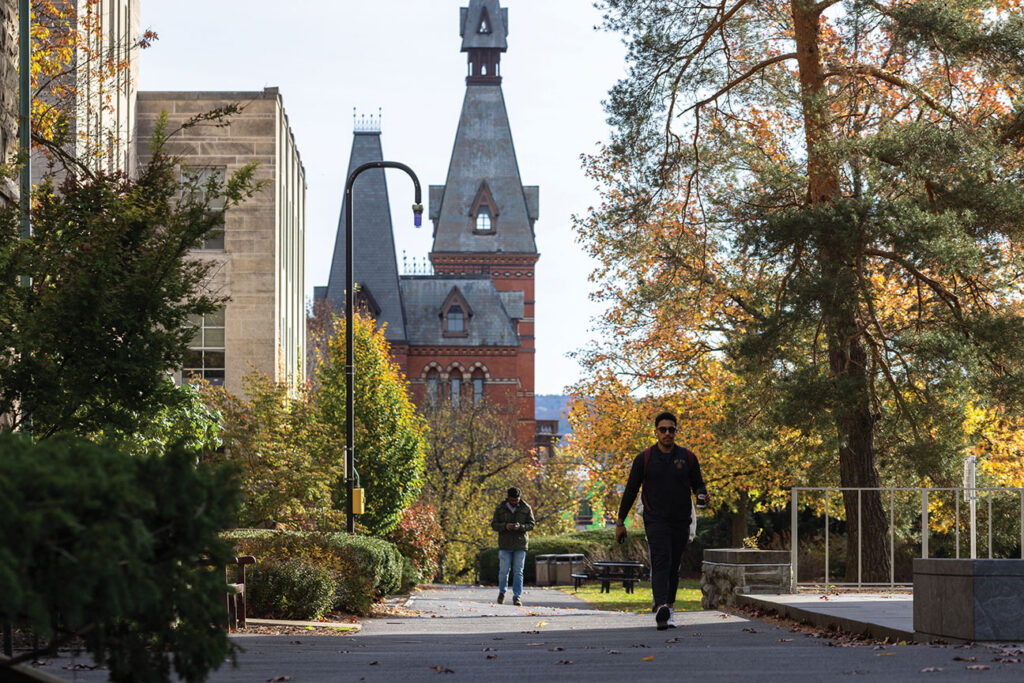
This summer, when a Cornell student refused a second job interview with: “Not interested in working for a jew…,” the response to him was too political and legalistic.  Exposed, he doubled down, telling The Cornell Daily Sun that he realized the interviewers were Jewish based on their “first and last name, LinkedIn, and physiognomy” – the last word uniting today’s manosphere with yesterday’s Nazis.

Defending free speech while fighting bigotry and avoiding thought-policing isn’t easy.   But a recent Chronicle of Higher Education article about the incident illustrated academics’ overly-politicized and disappointingly sterile approach. Thirty percent of the op-ed bashed President Trump and his appointees, assuming that Cornell officials only investigated this as a possible “bias incident” to placate the administration.

Cornell, the author argued, “should not be ‘investigating’ anyone for what they have said. Its own ‘Core Values’ statement declares that ‘free and open inquiry and expression’ — even of ‘ideas some may consider wrong or offensive’ — is fundamental to the university.” Warning of a slippery slope, while shifting the conversation from bigoted language to inflammatory political remarks, the author wondered: If Cornell “penalizes” the student “for declaring that he doesn’t want to work for Jews, who will be next? Someone who says Israel is committing genocide? Or that the university should boycott it?”

This clever category switch is absurd, given how universities spent years squelching speech.  Academics have repeatedly – and unacceptably — bullied those with dissenting views on issues of race, gender, immigration, among other politically-correct causes – while protecting blacks, women, gays, but often not Jews. In 2020, students boycotted a Cornell University Law Professor, William Jacobson,  for calling Black Lives Matters’ founders “anti-American, anti-capitalist activists.” His dean denounced him.

Other professors have suffered macro-career disruptions over supposed micro-aggressions – one veteran UCLA prof endured student sit-ins and was saddled with extra colleagues encroaching on his course for correcting grammar in papers.

While avoiding such assaults on free speech in the future, universities must also acknowledge their record of selective outrage.

In the Cornell case, apply a simple substitution test for consistency. Flip a switch. Replace “black,” “woman,” “gay,” “lesbian,” or “trans” in the sentence “Not interested in working for a jew.” Similarly, the student escalated on X, tweeting: “My experiences with Jews have not been pleasant….” Wouldn’t it be “bias” if he overgeneralized about others, saying “my experiences” with blacks or women or Catholics or Latinos “have not been pleasant?” Universities’ assault on bigotry cannot depend on “the context” — when “context” essentially means “it’s OK to target Jews.”

Hysteria and browbeating don’t help. Modeling that spirit, the employer who received the bigoted response posted it without the student’s name. “He’s just a student, he might not know any better — it could be people in his environment, or on social media he saw something about Jewish people and he is just following the wave,” the spurned boss, Gabe Einhorn, told the Cornell Sun. (Others online outed the student).

And this case is particularly confusing.  Refusing a Jew because you’re a bigot isn’t “discrimination.” The student didn’t offend a fellow Cornellian, which dilutes the assault on the “community.”

Also, the student sought employment privately – does it concern Cornell if the university placement office helped, but is it irrelevant if he networked independently? Does placing Cornell’s name on his CV make anything he does on the job relevant to the university? Does that involvement end with graduation?

Fighting bigotry requires balance, perspective, wisdom. The cancel culture craze revealed how suffocating it is to police every word, gesture, interaction, and how self-destructive it is when universities divert massive resources into creating bureaucracies monitoring students’ thoughts. Moreover, it’s always better to err on the side of fostering free speech than banning it.

Here, then, is the misfire in the anti-bias conversation, that highlights one of the modern universities’ greatest failures. These are educational institutions. But most universities have allowed bureaucrats – in Washington and on campus – to hijack what could be “teachable moments.”  Technical legalistic bureaucratese keeps eclipsing the moral language and character building that should be ingrained into campus culture.

Cornell[s “mission” is “to educate the next generation of global citizens….” Global citizens are cultivated by thoughtful, challenging professors committed to educating not punishing. Did any of this student’s professors or fellow students – Jewish or non-Jewish — contact him, explaining why the statement embarrassed him and the university, then inspire him to be better? And, did any one within the Jewish community, formally or inflormally, do the same, explaining how, especially today, such matter-of-fact bigotry is so morally repulsive?

Next month, most universities will welcome their new students with orientations. Most will offer anti-bias or sensitivity training reflecting today’s ideological circus, with all the soul of a computer instruction manual. Just as modern professors and administrators fail to build their community through bold, out-of-the-box, “I-thou” moments, these training sessions will fail to begin fostering what’s really needed to create diverse communities filled with critical thought and mutual respect.

It’s better to assign great, thought-provoking books than to list dos-and-don’ts. Today’s bureaucratic, hyper-politicized, and cowardly professoriate forgets that, as Ralph Waldo Emerson taught:  “Character is higher than intellect…. A great soul will be strong to live, as well as strong to think.”

Then again, perhaps these paint-by-numbers posturing sessions are precisely the orientation students need to grab their credentials and parrot back the certitudes imposed by far too many in today’s classroom.


Professor Gil Troy is a Distinguished Scholar of North American History at McGill University and a Senior Research Fellow at the JPPI, the Jewish People Policy Institute. He is the author of 9 books on presidential history and, more recently, To Resist the Academic Intifada: Letters to My Students on Defending the Zionist Dream  as well as two-e books, 250 Reasons to Thank America – with David Suissa, and  The Essential Guide to the U.S.-Israel Partnership: the 250th Anniversary Edition.

Professors Should Fight Campus Jew-Hatred as Educators, Not Bureaucrats Read More »

Framing the Faith of Maimonides

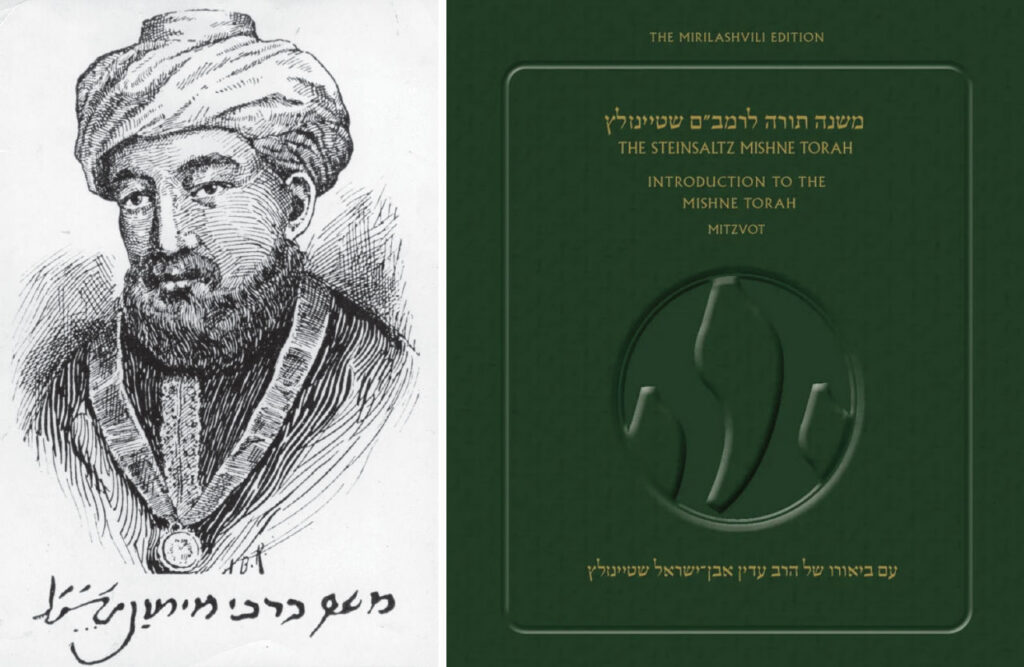
For those seeking an entry into the most brilliant of Jewish legal minds, a recently launched series serves as an immensely rewarding resource. The first volume of Koren Publisher’s Steinsaltz Edition of Maimonides’ code of Jewish law, the Mishne Torah, has been published in English. It seeks to make the legendary medieval thinker’s teachings accessible to a wide audience, utilizing the commentary of the late Rabbi Adin Steinsaltz, who passed away in 2020.

In addition to the clear English translation of the source material, this unique edition contains sections covering additional legal perspectives that supplement those of the Mishne Torah itself. Also included are some of the late Lubavitcher Rebbe’s writings on Maimonides’ legal rulings.

Most helpful are the conceptual essays in the back of the book, which touch upon how Maimonides’ thought has been adapted, and argued with, over the ages.

Case in point is the volume’s discussion of how Maimonides’ belief in the science of the day is to be thought of in our own era – and how it relates to the authority ascribed to his rulings.

The article does not shy away from the fact that Maimonides presumes several elements of the natural world that are no longer accepted as true. These include a geocentric universe (with the Earth at the center), the existence of transparent celestial spheres, the attribution of intellectual capabilities to those spheres, and the cosmos as being structured with fire above air, above water, above earth, in concentric layers.

“Already in [Maimonides’] own time many Sages rejected his opinions,” the essay notes. Some subsequent Jewish authorities banned his books, and even burned them. Though, it notes, the harshest reactions usually centered on the Maimonides’ philosophic worldview, “which were considered an expression of foreign philosophy, mainly Aristotelian, not his scientific claims, which were probably viewed as established scientific assertions.”

The 18th-century sage known as the Vilna Gaon objected to some of Maimonides’ scientific assertions, and argued that “he was drawn after the accursed [Greek] philosophy.” Rabbi Tzadok HaKohen of Lublin (1823-1900) also expressed reservations about Maimonides worldview, writing: “Maimonides, who explained the Act of Creation as referring to the natural sciences of created beings, found this useful in the service of God, may He be blessed, for loving and fearing Him. However, if this is true for him, it is not true for most of those who occupy themselves with these sciences… [the] knowledge of such subjects is not required for Torah believers, especially since many of his claims are not true, according to [gentile] scholars of the current day.” According to these opinions, the scientific content of the relevant chapters in Mishne Torah is not a matter of authoritative Jewish law, but rather a description of the world according to the knowledge and views of the author’s time. His Torah rulings are not to be undermined by new scientific concepts.

On the other end of the spectrum, the Lubavitcher Rebbe believed that all of Maimonides’ statements in the Mishne Torah — even those describing “science” — are binding and authoritative (though the Rebbe simultaneously argued that Maimonides’ philosophical writings in “The Guide of the Perplexed” are not binding and eternal). Accordingly, one must accept the views of Maimonides even when they contradict the findings of contemporary science.

Wherever one lands in this debate, the essay argues, “it is genuinely important from a religious and even a halakhic perspective to engage and delve into the science of the nature of the world.” This is the best way, in Maimonides’ opinion, to fulfill the commandment of loving and fearing God.

In this enriching new edition of the classic code of Jewish law, readers can delve deeply into the mind of Maimonides, from his analysis of the commandments to the controversies that have accompanied his writings, offering a window into the wisdom of one of our tradition’s preeminent thinkers.


Rabbi Dr. Stuart Halpern is Senior Adviser to the Provost of Yeshiva University and Deputy Director of Y.U.’s Straus Center for Torah and Western Thought. His books include the newly released “Jewish Roots of American Liberty,” “The Promise of Liberty: A Passover Haggada,” “Esther in America,” “Gleanings: Reflections on Ruth” and “Proclaim Liberty Throughout the Land: The Hebrew Bible in the United States.”

Framing the Faith of Maimonides Read More »

Hope in Faith, Faith in Hope

At gatherings of university leaders, my fellow college presidents and I would regularly review data on how Americans felt about higher education, and shake our collective heads.

Each year the percentage of U.S. adults who said that they had either “a great deal” or “quite a lot” of confidence in this country’s colleges and universities declined. Surely this was temporary, we would convince ourselves, and the number would rebound.

In 2015, when Gallup first measured trust in higher education, 57% of respondents reported having confidence. I remember at the time thinking that was shockingly low. Well, the 2026 survey results just came in, and that number has fallen to 38%.

The sharpest decline has been among Republicans. Back in the “good old days” more than half of Republicans held positive views regarding higher education; today that percentage has shrunk to below a quarter. Exactly half of Democrats remain positive, but that too is a new low.

Why has higher education lost so much of America’s trust?

The surveys suggest three main factors.

First is the perceived left-wing political agenda on college campuses. Most students study subjects such as engineering, economics, business and the sciences, disciplines where faculty focus more on teaching and research than on asserting ideological positions as established truths. But the humanities and humanistic social sciences, where such political activism is much more prevalent, receive the most attention in the media and in Washington. And never have their “progressive” agendas been so clearly exposed than after the Oct. 7, 2023 massacre, when long-standing anti-Israel views often spilled over into outright antisemitism.

Then there is cost. While selective private and public colleges and universities have put enormous sums of money into financial aid so that the price they charge the vast majority of their students is rising much slower than inflation, the “sticker price” still feels daunting to most Americans.

Third, there is the belief that colleges are failing to adequately prepare students for the workforce. Again, a mountain of evidence exists to the contrary, with college graduates earning a substantial wage premium relative to those who stop their education after high school, but perception rules over reality.

And now there is AI, which is seen by the American public as an emerging threat to the value of a college education, with almost half of the poll’s respondents expecting the financial return to a college degree to fall.

Scary.

And even scarier to note that Americans seem to be losing faith much more widely.

Only 36% have confidence in organized religion, 32% in medicine, 30% in banks, 29% in public schools, 27% in the Supreme Court, 17% in the criminal justice system, 15% in big business, and, everyone’s “favorite,” 10% in Congress. Hard to believe that as recently as in 2004, 30% of Americans trusted Congress!

The survey results provide a valuable comparative perspective: amazingly enough, with 38% of American adults still having confidence in higher education, colleges and universities are kicking butt – in a relative sense, at least.

This general mistrust is manifesting itself in really frightening ways, from a rise in political extremism, to the vilification of Jews on both the left and the right. Neither is surprising. History is replete with examples of how when a society stops believing in its enduring institutions, radicalism flourishes, with Jews all too often cast as convenient scapegoats.

Those of us who are baffled by the fact that only 54% of Americans have a positive view of capitalism (it is 42% among Democrats) should recognize that number isn’t so terrible given that Americans hate most everything these days. Socialism seems like an excellent way to address your many complaints, until it fails in practice. In any case, I believe in the old adage that the revolution ultimately devours its own.

Will Americans ever regain trust in our institutions? I think so.

Perhaps it is my religious faith that gives me hope. Still, I bet that the 36% of Americans who join me in having confidence in organized religion would agree that our nation could use some divine intervention right about now.


Morton Schapiro served for more than 22 years as President of Northwestern University and Williams College.

Hope in Faith, Faith in Hope Read More »

Finding Communal Comfort

Last week, just a few hours before Tisha b’Av, my aunt Devra called. It was time-sensitive and sweet, and it warmed my heart — she wanted to know how to stream our synagogue’s Tisha b’Av commemoration, because even though she lives in Kansas City, she’s a remote member of our community and loves our online offerings.

She reminded me that it was my Grandpa Jake’s English yahrzeit. But then she told me something chilling that I had forgotten, or maybe had never really learned: that on Tisha b’Av in 1941, the entire community where my grandfather was born was liquidated by the Nazis. On that day, his grandfather, David Davidovits was murdered along with his wife (my great-great grandmother) and countless cousins.

So for me, this year, Tisha b’Av wasn’t just about the destruction of the First and Second Temples, or the edict of expulsion from Spain, or the beginning of deportations from the Warsaw Ghetto to Treblinka in 1942. It was also the more personal tragedies that those who hate us decided, over the years, to perpetrate against us on that day — just to rub a little more salt in our wounds.

Like the mayor of New York City did when he released a video on erev Tisha B’av I think can fairly be called incitement against Israel — purportedly about Israel’s prime minister, but just as easily described as incitement against anyone who considers themselves a Zionist, a supporter of Israel’s right, and need, to exist. And since the vast majority of Jews worldwide consider themselves Zionists, more broadly, incitement against Jews. Two days later, on the Upper West Side, two men, including a Jewish man, were stabbed by an attacker shouting “Allahu Akbar.”

I’ve been thinking about all of this as we turn to consolation. After the heavy period leading up to the ninth of Av, the Shabbat immediately following is called Shabbat Nachamu, the Sabbath of Comfort. We read a passage from the book of Isaiah that comes to console the Jewish people, to inspire us to believe that things will somehow get better. For seven Shabbatot in a row, we read passages from Isaiah designed to carry that message forward, leading us to the New Year — to a moment of rebirth.

Part of the wisdom here is that being comforted takes time. It’s not a hug or a word of encouragement, and then we’re done. For someone who has suffered a loss or trauma, it can take years — decades, even. But we believe that in time, it will get better. Sometimes, as a people, we have to think in generational time, in thousands of years. The Jewish people found inspiration in those words of Isaiah long before they witnessed the return to our ancestral homeland. It took two millennia but we finally got there.

The other lesson is that we comfort each other. In the book of Isaiah, God calls the prophet to comfort the Jewish people. But we know this is really something we must do for one another.

So after a heavy week — communally, and for me personally, thinking about what it must have been like for my grandfather to discover that the world he’d left behind in Europe, including his entire family, was gone — I’ve also reminded myself of this: my grandfather lived to see, with joy, the birth of the State of Israel. He was privileged to bring me, my siblings, and our whole family to Israel in 1978, for the B’nai Mitzvah of my sister and brother.

And so even in this moment of communal darkness — as antisemitism reaches levels we haven’t seen in our lifetimes, as anti-Israel rhetoric has become normalized — even in such a moment, we do not give up hope. We will comfort one another. We will be comforted by one another.

And that’s our task. Now is the time to recommit to community. To join a synagogue or renew your membership. To become more involved, more committed. That is how we find comfort. That is where we find hope.


Rabbi Yoshi Zweiback is the senior rabbi at Stephen Wise Temple in Los Angeles.

Finding Communal Comfort Read More »

Leaving Behind a Better World

It was a close call, but my parents did it; the America they left for my generation was a safer and saner world. At age 10, being allowed to head out to play for the entire day, all I heard from mom was, “Be home by 6 and call if you’re going to be late. I worry.” Unimaginable today. Wives say, “Be careful.” Moms say, “I worry.”

The Apple AirTag was still a long way off. The only two tracking devices were looking out the window and a kitchen wall phone with an 8-inch cord. If my mother wanted to find me, she called other mothers.

We lived in an apartment building with no back or front yard; when I left to play, they had no idea where I was or who I was with. Their only clue that I was still alive was when I came home filthy. My hello was, “Go wash up before you touch anything and use soap.  That’s what it’s there for.”

Because I have children and grandchildren, I can now understand the sigh my mom let out when she saw I was still in one piece. That’s another thing she said: “Come home in one piece.” I wonder if Humpty Dumpty’s mother was the inspiration behind “Come home in one piece.”

They worried about me getting hurt or, God forbid, run over; they knew I was a habitual jaywalker. My wife, unlike me, is not a jaywalker.  For some unknown reason, when she spots hundreds of cars and trucks racing toward her, she lacks the desire to beat them across.

The America my generation seems to be leaving our kids and grandkids is not safer nor saner, and it breaks my heart. I’m worried for the future they will be facing. My parents had little to no concern that some antisemitic lunatic on the prowl was going to randomly shoot us kids while we were standing on a chalk base during a stickball game, or that I would be beaten senseless walking home wearing my yarmulke. Antisemitism was not an issue for me growing up. The real yarmulke concern back then was one of respect; I removed it when entering a non-kosher Chinese restaurant.

After the Second World War, things got quiet; the Jews were pretty much left alone. My parents understood not to trust quiet, though. When our house was too quiet, they wondered what I was up to. When the world gets too quiet, we also need to worry.

The American quiet has now morphed into flak-jacketed, pistol-packing, pepper-spray-carrying guards outside schools, shuls and kosher restaurants. It was inconceivable that I would not be allowed to walk my wife or child to the gate to see their plane take off and kiss them goodbye. We all believed this could never happen in America. We were so very wrong.

The Jew virus has mutated from “We will always be safe in America” to “Where would we go if we had to leave?” Counting on help from America is evaporating quicker than steam from a hot shower. Again, it breaks my heart.

My generation will probably be okay, but if my kids and grandkids had to leave, where to: Asia, Africa, South America, Antarctica, Australia, Europe?  Move to Israel; how safe is that if Iran ever gets the bomb?

We have gone from the America of “This could never happen” to “It’s happening.” So, I ask whether it is healthy, mentally and physically, to continue watching videos about how bad things are getting? Should I continue reading and writing stories like this one that have almost no solutions? How many stories before we’re too shook up to get out of bed or to send our kids to school or shul?

My personal solution is to listen to the few voices I still trust, that may or may not eventually let me down. Cut back on most of the videos and stories that get me crazy and occasionally voice my beliefs in private and public forums that most of my family hates me doing, fearing for my safety.

I pray to God the third act is saner and safer than what my mind projects and America returns to its senses before it destroys itself from the inside out.


Mark Schiff is a comedian, actor and writer and hosts, along with Danny Lobell, the “We Think It’s Funny” podcast. His new book is “Why Not? Lessons on Comedy, Courage and Chutzpah.”

Leaving Behind a Better World Read More »