Boy George Releases Song Calling Out Israel’s Critics
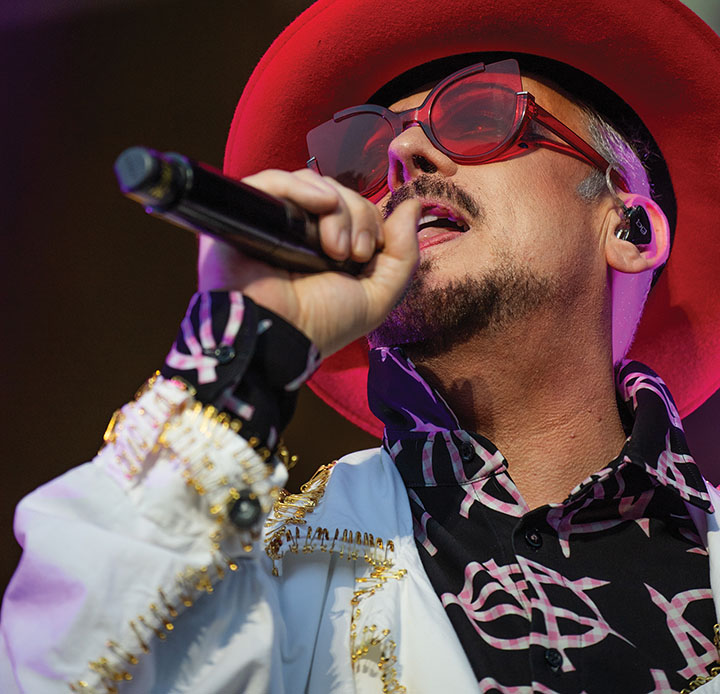
English singer-songwriter Boy George has had a busy year of standing up for Israel and the Jewish people. On July 26, he released a new song, “We Will Dance Again,” about the Nova Music Festival.
The Culture Club singer shared the song with a video featuring a static image, a black background with “We Will Dance Again.” In the post, he wrote a single word caption: “#shalom.” As of press time, the reggae-style track did not appear to be available for streaming on Spotify, Apple Music or any official channel on YouTube.
Lyrically, the song verses are a rebuttal, and the chorus is a rallying cry. In the verse, he rejects mischaracterizations of Israel’s Operation Swords of Iron in the media: “You say genocide, I say war, when you’re attacked that’s what the army’s for.”
In the Oct. 7, 2023 attacks, Hamas terrorists murdered over 1,200 people in Israel, including 364 revelers at the Nova Music Festival.
Before the first chorus, he calls out deniers and minimizers of the attacks with lines about some of the most brutal imagery from the day: “Young girls raped against trees, murdered brutally, for the crime of dancing.”
Boy George repeats the song’s title three times in the chorus. The lyrics leaves no equivocation where he stands: “But if you’re ever confused, I stand with the Jews, I don’t feel brave, I just need to behave like a human.” The percussion picks up and he repeats the full chorus a second time before going into an instrumental featuring a violin solo and a steel drum ringing out a reggae beat. He sings the final lyrics of the song in Hebrew, which translate to “You say genocide, I say war, when they come to kill you.” The 3-minute 20-second song ends with a light piano riff fading into one hit of a snare.
Nova Festival survivor Rom Braslavski responded to Boy George’s “We Will Dance Again” song by affirming, “Yes we are.” Braslavski was held hostage by Hamas in Gaza for 738 days.
The song follows years of public statements from Boy George about Jewish friends, Israeli fans and antisemitism. He has been particularly active on social media this past year, with his nearly 900,000 followers on Instagram and nearly half a million on X. In February of this year, Boy George responded to a video of Lady Gaga in 2014 at a concert in Yarkon Park in Tel Aviv. In the video, Gaga says, ““You are strong, you are brave, you are confident, and I f–ing love you Israel.”
George responded to the post by saying, “I love Israel too. Blaming an entire people is moronic. You can be against war and still love humanity. Good for her. She loves her Israeli fans. Like I do. Some of them were probably killed on Oct 7. I have DJ’d in Tel Aviv a number of times. I hope I will in the future!”
I love Israel too. Blaming an entire people is moronic. You can be against war and still love humanity. Good for her. She loves her Israeli fans. Like I do. Some of them were probably killed on Oct 7th. I have DJ'd in Tel Aviv a number of times. I hope I will in the future!
— Boy George (@BoyGeorge) February 16, 2026
After two Jewish men were stabbed in the Golders Green neighborhood northwest of London in April, Boy George posted support for the victims and the Jewish community.
“I was in Golders Green yesterday,” Boy George wrote on X. “I arrived just as the police presence was building. My heart goes out to the two Jewish victims and to their loved ones. We need to make our Jewish community know we support them. Even before I knew what had happened I was in tears because you could feel panic in the air. These are just regular people getting [on] with their lives. London has always been a great multicultural city. Our Jewish community brings us so much. They are an integral part of the fabric of this city.”
I was in Golders Green yesterday. I arrived just as the police presence was building. My heart goes out to the two Jewish victims and to their loved ones. We need to make our Jewish community know we support them. Even before I knew what had happened I was in tears because you… pic.twitter.com/Xa1kGkQ0p3
— Boy George (@BoyGeorge) April 30, 2026
Boy George reinforced that stance during an appearance on Ireland’s “The Late Late Show” in early May. After host Patrick Kielty linked the Golders Green attack to the war in Gaza, Boy George rejected holding Jewish people responsible for Israel’s actions. “Being asked to turn against the whole race of people is not acceptable to me and I am getting a lot of abuse for it but I don’t really care,” Boy George said.
Twelve minutes into the interview, Boy George turned to the crowd and said, “Do you know any Jewish people?” Nobody in the crowd made any noise. Boy George responded to the silence by saying, “Look at the quiet, it’s so weird.” A few in the crowd chuckled.
The interview took place during the lead-up to the annual Eurovision Song Contest in Vienna that week. Boy George, joined singer Senhit on San Marino’s song entry, “Superstar.” Five countries — Ireland, Spain, the Netherlands, Slovenia and Iceland — withdrew their participation from the contest in protest of Israel’s participation in the contest.
Boy George took the moment to explain that his band Culture Club was precisely the antithesis of the boycott.
“I think music is about bringing people together and not separating them, you know, and Culture Club, that’s what we were in the beginning. We’re a multicultural band: an Irishman, a Jewish drummer [Jon Moss], Anglo-Saxon guitarist…We used to wear Jewish stars and have Jewish writing on our clothes. It was a kind of mix of the whole Rastafarian thing, reggae music, 12 Tribes of Judah. That was always part of what we did. When I go on stage now, I look at the audience and I say, ‘This is what community looks like.”
In June, when Boy George spoke with The Telegraph about his Jewish friends, he weighed in about Palestinians. “Over the years it’s been a really personal thing,” Boy George said. “It doesn’t mean that I don’t have compassion for Palestinians, it doesn’t mean that I agree with what’s going on in Israel, but I am always going to defend the people that I love. I have a lot of Jewish friends and there would never be a situation where I’d turn my back on them.”
Culture Club was a massive pop group in the 1980s, with hits such as “Karma Chameleon,” “I’ll Tumble For Ya” and “Do You Really Want to Hurt Me,” a chart-topping hit,
In the video for “Hurt Me,” Boy George wore a white sweatshirt with the Hebrew words roughly translating to “Culture Club.” They won the Grammy for Best New Artist in 1984. Culture Club performed in Israel in 1987, and Boy George returned in 2011 for a DJ set in Tel Aviv.
Culture Club performed in Tel Aviv in 2017. In front of a sold-out crowd of over 10,000 at the Menora Mivtachim Arena, Boy George said, “Whenever I go to Israel, people always say don’t go there, don’t go there. F— off! I go where I like!”
Boy George Releases Song Calling Out Israel’s Critics Read More »