fbpx

June 18, 2026

Marking BCI’s 85th Anniversary, Jewish Leaders Reflect on a Program That Shaped Their Lives

Years ago, Rabbi Sara B. Arias was showing Camp Alonim’s Israeli delegation around American Jewish University’s Brandeis-Bardin Campus in Simi Valley when she asked the young visitors what the landscape reminded them of.

The answer came quickly.

“Israel.”

The winding roads, rugged hills and open terrain felt familiar to them. The resemblance was no accident. Shlomo Bardin, founder of the Brandeis-Bardin Campus and the Brandeis Camp Institute (BCI), was raised in what was then Palestine and was drawn to the 2,700-acre property because it reminded him of the land he once called home.

For generations, that landscape has served as the backdrop for Jewish exploration, learning and community-building. This year, the Ziering Brandeis Camp Institute (BCI) celebrates its 85th anniversary, marking more than eight decades of helping shape rabbis, educators, nonprofit professionals, entrepreneurs and lay leaders across the Jewish world.

The milestone comes as a new cohort prepares to arrive at the Brandeis-Bardin Campus. Approximately 30 participants are expected to attend BCI’s annual 18-day session, known as an aliyah, which begins June 23 and concludes July 12.

Founded in 1941, BCI was built on Bardin’s belief that Judaism should be experienced as much as studied. Through communal living, arts, music, discussion, outdoor experiences and Jewish learning, the program has long sought to help young adults explore both Judaism and themselves.

Today, its influence can be seen across synagogues, schools, camps and Jewish organizations throughout North America and Israel.

“I think what BCI does is it creates a space for young Jewish adults,” said Halle Shumate, associate director of BCI. “It’s a space that allows 20-somethings to explore Judaism and their Jewish identities in ways you wouldn’t in other places. And it’s not so formal. So much of the BCI curriculum is about artistic expression. The goal is for people to come away from BCI having a better understanding not only of Judaism but themselves.”

More than 55 years later, Arthur Pinchev still remembers the final day of his Brandeis Camp Institute aliyah.

Everyone’s bags were packed. The participants had spent three weeks immersed in hiking and prayer, Israeli dancing and art, Jewish text study and late-night conversations around campfires on the Brandeis-Bardin Campus in Simi Valley. Exhausted and preparing to return home, they gathered one final time near the campus amphitheater to hear from BCI founder Shlomo Bardin.

“Here at BCI, it’s easy,” Bardin told them. “Outside it’s hard. Go out and do stuff. Go out and make a difference.”

Pinchev never forgot those words.

More than five decades later, he serves as interim director of BCI, the same program that helped shape him as a young adult. This summer, he’ll return to BCI and help guide a new generation of participants through an experience that continues to transform Jewish lives.

Among the many Jewish leaders whose lives were shaped by BCI is Rabbi Sara B. Arias, whose connection to the Brandeis-Bardin Campus began long before she became a rabbi. This summer, Rabbi Arias is returning to BCI to serve as a senior educator.

She first arrived at Camp Alonim as an 11-year-old camper and later joined BCI in 2000 before returning the following year as an advisor.

“I believe Judaism is a profound resource for meaning making, and I experienced that for the first time at Camp Alonim and then later at BCI,” she said. “BCI was a ripening of something I’d been raised in my entire life.”

Rabbi Arias describes herself as both a day school student and a camp kid.

“I was a day school and summer camp kid—the winning combination,” she said. “I went to Heschel day school and Camp Alonim in the summers. At camp I decided I wanted to be a Jewish educator.”

Today, Rabbi Arias lives near Haifa, Israel, where she balances rabbinic work with leading Awakened Body, a wellness practice that integrates Jewish spirituality and holistic healing. She sees a direct connection between her work and the lessons she absorbed at BCI.

“Camp Alonim and BCI had a profound impact on my life,” she said. “BCI in particular is essentially a lab for a living, intentional Judaism.”

Rabbi Gordon Bernat Kunin, known throughout the community as Rabbi BK, traces his own path to the rabbinate back to BCI.

Now serving as rabbinic director at Milken Community School, Bernat Kunin has sought to bring elements of the BCI experience into everyday Jewish life through informal learning communities, intimate Shabbat gatherings and relationship-centered Jewish experiences.

“BCI was an incredibly formative experience for me, and I don’t think I would be doing what I’m doing today if not for my time there,” Rabbi BK said.

“If you can imagine Dennis Prager and Doniel Hartman overlapping and teaching their different visions of Judaism and engaging the students, that to me was totally magical,” he added. “I’m very grateful for my experience there.”

Not every participant leaves BCI on a path toward the rabbinate, but many discover new possibilities for Jewish leadership and community-building.

Adira Rosen, a Jewish life specialist at Mem Global (formerly Moishe House), said participating in BCI in 2021 was the moment she became “rabbi curious.”

“I came here looking for the arts and actually left being like, whoa … the Judaism,” Rosen said.

The experience helped shape the work she does today with young Jewish adults.

Others have carried BCI’s values into philanthropy, education, storytelling and communal leadership. Carolyn Siegel, who attended BCI in 2004, founded If You Heard What I Heard, an initiative that preserves and shares the stories of Holocaust survivors through the testimonies of their grandchildren.

Andrew Lustig, a poet and BCI alumnus, once described the program as “an artist colony and open-minded beit midrash in the middle of nowhere Los Angeles.”

Their experiences reflect a common theme among BCI alumni: the program’s ability to blend intellectual inquiry, creativity, spirituality and community in ways that continue to resonate long after participants leave the Brandeis-Bardin Campus.

Eighty-five years after its founding, the questions BCI asks remain largely unchanged: How can Judaism help people live more meaningful lives? How can community foster growth? And how can young adults discover their place within the Jewish story?

For generations of alumni, the answers began on a hilltop in Simi Valley and continue to shape Jewish life today.

BCI is celebrating its 85th anniversary from Oct. 24-25. To mark the occasion, alumni are gathering in cities across the country ahead of a community Havdalah celebration and a brunch at the Brandeis-Bardin Campus dubbed “A Taste of BCI.”

Learn more at aju.edu/brandeis-camp-institute

Marking BCI’s 85th Anniversary, Jewish Leaders Reflect on a Program That Shaped Their Lives Read More »

Mandana Dayani at JFSLA: ‘The Spirit of Humanity Is the Choice to Show Up When It’s Hard’

Gala events tend to follow a familiar rhythm, one that can feel at times, a little too long. A reception gives way to dinner, followed by a succession of speeches: a CEO or president addressing the room, a keynote speaker, a video honoring the cause, presenters taking the stage, and finally the honorees themselves, who often linger in gratitude, reflecting on the journey that brought them there.

And yet, the 33rd annual Jewish Family Services of Los Angeles (JFSLA) gala was nothing like that. Held at the Skirball Cultural Center, the evening carried all the expected elements—but none of the fatigue. There was no restless shifting in seats, no glow of phones lifted in quiet distraction. Instead, guests remained fully engaged, leaning in and eager to listen.

Much of that was thanks to JFSLA’s ability to tell its story not just with words, but with heart. An uplifting video captured the depth of their work, delivering warm meals to the elderly, answering calls from those struggling with mental health, supporting women facing violence, and offering dignity where it is often hardest to find. It was a reminder that behind every statistic is a human life, quietly held together by these efforts.

And then there were the honorees businesswoman and advocate Mandana Dayani, alongside her husband, television producer Peter Traugott who received the Susie Forer Dehrey Spirit of Humanity Award, and Randy Magnin, Board Member and past Board Chair, who received the Hirsh Award.

Dayani’s activism has taken many forms over the years, but at its core is a focus on civic engagement and Jewish identity. She co-founded the nonpartisan initiative “I Am a Voter” to encourage political participation, turning it into a widely recognized campaign backed by celebrities and cultural figures. Alongside her close friend, actress Debra Messing, she later launched the podcast The Dissenters, spotlighting voices advocating for social change. Since Oct. 7, Dayani has become an increasingly visible voice speaking out against antisemitism, appearing in the media, addressing rallies, and using her platform to amplify Jewish stories and experiences—work she often ties back to her own upbringing as a refugee from Iran.

Her husband, Peter Traugott, whom she married in 2010, served as president of Keshet Studios, the U..S-based production arm of the Israeli company Keshet International and is now head of TV at Fifth Season.

Traugott’s father, a German Jewish refugee who escaped the Nazis after Kristallnacht and rebuilt his life in Northern California, carried the trauma of the Holocaust with him. Growing up, Traugott recalls a quiet message at home: “My dad’s attitude was let’s just not advertise our Judaism, let’s just fit in and go with the flow.”

The day after he met Dayani, he came to work and said, “I met the woman I’m going to marry.”

Traugott didn’t only fall in love with Dayani, he also fell in love with her family.

Here were people who escaped persecution in Iran, who were refugees just like his father, and not only did they not keep their identity quiet, they displayed it. In a video clip that was screened during the evening, he recalled how struck he was by the way they embraced their Judaism: “They owned their Judaism. I didn’t have it growing up.”

Mandana, who escaped Iran with her family after the Iran-Iraq war, when she was five years old, can still recall clearly the fear in everyone’s eyes and the “constant sort of fear and panic.”

The family first settled in New York, where her father worked as a shoe salesman, and later moved to Los Angeles.

Mandana and Peter have two girls, Andy and Miller, who stole the show as they took to the stage to present their parents.

“Mom and dad inspire us every day of our lives. We always get to see how much they do for the world. They are the most generous people. They have dedicated their lives to standing up for others,” said the girls, taking turns with a written speech they prepared. “Since we learned how to walk, we’ve been volunteering and advocating for what we believe in.”

Messing, who described herself as the “third person” in their marriage, took the stage after Andy and Miller, saying, “That’s a hard act to follow and I followed Meryl Streep once.”

Messing arrived at the event from Australia, where she had been working. When she heard her best friends were receiving an award, it was a no-brainer for her; she hopped on a plane to be there.

“I watched Mandana do things most people only talk about — she left a successful career and built I’m a Voter from the ground up, launching initiatives that actually work,” Messing said. “After October 7, she traveled to Israel, raised funds, went to campuses, helped build One Campus United, created One Mitzvah a Day, and sent millions of messages of gratitude to allies.”

Mandana and her husband were then presented with the award, a silver menorah. The activist was clearly moved as she addressed the guests, opening her speech by thanking her parents, who were present at the event, and crediting them for their courage. She recalled how they had left Sanandaj, Kurdistan (a region in Iran), and moved their family to safety in the United States, starting anew.

She also credited all those who helped them along the way, enabling the family to build the life it has today. Perhaps that experience of being supported in times of need is what inspired her commitment to giving back and helping others.

However, after Oct. 7, she experienced a harsh awakening, realizing that antisemitism is still very much present in the place she calls home. She said she would not have believed it if someone had told her that Jewish students would one day be subjected to persecution and hatred at UCLA, just a mile from her home.

But it was not the hatred and antisemitism that shook her the most — she said she had already experienced that in the past, back in her homeland. “What broke me was the silence of the people I was sure would not look away,” she said. “Silence is not inaction — it’s a choice to look away and that’s the thing that broke me.”

In her darkest period, when she felt completely abandoned, Mandana attended a meeting where she sat in a room with a man she had never met before, a pastor with a tattoo on his arm that read: “Love Wins.”

“I don’t think he knew how much I needed to hear those words,” recalled Dayani. “He also saw how much I needed a friend. A few weeks later, the pastor and I broke bread and stayed late into the night. That is the spirit of humanity — it’s a choice to show up when it’s hard, to refuse the convenience of silence. That is what ‘never again’ looks like — and it’s not a slogan, it’s a commitment to keep doing the work.”

The gala surpassed this year’s goal, raising just over $1 million to support JFSLA services .

Mandana Dayani at JFSLA: ‘The Spirit of Humanity Is the Choice to Show Up When It’s Hard’ Read More »

From Beverly Hills to Capitol Hill: Three American Jews Honored

Jewish American Heritage month wrapped up this year with something worth holding onto: a room full of senators, foreign ambassadors and Jewish community leaders inside the Kennedy Caucus Room of the Russell Senate Office Building, gathered to honor three individuals doing the kind of work the moment demands.

The occasion was Project Legacy’s annual Jewish American Heritage Month luncheon, an event that civic engagement leader Ezra Friedlander has, over the years, turned into one of May’s most substantive gatherings in Washington

“This year’s honorees reflect a deep commitment to public service, innovation, philanthropy, and the fight against hatred and intolerance,“ Friedlander said.

Malcolm Hoenlein, CEO Emeritus of the Conference of Presidents of Major American Jewish Organizations, co-chaired alongside Eric J. Gertler, executive chairman of U.S. News & World Report. Hoenlein helped establish Jewish Heritage Week with Ronald Reagan and Elie Wiesel in the early 1980s, which ultimately became the program now observed in May.

“As we witness the rise [of antisemitism]across the country,” he said, “this event is an answer to these outrageous actions.“

Senators and representatives from both parties filled the room.

It was Sen. Elissa Slotkin (D-Mich.) who set the tone of the room. “It’s just never been a harder time in my lifetime to be a Jew in America,“ she said. “As a Democrat, it’s my responsibility to call out antisemitism in my own party, just as I hope that Sen. Lankford calls out antisemitism in his party.“ Sen. James Lankford (R-Okla.) was seated in the audience along with Senators Tim Sheehy (R-Mont.), John Fetterman (D-Pa.), Jeff Merkley (D-Ore.), Pete Ricketts (R-Neb.), Ron Wyden (D-Ore.), Richard Blumenthal (D-Conn.), John Hickenlooper (D-Colo.), and Jacky Rosen (D-Nev.), along with Reps. Randy Fine (R-Fla) and Ken Calvert (R-Calif.). Remarks came from Rabbi Pini Dunner of Young Israel of Beverly Hills, Rabbi Mordechai Suchard of The Gateways Organization, and Rabbi Levi Shemtov of American Friends of Lubavitch.

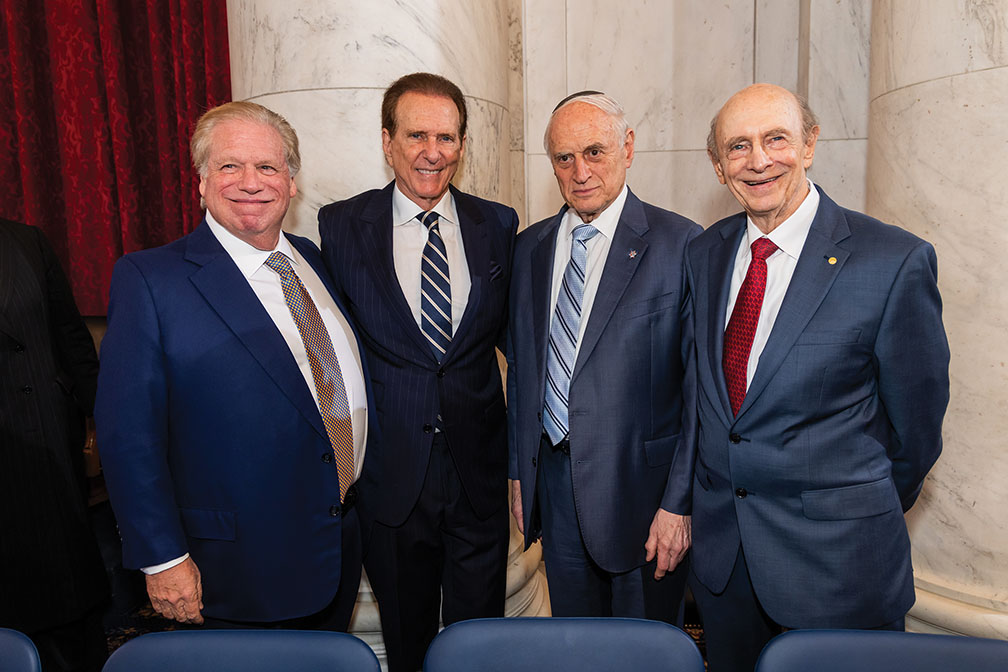
Elissa Slotkin, Ezra Friedlander, Elliott Broidy

The three honorees – a Nobel laureate, a Beverly Hills rabbi and an LA philanthropist – each received awards.

Dr. Harvey J. Alter received the David Nassy Award, named for the first Jewish physician in Philadelphia, who challenged medical convention during the 1793 Yellow Fever epidemic. A senior scholar in Transfusion Medicine at the NIH Clinical Center, Dr. Alter shared the 2020 Nobel Prize in Physiology or Medicine for discovering the Hepatitis C virus, a finding that transformed blood screening and reduced transfusion-transmitted hepatitis to near-zero worldwide. Elliott Broidy presented the award and called him “a gift from God to the field of medicine and the world at large.“ Dr. Alter offered his own theory on Jewish scientific achievement. “After years of intensive research, I’ve understood now why there’s such a preponderance of Jewish scientists,“ he said. “It’s because they all had Jewish mothers.“

Rabbi David Baron, founder of Temple of the Arts in Beverly Hills, received the Creativity in the Jewish Community Award for an early-childhood curriculum in altruism and empathy that started as a local community program and has since grown into a national and global educational initiative. The premise behind it is hard to argue: if you want to stop prejudice, you have to get to children before their frameworks harden. Adult education, legislation, enforcement – none of it reaches people at the moment when their understanding of the world is actually being formed. Rabbi Baron’s program does.

“Our great country was founded on the biblical principles that have kept the Jewish people for millennia and form the foundation of Western civilization,“ he told the room.

What brought Rabbi Baron’s curriculum to a global stage was a purchase made by the third honoree, one of the more striking acts of Jewish philanthropy the community has seen recently.

Elliott Broidy grew up in Los Angeles with his father, a World War II veteran and a Purple Heart recipient, and his mother who was a nurse. Broidy shared how his humble beginnings informed his philanthropic work. By his mid-30s he was already giving seriously to hospitals, synagogues and educational institutions across the U.S. and Israel. After Sept. 11, he spent three years on the Homeland Security Advisory Council, six on the LA Fire and Police Pension Fund, and six on the board of the Simon Wiesenthal Center–Museum of Tolerance.

Oct. 7, 2023 pushed him further and harder. Broidy now co-chairs, alongside philanthropist Dr. Thomas Kaplan, the Fund to End Antisemitism, Extremism and Hate – the organization behind ARCHER at House 88, the Auschwitz Research Center on Hate, Extremism, and Radicalization. ARCHER was built in collaboration with the Counter Extremism Project, the Auschwitz-Birkenau Museum, and UNESCO, and operates inside the former private villa of Commandant Rudolf Höss in Oświęcim, Poland. The house is now a global center for research and public education on extremism.

The connection between Broidy and Rabbi Baron runs deeper than a shared ceremony. Broidy previously acquired at auction one of only two existing original architectural whiteprints of the Auschwitz-Birkenau crematoria, paying $1.5 million – a figure chosen deliberately to match the 1.5 million Jewish children murdered in the Holocaust. The document, authenticated by Auschwitz historian Robert Jan van Pelt, is the technical blueprint for Crematoria II and III, the main gas chambers of Birkenau. The auction proceeds went to Rabbi Baron’s early-childhood curriculum. A blueprint designed to end children’s lives was redirected toward building them.

Broidy received the Visionary Award and directed his proceeds the same way. In his acceptance speech, he returned to the values his parents had instilled in him.

“Success is not something you achieve for yourself,“ he said, “but something you achieve so that you can give back to your family, your community and your country.“Jewish American Heritage Month exists to recognize exactly this, the accumulated work of Jewish Americans who didn’t wait for conditions to improve before deciding to act. Three of them stood in the Kennedy Caucus Room and made a fairly strong case for what that actually looks like.

From Beverly Hills to Capitol Hill: Three American Jews Honored Read More »

Alone No More: How Aliyah Became a Lifeline for LiAmi Lawrence

Less than a year after making Aliyah, LiAmi Lawrence, 62, was ready to leave Israel.

What began as a decisive “now or never” move from Los Angeles quickly unraveled into a reality many immigrants don’t anticipate: financial strain, isolation and the quiet shock of starting over without a safety net. Despite a successful career and strong connections, Lawrence couldn’t find work. His savings disappeared, his health deteriorated and, at one point, he found himself relying on neighbors for food.

“A year after I arrived in Israel, I was completely broke,” said Lawrence. “I had gone through almost all the $20,000 I came with. Suddenly there was nothing left — for rent, for food, for basic living. I started realizing I couldn’t even get a job. I was facing age discrimination. That’s when I decided I was leaving.”

For Lawrence, it wasn’t a dramatic exit plan. It was exhaustion. The feeling that the dream he had carried with him had quietly collapsed into something unlivable.

Then a friend, Tal, pushed back.

“Don’t go without a fight,” he told him. “Make noise.”

So LiAmi did.

He went on Facebook and wrote, openly and without filters, about what he was going through — how he had come to Israel with hope, and how he was now being forced to leave because he simply couldn’t make ends meet.

The post spread quickly. Within days, it reached thousands of people.

But more importantly, it didn’t just reach people – it recognized them. People were eager to be heard, to have others like them to talk with.

They were everywhere. Olim from France, Russia, South Africa, Argentina, the United States. People who had made the same leap of faith, only to find themselves isolated, struggling to navigate a new language, a new system and an unfamiliar sense of loneliness.

For LiAmi, something shifted.

“It wasn’t just my story anymore,” he recalled. “It was hundreds of messages. People telling me, ‘This is exactly what I’m going through.’” That was the moment the idea for KeepOlim began to form – a nonprofit organization that helps immigrants to Israel feel less alone and get support.   

Lawrence joined forces with attorney Tzvika Graiver, an Israeli who shared the same passion and wanted to keep Olim in Israel, advocating for them in the Knesset. He became KeepOlim’s co-founder and chairman of the board.

What started as personal frustration turned into a mission: to help immigrants who were falling through the cracks after arriving in Israel — people who were expected to “integrate” but were quietly struggling to find work, community and stability. “Olims get very lonely,” said Lawrence. “Especially during the holidays like Passover and Rosh Hashanah. Those are the loneliest time in the year, the same in America during Christmas and Thanksgiving. You see the highest suicide rate during these holidays. It’s the same in Israel, they have no friends or family to go to.”

And so Lawrence started matchmaking Olim with local families to host them for the holidays and even for Shabbat dinners. He called the program: No Oleh Alone for the holiday.

Judy Maltz, an editor at Haaretz who knew Lawrence from the time he used to work as a stripper in Israel, called him and asked to do a cover story about the male stripper turned Aliyah advocate. That was a strong story which she knew will draw attention.

Lawrence first came to Israel in his early 20s in the 1980s, arriving with the hope of building a life while studying at Tel Aviv University. In order to support himself, he reinvented his path in an unconventional way — opening Israel’s first striptease club, at a time when such entertainment did not yet exist in the country. What began as a practical solution to survive soon turned into a unique entrepreneurial venture, even bringing the Chippendales to Israel. Despite his efforts to integrate, the venture faced public opposition, ultimately leading him to return to Los Angeles — but that experience came to serve him well in an unexpected way when he launched KeepOlim.   

“Suzy interviewed me for a cover story on Friday, and by Sunday I was on every TV show in Israel,” Lawrence said. “Sex sells. If I were an accountant, I doubt my story would have garnered that much attention.”

That exposure became a turning point for Lawrence, drawing widespread attention to KeepOlim and bringing in much-needed donations. Back in the U.S., his father, seeing the impact his son was making, agreed to cover his rent for a year, on the condition that Lawrence handle all other expenses himself.

For the first year and a half, Lawrence took no salary for running KeepOlim, working 12 hours a day.  Even when he eventually began getting a pay check, it remained modest. Despite the financial strain, he was determined to stay in Israel. He felt he had found his purpose and refused to give up.

From someone who once needed help finding a job, food and support, Lawrence became the person providing it — offering connections, employment assistance, food gift cards and a 24/7 support line for those in need.

Today, 120 therapists work with KeepOlim, providing care in multiple languages, including English, Spanish, French, Russian and African languages. Their clinical director is Dr. Norman Goldwasser, who oversees training and supervision. Goldwasser made Aliyah in May of this year, joining his daughter, six grandchildren and three great-grandchildren in Jerusalem.

The organization’s Tikvah program, run by Susan Cohen, offers critical support to immigrants grappling with the challenges of uprooting their lives and starting over in a new country. In Israel, that often includes facing entirely new stressors — sirens, missile attacks and the need to run to bomb shelters. Many struggle with PTSD.

This was one of the first programs Lawrence launched. “Before we had a team of therapists, people would call ERAN — the Emotional First Aid hotline — but they couldn’t get help in their own language, so they stopped calling,” he said. “In our closed Facebook group, people would post cries for help. One wrote, ‘I’m on a bridge and going to jump.’ Another wrote, ‘I’m going to do the same.’” At one point, three people said they were going to end their lives. I’m not a therapist, but I told anyone in trouble: call me.”

Lawrence would travel to wherever the live, sit with them for hours — talking, comforting and even driving them to receive professional care, including hospital admission when necessary.

“I had no idea when I started, that mental health would become the cornerstone of KeepOlim,” said Lawrence. “In Israel, 40% of suicides are among Olim. I believe though that the number is even higher.”

The therapy service is given for free for lone soldiers and for a low cost for others.

It’s incredible to learn that despite the war in Israel and uncertainty about the future, people are still making Aliyah. From interviews The Journal had with some KeepOlim members, despite it all, they feel safer in Israel than in the countries they came from.

According to Dr. Goldwasser, people understand that the risk of antisemitism and the risk for emotional stress is more serious than the risk of some missiles from Iran. “People are coming to Israel because they’d rather have an external threat than an internal one,” said Goldwasser. “I’m from Miami Beach, and it’s much safer here than most places in the U.S., and still I feel safer in Israel.”

The missile attacks on Israel by Iran in February and March of this year caused tremendous stress for many Olim. For some, it was the final straw, and they chose to leave. These were mainly immigrants from Anglo-Saxon countries who had the means to return to their countries of origin, or who instead moved on to destinations such as Portugal, Spain and Hungary in search of stability and a quieter life.

Many others, however, stayed. The reasoning, however, is likely less ideological and more financial — for many, there is simply nowhere to return to. Their situation in their home countries is often more difficult or unstable than their current reality in Israel. There is also another, less discussed factor: many cannot afford to move back.

“People come here expecting to find a job and earn what they did back home, but once they arrive, they realize they have to settle for a much lower salary,” said Lawrence. “Many don’t have enough money to buy food. We had hundreds of Olim who were literally starving, so we began providing them with food gift cards to [Israeli Supermarket]  Super-sal, allowing them to buy whatever they need.”

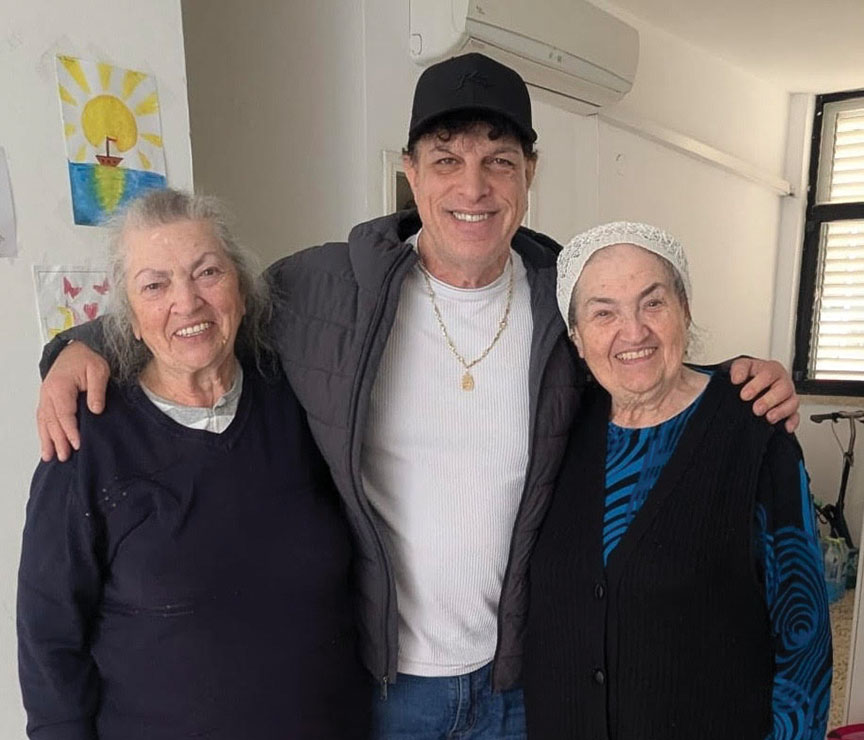
In Bat Yam, home to a large Russian-speaking immigrant population, Lawrence launched the Babushka and Dedushka program (“Grandma” and “Grandpa” in Russian). He was shocked to discover how many elderly Olim had empty refrigerators. Once a month, he personally visits and stocks their fridges. He has been doing this for nine years, helping approximately 1,250 people. Still, he said, it is not enough.

“There are 20,000 Russian speakers in Bat Yam, and thousands more like them across Israel, some of them Holocaust survivors. These are people unfortunately too often go unseen and unsupported.”

According to Lawrence, one of the more challenging waves of Aliyah occurred in the 1990s, with the secret immigration of approximately 1,500 Olim from Cuba to Israel. “Most of them were not Halachic Jews, and more than 90% eventually returned to Cuba,” he said. “That’s when you know it’s bad. They came from a socialist country and suddenly found themselves completely alone. Who was going to give them jobs? They didn’t even speak Hebrew.”

The term “Halachic,” referring to Jews who are recognized as Jewish according to Jewish law, came up repeatedly. Lawrence believes that as many as 50% of Olim are not considered Halachic Jews. They may have a Jewish ancestor, such as a grandfather or grandmother, or their conversion may not have been Orthodox. Nevertheless, Israel, which urgently needs new Olim, continues to welcome them.

At KeepOlim, he said, that definition is less important. The organization accepts people from all levels of religious observance, countries of origin and backgrounds — whether they are Jewish by birth, by conversion or simply connected through marriage.

“We say we are all in this together. Before KeepOlim, each group was separate — you had the French, the Russians, the Americans — but now we all celebrate together. We have people from 100 countries, and we host parties, gatherings and friendships naturally form.”

Over the organization’s 12 years, there have also been a few marriages between members — a French participant marrying an American, and a South African who married an Australian, among others. Their Purim party, he says, has become a celebration no one wants to miss. They have other events and parties throughout the year, although since the war he postponed parties for calmer times.

Before moving to Israel, Lawrence worked as a media director for the Israeli Consulate in Los Angeles. He also produced Sababa parties and organized red carpet events with numerous celebrities.

He recalled going to a job interview back in LA for what seemed like a lucrative position. Everything was going well — until he was asked a familiar question: “Where do you see yourself in five years?”

“I looked up at the ceiling and thought, I don’t want to be here — I want to live in Tel Aviv,” Lawrence said. “That night, I went home, logged on to Nefesh B’Nefesh, started downloading the application, and made Aliyah in 2014.”

Lawrence believed it would be easy for him to find his footing in Israel. He was well connected and had a strong social network. But reality hit quickly. Moving to Israel at 50, with limited Hebrew, proved to be a significant barrier in the job market. “The only type of job I could find was in binary options, and I didn’t want to steal people’s money,” he said.

To make matters worse, Lawrence began dealing with health issues. He was diagnosed with a hernia and prescribed opioids while waiting six months for surgery. He described that period as one in which he was functioning but largely disconnected from his own actions, including the early days of building KeepOlim.

“I used to run KeepOlim completely wasted,” he said. “Years later, people would stop me on the street and say, ‘You saved me,’ and I had no recollection of it. I was on opioids for two years, until I was able to get treatment and overcome it.”

During a Zoom interview, I see Max, a 34-year-old Russian immigrant and lone soldier, who sometimes couch surfs in Lawrence’s Tel Aviv apartment. The scene feels almost informal, but it reflects something deeper: for Lawrence, KeepOlim is not just a job or an organization — it’s a widening circle of people he considers family.

Growing up in Massachusetts, Lawrence said he was the only Jewish child in his school, often bullied by classmates and at times feeling singled out by a teacher who made his difference feel even sharper. Those early experiences of isolation stayed with him for years.

In Israel, he said, something finally shifted. Despite the struggles of building a new life from scratch, he had a sense of home he had never quite known before. For Lawrence, the work he does now is inseparable from that feeling — an attempt not only to support others making Aliyah, but to make sure that no one arriving alone would stay alone for long.

Alone No More: How Aliyah Became a Lifeline for LiAmi Lawrence Read More »

True Legends and a Smoked Brisket

Father’s Day is bittersweet. The patriarch of our family, my charming, devoted paternal grandfather Aba Naji passed away in 2019. And this will be the third Father’s Day without the wisdom and dry wit of my strong, handsome, beloved father.

I am immensely grateful for the other wonderful fathers in my life — my father-in-law, my uncles, my three brothers. My amazing son, Ariel.

I am especially thankful for my smart, kind and loving husband Alan, the best father and my biggest fan.

—Sharon

It’s my first Father’s Day without my father. Alongside the immense sadness is so much gratitude. I was blessed to have my father for 60 years and his love and presence shaped who I am.

My husband, Neil, is a loving and supportive partner, my best friend. He is a very devoted father and our children always knew they were loved and encouraged. And then there is my son Sam, the father of our two granddaughters. He is patient and present and so attentive to his two little girls. Seeing the way they adore him fills my heart.

Happy Father’s Day to all the fathers, grandfathers, and father figures who give love and show up every day!

—Rachel

This week we share our column with one of our favorite Instagram bloggers, New Yorker Jeff Mosczyc (pronounced Mah-zik). As the son of a German immigrant father and a first-generation Hungarian mother, his mouthwatering, meat-centric recipes reflect his Ashkenazi background.

The goal of his Instagram page @foodkidsandsleep is to help his followers expand their cooking horizons, to try new things and discover that they can do more, better, faster and tastier in the kitchen.

Among his most viral recipes is sheet pan fried schnitzel and the recipe he shares here with you. The most tender and flavorful “smoked brisket” ever!

Truly suitable for a special Father’s Day dinner!

—Sharon and Rachel

I would never say this in front of my wife, but being a Jewish dad is quite the challenge.

The era of the “strong, silent breadwinner” dad and the “stay at home” mom has seemingly passed, at least in the American zeitgeist. Studies show that since the 1960s, the amount of time that American fathers devote to childcare has nearly quadrupled.

Nowadays, fathers are expected to be equal partners in parenting. For me, that means doing my share of school drop-offs, taking to ballet practice and other after school activities, as well as supervising homework.

In the modern American family, making dinner is just as likely to be a dad’s responsibility. Men may still be breadwinners, but they may also be called upon to be bread makers.

Add to that the complicating factor of Jewish tradition and observance, where a father’s responsibilities must also make space for daily minyanim (prayer quorums) and other religious obligations. Not to mention that the cost of raising a Jewish family often necessitates dual incomes, making the rationale for the traditional division of parenting and household labor seem irrelevant.

When we were first married, my wife would return from work two hours after I did. Making dinner was my way of assuaging my guilt and lessening her burden. (I grew up with a mother who was a great cook and inspired my interest in food.)

Sleepless nights and long days at work made life feel like mere survival when our first child came along. A good dinner became a way to reward ourselves and have something to look forward to. A special treat after a day of work and parenting.

I needed dinner to be delicious and nutritious, but not add to the work load. I quickly learned to focus on making great meals, but with way less of the effort and clean-up than the recipes I found on the internet. I converted deep frying to sheet pans, stove-top simmers to roasting in the oven, and multiple dishes to one-pot meals. I was determined to have my steak and eat it too.

Five years ago, I began my Instagram blog, sharing my recipes. I became a zealot, desperately trying to convince people that they would feel differently about the end of their day if they finished it with a meal that felt like a reward.

If you’re a dad who wants to get in the kitchen, this “Three Ingredient Oven Smoked Brisket” just may be the recipe you’re looking for. It’s a lot less effort than smoking a brisket the traditional way—five minutes of prep, no mess and no supervision necessary. But the results are incredible.

Welcome to the club, dad. And don’t worry. I got you.

—Jeff Mosczyc

Oven Smoked Brisket

1 3 1/2-4 lb second cut brisket

2 Tbsp molasses

1/3 cup your favorite meat rub

2 Tbsp smoked paprika

Preheat oven to 225°F.

Cut a sheet of foil more than twice as long as your brisket and lay it over a sheet pan.

Cut an equal sized sheet of parchment paper and crumple it into a ball, then wet it.

Lay the parchment paper over the foil.

Place the brisket in the middle of the tray and rub well with molasses.

Then flip and rub the other side.

Coat both sides of the brisket with the rub and smoked paprika.

Pat the exterior to make sure the rub adheres.

Close up the parchment paper, then seal the foil.

Wrap the brisket in another large sheet of foil and return to the sheet pan.

Place brisket in the oven and cook for 7 1/2 hours.

Remove from oven and allow to rest for at least 30 minutes, then unwrap.

Let rest for another 10 minutes, then cut in half with the grain, Then slice against the grain for short slices.


Sharon Gomperts and Rachel Emquies Sheff have been friends since high school. The Sephardic Spice Girls project has grown from their collaboration on events for the Sephardic Educational Center in Jerusalem. Follow them
on Instagram @sephardicspicegirls and on Facebook at Sephardic Spice SEC Food. Website sephardicspicegirls.com/full-recipes.

True Legends and a Smoked Brisket Read More »

Father’s Day Food

Food extends beyond what’s on the table: its inherited recipes, memories and traditions.

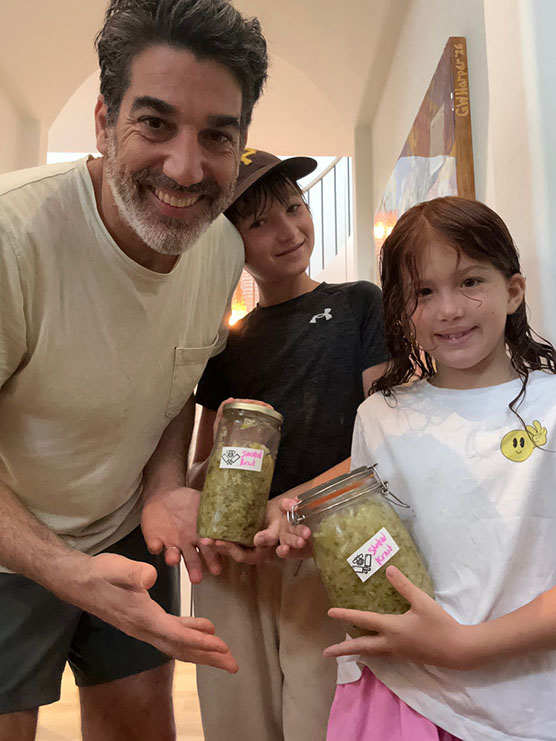
This year’s Father’s Day round-up features recipes from different ends of the Jewish spectrum: dill pickle kraut and a Moroccan tomato dip. Different flavors, different origins; yet, as families tend to be, complex, layered and fun.

“When thinking about Dads and what makes Dad, and parents in general, special is the effort, patience and perseverance that parenting takes,” Michael Shemtov, the owner and founder of Honest to Goodness Hospitality, told The Journal. “The dish that comes to mind that represents those qualities so well, is sauerkraut.”

While Shemtov’s dad loved eating kraut, he didn’t actually make it. “Some of the male elders on my wife’s side of the family used to make it, and now I make it,” he said.

Shemtov believes this is an “amazing” recipe to make for Father’s Day for several reasons:

• It’s literally made with your hands. You have to squeeze enough water out of the cabbage to cover all the cabbage in liquid. That makes it deeply personal.

• It’s quite simple to make, but very few people take the time and effort to make it at home.

• Delayed gratification – you could give it to your dad ready-to-eat, or still fermenting!

• Unlike a meal, they will have a jar of kraut for some time, making the gift something they’ll see every time they open the fridge.

• It’ll make for a fun thing for them to brag to friends about.

• It’s great for their gut health and overall health.

Dill Pickle Style Kraut

Green cabbage

Salt

Cloves of garlic

Fresh dill, chopped

1. Cut the core out of the green cabbage, then weigh out what’s left without the core.

2.  Add salt, 2-2.5% by weight.  So if you have 1000 grams of cabbage, you’ll need 20-25 grams of salt.  This depends on your love of salt, for me, 2.2% if the perfect amount.

3. Garlic – 2 cloves per head of cabbage, thinly sliced with a knife or mandolin. If your dad loves garlic, throw in a few extra cloves (for the batch, not per head).

4. One bunch of dill, or the unit you’d buy in those plastic containers at the grocery store, is enough.

Method of Prep:

1.  Thinly slice cabbage using a mandolin or knife, place in a big glass or stainless steel bowl. Do the same with the garlic.

2. Add salt, sprinkling it in and tossing the cabbage so that the salt finds its way to all of it.

3. Let sit for 5-10 minutes, then, working in batches, pick up the cabbage, squeeze as much liquid out of it as you can (into another bowl), and put the squeezed cabbage into your fermentation container.

4. Once you’ve done all the cabbage, pack it down in the jar (a spoon or pestle works well for this), then pour the liquid over the top, making sure all the cabbage is submerged. A bowl with a weight on top works well, though there are also fermentation weights you can buy.

    5. Ferment for one week, then add the fresh dill, and ferment for another 2-3 days. When ready, move to the fridge.

Additional Notes:

Want it less funky? Ferment for 5-7 days total before moving to the fridge.   

Want to simplify? Add the dill at the start, it’ll come out just fine, the dill just won’t pop as much.


In Liora Seltzer’s home, matbucha, a Moroccan spicy – or, depending on your taste, not so spicy – tomato dip was and is a staple at any Shabbat meal. “My aba, who is originally from Morocco, taught me how to make this recipe,” Seltzer, a professional organizer, mentor and educator from Fair Lawn, New Jersey, told The Journal. “He learned it from his mother.”

Like many family recipes, every family has its own variation. While this version includes onion, not all matbucha recipes do. “We serve it with the Slatim (salads) portion of Shabbat meals, with tahini, hummus and other dips before the main course,” she said. “It is also the perfect base for shakshuka on Sunday morning!”

Matbucha, she explained, takes time; about 15 minutes of prep and an hour or more on the stove. The recipe, however, can be easily doubled.

“When preparing a meal, start the matbucha first and then move on to the rest once it’s on the stove,” Seltzer said. “Fresh tomatoes will give you the best flavor, but you can use canned tomatoes in a pinch. It won’t be quite as good, but it will still be delicious.”

Matbucha, A Moroccan Spicy (or Not) Tomato Dip

6 ripe tomatoes (I prefer tomatoes on the vine, but they don’t have to be. You can also use more tomatoes if you want more matbucha.)

5 garlic cloves (or more)

1 small onion

3 Tbsp olive oil, plus more if needed

Optional: 1 chili pepper

Optional: 1 red pepper

Spices (start here and adjust to taste):

1 Tbsp sweet paprika

½ tsp spicy paprika

½ tsp black pepper

1 tsp salt

¼–½ tsp chili flakes

To prepare:

Wash the tomatoes and cut them in half.

Chop the onion and garlic.

Optional: Roast the red pepper in the toaster oven until the skin can be peeled off. Peel, chop, and set aside.

To cook:

Put the onion and garlic in a pot with olive oil over medium heat.

Add the roasted red pepper, if using.

Add the tomatoes, cut side down.

Cover and let it sit until the tomato skins begin to peel.

Remove the skins with tongs.

Mash everything with a potato masher and then reduce the heat.

Stir every 10 minutes or so. If you don’t have time, you can raise the heat and stir more often.

Once most of the liquid is gone and it looks more like a paste, add the spices. Taste and adjust as needed.

You can add a little olive oil if you need more moisture.

Serve hot or cold with challah, or with chips for dipping.

Enjoy!

Spice Notes: The spice amounts above are just a starting point. Some people use much more paprika and chili than this recipe calls for. Taste as you go and adjust to your preference.

For a much spicier matbucha, add a whole chili pepper while cooking, or even two if you really like heat.

Father’s Day Food Read More »

Table for Five: Korach

One verse, five voices. Edited by Nina Litvak and Salvador Litvak, the Accidental Talmudist

They assembled against Moses and Aaron, and said to them, “You take too much upon yourselves, for the entire congregation are all holy, and the Lord is in their midst. So why do you raise yourselves above the Lord’s assembly?”

– Numbers 16:3


Cantor Michelle Bider Stone

Temple Beth Am

Who gets to speak with God? Who gets authority? Does anyone get to be closer to God than the rest of us? These questions have challenged religious authorities for thousands of years. They are at the heart of Korach’s rebellion. Korach challenges Moses and Aaron’s leadership, arguing that God dwells among all the people. Ignoring the irony that Korach was seeking power for himself, the statement, “the entire congregation are all holy,” has shaped Jewish life for generations. One of Judaism’s most profound teachings is that no one stands between the individual and God. Every one of us has direct access to the Divine. We are all created b’tzelem Elohim, in the image of God, and possess the dignity and holiness to enter into relationship with God. This doesn’t mean Jewish communities don’t need strong, inspired leadership, but it assures us that no intermediary is required for a rich and spiritual Jewish life.

Unlike some other traditions, clergy in Judaism are not gatekeepers. We do not need someone more learned, more spiritual, or more certain to speak to God on our behalf. Rabbis and cantors teach, guide and inspire. They may be companions along the way, but they are not intermediaries on your Jewish journey. God is in covenant with each one of us. The gift of Judaism is that holiness is not reserved for a select few; it is something each of us can cultivate and experience in our own lives, every day.


Rabbi Shaul Rosenblatt

Director, Better World Charity

Korach comes to challenge Moshe’s leadership with 250 men. How could they all want the top job? Or were they merely cheerleaders for Korach himself?

Perhaps our verse itself provides the answer. The entire nation is holy, and God is in their midst. Korach’s argument – disingenuous as it was – questioned the very idea of leadership for the Jewish People. Great human beings surely can lead themselves.

In an ironic twist, Korach’s story provides the answer to his own question. Even a holy people, with God in its midst, is subject to the vagaries of its humanity. Godly people can be misled by arrogance; they can become consumed by jealousy; and they are prone to the seduction of wealth. A Godly nation can still produce Korachs, Dasans and Avirams.

And leadership is what stands in the way. It is not privilege, as Korach perceived, but responsibility. Time and again, Moshe complained of the burden of leadership. Yes, leadership can be abused, as Korach would certainly have done, but genuine leadership is service. As Chazal tell us, a king is ‘”the servant of the people.”

To volunteer for leadership is to volunteer for menial work; to volunteer to be abused, to be criticized, to be disrespected. Moshe took this on because of his love for the Jewish People and its mission. Korach, and his accomplices, sought it for the love of themselves.

Korach set out to prove that leadership was unnecessary. Instead, he demonstrated why it is indispensable.


Rabbi Tovia Singer

OutreachJudaism.com and YouTube

One of the most striking paradoxes in the Torah emerges from the rebellion of Korach. Standing against Moses — the most reluctant leader in Scripture, the man who pleaded with God not to send him — Korach declares: “The entire assembly is holy” (Numbers 16:3). It is an astonishing statement. In the very act of betrayal, Korach extols the holiness of the Jewish people.

And he is not alone.

Haman, seeking to persuade Achashverosh to annihilate the Jews, describes them as a distinct nation faithful to its own laws. Balaam, hired to curse Israel, can utter only blessings, foretelling redemption and the rise of a messianic king. Again and again, those who stand against Israel speak with awe of the Jewish people.

Yet the prophets of Israel speak very differently. Isaiah opens with words that scorch like fire, comparing Israel to Sodom. Jeremiah weeps over the nation’s betrayal. Joel thunders with relentless rebuke. The harshest criticism of the Jewish people comes not from Israel’s enemies, but from her greatest spiritual leaders. Why? Because enemies do not seek Israel’s transformation. They observe the Jewish people from afar and marvel at their uniqueness, their endurance, and their covenant. But the prophets loved Israel too deeply to flatter her. Their mission was not admiration, but elevation. Love that seeks greatness does not conceal wounds; it exposes them so healing may begin. The prophets rebuked Israel because they believed she could become what God called her to be: “a kingdom of priests and a holy nation.” Their criticism was pregnant with faith — faith in Israel’s destiny and in the glorious future foretold by Isaiah: that Israel was set to emerge “a light unto the nations” (Isaiah 49:6).


Rabbi Peretz Rodman

Masorti Rabbi and Author, Jerusalem

Rabbi Israel Salanter, the Musar Movement’s founder, once came to synagogue on his father’s yahrzeit. Also present was a man hoping to say kaddish on his daughter’s yahrzeit.

At that time Mourner’s Kaddish was said by just one person. (Extra recitations were added later.) The other worshipper was distressed to learn that Kaddish would be reserved for the rabbi, since the yahrzeit of a parent takes precedence. Hearing that the bereaved father was aggrieved, Salanter approached him and offered, pleaded and even, as rabbi, instructed the man to recite the Kaddish at the end of the service.

Later, Salanter’s students asked him, “How could the good rabbi treat the mitzvah of honoring his parent so lightly, letting someone else say kaddish?” He replied, “I am very happy that I was able to credit my late father, from his grave, with the mitzvah of gemilut hasadim (gratuitous kindness),” brushing aside considerations of his own honor or entitlement.

True leadership requires true humility. Moses, “the most humble of all people” (Numbers 12:3), was the object of a smear campaign. He and Aaron were not self-appointed, a fact that he refrains from declaring but soon effectively demonstrates.

All Israelites may be holy, but there is still a need for leadership, divinely appointed or democratically elected. In our society, some are chosen to lead but all citizens are equal before the law. It behooves the leaders to practice humility.


Rabbi Janet Madden Ph.D.

Malibu Jewish Center and Synagogue

When Korach and his followers confront Aaron and Moshe, asserting “rav lachem,” their statement parallels G-d’s chastisement of Moshe, who is told “rav lach” when he begs for what he cannot have.

The aggrieved Korach also wants what he cannot have. His specious assertion that his cousins have “raised themselves” is fueled by desire for his own elevation. His argument that “all the congregation are holy” is, ironically, true. But his argument’s motivation undercuts its validity; his argument’s catalyst is not L’shem Hashamayim, as cited in Pirke Avot 5:17. Its Latin derivation, invidia, “non-sight,” connects envy to blindness, perhaps an inability to think clearly or consider something beyond one’s own desires. Mental health professionals suggest that envy is connected to personal pain, stemming from a sense of inadequacy. Joseph Epstein argues in his 2003 book Envy that it is the only sin that offers no pleasure, a position rooted in Proverbs 14:30’s teaching that “envy rots the bones.”

The tenth of the Aseret HaDibrot addresses envy (kinah), which carries the potential for growth, but which also drives conflict. Korach’s argument leads to communal schism and personal destruction. But “rav lachem” and “rav lach” might also be understood as “You have enough. You are enough,” words that offer hope and peace, powerful alternatives to envy. The consequences, as Korach’s story demonstrates, make literal the words of Rabbi Elazar Ha-kappar in Pirkei Avot 4:21: envy, lust and [the desire for] honor put a man out of the world.

Table for Five: Korach Read More »