fbpx

October 2, 2025

From Yom Kippur’s “Silence” to the World’s Noise

Emerging from the twenty-five hours of solemnity that is Yom Kippur often feels like stepping from eternity back into time. For a day, Jews retreat into prayer, fasting, confession, and remembrance. We deny ourselves ordinary rhythms to face the divine, to recall who we are, and to remember that life itself is a gift we are commanded to sanctify.

This year, when I re-entered the world’s noise, I was met not with relief but with sorrow. The first news I read after the closing “Neilah” prayer was of a violent, antisemitic attack during Yom Kippur at a synagogue in Manchester, England. Once again, Jews gathered in prayer were assaulted and murdered simply for being Jews.

Then came more news: the Israeli Navy had intercepted a Hamas-organized “flotilla,” cynically branded “humanitarian,” but funded and manned by Hamas operatives and their fellow-travelers. Its purpose was not aid but to break the naval blockade that prevents Hamas—an openly genocidal group recognized as a terrorist organization by the U.S., EU, and much of the world—from freely importing weapons to use against Israeli civilians and the Gazans it rules with fascist brutality.

The Law and the Blockade

Israel’s naval blockade is not only defensive—it is lawful. Under the San Remo Manual on International Law Applicable to Armed Conflicts at Sea (1994), a belligerent may enforce a blockade if it is declared, effective, and does not bar access to neutral ports. Israel’s blockade meets those criteria. The UN’s Palmer Report (2011) confirmed it was a legitimate security measure. Stopping a flotilla attempting to breach it is therefore not “piracy” or “kidnapping,” as Israel’s haters insist, but legal enforcement against a group still holding hostages underground in Gaza.

Lies and Willful Blindness

In a sane world, the Manchester attack and the flotilla fraudsters would be recognized as part of the same old story: efforts to attack Jews in their synagogues and in their homeland. Instead, media and social media were filled with lies. The Manchester attack was minimized or ignored. And the flotilla’s interception was cast as a “kidnapping”—as though the defenders were criminals, and the victims were Hamas and its enablers.

That word—“kidnapping”—was deliberately chosen to invert morality (and like all Israel-hate-based allegations, to inflame rather than inform). And those repeating it remain silent on a basic fact: a 21-point peace proposal is on the table today, supported by most of the international community and even much of the Arab world. It would end the war Hamas began on October 7, 2023. Hamas could accept it now—but refuses because it values power and its eliminationist ideology above the lives of ordinary Gazans. And those condemning Israel the loudest never demand that Hamas release the hostages or accept peace.

The Meaning of the Season

This juxtaposition—the synagogue attack, the lies about Israel, the silence about Hamas rejecting peace—cut deep the day after Yom Kippur. Because Yom Kippur is not only about private penitence. It is a collective act of remembering that Jewish history is bound up with responsibility, resilience, and return. We spend the Ten Days of Repentance before Yom Kippur examining our failings because we believe in accountability. We read Jonah on Yom Kippur in part because we know nations, like individuals, can change.

The late Chief Rabbi Jonathan Sacks wrote that antisemitism is a mutating virus. Its forms change, but its purpose is constant: to hold Jews out for unique opprobrium and to deny us equality among nations. Today, that virus manifests in those who call Jews “colonizers” in our own land, who dismiss synagogue attacks, and who brand the defense against Islamist terror as aggression.

The Lesson of History

One of the most dangerous illusions in Jewish history has been the belief that if only we yield enough, the hatred will dissipate. History teaches otherwise. Pogroms in Europe, expulsions from Spain, the gas chambers of Europe, the ethnic cleansing of Jews from Arab lands, the attacks on synagogues from Paris to Pittsburgh to Manchester—none of these were about borders or policies. They were about Jews daring to live as Jews.

And so too today: Hamas’s war is not about 1967 lines. The flotilla is not about food aid. The chants in London, New York, and Paris are not about “policy criticism.” They are about denying the Jewish people the right to live freely in their homeland, and openly as Jews anywhere.

That is why the refusal by the loudest anti-Israel voices to pressure Hamas to accept peace is so telling. When peace is possible and one side alone rejects it, yet activists and “journalists” direct fury only at the Jewish state, that is not about human rights. It is about prejudice and hatred.

What We Must Say

Yom Kippur ends with the shofar’s blast—a reminder of hope, covenant, and destiny. It calls us to defend truth and life, and to remind the world, even when it does not wish to hear, that we are a people with an ancient home, a living covenant, and a moral voice.

The synagogue in Manchester, the flotilla from Gaza, the peace deal ignored—these are not separate stories. They are chapters in the same book of Jewish history. But we are not powerless. Our task, after Yom Kippur, is to speak, to stand, and to live the values that have sustained us for millennia.

And let us be clear: when outlets like the BBC, the New York Times, and others echo Hamas talking points or falsely recast defensive actions as crimes, they do not merely misinform. They embolden those who would harm Jews everywhere. Media malpractice has consequences. It shapes the world’s moral imagination, and in this case, it feeds the very virus of antisemitism Rabbi Sacks warned us about.


Micha Danzig served in the Israeli Army and is a former police officer with the NYPD. He is currently an attorney and is very active with numerous Jewish and pro-Israel organizations, including Stand With Us and the FIDF, and is a national board member of Herut North America.

From Yom Kippur’s “Silence” to the World’s Noise Read More »
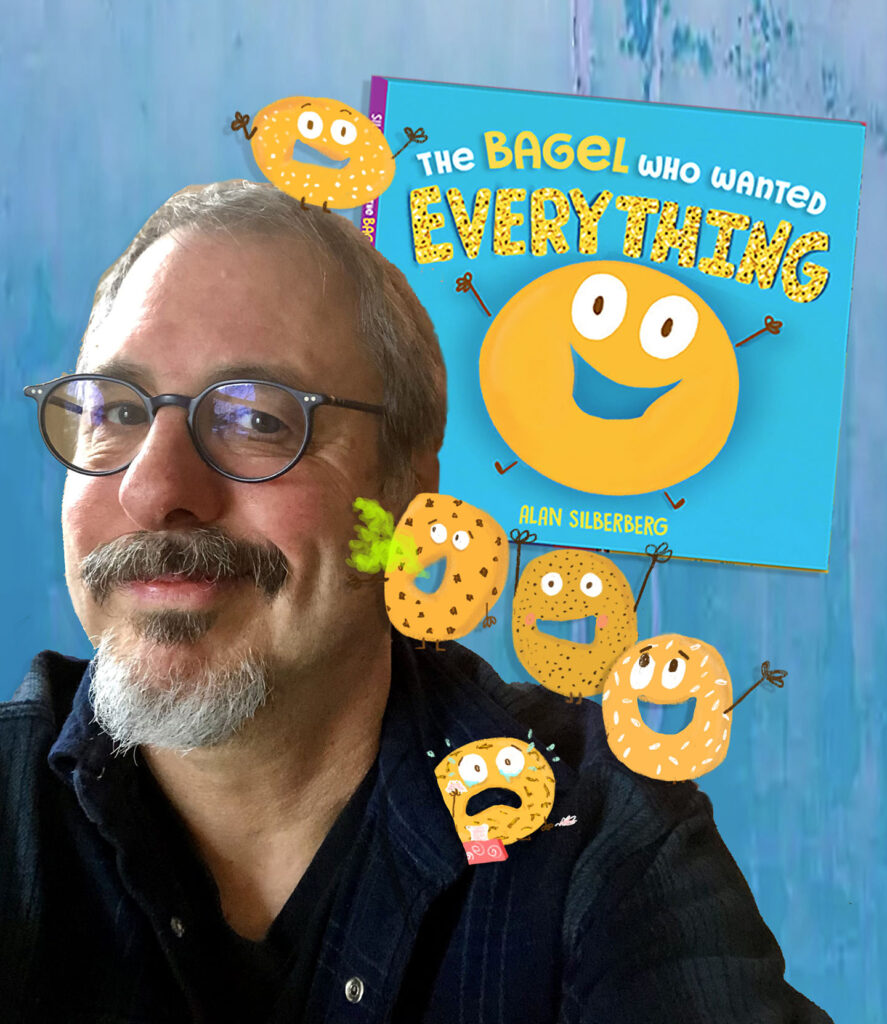
Alan Silberberg: “The Bagel Who Wanted Everything,” Food Cartoons and the Comfort Zone

Alan Silberberg is an award-winning author, cartoonist and children’s TV creator, whose latest book is “The Bagel Who Wanted Everything.” This funny, heart-warming story of a plain bagel’s quest to be more is the latest in his series of silly kids’ books about Jewish food; other titles include “P is for Pastrami” and “Meet the Latkes.”

When asked what it’s like to be in his head, Silberberg said, “”It’s like going up a really beautiful hill that sometimes you trip and then fall very fast into a big, splashy pool of chicken soup. I’m up, down, making things up … coming up with characters; it’s a fun life.”

Silberberg said he was one of those kids who was always doodling, but never considered himself an illustrator.

“On the advice of my agent I decided to try to write a picture book based on a silly cartoon, an [animated] Hanukkah greeting that I would send out every year about a Latke family,” he said. “It was really a blessing for me because … I didn’t see a career for this, even though I was a published author.”

Silberberg had previously released three chapter books: “Pond Scum,” “Milo, Sticky Notes and Brain Freeze” and “The Awesome 100% True Adventures of Matt and Craz,” inspired by a love of reading to and with his son.

“I didn’t see picture books as my pathway, but it was so well received,” he said. “[It was] both a traditional Hanukkah story, but really out there and silly and really fun to read aloud.”

Plus, Silberberg loves drawing food!

“It’s certainly more fun to make anthropomorphic characters come alive,” he said. “Drawing a whole alphabet book of Jewish food cartoons … and drawing a latke family and a kid piece of matzah that gets bullied at school.”

Food is a gateway to every kid, every family.

“It’s like a muscle memory for your tummy,” Silberberg said. “There aren’t enough good funny stories about food, especially Jewish food; I have the Jewish funny food niche.”

Silberberg said he cooks, but his recipes are pretty simple: chicken soup, latkes, pasta.

“I don’t have a recipe vocabulary, but I can throw things together and make something tasty,” he said.

Latkes are one of his favorites, so it’s fitting that it was the first book.

“It’s a family tradition in my home to eat them all the time year round,” he said.

Team apple sauce or team sour cream?

“I am team apple sour sauce,” said Silberberg, who dips his latkes in both. “One bite is applesauce, one sour cream and, before I know it, my plate is this white and yellow and pink schmear that I just scoop up and love the mixed flavor.”

Silberberg, who lives in Montreal and is a huge fan of the wood-fired Montreal bagel, said he does not relate to being a plain bagel- “I’ve always been somebody who bucks the trends,” he said. “If you tell me I can’t do something, I will do it and show you how I can do it three different ways.” However, he wanted to create a story for kids to know that it’s fine being plain, or salt or onion.

“This is that story of a bagel who doesn’t get angry about [being plain], but wants to find other things to be, because the world is full of so many wonderful things: Why do I have to be just one?” he said.

The story is about the search for other things, the search to become more, the search to become anything or everything.

“It’s a nice little fable,” he said. “I like it a lot. I’m very proud of it.”

Next up for Silberberg is “The Falafel who Felt Awful,” a book about expressing your feelings and “Dill Is in a Pickle,” about negative self-talk.

“I’m moving away from holidays and into social emotional stuff,” he said. “I just happen to be using these Jewish foods as a way into these stories that are really heart-based.”

Silberberg’s goal for the new year is to keep pushing himself out of his comfort zone.

“I’m in a comfort zone of Jewish food right now, and I’m blessed, I get to make these funny books,” he said. “But I want to, in the new year, push myself beyond Jewish food and see what’s out there as far as my creative storytelling goes.”

There must be other things out there, beyond the Jewish kitchen, right?

“My books allow kids to enter the story and not identify as the kid, but go, ‘Oh, I’m kind of like that bagel,’” Silberberg said. “There’s something safe about … being able to connect with a food and identify with [a food] who has a problem or who is funny or who doesn’t like to play with others.”

That’s a huge part of the food-kid-story connection.

“And you start thinking about eating,” he said. “You think, ‘When we finish this book, maybe we can have a snack.”

He added, “Life is complicated and we’re living in some funny times; comfort comes in many different ways … take care of yourself and eat what makes your tummy happy and makes your head feel better.”

To learn more about Alan Silberberg go to silberbooks.com and follow @alan_silberberg on Instagram.

For the full conversation, check out the episode of Taste Buds with Deb at JewishJournal.com/podcasts.


Debra Eckerling is a writer for the Jewish Journal and the host of “Taste Buds with Deb.Subscribe on YouTube or your favorite podcast platform. Email Debra: tastebuds@jewishjournal.com.

Alan Silberberg: “The Bagel Who Wanted Everything,” Food Cartoons and the Comfort Zone Read More »

Rabbis of LA | Rabbi Kress Landed in the Right Place

As he celebrated his fourth anniversary of leadership at Beth Shir Shalom, Rabbi Alex Kress beamed. It’s a look of happiness mixed with the well-earned pride of a man who has faced personal issues, but is exactly where he wants to be. 

It didn’t always feel that way.

The Philadelphia native was ordained at Hebrew Union College in Los Angeles. His first job, on New York’s Long Island, was a bumpy experience. “You come out of school as an idealist,” Rabbi Kress said. “You want to implement your big ideas.” But when he tried, the senior rabbi instantly squelched it. “This is what we do here,” he was told. “We are not looking for new things.”

That job did not last long. Moving back to Los Angeles, he said, was “particularly attractive coming back from that experience. … “I had lived a Jewish life here that was vibrant, constantly evolving. I was seeking new iterations. I wanted to find a (pulpit) job here.”

Finding no openings, he spent a couple of years at UCLA Hillel, which he called “a great experience,” even though he started there around the start of the COVID pandemic. About the same time, Rabbi Kress was diagnosed with testicular cancer. He modestly described it as “a really crazy period.” He was cautious when discussing his prognosis. “I am still cancer-free at the moment although I am in surveillance and I still go for screening.”

He was still looking for a congregation. There were two shuls he turned his attention toward: Beth Shir Shalom and the Santa Monica Synagogue, where the rabbis were nearing retirement.

Beth Shir Shalom, which dates back more than 80 years, posted first. He immediately applied. “This place has been so wonderful, a blessing to me, so supportive of me when I have gone through cancer, gone through family struggles, all I have gone through. And I just got married on June 21. It’s amazing.” What impressed him most were the sense of community. Beth Shir Shalom, he said, “is incredibly down to earth. The people who come to Beth Shir Shalom are just caring of each other. I stepped into a community that really cared about each other. It seems we have attracted more people who just want to be in community. There’s not much pomp and circumstance.  It’s made up of people – especially in the past couple years, since Oct. 7 – just wanting to be together.” Many in the congregation live within walking distance of the Santa Monica synagogue, and a lot who drive a decent way to come here.”

He feels a great sense of gratitude for the congregation “Stepping into a community like this, I didn’t know what I was stepping into. I got very lucky.”

“Some communities, he said, “can be judgmental – especially when a rabbi goes through life challenges, like divorce. I never felt that. They were so supportive. Life happens. One of my closest friends said ‘It’s okay for rabbis in the 21st century to have texture.’ I just love that. There’s a sense of rabbis being on a pedestal, being pure and perfect. I fought back against that before I was the rabbi who had the texture and the challenges.”

In his first few years at BSS, he said, “what people most connected to was vulnerability, sermons about going through divorce, sermons about making mistakes, about not being flawless, about not knowing everything, not knowing the path forward, just doing my best. That vulnerability really resonated.” 

While his predecessor, Rabbi Neil Comess-Daniels, has been known for his outspokenness, Rabbi Kress is not – though he has explored the territory. Rabbi Kress was “very outspoken” when he attended UCLA.  Beth Shir Shalom is a different experience.

Choosing his language carefully, he said “professionally, in a place like this where you are the only person, you are trying to rebuild and create trust. Today everything is political. You can’t say anything without offending somebody.” Often what you do say is not what they are struggling with but what you don’t say. “In many ways, the climate now is lose-lose,” said Rabbi Kress. “I appreciate anybody speaking out on anything because I know when they make comments, they will be attacked by somebody.”

Does that attitude influence Rabbi Kress’s sermons? “I would say I am not scared to speak up when I am rock-solid.”

A recent public incident sprang to his mind. “I upset some people when there was talk of President Trump ethnically cleansing Gaza,” he said. “I was among many rabbis who signed a letter that was headlined ‘Jews Say No to Ethnic Cleansing,’ and that ended up in The New York Times.”

That should have been “an obvious win,” he said. But the part he didn’t consider “was the people who sent it to me – whom I generally respect. They don’t have [malicious] intent toward Israel …  I was standing up at that moment against my government doing something in a region that deeply impacted Israel and Gaza. I thought it would be horrible for the Jewish State, horrible for the Jews in America and immoral regardless of your religion.”

In this complicated moment with Israel, he tries not to be divisive from the bimah. “There is a famous saying about rabbis – afflict the comfortable and comfort the afflicted. I really have tried not to afflict. I have urged much more gently than afflicted in moral ways to move us.” 

Reflecting on life inside the Jewish community, especially since Oct. 7, Rabbi Kress said that “divisiveness from the pulpit has resulted in an inability to create community. There’s no longer a tolerance for disagreement. It’s ‘I’ll find another shul.’”

At Beth Shir Shalom, they happily stay. 

Fast Takes with Rabbi Kress

Jewish Journal: What was your favorite childhood experience?

Rabbi Kress: I grew up with the Junior Jewish Basketball League in an era of games being like 12-8. At the end once, I hit a buzzer beater to win for our side. That league was a wonderful safe space.

J.J.: What is your next goal?

RK: To be the home of Jewish life in Santa Monica.

J.J.: What is your favorite moment of the week?

RK: I say the priestly blessing over my (two) children, every week. 

Rabbis of LA | Rabbi Kress Landed in the Right Place Read More »

AJU Names Alumni Engagement Director, United Hatzalah Gala, Honeymoon Israel

American Jewish University (AJU) has appointed Alissa David Duel as its new director of alumni engagement. 

According to AJU leadership, Duel’s role will be focused on strengthening connections among alumni of AJU’s Camp Alonim and Ziering Brandeis Camp Institute (BCI) communities while fostering lifelong relationships with the Jewish university.

“Alissa brings a rare combination of professional expertise and personal history with AJU,” AJU President Jay Sanderson said. “Her life has been deeply shaped by Camp Alonim and BCI, and she understands how these programs transform lives. As an institution singularly focused on the Jewish future, AJU is committed to ensuring that our alumni are not only celebrated for their past experiences but engaged as partners in shaping what comes next.

“Alissa will play a pivotal role in making that vision a reality.”

Duel previously served as a development officer at several nonprofit organizations, including the Crohn’s and Colitis Foundation; the New Leaders Project at Jewish Federation Los Angeles; and Jewish Federation of Orange County. She was also involved with AJU’s Intro to Judaism program and the predecessor to AJU’s Partnership Project, Making Marriage Work.

Growing up in Southern California, she’s been connected to Jewish camping since the age of 10 years old, when she first attended Camp Alonim. She went on to become a CIT, a BCI participant, and later a parent of two Alonim campers — her daughter now an alum and her son a current camper.

“Camp Alonim, BCI, and AJU offered me transformational experiences,” she said, “and as director of alumni engagement, I want to show the world what that means by stewarding alumni and deepening their lifelong connection to Camp, AJU and the Brandeis-Bardin Campus.”

She took the helm on Sept. 29.


At the United Hatzalah Los Angeles gala. From left: Event chairs Sunny Sassoon and Rick Caruso; actress Gal Gadot; Israeli Eurovision star and evening honoree Yuval Raphael; United Hatzalah founder/president Eli Beer; and United Hatzalah chairperson Mark Gerson. Photo by Orly Halevy 

United Hatzalah celebrated their annual gala event on Sept. 18 at the Fairmont Century Plaza. The event — themed “When Every Second Counts” — drew more than 1,300 supporters who paid $1,800 a ticket to participate at the event. 

The evening raised funds that will be used to train new medics, expand the psycho-trauma unit and equip volunteers to respond to more than 800,000 emergencies each year.

Israeli Eurovision star Yuval Raphael received the “Hero Award” from actress Gal Gadot, recognizing Raphael’s courage as an Oct. 7 survivor, and her resilience in the face of international hostility.

Addressing the audience, Gadot said, “To most people, it is an orange blur. But to someone in need, it is the most important sight in the world. Because it means United Hatzalah is seconds away.”

After receiving the award, Yuval wowed the room with her voice and a powerful performance of “New Day Will Rise,” the song that earned her second place as Israel’s 2025 Eurovision contestant.

Shaun Maguire of Sequoia Capital was honored with the “Am Yisrael Award” for his steadfast support of Israel. 

The gala was co-chaired by local business leaders Sunny Sassoon and Rick Caruso, with Ryan Marciano leading the young leadership and DJing the unforgettable afterparty into the early hours.

– Ayala Or-El, Contributing Writer


Honeymoon Israel participants gather for pre-trip service program in Los Angeles. Courtesy of Repair the World

Recently, couples from Honeymoon Israel — a program that brings young couples into the folds of Jewish life — connected during pre-trip service programs in Los Angeles.

They were brought together thanks, in part, to the efforts of Repair the World. A Jewish social service group, Repair the World leads the Jewish Service Alliance (JSA), which connects more than 50 Jewish organizations around the world in a shared commitment to Jewish service. Because of the JSA, Honeymoon Israel and Yahel Israel — which provides immersive volunteer opportunities in Israel — collaborated on a service experience framed by Jewish learning, including hands-on efforts to support underserved communities that were affected by the October 7 attacks. 

According to Repair the World leadership, “Young couples were able to embody Jewish values and cultivate a lifelong commitment to service. This collaboration demonstrates how Repair the World’s leadership in Jewish service creates vibrant partnerships that bring hope in times of brokenness.”

AJU Names Alumni Engagement Director, United Hatzalah Gala, Honeymoon Israel Read More »

Actress Is Flying with the Wind

In Israel, actress Maayan Malka starred in several hit television shows, campaign ads, and acclaimed feature films. 

Nowadays, she’s busy making movies under the radar in Hollywood.

Born in Jerusalem, she emigrated from Israel to Los Angeles at the urging of her parents. She packed a suitcase and, without questioning, came here two and a half years ago. 

“One day my mom just told me to fly,” Maayan said in a recent interview.

Her upcoming movie projects include a dramatic thriller, written by and co-starring award-winning actor Kent Harper, who previously worked with filmmaker Jennifer Lynch, the daughter of the late and great David Lynch. Maayan will play the leading female role as the rebellious daughter. 

Additionally, she recently completed the film “It Never Happened.” In the short, Maayan plays the leading role of Tzipora, a terrified young woman escaping a deadly situation who bursts into a random home for help, only to find herself in the care of a mysterious woman and a hitman. The film is described as an “ethereal fusion of retribution, healing and rebirth.” 

Most recently, Maayan was working with film director David Polcino on an intense film, set in a single claustrophobic location. Polcino says of her work, “It was a pleasure working with Maayan on my film, ‘Othello Syndrome.’ She has the perfect balance of innocence mixed with a touch of danger, which is exactly what the role called for.”

Asked which of these projects gives her the most excitement, she said it’s a no-brainer—“Broken Girls’ Police.” Maayan wrote and stars in this sci-fi-fantasy feature, which was shot in Israel and features top Israeli talent.

Additional upcoming film projects include a leading role in the comedy film, “Eve Lost,” where she’ll be playing Eve; “Broken Girls’ Police – I Am Mimi,” an American adaptation of her Israeli film; and a gripping film-noir thriller, drawn from a screenplay by the late Hollywood writer-director Robert Hyatt.

To be sure, Maayan draws on not just her passion for film but her deep Jewish identity. She’s the great-granddaughter of David Ben Hassin, who is considered to have been one of the greatest Jewish Moroccan poets and one of the best-known figures of Jewish liturgic poetry.

During the High Holy Days, you can find Maayan attending services at Tiferet Temen synagogue, a Yemenite congregation in Pico-Robertson.

Incidentally, at a time when Israel is being demonized in many industries, especially Hollywood, the actress said her Israeli background has endeared her to those she’s come across in her field.

“More people love me here in America, respect me because I’m Jewish. I feel more love from the industry. They know I’m Israeli, and yet they want to hug me, they want to help me,” she said. “They want to work with me.”

The challenges facing Israel are always on her mind. “My heart is there,” she said.

Currently, she’s living in Beachwood Canyon, in a classic Hollywood Hills property that once belonged to a producer of “Gone with the Wind.” Above the house is the ever-looming Hollywood sign. For Maayan, it’s a reminder of her love for cinema.

Actress Is Flying with the Wind Read More »

A Warm Hug in the Sukkah: Stuffed Onions

These cooler, amber-infused days of autumn lend themselves perfectly to the outdoor festival of Chag ha’Sukkot (Feast of Tabernacles). This holiday, a reminder of the Jewish people’s 40 years of wandering in the desert, symbolizes the temporary nature of life. Just as the sukkah is the only mitzvah that completely surrounds us, the sukkah is symbolic of HaShem’s embrace. Sukkot is also referred to as Chag Ha’Asif (Feast of Gathering), when the last grains and fruits were harvested in Israel.

On Sukkot, there is a tradition of eating stuffed foods from vegetables to pastries (think kreplach, stuffed cabbage, rugelach, dolmas and ma’amul).

These foods represent the agricultural abundance of the season, as well as the idea of being “wrapped” in the sukkah and HaShem’s “hug.”

This Sukkot, I will be serving my friends and family ma’hasha, delicious meat & rice stuffed veggies. I remember the great pleasure my Nana Aziza had in making ma’hasha for the holidays. She lovingly stuffed grape leaves and cabbage, baby peppers and zucchini, tomatoes and onions. And then she would slow braise the stuffed vegetables in a sweet and sour sauce resulting in a luscious melding of savory meat and soft caramelized vegetables.

It is thought that preparing dolma — stuffed vegetables — dates back to ancient Knossos, Crete. Recipes for stuffed eggplant are featured in the medieval Baghdadi Arab cookbook, Kitab al-Tabikh (“The Book of Dishes”) which was written by Muhammad bin Hasan al-Baghdadi around 1226.

In the Ottoman Empire, dolma were the height of culinary refinement, and initially were only served in the Sultan’s court at the Topkapi Palace. But over time, stuffed vegetables became widespread throughout the Ottoman Empire, with many regional variations.

Most dolma recipes call for a simple tomato-based sauce. But Baghdadi Jewish culinary traditions were influenced by migrations and trade through India, so this recipe for stuffed onion ma’hasha has a delectable sweet and sour profile. The stuffing includes ground beef and rice, pine nuts, parsley and mint, fresh chopped lemon flesh and Silan (date molasses), fresh tomatoes and tomato paste, cinnamon and sweet paprika. Everything simmers in a flavorful sweet and sour broth that perfectly complements the savory ground beef and rice stuffing and the subtle sweetness of the caramelized onions.

The recipe takes a little patience but the mouthwatering results are worth it.

Rachel and I wish you a joyous Sukkot festival, filled with delicious food, good friends and happy family.

—Sharon

Nana Aziza’s M’hasha

Stuffed Onions

Tomato Broth

1 3/4 cup boiling water

2 Tbsp tomato paste

1 Tbsp Silan

1 tsp salt

1/4 cup lemon juice

In a large measuring cup, dissolve the tomato paste, sugar, and salt in the boiling water. Add the lemon juice and stir to combine well. Set aside.

3 large white onions, peeled

1/2 lb ground beef

1 cup basmati rice

1 cup chopped tomato

1/2 cup finely chopped Italian parsley

1/2 cup mint, finely chopped

1/2 cup pine nuts

1/2 lemon, peeled and chopped

1/4 cup tomato paste

2 garlic cloves, minced

2 Tbsp organic Silan

1/2 cup extra-virgin olive oil, divided

1 tsp kosher salt

1/2 tsp black pepper

1 tsp ground cinnamon

1 tsp sweet paprika

Lemon peel, for garnish

Soak rice in cold water for 30 minutes, then drain and set aside.

Use a sharp knife to cut a lengthwise slit that reaches the core of the onion. Place the onions in a pot filled with cold, salted water, then bring to a boil over high heat. Cover the pot, reduce heat and cook for 10 minutes. Drain the water and set aside.

Preheat oven to 300°F.

In a large bowl, combine the ground beef, rice, tomatoes, parsley, mint, pine nuts, lemon, tomato paste, garlic, Silan, 1/4 cup olive oil, salt and pepper, cinnamon and paprika.

Pour remaining olive oil into a large skillet.

Peel a layer of the onion shell and stuff with 2 tablespoons of the ground beef mixture. Roll the onion shut and place the onion along the outer edge of the skillet.

Continue stuffing the onion shells and place in a circular pattern in the skillet. Save the small inner onion shells for the middle of the skillet. Garnish the stuffed onions with lemon peel. Pour the broth over the stuffed onions.

Cover with a layer of parchment paper and a lid or a layer of heavy duty aluminum foil.

Roast in the oven for 60 to 90 minutes, until meat is cooked.


Sharon Gomperts and Rachel Emquies Sheff have been friends since high school. The Sephardic Spice Girls project has grown from their collaboration on events for the Sephardic Educational Center in Jerusalem. Follow them
on Instagram @sephardicspicegirls and on Facebook at Sephardic Spice SEC Food. Website sephardicspicegirls.com/full-recipes.

A Warm Hug in the Sukkah: Stuffed Onions Read More »

Table for Five: Ha’azinu

One verse, five voices. Edited by Nina Litvak and Salvador Litvak, the Accidental Talmudist

And he said to them,
“Set your hearts to all of the words which I bear witness for you this day, so that you may command your children to observe to do all the words
of this Torah.”

– Deut 32: 46


Yehudit Garmaise

Therapist-intern at Chabad Treatment Center

Just before passing away, Moshe explains that if we are to fulfill Hashem’s expectations of us, it is our hearts, and not only our minds, that we must set to learning Torah. “Those who learn Torah without the intent of observing the mitzvot would have been better off had they not been born,” the Alter Rebbe quotes in the Tanya. Jews must be reincarnated until they have actually observed all 613 mitzvot, Rabbi Yitzchak Luria said. 

Once we start to bring Torah down from its lofty heights by mentally grasping it, then we must internalize Torah into our hearts and express it through our bodies. Not just our souls, but our bodies also will bear witness to the Divinity we experienced and expressed in our lifetimes, Rabbi Joey Rosenfeld teaches. 

Learning the secrets of the Torah while hiding in a cave, Rabbi Shimon bar Yochai and his son drew down the light of Hashem into themselves to embody the Torah. Similarly, we must work to make ourselves vessels that contain the Torah so we can express Divine light, love, dignity, and emet on Earth. 

“If a person obeys the commandments half-heartedly or with the attitude that Yiddishkeit is a burden, children will naturally feel reluctant to obey what we have taught them,” Rabbi Moshe Feinstein said. While Moshe uses the word “command” to describe teaching our children, expressing Yiddishkeit b’simcha is the only way we can hope to influence others. “Joy breaks all boundaries,” said the Baal Shem Tov.


Baruch C. Cohen, Esq.

Law Office of Baruch Cohen

Set Your Hearts 

When Moses finished speaking, he did not leave his people with monuments or armies, but with words. Words that must be carried not in parchment alone but in the chambers of the heart. “Set your hearts to all of the words which I bear witness for you this day …” (Deut. 32:46). 

This was no casual instruction. To “set your hearts” is to engrave the Torah upon your inner being, to make its truths pulse like blood through your veins. For Moses knew that scrolls can be lost, leaders can fall silent, but a heart awakened to God’s word cannot be extinguished. 

And then he turned outward: “so that you may command your children.” Legacy is not mere inheritance; it is testimony. We do not simply teach our children laws — we command them with the urgency of love, with the gravity of survival. For the Torah is not academic; it is lifeblood, oxygen, flame. 

In these final words, Moses binds generations together — parent to child, teacher to student, soul to soul. The command is not only to observe, but to live, to breathe, to do. 

The greatest memorial to Moses is not a tomb, but a people who carry his words in their hearts and pass them to their children. For in every child who learns, in every parent who teaches, Moses still speaks.


Rabbi Benjamin Blech 

Professor of Talmud, Yeshiva University

How would you end the major messages of the Torah for all future generations?

I think the challenge was the one Moses faced as we come to the concluding words of his final speech to the Jewish people. He has given his life to make the laws, the ethical ideals, the divine insights of Hashem’s magnum opus, the Torah, into the guide to a path of life that would help to transform a relatively small group of 12 tribes into “a kingdom of priests and a holy nation.” To succeed, Moses knew he must create a people who would transform history into His story. His mission had to be successful not simply for his generation but for the future, for the ages of generations yet to come. What was the secret?

 • It was to recognize the same truth that Robert Fulghum so powerfully popularized in his best-selling book “All I Really Need to Know I Learned in Kindergarten”: “Don’t worry that children never listen to you; worry that they are always watching you.” 

• It was to be guided by the beautiful insight of Abraham Joshua Heschel “What we need more than anything else is not textbooks but text-people. It is the personality of the teacher, which is the text that the pupils read, the text they will never forget.” 

• And in the family, parents are those “text-people.” Children need role models more than teachers. 

• Words instruct, but examples inspire. The truest legacy parents leave is not what they say to their children, but who they are before them. 

And that was Moses’ closing message!


Aliza Lipkin

Writer and Educator, Ma’aleh Adumim, Israel

Shirat Ha’azinu is a poetic testament delivered by Moshe to the people of Israel before his death. This song serves as a farewell address, encapsulating Israel’s history, G-d’s faithfulness, the nation’s future rebellions, Divine punishment, and ultimate redemption. Upon completing the song, Moshe urges the nation to take its words to heart, encouraging them to teach their children to observe the Torah. 

Moshe understood that for future generations to uphold the Torah, it must first be deeply ingrained in the hearts of their ancestors. He recognized aesthetics as a powerful means to achieve this. The vivid imagery and musical form of this poetic song engage multiple senses, creating a holistic aesthetic experience that bridges the human and the Divine. Music fosters mindfulness and spiritual awareness, inspiring actions such as repentance and worship. 

Moshe knew it was not enough for the nation to merely instruct their offspring; the Torah’s teachings had to be modeled in a compelling way. The most enduring connections are often formed through music, which transcends time and fosters a profound spiritual bond. This may explain why Shirat Ha’azinu, like Shir Hashirim, is written in all three tenses — past, present and future — reflecting its timeless nature. 

This temporal transcendence also sheds light on why the Mashiach is prophesied to descend from King David. David’s poetry, like Moshe’s, connects past, present, and future with the Divine in a unique and unparalleled way. Through the power of song, David continued Moshe’s legacy, forging a deep connection between humanity and God.


Rabbi Elchanan Shoff 

Rabbi, Beis Knesses of Los Angeles

Pay close attention to that which I am telling you, says Moshe. Rashi tells us – the Torah is extremely complex and nuanced. It takes a lot of attention. The Torah is God’s revealed wisdom to humanity. Now, it would stand to reason that there would be some things in the Torah that are simply baffling to us – after all, God is infinite and complex and His ways are mysterious. “If I knew Him, I would be Him,” quipped the ancient philosopher. There must be things that we would not understand at first about the way God is and how He works. And so if the Torah contains things that we might not have expected – and it does! – then we must work to allow God to make His ideals known to us. We must not simply dismiss things with, “well that mitzvah does not speak to me,” or “I don’t relate to that!” Never can we dismiss the Truth! We must pay close attention and put our hearts into it. This is a tall order – the Torah contains so many lessons that we can relate to easily, lessons that we can see ennobling our relationships and worldviews. That same Torah demands strict adherence to halacha; careful fidelity to Shabbat rules and kosher food. Take this to heart! Can the Torah teach us anything if we don’t? Let’s not be doomed to simply reading the parts that already reinforce whatever we would have believed anyhow, and take God’s words to heart.

Table for Five: Ha’azinu Read More »

Terrorist Kills Two in Manchester Synagogue on Yom Kippur

Two people were killed on Thursday in a terrorist attack at an Orthodox synagogue in Manchester, England.

The terrorist rammed his car into worshippers outside the Heaton Park Hebrew Congregation on Middleton Road before exiting the vehicle and stabbing others on Yom Kippur, Judaism’s holiest day. The attack took place at around 9:30 a.m. local time.

Three additional people were seriously wounded.

Greater Manchester Police declared “Operation Plato,” the national protocol for responding to a “marauding terror attack.”

Video circulating online shows two armed police officers shouting at the suspect as he lay on the ground outside the shul after being shot. The officers are then heard warning bystanders to leave the area, saying the attacker “has a bomb.”

Police later confirmed that the terrorist had been killed, although it remains unclear whether he was carrying an explosive device. Authorities said there was no ongoing risk to the public.

Assistant Commissioner for counter-terrorism Laurence Taylor said on Thursday that police believe they know the identity of the terrorist. He confirmed that two additional suspects have been arrested in connection with the attack.

British Prime Minister Keir Starmer called the development “absolutely shocking.” He cut short a trip to Denmark to convene an emergency COBRA meeting, a ministerial-level committee assembled in response to a crisis, saying additional police assets were being deployed to synagogues across the country.

“We will do everything to keep our Jewish community safe,” Starmer said.

The British premier last month recognized a Palestinian state, a move that Jerusalem condemned as rewarding terrorism in the aftermath of the Hamas-led Oct. 7, 2023, massacre.

Conservative Party leader Kemi Badenoch on Thursday expressed shock over “Jews murdered simply for being Jews. That should not be the U.K. of 2025. But it is.

“On Yom Kippur, the Day of Atonement, Jews take time for introspection. To ask themselves—where have we gone wrong in the past, and what do we need to do to be better in the future. These are questions we urgently need to ask ourselves as a nation,” Badenoch continued. “Today’s murders raise new questions. And they will require new answers.”

King Charles said he was “deeply shocked and saddened” by the synagogue attack, “especially on such a significant day for the Jewish community.”

The Israeli embassy called the killings “abhorrent and deeply distressing,” adding that its officials were in close contact with the Manchester Jewish community, British authorities and the Community Security Trust to monitor developments and ensure support was provided.

“We thank the Greater Manchester Police for their swift response. The safety and security of Jewish communities in the United Kingdom must be guaranteed,” the embassy statement continued. “The thoughts and prayers of the people of Israel are with the victims, their families and the entire Jewish community at this difficult time.”

Terrorist Kills Two in Manchester Synagogue on Yom Kippur Read More »

Print Issue: Zionism and the Sukkah | October 3, 2025

CLICK HERE FOR FULLSCREEN VERSION

Print Issue: Zionism and the Sukkah | October 3, 2025 Read More »