How does one export the Arab-Israeli conflict to the West on terms that are pro-Palestinian? This question underscores a critical issue: while many in the West are engrossed in resolving the conflict, they often fail to recognize that a viable solution is unattainable as the conflict itself frames Israel as guilty of crimes against humanity. On such terms, the only solution is, indeed, an “intifada revolution,” annihilation of all of Israel by violent means.
While many in the West are engrossed in resolving the conflict, they often fail to recognize that a viable solution is unattainable as the conflict itself frames Israel as guilty of crimes against humanity.
Although the Arab-Israeli conflict began in the early 20th century, efforts to “center Palestine” in American academia took clearer shape in the early 2000s. Inspired by Edward Said’s “Orientalism” in the 1970s, this movement gained momentum with three key events: the second intifada (2000), the 9/11 attacks (2001), and the 2001 Durban Conference on Racism.
Each event, to a lesser or greater degree, positioned the Jew as the villain. Whether dressed in the language of the Jew-puppeteer who secretly controls the world from “The Protocols of the Elders of Zion” or through Marxist, anti-colonial narratives that portrayed Jews, via Israel and Zionism, as oppressors, the Jew once again found himself recast in the role of villain, doing what he is accused of doing best: destabilizing world order.
In search of fertile ground to cultivate anti-Jewish sentiment through this conflict, academia — already primed by the “long march through the institutions” — offered ideal conditions to incubate and “center Palestine.” Replete with post-colonialism theory that condemns ‘the West’ for all ills of the world, the fecundity of departments such as Near East Studies, Sociology, Anthropology, History, English, Gender Studies, and Comparative Literature that employ post-colonial theory, provided those who wished to “center Palestine’’ with prime real estate space.
In search of fertile ground to cultivate anti-Jewish sentiment through this conflict, academia — already primed by the “long march through the institutions” — offered ideal conditions to incubate and “center Palestine.”
But what mechanisms would the faculty within these departments use in order to spread the anti-Zionist message, core to “centering Palestine?” Having arrived at U.S. campuses in 2001, the key mechanism used to “center Palestine” and denormalize Israel and Zionism is BDS (Boycott, Divestment and Sanctions). In February of that year, the Council of Palestinian National and Islamic Forces (PNIF) released a statement entitled “A Call for Comprehensive Confrontation,” outlining the three main “nonviolent” ways to achieve victory against the Jewish state: 1) advocating for the Palestinian “right of return”; 2) boycotting Israel; and 3) employing anti-normalization of anything Israel or Zionist. These three activities were meant to mobilize those in the West to achieve what they called “the blessed Intifada” — the eradication of the Jewish state. Within a few years, these three sets of “nonviolent” efforts — designed to support PNIF’s campaign to violently overthrow the Jewish state — became the goals and objectives of the BDS movement. Of the three methods outlined by PNIF, it is the anti-normalization of Zionism and Israel that is the most effective vessel used to propagate anti-Israeli sentiment.
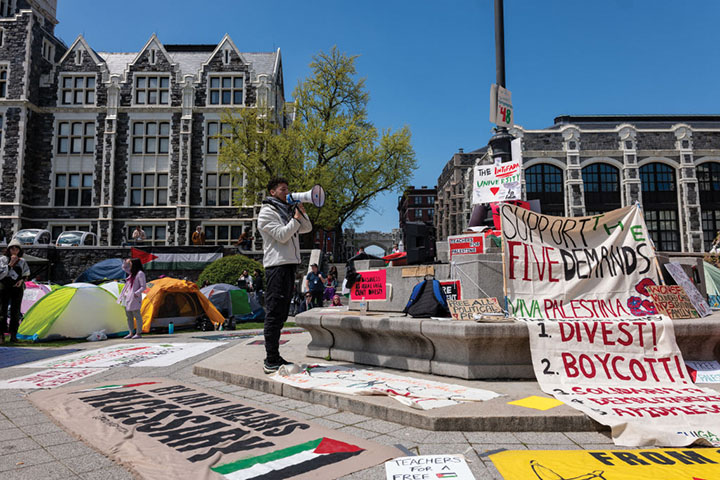
Students and others at City College continue to organize around a pro-Palestinian encampment on their West Harlem campus on April 26, 2024 in New York City. (Photo by Spencer Platt/Getty Images)
Significantly, the BDS movement successfully brings the Arab anti-normalization laws that currently exist within the broader Arab states to America and the West. Put differently, and most alarmingly, citizens of the United States may be enacting foreign laws on American soil. How so? Labeled as a “Powerful Weapon in the Fight Against Peace,” anti-normalization laws within the Arab world “stipulate that any type of contact between Arab and Israeli citizens is prohibited, with punishment ranging from a few months in prison to death.”
Anti-normalization is the vehicle used to spread anti-Jewish messaging. According to the BDS Movement’s own declaration, “normalization, tatbee in Arabic, means dealing with or presenting something that is inherently abnormal, such as oppression and injustice, as if it were normal.” This view labels Israel and Zionists as “inherently abnormal,” making normalization with the sole Jewish country unacceptable.
While supporters of the anti-normalization BDS campaign frame their actions as political activism, the campaign’s demonization of Israel mirrors the Nazi effort to isolate Jews. Significantly, while supporters of the anti-normalization BDS campaign may think they are participating in political activism, the demonization of Israel by the BDS movement shares eerie similarities with the Nazi campaign to label Jews as gefahrlich, “dangerous.”
The demonization of Israel by the BDS movement shares eerie similarities with the Nazi campaign to label Jews as gefahrlich, “dangerous.”
Throughout the 1930s, the Nazi Party enacted a series of laws that increasingly isolated and vilified Jews, leading to the boycott of Jewish businesses in Germany, and culminating with the ‘Final Solution,’ the attempted genocide of Jews in Europe and North Africa, as the only perceived solution to the “dangerous” and “abnormal” figure of “der ewige Jude” (“the eternal Jew”) was his complete isolation and eventual eradication. Essentially, according to “tatbee,” Israel and Zionists are “inherently abnormal.” As such, normalization with the sole Jewish country on earth would be beyond the pale of acceptable.
It is not a fluke, therefore, that at a protest against Hillel at Gallaudet University in February 2024, students yelled “Zionists off our campus!” or at UC Santa Cruz, the Faculty for Justice in Palestine (FJP) chapter posted to its Instagram page an advertisement for a student group’s “March Against Zionism” to shut down a Jewish student event, with the FJP group adding the following message: “UCSC: time for us to show up again! Let’s make it clear — zionism [sic] is not welcome on our campus.”
Similarly, it is not random that among the prominent demands from faculty groups that support Palestine is “to dismantle Study Abroad in Israel programs” because shutting down events about Israel, pro-Israel speakers, and going after Jewish organizations such as Hillel on campus is exactly how one were to implement anti-normalization mandates on U.S. campuses: PACBI (The Palestinian Campaign for the Academic and Cultural Boycott of Israel) instructs its supporters to avoid “any form of academic and cultural cooperation, collaboration, or joint projects with Israeli institutions,” which translates to a concerted effort to kick Zionists and Zionist institutions off campuses.
If the main vehicle for promoting and spreading anti-normalization is the BDS movement, who is operating this so-to-speak vehicle on campuses? For years student groups such as Students for Justice in Palestine (SJP) and individual faculty members from the aforementioned departments provided an imprimatur for BDS. However, the establishment of dozens of FJP chapters post-Oct. 7 across U.S. campuses played a significant, if not key, role in connecting faculty to one another and to a broader national and international network with a singular goal and the ability to effectively coordinate efforts to achieve the elimination of Zionist and Israel activities on campuses. Indeed, per AMCHA Initiative’s 2024 findings, having an active FJP chapter on a campus correlates with a more successful deployment of anti-normalization: campuses with an FJP presence were 11 times more likely to promote BDS in 2023.
While the accelerated success of anti-normalization activities may be traced to the presence of FJP, it does not fully address a larger problem: what is it about the institution of higher learning that allows for the spread of racist laws inherent in the wider Arab world? What is certain is that academic fields with a particularly high proclivity for using post-colonialism theory tend to be at the forefront of academic BDS. Indeed, an AMCHA Initiative study conducted back in 2015 found that 48% of faculty who support BDS are from a Humanities department, 36% from Social Sciences, and only 7% of Israel boycotters are affiliated with departments in Engineering and Natural Sciences. More specifically, the departments with the largest numbers of boycotters were English or literature, followed by ethnic studies, history, and gender studies.
But why English? One would expect a professor of political science to care more about politics. But the English discipline, where there is not an obvious connection between the academic discipline and the Arab-Israeli conflict — why? Of the 143 professors of English who endorsed the BDS studied by AMCHA in 2015, 92% had research interests that include race, gender, empire, and class, all of which adhere to the formulation of darling post-colonial critic, Michel Foucault, that “power is everywhere.”
As the disciple of English developed to incorporate research interests that privileged systems of power, so too did the profile of the English professor evolve. Those who operate the vehicle that spreads anti-normalization, namely professors from the Humanities disciplines, firmly believe that their job on campus is not to be transmitters of knowledge but activators of social change. Case in point: at NYU’s Changemaker Center, professors help students “realize the world they want.” At the same university, faculty formed a chain around the Gaza Solidarity Encampment as student organizers prepared to pray, which begs the question: what are the faculty members doing while on the university’s payroll?
Influenced by their disciplines which have become totally politicized, faculty are thus not averse to enacting anti-normalization mandates as they already believe that canceling what they deem to be beyond the pale of acceptability is the right thing to do. And so, while the effort to indoctrinate against Israel may have arrived well over 20 years ago, the changing nature of academic disciplines coupled with cancel culture successfully transformed universities to become epicenters for enacting anti-normalization campaigns inherent to the Arab world.
In sum, while our universities have increasingly become centers for de-normalizing the Jewish state, the minds of thousands of students are increasingly being won by a movement that positions itself as “nonviolent.” Of course, the antisemitism that accompanies anti-normalization of Zionism and Israel belies the chicanery of this “nonviolent” movement, as Jewish students are 7.3 times more likely to have been physically assaulted and 3.4 times more likely to have been subjected to threats of violence or death threats in schools with a large number of faculty members supporting BDS.
Jewish students are 7.3 times more likely to have been physically assaulted and 3.4 times more likely to have been subjected to threats of violence or death threats in schools with a large number of faculty members supporting BDS.
Knowing that the conflict has been successfully shipped to the West on anti-Israel terms and that anti-normalization campaign is being totally enacted on U.S. campuses, Jewish students may be the primary victims, but also the answer. And while many Jewish students are fighting back, we must ask ourselves, what is the best strategy? Is another report detailing discrimination of Jews on college campuses or passing the IHRA definition on antisemitism going to serve the Jewish students well? If anything has been learned from the success of anti-normalization of Israel and Zionism, it is that prevailing necessitates having a shared language and objective.
In America and the broader Western world, Jews are losing the narrative battle. We do not have an anti-normalization campaign, nor do we employ a mechanism such as BDS to call out the violation of human rights within the Muslim world. The reason is straightforward: unlike Israel, which listens to its willing executioners, Jews in the West are not hearing their assassins. In many ways, the situation mirrors where Israel stood after the 1967 war when the Arab world issued the three Nos. However, unlike Israel at that time, the current strategy in the West is one of engagement — engaging with those who actively work toward their demise. For example, organizations like Hillel continue to promote dialogue on campuses even after Oct. 7. Hillel at Ithaca College hosted a discussion on the Israeli-Palestinian conflict on Feb. 6, 2024, featuring Nizar Farsakh, who stated on QNews, a Cairo-based media platform, that it was “hard to argue that Israel tried to avoid civilian casualties” during the IDF’s Gaza incursion.
And of course, unlike the physical war between Israel and her neighbors, this battle is fought with words — with the sharp blade of rhetoric. A few years ago, an SJP talk took place at UCLA. I went undercover and played the part of an enthusiastic anti-Israel student. The young lady leading the presentation was a third-year undergrad, and during her entire presentation, she never once referred to the land that lies from the river to the sea as Israel; she always referred to the land as “occupied Palestine.” Likewise, when talking about the IDF, she used the acronym IOF (Israel occupying forces). I remember sitting there and thinking, this young lady is remarkable. She is fighting in the trenches of language and not giving one inch. She has entirely soaked up the ideology of her movement and, in many ways, absorbed the 3 Nos: she does not recognize Israel.
Another time, I went, again undercover, to an SJP meeting at Pitzer College, one of the Claremont schools in California. There, a young lady leading the discussion warned us not to use the word Jew in public, though, and I won’t forget the applause she received when she remarked, “we all know we mean Jew when we say Zionist.” Meanwhile, Israel advocates in the West often undermine their own position with excessive concessions, equivocations and false symmetries by saying things like not all criticism of Israel is antisemitic; we need to distinguish between anti-Zionism and antisemitism; Zionism and Judaism are not the same; and both the Palestinians and the Israelis must stop the violence.
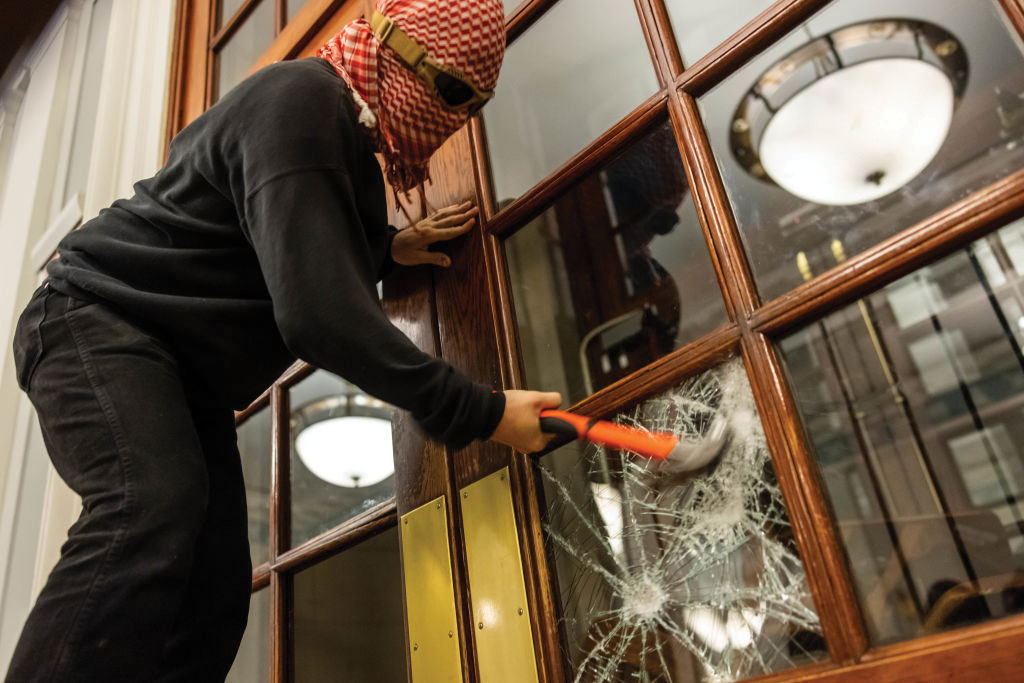
A demonstrator breaks the windows of the front door of Hamilton Hall, an academic building at Colombia University, on April 30, 2024 in New York City. (Photo by Alex Kent/Getty Images)
I can hear the chorus of humanistic Jews, Jews who have emerged scarred from the Diaspora, inflicted by the illness of wanting to be loved, rebuke my invitation to go on the “offense.” If we employ the tactics of our detractors, then we are no better. This, however, would only be true if the two sides are equal. If one sees the side fighting for Israel’s existence as a sovereign Jewish state and the side fighting for a Palestinian sovereign state from the river to the sea as equal, then I concede to this symmetry. However, as the British writer Salman Rushdie observed, having a Palestinian state “right now” would mean a “Taliban-life state.” Conversely, having a sovereign Jewish state from the river to the sea secures the safety and well-being of not only Jews, but non-Jews who, under Israel’s sovereignty, currently enjoy equality, freedom of speech and freedom of religion.
There is nothing abhorrent to going on the “offense” and employing tactics that would call out the inhumane face of Hamas, and by extension, Muslim states that do not uphold the values we hold dear to us. There is nothing unethical to using a lexicon that states with tenacity that the Jewish people hail from Judea and Samaria.
True, those who have been shipping the conflict on pro-Palestinian terms may very well have over 20 years on the Jewish people. But we can take the conn and save academia from the storm by understanding that antisemitism is not a threat to the Jews, but a symptom of a disease. The host body, here being academia, has been infected by antisemitism but only because its immunity has been suppressed by the devastation of higher education becoming increasingly politicized. To stay on course, we must call out those who have hijacked the academy: groups like Faculty for Justice in Palestine, Students for Justice in Palestine, Faculty Against Genocide, and faculty members who see themselves as activists first, and educators second.
Naya Lekht is currently the Education Editor for White Rose Magazine and a Research Fellow for the Institute for Institute for the Study of Global Antisemitism and Policy.
American churches and synagogues cannot significantly affect the future of the conflict between Israelis and Palestinian Arabs. But how we discuss the conflict, especially since October 7, 2023, can either severely strain Jewish-Christian relations, or plant seeds for a better future. Christian critique of Israel’s conduct of the war, including that of Pope Francis whose letter from October 7, 2024 included a citation of John 8:44 (a verse that accuses Jews of being “from [their] father, the devil,” and historically provoked and justified Church hostility to Jews) has, at times, veered into antisemitism. Coarsening discourse about Israel-Palestine threatens the future of Christian-Jewish relations in America.
The Life of a Rabbi After October 7th
After October 7, many liberal American Jews felt ostracized, besieged, and betrayed by longtime friends who denied or minimized the evils which had occurred on that day in Southern Israel. College campuses bred intimidation and hate rather than reasoned discourse. American rabbis pastored their congregants, many of whom felt scared and alone, while at the same time, we nurtured and navigated our communities’ relationships with the State of Israel. Israel is, for me and for the vast majority of American Jews, not only a critical refuge as the one and only country in the world where Jews can flee persecution. It is also a homeland where the story of the Jewish people began. It is the land where the Jewish people’s covenantal obligations are meant to be fulfilled; it is the place where Jews have yearned and prayed to return for thousands of years. Israel as a haven of belonging is a crucial aspect of modern Jewish identity and religious practice for most (though not all) American Jews.
I traveled to Israel in November 2023. Upon return, I reported about my experiences, not to convince people of the rightness of a particular political perspective, but to help American Jews feel more seen and understood in a time when so many felt invisible and misunderstood. I spoke and attended numerous rallies to bring the hostages home, one of whom, Keith Siegel, is the son of a member of my congregation. Thankfully, Keith was released from Hamas captivity in February 2025. Tragically, his mother, Gladys Siegel (z”l) died in December of 2024 before Keith was able to see her.
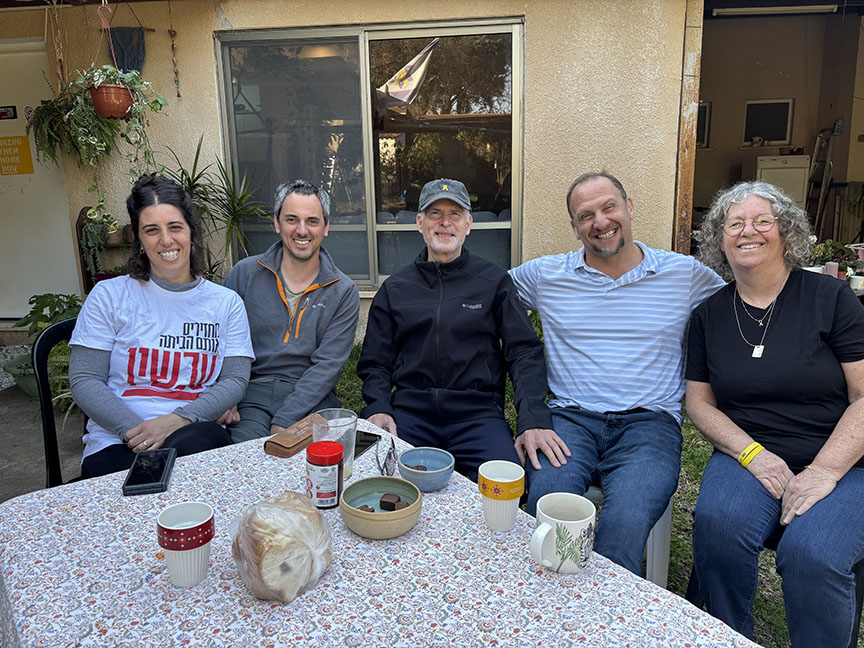
Visiting with Keith and Aviva Siegel and their family
I taught classes about how Jewish texts address issues such as redeeming hostages and the moral challenges of asymmetrical warfare. While struggling to hold together my synagogue community with a diversity of strong, divergent political opinions, I also combated a one-sided Durham city council resolution, an early version of which didn’t even mention Hamas in reflections on October 7.
Church #1: A Church Next Door
It was in this context that I received an email from the pastor of a Presbyterian church across the street from our synagogue that farms a plot of land and donates the crops to combat hunger. The pastor wrote to tell me that their church would be releasing a statement about their “community’s desire for an end to the fighting between Israel and Hamas,” adding “we see you, we love you, and we desire your safety and thriving, alongside the safety and thriving of all the people of Israel and Palestine”. While I appreciated her email, I was angered and disappointed by the statement. It expressed deep sympathy for the plight of Palestinians in Gaza—a sentiment I shared and continue to share—but accused Israel of genocide while ignoring Jewish suffering and Hamas crimes. It failed to call for the immediate and unconditional release of hostages, when the church was located literally across the street from a synagogue, one of whose members’ children was, at that moment, a hostage in a Hamas tunnel. It affirmed Palestinian indigenousness while ignoring Jewish historical and religious connections to the land of Israel. The statement condemned Israeli settler colonialism and occupation but failed to affirm the legitimacy of Israel’s right to exist within the Green line as declared by the United Nations in 1947.
I expressed my concerns, but the church leadership refused to meet with me because a local chapter of Jewish Voice for Peace, endorsed their statement and they felt it unnecessary to hear an additional Jewish perspective, even if it came from their literal across-the-street neighbors. I pass their plot of land daily; when I see their church’s members working the field or praying or studying, instead of love and fellowship, I feel anger and betrayal. The fact that I feel those things fills me with sadness.
Church #2: Kitchen Table Learning
In contrast, I received a thoughtful email from pastors of a different church, Reverend Mindy Douglas and Reverend Esther Hethcox of First Presbyterian Church in Durham, NC. They invited me to discuss a statement their church was considering. It called for the return of the hostages, condemned Hamas, and refrained from genocide accusations. Reverends Douglas and Hethcox are precious friends. I thanked them for reaching out and considering how their church’s public comments could affect members of my synagogue. I offered for us to talk over coffee around my kitchen table. When I asked why their church chose to issue a statement about Gaza, Mindy explained that some people in the church had been to Israel but also that “part of our story is there. When we read the stories of the Bible, that is the place where our stories are taking place.”
I found that answer genuine, honest, and something Jewish and Christian leaders should reflect upon together. What does it mean when a Christian church weighs in (particularly) on Israel because it sees what happens there as part of its own story?
Untangling Jewish and Christian Stories
Reverends Douglas and Hethcox are sensitive to the treachery that centuries of Supersessionism— seeing the Jewish story as being supplanted by the Christian one— has wrought upon the Jewish people. True Christian-Jewish reconciliation cannot take place by ignoring European Christianity’s oppressive history of appropriating Jewish self-understanding. Centuries of Christian Supersessionism did not disappear with Nostra Aetate in 1965; the work of ending its harmful influence must extend beyond statements and theology to one of the most difficult and divisive topics in modern religious life: the Israeli/Palestinian conflict.
American churches that descend from European Christianity inherit a responsibility to reflect on how anti-Israel rhetoric can fuel hate, especially when paired with Supersessionist theology. What is happening between Israelis and Palestinians is not, primarily, a Christian story, even though it is taking place in a religiously significant place for Christians. When choosing to participate in conversations about the Israeli-Palestinian conflict, American Christians do not owe blind, uncritical support to any Israeli government, and my point of concern is not meant to silence legitimate criticism of Israel’s current government. But as inheritors of a tradition that appropriated the Jewish story for two thousand years, I would argue that Christians have an ethical obligation to support the right of the majority of the Jewish people who are Zionists to tell their own Jewish and Zionist story and, at the very least, when speaking about modern Israel, to avoid repeating the sins of the past by again placing themselves at the center of the Jewish story.
Church #3: Seeing Israel Together
In June 2022, Beth El Synagogue and Trinity Avenue Presbyterian Church (TAPC), led by Reverend Dr. Katie Crowe, embarked on an interfaith trip to Israel and the West Bank. It included visits to Jewish and Christian holy places and a meeting near Bethlehem with Roots, a grassroots movement of understanding, nonviolence, and transformation among Israelis and Palestinians. Our trip formed the basis for more knowledgeable and nuanced understandings about the meaning of Israel for our communities at home.
On the Sabbath after October 7th, Reverend Crowe and members of TAPC attended our services along with Mindy and Esther and other local Christian and Muslim faith leaders. Imam Abdullah Antepli offered the Prayer for Peace from our dais. The presence of our interfaith partners bore witness to our community during a time of searing pain. Later, TAPC and Beth El co-hosted speakers from Roots to model how respectful dialogue about the conflict between Israelis and Palestinians could take place, and to challenge local religious and political leaders: if Israelis and Palestinians who are directly affected by the conflict can speak respectfully with each other, shouldn’t we, who are thousands of miles away, be able to do so?
Looking Ahead
What best practices can be followed to preserve and deepen Jewish-Christian relationships?
Reach Out!
I pray and hope and fervently wish for peace but this is not the last time violence will occur between Palestinians and Israelis. When it does, faith leaders should reach out to one another. Good communication can help Christian pastors find out if and how the local Jewish community is being affected by the violence overseas. Is someone a hostage? Is there a family member who was injured in an attack? Communication can also help Jews and Christians affect real and positive change. Rabbis and others who visit Israel are often aware of non-profit organizations doing effective and meaningful work on the ground. Local churches and synagogues can partner to support those organizations.
Prioritize the Local
Rabbis and pastors should be wary of damaging Jewish-Christian relations in America for the sake of issuing statements about the war in Israel. If a church feels called to speak, it should engage in internal reflection and consult a diverse range of Jewish voices— not only the “anti-Zionist” ones— before making public statements about such a complex topic. Christian communities cannot claim to be engaged in serious interfaith dialogue by cherry-picking those Jewish voices who agree with their point of view. The burden of true commitment to the work of interfaith dialogue involves proactively seeking out diverse Jewish voices and listening deeply with an open intent on honoring the modern complexity, pain, and hope of ancient people, groups, and stories. Take the time to get to know many Jewish neighbors; ask about their perspectives and experiences and learn how the issues are affecting them. This will aid in the formulation of a uniquely local, distinctively Christian response that builds community rather than erodes it.
Learn Together
Too often our learning takes place in silos. When a church or synagogue hosts a speaker or offers a class about the Israeli-Palestinian conflict, invite local Jews, Muslims, Israelis and Palestinians to learn together with your community. Doing so will give local people most affected by the conflict the gift of feeling seen, heard and known, rather than being objectified as the topic of a conversation that involves them but in which too often, they are not invited to speak. Christians can play a key role in convening Jewish and Muslim communities in ways that neither be able to do for themselves.
Lead with humility and curiosity
Israel-Palestine is a complex, painful conflict that vexes the most capable scholars and religious leaders in the world. All of us must remember that none of us have the answers. Focus on listening to different perspectives and finding compassion in your heart for all who suffer.
One final story
As Reverend Crowe and I walked through the streets of Israel, time and again Jewish and Arab shopkeepers pedaled their wares and asked us about ourselves. When we explained we were a rabbi and a pastor with a synagogue and a church, traveling to see the Holy Land together, people were astonished. They had rarely, if ever, encountered such a partnership. A plurality of Israeli Jews descend from Arab-Muslim countries where they had limited cultural and religious interaction with Christians. Ashkenazi Jews lived in fear of Christian neighbors for much of their history. Jews from Christian countries who live in Israel have had few interactions with the local minority Christian communities, most of which are not Catholic or Protestant. Jewish-Christian relations in Israel are frozen in time. Israeli Jews and Palestinian Christians relate to one another (if at all) through the suspicious screens of a terrible history, or the fog of the political conflict. Jewish-Christian relations in Europe and elsewhere in the world are better, but not by much.
America offers Jews and Christians an unparalleled opportunity for healing old wounds, for growing in ways unimaginable to our ancestors. Many (though not all) American Christians are willing to set aside seeing Jews as incomplete, in-need of conversion, and noxious beliefs that Jews are going to hell or responsible for the death of Christ. Many (though not all) American Jews know the difficult history of Jewish-Christian relations but realize the fundamental goodness of their Christian neighbors and seek to embrace the opportunity to build something new and different. But when it comes to the Israeli-Palestinian conflict, how we speak about it may put that hopeful future at risk. If we can speak with honesty and humility and curiosity, helping each other feel more known and understood and caring for one another’s safety, only then will God be glorified, by building community across difference and, in doing so, building a better future for us all.
Daniel Greyber is rabbi of Beth El Synagogue in Durham, NC, a Senior Rabbinic Fellow at the Shalom Hartman Institute, and an Adjunct Faculty Member at Duke Divinity School. He is the author of Faith Unravels: A Rabbi’s Struggle with Grief and God and is currently pursuing a Doctor of Hebrew Literature (DHL) degree with a specialization in Bible at the Jewish Theological Seminary (JTS).
One of Hannah Sattler’s strongest food memories has to do with Passover. Her grandmother would make strawberry ice cream with egg whites, so it’s parve and perfect for Passover.
“As a little girl, I just thought it was such a luscious treat,” Sattler, owner of Hannah’s Kitchen, told The Journal. “I’ve [made] it with my kids, here and there, because it just feels special and different and a little refreshing.” That recipe is below.
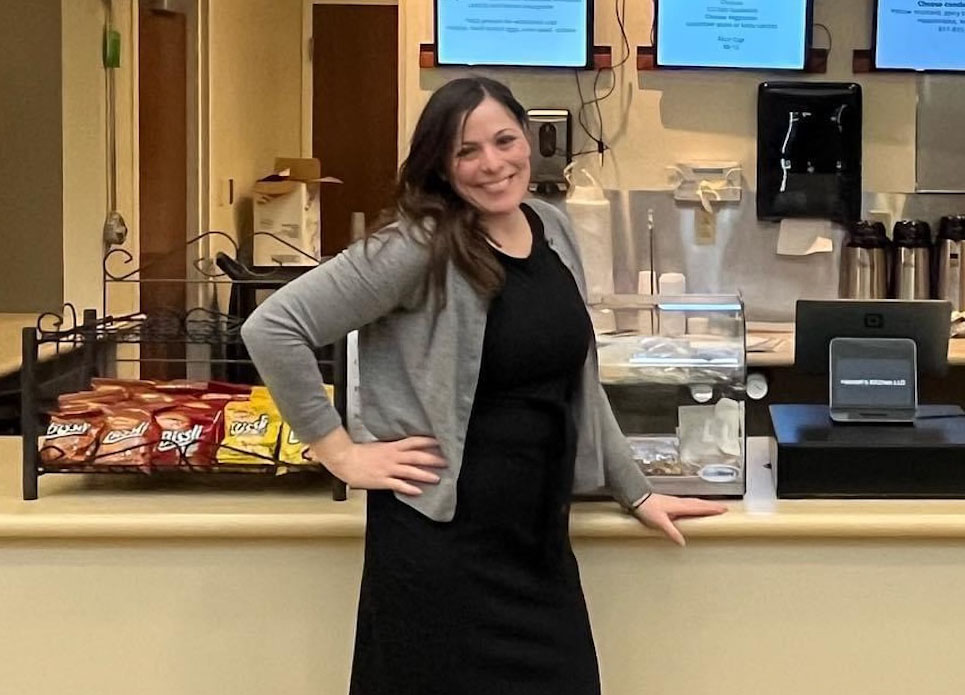
Hannah’s Kitchen is a Jewish-focused catering business and cafe, based inside the Jewish Community Center in Whitefish Bay in the suburbs of Milwaukee, Wisconsin. Sattler prides herself on nourishing the soul, preserving tradition and creating meaningful connections through food.
Sattler always loved food and cooking. Her mother and grandparents loved to cook and bake; her grandfather enjoyed experimenting with making Asian foods kosher. Known as “Grandpa Sy,” he would come to her preschool to braid challah with her classmates.
However, it took a while for Sattler to get to her calling.
“I started off as an engineering major in college, and two weeks in, I had to write a report on why I wanted to be an engineer,” she said.
Sattler recalled what she told her mom, ‘I’d be really good at it — I’m very much a math and science brain — but I’d hate it.”
She suggested Sattler see a career counselor, who gave her an aptitude test to help her decide on a major. Sattler remembered thinking the results were so stupid, she put them away and never looked at them again. Around 2020, that memory popped back into her head: the test said she would be good at religion and business.
“I end up in the financial industry because I’m a numbers cruncher,” she said. “I’m good at that.”
Sattler worked in investments at a hedge fund, before taking the time to be a stay-at-home mom for her three daughters. She ended up running her synagogue’s kitchen, starting as a volunteer, before being hired as their kitchen manager.
“I’ve always been really organized and [that applies] especially in the catering world,” she said. “You really need to not just know food, but how to organize and delegate.”
About 10 years ago, when her life went through some changes, Sattler started Hannah’s Kitchen.
It may have taken a while to get to her destiny, but she ended up in the right place. Catering, after all, is as much about connecting with people as it is about the food. People remember her years later, whether she’s feeding them during a happy rite of passage or a time of mourning.
“I always say we’re there in the good, but also the hard times, because as a community that’s what’s important.”
A huge part of enjoying cooking is being creative in the kitchen. However, you also need to not overwhelm yourself.
“Sometimes people take too much on,” Sattler said. “Don’t try to make everything at once … you don’t necessarily need to do every component from scratch.”
That means finding easy components, like using preseasoned rice or pouring sauce over chicken and throwing it in the oven. Also, know your go-to recipes that you know will turn out perfectly.
“Not everything, culinarily, has to be complicated,” she said. “You can make some easy meals and [then have] quality time with your family.”
And if you are preparing for a bigger event, like a large dinner party, space out your prep.
“Soup and dessert can be done a day or two ahead of time,” Sattler said. “Don’t make so much work where, by the time you’ve got everyone at your home, you’re feeling so stressed out, you [enjoy] the meal.”
And, if you do want to be creative in the kitchen, do it when you have the time. And do not be scared when attempting something new. It may not succeed, but you’ll learn from it.
At her kids’ school they say, ‘FAIL’ stands for First Attempt In Learning.
“Trying to figure out how you adapt things – making things fun and different and interesting – you roll with it,” she said. “If it works and tastes good, that’s all that matters sometimes.”
A nostalgic frozen treat — airy, sweet and Passover-friendly.
1 egg white
Pinch of salt
1 Tbsp lemon juice
¾ cup sugar
1 cup strawberries (fresh or thawed frozen)
Start by beating the egg white in a mixing bowl until it gets nice and foamy. Add in a pinch of salt.
While continuing to beat, slowly add the sugar — just a little at a time — until the mixture starts to form soft peaks.
Now add your strawberries. You can slice them, lightly mash them, or leave a few chunky bits if you like a little texture. Pour in the lemon juice too.
Keep beating the mixture for 15 minutes. Yes, a full 15! You’re looking for a fluffy, glossy texture that holds stiff peaks. This part gives it that light, mousse-like ice cream feel.
Once it’s whipped and gorgeous, transfer the mixture to a freezer-safe container and freeze until firm.
Scoop and serve straight from the freezer. It’s fresh, fruity and the perfect light dessert after a big Passover or meat meal!
Debra Eckerling is a writer for the Jewish Journal and the host of “Taste Buds with Deb.” Subscribe on YouTube or your favorite podcast platform.Email Debra: tastebuds@jewishjournal.com.
It’s been a long, matzah-filled week. Here are some fun treats to keep you going.
When Gail Pasternack found out that her son was gluten-intolerant, she and her husband scoured cookbooks to find recipes for him. “Sadly, we didn’t like most of them,” Pasternack, a writer and storyteller, told The Journal. “We found it simpler to adapt our own recipes.”
She altered Passover sponge cake recipes by substituting coconut flour for matzah cake meal and adjusting the quantities of the other ingredients. “I was nervous when I served it, because cakes made with coconut flour can get dry,” she said. “But when we cut into it, the cake was moist and delicious!” She added, “My family decided that it was the best sponge cake they’d ever had; a holiday tradition was born.”
Coconut Sponge Cake
10-12 servings
10 large eggs, room temperature
1 lemon
1 ½cups sugar
1 tsp kosher salt
¾cup coconut flour
Preheat oven to 350°F
Grease either a bundt pan or a 9-inch tube pan well. If you use a flat-bottomed tube pan, grease the bottom of the pan, line the bottom with parchment paper, and then grease the parchment paper.
Separate the egg yolks and whites into two bowls.
Zest and juice the lemon.
Beat the egg yolks well with a fork and add the lemon juice and zest to the yolks. Set aside.
Add the salt to the egg whites. Beat with an electric blender until very stiff. The whites will begin to look lumpy.
Gradually add sugar to the egg whites in small additions, and beat after each addition. The mixture will become smooth and will have a nice sheen.
With a large spatula, gently fold the egg yolk mixture into the egg whites mixture. Add one to two tablespoon(s) of coconut flour at a time to the egg white/egg yolk mixture and gently fold after each addition.
Pour the mixture into the prepared pan and bake for 40-50 minutes, or until a tester comes out clean.
Allow to cool for a few minutes before turning out onto a cooling rack. Once the cake is completely cool, dust it with powdered sugar (or even cocoa powder) to serve.
Judy Elbaum has been told that her chocolate filled macadamia crisps are the best Passover cookie ever. “They are delicious, addictive crowd pleasers,” Elbaum, founder of LeaveItToBubbe.com, told The Journal.
Chocolate Filled Macadamia Crisps
Makes 40 macadamia crisps/20 chocolate filled cookie sandwiches
Macadamia Crisps:
1 cup macadamia nuts (4 1/2 ounces)
1/2 cup sugar
8 Tbsp unsalted margarine (room temperature)
2 egg whites
4 Tbsp matzah cake meal
Chocolate Filling:
6 ounces semisweet chocolate
4 Tbsp unsalted margarine
Preheat the oven to 300°F. Adjust racks to middle and low positions in the oven. Line two uninsulated baking sheets with parchment paper.
Put the nuts and sugar in the bowl of a food processor and pulse until the mixture resembles a fine meal.
Beat the margarine in the bowl of an electric mixer until light and creamy for 3 or 4 minutes.
Add the nut/sugar mixture and beat for 5 minutes, until very light.
Add egg whites one tablespoon at a time and beat until batter is shiny and smooth, about 3 minutes.
Stir in the matzah cake meal.
Put the batter into a pastry bag fitted with a ½-inch round tip and pipe ¾-inch mounds of batter 2 inches apart on baking sheets.
Bake for 8 to 10 minutes, until the edges are lightly browned.
Cool for about 1 minute. Then, using a spatula, carefully transfer the cookies to a cooling rack to cool completely.
To make the filling: Melt the chocolate and margarine in the top of a double boiler.Cool to room temperature.
To Assemble: Spread the flat side of a crisp with a thin layer of chocolate. Top with the flat side of another crisp.
Can keep up to two weeks in an airtight container or freeze up to one month.
Every year, Lior Lev Sercarz eagerly anticipates Passover cookies, as they evoke wonderful childhood memories. Growing up, coconut macaroons and peanut cookies were a special treat, only available during this holiday.
“When we launched La Boîte and began experimenting with cookie recipes, I realized that tahini could be a fantastic, naturally gluten-free addition to coconut,” Lev Sercarz, chef, spice master and owner of La Boîte,told the Journal. “The result is an incredibly flavorful cookie that transcends the Passover season, a testament to the power of unexpected ingredient pairings.”
In a bowl combine all the ingredients except the beaten egg whites. Gently fold in the whites. Scoop small balls of the batter (about golf ball size) and place evenly on a baking tray lined with parchment paper.
Bake for 12 minutes then let cool.
If using a professional convection oven, like we have here at the shop, reduce the heat to 325°F and the baking time to 11 minutes.
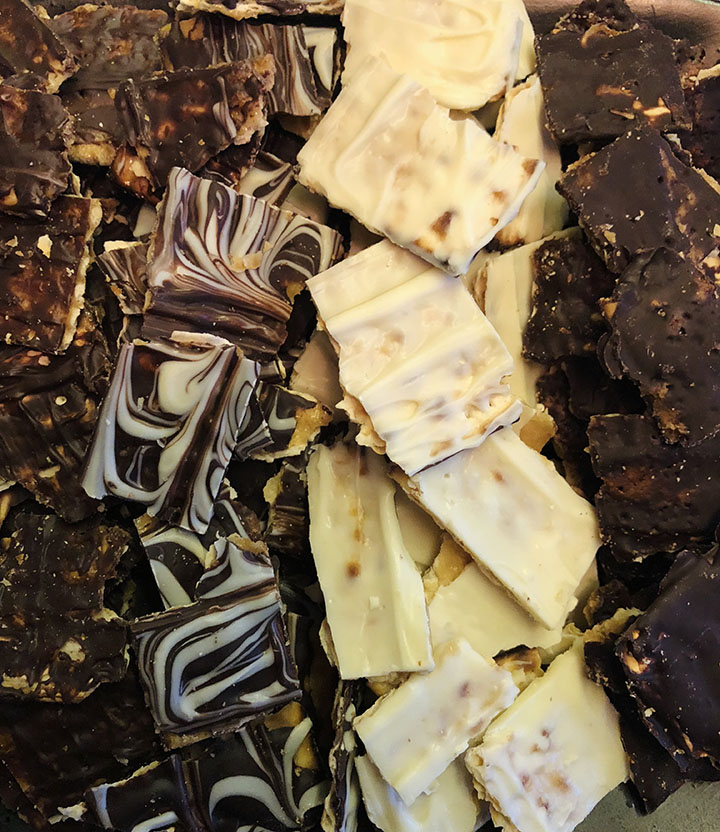
It would not be a Passover roundup without chocolate covered matzah.
Allyson Stone’s family recipe is a crowd-pleaser year after year.
“It’s essentially fool-proof to make,” Stone, founder and president of Stoneshine Ventures, told The Journal. “The steps and patience are really what makes it the most special.”
Stone’s Chocolate Covered Matzah
6-8 sheets of unsalted matzah
1 cup of salted butter
1 cup of tightly packed light or dark brown sugar
1.5 bags of chocolate chips
½ tsp of vanilla extract (optional)
Preheat the oven to 350°F. Line two large cookie sheets with foil, covering all ofthe edges. Line the bottom of the cookie sheet evenly with the matzahs, darker side facing up. Fill in any open spaces with smaller pieces of matzah.
In a 3-quart saucepan, melt the butter completely then add the brown sugar. Cook over medium heat, stirring constantly, until the mixture comes to a boil (about 2 to 4 minutes). Add a ½ teaspoon of vanilla extract (optional) then stir. Let the mixture cook for an additional minute before pouring over the matzah. The mixture will spread in the oven to cover the surface completely.
Place the baking sheets in the oven. Bake for 5 minutes or until mixture begins tobubble. Remove from the oven and sprinkle immediately with chocolate chips. Let stand for 4 minutes, then spread the melted chocolate over the matzah with a butter knife. Refrigerate or freeze baking sheets until chocolate hardens completely. About 30 to 45 minutes.
Remove the baking sheets from the refrigerator or freezer then cut matzah sheets into squares (9-12 pieces, depending on the size of matzah squares). Enjoy!
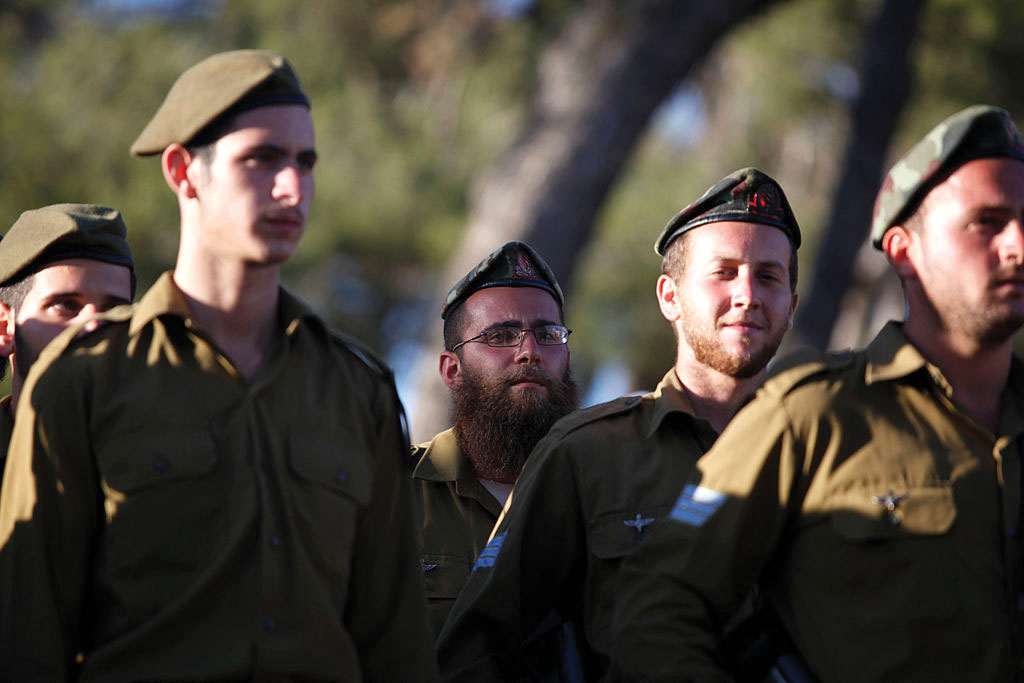
A key takeaway from John Lewis Gaddis’ book “On Grand Strategy” — recommended reading that was translated to Hebrew not long ago — resonates profoundly: a nation fails to achieve its objectives when it does not align its goals with its capabilities. From this principle, all else follows: The Chief of the IDF warns the politicians that there aren’t enough soldiers to fulfill their aspirations. The ensuing choice is binary: either reorganize the objective board, set priorities, and decide what’s essential now, what can be postponed for later, and what can be ditched — or find a realistic way to bolster manpower so the goals can be pursued.
Here’s a mundane yet revealing story. The details have been altered slightly to obscure identities. Recently, commanders of an Israeli reserve unit slated for mobilization were summoned for a preparatory meeting — a briefing, a tour of the area, and familiarization with their tasks. About 90 reservists were called in. Only 35 showed up. And these were commanders, not the rank and file. Disappointing? Certainly. Predictable? Arguably, yes. Challenging? Undoubtedly.
The younger generation of Israelis (and quite a few of the older ones) have demonstrated over the past year-and-a-half that when the mission is clear and the urgency is palpable, they show up with determination, courage, and willingness to sacrifice. They now prove with their growing absence that they neither perceive a clear mission nor a pressing urgency. What they perceive is evasion, a dodging of uncomfortable decisions.
An example of an uncomfortable decision that could be made: conceding some war objectives due to manpower shortages. Politicians could decide that matching capabilities to objectives necessitates such moves. This would require them to look at the list of desired tasks and decide which objectives are absolutely crucial and which are less so. Of course, this involves taking certain risks. Giving up on any way objective involves risk. It would compel the leaders to ask fundamental questions about Israel’s possibilities in a complex arena filled with numerous actors, constraints, and limitations. It would require them to face the public — possibly their own supporters —and explain a decision that will invariably sound negative. “We decided to withdraw forces from the Syrian Golan” — this sounds bad, defeatist. “We decided to thin our number of forces in Judea and Samaria” — this sounds risky. “We’ve decided not to continue the maneuver in Gaza, although Hamas still controls the area” – this sounds miles away from “total victory.”
So one uncomfortable option given the reality that has emerged is to change the objectives to match the capabilities. Another uncomfortable option is to take the opposite route: to strengthen capabilities in order to meet the original and emerging objectives.
What does this option entail? It requires a significant increase in military manpower, and this increase must be based on a realistic plan of recruitment. There is only one place where enough young people remain to fill the IDF’s needs: the Haredi sector. But etting these youngsters is highly uncomfortable. It would destabilize the coalition, complicate the continuation of government tenure, and rupture the political alliance of groups that hold significant power. Not to mention the actual difficulty of recruitment. Uncomfortable.
In recent weeks, while filming episodes of my video series on the “Haredi Challenge,” I met with several professionals who have dealt with manpower management in Israel’s security apparatus. Not one — literally, not a single one — suggested an alternative to significantly increasing the combat force other than drafting young Haredim. Yes, they said, you can further explore the existing pool for manpower, find a few lost servicemen who haven’t yet been called up, bring back veterans. All this, as one of them told me, is “marginally beneficial.” Another one said: “The lemon is squeezed.” There are only two large groups of men who have not yet been drafted: Haredim and Arabs. Hence, for those who want a larger army capable of achieving all objectives, there is only one option, and it is not an easy option to implement.
Two options. “How long will you keep hopping between two opinions”, prophet Elijah (the classic Passover source) implored the people when they failed to choose between to clear options. “If the ETERNAL is God, then follow [the ETERNAL]; and if Baal, follow [Baal]!”. Instead of choosing, they procrastinated, avoided the truth, hoped for some miracle that would save them from having to make a choice, shifted responsibility onto others. The prophet implores the people to choose the true God. They, like Israeli politicians today, “answered him not a word.”
Something I wrote in Hebrew
The IDF leadership decided to suspend from the reserves Air Force pilots who signed a letter protesting the current war aims. Here’s what I wrote:
Let’s be blunt: suspension from reserve duty is not a punishment for the signatories – it’s a punishment for the state. Whoever decided to suspend the signatories of the letters made a mistake that he will be forced to retreat from, as every suspension will lead to another letter, and every punishment will add more signatories, and the IDF is in a manpower shortage, not in a surplus. What will it do if a majority of a brigade signs a letter — not draft them? What will it do if it receives a petition from 10,000 reservists — forgo their service? … Those who think the right response to these letters is suspension from military service are wrong.
A week’s numbers
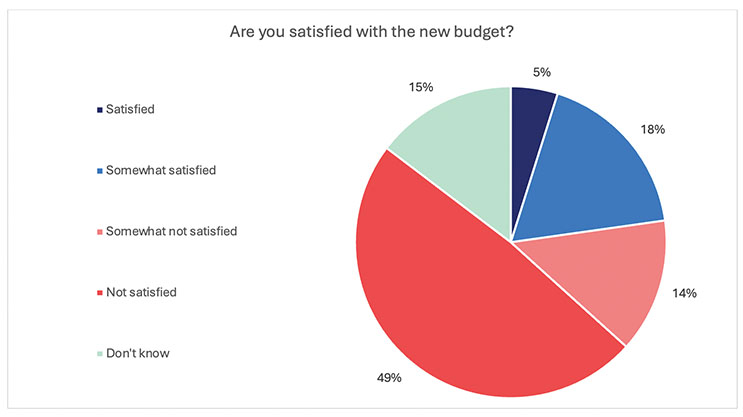
Economic issues are on everyone’s minds. There are tariffs, there’s also the new Israeli budget … (JPPI numbers)
A reader’s response
Elana Rosenberg: “Whenever I see Netanyahu cozying up to Trump I feel embarrassment.” My response: Sometimes a leader’s got to do what a leader’s got to do.
Shmuel Rosner is senior political editor. For more analysis of Israeli and international politics, visit Rosner’s Domain at jewishjournal.com/rosnersdomain.
Trump Administration Freezes More Than $2 Billion to Harvard After Rejecting Admin’s Demands
The Trump administration froze more than $2 billion to Harvard University on April 14 after University President Alan Garber announced the university is officially rejecting the Trump administration’s demands to retain nearly $9 billion in federal funding.
The administration had initially demanded that the university ban masks and rescind its Diversity, Equity and Inclusion program; on April 11, the administration issued more demands, which included “asking Harvard to derecognize pro-Palestine student groups, audit its academic programs for viewpoint diversity, and expel students involved in an altercation at a 2023 pro-Palestine protest on the Harvard Business School campus,” according to The Harvard Crimson. The administration also demanded that the university screen students in their admissions process to see if they support terrorism and antisemitism. Garber said in his announcement the new demands suggest “that the intention is not to work with us to address antisemitism in a cooperative and constructive manner” and that the demands violate the university’s “First Amendment rights and exceeds the statutory limits of the government’s authority under Title VI [of the Civil Rights Act].” Garber added that “we do not take lightly our moral duty to fight antisemitism.” The Trump administration’s Joint Task Force to Combat Antisemitism responded by saying that the university’s statement “reinforces the troubling entitlement mindset that is endemic in our nation’s most prestigious universities and colleges – that federal investment does not come with the responsibility to uphold civil rights laws.” The Task Force further announced that it would be freezing $2.2 billion in grants and $60 million in contract value from the university.
Judge Says Mahmoud Khalil Can Be Deported
An immigration judge ruled on April 11 that Mahmoud Khalil, a Columbia University graduate, can in fact be deported.
Assistant Chief Immigration Judge Jamee Comans agreed with Secretary of State Marco Rubio’s memo that Khalil, a legal resident with a green card, could be deported under the government’s reasoning that his “beliefs, statements or associations” undermines the United States’ foreign policy interests and that Khalil participated “in antisemitic protests and disruptive activities.” Keeping him in the U.S. would “undermine U.S. policy to combat anti-Semitism around the world and in the United States, in addition to efforts to protect Jewish students from harassment and violence,” according to CNN. Khalil’s attorneys will be appealing the decision to the Board of Immigration Authorities and will in all likelihood be filing an asylum claim for him.
ICE Arrests Columbia Student
Immigrations and Customs Enforcement (ICE) arrested Columbia University graduate philosophy student Mohsen Mahdawi on April 14 in Burlington, Vt.
According to The Washington Free Beacon, Mahdawi, a green card holder, was the co-president of the university’s Palestinian Student Union––a coalition of anti-Israel groups on campus––and a member of the suspended Students for Justice in Palestine chapter. A senior State Department official told The New York Post that Mahdawi “played an active role in fall 2024 student protests at Columbia University, instructing protesters to physically push a small group of pro-Israel students.” The official also alleged that Mahdawi promulgated antisemitism at protests by calling Israel Defense Force soldiers terrorists and using a megaphone to yell “at Jewish bystanders and supporters of Israel,” per the Post. Mahdawi’s attorneys filed a habeas corpus petition contending that the Trump administration is engaging in “retaliatory” action over Mahdawi’s “constitutionally protected speech.” His attorneys also pointed to Mahdawi shouting “shame on the person who [called] for ‘death to Jews’” during a Nov. 2023 protest as evidence that he is not antisemitic, reported The Columbia Daily Spectator.
12 Anti-Israel Protesters Charged with Vandalism, Trespassing After Occupying Stanford Building
Santa Clara County District Attorney Jeff Rosen charged twelve anti-Israel protesters with felony charges of vandalism and conspiracy to trespass on April 10 after the protesters occupied a building at Stanford University on June 5.
The building had the university president’s office in it; Rosen alleged that the twelve charged individuals, ages 19-32 and are current and former Stanford students, caused damage ranging from $360,000 to $1 million. He accused the protesters of breaking “windows, furniture, disabled a camera and splashed fake blood,” ABC7 News reported. “Dissent is American, vandalism is criminal,” Rosen said in a statement, adding that the 12 charged individuals “had been conspiring for days in advance to do this.”
The university said in a statement, “As we’ve maintained consistently, we believe the decision on how to proceed with these cases rests with the Santa Clara County District Attorney’s Office based on the evidence gathered. We respect their decision in this matter. With regard to Stanford’s internal disciplinary proceedings, panels from the Office of Community Standards (OCS) found that students were responsible for violations of university policies and issued sanctions, including two-quarter suspensions followed by probation, delayed degree conferrals, and community service hours.”
As an Orthodox Jew with a broad group of friends, I often find myself navigating a frustrating dilemma. I have two options: I can attend an event designed for the Orthodox community, where I can comfortably observe kosher, Shabbat, and other aspects of religious life; or I can participate in a pluralistic space, where I meet people from all walks of Jewish life — but where my Orthodox identity sometimes feels like an obstacle.
In pluralistic settings, I find myself negotiating my surroundings, navigating confusing kosher/nonkosher buffets, and wondering if the marshmallows on the “kosher” table have wandered over from the nonkosher side — and actually contain gelatin (yes, that usually means pork), or hurrying away from live music and bonfires, in order to preserve the spirit of Shabbat. Writing, electricity, even motion-activated bathroom fixtures can all be challenges at these events.
At times, exclusion has been more direct. In one progressive Jewish space that prided itself on being “inclusive,” I was told, point blank, that Orthodox Jews were not welcome. I replied, “I can’t force you to welcome certain communities, but I do want to ask: would you say the same thing to someone from the LGBTQ community?”
This kind of exclusion has weighed on me for years. I’ve met people who had never interacted with an Orthodox Jew before and were eager to learn about our community, lifestyle, and interpretation of Jewish law. In turn, I’ve deeply appreciated the opportunity to learn about Reform, Conservative, Reconstructionist, Renewal, and other Jewish movements. If there’s so much to learn from one another, why do we distance ourselves from each other?
In a world where we already face so many threats from the outside, why are we so siloed from each other on the inside? I am reminded of this chilling quote from a survivor of the Nova music festival massacre, who said that one of her Hamas captors told her: “Right now, your people are unified, so we can’t touch you. But soon that will change — and we’ll be able to attack you again.” Even our enemies understand the power of Jewish unity. We face enough threats to Jewish identity from the outside. We shouldn’t fight inclusion from within.
Those concerns were on my mind at last month’s StandWithUs International Conference. Would this be another pluralistic gathering that left Orthodox Jews on the sidelines?
The conference, which took place from Feb. 27 to March 2, included Shabbat — a notoriously complex time in Jewish communal gatherings. From the outset, I was struck by how it was handled. At a Thursday night session for rabbis and community leaders, I sat in a room that included an ultra-Orthodox rabbinic couple from New York and a gay family from San Francisco. As introductions were made, I realized creating inclusive Jewish spaces isn’t magic. It just takes planning and care. Many “Shabbat friendly” events that didn’t live up to the label. This one did.
Creating inclusive Jewish spaces isn’t magic. It just takes planning and care.
Throughout Shabbat, the environment supported observance without drawing attention to it. The food was Glatt kosher, spaces were Shabbat-observant, and Orthodox attendees were housed on accessible floors. Non-Jewish staff were available to help with halachic needs, and prayer options included Orthodox, egalitarian, and musical services. I attended the Orthodox minyan, which was packed — and even included some of Christian students, who seemed fully immersed in the moment. It was powerful to see such diverse communities come together in shared sacred space.
On Shabbat day, I joined sessions on self-care, Israel education, and difficult campus conversations. I found the experience both refreshing and healing. Shabbat ended with a musical Havdalah, arms linked and voices raised as Jewish melodies poured into the night — a reminder of what intentional inclusivity can make possible.
The experience stood out not because everyone was the same, but because no one was asked to compromise who they were. I’ve often felt forced to choose between belonging and observance, the conference reminded me I don’t have to.
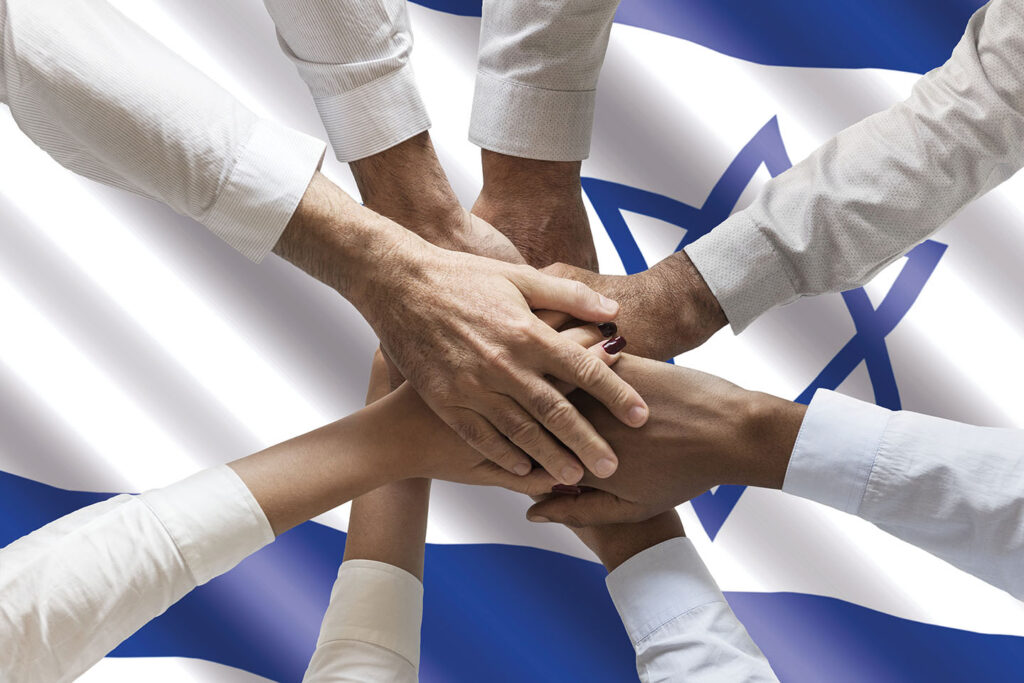
I hope more Jewish organizations rise to that challenge. Creating inclusive spaces — across political, religious, and cultural lines — isn’t always easy. But at a time when the Jewish people face so many threats, from rising global antisemitism to campus hostility, our survival depends on our unity. How can we expect other communities to include us if we don’t include each other?
We don’t need to erase our differences to stand together. But we do need to make space for one another — with intention, respect, and courage. When we do, we begin to unlock the deeper power of our people: the beauty of our diversity, the wisdom in our disagreements, and the truth that — as our sages teach — each and every Jew is an entire world.
We are strongest when every Jew has a seat at the table — without exception.
That’s the future I’m fighting for. And it’s one we can build — if we feel inspired to do so.
Alexandra Fishman Ph.D. is Director of Data & Analytics at StandWithUs, an international, non-partisan education organization that supports Israel and fights antisemitism.
Paul Kujawsky and Eleanor Mayer (the latter a pseudonym) are both Ivy-educated, both attorneys, and have been friends since high school. But Eleanor supports much of what President Donald Trump is doing, while Paul regards Trump as the most dangerous American politician in living memory.
Paul started their dialogue with a series of challenging Facebook posts—“Trump voters, is this what you voted for?” with links to news stories about Trump’s confrontations with the judiciary, preparations for military action against Panama, misconduct by Elon Musk’s DOGE, Trump’s mass pardon of the January 6 rioters, and so on. Eleanor replied privately by email, leading to the following exchange, which has been lightly edited for publication:
Eleanor Mayer: I’ve wanted to respond to some of your “is this what you voted for” Facebook posts, but don’t want to get into an endless comment exchange, as has happened the few times I’ve brought my politics to Facebook.
As a general introductory summary: I don’t have voter’s remorse. I am still glad that Trump/Vance won the election, rather than Harris/Walz. I voted against federally mandated “progressive” extremism. I voted for a reduction in federal bureaucracy and overregulation — and have been pleased at how committed Trump seems to be to that goal. I voted against hostility towards Israel. I voted for a stronger military, one focused on fighting enemies rather than on DEI and pronouns. I did not expect to like everything Trump et al. did in office. I hoped I would approve of a substantial chunk of what they did, as happened (to my considerable surprise) during Trump’s first term. I wince at Trump’s frequent bizarre blowhard utterances, and probably wouldn’t have voted for him if I didn’t somewhat prefer his actions to his words (to the extent they’re separable). I consider him a pathological narcissist, but also think running for and being president has acted as pretty effective occupational therapy — which wouldn’t lead me to support him if I didn’t also prefer him to the appalling alternative.
“I voted for a reduction in federal bureaucracy and overregulation — and have been pleased at how committed Trump seems to be to that goal. I voted against hostility towards Israel. I voted for a stronger military, one focused on fighting enemies rather than on DEI and pronouns.” – Eleanor Mayer
I’ve been pleased with most of Trump’s cabinet picks. I’m not happy about RFK Jr., though at least he’s not currently pushing a full-blown anti-vax screed. I’m open to hearing more about his claims that food additives, etc. are unhealthful.
I’m aware that some of the personnel cuts have been badly aimed, and that the fired-rehired results have hurt people who don’t deserve it. I am inclined to accept the proposition that given the possibly limited time in which Trump can make significant changes to the federal leviathan, there is an argument to be made for the chainsaw approach.
I’m concerned about the pressure Trump is putting on Ukraine and the extent to which he’s seemed to make concessions on important negotiating points before negotiations have (as far as we know) taken place. I’m aware that I don’t know that much about Ukraine or about Zelenskyy. I have, like Vance, seen video (one, in my case) of men being seized on the streets, allegedly for purposes of forced conscription. I’m also aware of Russia’s historical claims to Crimea, and doubt the war can end without ceding Crimea to Russia (unless Ukraine pulls one hell of a military rabbit out of its metaphorical hat). I’m unhappy about the prospect that some of the Russian-speaking, but no longer pro-Russian territory may have to be ceded to Russia. I don’t approve of a settlement that will make Putin feel the war was worthwhile, and don’t know what settlement will actually make him feel that way (as opposed to claiming victory). I don’t think Trump is as pro-Putin as many people (possibly including Putin) currently assume.
I’m not a fan of tariffs other than reciprocal ones. I also think Trump has taken his provocations re Canada beyond acceptable trolling of [Canadian Prime Minister Justin] Trudeau, and that he contributed to the decline in [Canadian Conservative Party leader Pierre] Poilievre’s political fortunes, which I regard as a detriment to both our and Canada’s future.
I don’t want the U.S. to acquire Greenland (or any other territory accustomed to a welfare system more extensive than ours), but do see substantial benefit in a closer relationship with that country, whenever it becomes independent.
I was dismayed at Trump’s extending feelers toward Iran re some sort of “deal,” and hope Iran continues its arrogant rejection of same. (On a related topic, I hope Israel destroys Iran’s nuclear program — which, per my very well-informed husband, it could do even without active US assistance – before it’s too late and all Israel can do is send off a Samsonesque posthumous volley of missiles. I’m not sure such a volley would even be sent, given the ethical complexities.)
As a closing generality, I find it hard to assess some of Trump’s decisions when media and blogger reports are likely to be irredeemably slanted in one or the other direction.
Feel free to ask me about issues I’ve failed to mention.
EM: P.S. As for immigration and deportations: I’m no expert on the legalities. I’m glad to see the massive influx of illegal immigration at the southern border drying up. I’m inclined to agree with my husband’s assertion that the U.S. Constitution doesn’t include immigration restrictions among the limited federal powers, but I do think it makes sense for this to be a federal power (once a constitutional amendment adds it to the list). I’m also intrigued by his recommended policy approach: that immigration be open to all, but that no financial assistance be provided, since it acts as an incentive to those who have no special interest in American values. I might exclude those who’ve been convicted of certain crimes, if those convictions followed a trial with a reasonable amount of due process.
EM: P.P.S. Given what I’ve learned about climate issues from reading over my husband’s shoulder, I’m glad to see Trump’s deemphasis on measures intended to address what I view as a nonexistent climate emergency.
Paul Kujawsky: Eleanor, thanks for sharing your thoughts about Trump. I think a big part of our disagreement is that we’re actually arguing about different concerns, concerns that to a large degree don’t overlap.
“I think a big part of our disagreement is that we’re actually arguing about different concerns, concerns that to a large degree don’t overlap.” – Paul Kujawsky
You’re arguing about policies. There are some defensible policies coming out of the Trump administration, in part because Democrats have shifted too far to the left–or to be more precise, Democrats have allowed their far-left minority to exercise disproportionate influence and power. A backlash was probably inevitable, though I would argue that the pendulum has swung back too far in reaction, as usually happens.
So, for example, in the Middle East, Trump is clear that Israel is our ally, Iran and its proxies are the enemy. People should not come en masse into our country unvetted and in violation of our laws. There are prudential reasons to favor a lean government that focuses on effectively and efficiently handling its core functions. These are perhaps good Trump policies. There are also some abhorrent Trump policies: For example, switching sides in the Ukraine-Russia war.
But here’s my point: whether the policies are good or bad, or whether the good policies outweigh the bad policies, is not the main issue. It’s the terrible, undemocratic way they are implemented. My Trump fears are not about policies, but about liberal democracy. When the Republican Party was a conservative party, it was sometimes right, sometimes wrong, but not fundamentally dangerous. But now that the GOP has become a nationalist-populist, authoritarian personality cult centered on Trump, it is profoundly dangerous to the preservation of liberal democracy.
“The main issue is the terrible, undemocratic way [his policies] are implemented. My Trump fears are about liberal democracy. Everything Trump does is done with an indifference if not hostility to democratic norms and rules.” – Paul Kujawsky
Everything Trump does is done with an indifference if not hostility to democratic norms and rules. Everything is an assertion of presidential (meaning personal) power. He could try to work through Congress to pass actual laws to implement his preferred policies; but at every turn he implicitly relies on the claim he made in his first term: “I have an Article 2 where I have the right to do whatever I want as president.” He wants to be a dictator, like Putin and Xi.
I trust you will agree that from Inauguration Day till today, Trump has brought chaos to virtually every aspect of the federal government, largely by illegally trying to shrink it–or crush it. The assertion of raw power is an end in itself for the authoritarian personality, but there is more: it is well known that there is a plan to replace large swaths of the bureaucracy with Trump loyalists, i.e., loyal to Trump, not to the Constitution. All this creates a weaker yet more Trump-centered government–a government easier for Trump to dominate and control.
Thus we have an authoritarian executive, faced with a neutered legislature, and getting ready to ignore any inconvenient judicial rulings. This is potentially the end of the rule of law, and with it, liberal democracy itself.
There are only two possible responses to what Trump is doing: pretend it isn’t happening, or embrace some variant of “you can’t make omelets without breaking eggs”–the good policies are worth the threat to our institutions. I think that’s a profound error. Policies come and go in a democracy; but liberal democracy, once wounded, may not revive or survive.
And finally–remember, populism is at heart a conspiratorial way of thinking: “You the People don’t have what you deserve because they (elites, corrupt politicians, immigrants, etc.) are keeping it from you!” It’s almost never true, but it creates a useful enemy. Useful enemies are an essential part of the authoritarian toolkit. And the more a populist movement fails, the more it seeks scapegoats. And who is the most common scapegoat throughout history?–people like you and me, Eleanor.
EM: Dear Paul –We agree somewhat, but not entirely, about the way Trump is approaching his goals and the concerns his approach raises. I see your description as painting with too broad a brush. He combines a (possibly vague) notion of the ways our system has been pulled out of its intended shape over the decades and centuries with a disturbing enthusiasm for pushing presidential authority to and beyond its limits.
Some of his haste and carelessness may be a reaction to how he underestimated the forces dedicated to hemming him in and interfering with his initiatives in his first term. Some of it is his taking advantage of the “hell, go ahead and break things!” sentiment of some of his supporters and followers. As for ignoring judicial rulings, so far he’s been playing cutesy games and pushing some boundaries as regards federal district judges who are pushing boundaries of their own. I may well be wrong, but I don’t think he’s very likely to outright ignore or defy orders from the circuit courts of appeal or from the Supreme Court.
As for whether his populists will end up coming for the Jews, it may, ironically, be some protection that the leftists those populists despise have already been doing so.
PK: Eleanor, you write that Trump has “a disturbing enthusiasm for pushing presidential authority to and beyond its limits,” implying that he is simply building on “the ways our system has been pulled out of its intended shape over the decades and centuries.” It’s true that the party system has distorted the constitutional plan. Instead of Congress defending its rights and prerogatives against the executive branch, as intended, Democrats in Congress defer to Democratic presidents as their party leader; Congressional Republicans similarly defer to Republican presidents. Thus, Congress willingly gives up its power to the President. This has indeed been going on for generations, with both parties at fault.
But Trump’s appetite for power is so ravenous, his disregard for limits so unbounded, that it is a difference in quantity so great as to become a difference in quality. No previous president, however grandiose his pretentions, has been as openly dictatorial and monarchical as Trump. Other presidents have pushed the limits of their power; Trump recognizes no limits. And no previous Congress has been as supine and complicit in its own emasculation.
You call this analysis “painting with too broad a brush.” I call it “reading the newspapers.” Please take seriously what Trump says and does. He isn’t hiding it.
Sugar-coating Trump’s attempt to subordinate the country’s political systems to his will as “haste and carelessness” is to ignore his “above the law” mindset. “Lawless” isn’t even strong enough– “gangsterish” is closer to the mark. You are closing your eyes to the truth, including the truth that Trump will defy the courts unless there is strong Republican pushback. But from here to the horizon all I see from Republican politicians are “Profiles in Spinelessness.” There will be no help from that quarter.
You write: “As for whether his populists will end up coming for the Jews, it may, ironically, be some protection that the leftists those populists despise have already been doing so.” I’m afraid I don’t understand your point. Do you mean that, since the illiberal left is attacking Jews, the radical right won’t? That is the merest wishful thinking. Throughout modern history, the far left and the far right have always been able to agree on one thing: Jew-hatred. Trump may not be an antisemite himself. But he is very comfortable in the company of antisemites, and can’t be counted on to restrain them. Populists require scapegoats. We are not safe.
We are not safe not just because we are Jews, but because under Trump nobody is safe. This is the inevitable consequence of the administration’s siege and corruption of the rule of law. Genuine liberals, both left and right, need to band together to fight the extremists of both left and right. This is a struggle that transcends party identification.
“You make some conclusory statements that (a) I don’t currently agree with and (b) I hope prove to be overstatements. We shall see.” – Eleanor Mayer
EM: Dear Paul, You make some conclusory statements that (a) I don’t currently agree with and (b) I hope prove to be overstatements. We shall see.
We stopped here, although there’s much more to discuss–tariffs, for example. Neither of us persuaded the other, but we had the kind of respectful dialogue that’s hard to find these days, and we’re still friends.
Paul Kujawsky is an appellate attorney in Los Angeles. Eleanor Mayer is a quasi-retired appellate attorney and novelist in Bloomington, Indiana.
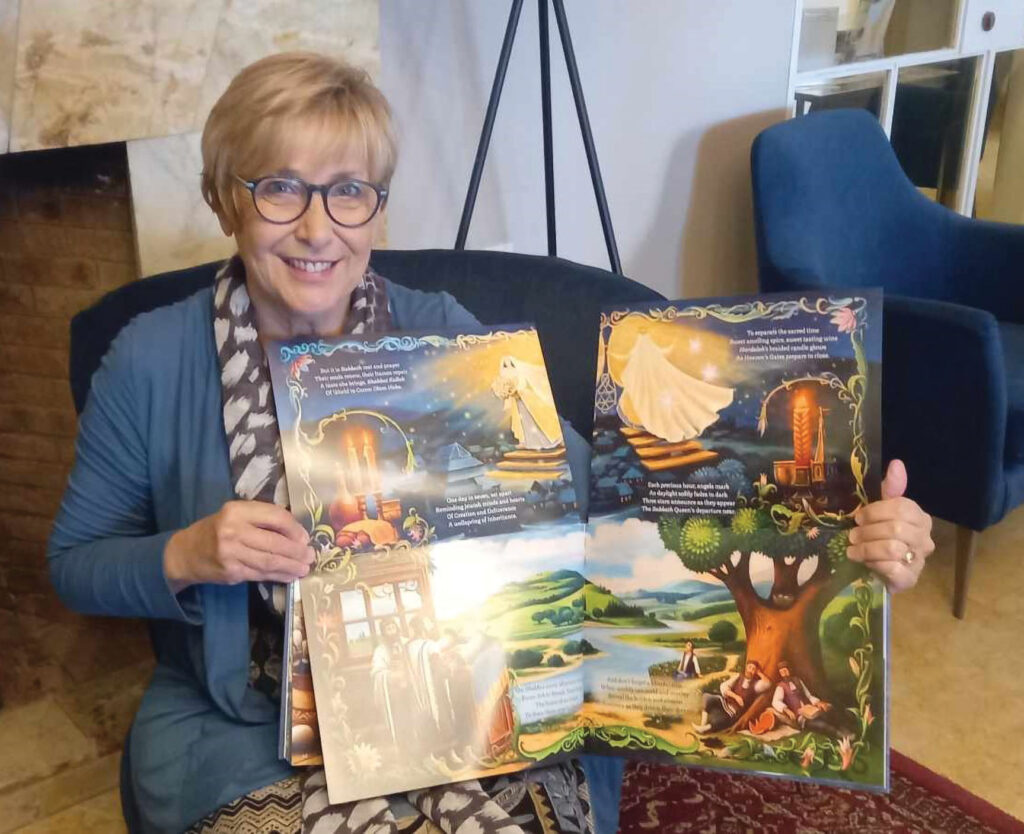
This is a story about a magnificently illustrated picture book, for both children and adults, inspired by a breathtakingly beautiful painted ceiling of a synagogue in Gwoździec, Poland, destroyed during WWI, and about the book’s author, Wanda Peretz, who is a storyteller, an artist, a creator of ceremonial textile art (Torah mantles, challah covers and wedding canopies) and educational murals and activity projects celebrating Jewish holidays, and a scenery designer for schools and children’s musical theater.
It is also about the original creation and then recreation of the synagogue and its exquisite ceiling, and about Peretz’s dedication, over ten years, to bring to fruition a celebration of that work of spiritual art in this deeply meaningful book, titled, simply, “The Ceiling.”
The history: In 1914, inebriated Russian soldiers set fire to Gwoździec’s “Old Synagogue,” reducing it—and the entire town three days earlier—to ashes. A description of this event is found in the Gwoździec Yizkor Book. All the other hundreds of shuls in Poland were destroyed by the Nazis during WWII.
For over 180 years, the tent-shaped cupola of this synagogue had been adorned by the resplendent artwork of Israel ben Mordechai Lisnicki and Isaac ben Yehuda Lieb HaCohen, who left their names, their lineage, the name of their hometown Jaryczów, and quotes from the Prophet Isaiah on two prominent signature medallions in the ceiling.
The fact that we have any record of all of this synagogue and its magnificent ceiling and bima, is thanks to the fact that between 1910 and 1913, photographer-artist Alois Breyer meticulously documented the synagogue’s interior and exterior. Today, these images are safeguarded in the Archives of the Tel Aviv Museum of Art. With the Museum’s permission, they grace the front and back inside covers of Peretz’s book, serving as poignant “endpapers” of what was lost.
Peretz pays homage to this synagogue, imagining also the artistic creation of its ceiling, via an enchanting Story-poem written by her, and the richly colored illustrations of Israeli artist Boris Shapiro, who is known for his paintings showing 17th century everyday shtetl life, often with a fantastical approach, that were influenced by the Dutch master, Peter Bruegel. Shapiro, who made aliya from the FSU in 1991, has had solo and group exhibitions in Israel, America and throughout the world.
For seven years, Wanda immersed herself in studying the Lost Wooden Synagogues of the Polish-Lithuanian Commonwealth, focusing on the masterful artwork that once adorned the prayer halls. Her dream and implementation of the book spanned a decade.
That’s quite a mouthful for what began as an invitation to the launch of the book “The Ceiling” at the ANU Museum in Tel Aviv (previously Museum of the Diaspora), an event I could not attend. But, as Wanda will be the first to tell you, there are no coincidences in life, so it should not surprise me that several days later, rather than settling for a Zoom interview, an unexpected change in schedule enabled me to respond to Wanda’s request to meet face to face in Jerusalem, on Shushan Purim.
There is also a back story of how this non-Jewish woman came to meet her Jewish husband and eventually convert to Judaism (though her interest in Judaism began long before she met him, when she was only a child) and her spiritual journey. Her Hebrew name is Ariella the daughter of Avraham and Sarah. “Ariella” means “lioness of God,” because, says Wanda, “If I was going to be part of the Jewish People, it was time to take on a new name…to be strong, stand up, be a Lioness of G-d… I want to be brave!”
Their love story is worth a book of its own.
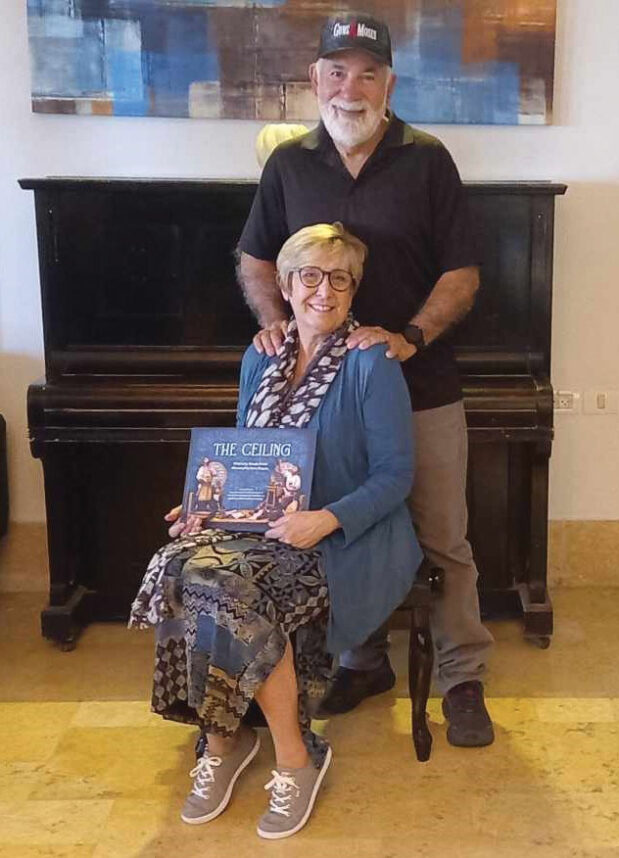
Wanda and Avi (Photo by Toby Klein Greenwald)
As Wanda carefully removes the shrink wrap from the book and excitedly lays it in front of me, but I am curious also about her background, about what led her to this project. So we will take a detour and then return to the book.
Wanda Peretz was born and raised a Presbyterian. Her father had been a commander in the U.S. Navy of diesel submarines in San Diego. When the family was stationed, due to his work, to Australia for three years, she saw the film “Fiddler on the Roof,” at the age of ten, and was spellbound. Having received the album, along with many other musical theater albums, from her grandmother, she learned all the songs by heart. “And I knew I had to have fringes [tzitziot], so I got my mom’s ski cap, which had long yarn fringes. And my dad’s little costume play beard. And we would perform the musical numbers. That was my beginning in musical theater, and I’ve designed probably three children’s theater sets of ‘Fiddler on the Roof.’
“Fiddler was my first introduction into my brain, into my databanks of these images, whether I was aware of them or not… And all my boyfriends were Jewish when I was growing up. When I finally told my parents that I’m converting to Judaism, they’re were like, well, we’re really not surprised.
“In my adulthood, I loved going to church. I loved doing the Bible studies with the women’s group, and I was very involved. But at some point, I came to a realization. I’d been raised that if you believe this certain thing, you’re going to heaven and everybody else is going to hell. And it didn’t make sense to me…. I thought, God isn’t that small.”
She started exploring new age ideas, and past life regressions, and arrived at the belief that, “This is not my only lifetime. I believe that still. I can’t prove it.” Then she heard about the concept of “gilgul” in Kabbala, and thought, “Judaism has room for all of my beliefs. But the thought of converting was not in my brain.”
At 19, she married (a non-Jewish man), had two boys, and after seven years they divorced.
Meanwhile, her husband Avi Peretz, who accompanied her on this trip (and met me with a big smile and a baseball cap with the slogan “Guns and Moses”), had his own story to tell.
His father was Moroccan, born and raised in Casablanca, and came to Israel in 1945. “My mom was from Canada. When the State of Israel was formed, she, along with so many other American and Canadian Jews, took buses to New York and boats to Haifa. My father was a policeman. She met him when she asked for directions. 30 days later they’re married.” His older sister was born in Jaffa, but then his mother wanted to move back to Canada, where he was born. “When I was six years old, my parents moved to L.A. and that’s where I grew up.”
Avi also married, adopted his wife’s son, to whom he is still close, and divorced.
Wanda and Avi met 35 years ago at a new age, self-realization retreat called “LifeSpring.”
Avi says, “I had been very much estranged from my Jewish world, though I was very much a Zionist. I was Israeli infused because of my parents, but the Judaism part after the age of 16, 17, it was like, okay, that’s enough.” So he was fine with Wanda not being Jewish.
He was enchanted by her bubbly personality, which jived with his own. And, Wanda says, “My parents really loved him. And my dad, who’s a very committed Christian, and my mother as well, he loved that he had this Jewish man who he could ask any questions of and nobody was trying to convert anybody or save anybody’s soul. So when we got married four years later, by a judge, I made my own chuppah. I wanted to smash a glass. My dad held one of the poles of our chuppah. It was looking out across Pacific Palisades, which is now burnt down.”
They married in March, 1994. In September, Avi said, “Let’s go on a trip. Would you like to go to Israel?” She said, “Sure, that sounds great.”
They made reservations. “And I thought, we’ll plan it so we’re staying at a kibbutz guest house – Shfa’im — on the Mediterranean, just north of Tel Aviv, and we’ll go to the beach on Yom Kippur,” says Avi. “So Yom Kippur comes, we get to Sh’faim, we check in and Wanda tells me, ‘You know, I’ve read that they’re having services here tomorrow for Yom Kippur.’
“So I said, ‘Yeah, that’s great; we’re going to be at the beach.’ And she says, ‘I think we should go to the services.’ So I say ‘No, you’ve never even been to services. You don’t even know what they are. Let me tell you, it’s brutal.’
“And she says, ‘I think we should go.’
“Now, one of the lessons that I learned from my first marriage is that just putting my foot down, period, doesn’t always work. So I said, ‘Okay, I guess I’ll go.’ It was sponsored and run by Chabad.
“So I go. The machsor doesn’t have English. It doesn’t even have nekudot (vowel dots). So I’m completely lost. I’m sitting with the guys. And she’s in the back with the women and they’re having just a grand old time.”
Wanda: “They totally welcomed me in. They made sure I had a prayer book that had the English as well. And they’re like, ‘This is what we’re saying right now.’… It was so much fun.”
“The time came to leave Israel. We’re headed back,” says Avi. “When we got married, we decided she’d had her two kids, I had my adopted son who was like a son, so we had three boys, so it was like, OK, no kids. We’re driving to the airport and Wanda says to me, ‘It’s a good thing we have a long flight because I have a couple of things I’d like to talk about.
“’One of them is I want to convert to Judaism.’
“And I said, ‘Do not think of converting to Judaism in the afterglow of your first trip to Israel. Come back to L.A. Wait a little bit, you know, like maybe five or 10 years.’
“I said, she can still do all the things she enjoys about Judaism, like Shabbat, and going to shul. But Wanda revealed, ‘I checked before we left for Israel and the conversion classes start at the University of Judaism next Wednesday. And they want you to go also.’”
Wanda picks up the story thread. “It was the University of Judaism where I first took the conversion course. Rabbi Neal Weinberg, who is Conservative, ran the Judith and Louis Miller conversion introduction to Judaism in L.A. I’m like, ‘I really want to embrace Judaism,’” she said to Avi.
“And oh, one more thing. ‘There’s a little girl who wants to come through. She wants to be born. Do you mind if we get pregnant?’
“Two years later,” says Wanda, “I completed my conversion course, went to the Beit Din, went into the mikvah eight months pregnant, and Rabbi Neal Weinberg married us in our living room in Pacific Palisades.” She took the Hebrew name Ariella bat (the daughter of) Avraham and Sarah for herself. “Ariella” means “lioness of God,” because, says Wanda, “If I was going to be part of the Jewish People, it was time to be strong, stand up, be a Lioness of God… I want to be brave!”
Six weeks later she gave birth to a baby daughter, Emma, “Eliana Shulamit.”
Avi: “So Wanda is in conversion and I had to go to the classes. All of a sudden I started learning Judaism from an adult’s perspective and I embraced it. I felt like I went through my own conversion and I wasn’t particularly happy about it, to say the least, and ended up being very deeply connected with synagogue life. I ended up being the president of a thousand family Conservative synagogue in LA, Temple Beth Am.”
They put their daughter, Emma, into a Jewish day school, which was far away from the Palisades, where they lived, so they moved into a Jewish neighborhood, the Beverlywood neighborhood, the Pico Robertson neighborhood of LA, “Which was absolutely delightful,” says Avi.
Wanda adds that before that, they belonged to the Reconstructionist synagogue in Pacific Palisades for two and a half years after she converted.
“While we’re at Kehillat Israel, the Reconstructionist synagogue, Emma is in preschool there. All of my Jewish life and creativity has been focused on Emma and her classmates and her friends and the Havura and the other parents that we gathered in a very tight group.
“Two of the parents died during our time there, each from cancer, one, a dad and one, a mom, a very close friend of mine. This is our group. The thing about moving to Scottsdale, Arizona [where they live now], and even though we joined two shuls there, the Conservative and the modern Orthodox one, I’ll never have that same group.
“That was two decades of time in Los Angeles that we were really connected. And everybody at Temple Beth Am knows who Wanda Peretz is because she does all the set designs and decorations for a decade. Even after our daughter left Pressman Academy, I was still doing sets for the musicals.”
She shows me the photo of a gorgeous mural that she painted in 2001 for the Pacific Palisades shul’s early childhood center. “This mural was the culmination of everything I learned in my ‘Judaism by Choice’ class.” She points out the artistic elements of the holidays, the Ushpizin on Succot, biblical characters, the numbers of S’firat HaOmer going through Yom Hashoah, Yom Hazikaron, Yom Hatzma’ut, “all the way up to Shavuot. I put myself in as Ruth. Eventually they painted over it, but they used this as a teaching tool for 16 years.”
Avi: “Five years ago, Wanda ran into someone, just chatting, a younger person, about 30 years old. He said, ‘That’s how I learned about the cycle of the holidays.’”
Wanda: “We were always taking classes. You’re always learning the next level of those little intricate details that nobody ever told you about at first, you learn more and more about the holidays and what the food means and what everything’s representing. And if you throw in a couple of Kabbalah classes, it’s like, okay, I’m not a male and I wasn’t even 40. But I love it because Kabbalah totally is like, I’m there. And Shabbat is always in the middle.” She points to the glowing Hebrew letters at the center of the mural. “So this says Shabbat Shalom.”
Avi: “When Wanda was converting, we lived in the Palisades, which a month and a half, two months ago, burned down to the ground… And Rabbi Weinberg had said, ‘You have to join and go to whatever your local shul is.’ And that’s part of the process.
“Wanda tells me there’s a synagogue here in the Palisades. It’s Reconstructionist. I’d never heard of Reconstructionism. So I said, ‘I don’t think it’s Reconstructionist. It’s probably Conservative.’ She says, ‘Well, you might be right, but here’s their card. And it says Reconstructionist.’ So I go, okay, so what is it? And to me, it was to the left of Reform.
“But it was interesting to me. They had a female rabbi, and Rabbi Steven Carr Reuben, the senior rabbi, played guitar on Friday night.
Wanda: “I had to have a sponsoring rabbi. So Rabbi Carr Reuben and Cantor Chayim Frenkel of that synagogue became my sponsoring rabbi and cantor.”
Avi: “And I said to Rabbi Carr Reuben, ‘I’m so comfortable here and I’m so uncomfortable here.’
“And he told me, ’Well, that discomfort may one day lead you into going back to where you were raised, in a Conservative, almost modern Orthodox type of Judaism. But this, here, for someone who abandoned the religion for 25 years, is a good re-entry point. Look at it that way. If you end up going past us, it’s okay. You know, we’re here to make sure that there’s something for everyone who thinks of themselves as Jewish.’
“And I said, ‘Okay, that’s fair enough.’”
Wanda: “When I went in for my meeting with Rabbi Steven Carr Reuben, it was in the old synagogue building and we rebuilt it…everywhere we go, we’ve rebuilt the synagogue, we rebuilt the sanctuary…and I had decorated many different spaces to make them into sanctuaries for secondary High Holiday services.
“So we’re sitting in his little office and now I’m just talking about how do we get involved with the Reconstructionist community? And he said, ‘Hold on one moment’ and he went out and he came back with a Torah scroll with the mantle on. And he gives it to me to hold. And I’m sobbing because I feel like I’m holding a baby. I feel like I’m holding something that’s precious and real and alive. And it was that moment. It was just like, okay, I’m home. I’m home. I know. I know.
“So that was with our Reconstructionist synagogue in Pacific Palisades, but we wanted Emma to be in a Jewish day school. And Kehillat Israel only had preschool.”
Avi: “We were already upgrading our practice. We were moving past Reconstructionism. Reform clearly wasn’t going to work. It was obvious to us that the Conservative world was probably the best fit. Although Wanda did go and check with the Orthodox, the Chabad on Pico Boulevard, when our daughter was there. And they kind of said, unless you’re willing to take on the Orthodox life, it’ll be a difficult experience for your daughter, because her friends would not be permitted to eat in your home, even if it is kosher, because it might not be their level of kashrut.
“About a third of our friends are Orthodox and two thirds are Conservative. That’s how I returned. My parents, my God, my parents were so happy.
“And we have a funny story. It was during the first four years of our being together. My dad was beginning to suffer from Alzheimer’s, and I kind of wasn’t believing it. And I remember driving with him, and him telling me, ‘You know, I really want you to marry Wanda.’ And the only thought that went through my head was, Oh my God, the Alzheimer’s must be worse than I think, because he’s forgotten that she’s not Jewish. So this story is now family lore that somehow in his pre-Alzheimer state, he already saw what I didn’t see, what I couldn’t see, that here we end up He died, just as Wanda got pregnant.”
Wanda: “And Emma would go over to his photographs and talk to him. When she was two years, three years old. And she’d never met him. He died before she was born. She’s talking to the picture.”
Avi: “And we had photographs of my mother and of Wanda’s parents and others. But she would be sitting there having these three-year-old conversations only with the picture of my father.”
Wanda: “During the 10 years that I’ve been obsessed with “The Ceiling,” I wanted to join a Torah observant women’s creative writing group. And during the one-hour pre-interview with the teacher, she said, “I love talking to you. I’ve looked you up online. I see that you do Jewish artwork, but you can’t be a part of my group because you’re not a Torah observant Jew. And my group of women are Torah observant, and I have to have that ‘fence’ around them… ‘I said, ‘That is so sweet. And I so admire that, and understand it.’ I told her that in the last year or so I had realized I was not a Jew, but that I had chosen Judaism as my spiritual path, and I was now calling myself a “sojourner” with the Jewish people, and that I loved the Jewish people. As a result of that one-hour interview, she ended up creating a second group called “Lamp Lighters” for Jewish women and “sojourners” who were not Torah-observant.
“And I got off the phone call, and I felt, I have to up my conversion, because now I do like my version of Judaism. Apparently, that’s not Hashem’s version of Judaism. Our version of observing Shabbat is having a lovely big meal, and people over, and lighting candles, and doing the hand-washing. And Avi doesn’t sing Eshet Chayil, because I’m not comfortable with Eshet Chayil. I don’t want to be an Eshet Chayil. I have a resistance to that.”
(“Well, you are,” I kind of whisper.)
“He reads a poem by Rabbi Naomi Levy Eshman. We also helped start their Nashuva group. And my daughter, when she was with us for Shabbat dinner, I knew this is all going into her programming, her computer banks….” Emma today is almost 29.
Avi: “Wanda’s journey is all about upgrading. She’s been talking about Orthodox conversion in various stages for the last 15 years. The creative writing teacher not accepting her to a group of Torah-observant women — that actually elevated her view of the Orthodox conversion. We’ve been together 35 years. I know her, that she’s absolutely heading in that direction. All I think about is, what does it mean for me? Oh my God.”
How the book came to be
Wanda’s excitement is palpable as she opens it.
She doesn’t believe in coincidences. She shared the following story at her book launch, and with me.
In 2001, she “wandered into a pop-up gallery in Beverly Hills” featuring artists from Israel, after dropping off their daughter in preschool. She fell in love with Boris Shapiro’s painting, Eishet Chayil. Calling Avi at his office, he balked and said a flat no to the $6,000 price tag. “But Eishet Chayil was calling to my soul. I went home and gathered every dollar I had for emergencies, emptied my personal savings account, even called my mom…I returned with $2,600 in cash and placed it on the counter, saying, ‘This is what I have. For that painting. Please.’
“In the painting is a Yiddish woman with a head covering, and she’s in the shtetl, and she’s holding lines that have laundry and cooking pots, and she’s got a baby carriage and a chicken at her feet, and her husband’s floating above her head, like Chagall, reading a book and sipping a cup of tea. And one of those lines is just gently looped around his ankle, so he cannot fly away.
“The art dealer, a bearded man wearing a kippah and wire-rimmed glasses, looked down at the pile of bills, then up at me. He took a deep breath and nodded. ‘Yud Hey Vav Hey,’ he said…” She didn’t understand the language, though she could draw Hebrew letters. “He said, ‘Twenty-six is the numerical value of “Yud Hey Vav Hey,” – the name of God – I will sell you the painting for $2,600.’”
One year later, Wanda met Boris, “by chance,” when she and her husband Avi were staying at the King David Hotel and Boris stopped by at the art gallery, that was showing his work. It was then that she purchased another painting by him, this one of Noah. Later, she confided to me over lunch, “I bought Noah, and now I realize it was because I also struggle with whether I should just be a Noahide and follow the Noahide laws [as she has not yet undergone an Orthodox conversion], which are said to be seven, but they go into like 33 specific ones, like, it’s not just that you don’t steal. You also don’t steal someone’s good name…So I can be a Noahide. I’m golden, I’m good, because that’s not being a Christian, but saying I came from the line of Noah, I’m a good human being, I’m from among the righteous nations.
“Or I get to do the extra work. I have to learn Hebrew. I can do it. I want to observe Shabbat properly. Keep kosher properly. All 613 commandments. Okay, I know some of those are for when the Temple is rebuilt, and I don’t have to worry about those, or about the ones that are for the guys.” She smiles, “I don’t have to worry about family purity anymore (since I just turned 64). So this could actually be easier than if I had done it earlier.
“I think it’s fascinating that the two paintings that I bought back then were Eshet Chayil, which is an Orthodox Torah observant woman in a shtetl, and Noah.”
Years passed, and in 2014, “On a whim, I signed up for an adult Jewish art class called ‘Reclaiming Wonder.’ There, I saw photographs of Polish wooden synagogues and their decorated prayer halls for the first time. I was captivated – and became obsessed really – with the animals, flowers and Hebrew calligraphy.”
Meanwhile, “Across the world, the reconstructed ceiling of the Gwoździec synagogue was being installed as the centerpiece of the POLIN Museum in Warsaw.”
Two years later, they stood beneath it and Wanda says she was, “Overwhelmed. Waves of goosebumps flood through me, and tears streamed down my cheeks.” Checking later in the POLIN museum bookstore, she searched for, and could not find, an illustrated children’s book on those synagogues. “They had none. How could that be?” she thought. And then made the decision. “I will write this book.”
Avi: “She starts showing me all of this research that she’s doing and I told her, you know, Wanda, Jews don’t know about this. When the Jews of today think about Poland, they think about death. They think about the Holocaust.”
Wanda discovered the names of the artists of the ceiling in that shul – Israel ben Mordechai Lisnicki and Isaac ben Yehuda Lieb HaCohen. “They visited me in dreams. I wrote rambling stories, gave them a crew of men with Yiddish names. A cart. A donkey named Mathilde. Storylines flooded my mind.”
And from that emerged her Story-poem. But she still sought a partner, an artist. And she remembered Boris and contacted him. “For seven years, we worked together…communicating only in written English,” never being in the same room, or even speaking on the phone. They sent sketches and painting back and forth across the ocean.
And then she discovered that Boris was from Lvov, in the Former Soviet Union, “the same province that both Israel and Isaac engraved in their signature medallions 300 years ago, when Lvov was part of the Polish-Lithuanian Commonwealth. Three artists, born within miles of each other, three centuries apart. A coincidence?” she asks. “Or the hand of God?”
Wanda points out another string of coincidences. On March 12, the same date that she had met Avi 35 years earlier, the same date on which she and Avi were married (in a civil ceremony, by a judge) in 1994, and the same date they were remarried, by a rabbi, in 1996, after her conversion, was the date in 2025 that the launch of “The Ceiling” was held at the ANU Museum, which included the presence of Magdalena Kukula, Head of Communications and Public Diplomacy from the Polish Embassy in Tel Aviv.
The recreation of the shul and ceiling on which the book is based was accomplished due to the imagination and perseverance of Rick and Laura Brown of Handshouse Studio, and their team of artists and students, as the centerpiece exhibition for the POLIN Museum of the History of the Polish Jews in Warsaw, Poland.
But how could they recreate a magnificently colored ceiling, subsequently replicated by Shapiro in Peretz’s book, if all they had to work with were sepia photos taken, thankfully (the only record of any shul ceiling in Poland from those years) between 1910 and 1913, by photographer and artist Alois Breyer, who documented the synagogue’s interior and exterior?
There is only one, small color study called the Breier. Using that as their Rosetta Stone, the Browns slowly build a library of Gwoździec’s colors.
Wanda speaks animatedly about the details in the ceiling, that include, in addition to Jewish symbols and verses and designs drawn from nature, Torah, and Talmudic stories, the signs of the zodiac, familiar, unusual, and some mythical animals, griffins (not cherubs) flanking the two Tablets of Law, a North American turkey (!), elephants (had they even seen elephants in Poland then?), and a back-facing deer. Wanda says, “Like in the Zohar.” Her interpretation is, ”This means ‘Don’t forget us. Turn back and look at us. Do not forget your people.’
“Look at the bear with the Tree of Life just exploding out of the bear…it’s like there’s life and babies and reproduction and the constant flowing of life. There’s a unicorn and a lion tussling. And the unicorn and the lion are on the royal standard of Britain’s royalty.
“This is for ‘strong as a lion and bold as a leopard.’ And this is Yaakov, who knows the key to everything is being present. Hineni. And there’s Noah’s Ark. Here are the righteous Gentiles of the nation. So this is not just for Jewish people. This is for everyone who is fascinated with being creative and making a contribution and making the world a more beautiful place.
”And Boris captures the vibrant world of Eastern European Jewish heritage.”
All of these breathtaking images illustrate the storyline itself, in which these two artists come from their home village of Jaryczów to Gwoździec to paint the synagogue ceiling and bima in the late 1720s. Wanda explains in her introduction that the Jewish community “most likely used non-Jewish timber workers, who modified the prayer halls’ original barrel-vaulted ceiling that dated back to 1640.” She did research to describe the paint preparation process that Israel and Isaac would have used, and in the Story-poem itself is embedded the description of their work, and how the Jewish community took care of their meals and lodging, all of them resting together to observe and celebrate Shabbat.
One of the verses includes both hope and a strong dose of reality, for when was it ever easy for the Jews?
A local resident (perhaps a rabbi, based on his clothing) says,
“Your work, when finished, must convey
Wonder…awe…for those who pray!
Shine hope to help dispel the fear
We sadly must acknowledge here.”
(I shudder a bit as I type those words, having just returned to my computer after spending ten minutes in our downstairs safe room, following a siren signaling an airborne “visit” from the Houthis.)
Both the Story-poem and the illustrations describe the artistic process, clearly a labor of love.
Women are present throughout. Cooking, baking (it was after all a traditional society) and Wanda says she insisted that every page that included children must include a little girl. Sometimes the children are helping by carrying water or in other ways, and we see them peeking curiously around the bedroom door at the sleeping artists. There are also whimsical squirrels near the brushes and paints. We see the community in the summer and in the snow.
The verse she writes on the Hineni page, as the poem continues to describe the process of the artists, is:
What is their secret hidden key?
Remaining present: Hineini
Like lions strong! Like leopards bold!
So swift the imagery unfolds!
I ask, “So since it was all photographed in sepia, how did they know what the colors were?”
Wanda: “Because there are a couple of oil paintings done by Isidor Kaufmann in 1898. This one is Portal of the Rabbi. We used that as our basis for the colors in the book.”
On the page where Shabbat is leaving, there is a lady in a flowy white gown. “The three stars of Havdalah are her attendants. They move around her, and they escort her out through a gate of heaven. And then the gate of heaven closes for another seven days,” says Wanda.
“And all these (she gestures to the landscape pages) are the Carpathian Mountains and the rolling hills in the Ukraine and the Soviet Union that are so beautiful. This is what Boris probably idealized a bit, but this is what he grew up looking at outside of the city. So it’s all connected, all connected.
“And then a week before this went to print, I’m working with the wonderful graphic designer, Irit Harel, and I said there have to be three blessings. We have the Traveler’s Prayer. We have “Poteach et Yedecha.” (“Open your hand and satisfy the desire of every living thing.”) We need a Shehecheyanu.
“So she just said, no problem. Two seconds later, we have a Shehecheyanu flowing across the page.
“Here’s the rabbi. The musicians are playing Klezmer music. They’re going to have a party afterwards. This isn’t Shabbat. It’s not a yom tov. It’s just them saying the ceiling and the bima are complete. Everyone, come in, come in, and look at the ceiling. The joy!”
The creative artistic process
Wanda says to me, “I want to share with you the process that Boris and I went through. We don’t speak a common language. We already established that in 2002 during the second intifada when we met and we were both young.
“I contacted him 16 years later and I said, ‘I’ve written this poem. I really want to do a beautiful, beautiful book that people will want to have on their coffee tables. Have you ever illustrated anything for children?’ I didn’t know about all the children’s books he’s illustrated for Chabad, and they’re amazing. He does spiritual concepts in children’s illustrations that children will look at and say, ‘Oh. I get it!’
“I sent him descriptions. And he started sending me these sketches and I made comments on them.” She opened a portfolio of their working file, including changes Boris had made based on Wanda’s requests.
Avi adds, “Boris, when he was a young man, was in the red army. At 18. And you know what they had him doing? Painting portraits of generals. Boris said, ‘I had a lot of business.’”
Wanda: “I kept sketching and sketching. This is how they did the lighting… and this is when they read the Torah there’s a line inside the wooden bima in Hebrew calligraphy that says ‘Behold I make aliyah when I read from the Torah’ and I’m connecting the Shekhinah to Hashem, like that’s what’s happening metaphysically when they read from the Torah… the whole square room is 36 feet from top to bottom…and there’s a lattice, a circle that leads to the inside of an attic. It’s not a window to the outside world; it’s where the Shekhinah looks in.
“There’s a whole thing about lattices in wooden synagogues and in other synagogues; there’s always a lattice because it’s like, Who is watching my every word? Who knows my thoughts? Who knows the actions I’m taking? The Shekhinah is always there.”
Wanda shows me some sketches she has planned for a future coloring book. “We’re going to make it much more affordable.” They invested a great deal in this hard-copy book, and made 1000 copies. It is of the highest quality, with thick chrome pages, gorgeous color and exquisite printing and production level.
Avi: “It was a labor of love, for her primarily, but really for both of us, as well as to say, this needs to come into being.” They had Jerusalem Fine Arts (known to be the best) prepare the pages, “And they told us, ‘You know, if you print it in China it’ll be a fraction of the price’ and we said no, only in Israel.” It was printed at A.R. Printers in Tel Aviv. It was recently submitted to the National Library of Israel and is already catalogued in the Tel Aviv Museum of Art Library.
As Wanda said at her launch, “’The Ceiling’ has been my special assignment – to describe these artists, to celebrate their work, to bring a moment of Jewish life in Poland back to life…It is my gift to my entire Jewish family, to allow them to see beauty and love of life in centuries of extraordinary Jewish presence in Poland and surrounding areas. Those incredible Jewish souls deserve our recognition and acknowledgement.”
The story ends (spoiler!) in a magnificent spread over two pages, with the line flowing across the heavens, from the Traveler’s Prayer, in Hebrew, “And return us to our home in peace” and the words:
The Ceiling can be ordered and shipped from the author with a personalized Thank You letter for a 100% tax-deductible of $180 donation to JewishGen-erosity’s Yizkor Book Project. https://www.wandaperetzauthor.com/landing/
Toby Klein Greenwald is an award-winning journalist and theater director, and the editor-in-chief of WholeFamily.com.
This past winter, Sinai Temple hosted a basketball team consisting of teenagers from the destroyed kibbutzim on the Gaza border.
After they attended a Laker game, I told them they would attend Shabbat services.
They responded, “Rabbi, we are secular, we don’t do synagogue.”
That Shabbat, the team reluctantly arrived in t-shirts and shorts and refused to enter the sanctuary. After gentle urging by host families, I watched as they gradually opened prayer books and recited the Shema. At the conclusion of services, the entire team led the congregation in Am Yisrael Chai.
When they returned to Israel, I received a note from a mother that read, “My son wants to thank all the amazing open minded religious people he met.”
In other words, this mother was acknowledging the radical center of Judaism we provided, a place where all Jews can express their Judaism in a pluralistic manner and develop a deep bond between Israel and the Diaspora.
This is a common sentiment when Israelis attend Conservative synagogues in America for the first time.
Sinai Temple is a proud participant in the shinshin program, where recent high school graduates defer a year of IDF service and teach Diaspora Jews about Israel.
However, the surprise to the shinshin is how they learn more about their Judaism in Los Angeles then they do in the land of Israel.
One day our shinshin came to the clergy and asked, “How can I have a bat mitzvah just like the girls I see wearing a tallit and chanting from the Torah?” Before she left, that is exactly what she had.
Israel has much to teach the Jews of Diaspora. Yet there is one lesson that the Diaspora continues to teach the Jews of Israel: the fact that we can respect our religious differences while keeping our common beliefs; that we can have unity without uniformity. Indeed, when Herzl gathered the first World Zionist Congress, a diversity of Zionists filled the room.
In 2007, as a rabbinical student in Jerusalem at Machon Schechter, I volunteered in the Masorti special needs bnai mitzvah program. One child was nonverbal and spoke through an electronic keyboard, one child was confined to a wheelchair and another child was deaf. Over that year of study, no one asked if they were Orthodox, Conservative or Reform. All we asked was: “What would it take to ensure they had a meaningful simcha like any other child?”
We faced many hurdles as we drew closer to the ceremony. More observant families were not accustomed to egalitarianism, and secular families were not familiar with synagogue ritual.
Yet, that day will forever be etched in my mind, created by the radical center of religious pluralism.
Each family attended. Each child had a bar and bat mitzvah according to their needs, and all of us together held hands, shed a tear, and danced the hora.
These stories are a few of many that happen every single day in the land of Israel. They are not plastered on social media, but they change innumerable lives for the better and ultimately inspire the next generation of Jews in Israel to be deeply connected to the land, to God, and to Jews around the world.
Our world is divided. Right and left, Jewish and not Jewish, religious and secular.
Some may give up hope, but a strong radical center of Judaism enables us to reach out into both directions, accept multiple truths, and say, “Yes, you are right, and I am right too! We can do this together!”
I am not an Israeli citizen, and I have never enlisted in the IDF.
I am a Diaspora rabbi who deeply cares about the future of the Jewish people. That is why I commit myself to preserve religious pluralism in Israel, so that my children will feel as Jewishly comfortable in Haifa, Eilat, and Jerusalem as they do in Los Angeles.
However, I am a Zionist, I am a Jew, and I am a Diaspora rabbi who deeply cares about the future of the Jewish people. That is why I commit myself to preserve religious pluralism in Israel, so that my children will feel as Jewishly comfortable in Haifa, Eilat, and Jerusalem as they do in Los Angeles; so that athletes in Eshkol and special needs students in Jerusalem will understand that we are am echad, one nation of Jews.
This year, I am honored to vote in the World Zionist Congress elections, where you too can continue Herzl’s tradition from 137 years ago and ensure the religious center of Judaism will continue to thrive for generations to come.
Am Yisrael Chai.
Rabbi Erez Sherman is Senior Rabbi of Sinai Temple and is running on the Mercaz slate in the World Zionist Congress elections.