fbpx

April 16, 2025

The Unexpected Guest at a Painted Passover in Jerusalem

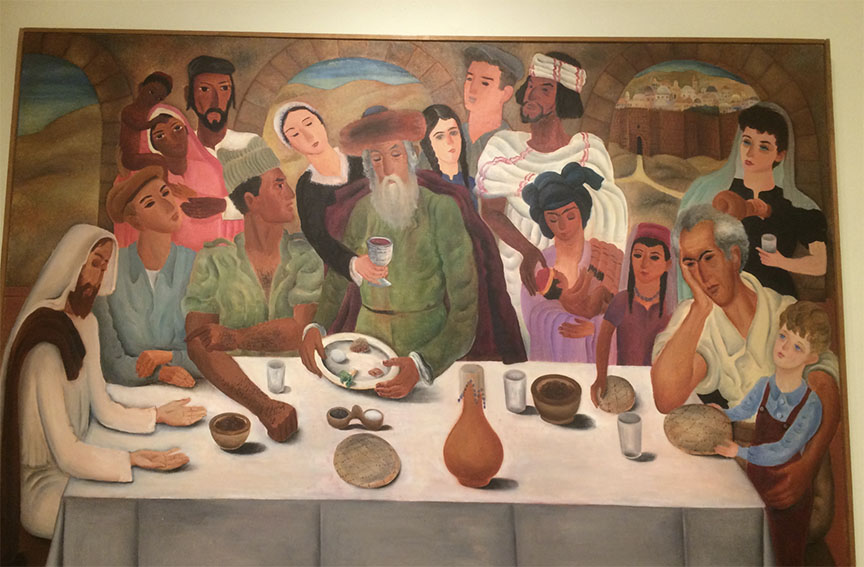
Reuven Rubin’s 1950 painting “First Seder in Jerusalem” at first glance seems like a simple but moving representation of a diverse group of Jews at a Passover table. There are secular-looking kibbutzniks, a Hasidic rabbi, two IDF-uniform wearing soldiers, immigrants from Africa, and a young Haredi boy with sidelocks. But at second glance, one notices what makes the assembled group really diverse. Seated to the left, with his palms turned upwards, is, yes, Jesus.

Rubin, né Zelicovici, was born in Romania in 1893, and would later serve as the nascent Jewish state’s first ambassador there. As a child, he demonstrated a precocious artistic ability and at age eighteen the local Zionist leader Dr. Adolf Stander sponsored his studies at the Bezalel school of art in Jerusalem. But, upset at being assigned to an ivory carving workshop, Rubin dropped out and continued his artistic studies in France before returning to Romania. In 1923, he returned to Mandatory Palestine where, five years later, returning from one of his art shows in New York, he met his wife Esther, a young woman from the Bronx who had won a free trip to Palestine in a Young Judea competition. 

Two years after Israel’s founding, Rubin painted “First Seder in Jerusalem,” inspired by the hope and potential of the developing Promised Land. It is steeped in symbolism. Jerusalem’s Old City walls can be seen through the windows. The white-haired figure embracing his son on the right is the artist himself. Behind him stands Esther, pouring some wine. And as even lay art historians might notice, the figures are positioned to mirror Leonardo da Vinci’s “The Last Supper.” That famous image depicts Jesus with his disciples, the evening before his execution by the Romans.

As Tsvi Sadan writes in “Flesh of Our Flesh: Jesus of Nazareth in Zionist Thought,” the revival of the modern Jewish state negated nearly two millennia of Christian thinking that the Jews had been supplanted on the stage of history. Rubin is therefore purposely playing off of the most famous rendering of Jesus’s Paschal meal. As the art historian Gabriel Goldstein has suggested, “the inclusion of the resurrected Jesus is to remind the world that the Jewish people also suffered and died but yet rose again to life in their own land. Rubin’s title stands in contrast to da Vinci’s – this is a first Seder not a last supper.” 

The dreamlike aura in the image is no accident. “The peaceful scene,” Goldstein continues, “is just a dream of a peaceful future that has not yet arrived,” an impression strengthened by Rubin’s rendering of himself resting on his hand, staring as if unaware of the others at the table, lost in thought. 

Rubin’s painting emerged from the modern-day exodus of Jews from across the globe to build the new state and their stunning defeat of surrounding Arab armies, the Pharaonic forces of their day. As the Rubin Museum curator Carmela Rubin has noted, “the exceptional new reality demanded a didactic mode of expression, one that would elevate his narrative beyond the reality of mundane existence.” 

Alas, the full realization of Reuven Rubin’s dream has not yet materialized. Social fissures in Israel and antisemitism worldwide have pushed off the peace of mind, and of Jerusalem, that Rubin hoped for. But the chords of Jewish unity remain strong despite challenges. And Christian Zionists are among the leading supporters of Israel in its fight against those who seek its destruction, with millions offering not supersessionism but support for their Jewish friends. 

Rubin’s image, then, is perhaps the perfect painting for our moment, a reminder of how close we are to meriting that era of ultimate redemption the Haggadah hopes for – perhaps even next year, in Jerusalem.


Rabbi Dr. Stuart Halpern is Senior Adviser to the Provost of Yeshiva University and Deputy Director of Y.U.’s Straus Center for Torah and Western Thought. His books include “The Promise of Liberty: A Passover Haggada,” which examines the Exodus story’s impact on the United States, “Esther in America,” “Gleanings: Reflections on Ruth” and “Proclaim Liberty Throughout the Land: The Hebrew Bible in the United States.”

The Unexpected Guest at a Painted Passover in Jerusalem Read More »

Easing the Pain of Betrayal

Two recent speakers at Shabbat services talked movingly about having their hearts broken by organizations that betrayed them.

The first had been a leader of a group safeguarding abortion rights. But following the Oct. 7 massacre, her coworkers decided that vilifying Israel, and those who defend it, was a worthier goal. While their mandate was to protect a woman’s dignity and agency, they willfully ignored what happened to women in Israel that terrible day. Obviously, they cared more about validating their “progressive” credentials than about their purported cause. She spoke about being one of many Jews who was distraught to find herself no longer comfortable being part of a once beloved organization. 

The other speaker was a prominent author who has proudly supported a national lobbying association devoted to preserving free speech, decrying book-banning, and the like. But soon after the massacre, they came out for boycotting Israeli writers and the “Zionists” who endorsed them. Protecting the First Amendment and advocating for all writers, it turned out, was secondary to admonishing Israel. As in the first case, he was deeply distressed to witness former colleagues jumping on the bandwagon of Jew-hatred. 

Alas, many of us can tell similar tales. But if we celebrate those who are using their public platforms to denounce antisemitism, while distracting ourselves on occasion with whatever brings us joy, it might just help stanch the pain of betrayal.

All I knew about Congressman Ritchie Torres, Democrat from the South Bronx, was that he was a member of the “Progressive Caucus,” a group whose demonization of Israel seems more important to them than protecting the environment, defending a woman’s right to choose and related causes. But Torres has been consistent in advocating for Israel, and in condemning terrorism and antisemitism.

New Jersey Senator Cory Booker, another Democratic member of Congress, has long been a stalwart in his defense of Israel. He was a co-sponsor in 2018 of the Israel Anti-Boycott Act, which, with limited backing from other Democrats, was never brought to a vote. Booker has doubled down on his pro-Israel stance after Oct. 7, writing that while he blamed Prime Minister Netanyahu for having “made ensuring true Israeli security, ending the conflict, and establishing a lasting and just peace more difficult … I support the State of Israel – its security, its flourishing, and its profound potential.” And most recently, during his historic 25-hour speech on the floor of Congress, Booker reminded us that an American, Edan Alexander, is still being held captive in Gaza.

Then there is Pennsylvania Democrat, Senator John Fetterman. I don’t know whether the rumors are true that he undermined the vice-presidential candidacy of his fellow Pennsylvanian, Governor Josh Shapiro, but he has become the conscience of his party with regard to calling out terrorists and those who enable them. Israel, and the Jewish people, have no greater supporter in Washington.

Recognizing the boldness of these righteous allies can diminish some of the sting from those who have abandoned us. Another salve comes from seeing Jews affirming their identities in the public eye.

I was thrilled watching the recent ESPN interview with Auburn men’s basketball coach, Bruce Pearl, leading up to his Final Four semifinal game against the University of Florida. Over his shoulder, for all to see, was the Israeli flag. Not at all surprising since, at a press conference earlier in the week, Pearl, a self-described ”proud Jewish-American,” focused less on basketball than on the plight of the hostages and on Israel’s fight for survival. 

Ironically, Pearl’s opposing coach, Todd Golden, is an Israeli-American, who played for Pearl at the Maccabi Games. And then you have a third Final Four coach, Duke’s Jon Scheyer, who, like Godin, played basketball in Israel and has dual U.S.-Israeli citizenship.

To top it off, Florida ultimately beat the University of Houston for the national championship, a team starring Emanuel Sharp, who was born, you guessed it, in Tel Aviv.

What a well-needed distraction from the miseries of the world!

We mustn’t let our hurt and anger rob us of all joy, or to focus so much on those who have betrayed us that we lose sight of those who have publicly supported us.


Morton Schapiro is the former president of Williams College and Northwestern University. His most recent book (with Gary Saul Morson) is “Minds Wide Shut: How the New Fundamentalisms Divide Us.”

Easing the Pain of Betrayal Read More »

Clouds Overhead, Joy Within: A Passover Morning Reflection

It was early morning on Chol Hamoed Pesach—the in-between days of Passover that carry both the freedom of the holiday and the calm of the everyday. As I woke, I made a deliberate choice to look up. The sky has always taught me things. Or at least reminded me of things that matter.

I could use some uplifting. After all, it’s a mitzvah to feel joy during the festival. So I allowed the sky to do its work.

Above me stretched a breathtaking techelet—a soft, Israeli blue, radiant and alive. Sure, scientists can explain it with atmosphere and light, but that morning it felt like something more. It was a harmony between sechel and regesh—between reason and feeling. Not money, not noise, not the day’s errands—but an inner light, a trace of G dliness.

And then I saw the clouds.

There were three distinct colors. White, grey, and black. Perhaps because it had rained during the night—and maybe again that morning—the sky was layered and textured, shifting above me. I stood still, bundled up in coat, sweaters, and wool hat (it can still be cold on Pesach here in Israel). I watched the clouds.

Three colors. Three stages. Three moods of life.

The black ones, we tend to fear. They bring cold, disruption, rain. But rain is life. The soil, the plants, even the quiet creatures underground—like the humble earthworm—all thrive from it. Even the darkness is, in its own way, a blessing.

But how can I say that to those who lived through our darkest times? To Jews in exile, to those who suffered through so many storms? Sometimes black is just… black. Pain is not always something we can explain. Still, in our tradition, we say gam zu letovah—“this too is for the good.” Not because it feels good, but because we hold on to hope.

Then come the grey clouds. The in-between. Nothing dramatic. Nothing awful. Just quiet. Maybe boring. But maybe necessary. A time to recover. To breathe. To rebuild after the storm. Even after a hurricane, people return, fix what they can, and keep going. That’s human resilience. That’s the quiet part of healing.

And finally—the white clouds. The soft ones. The moments when things begin to feel clear again. After the tension, the pressure, the traffic jams of life, there’s a shift. A new pace. A smoother path. Like sailors resetting the sails, rolling up their sleeves, and pushing on. You begin again.

Sometimes, the sky is cloudless. And even that, just being, can be holy.

To sum it up: the clouds pass. All of them.

Black, grey, white. There is always space between them. Life is like that—changing, unpredictable, rich in seasons. Some days bring challenge. Some bring quiet. And some bring light.

And if we pause long enough to look up—we might just feel it.

A whisper of presence.

A blessing in motion.

A touch of holiness on an ordinary morning.


Dr. Hayim Abramson is an educator, writer and poet whose work explores Jewish spirituality, language, and human resilience. He is the author of “Shirat HaNeshamah” (available at www.hayimabramson.com), a collection of Hebrew poetry, and his works appear in both English, Hebrew and Spanish.

Clouds Overhead, Joy Within: A Passover Morning Reflection Read More »

Witkoff No Match for Iran

When we last checked in on Trump Administration negotiator Steve Witkoff almost two months ago, he was discussing his strategy for reconciling the irreconcilable demands of the Israeli government and Hamas terrorists. Hamas insisted that Israel withdraw completely from the Gaza Strip and release all remaining Palestinian prisoners from Israeli jails. Israel’s bottom line required the end of Hamas’ control of Gaza and the exile of its leaders from the region.

Witkoff’s analysis was a striking example of understatement: “It’s hard to square that circle.”

Which it continues to be. Peace now looks further away than ever. There has been no meaningful discussion of a ceasefire for weeks and Israel now occupies a larger portion of Gaza than at any time since their 2005 withdrawal from the territory. Donald Trump has also designated Witkoff as his lead negotiator in ending the war between Russia and Ukraine, where the fighting appears to be getting more intense. As a reward for the lack of progress on both of his administration’s most important two non-tariff international challenges, Trump has now tasked his long-time business associate with brokering an agreement with Iran to cease its efforts toward developing nuclear weaponry.

This means that Witkoff, a successful realtor with no previous diplomatic experience, is now in charge of resolving conflicts in the three most highly-charged international hot spots on the planet. Neither Gaza nor Ukraine is any place for a rookie, but almost a half-century of tension, conflict and anger between the U.S. and Iran might make this one the most difficult challenge of all. Such was the setting for Witkoff’s initial meeting last weekend, which began with extremely low expectations that now seem to require even lower ones. 

Saturday’s meeting was brokered by Oman, a necessary step given the Iranians’ refusal to speak directly to Americans. Before that meeting even began, Witkoff had unilaterally conceded on a critical negotiating point by suggesting that his “red line” should be for Iran to agree not to proceed toward the production of nuclear weapons. Israel, along with Saudi Arabia and the other Arab states who have relied on the U.S. to require that Iran completely dismantle its existing nuclear program, were alarmed, as were observers in this country who had assumed the talks would proceed under that assumption. 

Witkoff’s overture may have been designed to reassure Iran’s leaders that the U.S. would enter the negotiations in good faith, but such a unilateral capitulation is more likely to embolden the mullahs to hold out for even more. Just as Vladimir Putin and Hamas’ leaders have learned, Iran will see that Witkoff can be convinced to move slowly by being given verbal reassurances without any substantive movement. Both Russia and Hamas benefit from extremely drawn-out discussions that do little to constrain their military efforts. Iran, which suffered massive defeats at Israel’s hands last fall, is now unusually vulnerable to further military incursion and would like as much time as possible to rebuild their shattered defenses. 

Based on the initial session, it’s hard to imagine how Trump’s original two-month deadline can possibly be met. Witkoff deserves credit for getting 45 minutes of face-to-face interaction with his Iranian counterpart after hours of shuttle diplomacy in which they spoke only through an Omani intermediary. But it’s worth assuming that the Iranians, like their Russian and Hamas allies, will string Witkoff along to encourage him to ask Trump for more time. Since ongoing repairs will allow Iran’s military to grow stronger every day, this buys them both additional time and enhanced protection.

For the Israelis, Saudis and other sensible people who learned long ago to assume the worst from Iran, this looks like a long, slow march toward Iranian military and economic empowerment. 

For the Israelis, Saudis and other sensible people who learned long ago to assume the worst from Iran, this looks like a long, slow march toward Iranian military and economic empowerment. It’s possible that Iran ends up with sanctions relief and a revitalized economy. More likely, they maintain a dangerous status quo. In either case, the possibility of unilateral Israeli military action grows more likely. But Witkoff’s negotiation strategy is unintentionally providing Iran with breathing room of enormous value as the regime fights for its survival.


Dan Schnur is the U.S. Politics Editor for the Jewish Journal. He teaches courses in politics, communications, and leadership at UC Berkeley, USC and Pepperdine. He hosts the monthly webinar “The Dan Schnur Political Report” for the Los Angeles World Affairs Council & Town Hall. Follow Dan’s work at www.danschnurpolitics.com.

Witkoff No Match for Iran Read More »

Woman Completes List of Passover Tasks, Drinks Four Cups of Wine Before Seder Begins

Over the years, I have seen a lot of difficult sights during Passover seders: raw shank bones that someone accidentally forgot to cook; fluffy, glorious rice that was forbidden to the Ashkenazim at the table; parents whacking children; children whacking parents; grandparents whacking their children and grandchildren (and that was just the Persian “Dayenu” ritual of weaponized scallions). 

But of all the difficult sights I have witnessed during seders, the hardest to endure was the sight of a nearly 60-year-old man who sat down at his hosts’ seder table, asked when the food would be served, and when he had finished eating, left his plate on the table and headed over to an armchair to doze off.

The outrageous sight made me wonder whether most people actually know what it takes to prepare for Passover, especially for more traditional or observant Jews. And that motivated me to sit down and create a painstaking list of many Passover-related tasks that I undertook in honor of this beautiful holiday. 

As far as I can tell, Passover 5785/2025 began as follows: 

In mid-March, I began counting down the weeks until Passover. Six weeks seemed safe; four seemed doable; two weeks felt worrisome; one week resulted in a visit to Whole Foods, where I asked the vitamin guru whether St. John’s Wort actually relieves anxiety and “takes the edge off.” 

Also in mid-March, I was forced to answer the following: Would my family and I be in town this Passover? Given that tickets to most Passover programs cost more than our monthly mortgage, the answer was yes. Would we host a seder? Yes. In fact, we would host both seders. Would we be in town during Chol Ha’Moed, the days in between the first and last “Yom Tov” days of Passover? Yes, we would stay in town. I’d rather visit Palm Springs when I can order a (chametz) cocktail by the pool, then spill it all over myself after tripping on my kids’ water toys.

Also, I would have to be in town, after agreeing to watch our friends’ pet hamster, named Cheeseburger. Would a hamster named Cheeseburger be an appropriate addition to a home during Passover? The more important question is whether I can retain my sanity while eating underwhelming matzah and saying “Cheeseburger, come here!” for one week. 

After deciding to host both seders, it took weeks to confirm who would be able to attend our seders. If only everyone had been as organized as Cheeseburger’s owners. 

And then, last week, the floodgates of Passover preparation, also known as the annual Compromised Executive Functioning Week for Jewish Women, were opened. It is a week filled with short-term memory challenges, decision fatigue, difficulty planning anything and even more difficulty with self-regulation. For the past week, I had to somehow keep track of the following, while also working, cooking weekday meals, rushing to appointments, attending events and begrudgingly posting content to social media. Here is the list I recall. It is not the complete list. The print version of this wonderful paper could not possibly accommodate the complete list. Or even half of the tasks related to preparing the refrigerator alone. Here is how I spent last week:

• Took a mental inventory of what Passover pans, pots and dishes I had in stock in a cupboard above the refrigerator that I cannot access without a ladder. 

• Wasted 40 minutes on Amazon trying to find two new pots.

• Calculated exactly how many days I had to work and tend to my own mental and physical health, until school closed for 13 days.

• Took inventory of the chametz pasta cabinet, snack cabinet, pantry, fridge, freezer, to-go bag filled with treats and yes, my secret cabinet filled with cheese puffs, which I keep exclusively for myself.

• Returned one of the new Passover pots to the Amazon kiosk at Whole Foods, where I also inquired about more St. John’s Wort.

• Force-fed my family nearly all of the pasta, grains, oats, and other chametz items in the house, which I prepared and cooked

• Emptied a dozen cupboards and wiped them clean. Opened my “Chametz-Free Cabinet” to find that it was full of chametz.

• Prepared a list of new Passover groceries and added to existing grocery lists saved on my phone dating back to 2015.

• Scheduled an eyebrow touch-up with a local aesthetician so I wouldn’t resemble Eddie Munster during the seder.

• Updated the Passover grocery list every few hours, whether I was working, brushing my teeth, at the doctor, working, already at the market to buy ingredients for that week’s meals or working. Basically, thoughts regarding Passover entered my mind hundreds of times for days or weeks. When a Jew prepares for Passover, every thought becomes a task. 

Sometimes, I am able to write down these incessant thoughts. Other times, I beg my family to pretend that Shmurah Matzah is really just regular matzah that lives in a fancier zip code. 

• Canceled the appointment with the aesthetician, because who would devote time to their eyebrows when there were boxes of chametz strewn around the kitchen, living room, office and closets? Perhaps we can enjoy a “Munsters”-themed seder this year and my father will agree to wear a cape and dress as the beloved “Grandpa.”

• As occurs each year, I used the little left of my bandwidth to figure out whether I should shop for Passover groceries first, or clean out my refrigerator first and make the countertops kosher. Which came first, the overwhelmed chicken or the heavily tranquilized egg?

• Masochist that I am, I opted to visit the local kosher supermarket first. Two hundred dollars and one hour later, I left with just the basics.

• As I drove away from what I had hoped would be my only trip to the crowded kosher market, I realized I forgot a few more items. 

• Took the car to the wash, but not before taking time to remove everything from inside, including overcoats, emergency bags, picnic blankets, vomit bags, toys, wrappers, receipts and half a bag of cheese puffs I had been saving for myself. They were so stale. 

• Found space for countertop items that cannot be made kosher for Passover, including a slow cooker, toaster, many utensils, dish racks, and trivets. The slow cooker will sleep alongside me, under our bed. 

• Made the countertops kosher. Spent 20 minutes and untold elbow grease trying to remove one stain. Then koshered the sinks. 

• Koshered the dishwasher, then yelled at anyone who tried to use it afterward.

• Cleaned the stove and stove top thoroughly, then koshered them both, then boiled a giant pot of water, then koshered some stainless-steel utensils. Enjoyed an unplanned, boiling-pot-steam-facial that rejuvenated my skin, though my eyebrows are now interlocked like two vines that connect in the jungle. 

• Koshered the dishwasher. Made the microwave kosher. Realized I now had no way of rewarming food for my family for several days.

• Visited Trader Joe’s. Visited Whole Foods (again). Visited the kosher market again to buy two items. Left the kosher market having remembered to buy one item. 

• Bought new toothpaste and toothbrushes. Demanded to know why my kids kept asking me if they could search for chametz in the dark, with a feather, like their Ashkenazi friends. I threatened to make them prepare for Passover as my grandmother did back in Iran: by banging heavy, wet curtains against river rocks and breaking off a chunk of turmeric with an ice pick (the town collectively bought a giant block of turmeric to divide among itself).

• Ordered fancy, disposable plates, napkins and utensils for the seders. I forgot to order cups.

• Realized I had forgotten that I must also feed my family Shabbat dinner the night before Passover. I also forgot about Shabbat lunch, and lunches for us the first two days. 

• Asked myself how much wine I can consume until I cannot tell the difference between the prophet Elijah and the Pillsbury Doughboy.  Four cups of wine before the seder should do the trick.

• Remembered that I am not a victim of the demands of Jewish law and rituals; in fact, my life is indescribably enhanced and given meaning through the choices I make to uphold my beloved Judaism. I thanked G-d profusely for my blessings. And then, I passed out among a heap of shiny countertops, dirty clothes and renewed gratitude for being here another year to observe the rituals of a miraculous moment, 3,000 years ago, that finally freed me body and soul. 


Tabby Refael is an award-winning writer, speaker and weekly columnist for The Jewish Journal of Greater Los Angeles. Follow her on X and Instagram @TabbyRefael.

Woman Completes List of Passover Tasks, Drinks Four Cups of Wine Before Seder Begins Read More »