fbpx

January 29, 2025

Trump Signs Executive Order Revoking Student Visas of Pro-Hamas Students

President Donald Trump signed an executive order on Jan. 29 revoking student visas for students that participated in pro-Hamas protests and activities on campus.

The executive order states in part: “Jewish students have faced an unrelenting barrage of discrimination; denial of access to campus common areas and facilities, including libraries and classrooms; and intimidation, harassment and physical threats and assault. It shall be the policy of the United States to combat antisemitism vigorously, using all available and appropriate legal tools, to prosecute, remove or otherwise hold to account the perpetrators of unlawful antisemitic harassment and violence.” In a White House fact sheet, Trump said “to all the resident aliens who joined in the pro-jihadist protests, we put you on notice: come 2025, we will find you, and we will deport you” and that he will “quickly cancel the student visas of all Hamas sympathizers on college campuses, which have been infested with radicalism like never before.”

Some praised the executive order. The Anti-Defamation League (ADL) posted in a thread on X that it welcomes the order, as the group has “has long supported holding those accountable who harass, intimidate, or attack Jewish students and faculty — and break the law. We hope holding perpetrators accountable to the full extent of the law will protect more Jewish students. There must be real consequences for those who commit violent crimes. Obviously, any immigration-related ramifications must be consistent with due process and existing federal statutes and regulations and should not be used to target individuals for their constitutionally protected speech.”

Rep. Ritchie Torres (D-N.Y.) posted on X, “If you’re a student who is here on a visa and you’re breaking laws, committing crimes and aligning with terrorist organizations that seek the destruction of the United States, you should have your visa revoked. A visa is not a right but a privilege, and that privilege, once abused, should be revoked.”

Columbia University Professor Shai Davidai posted to X, “I came to the U.S. on a student visa and treated it as a contract. As long as I fulfilled my end and didn’t break any laws, I got to stay. Welcome to adulthood.”

“I came to the U.S. on a student visa and treated it as a contract. As long as I fulfilled my end and didn’t break any laws, I got to stay. Welcome to adulthood.” – Prof. Shai Davidai

Shabbos Kestenbaum, a recent Harvard University graduate who is suing his alma mater over the university’s handling of antisemitism on campus, posted on X, “This is precisely why I supported [Trump]. Jewish American students will finally receive Justice. Joe Biden could have done this at any point, and didn’t.”

Others were critical.

“J Street finds it deeply concerning that President Trump today called for deporting noncitizen students simply for participating in protests on campuses that we may find offensive or uninformed,” J Street posted to X. “We will be watching closely to see whether the actual executive order — which itself does not call for such deportations — is enforced in accordance with American laws & the Constitution. We oppose any deportation grounded solely in the content of a student’s beliefs & opinions.”

Bend the Arc: Jewish Action CEO Jamie Beran said in a statement that the executive order “is an excuse to exploit real Jewish fear and trauma to enact authoritarian policies — policies that functionally make all Americans, including Jews, unsafe. It’s the latest cynical attempt by Republicans to use antisemitism and Jews as a tool to divide and attack their perceived enemies to further their dangerous authoritarian agenda. Jews know from our history that policies limiting free speech and activism and targeting other marginalized communities have never kept Jewish people safe. Jewish safety depends on our freedom to dissent and our solidarity with other targeted groups — including Jews who belong to those groups. And we can only fight antisemitism in solidarity. All antisemitism is harmful — no matter where it comes from — but this reported executive order doesn’t actually fight antisemitism. Functionally, this is an executive order to deport activists and attack all of our Constitutional rights to free speech. It’s an excuse to target, silence, and persecute even more immigrants — particularly Arab, Muslim and Palestinian immigrants — all disguised as a policy to promote Jewish safety.” Beran further contended that “the order also promotes the false premise that Jews and Israel are one entity. This idea reinforces the antisemitic ‘dual-loyalty’ trope. Jews feel many ways about Israel and Palestine, and the protests on college campuses have included and continue to include many Jewish participants.”

Jewish Voice for Peace Executive Director Stefanie Fox said in a statement, “We stand with the student protestors who so bravely put their bodies and academic careers on the line to save lives and demand an end to the Israeli military’s destruction of Gaza. As Jews we refuse to be pawns in the far-Right’s authoritarian takeover. Trump and his cronies do not care about Jewish safety — in fact, they and the White Nationalists who support them are themselves the greatest threat to American Jews. They are waging a campaign against all those who are brave enough to challenge their power.”

The Foundation for Individual Rights and Expression (FIRE) took a bit of a neutral approach, stating that “students who commit crimes — including vandalism, threats, or violence — must face consequences, and those consequences may include the loss of a visa. But if today’s executive order reaches beyond illegal activity to instead punish students for protest or expression otherwise protected by the First Amendment, it must be withdrawn.”

Trump Signs Executive Order Revoking Student Visas of Pro-Hamas Students Read More »

Campus Watch January 29, 2025

Case of UC Davis Prof Allegedly Posting Threats to Zionist Journalists Unresolved 15 Months Later

A case in which UC Davis Professor Jemma Decristo allegedly posted threats against Zionist journalists is unresolved 15 months later, prompting UC officials to try to streamline the faculty discipline process.

Decristo allegedly posted to X in October  2023: “one group of ppl we have easy access to in the US is all these Zionist journalists who spread propaganda & misinformation / they have houses [with] addresses, kids in school / they can fear their bosses, but they should fear us more.” The post concluded with knife, axe and blood drop emojis. The university told The Los Angeles Times on Jan. 23 that couldn’t comment on the status of the case due to “confidential personnel matters.” Decristo has not taught since the alleged post, but can still be found in the UC Davis faculty directory, according to the Times.

On Jan. 23 UC regents discussed possible reforms to streamline the faculty process were suggested, including “systemwide case tracking to understand where delays are occurring, chancellor progress reports on cases, timelines to complete investigations, and a systemwide faculty committee to review cases that an individual campus may be reluctant to take on,” per the Times.

Harvard Kennedy School Program Director Resigns Over University’s Embrace of IHRA

Jay Ulfelder resigned from his position as program director of Harvard Kennedy School’s Nonviolent Action Lab after the university adopted the International Holocaust Remembrance Alliance (IHRA) definition of antisemitism as part of a settlement.

The settlement agreement was over two lawsuits alleging that the university failed to adequately respond to reported antisemitic incidents on campus. In his Jan. 22 resignation letter, Ulfelder wrote that the university “will not allow me or my colleague to speak freely” about “one of the worst humanitarian and human rights catastrophes in my 55-year lifetime” in the Gaza Strip, reported The Harvard Crimson. He further told the Crimson that he believes the university’s adoption of IHRA would cause academics to engage in self-censorship. Law Professor Noah Feldman told the Crimson that the university’s adoption of IHRA would not encroach on freedom of speech; offensive speech would only be actionable if it involved “harassment or bullying.” The university declined to comment on Ulfelder’s letter. 

Anti-Israel Protesters Disrupt Israeli Columbia Prof’s Class

A group of anti-Israel protesters disrupted Columbia University Professor Avi Shilon’s History of Modern Israel class on Jan. 21.

The protesters handed out flyers stating “Burn Zionism to the Ground” and “Crush Zionism,” the latter of which featured a black boot about to crush a Star of David, CNN reported. The protesters eventually left. The university has announced that it has identified one of the protesters as a student and two others as individuals “from an affiliated institution” but are not students. The student has been suspended and the two other identified individuals have been barred from the Columbia campus and referred to their affiliated institution for further disciplinary action, per The Times of Israel. The investigation remains ongoing.

NYU Suspends At Least 13 Students Over Anti-Israel Sit-in At Library

New York University (NYU) reportedly suspended at least 13 students over an anti-Israel sit-in at the university’s library in December and put at least 20 others on probation for at least a year on Jan. 7.

The protesters involved in the sit-in, which included both students and faculty, were urging the university to divest from companies that conduct business with Israel. The Washington Square News (WSN) reported that the Office of Student Contact (OSC) sent out emails to the suspended students accusing them of “substantially” disrupting university operations in violation of school policy; the disruptive behavior included “draping unauthorized banners and flags,” loud chanting and refusal to remove a chair and table that the protesters placed near an elevator. Students were given a chance to appeal, and their suspensions have ranged from a year to a semester to being rescinded altogether.

Some suspended students who spoke to WSN contended that the university’s punishment was “disproportionate” and that the same email was sent to all suspended students regardless of their behavior. One student, Hafiza Khalique, told WSN that they were studying in the library for most of the demonstration and the charge that they draped unauthorized banners in the library is false. Khalique further claimed that the university took a harsher approach against the sit-in protesters than similar past protests. WSN also obtained a recording in which one of the suspended students was reportedly told by an administrator that they would not be sanctioned; the student claimed to have sent that recording as part of their appeal, which was denied. University spokesman John Beckman told WSN that the university couldn’t discuss the disciplinary measures for each student and that the university has been engaging in disciplinary hearings against the students involved in the sit-in.

Campus Watch January 29, 2025 Read More »

The Vanishing Bridge

An email from my cousin in Australia left me devastated. Writing from Brisbane, Dianne, my mother’s second cousin, shared the news that her brother Peter suffered a massive stroke. Her words made it clear that he wouldn’t last long. Peter and I had just exchanged several emails about our family history. I didn’t know they would be our last.

I didn’t know about Peter, nor about a large branch of my family in Australia, until Dianne and I were genetically matched via Ancestry.com in 2017. Dianne’s messages, at first, wouldn’t get through to me, so she Googled my name and, chancing upon my daughter’s bat mitzvah announcement, contacted the rabbi of our shul in Long Beach, California. We soon established our common origin – Ukraine – and included her brother Peter, who had made aliyah in the early 1970s, in a deep dive into our family’s past.

Our connection wasn’t just genetic. Meeting Peter for the first time in Israel in 2019, not only did his resemblance to my grandmother tell me we were family, but also our childhood memories, shared across three continents. We were both raised in the shadow of the shtetl. We knew where we came from.

Peter grew up with his grandmother Tobl Zitserman, born in Bershad, a Jewish town in southwestern Ukraine, close to the border with Moldova. In 1909, the newly wed Tobl and Moshe Hoffman sailed from Odessa for Palestine, but finding few prospects there for themselves, followed the link to Moshe’s brother on the west coast of Australia. They arrived in Perth in 1910 and settled there.

I grew up with her niece, my grandmother Maryam-Zisl Zitserman, in Moscow. Yakov Zitserman, Maryam’s father and Tobl’s brother, left Bershad to marry Rohel, a young woman from the nearby shtetl of Chechelnyk. During WWI, Yakov was drafted into the Russian army and killed, leaving behind Rohel and two small kids: Maryam and her older brother Aron. 

Rohel soon remarried, and Maryam and Aron grew up with their stepfamily, losing the connection with Yakov’s family. The Zitsermans in Ukraine and Australia wouldn’t know what happened to him, nor would we know about his siblings and parents. 

Cataclysmic political changes probably had something to do with the family rapture as well. The Russian Civil War, which broke out after the October Revolution of 1917, would wreak havoc upon the Jewish population of the lawless Ukraine. The number of Jewish deaths is estimated by the United Nations’ Whitaker Report on Genocide to be in the 100,000-250,000 range.

The nascent Soviet state emancipated the Jews, removing the confines of the Pale and the barriers to education and professional careers. In 1928, Maryam left Chechelnyk to study at a new chemical college 400 miles away in Kharkiv, an audacious move for a 15-year-old raised in a traditional family. In her class photo from 1930, Maryam sits in the front row – a modestly dressed woman, her head wrapped in a scarf. She would return to the shtetl every summer to visit her family and meet there Yosif, an engineering student, whom she would marry and follow to St. Petersburg and later to Moscow.

My grandmother was a very reserved, stern woman. My father’s family would call her ironically “The Iron Lady,” but this modest, unassuming strength was a prized quality of the eshet chayil of the Pale. 

Maryam’s strength would also serve her well during WWII. Evacuated to the Russian hinterland, she would work as the staff chemist at a grain distillery producing liquor for the troops, a war-time necessity second only to weapons, while nursing Yosif — wounded in the war — raising their son Yakov, and gathering around her the few relatives who had escaped the Holocaust in Ukraine. 

After the war’s end, Maryam joined the Russian Grain Institute in Moscow as a lab scientist, while also steadily, diligently completing her Ph.D. in chemistry. She would work there until, and even after, her retirement. It was also during her retirement that in the aftermath of my parents’ divorce, she and Yosif, now in their late 60s and 70s, would take me in and raise me for the next 15 years. 

Maryam and Yosif were the first generation to leave the shtetl, but the shtetl never left them, its values extending naturally into their home. Striving for high education, career achievement, and a good diet was expected, while being a schnorrer (“beggar”), schiker (“drunk”), schlump (“lazy bum”), ‘mot‘ (“spendthrift”), or oyzgeputzt (“flashily dressed”) was always abhorred.

“Feh!” my grandmother would smirk, commenting to Grandpa on such behavior. “They do that, we don’t.”

Tradition also evidenced itself in small things. My grandfather never left the flat without a close shave and a fedora. Similarly, Grandma never stepped outside without her luxurious dark hair braided and upswept, a pair of simple pearl earrings, and a touch of lipstick. It mattered greatly to Maryam and Yosif how people saw them, what they would say. 

By the same token, you had to be selective about what the others should know. Some subjects were not discussed in public, my mother’s divorce being one example. 

Another unspeakable subject was the pogrom which swept through their shtetl in 1920 when they were 7 and 11. I had no idea the pogrom even happened until I read about it years after my grandparents’ passing. I also found that in Tobl’s hometown of Bershad nearby, “150 Jews were massacred by Ukrainian gangs and soldiers of Denikin’s army” (Encyclopedia Judaica). Peter, growing up in Perth, heard some oblique talk about the troubles from his grandmother, but I never got to ask my grandparents what they saw.

Returning to visit Peter in 2022, I got to see family heirlooms – a gold-rimmed pink-and-white cup and a saucer that traveled with Tobl from Bershad to Palestine and all the way to Australia. Later they retraced some of the journey back to Peter’s condo in Rehovot. My heart skipped a beat realizing that my great-grandfather Yakov would see the cup and the saucer growing up. And here I was holding them in my hand.

“Do you want to see the tallit Grandma made for my bar mitzvah?” asked Peter.

In Bershad, many Jewish girls were taught how to make tallitot. Encyclopedia Judaica notes that Bershad was “celebrated for its tallit weaving industry … Of the town’s 175 artisans, 163 were Jewish.” In Perth, Tobl made tallitot for her family members, as well as for the bar mitzvah boys at Peter’s grandfather’s shul.

I snapped a few photos of Peter beaming broadly – a transplanted Jewish Australian physician, wearing the Ukrainian-style tallit, striped in blue and fringed in white, over a T-shirt and shorts. 

Peter is gone now, and with him, his connection to Tobl’s past. His children and grandchildren, all born in Israel, have some understanding of Peter’s Australian background, but his Ukrainian roots are as distant to them as the images of Tevye in the famous musical. 

Not so to me. The reminiscences of growing up in the Pale, the joys and suffering of the post-revolutionary decades and WWII weren’t just entertainment choices, they were my grandparents’ lived experiences woven into the fabric of my childhood, kept alive in their home.

I spent my entire adult life in California, and raising my own kids I tried to pass the values I’d learned from my grandparents. But what about those vivid echoes of life in the Pale, when I’m gone, what will happen to them?

All I can do is to fix these memories on the page, preserve their images in words and sentences. Otherwise, there will really be nothing left.


Lane Igoudin, Ph.D., is the author of the memoir “A Family, Maybe” (2024) and professor of ESL and linguistics at Los Angeles City College. Find him @laneigoudin or at laneigoudin.com.

The Vanishing Bridge Read More »

Some of the Murderers Being Released

Editor’s note: This is an excerpt of an email from Jerusalem artist and printmaker Andi Arnovitz.

Here are some of the murderers we are releasing in exchange for the hostages. This is why Israelis are holding their breath and our noses as we do this trade (30 prisoners per hostage) to get back our people.

Wael Qassem – Serving 35 life sentences. Led a cell responsible for three suicide bombing attacks in 2002—Café Moment, the Hebrew University cafeteria, and the Sheffield Club, murdering 35 in total.

Ammar Al-Ziben – Serving 32 life sentences. Hamas. Planned several suicide bombings, including the double suicide bombing at the Mahane Yehuda outdoor market in 1997, murdering 16.

Majdi Za’atri – Serving 23 life sentences. Hamas. Planned and assisted a suicide bombing in 2003—drove a suicide bomber to a bus stop in Jerusalem where the bomber boarded the #2 bus and blew himself up, murdering 23, including children and babies.

Ahmad Salah – Serving 21 life sentences. Involved in two Jerusalem suicide bus bombings in 2004, murdering 19 people and injuring over 100.

Sami Jaradat – Serving 21 life sentences. Head of Islamic Jihad in the Jenin district. Planned several attacks, including the 2003 suicide bombing at the Maxim restaurant in Haifa where 21 people were murdered and over 50 were injured.

Fahmi Mashahreh – Serving 20 life sentences. Aided and instructed suicide bomber Muhammad Al-Ghoul, who murdered 19 and wounded 74 on a Jerusalem bus in 2002.

Shadi Ibrahim Ammouri – Serving 17 life sentences. Islamic Jihad. Prepared the bomb for the 2002 Megiddo Junction bombing in which 17 were murdered and 43 were wounded on the #830 bus from Tel Aviv to Tiberias.

Salim Hijja – Serving 16 life sentences. Assisted a suicide bomber in blowing up a bus in Haifa in 2001, murdering 15 and injuring 40.

Mansour Shreim – Serving 14 life sentences. Participated in the murder of an Israeli soldier near Kibbutz Metzer in 2001. Sent terrorists to carry out attacks, including an attack at a Bat Mitzvah celebration in Hadera in 2002, where 6 were murdered and over 30 were injured, and an attack in the town of Itamar in 2002, where 3 teenagers were murdered.

Muhammad Naifeh ‘Abu Rabia’ – Serving 13 life sentences. Tanzim. Involved in the murder of 5 Israelis at Kibbutz Metzer in 2002, 3 Israelis in Hermesh in 2002, and 5 others in various shooting attacks in 2001.

Ahmed Barghouti – Serving 13 life sentences. Commander of the Al-Aqsa Martyrs’ Brigades in the Ramallah region. Dispatched terrorists to lethal attacks in 2002. Sent terrorists to shooting attacks in which 12 people were murdered. 

Ahmed Abu Khader – Serving 11 life sentences. Palestinian terrorist and former member of the PA Security Forces, Al-Aqsa Martyrs’ Brigades, and Tanzim. Trained terrorists for suicide missions, carried out shooting attacks, and transported terrorists who committed lethal attacks.

Mar’i Abu Sa’ida – Serving 11 life sentences. Hamas. Member of cell responsible for several terror attacks, including a suicide bombing at the Tzrifin bus stop (9 murdered, 14 wounded, 2003), a suicide bombing at Café Hillel in Jerusalem (7 murdered, over 50 wounded, 2003) and a bombing at a bus stop in Tel Aviv (1 murdered, 24 wounded, 2004).

Izz Al-Din Khaled Hamamrah – Serving 9 life sentences. Tanzim. Recruited suicide bomber Muhammad Za’oul, who blew up the #14 bus in Jerusalem in 2004, murdering 8 and injuring dozens. Also perpetrated shooting attacks in the Bethlehem area.

Osama Al-Ashqar – Serving 8 life sentences. Tanzim. Organized two attacks resulting in the deaths of 8 Israelis in 2002 besides carrying out dozens of shooting attacks in the Tulkarem area.

Samer Al-Atrash – Serving 8 life sentences. Assisted a suicide bomber in blowing up a bus in the French Hill neighborhood of Jerusalem in 2003, murdering 7.

Ahmad Obeid – Serving 7 life sentences. Hamas member from East Jerusalem. Together with Nael Obeid, he planned the Café Hillel suicide bombing in Jerusalem in 2003, where 7 people were murdered, and he brought the terrorist to the attack site.

Taleb Ali Taleb Amr – Serving 7 life sentences. Al-Aqsa Martyrs’ Brigades. Provided the explosives to a suicide bomber who murdered 6 and wounded more than 80 at Jerusalem’s Mahane Yehuda outdoor market in 2002.

Muayyad Hammad – Serving 7 life sentences. Ambushed Israeli soldiers near Ramallah, killing 3.

Amjad Takatka – Serving 6 life sentences. Played a role in a suicide bombing at Jerusalem’s outdoor market where 6 were murdered and more than 80 were wounded in 2002.

Ashraf Zgheir – Serving 6 life sentences. Drove a suicide bomber to Tel Aviv’s Allenby Street in 2002, where 6 people were killed and 84 were wounded, in addition to playing roles in other attempted bombings.

Bakr Al-Najjar – Serving 6 life sentences. Tanzim. Was involved in two deadly shooting attacks in 2002.

Hatem Al-Jayousi – Serving 6 life sentences. Provided the car used to perpetrate the 2002 Hadera Bat Mitzvah attack, in which 6 Israelis were murdered and dozens of others were wounded.

Ibrahim Sarahneh – Serving 6 life sentences. Israeli Arab who drove suicide bombers in 2002 to carry out three different attacks in Israel in which five were murdered.

Iyad Masalmeh – Serving 4 life sentences. Hamas. Sent and directed Ahmed Masalmeh and Ali Asafra in 2002 to infiltrate Karmei Tzur near Hebron, where they shot and murdered Eyal Sorek, his pregnant wife Yael, and Shalom Mordechai, and wounded five others.

Yusuf Al-Skafi – Serving 4 life sentences. Al-Aqsa Martyrs’ Brigades. Recruited suicide bombers.

Othman Younes – Serving 4 life sentences. Al-Aqsa Martyrs’ Brigades. Sent Habash Hanani to murder 3 Israeli students and injure 2 others in the town of Itamar in 2002. Was also involved in other shooting and bombing attacks.

Ali Suleiman Al-Sa’adi – Serving 4 life sentences. Islamic Jihad. Organized an attack at Afula’s central bus station in 2001 that killed Michal Mor and Noam Gozovsky and wounded 50 others. Organized several suicide bombings, including the attack at the Wall Street Café in Kiryat Motzkin in 2001.

Nasser Al-Shawish – Serving 4 life sentences. Responsible for 3 suicide bombings.

Husam Abd Al-Qader Halabi – Serving 3 life sentences. Member of Yasser Arafat’s Presidential Guard. Planned and provided the arms for the attack in which Avi and Avital Wolanski were shot and murdered and their three-year-old son was wounded in 2002.

Nasser Al-Shawish – Serving 4 life sentences. Responsible for 3 suicide bombings.

Bilal Ghanem – Serving 3 life sentences. Shot and stabbed passengers on a bus in Jerusalem’s Armon Hanatziv neighborhood, murdering Israelis Chaim Haviv (78), Alon Govberg (51), and Richard Lakin (76), and wounding 3 Israelis.

Yasser Abu Bakr – Serving 3 life sentences. Al-Aqsa Martyrs’ Brigades. Directed an attack in Netanya in 2002 where Israel Yihye and 9-month-old Avia Malka were murdered. Also responsible for the killing of Border Policeman Constantine Danilov.

Mahmoud Abu Wahdan – Serving 3 life sentences. PFLP. Planned suicide bombings during the PA terror campaign (the second Intifada, 2000-2005).

Muhammad Khamis Brash – Serving 3 life sentences. Shot and killed Elad Wallenstein, Amit Zaneh, and Sarah Lisha in 2000.

Akram Othman Hamed and Rafat Othman Hamed – Both serving 3 life sentences. Members of the PA Security Forces members and of the Al-Aqsa Martyrs’ Brigades. Shot Israeli civilians and soldiers, murdering Assaf Hershkovitz and Idit Mizrachi in 2001. Also murdered a Palestinian they suspected of aiding Israel during the PA terror campaign (the second Intifada, 2000-2005).

Murad Nazmi Al-Ajlouni – Serving 3 life sentences. Al-Aqsa Martyrs’ Brigades. Together with Mazen Al-Qadi, he used his status as an Israeli Arab to freely drive Ibrahim Hassouneh to carry out an attack in which 3 Israelis were murdered and 15 were wounded.


Andi Arnovitz is an American-Israeli printmaker and multimedia artist.

Some of the Murderers Being Released Read More »

Pharaoh’s Daughter and the Fateful Bath

Never before had cleaning off so shaped history. But when an Egyptian princess went to take a quick dip in the Nile, her discovery and rescue of baby Moses in his basket set the Israelites on their path toward that eventual dramatic escape from the shackles of Egypt.

The second chapter of Exodus sets the scene: “The daughter of Pharaoh came down to bathe at the river, while her attendants walked beside the river. She saw the basket among the reeds and sent her maid (amatah) to bring it. When she opened it, she saw the child. He was crying, and she took pity on him. ‘This must be one of the Hebrews’ children,’ she said.” 

Miriam, Moses’ sister, having held out hope at the riverbank that somehow her brother might sail past the clutches of Pharaoh’s decree that all male Jewish children be slaughtered, saw what unfolded and helpfully offered to find a nursemaid to suckle the child. That volunteer caretaker she recommended, of course, was secretly Moses’ biological mother, Yocheved. Moses then grew up in the palace of the king but with the spiritual and national mentorship of his Jewish family, uniquely positioning him to lead his people to freedom.

The act of warm-heartedness of this unnamed Egyptian was, ever since, celebrated by the Jewish tradition. 

Moses’s rescue-by-princess was depicted on the western wall of the ruins of the ancient synagogue ruins found in Dura-Europos, modern-day Syria, in a rendering dated to the mid-third century C.E. In it, Pharaoh is off to the side, seated on his throne. A scribe next to him writes down the royal commands —  no doubt the order to execute babies, the very edict his own daughter disobeys.

Rabbinic texts also parsed every aspect of the brief episode. Why did she need to go bathe, they wondered? Sefer HaYashar suggests a sunburn. God had sent a heatwave, which seared the Egyptians and left them seeking a means of cooling off. Perhaps, came another conjecture, she had that awful skin disease, tzara’at. Thus Shemot Rabbah’s proposal that “Pharaoh’s daughter was a leper; that is why she went to bathe. When she touched the basket she was cured. That is why she had compassion for Moses and loved him exceedingly.” 

Pirkei deRebbe Eliezer adds that her sensitive skin required the cold Nile water, as opposed to the warm water of an indoor facility. Her subsequent reward, though unspecified in the Bible itself, was eternal bliss – “Whosoever preserves a life is as though he had kept alive the whole world. Therefore was she worthy to (inherit) the life in this world and the life in the world to come.” Mystical texts record her entering the heavenly realm alive, sitting alongside Elijah and the Messiah.

The Talmud, in turn, senses a sign of her personal fealty to the Jewish cause as an aspiring convert to the faith. “Rabbi Yohanan says in the name of Rabbi Shimon ben Yohai: This teaches that she came down to the river to cleanse herself from the impurity of her father’s idols, as she was immersing herself as part of the conversion process.” 

No doubt miracles enabled the shocking rescue. She felt compelled to head to the site because of a dream, offered the first-century work Biblical Antiquities. Other texts add that the princess saw the Divine Presence hovering above Moses. When her maidens tried to convince her not to save him, the angel Gabriel came from heaven and struck them down. Though perhaps it wasn’t a maiden she sent to grab the basket, but rather her arm stretched many cubits (amot) to enable her to grab it.

Another Talmudic tractate gives the anonymous-in-the-Bible heroine a name reflecting her loyalty to Israel’s God. Actually, two names. She was called Bityah (“God’s daughter) or Yehudiyah (“Jewess”).

Was she even Pharaoh’s biological daughter? A surprising Midrash Talpiot argued that she was not. Rather, she and Moses’ future wife Tziporah were Moses’ biological sisters (!). The former was seized by force by the Egyptian king, and the latter by Jethro, Pharaoh’s adviser and Moses’ eventual father-in-law, and raised in their respective homes. (Lest one be shocked that Moses, according to this text, eventually married his sister, the midrash notes that this was permissible prior to Sinai, and Tziporah was uniquely righteous.)

Of course, suggests the Arukh HaShulchan, Pharaoh’s daughter was spared the death of the firstborn — the 10th of those notorious Plagues — in the merit of Moshe, whose life she had saved.

Moses undoubtedly expressed gratitude for the rescue. As the scholar of the Second Temple period Malka Simkovich has noted, Ezekiel the Tragedian, a second- or first-century B.C.E. Jew who lived in Egypt, composed a Greek play whose verses have Moses reminiscing how: “Throughout my boyhood years the princess did, for princely rearing and instruction apt, provide all things, as though I were her own, the circle of the days then being full.”

Simkovich also notes that the second century BCE Book of Jubilees calls Bityah a different name, Thermuthis, as does the historian Josephus. A popular Greek name for Egyptian women at the time, it’s a variation of the Egyptian Renenūtet, the Egyptian goddess of nourishment, from the verb meaning “to nurse or rear,” a fitting appellation for the adoptive figure.

In Josephus’ dramatic detailing, after the extraordinary rescue, she hoped Moses would himself become king: “… one day she brought Moses to her father and showed him to him, and told him how she had been mindful for the succession, were it God’s will to grant her no child of her own, by bringing up a boy of divine beauty and generous spirit, and by what a miracle she had received him of the river’s bounty, ‘and I thought,’ she said, ‘to make him my child and heir to your kingdom.’” 

Alas, in playing with his adopted grandson, Pharaoh freaks out. “To please his daughter, [he] placed his diadem upon [Moses’] head. But Moses tore it off and flung it to the ground, in mere childishness, and trampled it underfoot; and this was taken as an omen of evil import to the kingdom.”

When the adult Moses led his people to liberation, Bityah joined her now-fellow Jews and went too. In her old age, she married Caleb, who, alongside Joshua, encouraged the desert-wandering Israelite tribes to ignore the bad report of the spies who had returned from scouting the Promised Land. As the Talmud tells it, “The Holy One, Blessed be He, said: Let Caleb, who rebelled against the advice of the spies, come and marry the daughter of Pharaoh, who rebelled against the idols of her father’s home.”

Modern literary scholars have suggested the princess’ salvation foreshadows God’s own extension of His saving hands to His people. Pharaoh’s daughter’s coming down and seeing a baby crying is mirrored by God’s actions in Exodus’ third chapter, which has Him telling the now adult Moses “I have indeed seen the misery of my people in Egypt. I have heard them crying out … So I have come down to rescue them.”

The bath of Bityah (or Yehudiyah or Thermuthis) then, even without the rabbinic accounts of the many miracles involved in her saving of Moses and subsequent religious conversion, offers a model for those non-palace-dwellers of us to follow. If her dunk to cool off on that hot Egyptian afternoon teaches us anything, it’s that small acts of kindness to the other might very well draw forth God’s salvation for us all.


Rabbi Dr. Stuart Halpern is Senior Adviser to the Provost of Yeshiva University and Deputy Director of Y.U.’s Straus Center for Torah and Western Thought. His books include “The Promise of Liberty: A Passover Haggada,” which examines the Exodus story’s impact on the United States, “Esther in America,” “Gleanings: Reflections on Ruth” and “Proclaim Liberty Throughout the Land: The Hebrew Bible in the United States.”

Pharaoh’s Daughter and the Fateful Bath Read More »

Hillel Fuld Talks About His Brother’s Murderer Going Free and Why Israel Must Unite

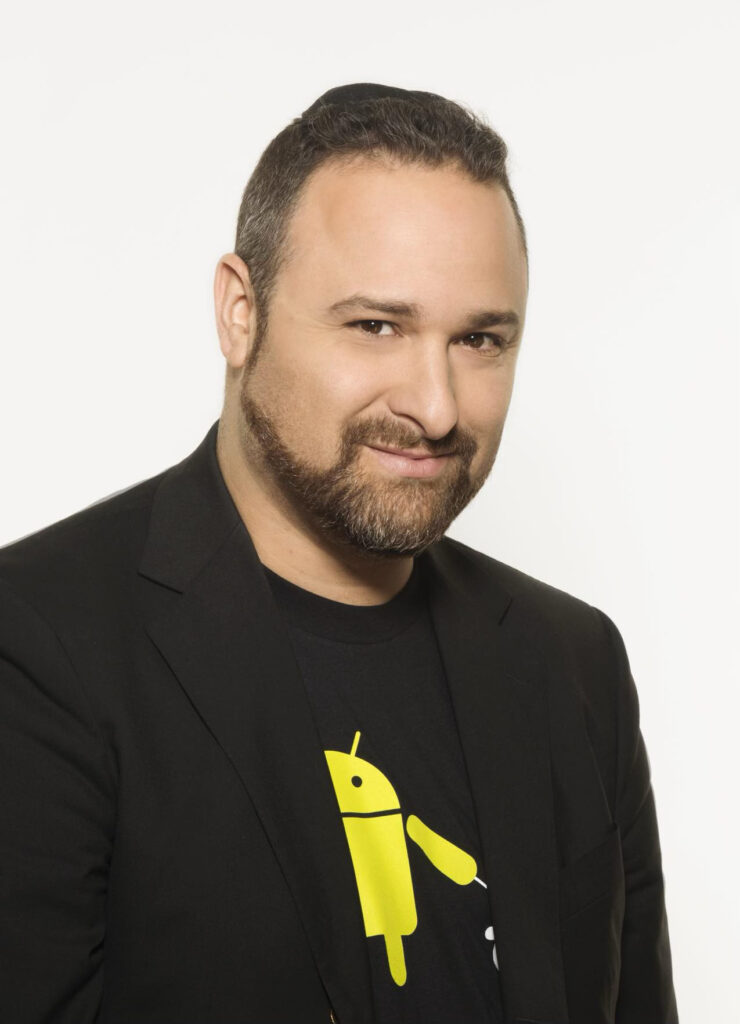
Hillel Fuld, Israel’s tech and marketing guru, has been on a mission to spread truth online since the attacks of Oct. 7, 2023. He has helped raise the morale of his nearly 168,000 followers on Twitter.  He was elated to see hostages return but was disgusted that among the terrorists who were freed was the man who killed his brother Ari .

On Sept. 16, 2018, Ari Fuld was stabbed by Khalil Jabarin, a 17-year-old Palestinian in a shopping mall at the Gush Etzion Junction in the West Bank.  Before he collapsed and died, Fuld shot at the terrorist, preventing him from killing a woman who was selling food. This was captured in a dramatic video that impacted Jews worldwide.

“I’m not going to pretend there isn’t pain and frustration but as a human being it doesn’t help me to be angry or help my cause at all,” Fuld told The Journal by phone from Israel. “When we look at this at a wider angle, in a way, Ari is saving these hostages, even after his death. There is the beautiful aspect of the deal that some families are getting their loves ones back and the terrible aspect of the deal is that we have to release terrorists. So, the deal is beautiful and terrible at the same time.”

Romi Gonen, 24, Emily Damari,28 and Doron Steinbrecher, 31 were released on Jan. 19 after 471 days of captivity;  Naama Levy, 20, Daniela Gilboa, 20, Karina Ariev, 20 and Lili Albag, 19 were released on Jan. 25 . A total of 33 hostages are to be released over the 42-day ceasefire. Authorities are uncertain how many of the remaining hostages are still alive. Of the approximately 2,000 Palestinian prisoners Israel agreed to release are convicted murderers who were never supposed to come out of jail alive.  Yahya Sinwar, the mastermind of the Oct. 7 attacks was one of more than 1,000 prisoners released from Israeli jail for Israeli soldier Gilad Shalit on Oct. 18, 2011.

Why doesn’t Israel have the death penalty for terrorists convicted of capital crimes to de-incentivize hostage-taking?

“You would think that would already be in the law, but unfortunately, that is not the case,” Fuld said. “I don’t know that Israel would ever do that, but it should be obvious.”

Fuld said that what was shown was Israel’s tremendous unity in the happiness that the three hostages came home safely, as many thought they might not see a single hostage come home safely.

“There wasn’t a person in Israel who wasn’t thanking God or thinking that we united as one,” he said. “We were unified watching those hostages come home. We would love to be unified without our enemies bringing destruction onto us but it’s not unique to this generation of Jews. We find that we are divided until we are united by our enemies.”

“There wasn’t a person in Israel who wasn’t thanking God or thinking that we united as one. We were unified watching those hostages come home. We would love to be unified without our enemies bringing destruction onto us but it’s not unique to this generation of Jews. We find that we are divided until we are united by our enemies.”

Fuld said from a nonemotional and strategic standpoint, releasing murderers doesn’t make sense, but Israeli citizens need to know that their government would do anything in its power to free them.

In November 2023, 95 hostages were freed as part of a deal. In a daring mission, Noa Argamani and three male hostages were freed by the IDF. American Hersh Goldberg-Polin and five other hostages were murdered by Hamas, reportedly when it was clear Israeli soldiers were nearby.

Fuld said while aspects of the deal are extremely problematic, he thinks President Trump must have promised help against Iran and or making sure Hamas would not continue to be in power.

“I think there is something under the surface,” he said. “I would be shocked if Prime Minister Netanyahu didn’t agree because there were incentives or maybe threats, but I think it was incentives.”

Fuld noted the similarities to Parashat Va’era and the current tenuous situation. In that Torah portion, Moses demands from Pharoah “Let My People Go.” After the first five plagues, Exodus 9:7 tells us that God hardened Pharoah’s heart.

“After blood and frogs and all of the destruction, you would think Pharoah would say, ‘Get the hell out of there,’” Fuld said. “But it says God hardened his heart. There is no way to explain this insanity we are seeing know other than God is hardening their hearts.”

He said that Israel obviously wants all the hostages back but doubts that was on the table and knows that the coming days could be volatile as family members of hostages are waiting to see if their loves ones are alive or not, and family members of those not released hope there is still a chance their relatives can come home. He said he and relatives of those murdered by terrorists who will be free as part of the deal feel the hurt.

Fuld said people should be prepared for Israel to be scapegoated no matter what happens. Many in “mainstream America” will say “enough already” and want a ceasefire, without thinking about security concerns.

Charges that Israel was committing genocide were always absurd but now, even more so, he said.

“That accusation in it of itself never made sense,” Fuld said. “But now, Hamas is declaring victory. So, which is it? You can’t have both. The forces are so unbalanced, and Israel is such a great power, but the truth is Israel put its soldiers in danger on the ground and we lost many in the effort to target only Hamas. It would be the first time in history a country in sending in trucks of aid to people that they want to commit genocide on. It’s ridiculous.”

Fuld has appeared as a guest on major networks and is a sought-after speaker around the global for tech companies and Jewish institutions. He founded the online community “The Inner Hillz” a few months ago.

He has faith in God though we cannot know why he does what he does. He added that when the enemies of Israel and Jews smell weakness, that is when they attack the hardest.

“The greatest challenge going forward is to bring unity to this society which is so greatly divided. We need to do some open-heart surgery, not just put Band-Aids on Band-Aids on Band-Aids. We need to heal our society. If you actually sit with a pen and paper and go over fundamental values, you will find ultra left, ultra-right, super religious and super secular, share 90% of their values. As a society, what is amplified is that we focus on what we don’t have in common and that shouldn’t be the case.

Hillel Fuld Talks About His Brother’s Murderer Going Free and Why Israel Must Unite Read More »

Can The Trump Vibe-Shift Include Nuance?

My grandmother Charlotte Gerson used to read us a great children’s book by Remy Charlip, ”Fortunately.” It followed Ned’s roller-coaster experiences as “Fortunately,” he was invited to a party, “Unfortunately” it was far away, etc. etc. Up and down he went – with each success balanced by potential disaster – until saved by another burst of good fortune. It offered great character training, cultivating resilience. And it, unintentionally, provided basic training in Jewish history, Zionism – and these days, the nuance and fortitude needed for Donald Trump’s presidential rerun.

There’s much talk about America’s long overdue “vibe shift.” Perhaps that cultural reset can restore appreciation for nuance, subtlety, complexity – and a democratic politics living with paradox.  

Consider last week. For starters, “Fortunately” Hamas released seven holy hostages – but “Unfortunately” Israel released hardened terrorist killers. Then, Trump’s inauguration sent Americans – and the pro-Israel community – on a whipsaw adventure.  

Fortunately, Secretary of State Marco Rubio and Secretary of Defense Pete Hegseth agree with National Security Adviser Mike Waltz that “Hamas will never govern Gaza…. That is completely unacceptable.” 

Unfortunately… Hamas terrorists saunter around Gaza, acting as if they won thanks to the Trump-imposed ceasefire. Meanwhile, some Trump appointees, like Deputy Assistant Secretary of Defense for the Middle East Michael DiMino, believe America has “no vital or existential” interests in the region, while others are Tucker Carlson neo-isolationists downplaying Israel’s importance to America’s national security.   

Fortunately, Trump’s inaugural welcomed a “golden age,” denounced an “education system that teaches our children to be ashamed of themselves — in many cases, to hate our country,” envisioned “a society that is colorblind and merit-based,” and embraced an understanding of America as an “ambitious” nation of dream-fulfillers and history-changers, with the “spirit of the frontier… written into our hearts.” 

Unfortunately, as the pro-Trump Wall Street Journal editorialized the next day, this patriotic president pardoned “the Jan. 6 Cop Beaters,” including “those convicted of bludgeoning, chemical spraying, and electroshocking police to try to keep Mr. Trump in power.” 

Clearly, every day, there will be enough to outrage Trump-haters and charm Trump-lovers, further polarizing American politics. It will be easy to lose perspective as Americans continue their Rorschach test politics. Every “Fortunately” will thrill Trump-worshippers – every “Unfortunately” will thrill Trump-demonizers. Elon Musk’s awkward one-handed salute from his heart to the air will offend those who overlook that Tim Walz – remember him – made a similar gesture while campaigning – and that unlike Walz, Kamala Harris, and Harris’ husband Doug “Superjew” Emhoff, Musk visited Israel and toured Kfar Azza in November, 2023. 

Similarly, a little Republican tolerance could go a long way too. Having won, Republicans could be gracious. Is it really that outrageous that at a national prayer service Bishop Mariann Edgar Budde added a “final plea” to “have mercy upon the people in our country who are scared now”? Why did that request infuriate?  

In his 2023 book canonizing Joe Biden, “The Last Politician,” Franklin Foer wisely calls politics “the means by which a society mediates its difference of opinion, allowing for peaceful coexistence. It’s an ethos that requires tolerance of competing truths…. It’s a set of rules whereby the side that fails to prevail in democratic decision-making accepts its defeat.” Clearly, even under Biden, America, Israel, and many democracies suffered from an anti-politics. Today’s politicians keep framing politics as good confronting evil, without tolerating competing truths or disagreements. 

In a moment when most Westerners doubt God, many inject religion’s absolutes into politics. The devotion traditionally focused on God is now misdirected toward deifying your leader – and demonizing your rivals. This is toxic to democracies. 

Perhaps even worse than this intense partisan warfare is the suffocating, all-or-nothing party discipline it spawns. Democracies need doubt, division, debate – within limits. Contained chaos keeps everyone honest, sharper, reducing groupthink. When fair-minded historians start autopsying the Biden administration, we will see how the slavish devotion to racist “anti-racism,” to suppressing “disinformation,” to staying “woke,” to demonizing Trump, and most outrageous, covering up Biden’s deterioration, destroyed his presidency.

Perhaps even worse than this intense partisan warfare is the suffocating, all-or-nothing party discipline it spawns. Democracies need doubt, division, debate – within limits. Contained chaos keeps everyone honest, sharper, reducing groupthink.

I grew up in a world riddled by paradox but tempered by compromise. Racist Southern Democrats governed with liberal Democrats, while William F. Buckley Connecticut conservatives belonged to the same Republican Party as Jacob Javits New York liberals. In Israel Shimon Peres and Yitzhak Rabin fought within the Labor Party.  

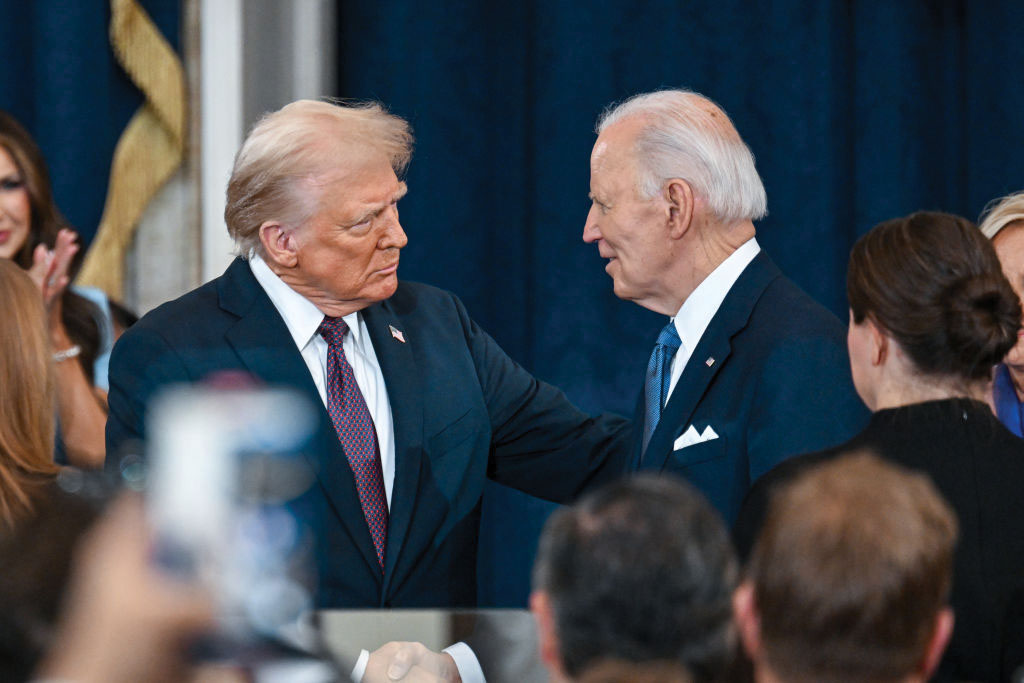
In healthy democracies, the leader you choose should be the politician who annoys you the least, not some supreme leader whom you never question. True, trying to change tone and moderate opposition with Donald Trump on a roll in the White House again is a big stretch for the 75,019,230 voters who rejected him. Democrats are not feeling magnanimous – especially after Trump’s Inaugural Address disrespected President Biden.

But are people really enjoying this Age of Outrage? Is it that much fun to be disgusted by half your fellow citizens, constantly? Or, more accurately, is it really that much fun to be manipulated by social media algorithms and real-life demagogues, left and right, into detesting half of your country again and again? And are they really that bad? Is every issue that morally clear? 

That’s where Remy Charlip’s lesson for children from 1964 comes in. Take a breath, and re-read Trump’s inaugural. Trumpophobes should seek 1, 2, 3, points to applaud – while Trumpistas should find 1, 2, 3, points they reject. If you can’t find anything, if it reads all good or all evil, perhaps you need to take a breath, and take a better, more self-critical, look at yourself.


Professor Gil Troy, a Senior Fellow in Zionist Thought at the JPPI, the Jewish People Policy Institute, is an American presidential historian. His latest book, “To Resist the Academic Intifada: Letters to My Students on Defending the Zionist Dream,” was just published.

Can The Trump Vibe-Shift Include Nuance? Read More »

Prologue to a Disaster: Watching a Three-Hour Meeting of Bureaucrats

It’s like watching a ghostly dinner of the crew on board the Titanic. A succession of seamen inform the captain that there are dangerous icebergs ahead and they must change the ship’s direction, but the captain, resplendent in his uniform, champagne glass in hand, merely thanks them for their contributions. He’ll think about it; not to worry, there’s plenty of time. Meanwhile, beef, chicken or fish? 

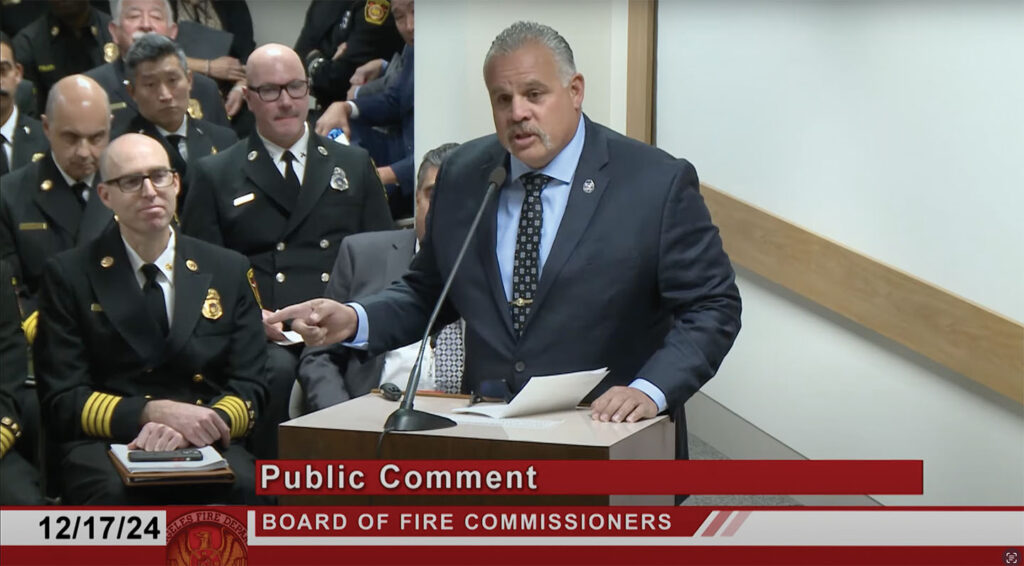
Conversations on that doomed ship must be left to our imagination, but thanks to YouTube, we have a portal onto another disaster. On December 17, the Los Angeles Board of Fire Commissioners met, as they do twice a month, and as usual, they posted the video afterward for anyone curious enough to watch it. It makes for haunting viewing.

The role of the Fire Commission is, according to the city’s website, to “establish goals and provide direction to the Fire Department through Fire Chief Kristin Crowley,” who also attends and speaks. The civilian members seem like nice people who know little about the fire stations they’re supposed to be overseeing.

So the firefighters come, in manifest desperation, to speak to them during public comments. The first speaker, a 31-year veteran, says he and his colleagues are busier than he’s ever seen and they have ongoing difficulty getting essentials. “The people of Los Angeles rely on us,” he says. “We can’t endure these budget cuts.” President Genethia Hudley-Hayes congratulates him: “That was great,” she says, “you did it within your three minutes time. Just like you’re an old hand at speaking at commission.” 

As more firefighters take the podium to speak, it becomes impossible for the board not to see that the situation in the Los Angeles Fire Department is dire and dangerous. Firefighter Chung Ho says the $23 million cut to their budget “came at exactly the wrong time, with calls for services at an all-time high and our firefighters at their breaking point.” He refers the board to the Fire Chief’s report showing that their call volume has increased by 55% since 2010. “This is unacceptable and clearly unsustainable,” he says, adding that the LAFD is the most understaffed fire department in America. 

Freddy Escobar, president of the United Firefighters of Los Angeles, says “there are some truly shocking findings in the current state of the LAFD. In 1960 our city population was 2.5 million and we had 112 fire stations. In 2020 our city population was 3.9 million and we had 106 stations. That’s 1.4 million more people and six fewer fire stations. In 1969 the LAFD responded to 101,000 emergency incidents. In 2023 we responded to 505,000 emergency incidents. That’s five times the number of calls, with fewer stations and fewer fire stations. …This is simply unacceptable.” He says the department must add at least 62 new fire stations and hundreds more personnel. 

“If we cut one position,” Escobar concludes, “if we close one station, if we close one resource, the residents of Los Angeles are going to pay the ultimate sacrifice and someone will die.” 

“Thank you,” Hudley-Hayes says, as Escobar steps down. 

Councilwoman Traci Park backs up the firefighters with force and clarity, echoing their alarming facts. “We are straining our department’s resources beyond the brink and we cannot continue on this path,” she says. There are gaps in coverage across large swaths of Los Angeles. “Those huge chunks of red, where there is no resource in our city, are scary.” 

Finally comes the truly devastating report, narrated by a dark-haired young man, about the LAFD’s effectiveness between 2018-22. “I’m sad to report that if this were a report card,” he says, “we’d be getting an F.”

Maps of the city show large areas where the fire department simply cannot respond within the recommended time, because fire stations are too few and not where they should be. The LAFD didn’t meet the four-minute response standard for 55% of emergency medical incidents, and during the time studied, the problem got worse. 

The national industry standard recommended for large cities is 1.54-1.81 firefighters per 1,000 residents. Boston has 3.4, Seattle 1.38, Houston 1.73, Chicago 1.82 and San Francisco 1.77. “LA stands, abysmally, at .91,” the man says. It’s not surprising that the LAFD’s response time is nearly double the national average, “because we’re half the size we should be.” He says the obvious solution is to put more firefighters on the street, as Chief Crowley has proposed, and build, at minimum, 62 fire stations. 

“I like your energy,” Vice President Sharon Delugach responds. “The”—she jabs her fists at the air— “urgency!” She laughs. Later she asks, jokingly, if the data measuring LA’s topography takes into account how many Tesla drivers there are—how they don’t know what they’re doing. Everyone laughs.

But Hudley-Hayes is visibly sobered by the report. She proposes “an earthquake shift” to get City Council members to hear this presentation. It only took 20 minutes, after all; it’s not like they’re asking a lot of time. A motion is passed endorsing the report and its recommendations. 

Finally, the Commission hears a brief report motivating the Fire Chief’s proposal for a department budget of $1.2 billion for the coming fiscal year—an increase of 7%. Hudley-Hayes stresses the importance of attending the first meetings about the budget this coming April, to discuss how serious the situation is. She says they need to organize, like in the Civil Rights Movement—there’s plenty of time between now and April. 

At this point, the Fire Commission seems concerned about what they’ve heard. It’s just much too late.

The final order of business is to cancel the next Fire Commission meeting, scheduled for Tuesday, January 7, so firefighters can have some much-deserved time with their families around the holidays. Only we know that instead, they were called that day to the most devastating fire in LA’s history.

Of course, in the Titanic analogy, the Fire Commission is not really the captain. The unseen captain is our mayor, our Nero, who danced in Ghana while Los Angeles burned. Mayor Bass insists she didn’t cut the LAFD budget—that funds were simply reallocated from one department to another—but this meeting reveals otherwise. Many firefighters referred to the $23 million budget cut to the LAFD (more than the $17.5 million widely published), and no one claimed it didn’t happen. We’re now supposed to believe that the horror that engulfed our city has nothing to do with the appalling conditions our brave firefighters described three weeks earlier.

We live, as our elected officials remind us, amid the constant threat of fire and other disasters. But instead of mitigating the danger by funding the best, most fully staffed fire department possible, our mayor and City Council did the exact opposite.

We live, as our elected officials remind us, amid the constant threat of fire and other disasters. But instead of mitigating the danger by funding the best, most fully staffed fire department possible, our mayor and City Council did the exact opposite. City leaders ignored the firefighters’ protests, and innocent people have paid with their homes, their livelihoods and, in many cases, their lives. It’s up to us, as citizens of this city, to hold to account those responsible and draw the lessons of this horrific, all too preventable tragedy.


Kathleen Hayes is the author of ”Antisemitism and the Left: A Memoir.”

Prologue to a Disaster: Watching a Three-Hour Meeting of Bureaucrats Read More »

What Can We Do with Vicarious Trauma?

There is a concept in psychology known as vicarious trauma. It was first identified in mental health care professionals who were repeatedly exposed to their patients’ traumatic experiences. By witnessing or hearing about the fear, pain, distress and terror of others, our own well-being can be deeply affected.

I suspect many of us can relate to the concept of vicarious trauma. Since Oct. 7, we have, as a community, felt the weight of the horrors of those heinous attacks and their aftermath — including the plight of the hostages and the bloody, devastating war that has followed. Although most of us have not personally endured this violence, repeatedly witnessing the suffering of others over these many months has left us with painful residual consequences. Social media can be especially harmful as all-too-vivid images and videos appear on our feeds again and again.

Vicarious trauma can manifest as excessive worry, loss of sleep, mood changes, and difficulty managing one’s emotions.

For those of us living in Southern California, there is currently an additional layer of distress caused by the fires. Some members of our community have lost their homes. Others have been evacuated. All of us have been affected by the often dangerous air quality. Emergency alerts — some sent in error — have heightened our fears and triggered feelings of insecurity. This is real trauma. 

We see images of cherished places we have visited, now decimated. We hear heartbreaking stories of those who couldn’t escape in time, of lives lost. We think of the exhaustion of first responders. It’s not just overwhelming — it can feel like too much entirely.

So, how can we cope with all this pain? We don’t want to become numb, heartless people who stop noticing or responding to the suffering of others. At the same time, we don’t want to be paralyzed by vicarious trauma, unable to function or support those who desperately need our help.

The Torah portion we read last week offers a model.

In this part of the Exodus narrative, we read about the terrible oppression of our Israelite ancestors. In suffering and desperation, they cry out to God. The Torah then tells us that God hears their voices, God remembers the covenant, and God responds by setting into action the plan for the Israelites’ rescue. 

These are three steps that can nurture empathy while protecting us from being overwhelmed by vicarious trauma. We need to listen, to be aware of the suffering of others. We need to recognize our role, our responsibility as helpers. And we need to act. 

That being said, the Torah does not call on us to obsess over it or to dwell in it unreasonably. The human experience includes suffering, natural disasters and, unfortunately, cruelty. However, it also includes kindness, generosity, beauty and blessings beyond measure. Our task is to hear the voices of those in need, to recognize our connections, and to act in ways that improve life for others and ourselves as well.

When you feel distressed by external trauma, don’t stew in it. Stop scrolling. Instead, reach out to a loved one with a phone call. Volunteer at a soup kitchen. Drop off clothing at a shelter. 

When you feel distressed by external trauma, don’t stew in it. Stop scrolling. Instead, reach out to a loved one with a phone call. Volunteer at a soup kitchen. Drop off clothing at a shelter. Make a donation. Care for your own spirit, soul, and heart by joining your community in prayer. Write a gratitude list of the blessings in your life. Create a list of blessings you wish for others.

In my experience, this is the best way to respond to the pain that is an inevitable part of life. We can best manage our distress by working together to make things better for our community and our world.


Rabbi Yoshi Zweiback is the Senior Rabbi of Stephen Wise Temple in Los Angeles, California.

What Can We Do with Vicarious Trauma? Read More »

Surround Yourself with Good People

There is a Jewish teaching in Perkei Avot that if you have a bad neighbor, you must move away from them. 

I believe the corollary is also true: You need to surround yourself with good people. Then, you will likely become better yourself. I’ve certainly seen it in terms of my own self-growth. 

As a teen, I had a best friend who urged me to cut class and go to the mall with her. I thought she was cool, so I did. 

In college, I hung out with friends who would binge drink every weekend until they passed out; I did the same.  

One friend encouraged me to shoplift, so I did it; she told me that taking from a corporation was fine. In fact, they deserved it. 

Looking back, I’m ashamed of my behavior. I was young, and atheist, with no set morals or values. 

Now that I view the world through the framework of the Torah, I see how wrong I was. However, I was friends with people who didn’t have any moral clarity either, so I didn’t know right from wrong. 

These days, I’m an observant Jew, surrounded by other Jews dedicated to the Torah and mitzvot. Every day, I see people in my community not only doing the right thing – they go above and beyond for others.  

I have been the recipient of this incredible kindness. I had my third child recently, and I had to undergo a C-section for the first time. 

It. Was. Brutal. I was in terrible pain for the first week, unable to get out of bed and having to completely rely on my thoughtful husband and lovely mother-in-law to take care of me. Thank goodness I had them. My community also stepped up to help.  

Friends and people I’d never met dropped by with dinner every night for a month. Our friends’ daughters made centerpieces and helped decorate for our son’s bris. Local high schoolers showed up to babysit. People came by with bags of clothes, gifts and handmade items. One friend made us a complete Shabbat dinner and lunch two weeks in a row, while another offered to watch my baby during the day so I could work. 

I’m so grateful for the kindness and generosity I’ve experienced. It inspired me to give back to others too.  

When a friend’s mother passed away, I made lunch for her. I hadn’t stepped into the kitchen in over a month because I was recovering, but I wanted my friend to know she had people in her corner in her time of need. 

When one of the teachers at my daughters’ daycare gave birth to her eighth child, God bless her, I brought over a baby gift and a self-care package filled with good-smelling soap and lotion, so she could take her of herself too. 

When a Jewish family I didn’t know experienced a tragedy, I gave a little more tzedaka than I could afford to their GoFundMe page, because I knew they needed it. 

I’m not bringing these things up to pat myself on the back. I’m bringing them up to show the power of doing good, the power of surrounding yourself with people who are actively making the world a better place. The giving attitude is contagious. 

This was something I’d seen in my Jewish community of Pico-Robertson, but not in greater LA. The city didn’t seem to have a community; it felt disjointed, isolating and lonely.  

The city didn’t seem to have a community; it felt disjointed, isolating and lonely. However, in the wake of the LA fires, I’ve completely changed my opinion. 

However, in the wake of the LA fires, I’ve completely changed my opinion. I’ve seen so much good happening over these past few weeks. Donation centers are filled to the brim. People are offering to cook meals for the devastated communities and sheltering pets who don’t have a home. Others risked their own lives to save their neighbors. Just like my Jewish community, they motivated me to give back, to donate to the victims and show up for them when they need our love and support. 

I encourage you: attach yourself to good people. Stay close to them, and you will become better yourself. Together, you’ll all make the world a much more beautiful place.


Kylie Ora Lobell is an award-winning writer and Community Editor of the Jewish Journal. You can find Kylie on X @KylieOraLobell or Instagram @KylieOraWriter.

Surround Yourself with Good People Read More »