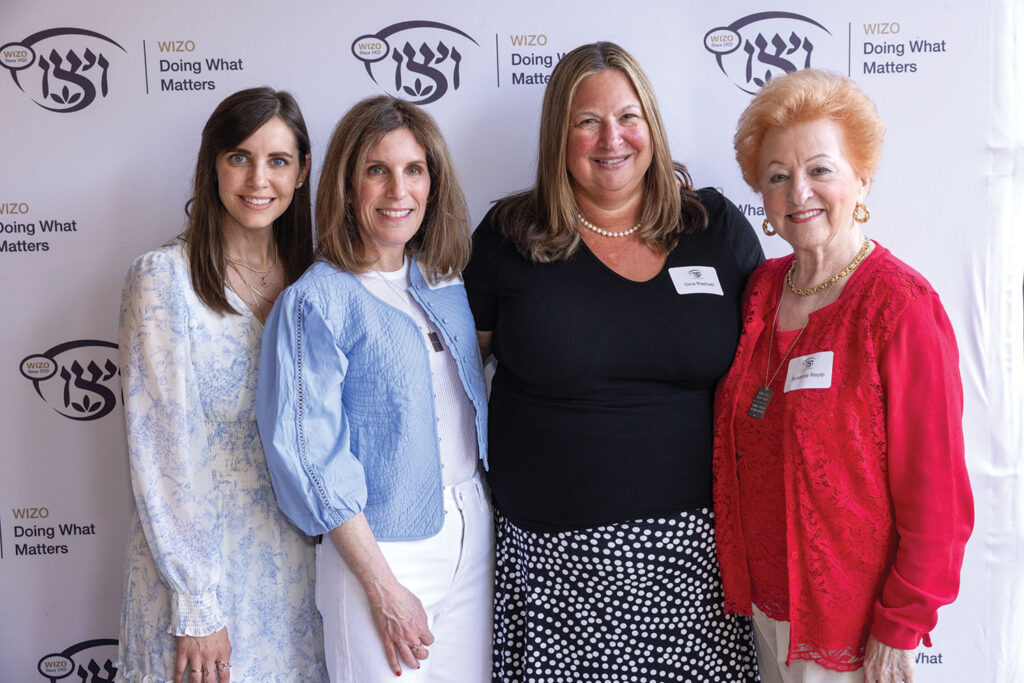
On June 18, Amanda Markowitz, a Los Angeles native, film producer and the granddaughter of four Holocaust survivors, moderated two Holocaust survivors in powerful and meaningful conversation. There were more than 80 attendees at the WIZO (Women’s International Zionist Organization) Summer Valley Dinner, which was hosted by WIZO Valley Chair Shana Glassman and WIZO Los Angeles Chair Gina Raphael.
The meaningful event was held at a home in Tarzana.
“We are profoundly grateful for the incredible generosity of our supporters, who came together at this year’s gala to celebrate and uplift the vital work of Jewish Family Service LA,” JFSLA Chief Community Engagement Officer Catherine Schneider said.
Schneider continued, “Thanks to their unwavering commitment, we are able to continue offering essential services — ranging from mental health support and senior services to food assistance and family safety — that stand as a beacon of hope for so many in our community.”
The gala, which raised $1.2 million, featured remarks from JFSLA leadership, a soulful performance from singer-songwriter Breland as well as a lively auction. About 350 supporters came together to contribute to this remarkable fundraising effort, which will enhance JFSLA’s social service network available to the entire Los Angeles community.
Challah and Soul was at the Juneteenth celebration for freedom, held on June 19.
Shonda Walkowitz and Judi Leib, founders of Challah and Soul. Courtesy of Challah and Soul
Community leader Judi Leib spoke about freedom and how the Black and Jewish communities, at a politically fraught time in this country, need to come together to continue to fight against antisemitism and racism and about voting rights. In an insightful address, Leib talked about how Black and Jewish people work together. Pastor David Robinson of God is Love Christian Church strongly agreed with the solidarity of working collaboratively with the Jewish people and supporting Israel, particularly at this difficult time facing the Jewish State. The organization thanked him for his ongoing support and solidarity for the Jewish community and the Black community —two communities that know too well what it is to be marginalized.
A Los Angeles-based nonprofit, Challah and Soul aims to connect Black and Jewish communities through food and storytelling.
At Shabbat Ritual 101 Retreat in Los Angeles, a group of eager participants celebrated their Jewish identities and created new rituals around Havdalah. They also painted Shabbat candlesticks and made vision boards reflecting their visions for their own Shabbat observances.
The recent Shabbat Ritual 101 Retreat in Los Angeles. Courtesy of Moishe House
After the well-received retreat, a participant led a Moishe House event in their community that involved making Shabbat candles and a lesson behind the history and symbolism involving the practice.
“We love when participants bring and spread their learnings from retreats to their home communities!”
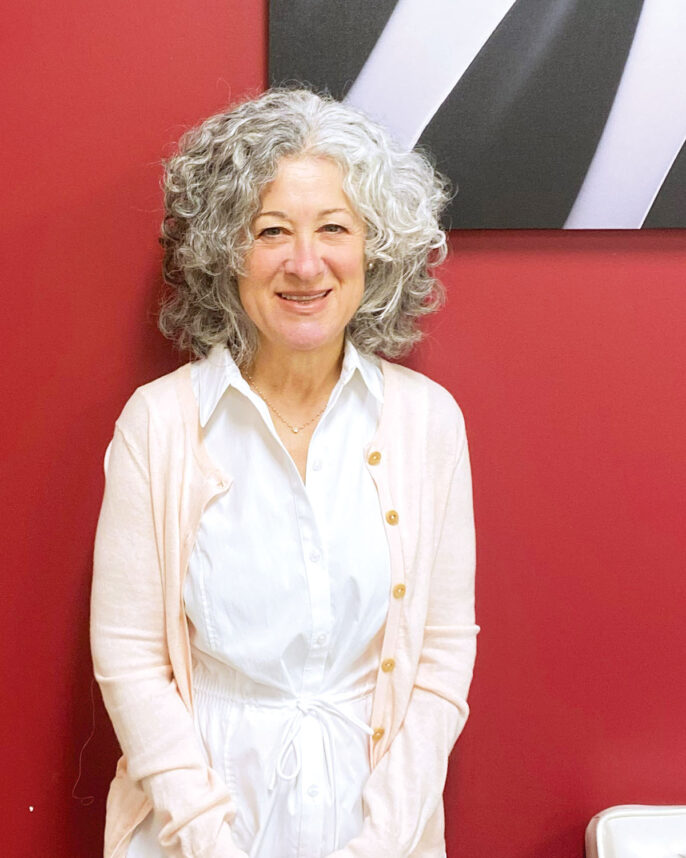
De Toledo High School, a college-preparatory Jewish High School located in the West Hills district of the San Fernando Valley, has hired Lesley Plachta, a decorated nonprofit professional, as its new director of development.
Lesley Plachta. Courtesy of de Toledo High School
“We are thrilled to welcome Lesley to the de Toledo team,” Head of School Mark Shpall said. “Lesley’s passion, her proven leadership, and extensive development experience bring immense value to our school and community. Her creative drive will ensure we continue to deliver an incomparable Jewish education for generations to come.”
Plachta, who has years of experience working in the Jewish community, brings extensive experience in strategic fundraising, donor development, and organizational leadership to de Toledo, according to a statement from the school. She holds a BA in Psychology from UC Santa Barbara, a masters of social work from USC and a masters of Jewish nonprofit management from the Zelikow School at Hebrew Union College.
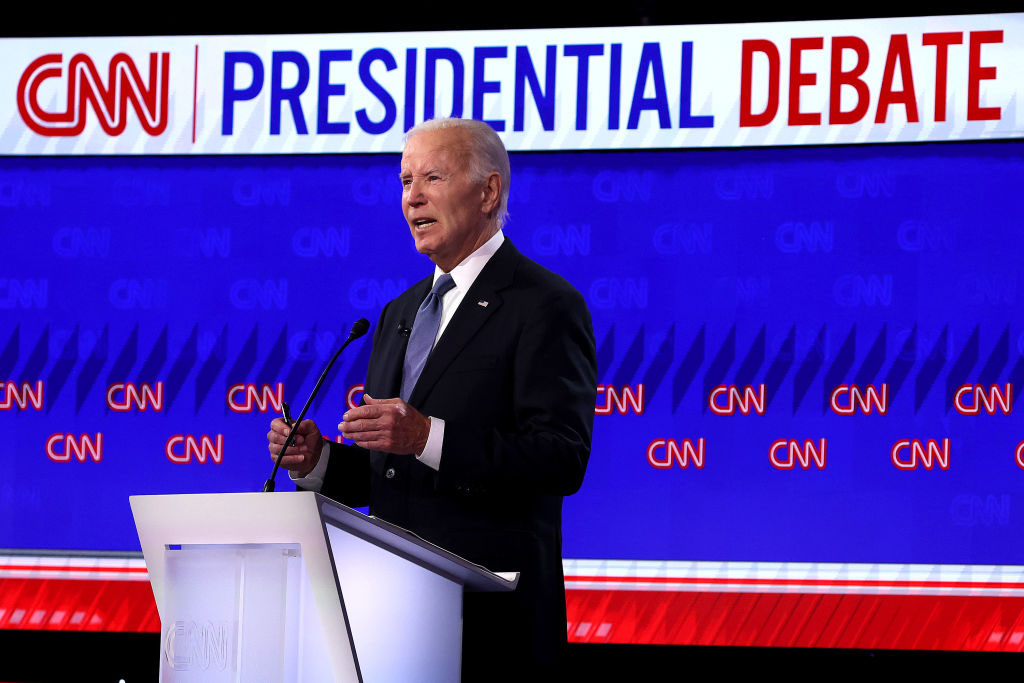
President Biden was not fit to run for another four years in the world’s toughest job. He slurred his words. He mumbled incoherently. A special probe that cleared him of criminal charges noted that he was “elderly and forgetful.”
The nation agreed. In a recent poll, 77 percent of the public, including 69 percent of Democrats, said Biden is just too old to be effective for four more years.
“Democrats denying decline are only fooling themselves,” Ezra Klein wrote in The New York Times.
It’s not as if his aides couldn’t see what everyone was seeing. Nevertheless, they tried to hide and minimize and spin our heads to convince us all was good with Scranton Joe. So instead of gracefully replacing him, Democratic honchos with the implicit support of the mainstream media chose to close their eyes and hope for the best.
Surprise, surprise: In the wake of Biden’s stumbling debate performance Thursday night, now they’re panicking.
What were they expecting?
When even CNN describes it as an “unmitigated disaster” for Biden, and The New York Times calls it a “shaky, halting debate performance [that] has top Democrats talking about replacing him on the ticket,” you know we’ve reached a low point.
It was a low point that could have been avoided.
Biden was never supposed to be a two-term president. As Mark Leibovich wrote in The Atlantic, “Biden had promised voters in 2020 that he was ‘a bridge,’ and nothing more: As a vehicle to end Trump’s time in the White House, Biden presented a stability candidate who could ease the transition to a new political era without the aging Trump — and without the also aging Biden.”
Now, he may go down in history as the man who brought Donald Trump back to the White House.
What was especially dismaying about the debate is that Biden’s poor performance took attention away from Trump’s lies, bluster and evasiveness, as well as the issues themselves. Most of the conversation is now about the fallout from Biden’s “unmitigated disaster” and whether it’s too late for Democrats to do something about it.
Democrats who allowed it to get this far have only themselves to blame. They knew what we all knew. Perhaps they were hoping against hope that Biden could pull off another miracle and slay the dreaded Orange Man, that he had some special superpower to do so. But whatever else they were thinking, they aggressively downplayed the president’s declining fitness for office and are now paying the price for a high-stakes gamble that backfired.
Biden himself is hardly blameless. If he’s not aware of his declining state, I feel sorry for him. But if he is aware and still chose to run for another four years as leader of the free world, I can only cringe at that level of self-absorption.
As Mark Antonio Wright starkly noted in NRO, “There’s only one thing to say about Thursday night’s debate: Joe Biden’s selfishness, stubbornness, ambition, and pride have made it very likely that Donald Trump will be the next president of the United States.”
There’s a concept in academia called “Awareness of age-related change (AARC),” that describes “all those experiences that make a person aware that his or her behavior, level of performance, or ways of experiencing his or her life have changed as a consequence of having grown older.”
Maybe Biden’s declining state has made it harder for him to recognize that decline; maybe it’s too difficult or painful for him to accept the effects of aging on his performance. But it’s one thing for the president to be in denial. It’s quite another for all those around him who knew better and are now panicking.
Rabbi Gedaliah Gurfein is the creator of the People’s Talmud, a remarkable online resource that makes the Talmud accessible to all who are curious, even those with little Jewish knowledge. Rabbi Gurfein explains what the Talmud is and why it’s the operating system of Judaism. Far from being archaic, the Talmud addresses issues that highly relevant to the modern world such as life after death, other inhabited planets, marriage and parenting, and how to create a just and fair society.
Hating Ultra-Orthodox Jews has become an acceptable face of Jew hatred in the U.S. In one of the most egregious examples in 2022 and 2023 the New York Times mobilized massive journalistic resources to write an 18-part series (yes, 18 parts, with many multi-page articles!) on how the privately funded Haredi schools in New York City are the worst thing to ever happen in the history of education in the city, in the world, in the galaxy. At the same time the NYT had nary a word to say about whether the New York public school system is effectively teaching students using taxpayer money, a reasonable question and comparison. It is not an exaggeration to say that all but a few of the 21st century’s wars received less coverage than the Haredi schools.The series was drenched in antisemitic inferences and dog whistles such as Jews “influencing politicians,” dismissing responses as not in good faith, speaking to the few critics in the community but not to the overwhelming majority, not endorsing the NYT narrative. It was also published at a time of dramatically rising violent antisemitic attacks in Brooklyn, which concomitantly received sparing coverage. Finally it came out in a general context of support or at the very least tolerance for minority communities, like the Amish, or indigenous groups, who seek to sperate themselves from others.
But it is not only Americans (Jews and others) who demonize the Haredi. The new head of Israel’s Labor Party, Yair Golan, who aspires to become Israel’s Prime Minister, called the Haredim “a parasitic population.” This was only one example of the many negative comments he has made about them.Nor is he alone; many other secular Israel politicians make vilifying statements about the Haredim.
In Israel in particular, some of the animus towards the Haredim is understandable.Most Haredi men do not do military service and many work in an untaxed manner. This arrangement dates to the creation of the State of Israel and is based on the Haredi leadership’s view that they serve the country through learning Torah. This is disputed not only by secular Jews but by other religious Jews who claim that learning Torah does not exempt oneself from the duty to protect the country or get a job.Nevertheless this status quo remains in place. But even more shocking than the military exemption is the mocking of army service itself on the part of some Haredi leaders. After Oct. 7, Rabbi Simcha Bunim Schreiber, the head of one of the leading Haredi yeshivas, said people should not feel more gratitude to IDF soldiers than to garbage men. Rabbi Dov Landau, a rabbinic leader from Bnei Brak, a major Haredi center, said that Haredim should not devote any time to assisting the IDF as it takes away from Torah study.It’s hard to get more insulting than this.
Indeed beyond the animus and prejudice, most observers mainly see a population with unusual dress and who keep to themselves. Just who are the Haredim and what do they actually think about their others?
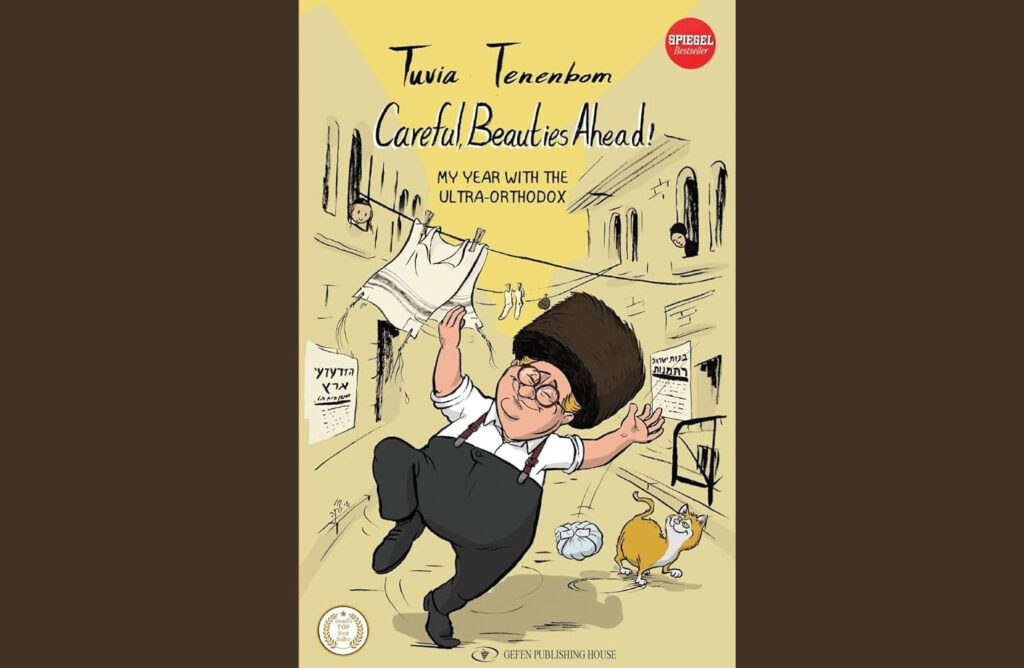
Into the breach steps Tuvia Tenenbom, who spent a year with his wife Isi living, praying, singing, befriending and being befriended in two of the major Haredi communities in Israel, Mea Shearim and Bnei Brak. His book, “Careful, Beauties Ahead!,” was a best seller in Germany and in Israel. Tenenbom also wrote the English translation.Appropriately, the title of the book in Germany was “Gott spricht Jiddish” (God speaks Yiddish). Tenenbom, who was born into a Haredi family (though he left it as a young man), speaks fluent Haredi Yiddish. This allowed him to chat to Haredim and for the Haredim in turn to open up to him in a way they would not to other “visitors.”The book consists mainly of these conversations.Tenenbom makes the reader feel like his traveling companion.
And it is a fun journey with many laugh-out-loud moments, not something I often do reading a book. Tenenbom is one of the few modern gonzo journalists who does not place his own agenda first and foremost but listens to the people he is interviewing.And he also lets his subjects interview him, if they wish, which also turns out to be pretty funny. The book was a best seller in Israel and Germany, and for good reason.
Spoiler alert — it turns out that the Haredim are a lot like everybody else. By letting us get to know the Haredi world on its own terms, we learn that they have the same struggles as most other groups.They sometimes suffer from bad leadership, or from tiny splinter factions who besmirch the whole group.We learn about the Haredi anti-Zionists who reject all state institutions and all sorts of different mischief-makers that plague the community by aggravating tensions with other Israelis and fostering public disorder.In some cases, Tenenbom names the leaders of some Hasidic courts where the rebbe (rabbinic leader) in question takes the divine right of kings to heart, leading to disturbing levels of authoritarianism.
Spoiler alert — it turns out that the Haredim are a lot like everybody else.By letting us get to know the Haredi world on its own terms, we learn that they have the same struggles as most other groups.
Yet, as Tenenbom’s companion we also experience the warmth, busyness, diligence, loyalty, dedication to family, humor and deep faith of the community.We also meet a community that values learning for learning’s sake and not as a tool or a way to get ahead. The reader understands why Tenenbom falls in love with the Haredim.We readers may not fall in love, but Haredim become much less “the other” and more just like us.
“Careful, Beauties Ahead!” can be read in two ways.First, just for the fun of it.And there is a lot of fun. While Haredim may appear solemn to outsiders, they are happy to tell a joke, engage in humor and tease back a questioner. Haredi humor, in turns out, has the same anti-authoritarian, satirical and mocking nature as the best of Seinfeld — a revered rebbe could be the punchline of the joke. They also know how to drink alcohol, which they often do while Tenenbom is sipping his Coke Zero—a drink that appears so often, it should be credited as a supporting actor. The second way to read the book is as a meditation on how any community works, seeks to maintain its way of life, and responds to stimuli. You may come for the laughs, but the rest will linger with you.
Scott A. Shay is the author of “Conspiracy U: A Case Study” (Wicked Son, 2021) and “In Good Faith: Questioning Religion and Atheism” ( Post Hill Press, 2017). His essays and reviews have appeared in numerous publications.
For the last 18 years, PJ Library has been inspiring joyful Jewish experiences by sending free storybooks and activities to families with children up to age 12.
“PJ Library is designed to be welcoming, inclusive and meaningful to families, regardless of Jewish experience or level of observance,” Alex Zablotsky, executive director of PJ Library, told The Journal. “No matter what Jewishness looks like in any family, strengthening a child’s connection to Jewish values, traditions and celebrations can be as easy as adding PJ Library storybooks to reading time.”
Founded in 2005 by the Harold Grinspoon Foundation (HGF) and today, with the support of generous donors and partners, PJ Library distributes books in seven languages to more than 650,000 children in over 40 countries every month.
“New generations of kids are growing up with their own library of books that allows them to explore Jewish holidays, traditions and culture,” Zablotsky said. “Seeing positive, joyful Jewish representation in these stories helps to reinforce and strengthen a child’s Jewish identity and the entire family’s connections to Jewish life.”
To celebrate this milestone, PJ Library’s community partners across North America are hosting events.
“We’ve also celebrated with our colleagues and community partners at our PJ Library conference back in April and will celebrate with a collective of our leading donors in August,”he said. “It’s a great opportunity to thank all our partners and supporters who have made our first 18 years so unbelievably successful.”
The Journal spoke with Zablotsky about the program’s origins, growth and value to Jewish families around the world.
JJ: What inspired PJ Library?
AZ: In 2005 PJ Library’s founder, Harold Grinspoon, heard country-music legend Dolly Parton on the radio discussing her children’s book-gifting program called Imagination Library. Dolly wanted kids to have their own library of books in their homes to grow their love of reading and build literacy for new generations.
At that time, Harold had already been thinking of ways to share the joys of Jewish life with children. He wanted to build Jewish literacy and connection to the values, stories, and tradition that have always been at the center of the Jewish experience.
As Harold listened to Dolly lay out the structure of her program, the idea for PJ Library started taking shape. He would use this as his blueprint. Harold later called his daughter-in-law and now president of the Harold Grinspoon Foundation, Winnie Sandler Grinspoon, to say, “We should create a Jewish version of Imagination Library.” The model of sourcing and distributing books to children each month with the help of local partnerships is still the foundation of how PJ Library operates today.
JJ: How has it evolved over the years?
AZ: PJ Library has evolved in so many ways. In North America it has grown from a book program created for kids to a program that engages the whole family in both local and online Jewish communities. Our local partners utilize a full suite of programs, events, parent ambassadors and other engagement opportunities to help families connect with one another. The resources, activities, and tools that we create as companions to the books inspire conversations and help families from the wide diversity of the Jewish experience connect to Jewish life.
We have also expanded beyond the books to telling stories in other media, including podcasts, story time videos and audiobooks.
PJ Library has also evolved and adapted to grow around the world. The program is now found in 40+ countries with books in seven languages including English, Hebrew, Spanish, Portuguese, German, Russian, and Ukrainian. Our largest program is in Israel, where we distribute more than 370,000 Hebrew-language books each month in partnership with the Israeli Ministry of Education.
PJ Library has also evolved and adapted to grow around the world. The program is now found in 40+ countries with books in seven languages including English, Hebrew, Spanish, Portuguese, German, Russian, and Ukrainian.
JJ: What has been the greatest challenge?
AZ: Meeting global demand. Scaling the program and distributing books to nearly a third of Jewish families around the world has been a tremendous achievement. And there are still many global Jewish communities that we are not yet engaging, as we seek local partners and financial supporters to extend beyond the current seven languages offered. We hear from families regularly from all around the world asking for the opportunity to engage their children in Jewish life through PJ Library books.
JJ: The biggest accomplishment?
AZ: Contributing to the publication of hundreds of wonderful Jewish books: Classic stories, old stories told in new ways and brand-new stories that share new and increasingly diverse Jewish voices with families all around the world. Jewish children today have access to an extraordinary canon of beautiful, joyful Jewish stories from a broad range of publishers, each of which is an invitation to connect to Jewish life.
JJ: What is something people don’t typically know about PJ Library?
AZ: It’s funny: So many people ask what does the “PJ” in PJ Library stand for? It simply stands for Pajamas.
JJ: Anything to add?
AZ: At such a tumultuous time, we hope that PJ Library can play a small part in helping Jews around the world feel connected to each other and to the larger global Jewish community. We are proud to be partnering with the Israeli Ministry of Education to support families displaced following Oct. 7, to continue providing Jewish connections for more than 3,000 Jewish Ukrainian children across Europe and to be a source of reliable, much-needed Jewish joy for families.
Learn more or sign up for monthly children’s books at pjlibrary.org. Learn about some of the East Coast celebrations: https://newyork.pjlibrary.org/18. ■
The first portion of your dough, you shall separate a loaf for a gift …
~ Numbers 15:20
Every Friday afternoon my wife comes home from
the Jewish institution of learning where she spends
her days filling hearts and souls with song with
a challah in hand.
This wasn’t written into her contract, but rather
comes from the original contract delivered
in the desert during forty years of wandering
between Sinai and the promised land.
This challah will turn into French toast by the
miracle of her hands and a knowledge that isn’t,
per se Jewish, but is so ingrained and perfect,
it might as well, also have come from Sinai.
On a good week, when we haven’t forgotten
to remember the Sabbath, as we are continually
reminded, we’ll find ourselves at another
Jewish institution to say our words and sing our songs
which, invariable, will culminate with another
set of two challahs. We will bless them, and we
will eat them, and everyone present will look
into each other eyes as the pieces go into our mouths
with an understanding of how good we have it.
Not everyone has it so good, so we divide this bounty
into two and reserve half for anyone whose means
doesn’t match the desires of their stomachs.
There is an ancient precise formula for this
but I say more is more and suggest we
give everything we can. If flour and water and
yeast and egg come easy to you …
if the joy of kneading and twisting dough is
one you frequent … if you have the patience
to let it rise, remembering the time, not too long ago
when we had to rush out of town …
Then make a double portion for your mouth
and soul … and anyone nearby with the same.
Add raisins and sesame seeds if that’s your thing.
There’s no mitzvah more delicious than this.
Rick Lupert, a poet, songleader and graphic designer, is the author of 28 books including “God Wrestler: A Poem for Every Torah Portion.” Find him online at www.JewishPoetry.net
Two members of the Los Angeles Jewish community who say they were attacked by anti-Israel protesters in front of Adas Torah Synagogue on June 23 related their experiences in an interview with The Journal.
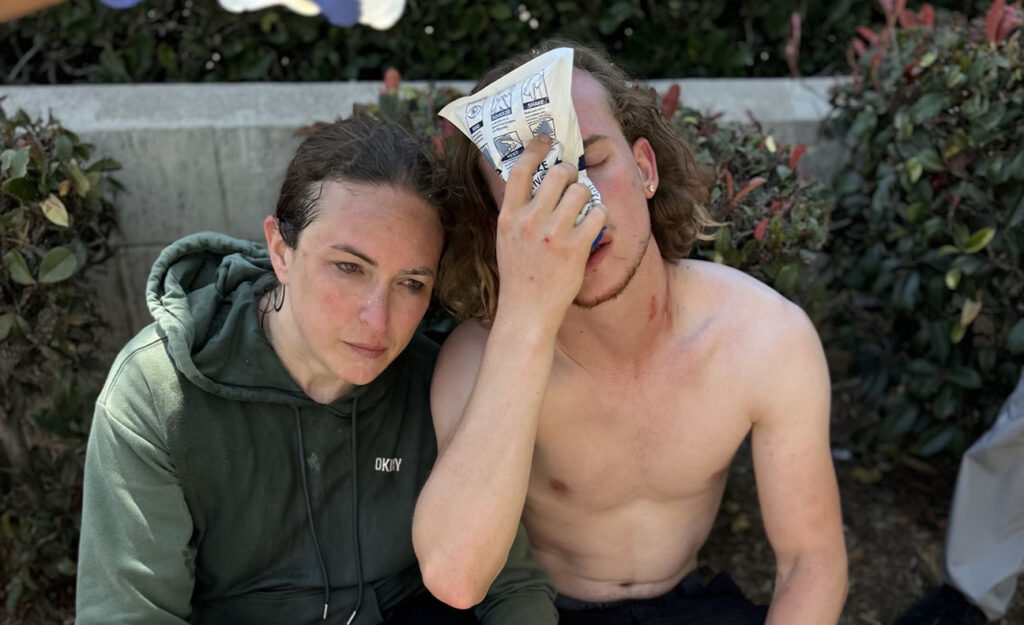
Naftoli Sherman, 25, suffered a broken nose and a black eye after being attacked by anti-Israel rioters that day; in social media videos that went viral, he was misidentified as a woman. Pico-Robertson resident Talia Regev, 42, was bear-sprayed. Sherman, who is originally from Brooklyn and now runs a bartending service, came to the synagogue because he “knew we needed as many people as possible to protect each other and make sure that [the anti-Israel rioters] just can’t come into our community and say things that go against us.” Regev, who is starting a chronic pain management company, showed up to attend the Israeli real estate fair being held inside Adas Torah and “to support the Jewish community knowing that the recent past that there has been issues across the world with violence against Jews in many places.”
Naftoli Sherman. Photo by Aaron Bandler
“On our right and on our left, we had pro-Palestinian protesters that were chanting ‘Free Palestine’ and things like ‘we don’t like Israel’ and ‘Israel should be destroyed’ and stuff like that,” Sherman said, adding that there wasn’t much in the way of security present outside of Shmira Public Safety and Magen Am and around 10-15 police officers.
Regev said that initially there were 10-15 members of the Jewish community there, and that police officers told her that the anti-Israel protesters were going to stay across the street, separated from the Jewish community. But the anti-Israel protesters attempted to break through the police barricade “and it was a little bit scary because I could see the hands going through.” Over time, “hundreds of people from both sides” came.
Regev claimed that the police initially wouldn’t let Jews enter the synagogue but eventually relented; at which point, the protesters formed a human chain to try and bar anyone from entering Adas Torah. “They started pushing us forcibly,” she said. “If we didn’t move back, I would have been toppled over. So I told everybody on our side: don’t engage. What they wanted to do is push us and say, we didn’t touch you… but they were literally shoving into us.”
“Eventually there was no more room for the Jewish people to be standing right in front of the synagogue, so I had to go out to the street and as I’m going to the street, I realize that Jewish people and the pro-Palestinian protesters were not separated. We were all mixed together,” Sherman said. “Everyone started speaking loud to one another, being in each other’s faces, there was no separation, so we were all literally right next to each other. You could have gotten hit from any side anywhere, and no one had any protection at all.”
Talia Regev. Photo by Aaron Bandler
Sherman said he saw people get pushed, as well as a female anti-Israel protester “throw something at a Jewish girl that was just there with a flag” and the protesters kept saying “I’m going to catch you after, I’m going to see you.” The Jewish woman then stood behind Sherman for protection.
He also claimed to have told one of the anti-Israel protesters to leave, and the Jewish community would leave as well “and we’ll call it a day. But you’re in our community, we can’t leave before you guys fully leave.” Sherman said that the rioter responded that they wouldn’t leave “until we finish what we came here to do, which I don’t know what he meant by that, but I don’t think he meant something good.”
At this point, Sherman saw 30 people throwing punches and tried to get back to the side where the Jewish community members; he ended up passing by 10-15 protesters “and as I passed them they all jumped me. So one person just punched me, broke my nose … and then I felt like a bunch of people were kicking me on the head. There’s no cops there to protect us, which is insane.” Some Jewish community members intervened to break up the fight, which Sherman believes saved his life. “Who knows, a few more seconds and I could have been brain damaged or something … thankfully I got out and I’m okay.”
Regev, along with two other rabbis, helped break up the fight. “I ran towards it [and] police just stood there,” she said, adding that Sherman “was in a football hold. There were people stacked on top of him, so we literally… had to peel him off and we pushed away the hooligans.” Regev claimed that she told the police that Sherman needed medical attention, but they seemed “perplexed” and told her that they’re “not medical.” Hatzalah was then called, though Regev alleged that they weren’t allowed in, so they had to get medical help at Walgreens. Sherman also claimed that police wouldn’t let him pass to go the emergency room, telling him he had to walk around the block despite Sherman’s pleas that his nose could permanently disfigured if he didn’t get medical attention soon. He did eventually make his way to the ER, but had to wait six hours.
Regev noticed that the rioters were headed toward the nearby Jewish residential neighborhoods, so she and a rabbi “formed another line and we held them off.” She told the protesters to “please leave so everyone’s safe. Let’s just not fight. A lot of them didn’t listen, but most of them did.” As she was ushering out the protesters, Regev saw one of them look angry with two flagpoles and seemed like he was going to use them to attack people; Regev pleaded with him to calm down and peacefully leave the area. The protester did leave, but as he got in his car he sprayed bear repellent in the area, and came in contact with Regev’s right side.
“It was burning like crazy,” Regev said. “I almost fell down.”
Regev found Sherman, and together they limped “in pain” to Walgreens, where they were treated by Hatzalah. Regev then called a doctor who works at an urgent care across the street, only to find out that the doctor had been pepper sprayed, which is why she and Sherman sought care at Cedars-Sinai Medical Center.
Further, Sherman heard “crazy things” coming from the anti-Israel protesters, including one who said he didn’t like Israel and then said “all you Jews are crazy,” prompting Sherman to confront the protester by saying: “Oh wait is it Israel or is it Jews?” The protester responded by saying he didn’t like Sherman’s long hair and “was getting in my face.” Regev claimed that she heard anti-Israel protesters shout “Zionist pigs” and “globalize the intifada”; additionally, she said that a neo-Nazi was there and that he said directly to her that “Jews may be from Europe, but so are Nazis.”
Los Angeles Police Department Chief Dominic Choi said in a June 24 press conference that the anti-Israel protesters were coming “in waves”; Sherman said that was “100%” true. “Everywhere you walked there were more of them,” Sherman said, describing some of the rioters as being “bigger” and were “looking people in the eye and saying, ‘come here, I want to fight you.’”
Regev said that eventually the anti-Israel protesters “started moving east towards the Jewish restaurants and the Jewish neighborhood. The police are literally doing nothing.” So Regev “followed the crowds” and formed a chain with a rabbi and another person to form a human chain to hold the rioters back. Regev also saw anti-Israel protesters banging on the windows of a Jewish-owned bagel store; she broke up a fight there.
So she walked up to the police and told them “to stop this because it’s about to start turning violent in five minutes.” Regev claimed the police told her that they were told to stand down; Regev couldn’t recall specifically if the police told her that it was their captain or sergeant that gave the order. However, at a community security briefing on June 26, LAPD Commander Steve Lurie emphatically denied claims that they were told to stand down as “patently untrue” and “nonsense.”
Sherman doesn’t know if the police were told to stand down by elected officials, but what he does know is that “they didn’t do anything when they were supposed to do something. I don’t understand why they didn’t come in and separate the Jewish people from the pro-Palestinians. It was in front of their face, they saw how we were getting hit, they saw how they were yelling, it was so obvious that there were going to be fights.”
“[The LAPD] didn’t do anything when they were supposed to do something. I don’t understand why they didn’t come in and separate the Jewish people from the pro-Palestinians. It was in front of their face, they saw how we were getting hit, they saw how they were yelling, it was so obvious that there were going to be fights.” – Naftoli Sherman
He also believes that a number of the anti-Israel protesters were paid agitators. “The things that they were saying, they didn’t know any of the history about Israel,” Sherman said, recalling asking an anti-Israel rioter she condemned Hamas and the 9/11 terror attacks; the rioter said no to both. “The only thing that makes sense to me is that they were paid for. I don’t know who pays them and how they get these addresses and stuff, but they definitely don’t know what they’re talking about.” Regev also believes that myriad rioters were paid, as many of them were calling for an “intifada” but didn’t know what the term or “Zionism” meant. “Obviously some did, but a lot of them had no clue,” she said, adding that “they were there to be in our faces.”
Another witness to the June 23 events, 62-year-old business consultant Marvin Epstein, noticed that at least one of the anti-Israel protesters was dragging a keffiyeh (which is considered sacred) on the ground. “[He] looked like someone who just finished working and was exhausted after his long day of work, so it’s hard to believe there’s authenticity to some of their ideologies’ story when literally they don’t even respect the costume they’re wearing,” Epstein said. “And that’s why even somebody said, ‘why do you even wear this costume?’ And they said, ‘because there’s genocide in the world.’”
Regev said that what happened on June 23 reminded her of “Nazi Germany before the Holocaust. We are supposed to feel safe in our own synagogues … we need security guards because we know we are not safe.” But she believes that the message from the Jewish community is that “we’re not scared, and that’s why we went to help. Because we knew that if the police are not going to help, then at least we can help.”
She further contended that the Jewish community should arm themselves for protection and lamented that it can take a year-and-half to get a permit.
In the aftermath of the events of June 23, Sherman “had this realization that I need to take life more serious[ly]” and that “being a Jew, I should be so proud of it … I feel so lucky and privileged to be a Jew and that’s the one thing I’ll never give up … I want to share that feeling with every Jew around the world.”
“We’ve had antisemitism for thousands of years, and we have survived and we will survive and we are strong,” Regev declared. She added that the Jewish community is willing to work with LAPD and other local police to make sure that this never happens again.
It was a scary scene on Sunday morning on Pico-Robertson, just outside Adas Torah synagogue at 9040 W. Pico Blvd. A few dozen pro-Palestinian protesters, wearing keffiyehs and facemasks and holding Palestinian flags, tried to prevent people from entering the temple. It didn’t take long for the pro-Palestinian demonstration to turn violent as they shoved, kicked, threatened and yelled insults at Jewish men wearing yarmulkes who wanted to pray.
What brought these demonstrators to the area was a post on social media: “Our land is not for sale! This Sunday 6/23 a real estate event will be marketing homes in ‘Anglo neighborhoods’ in an effort to further occupy Palestine. Racist settler expansionists aren’t welcome in LA.”
Gidon Katz, who organized the seminar, told The Journal that over the past few months he became used to seeing anti-Zionist demonstrations outside his events, but they were usually at a safe distance. “They were literally at the entrance. I have no problem with someone who wants to demonstrate, but they should be designated an area to do so and not intimidate people from coming in and blocking the entrance.”
Katz’s company sells apartments in Israel and has been organizing conferences in the U.S. and Europe.
“I had a few events in the U.S. since March, including New York, New Jersey, and Montreal, Canada, and there are always demonstrators. However, police don’t let them approach the building where the conferences were held. Here, they were just outside the synagogue. I don’t know why the police couldn’t stop them.”
People in the neighborhood, a hub of the Jewish community, who heard about the clashes and hurried to the area witnessed scenes of a mob of pro-Palestinians attacking Jewish men and women. It didn’t take long for a fight between them to erupt.
“There was a big police presence there, wearing riot gear,” said Albert Shirazi, who lives in the area, “but they didn’t do anything at first. They just stood there.”
Noam Niv, an American-Israeli businessman said “you can’t arrive in a known Jewish area in Los Angeles and create provocations. The demonstrators held signs against Israel, such as ‘Israel is Nazi,’ and one was holding a spiked flag. There was the usual crowd of Palestinians, Arabs, far-left, and college students who have nothing to do with this conflict but take the opportunity to join any anti-Israel demonstration.”
Mayor Karen Bass said she was appalled by the scene outside the synagogue. She promised to have more security and proactive policing to prevent future attacks on Jewish residents.
“The violence was designed to stoke fear,” she said. “It was designed to divide, but hear me loud and clear, it will fail.We will be working to immediately convene leaders of houses of worship and cultural centers to discuss how to protect sacred spaces. … LAPD will enhance their partnerships with Jewish public safety organizations to continually review evolving tactics and threats to the community and to ensure that we are not just responding but taking proactive actions to prevent these instances from happening in the first place.”
The following day, at the closing night of the Jewish Film Festival, which premiered the Matisyahu documentary, “Song of Ascent,” Rabbi Noah Farkas, Jewish Federation’s president and CEO, said that the demonstration was organized by a few groups.
“It is not a spontaneous use of the First Amendment right. It was a simple anti-Israel protest and use of the First Amendment right; it was a coordinated and collective attack on Jewish identity and community. It was proven over and over again, no matter what you say about the difference between anti-Zionism and antisemitism, there really is no difference.”
Photo courtesy of LAJFF by Todd Felderstein
Farkas said many people were assaulted during the demonstrations, including his own staff members. “This is a serious problem. My team has been working with the City Council of L.A., City Council Beverly Hills and the L.A. County Board of Supervisors.”
Earlier that day, there was a press conference at the Jewish Federation in response to the attack on the Jewish community. Participating in the event were Mayor Bass, Councilwoman Katy Yaroslavsky, ADL L.A., and the Museum of Tolerance.
“The city, the county and the mayor’s office have promised to work with us to set up safe zones around synagogues, batei midrash, schools, and cultural institutions that will make it illegal to protest in front of them,” Farkas said. “We are going to work very hard to apply the anti-masking laws to unmask protesters so we know who you are. You have the right to protest but not to be anonymous.”
He also announced the biggest security grant program in California history: $80 million for Jewish security.
Despite the efforts of the pro-Palestinian demonstrators to prevent people from attending the convention, Katz said over 300 people attended.
“They were mostly American-Jews but also Israelis. This is exactly why people are considering making Aliyah, the rise in antisemitism.”
He added that since Oct. 7, the interest in purchasing homes in Israel, had increased in the USA and Europe.
Every day, children from across Los Angeles make their way to the Chabad Pico Learning Center on Pico Blvd. The school at B’nai David-Judea offers affordable Jewish studies to all.
Head of school, Rabbi Moshe Levin of Chabad Pico–Bais Bezalel, notes that many children who are academically exceptional but in need of financial assistance often don’t find their place in Jewish schools. As a result, they miss out on learning about Judaism and have a harder time connecting to the Jewish community. His goal is to change that.
“With a smaller teacher-to-student ratio, we can really hear and see each child and design a plan that is customized to their academic performance and spirit,”Levin said.
“With a smaller teacher-to-student ratio, we can really hear and see each child and design a plan that is customized to their academic performance and spirit.” – Moshe Levin
While some Jewish high schools charge upwards of $40,000 per year, making it unaffordable for many families even with available discounts, this school provides a much-needed competitive alternative. Faced with the tough choice between essential living expenses and school tuition, many parents opt to send their children to public schools. Levin recognized this problem and decided it was time to offer affordable Jewish education to those who can’t afford it. The idea came about in 2020 when schools switched to Zoom.
“We started a program that provided a space for children in public schools to do their Zoom sessions in our synagogue,” Levin said. “We also taught these children about their heritage and traditions between Zoom sessions. This opened our eyes to a real need that is not being addressed by many private schools in Los Angeles.”
A temporary solution after COVID hit became a permanent one. “I had to roll up my sleeves and seek support from anyone who could help,” Levin said. “We opened our school because we care about these children, and we refused to believe those who said it couldn’t be done.”
Over a decade ago, Rabbi Benzaquen of Magain David sponsored the establishment of Yeshiva High Tech High School. This school successfully leveraged the development of an online curriculum to significantly reduce the cost of the usual brick and mortar classroom. This school was located, most recently, in the Beth Jacob Synagogue on Olympic and Doheny.
The Yeshiva High Tech High School (now known as Harkham-Gaon Academy) attracted about 60 to 80 students yearly, many of whom paid about half the typical tuition, with others receiving reduced fees or full scholarships based on need. Unfortunately, the school recently closed, forcing many students to look elsewhere for the coming school year. Benzaquen and a small group of supporters asked Chabad Pico Learning Center to step in and try to not only rescue the school, but also do their best to help grow as much as possible.
Some schools often reject applicants because they are full by April and need to be very selective. “A parent and a child can be easily intimidated during the interview process when the principal asks, ‘Why does your child deserve to attend our school?’” Levin said. “Our question is coming from a different place, ‘How can we help your child?’”
The students at The Chabad Academy come from both religious and non-religious homes. Some have one Jewish parent, others are Orthodox Jews. What they all have in common is a desire for Jewish education and the security, love, and attention that are often lacking in public schools.
“Some students had never learned about Abraham, Isaac and Jacob before coming to our school,” Levin said. In addition to religious studies, there is a strong emphasis on the secular program.
“People don’t necessarily associate the word ‘Chabad’ with their kids becoming scientists or doctors, but current graduates of Chabad Academy are candidates for the best colleges and universities,” Levin said.
The school also takes the students on regular educational trips and celebrates all the holidays with them. More importantly, it teaches them Jewish values and how to be a mensch. Regular tuition is $18,000 a year, but scholarships are available to those in need, and 10% of the students receive full scholarships. “We work with parents who can’t afford the tuition,” Levin said. “Nobody will be refused because of lack of funds.”
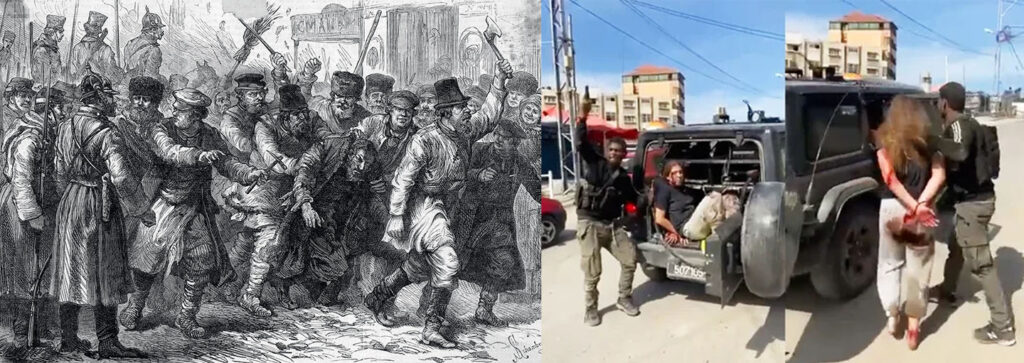
Ukraine, which once inflicted pogroms on the Jews,
now faces a disaster that was instigated by
co-religionists, although the country’s led now by
a Jew who once would have been pogromized, caused to die.
Although Ukraine and Russia have a common Christ,
this does not save their Christian citizens, and though
a Jew is trying to avert disaster, the Zeitgeist
appears to be extremely ghastly in this horror show.
No pogroms have in my own neighborhood occurred,
but some pro-Palestinian people yesterday,
just two days after midsummer, by hate were stirred
to demonstrate outside a shul where Jewish people pray.
In eight-six years of my long life I’ve never seen
a comparable demonic demonstration,
yet never before now have I as worried been
as I am now about the future of my nation.
But while I’m celebrating the anniversary
of my dear father’s Yahrzeit, I turn to Hashem,
the Referee who will ensure reversery
of the demonic goals I’m sure He will condemn.
Jon Levenson writes in an article in the Spring 2010 issue of the Jewish Review of Books “The Idea of Abrahamic Religions: A Qualified Dissent,” that the view that the three monotheistic religions, Judaism, Christianity and Islam, share a common Abraham is misguided. The interpretation of Abraham by the three religions is radically different. For Judaism Abraham is the founder of a family, for Christians he is a universal figure while for Islam he is the first Muslim. Each religion imposes its own view of Abraham on the biblical protagonist in a manner that contradicts the view of the other two.
My wife. Linda Hepner, sent this letter on 6/24/2 to the NYTimes:
My Jewish stomach churns at the horror the historian Professor Dekel-Chen must feel for his beloved son Sagui, may he return safely. I don’t know how I would react.
But if it looks like a pogrom, feels like a pogrom and smells like a pogrom, it may well be a pogrom.
If “From the River to the Sea, Palestine will be free” is chanted all over the English-speaking world, most supporters apparently going along with the ominous implication which in Arabic is usually “Palestine will be Muslim”, sounds like Hitler and Co’s mantra that Germany would be “Judenfrei” (free of Jews) with its chilling implications, then perhaps it does presage a holocaust. Then as now this was cheered or nodded at by enormous incipiently violent crowds.
Those that died as the result of Hitler’s wishes would be the first to sense the similarities and would be ultra wary of the dangers.
Gershon Hepner is a poet who has written over 25,000 poems on subjects ranging from music to literature, politics to Torah. He grew up in England and moved to Los Angeles in 1976. Using his varied interests and experiences, he has authored dozens of papers in medical and academic journals, and authored “Legal Friction: Law, Narrative, and Identity Politics in Biblical Israel.” He can be reached at gershonhepner@gmail.com.