fbpx

June 6, 2024

Turturro Receives Award at Sephardic Film Festival Opening

John Turturro, a gentile actor who has played Jewish roles, received a Pomegranate Award recognizing Lifetime Achievement on June 2 at the opening ceremony the New York Sephardic Jewish Film Festival.

In “Quiz Show” Turturro nailed the anxiety of Herb Stempel, the game show contestant who blew the whistle on the “Twenty-One” cheating scandal. He’s played Holocaust survivor Primo Levi, and he presented a magnetic and persuasive Rabbi Lionel Bengelsdorf, who supported Charles Lindbergh’s pro-Nazi candidacy in the HBO series “The Plot Against America” based on the Philip Roth novel” and professional poker player Joey Knish in “Rounders.”

Turturro, who is masterful in dramatic roles as well as comedic ones, showed his humor.

“Thank you very much for this Pomegranate Award,” Turturro told the crowd at The Center for Jewish History. “I know that a pomegranate is high in dietary fiber, folic acid, Vitamin C and Vitamin K so it’s a healthy award. My wifeCatherine is Ashkenazi. She’s someone jealous that I’ve been chosen as an honorary …”

His craft has been informed by the city where he lives, he said.

“As an actor and sometimes director, I’ve had the great pleasure to investigate many other different cultures,” Turturro said.  “Having grown up in New York, it’s a big part of my DNA.” He added that he enjoys “telling stories that are not“pre-packaged” and make people think.

Also receiving a Pomegranate Award was French director Alexandre Arcady, who is Jewish. His film “The Little Blond as The Casbah” is being screened on June 3. Speaking through a translator, Arcady told the crowd he was moved the see the exhibit of the Nova massacre now on view in downtown Manhattan, then “three hours later, the Israel Day Parade … To see the children, the crowds, with the flags was very exceptional walking down Fifth Avenue.”

The director said that while he was inspired in New York, he was troubled by the situation back home.

“In France, we have removed mezzuzot from our houses,” he said, adding that some have removed kippot, which he described as “a very disturbing situation.”

Many of his films tell the Sephardic Jewish story, be it Israeli characters or members of the mafia.

Stella Levi, who was given the Pomegranite Award for “preservation and celebration of Sephardic Culture, is 101. She took the stage and read a prepared speech, speaking clearly and with conviction.

She thanked her son for calling her every Friday and wishing her “Shabbat Shalom” despite not being religious.

But in the eyes of mainstream American Jews, she said, she was considered an exotic person.

“In fact, when we arrived at Auschwitz, the other prisoners shunned us for not knowing Yiddish,” Levi told the crowd. “It was French, the language that saved us because the French women in the camp spoke both Yiddish and French, translated German for us.”

She helped a number of Jewish cultural institutions around the world and said humanity must be placed above everything else. She cited the “Adon Olam” prayer “Adonai Li V’Lo Ira” or “the Lord Is With Me And I have No Fear.”

Asked how she had the strength to give such a speech to a big crowd, she told the Journal: “This is what I do.”

The program also included a performance by French Algerian singer Enrico Macias, who is Jewish ( his real name is Gaston Ghrenassia). The 85-year-old wowed the crowd with a clear and strong voice and guitar playing. He delighted the crowd with the song “Ose Shalom.”

David Dangoor, president of the American Sephardi Federation said truth and education is important.

“One of the biggest problems for Jews today in the world is the world doesn’t know Jewish history,” he told the crowd. “I mean if you look at all the modern theories that exist-colonizers, occupiers … I don’t think there’s any race or any people that have been on the receiving end of the viciousness of the world and what the world can provide in terms of evilness than the Jewish people, and it continues and it’s difficult to understand why it’s never rectified itself.

“I don’t think there’s any race or any people that have been on the receiving end of the viciousness of the world and what the world can provide in terms of evilness than the Jewish people, and it continues and it’s difficult to understand why it’s never rectified itself.” – David Dangoor

“A very big part of the Jewish world, they don’t know about Sephardic Jews-they don’t understand them, they don’t know them, I almost sounded like Jackie Mason,” Dangoor said.

He joked that the difference between an Ashkenazi rabbi and a Sephardic rabbi is the former tells what is prohibited and the latter tells what is permitted.

Dangoor told The Journal that while these are difficult times the world over, “it was important to have an uplifting and positive event that reminds us of the good things we bring into the world.’”

To see the schedule, go to americansephardi.org.

Turturro Receives Award at Sephardic Film Festival Opening Read More »

“Love the Food That Loves You Back” Is the Latest from Nutrition Powerhouse Ilana Muhlstein

When Ilana Muhlstein was a child, she ate to cope with her feelings: the feelings surrounding her parents’ divorce, as well as multiple moves. She relied on food for happiness and comfort. And by the time she was 13, the five-foot-two teenager weighed 215 pounds.

Though her family tried to help her, Muhlstein knew she had to address her weight on her own. She adopted a new mindset, where she focused on other ways of finding happiness other than food, and looking at food as something nutritious that fueled her body. By the time she got to college, she lost 100 pounds and found her calling: she was going to help others shed the pounds and feel healthier as well.

Today, the wife and mother of three, who lives in Los Angeles, is a hugely successful dietician and online personality with millions of followers. Her new book, “Love the Food That Loves You Back” is her first cookbook, filled with 100 nutritious recipes that are high in protein and low in carbs.

“Everything is from my nutrition point of view, which is high volume, delicious foods that are very good for you and your health,” she said. “I never formally went to culinary school, which makes these recipes much more attainable and accessible to the regular cook.”

“Everything is from my nutrition point of view, which is high volume, delicious foods that are very good for you and your health.”

Muhlstein shows readers how to make healthier versions of the food they love, like turnip fries instead of French fries, portobello mushroom pizza caps and spaghetti squash instead of pasta.

“These recipes came from my curiosity about and love of food,” she said. “I have a nonstop curiosity to taste the comfort foods of my childhood, but in a way that suits my health needs.”

The cookbook’s recipes are for adults and kids alike and, along with addressing weight issues, can help with lowering cholesterol as well.

In all her work, Muhlstein, a registered dietician with a master’s in nutrition, focuses on creating content that her audience can relate to – and she makes being healthy easy. When going out to eat, she recommends a few hacks, like ordering sauce on the side, asking for dishes to be steamed instead of fried and ordering a salad or a side of tuna fish with pizza, since it’s low in protein.

“I’m not taking foods away,” she said. “I’m figuring out what to add to them to make them more satisfying.”

Along with changing takeout habits and making healthy recipes, Muhlstein, who uses her signature 2B Mindset program, advises people to drink water first and to eat more veggies. She also said that the more effort someone puts in at the start, the easier it gets down the road.

“A lot of fad diets are easy to start, but they become impossible overtime because there is a negative focus,” she said. “With my program, there is more effort in the beginning where you change your mindset and behaviors and understand food groups. The more effort you put in, the more effortless it becomes.”

With “Love the Food That Loves You Back,” Muhlstein is not only providing healthy, delicious recipes. She is also offering hope to those who are struggling, like she once was.

“I love food, have a big history with emotional eating and have been able to overcome it,” she said. “Thankfully, it inspires people to make a change.”

Chocolate Banana Cream Rolls 

Makes 2 servings

2 bananas

4 eggs

1 tsp vanilla extract

1 ½ cups 0-2% plain Greek or dairy-free “Greek style” yogurt

1 tbsp. Cocoa powder

1 tbsp honey, maple syrup, monk fruit or use stevia drops to taste

Pinch salt

Preheat oven to 350F. Cover a rimmed baking sheet or rectangle cooking dish with parchment paper and spray with oil.

Blend bananas, eggs, and vanilla extract in a blender. Pour batter on to the baking sheet and bake for 25 minutes.

In the meantime, whip the yogurt with the cocoa powder, salt, sweetener of choice in a bowl and set aside.

Allow the sheet pan banana “cake” to cool. When cooled, spread the yogurt topping evenly over the sheet pan. Slice lengthwise down the center and roll. Serve along with berries and enjoy.

Notes: Stores well covered in the refrigerator, so you can prep the recipe in advance and enjoy the second serving on the next day.

“Love the Food That Loves You Back” Is the Latest from Nutrition Powerhouse Ilana Muhlstein Read More »

Three Jewish Students File Lawsuit Against UCLA Over Pro-Palestinian Encampment

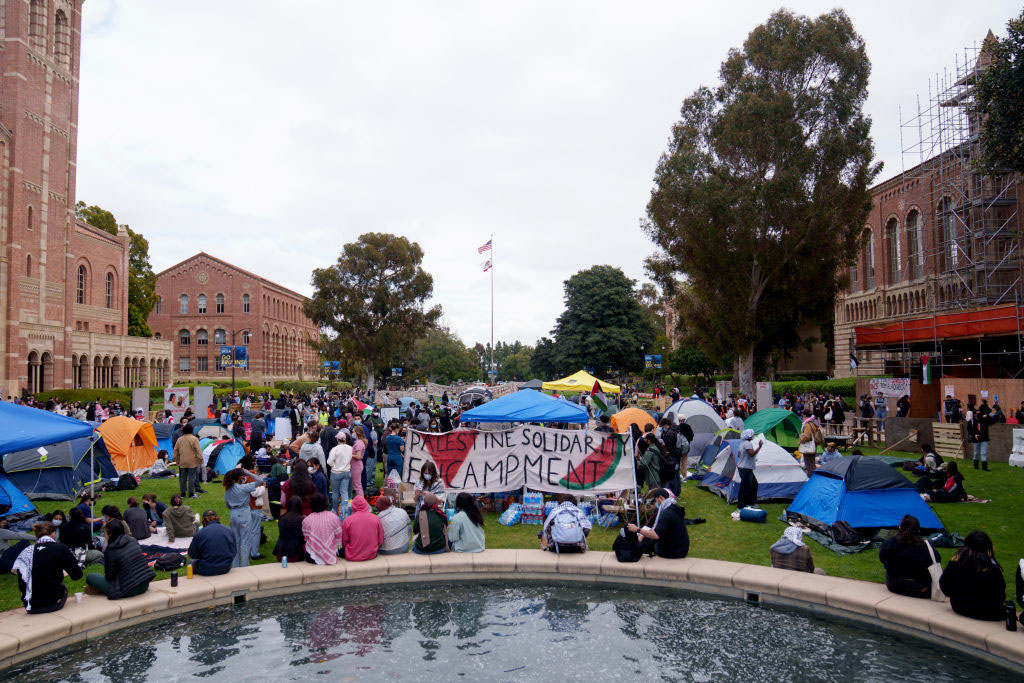
Three Jewish students filed a lawsuit against UCLA on June 5 over the university’s handling of the pro-Palestinian encampment.

The three students are identified as Yitzchok Frankel, Joshua Ghayoum and Eden Shemuelian; The Becket Fund for Religious Liberty and Clement & Murphy, PLLC filed the lawsuit on behalf of the students.

The lawsuit refers to the encampment as a “Jew Exclusion Zone” that was first erected on April 25 in Royce Quad, which was described as “one of the most-frequented areas on campus where students gather during the day and between classes” and “considered ‘the symbol of UCLA,’ distinguished by its impeccable beauty.’’ The lawsuit alleged that members of the encampment “chanted antisemitic slurs like ‘this is the final solution,’ ‘f— Israel,’ ‘death to Jews,’ ‘death to Israel,’ ‘intifada revolution,’ and ‘from the River to the Sea’” and used “antisemitic imagery” such as “inverted red triangles, a common image used by Hamas to denote Jewish targets” and “signs with the Star of David crossed out.”

Additionally, the encampment established checkpoints where people could only be let through if they acquiesced to the encampments’ demands of urging for “an end to the occupation and genocide in Palestine” and for the university to cease ties with Israeli universities. Even then, the encampment would only allow someone to enter if a member of the encampment could “vouch” for them, at which point they would be given a wristband to enter. The encampment would not let any Zionist students enter and did not allow students to enter if they simply wore a Star of David necklace, per the lawsuit.

“On information and belief, a case manager within UCLA’s Office of Equity, Diversity, and Inclusion called a UCLA student on or about May 20, 2024, and asked the student if he was ‘aware that the protesters had an agreement with the University to screen students based on their viewpoints,’” the lawsuit alleged.

The lawsuit proceeded to accuse UCLA of directing university police “not to intervene in the disturbances on campus, including with respect to the encampment and the Jew Exclusion Zone,” citing an April 29 phone call between a parent and a university police dispatcher in which the dispatcher said: “The police are not intervening with that right now, and this is coming from the University. So if you had any questions or concerns, you would take it with the University itself… We have received a directive to not intervene at this time, yes.” Additionally, the lawsuit claimed that the university hired private security around the encampment who “directed students away from the encampment and, in some cases, stated that they needed permission from the activists to access the encampment, essentially acting as force multipliers to the activists manning the barricades.” The security turned away two of the plaintiffs, Ghayoum and Shemuelian, the lawsuit alleged.

The lawsuit also claimed that there are faculty members who supported the encampment, even going as far holding classes and study sessions inside the encampment.

Members of the encampment engaged in acts of violence against those that disagreed with them, highlighting April 28, 2024, when a “female student suffered a concussion after clashing with an encampment member … That same night, another female student was pepper-sprayed by a member of the encampment.”

In an email sent to the campus community in response to the event, Chancellor Gene Block wrote that the encampment was “unauthorized” and had resulted in “instances of violence completely at odds with our values” and “students on their way to class [being] physically blocked from accessing parts of the campus.”  The email also noted that many students felt “bullied, threatened, and afraid … especially our Jewish students, in a state of anxiety and fear,” per the lawsuit. But the university didn’t take action to clear the encampment until the night the encampment was attacked by counterprotesters on April 30-May 1. Even after the encampment was cleared on May 2, groups involved like Students for Justice in Palestine (SJP) insisted that they “will not rest”; on May 6 and 13, pro-Palestinian protesters tried to occupy Moore Hall and block two campus parking structures, respectively; there was an attempt to establish a second encampment on May 23 that was thwarted by law enforcement.

The lawsuit then covered the experiences of the plaintiffs. Frankel, a UCLA law student and Orthodox Jew, was allegedly approached by “a masked female student” on April 25 who held an inverted red triangle sign at his face while Frankel was participating in a peaceful pro-Israel rally. Subsequently, “masked participants in the encampment left the encampment and surrounded these observers, including Frankel, tearing at their signs and pushing them.” “Security not only failed to intervene, it actively assisted the encampment participants,” the lawsuit alleged. “A UCLA security guard brought out metal barricades and directed other staff to set up the barricades around the protesters — in effect expanding the protected area of the encampment and leaving Jewish students including Frankel stranded inside … Later, three masked female students holding a triangular red bike light stood in front of Frankel, mocking him and taking pictures.”

Ghayoum, a second-year undergraduate student who is also religious, was blocked twice by the encampment from getting to his desired destination; the first time, he had planned to study at Powell Library, but left when security would not let him through. The second time, he was going to meet a friend at Ackerman Union, when he was stopped by a man at Janss Steps who told him he could not continue forward without a wristband. “Ghayoum attempted to continue walking, but the individual signaled for three other male individuals of the same approximate age to join him,” the lawsuit stated. “The four men stood in a line in front of Ghayoum, repeatedly demanding to see his hands and wristband and telling him he could not walk down Janss Steps. The four men aggressively walked toward Ghayoum, forcing him to walk backward away from the Steps. Occasionally, the activists made physical contact with Ghayoum.” Ultimately, Ghayoum decided to cancel meeting with his friend.

Ghayoum’s history professor allegedly held extra office hours near the encampment as a means to give encampment members a chance to meet with him and also scheduled a “teach-in at or near the site of the encampment” instead of having regular class; Ghayoum allegedly told students the teach-in wasn’t mandatory because “there are folks so traumatized by the fascist/zionist/police assaults on those very grounds that returning can be triggering.”

Further, Ghayoum has a class held at Haines Hall, which is near Royce, and because the encampment made him feel unsafe, he skipped “at least four days of class” at Haines and listened to recordings of the lecture instead.

The last plaintiff, Shemuelian, is a law student and an observant Jew. According to the lawsuit, she and other students donning “Jewish garb such as kippahs and Stars of David or holding Israeli flags” observed the encampment on April 26; Shemuelian alleged that a member of security told her that she needed to leave if she wasn’t going into encampment (Shemuelian was just watching in silence). She also accused multiple security members of mocking her and other Jewish students, “laughing at a male student singing in Hebrew who was yelled at by activists, jeering at the students when they professed anger at not being able to pass through, and repeatedly telling Shemuelian and the other Jewish students that they needed to leave.”

Additionally, Shemuelian alleged that she had to park near the encampment due to parking restrictions to get to her law classes and had to walk by the encampment and was forced to hear “antisemitic chants” and see “antisemitic signs in her face.” She claimed that her request that she not come to campus for her final exam due to safety concerns from the encampment was denied and appeals for reconsideration ignored.

The lawsuit contended that the university’s handling of the encampment was inadequate and cost the plaintiffs equal access to educational opportunities as well as caused the plaintiffs emotional and physical distress; therefore, the lawsuit argued that the university violated state and federal laws protecting free speech and civil rights.

“If masked agitators had excluded any other marginalized group at UCLA, Governor Newsom rightly would have sent in the National Guard immediately,”Becket President and CEO Mark Rienzi said in a statement. “But UCLA instead caved to the antisemitic activists and allowed its Jewish students to be segregated from the heart of their own campus. That is a profound and illegal failure of leadership … This is America in 2024 — not Germany in 1939. It is disgusting that an elite American university would let itself devolve into a hotbed of antisemitism. UCLA’s administration should have to answer for allowing the Jew Exclusion Zone and promise that Jews will never again be segregated on campus.”

George Mason University Professor David Bernstein posted on X “I was wondering when a serious lawsuit would hit UCLA over its toleration of, and indeed collaboration with, a pro-Hamas encampment which closed off parts of campus to anyone, especially Jews, whom the encampers didn’t approve of,” adding that “even before this lawsuit was filed, it was widely reported that UCLA had instructed its security to work with the encampment rather than helping students exercise their right to not have their movement on campus restricted by the pro-Hamas thugs. I don’t see how UCLA wins this one.”

In a later post, Bernstein wrote that he’s “a bit surprised that, though the complaint notes several times that miscreants were masked, it does not note that masking to conceal identity is a crime in California”

UCLA Vice Chancellor for Strategic Communications Mary Osako said in a statement to The Journal, “We are aware of the lawsuit that has been filed, which to our knowledge, has not yet been served. We will review and respond in due course. UCLA remains committed to supporting the safety and well-being of the entire Bruin community.”

Three Jewish Students File Lawsuit Against UCLA Over Pro-Palestinian Encampment Read More »

Turning Heartache into Triumph: How Chana Leah Lacesa Is Helping Parents Navigate Autism Support Systems

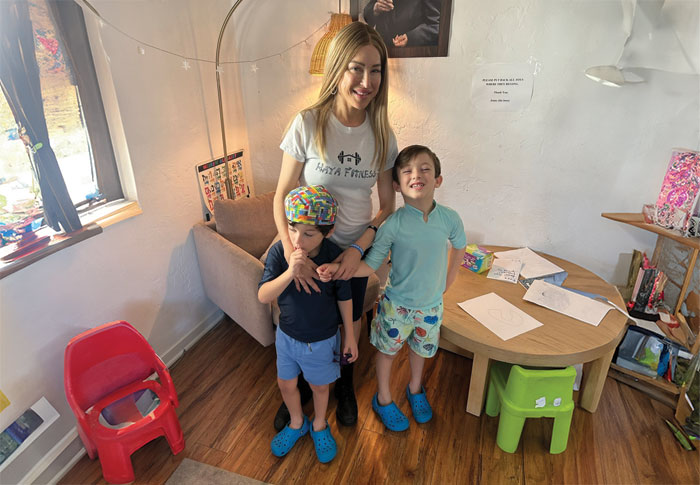
In 2020, Chana Leah Lacesa suffered a great tragedy: Her husband suddenly passed away, leaving her with two young children, age two and three. A few months later, her younger son was diagnosed with autism. It would have been understandable if the young mother had broken down, feeling desperate and angry. Instead, she made it her mission to get the best help possible for her son.

Four years later, Lacesa had opened her own consulting company, helping parents of children with autism navigate the system and understand how they can also get help. Early intervention is pivotal for a child’s development, but it can be overwhelming and confusing.

“It’s not easy to discover all the benefits that are available to you,” said Lacesa. “Thank God I’ve been able to get a ton of support for my son, and I’m very grateful for this. There was one woman, a Lubavitch Rebbetzin in Orange County, who really helped me. She held my hand and mentored me through the process, and because of her, I was inspired to mentor others.”

Many parents struggle with the possibility that their child might have special needs. Once they acknowledge that and seek help, they find themselves confused by where to go from there and what resources are available to them. For many parents, the first stop is the regional center, but Lacesa stresses it’s just one of many.

“There are a lot of things the regional center doesn’t tell you,” she said. “There are many programs and a lot of paperwork. It’s not easy to understand how to navigate through all of these. A couple of years ago, I hired an advocate agency that has been tremendously helpful. Every time I applied for something and got rejected, they told me the right forms to fill out for an appeal. They helped me with the program that pays parents as providers and with the regional center. It’s really been invaluable.”

Prior to the diagnosis, Lacesa suspected that her son had autism. He failed to make eye contact and was delayed in speaking and walking. When he was finally diagnosed, it didn’t come as a shock, but hearing the confirmation was extremely hard. It made it all real and final.

“They called me one day and said, ‘We have the results. Your son is on the autism spectrum,’” she said. “I was very overwhelmed. Because UCLA is a large hospital, it’s not a hands-on approach. They just said, ‘Call us in a few months, here are some numbers to call, here are behavior therapists, etc.’ Thank God I was able to see a private developmental pediatrician who, although more expensive, works with you on a very personal level, holds your hand and is much more thorough than UCLA.”

She continued, “You go through the five stages of grief: Denial, anger, all these things. I was very overwhelmed because it was five months after my husband died and I was still grieving but couldn’t focus on the trauma. I had these two little boys to take care of and I put all my energy into them.”

With the assistance of the regional center, speech therapists and a world-renowned program in another state, Lacesa’s son received the best help he could get. His progress and development were reassuring and encouraging. Today, he attends a private Jewish school with behavioral support. 

“He’s doing great, which is a testament to our supportive team. One day at a time. It’s a journey for sure,” said Lacesa. 

Having children on the spectrum, especially those with more severe autism, requires parents to dedicate long hours to seeing specialists, working with therapists and taking their child to classes. It’s no wonder that one parent often chooses to leave their job to dedicate their time to their child. There simply isn’t enough time in the day to have a job and take care of a special needs child.

“My full-time job is caring for my children,” Lacesa said. “Prior to that I worked for 15 years for attorneys but thank God I was able to stop working for now and raise my boys.”

Seeing the great improvement her now 6-year-old son achieved, Lacesa decided to take the knowledge and experience she accumulated and open a consulting company where she will offer help to parents like her. 

Seeing the great improvement her now 6-year-old son achieved, Lacesa decided to take the knowledge and experience she accumulated and open a consulting company where she will offer help to parents like her. 

“I want them to understand what resources are available, recommend therapists, schools and programs, and assist in completing paperwork,” she said. “Early intervention is key.”

One of the things Lacesa recommends is to get the child diagnosed as soon as possible. It takes months to get a diagnosis, so once you suspect your child is on the autism spectrum, don’t hesitate – put yourself on the waiting list.

“The regional center provides assistance for life, but you need an autism diagnosis,” she said. “This can take months because the regional center has its own method of diagnosis. It’s pivotal to be on the waiting list immediately when you suspect something. Early diagnosis and intervention are key.”

California is a great state for children on the autistic spectrum because of all the programs that are available to them. To get this assistance, however, the parents will need to work hard. 

“You have to be persistent,” Lacesa said. “There are programs, but you need to prove that your child can hurt himself to get certain supports. Regional centers are overwhelmed, so my biggest advice is to stay on top of your case manager consistently. An advocate can really help by writing on your behalf, filling out paperwork, and following up.”

To contact Chana Lacesa, email chanaleahlacesa@gmail.com

Turning Heartache into Triumph: How Chana Leah Lacesa Is Helping Parents Navigate Autism Support Systems Read More »

Heritage Retreats: A Scenic Getaway for Jewish Collegiates Seeking Meaning

While many American Jews have been angered by the antisemitic, anti-Israel encampments and protests this spring on college campuses, some see an upside. 

“The protests have created a spike in unprecedented interest in Judaism among college students,” Rabbi Mordechai Kreitenberg said. “Jewish young people are looking to be together with the tribe, the expanded mishpocha.”

That is not merely an idle observation. 

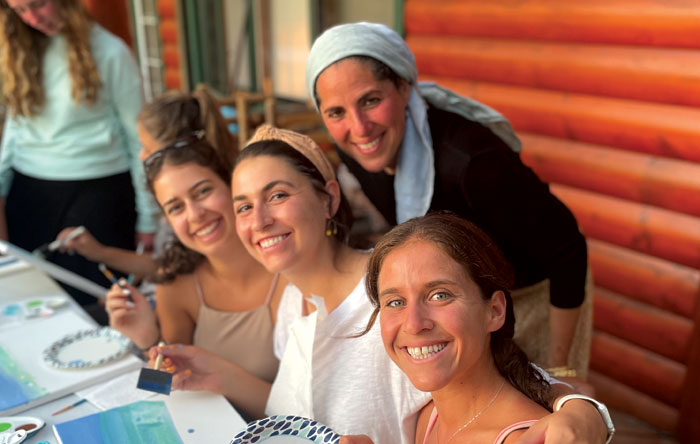
Twenty-five years ago, the Los Angeles native founded Heritage Retreats with two friends — Ken Alter, a classmate at UC Berkeley, and Rabbi Aron Dov Friedman. They provided affordable week-long summer and winter camps for college students (men and women between 20 and 32).

Asked why there are so many “Jews for Palestine” activists on campuses, Kreitenberg shrugged. “You always will have Jews who are on the fringe,” he said. But for the “vast majority of Jews who are in the middle ground,” he said, “what has been happening this spring has been an awakening. They have been forced to see the values in Judaism they were educated with that basically were synonymous with liberal values. Now these have come into question.”

Kreitenberg said Jews need to answer two questions: “What is my Judaism? What does it really mean?” Heritage Retreats, he explained, was born in 1999 as “a personal quest to engage a disenfranchised generation.” 

Kreitenberg said Jews need to answer two questions: “What is my Judaism? What does it really mean?” Heritage Retreats, he explained was born in 1999 as “a personal quest to engage a disenfranchised generation.” 

The Beverly Hills High School graduate, who attended Beth Jacob Congregation with his family, said the telling moment occurred at the 10-year reunion of his high school class.

“Despite the fact 93% percent of the graduating class was Jewish, when I looked around the room, I realized it was a complete wash for the Jewish people,” the rabbi said. “There wasn’t any connection or sign of Jewish identification.”

In that moment, a career path was born.

“I felt as if something had to be done for young people in order for Jews to realize the value of their heritage,” the rabbi said. “It’s not just an ancient wisdom relegated to the synagogue or to some library. Rather, it is alive, vibrant and speaks to my everyday life and all of my human needs.” He got together with Alter and Friedman and “decided we would create a living and learning experience up in Yosemite” the rabbi said. 

In 2000, the three friends rented a small lodge in Yosemite to host young Jews in a setting where they could disconnect to re-connect to their heritage.

In the initial stages, Rabbi Kreitenberg used to go from campus to campus, talking to Jewish students, recruiting them to participate in the new program. Over the past 25 years, the rabbi has seen an evolution in young peoples’ identification with their Jewish heritage.

The decades of the ‘60s and ‘70s were a period of seekers, he said. The following decades brought a direction change. “The idea that there was a capital ‘T’ in truth became a small ‘t’ for most young Jewish people,” Kreitenberg said.  “And they are looking for what their truths are. Within the journey young people are exploring, our faith has a tremendous amount to offer about who we are as a person and our relationships with the people most important to us – our parents, our siblings, our spouse. Therefore, it provides critical additional insights we otherwise are missing.”

When they started, Kreitenberg said, “I thought what was most common was the kids we were bumping into were from Conservative Jewish homes. That slowly dried up, though, since that segment of the population slowly has diminished. He cited a Pew study that came out 10 years ago contrasting the three major movements within Judaism. 

“It accurately describes where we are now. Kids nowadays don’t come from Reform or Conservative homes. They come from Jewish homes with absolutely no affiliation. That is the norm.“ The critical difference between the decades is the passion. “Whereas once upon a time there was an existential conversation whether Judaism is truth with a capital T, now the question is ‘how does Judaism fit into my life, and how does it make me a happier person?’”

The rabbi noted that Heritage Retreats campers were wandering Jews for two decades. In 2021, Heritage purchased a 40-acre ranch in Whitefish, Montana (pop. 10,000), to have a campus and a meeting spot where students from all over the country could convene and explore their roots.

People ask Kreitenberg why Montana, why Whitefish, 1350 miles from Los Angeles? He is prepared. “Montana is the fourth largest state in the union,” he said, “and it has one of the smallest populations. Montana is one of the last frontiers. You also get Glacier National Park [half an hour away], one of the most beautiful [places].”

Heritage Retreats is 10 minutes from downtown Whitefish. “You don’t have the background noise of the cities in population centers,” said the rabbi, “and cowboy culture is the only culture in the state.”

The rural Whitefish setting fulfills the commitment to create an environment where students can disconnect. 

The setting is ideal, he explained.

“When you are able to see the wonders, the beauties of nature, it opens up a part of yourself that is more spiritual.” – Rabbi Mordechai Kreitenberg

“We take groups of young people for one week at a time. This gives them an opportunity to both explore their roots and explore some of the most beautiful places in North America. Those two factors enable a person to recalibrate. When you are able to see the wonders, the beauties of nature, it opens up a part of yourself that is more spiritual.” Alumni regularly testify the camp experience has enabled them to find a north star, that it has been a way of gaining their bearings in a turbulent world.   

Each Heritage Retreats session is one week. The basic structure is classes in the morning, hiking and other activities in the afternoon. This schedule is intended to enable the young men and women to process what they have learned, and to develop a sense of Jewish community and bonding.

The cost is $249, which, Kreitenberg said with a smile, covers about five minutes. That he said, still smiling, is why he spends the rest of his year fundraising. 

To learn more: https://heritageretreats.com/about/

Heritage Retreats: A Scenic Getaway for Jewish Collegiates Seeking Meaning Read More »

Matan Honors Contributions to Disability Inclusion

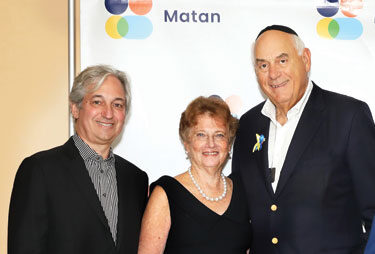
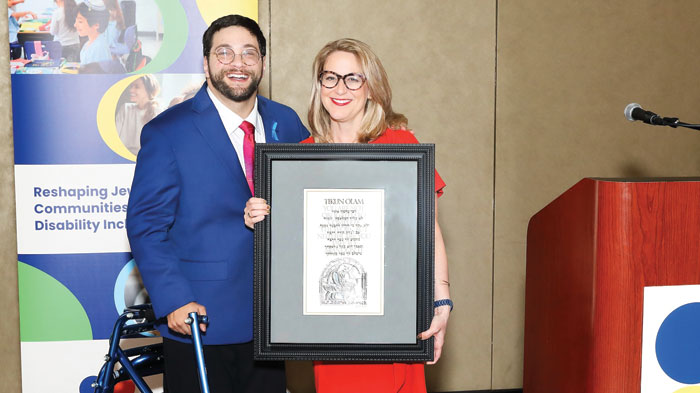
On May 29, Matan honored ABC’s “The Good Doctor,” along with Rabbi Shai Held and Aaron Kaufman, at its annual gala. Matan is a New-York-based, national nonprofit organization, dedicated to promoting disability inclusion and belonging in Jewish communities.

Aaron Kaufman and Dori Frumin Kirshner

“Every year we recognize several honorees with awards,” Dori Frumin Kirshner, Matan’s executive director, told the Journal. “Each honoree embodies our mission of disability inclusion in communities.

Past honorees include the late actor Ed Asner; comedian Pamela Rae Schuller; “Sesame Street”’s Emily Perl Kingsley; author Andrew Solomon (“Far from the Tree); the late Judy Heumann, matriarch of the disability rights movement; Jewish filmmaker Ilana Trachtman and disability rights advocate Matan Koch.

“The Jewish community is only as strong and vibrant as its ability to include individuals with and without disabilities,” Kirshner said. “We exist to ensure that disability inclusion is a priority, and that every Jewish community has the tools and knowledge necessary to promote successful and meaningful inclusion.” 

Kirshner hopes Matan’s work results in inclusion and belonging becoming the norm, rather than the exception.

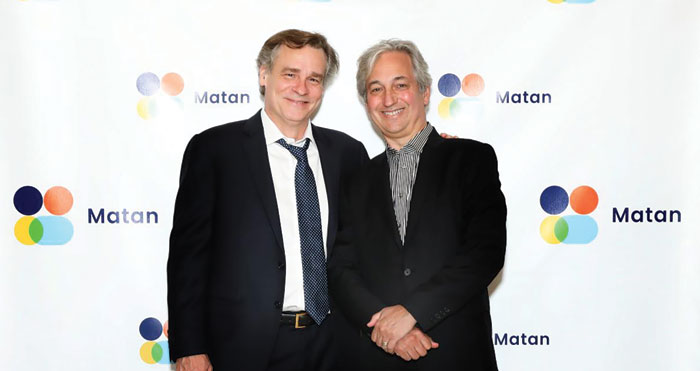
Actor Robert Sean Leonard and David Shore

Held, who is the president and dean of the Hadar Institute in New York City, received Matan’s Leadership Award. One of the most influential American Jewish thinkers and leaders, Held’s most recent book, “Judaism Is About Love,” was gifted to the attendees. 

“Through this award, we honor his erudition, his teaching and writing, as well as his openness in sharing his life experiences living with a chronic illness, enabling others to better understand that one can be both incredibly accomplished and productive while also contending with a condition that to most is invisible,” Kirshner said.

“Judaism places such a high premium on seeing the unseen, remembering the forgotten, paying loving attention to those who are too often relegated to the margins.” -Rabbi Shai Held

Held told the Journal he has much admiration for Matan. “Judaism places such a high premium on seeing the unseen, remembering the forgotten, paying loving attention to those who are too often relegated to the margins,” he said. “That is so much of what Matan is about.” 

He called Matan a Kiddush Hashem, a sanctification of God’s name, a way of enabling God to be more present in the world. 

“It feels like human history is – or ought to be – a journey towards more and more people seeing and honoring the full humanity of every last person on this earth,” he said. “Disability inclusion (embrace, not merely inclusion!) is thus a major mitzvah and an ethical imperative.”

Kaufman, the Jewish Federations of North America’s senior manager of legislative affairs, was presented with the Impact Award. This was recognition of his commitment and partnership, working to create inclusive Jewish communities. He focuses on disability and poverty issues and is a member of the Maryland House of Delegates. 

Kaufman considers the Matan staff kindred spirits, and said it is special to be honored by the organization. “People sometimes think including people with disabilities will be a headache or detract from the experience of those without disabilities,” Kaufman told the Journal. “However, people with disabilities enhance and enrich the experience for everyone.”

Jason Lieberman

When asked what inspired his work, Kaufman said, the memory of his late brother drives him. “My brother Jay Kaufman was quadriplegic and needed assistance with all activities of daily living, such as showering, feeding and toileting,” he said. “Even though, like him, I have CP [Cerebral Palsy], my brother taught me the importance of advocating for those with more significant needs.”

During the gala, the Trailblazer Award  was accepted by “The Good Doctor”’s  executive producer and co-showrunner David Shore on behalf of himself, executive producer and co-showrunner Liz Friedman and executive producer Erin Gunn. The award expresses Matan’s heartfelt gratitude for “The Good Doctor” and its profound impact on viewers worldwide.

“The Good Doctor“’s groundbreaking portrayal of Dr. Shaun Murphy, a young surgeon with autism and savant syndrome, both entertained viewers and sparked crucial conversations about the abilities, challenges and aspirations of individuals with disabilities.

“For the past seven years, the show has demonstrated the importance of focusing on ability versus disability, and showcasing what is gained when everyone is included,” Kirshner said. “The show has portrayed so many different types of issues: congenital, acquired, cognitive, behavioral, those that impact mental health; it’s been a masterclass on raising awareness about disability inclusion and belonging.”

Shore said he’s very honored for the show to be recognized, although a little bit surprised, as it’s “people doing great work honoring someone who pretends to do great work,” he told the Journal. “I quickly learned, when I started ‘The Good Doctor,’ that the show was much more interesting when we learned from him than the other way around,” Shore said. “We think we know stuff. We’re comfortable in our worldviews, but we need someone to come along and make us a little uncomfortable and shake those views and help us grow.”

Learn more about Matan and this year’s honorees at MatanEvent.org

Matan Honors Contributions to Disability Inclusion Read More »

JNF-USA Screening, AFMDA Ambulance Dedication, Simms/Mann Foundation

At Jewish National Fund-USA’s (JNF-USA) Women for Israel screening of the documentary film, “Al Tira: Diary From a Nation at War,” the filmmaker Jonathan York said he wasn’t planning to make a film when he visited Israel this past December.

“I went with no intention of creating a film…I just instinctively started to record,” he said at the May 29 event, held at Sinai Temple.

JNF-USA National Campaign Director Sharon Joy, JNF-USA Greater Los Angeles Co-Presidents Fred and Susie Toczek and JNF-USA Greater L.A. Executive Director Lou Rosenberg. Photo by Moshe Elgrably Photography

The result is an emotionally stirring, 30-minute film — shot on an iPhone — of Israeli society coming to terms with life in the aftermath of Oct. 7. “Al Tira” — Hebrew for “fear not ”— follows York as he visits kibbutzim targeted in Hamas’ attack, as he attends funerals of fallen IDF soldiers and as he comes across protests in Tel Aviv convened by the family members of hostages. In the film, he explains that as a Persian Jew he’s had a lifelong connection with Israel, and he felt compelled to visit the country after it suffered what was the most tragic event for the Jewish people since the Holocaust.

Since the completion of the film, York, along with JNF-USA, have organized in-person screenings of the film in cities including Los Angeles, New York and Tel Aviv.

In an interview, York, who grew up in Los Angeles and works professionally as an attorney, said he prefers screening the film in communal, in-person settings rather than making the film available online. He’s foregoing reach, he said, “for depth.”

Attendees of the screening included Sinai Temple Co-Senior Rabbi Erez Sherman, attorney and activist Sam Yebri and several JNF-USA staff-people and leaders, including JNF-USA Greater Los Angeles Co-President Susie Toczek; Executive Director Lou Rosenberg; National Campaign Director Sharon Joy; and Director Neuriel Shore.


L.A. couple Barak and Indre Raviv spearhead an ambulance dedication ceremony for Magen David Adom, Israel’s national emergency medical service. Photo by Vince Bucci Photography

A community of donors in Los Angeles, led by Barak and Indre Raviv, dedicated an ambulance to Magen David Adom in Israel, the national emergency medical, disaster, ambulance and blood bank service. This gesture was a direct response to the tragic events of Oct. 7 in Israel.

Raviv, a financial advisor in wealth management, along with his wife, Indre, a senior vice president for a cybersecurity company, spearheaded this humanitarian effort. The couple was moved by the recent attacks and felt compelled to make a tangible difference. Their initiative culminated in a touching ceremony attended by 150 donors, supporters, family members and friends, held at The Community Shul in Pico-Robertson.

During the ceremony, Raviv dedicated the ambulance in memory of his grandmother, Sara Mostysser, who died in Israel on her 101st birthday. In his emotional speech, he shared a cherished lesson from his grandmother, saying, “My Bubby always taught us that talk is cheap and if you want to get something done, you need to do it yourself!”

The evening was further enriched by the soulful performances of Israeli singer Liyah Bey Lapidot, whose songs added a poignant backdrop to the event. Speakers included Rabbi Pini Dunner, Marcus Freed and Janet Morgan, the director of philanthropy for the American Friends of Magen David Adom for the West Coast. Miriam and Dana Raviv, Barak’s mother and sister, spoke of Mostysser’s love for Israel and the Jewish people. Each speaker highlighted the role of Magen David Adom and the profound impact of the community’s support.


Victoria Mann Simms. Photo by Jonah Light Photography

Local Jewish philanthropist Victoria Mann Simms spoke at a celebration, held May 28 at the Luxe Sunset Boulevard Hotel, honoring the 2024 recipients of a three-year campaign recognizing extraordinary nurses. 

Etti Rosenberg with Victoria Mann Simms.
Photo by Jonah Light Photography

At a time when the nursing care crisis is growing in urgency on a national and global scare, the campaign, “Off the Chart: Rewarding Nursing Greatness,” awarded 40 nurses from four leading Los Angeles-area health systems—Cedars-Sinai, City of Hope, UCLA Health and Keck Medicine of USC—each with an unrestricted financial gift of $10,000. Ten nurses were recognized from within each healthcare organization. 

The campaign, an initiative of the Simms/Mann Family Foundation, is currently in its second year. The announcement of this year’s honorees coincided with National Nurses Week.

At the Luxe, speakers included Etti Rosenberg, an Israel-based, globally recognized nurse innovator. 

JNF-USA Screening, AFMDA Ambulance Dedication, Simms/Mann Foundation Read More »

A Bisl Torah – Always in Reach

I had the blessing of addressing our Sinai Akiba Academy 8th grade graduates and this is the story and message I shared:

As many know, the stories about the people of Chelm are completely absurd. They are considered a silly group of fools, characters that have little sense of the world. Often, Chelm stories provide a greater, deeper lesson.

One day, the people of Chelm were concerned to learn about a robbery in the synagogue. Thieves stole the tzedaka box! The Chelm leadership decided there was only one solution: construct a new tzedaka box and hang it from the ceiling! No chance for a robbery with that idea. The tzedaka box would be properly out of reach.

Other Chelm leaders countered the solution. How would anyone contribute back to the shul and give tzedaka to those in need? The leaders pondered the issue and came up with what they saw as an ingenious compromise: they would construct a stairway leading all the way up to the tzedaka box.

See what I mean about the people of Chelm?

But here is the greater lesson: we cannot let our Judaism be out of reach.

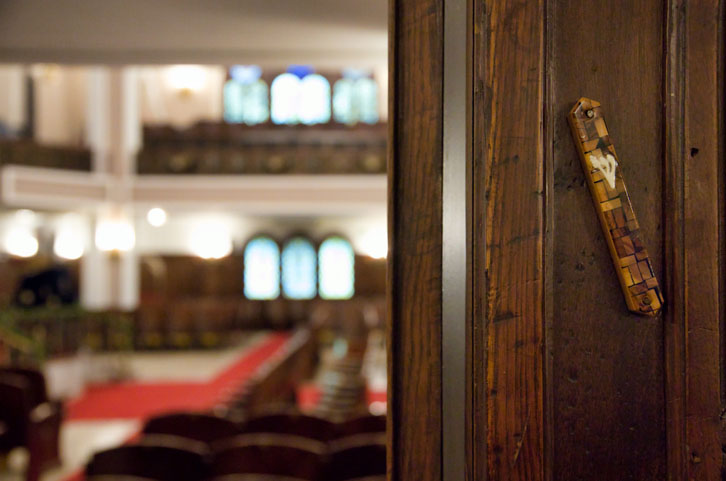
When one attends a Jewish day school, especially one within a synagogue, Jewish life is engrained in every moment. Mezuzot on the doorways, tzedaka boxes in classrooms, a ner tamid and sanctuary within which one prays. A flag for Israel turning our hearts towards Jerusalem. Judaism at our fingertips! And when one graduates and Jewish life doesn’t come as easily, the challenge is simple: will one let the synagogue and Jewish living become out of reach? Will one need to build a staircase to come closer to Jewish life that was once part of the every day?

My prayer to you on your graduation day: Let a synagogue always be within reach. Let Jewish living be close to your heart. Let the words of our faith and the traditions of our people remain active within your hands. Something that perhaps was taken for granted will now become a daily question and constant challenge.

In the future, you may find yourself feeling as if you have wandered away. Far from this holy place of safety, connection and belonging. Far from God. Far from Jewish community.

But don’t forget: your rabbis, your cantors, your teachers and mentors are here to remind you that within a synagogue, any synagogue, and especially within this synagogue, there is always room to find your way. To rediscover and strengthen your Jewish roots.

Just walk through these synagogue doors, the same doors you walked through each morning for class, each morning for tefillot, each morning as you grew from child to young adult. The doors of Sinai Temple, a place in which you will always, always be welcomed home.

And if you let us, we will be your partners in ensuring that Jewish life and Jewish living is as it should be—always in reach.

Mazel tov to our graduates, you’ve made us very proud.

Shabbat shalom


Rabbi Nicole Guzik is senior rabbi at Sinai Temple. She can be reached at her Facebook page at Rabbi Nicole Guzik or on Instagram @rabbiguzik. For more writings, visit Rabbi Guzik’s blog section from Sinai Temple’s website.

A Bisl Torah – Always in Reach Read More »

Creamy Cassola—A Sephardic Cheesecake for Shavuot

About ten years ago, my husband Neil, my daughter Rebekah and I enjoyed a very beautiful vacation in Italy where we visited Rome, Florence and Venice. On our trip, we ate many incredible meals in the kosher restaurants that line the shiny black cobblestone streets of the old Ghetto in Rome. Perhaps my favorite, most memorable moment was discovering the magical baked goods in Pasticceria Boccione a 200-year-old bakery where they still bake in the original oven. 

The Jewish community of Rome is the oldest community in the world outside of the Middle East, with a continuous presence from classical times until today. In 1555, Pope Paul IV decreed that all Jews reside within the walls and locked gates of the Roman Ghetto, which was situated in the Sant’Angelo district. Although most Roman Jews already lived in this neighborhood, this undesirable area was chosen because it was subject to flooding from the nearby Tiber River. The Jews were deprived of property rights (even within the Ghetto), denied work in certain professions and were subject to Catholic sermons on the Sabbath. 

The legacy of the Ghetto is a unique dialect called Giudeo-romanescu, which preserves 16th-century Italian dialect and includes many romanized Hebrew words. The Ghetto is also considered one of Rome’s most charming and eclectic neighborhoods, with its old limestone buildings and the architecturally eclectic, art nouveau structure of the Great Synagogue of Rome, which was completed in 1904 (replacing Cinque Scole, the five ancient synagogues of the Ghetto). 

When I entered that bakery, I noticed many of the pastries looked very humble. I was shocked to notice that some were even burnt. But the bakery’s blackened crostata have a serious history. Those crispy blackened tops have an important purpose because another Papal decree of the 16th century forbade Roman Jews from selling dairy products. So creative Jewish bakers hid a ricotta and cherry filling inside the blackened crust. I was truly enamored of the pizza ebraica, a large flat cookie studded with dried fruit and nuts, which was definitely the best bite I had in Rome. 

Then there’s the Sicilian connection. After the destruction of Jerusalem in 63 BCE, a large number of Jews arrived on the island of Sicily. By the time that the Crown of Aragon took reign over the island in 1412, Sicilian Jews constituted 8% of the vibrant mixed population. They were well integrated into the population and found occupation as philosophers, doctors, builders and farmers.

In 1493, the Spanish Inquisition ordered the expulsion of the 36,000 Jews residing in Palermo, Messina and other cities. Around 2,000 Sicilian Jews fled to Rome, where they settled in the Ghetto. 

They brought with them the recipe for a ricotta cheesecake.

In 1493, the Spanish Inquisition ordered the expulsion of the 36,000 Jews residing in Palermo, Messina and other cities. The majority fled to the friendlier lands of the Ottoman Empire, especially Greece, Cyprus and Turkey, where they were welcomed. But around 2,000 Sicilian Jews fled to Rome, where they settled in the Ghetto. 

They brought with them the recipe for a ricotta cheesecake. This delicious recipe, called Cassola in Italian, has many variations. Some cheesecakes include cinnamon or chocolate, others are citrusy flavored with lots of lemon zest and fresh lemon juice. The one I tasted in the Roman Ghetto featured raisins soaked in rum. It was incredibly light and fluffy and creamy, reminiscent of a custardy flan. I just love the hint of rum and the sweet surprise of the raisins. This might be your chance to try this traditional Italian Jewish cheesecake for Shavuot. (It must be a good recipe because many Catholic Romans bake it for Christmas!)

Buon Appetito!

—Rachel 

Cassola Ricotta Cheesecake

3 cups whole milk ricotta (drained in a cheesecloth or fine sieve for 1 hour)
¾ cup sugar
3 large eggs
1 Tbsp cornstarch
2 Tbsp vanilla
2 Tbsp orange liqueur or rum
1/3 cup golden raisins
1 pinch of salt

In a small bowl, combine the raisins and liquor and allow to soak for 1 hour.
Preheat oven to 350°F degrees.
Lightly grease a springform pan and line the bottom and sides with parchment paper.
In the bowl of a stand mixer, add eggs and sugar, beat on medium speed until mixture is pale yellow.
Add the ricotta, cornstarch, vanilla and salt. Continue beating for an additional 3 minutes until fluffy.
Add the raisins and liqueur and use a spatula to gently combine.
Pour into prepared pan and bake for 60 minutes or until the center barely jiggles.
Allow to cool on a wire rack for one hour, then place in the refrigerator for two hours, or overnight.
Decorate with orange slices or any other fruit. Sprinkle powdered sugar on top.
Serve with fruit and whipped cream.


Sharon Gomperts and Rachel Emquies Sheff have been friends since high school. The Sephardic Spice Girls project has grown from their collaboration on events for the Sephardic Educational Center in Jerusalem. Follow them
on Instagram @sephardicspicegirls and on Facebook at Sephardic Spice SEC Food. Website sephardicspicegirls.com/full-recipes.

Creamy Cassola—A Sephardic Cheesecake for Shavuot Read More »

A Moment in Time: “The Days are Long, and the Years are Short”

Dear all,

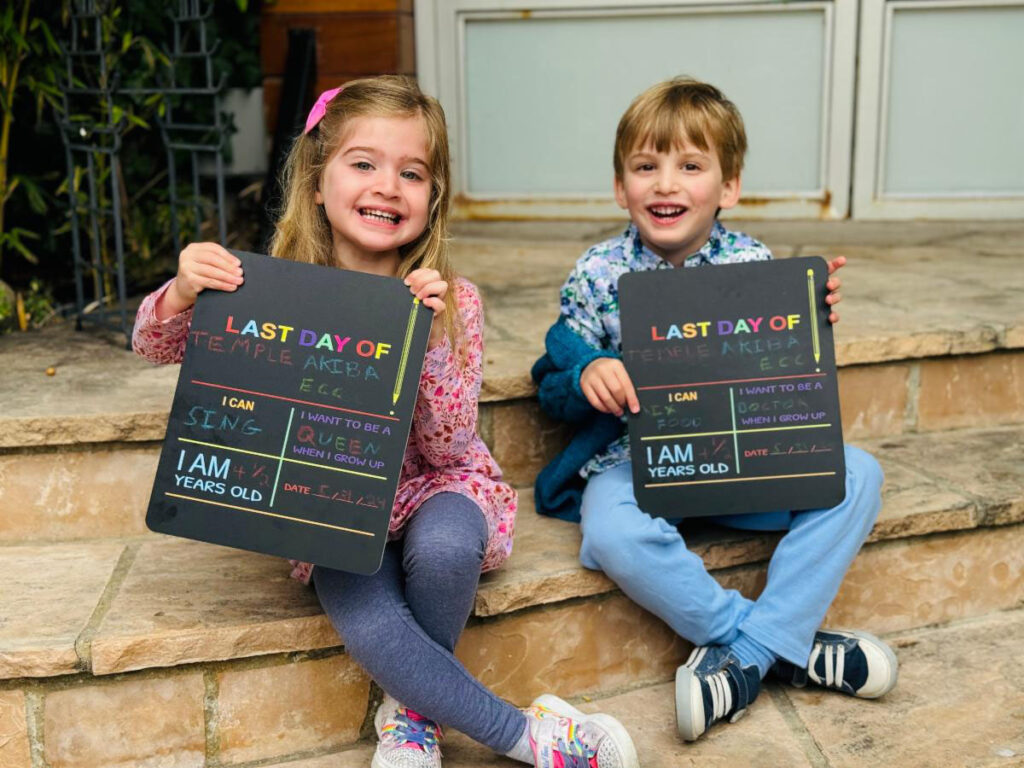
When Maya and Eli entered the world 4.5 years ago, Ron and I were beside ourselves with love, affection …. and exhaustion! There were days we thought would never end.

But, as my mother would say, we blinked our eyes and a year went by.

Last week, they graduated Temple Akiba’s ECC. It’s insane how quickly this happened. Indeed, the days are long, and the years are short. It’s a reminder to savor the hugs, to listen to the giggles, to focus on their adventures, and to be present with their hearts.

Judaism teaches that when Moses ascended Sinai, God instructed him to “be there” (Ex. 24:12).

We can’t and should’t stop time. But we do want to ensure that we do whatever it takes to “be there” so that the years can be bookmarked with each and every extraordinary moment in time.

With love and shalom,

Rabbi Zach Shapiro

A Moment in Time: “The Days are Long, and the Years are Short” Read More »