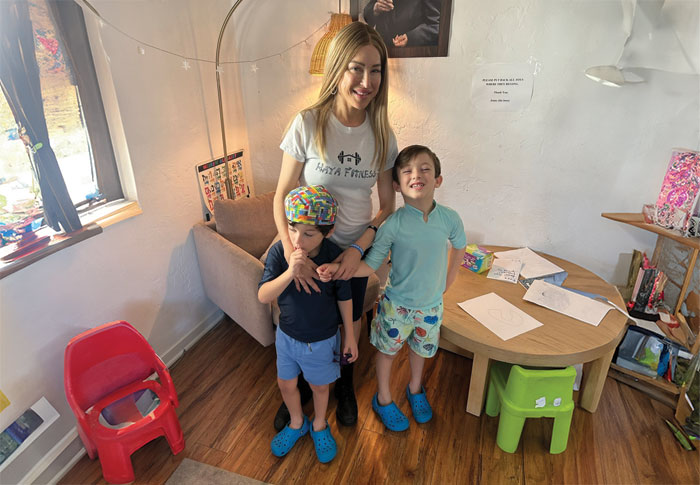
In 2020, Chana Leah Lacesa suffered a great tragedy: Her husband suddenly passed away, leaving her with two young children, age two and three. A few months later, her younger son was diagnosed with autism. It would have been understandable if the young mother had broken down, feeling desperate and angry. Instead, she made it her mission to get the best help possible for her son.
Four years later, Lacesa had opened her own consulting company, helping parents of children with autism navigate the system and understand how they can also get help. Early intervention is pivotal for a child’s development, but it can be overwhelming and confusing.
“It’s not easy to discover all the benefits that are available to you,” said Lacesa. “Thank God I’ve been able to get a ton of support for my son, and I’m very grateful for this. There was one woman, a Lubavitch Rebbetzin in Orange County, who really helped me. She held my hand and mentored me through the process, and because of her, I was inspired to mentor others.”
Many parents struggle with the possibility that their child might have special needs. Once they acknowledge that and seek help, they find themselves confused by where to go from there and what resources are available to them. For many parents, the first stop is the regional center, but Lacesa stresses it’s just one of many.
“There are a lot of things the regional center doesn’t tell you,” she said. “There are many programs and a lot of paperwork. It’s not easy to understand how to navigate through all of these. A couple of years ago, I hired an advocate agency that has been tremendously helpful. Every time I applied for something and got rejected, they told me the right forms to fill out for an appeal. They helped me with the program that pays parents as providers and with the regional center. It’s really been invaluable.”
Prior to the diagnosis, Lacesa suspected that her son had autism. He failed to make eye contact and was delayed in speaking and walking. When he was finally diagnosed, it didn’t come as a shock, but hearing the confirmation was extremely hard. It made it all real and final.
“They called me one day and said, ‘We have the results. Your son is on the autism spectrum,’” she said. “I was very overwhelmed. Because UCLA is a large hospital, it’s not a hands-on approach. They just said, ‘Call us in a few months, here are some numbers to call, here are behavior therapists, etc.’ Thank God I was able to see a private developmental pediatrician who, although more expensive, works with you on a very personal level, holds your hand and is much more thorough than UCLA.”
She continued, “You go through the five stages of grief: Denial, anger, all these things. I was very overwhelmed because it was five months after my husband died and I was still grieving but couldn’t focus on the trauma. I had these two little boys to take care of and I put all my energy into them.”
With the assistance of the regional center, speech therapists and a world-renowned program in another state, Lacesa’s son received the best help he could get. His progress and development were reassuring and encouraging. Today, he attends a private Jewish school with behavioral support.
“He’s doing great, which is a testament to our supportive team. One day at a time. It’s a journey for sure,” said Lacesa.
Having children on the spectrum, especially those with more severe autism, requires parents to dedicate long hours to seeing specialists, working with therapists and taking their child to classes. It’s no wonder that one parent often chooses to leave their job to dedicate their time to their child. There simply isn’t enough time in the day to have a job and take care of a special needs child.
“My full-time job is caring for my children,” Lacesa said. “Prior to that I worked for 15 years for attorneys but thank God I was able to stop working for now and raise my boys.”
Seeing the great improvement her now 6-year-old son achieved, Lacesa decided to take the knowledge and experience she accumulated and open a consulting company where she will offer help to parents like her.
Seeing the great improvement her now 6-year-old son achieved, Lacesa decided to take the knowledge and experience she accumulated and open a consulting company where she will offer help to parents like her.
“I want them to understand what resources are available, recommend therapists, schools and programs, and assist in completing paperwork,” she said. “Early intervention is key.”
One of the things Lacesa recommends is to get the child diagnosed as soon as possible. It takes months to get a diagnosis, so once you suspect your child is on the autism spectrum, don’t hesitate – put yourself on the waiting list.
“The regional center provides assistance for life, but you need an autism diagnosis,” she said. “This can take months because the regional center has its own method of diagnosis. It’s pivotal to be on the waiting list immediately when you suspect something. Early diagnosis and intervention are key.”
California is a great state for children on the autistic spectrum because of all the programs that are available to them. To get this assistance, however, the parents will need to work hard.
“You have to be persistent,” Lacesa said. “There are programs, but you need to prove that your child can hurt himself to get certain supports. Regional centers are overwhelmed, so my biggest advice is to stay on top of your case manager consistently. An advocate can really help by writing on your behalf, filling out paperwork, and following up.”
To contact Chana Lacesa, email chanaleahlacesa@gmail.com