fbpx

April 18, 2024

NSFW – A Poem for Parsha Metzora

And anyone who touches them shall become unclean … ~ Leviticus 15:27

The context of this text is not suitable for work.
The context of this text should be kept away
from young children.

Woe is the bar mitzvah boy who is not ready
to read this text, but somehow has to in front of
his family and friends … and explain it.

The bat mitzvah girl may do okay. It’s a known fact
girls mature faster than boys. I, myself, am still
a toddler next to the wisdom of my wife.

There are words in this text not suitable for
a wider audience. Even the majority of the
narrow audience would prefer not to discuss it.

The don’t forget to wash your hands signs
don’t quite cover what’s going on here.
Suffice it to say the mikveh industry is making bank.

Suffice it to say if you don’t have mikveh money
you should spend a lot of time in the shower.
Or find an ocean, or a river or at least a pond

where things flow freely. Where the creatures
of the pond breathe the water and the ecosystem
is intact. See how we’ve pivoted to nature.

We can always talk about nature, and its beauty.
The clouds, the forest, the aurora borealis!
Everyone wants to talk about the aurora borealis!

But not the images in this text. Diseases and
discharges. I’ve already said too much.
The mikveh people are knocking at my door.

I’m writing them a check.
I’m changing my clothes.
I’m jumping in the ocean.


Rick Lupert, a poet, songleader and graphic designer, is the author of 27 books including “God Wrestler: A Poem for Every Torah Portion.” Find him online at www.JewishPoetry.net

NSFW – A Poem for Parsha Metzora Read More »

Israel War Room Launches in Spanish

Israel War Room is known for pushing out breaking news about Israel and the Jewish community, providing facts about the conflict and keeping followers up to date on their popular social media accounts.

Now, IWR has launched a new initiative: a Spanish account on X called “Centro Mando Israel.” It only tweets and retweets in Spanish and is geared towards Latinos in the U.S., which is the fastest growing segment of the population.

Rep. Alma Hernandez, the outspoken Jewish-Mexican Arizona State House Representative, stands behind the new IWR channel because she believes it’s an important source of information for the community.

“Having Jewish and Mexican roots, I’ve often wished this unique resource was available to native Spanish speakers among my friends and family,” she told the Journal. “Research shows that Israel and the Middle East are topics of profound interest to Hispanic Americans. With its new Spanish-language channel, Centro Mando Israel is poised to meet this need and ensure that my Spanish-speaking constituents, friends and family have a reliable source of information in real-time.”

According to Pew Research Center, Hispanics are the youngest major ethnic or racial group in the U.S.; nearly 6 in 10 Hispanics are Millennials (ages 28-43) or younger.

A recent Axios poll of 1,012 Latino adults revealed that 40% of Latino adults in the U.S. say that the U.S. needs to push for an immediate ceasefire in the Israel-Gaza War. Additionally, 39% said that the U.S. shouldn’t have any involvement in the conflict.

An article in Israel Hayom from this past February asked, “Is Israel overlooking the most important minority group in the U.S.?” and featured the Jewish-Latina CEO of Fuenta Latina Leah Soibel.

She said that young Latinos are “the future of the United States and of the relationship between Israel and America” and that they “Consume information and form opinions almost exclusively through social media, mainly content in Spanish, but also content in English, presented from a cultural perspective.” In an op-ed for Sapir Journal, Soibel discussed how AJ+, Al Jazeera’s social media arm, is capitalizing on the trend of viewing the world through the lens of race and identity and targeting young Latinos. HispanTV, which is Iranian government TV, sends out the mullahs’ destructive messages to the Spanish-speaking community as well.

“With Hispanic Americans more likely to get news from social media, partly because our community skews young, we have been particularly targeted for disinformation,” said Hernandez.

Centro Mando Israel will aim to counteract that disinformation, providing 24/7 information to a population that has shown they don’t yet have firm views on Israel. After all, their tagline, “Israel’s enemies don’t sleep. Neither do we” is not only relevant in the English-speaking world.

“In a globalized world, public interest in a site as profoundly resonant as the birthplace of Judaism and Christianity, which is also home to the third-holiest site in Islam, is to be expected in all major world languages,” wrote Hernandez, in an op-ed for the Times of Israel. “Spanish is not only the second-most spoken language in the world but also, crucially, the second language of the United States, natively used by a highly sophisticated consumer base with a deep interest in global issues. Thankfully, there is finally a trusted social media resource to help Spanish speakers engage with this complex and impactful issue.”

Israel War Room Launches in Spanish Read More »

Modern Book Bans Echo Past Atrocities and Further Silence Marginalized Voices

Never did we think that in the year 2024, we would have to write an op-ed defending the right of people to read. Yet, here we are.

At the Academy Awards last month, one of the five productions nominated for an Oscar in the Documentary Short Film category was “The ABCs of Book Banning,” which featured school-aged children discussing books that have been challenged, restricted or banned in their schools. Two of the books were “Maus,” a graphic novel featuring cartoon mice reflecting on the Holocaust, and “Anne Frank’s Diary: The Graphic Adaptation.”

Indeed, many targeted books center the stories of individuals representing already-marginalized communities, like LGBTQ+, Black and Jewish characters. As The Forward reported last September, “Three Jewish writers of young-adult fiction are among the 10 most-banned authors … in the U.S.” Stories like “Purim Superhero,” about a Jewish child with two fathers, and “Chik Chak Shabbat,” about a diverse group of neighbors who help a Jewish woman prepare food when she is feeling ill, have been attacked.

While much of the national attention on book ban efforts have focused on more politically conservative states like Florida and Texas, such efforts have been occurring even in states with more liberal reputations, like our own Massachusetts, with greater frequency (perhaps shockingly, Massachusetts had the 4th highest number of attempts to remove books from shelves in the entire country in 2022). The plague of book bans can happen anywhere in the United States—and is happening.

We have seen what happens throughout history when such anti-free-speech, anti-education efforts are permitted to flourish. From the beginning, book bans have been used as a tool to control public beliefs and perceptions, as well as extinguish critical ideas and diversity of thought. The very first book ban in early colonial America occurred in 1637 in what is now Quincy, Massachusetts. Author Thomas Morton’s work, “New English Canaan,” was critical of Puritan customs. Because he dared to challenge existing power structures, Morton was labeled “Lord of Misrule” by Plymouth colony Governor William Bradford, and “New English Canaan” was banned by the Puritan government.

In the Jewish community, many of us have a visceral reaction when we hear about book bans.

As a 2022 column in Publishers Weekly boldly declared: “Book Bans and Antisemitism Go Hand in Hand.” Such efforts evoke in many of us recollections of the notorious Nazi book burning campaigns in May 1933 that included the destruction of works by everyone from Helen Keller to Albert Einstein. There is a direct through-line from that authoritarian regime to ongoing efforts today. Ultimately, book bans not only suppress information and art from public access. They undermine democracy and corrode our very humanity.

Particularly as challenges overwhelmingly focus on works that center marginalized voices, we see two related outcomes: authors representing marginalized communities are more readily silenced; and readers have fewer opportunities to hear about and learn from those with different life experiences, reducing the opportunity for understanding and empathy. In aggregate, book bans are tactics designed to control what ideas people can be exposed to, and to manipulate our understanding of history in order to whitewash it. Topics like slavery and the Holocaust become subject to interpretation at the whim of current political agendas.

Combatting book banning is how we stand up to authoritarians, antisemites, white nationalists and others who would use division as a political tactic to keep us from coming together in a thriving democracy rooted in equity, empathy, and opportunity for all. Last year, Illinois enacted a new law, to become the first state to effectively outlaw book bans. New legislation to combat book banning here in Massachusetts would require libraries to create clear guidelines for how to approach a book challenge, establishing guardrails against insidious efforts to unduly remove books from public access and silence marginalized voices.

In addition to legislation, we can demonstrate support for literary works that have faced challenges, restrictions and bans.

In addition to legislation, we can demonstrate support for literary works that have faced challenges, restrictions and bans. Buy these books from your local bookstore or borrow them from your local library. If they aren’t available, urge your local institutions to carry them as a demonstration of opposition to book bans.

The Jewish community nationally needs to join with our allies and have a much louder voice in the efforts to combat book bans. The Jewish Alliance for Law and Social Action (JALSA) started a Book Ban Action Team last year to monitor book challenges. This year, we started a virtual Banned Book Club over Zoom, where we select, read and discuss banned books and relate the selected book’s themes to issues on our public policy agenda. Further, JALSA is working with a community organization in Tulsa, Oklahoma, to provide them with copies of banned books that they can use to develop their own collection and share them with students who can no longer access these books in their school libraries. If you would like to join in any of these efforts, just contact us!

In 2022, requests to ban books in American schools and libraries “surged” to a 21-year high. Those who employ the authoritarian tactics of book challenges and bans are relentless and vocal, making it appear that they are much more than their actual numbers. We must be just as tenacious in combating this scourge. We cannot take free speech and free expression for granted. Our multicultural, pluralistic democracy depends on it.


Larry Bailis is the Chair and Cindy Rowe is the President and CEO of the Jewish Alliance for Law and Social Action (JALSA), which puts our Jewish values into action by engaging the community in promoting civil rights, protecting civil liberties, and passionately pursuing social, economic, environmental, and racial justice.

Modern Book Bans Echo Past Atrocities and Further Silence Marginalized Voices Read More »

The Power of the Passover Seder to Unite Jews

Passover has long been a favorite holiday of mine; it offers a moment to pause daily life, gather with friends and family around a festive Seder meal, celebrate freedom, and share and teach values learned from Jewish history. This year, just six months after the brutal terrorist attack on October 7th, the Passover holiday is more important than ever for promoting the survival of the Jewish people.

I do not say this lightly. The tragedy that unfolded in Gaza unleashed a global wave of antisemitism. In the United States, hatred against Jews is omnipresent; it can be found on college campuses, in popular culture, in town squares, and in the halls of Congress. And in the face of vitriolic hatred, the Jewish community is deeply fractured, cannot reasonably push back against the hate, and appears to have forgotten the very history that is central to the Passover holiday.

In response to the Hamas attack, Israel has every moral right to defend itself and rid the world of a terror organization that threatens its safety. Far too few Jews recognize that the Hamas Charter calls for the complete destruction of Israel and the annihilation of Jews. Yet, many American Jews—particularly the younger, not traditionally engaged, or with shallow backgrounds in politics and history—have turned on Israel, contributing to an emboldened Hamas and antisemitism worldwide.

The Jewish People are blessed with a wide variety of pro-Israel groups and public figures ranging across a broad spectrum—most notably, the American Jewish Committee, AIPAC, J Street, ZOA, Stand With Us, the New Israel Fund, and many others. That said, there are many vocal anti-Zionist Jewish groups as well. Numerous public figures claim to support Israel with a wide variety of stances—both President Biden and former President Trump claim to be pro-Israel, as do Senators Lindsey Graham and Chuck Schumer, who called for Israelis to oust Prime Minister Netanyahu.

Add to the mix a host of commentators with diverse views from Peter Beinart on the left, Tom Friedman and Bret Stephens somewhere in the center, and Hillel Fuld on the right and we are seeing a sharply divided Jewish community with little tolerance for variations left and right.

David Bernstein astutely observed that there is a growing disconnect between American Jews and mainstream Jewish organizations because “Jewish organizations are reluctant to confront radical trends on the left because the progressive activists they’ve long allied themselves with leave little room for differences of opinion.” The American Jewish community is in conflict between individual organizations and congregations are paralyzed with their constituencies divided and holding vastly divergent views, even as antisemitism and attacks on Israel grow.

This is why Passover this year is so critical for the Jewish community. Passover and the Seder represent one of the few Jewish cultural moments when significant numbers of Jews gather together outside of an explicitly religious context. While Pew has found that only one in five American Jews attend religious services in some form at least once or twice a month, a solid majority of Jews report participating in a Seder, making it the most widely cultural event of the Jewish year.

I hope that as different generations of Jews with sharply contrasting viewpoints gather to retell the story of the Exodus from Egypt there will be a chance to talk about the ties that bind Jews together, the need to protect and support our community, the centrality of freedom for all, and the fact that Israel is the Jewish homeland and has a right to defend itself. The Jewish community must reaffirm its core values, and sadly continue to defend its right to exist—an occurrence far too common in history. But to do this effectively, Jews must sit down and listen to each other, debate, and work together; and all Jews, whatever their points of view, should be at the Seder table.

The Passover Seder is explicitly designed for Jews to engage with difference and disagreement. In fact, a centerpiece of the Seder meal is the Four Sons parable, four types of guests at the holiday dinner who have notably different outlooks: the wise, wicked, simple, and one who doesn’t know how to ask questions. The parable teaches the idea that people understandably approach the world through vastly different lenses and ask questions about understanding the Exodus with varied dispositions.

The Passover Seder is explicitly designed for Jews to engage with difference and disagreement.

For instance, the so-called “wise child” inquires about the specific meaning of the laws of Passover observance: “What are the testimonies, the statutes, and laws which Adonai our God has commanded you?” We then respond with a summary of the very specific laws of the Passover Seder. For the “simple child” who asks a far broader question about the evening and queries “What does this mean?” we give a straightforward summary of the story: “It was with a mighty hand that God brought us out from Egypt, the house of bondage” (Ex 13:14).

While the Seder tradition does not expand beyond providing these short answers to the questions of the Four Sons parable, the exercise explicitly demonstrates that the Seder ritual is about embracing and promoting a multitude of views and disagreements about how to make sense of the world. The Four Sons come to the Passover story with vastly different views and understandings about faith, religious traditions, and how do manage differences with others. The Seder participants are taught not to reject or condemn those who hold views that are aggressively hostile to or uninterested in understanding the Passover story. Rather, participants are shown that we should engage with all types of Jews and embrace viewpoint diversity. The Four Sons teach us that we cannot be dogmatic or narrow about ideas; instead, we must welcome varied views about faith and the world and, like the Seder itself, be open to teaching all at their respective levels and needs.

As Passover is only weeks away, those hosting Seders need to be as inclusive as possible and make a special effort to invite those thirty percent or so of Jews who typically do not attend the Seder. Jews need to talk, argue, reconnect and come to an understanding of what Jews need globally. Social media, polarized politics, extremist politicians and rhetoric designed to divide rather than unite are making connecting harder than ever. But the Seder is designed to address these issues and can help Jews realize that we are in this together, our fate is linked, and we must speak out more strongly and collectively against this hate and the calls for our destruction. This Passover may be the moment to start this crucial process.


Samuel J. Abrams is a professor of politics at Sarah Lawrence College and a senior fellow at the American Enterprise Institute.

The Power of the Passover Seder to Unite Jews Read More »

Dr. Nicole Saphier Reflects on Motherhood and Jewish Advocacy

Dr. Nicole Saphier was just 17 years old when she discovered she was pregnant. Along with the mix of emotions that brought, she also faced naysayers who told her she’d have to give up her dream of being a doctor to take care of her baby.

Fast forward decades later, and Saphier has proved them wrong. Not only is she a proud mother of her son, but she is also a FOX News medical contributor who works as an associate professor in radiology at Memorial Sloan Kettering Cancer Center and Weill Cornell Medical College.

Just in time for Mother’s Day, Saphier has put out a new book called, “Love, Mom: Inspiring Stories Celebrating Motherhood,” which includes stories about motherhood from the doctor herself, along with co-host of “FOX & Friends Weekend” Rachel Campos-Duffy, who discusses raising nine children; bestselling author Janice Dean, who talks about the difficulty in navigating miscarriage; and FOX host Martha MacCallum, who highlights balancing work and motherhood and the importance of being kind to yourself.

The Journal caught up with Saphier, now a mother of three, who is married to Dr. Paul Saphier, a brain surgeon. She talked about “Love, Mom,” overcoming life’s obstacles and advocating for the Jewish community.

Answers have been edited for clarity and length.

Jewish Journal: Why is your book important?

Nicole Saphier: Motherhood is an incredible journey marked by love, sacrifice and resilience. The role of a mother extends far beyond biological ties, encompassing emotional support, nurturing and guidance. Sharing stories of motherhood, particularly ones that recount obstacles overcome, can offer invaluable support and solidarity to mothers everywhere. These narratives inspire hope, foster empathy and provide a sense of community, reminding mothers that they are not alone in their challenges and that their experiences are both valid and shared.

JJ: What do you hope people get out of it?

NS: As a teen mother, I faced numerous challenges and uncertainties, but through perseverance and determination, I’ve crafted a life filled with love, success and joy. Despite the initial obstacles, I’ve grown personally and professionally, proving that with resilience and support, even the most daunting circumstances can be overcome. My story is a testament to the strength of the human spirit and the boundless possibilities that await those who choose to embrace life’s challenges with courage and optimism.

JJ: How has your life changed since Oct. 7?

NS: Since Oct. 7, like many, my life has been marked by change and emotional upheaval. One major shift was my nephew’s departure to rejoin the IDF, a decision that filled our family with both pride and concern. Additionally, the loss of friends who do not support Israel has been challenging, prompting me to reassess relationships and focus more attention on those who share my values and beliefs. These events have deepened my sense of connection to my family and reinforced the importance of standing firm in my convictions, even in the face of personal loss and adversity.

JJ: How do you advocate for the Jewish community?

NS: As a FOX News contributor, I leverage my public platform to advocate for the Jewish community, utilizing my voice to raise awareness about issues affecting Jewish people worldwide. Through my professional services, I maintain a special relationship with the Orthodox community, providing tailored support and guidance that respects their traditions and values. Following the Oct. 7 atrocity, I put together a community event for Jews and non-Jews to gather while I hosted a fireside chat with Lizzy Savetsky, a public pro-Israel voice.

JJ: Is there anything else you’d like to add?

NS: Family is everything; they are the anchor in life’s storms, the source of unconditional love, and the constant support that sustains us through every triumph and challenge. Unfortunately, it seems much of the world is losing sight of the importance of family. I put together this collection of motherhood stories to remind people to cherish their family because in their embrace, we find solace and the true essence of what it means to be cherished and valued.

Dr. Nicole Saphier Reflects on Motherhood and Jewish Advocacy Read More »

Israel’s David Moment

Iran attacked Israel early Sunday morning, April 14. I had just arrived in Israel from the U.S. on Monday. As I took in the resolute spirit on the streets, my mind turned to the biblical story of David. But not the part you might expect.

When we think of David, the iconic image is of the young shepherd squaring off against the giant Goliath. It’s a stirring tale of an underdog’s triumph through faith and courage. And it’s tempting to draw parallels to plucky Israel standing against the Iranian Goliath and its proxies Hamas, Hezbollah, and the Houthis. After all, tiny Israel once again faced down a massive barrage, with over 300 Iranian missiles and drones raining down, nearly all intercepted by technologies like the Iron Dome and David’s Sling.

But there’s another part of David’s story, one that speaks more powerfully to this moment. It’s what happens later, after David becomes king. He inherits a fragmented realm of quarreling tribes, surrounded by enemies. His great achievement is not slaying a giant, but uniting a coalition. David takes the throne and “reigned over all Israel, doing what was just and right for all his people.”

That same unifying spirit was on display in the aftermath of Iran’s assault. This attack was not just answered by Israel, but by a united front of nations standing together against Iran’s aggression and in defense of our shared democratic values.

An extraordinary alliance came together to protect Israel. Jordanian fighter jets patrolled the skies and shot down Iranian missiles. The UAE and Saudi Arabia provided critical intelligence. British and French warplanes joined the effort. U.S. destroyers intercepted missiles at sea. It was a powerful display of collective resolve.

Let’s be clear: This alliance is a historic development. For decades, the U.S. sought to foster military ties between Israel and Arab nations with little success. But in recent years, thanks in part to the Abraham Accords, we’ve seen growing cooperation against the common Iranian threat. When Israel moved under US Central Command in 2021, it enabled unprecedented coordination.

Still, political barriers remained. Wary of Tehran’s wrath, some Arab governments were reluctant to be seen aiding Israel too openly. It took intense diplomacy to bring everyone to the table. The alliance that turned back Iran’s missiles was years in the making — and battled-forged under fire.

Like David uniting the tribes of Israel, we are witnessing the emergence of a regional coalition for collective security and defense of the values we hold dear. Not a formal alliance like NATO, but a growing architecture of shared early-warning systems, joint training, and military cooperation.

Israeli technology also cannot be overlooked. Ingenious systems like Iron Dome and David’s Sling, and even more sophisticated laser-based defenses on the horizon, are not just protecting Israel — they are shifting the regional balance. Iran understands that Israel’s defensive edge is a deterrent it cannot easily overcome.

So while Israel may seem like David against the Iranian Goliath, it is not standing alone. Far from it. This attack has revealed Israel’s hidden strength — the allies and friends who will stand with her in moments of peril. The world is beginning to understand that Israel’s cause is the cause of all who value peace and freedom.

“How good and pleasant it is when God’s people live together in unity!” the Psalmist tells us. As I walk Israel’s ancient streets, those words resonate. The unity on display in recent days — of faiths, nations, and peoples — is a reason for hope.

Iran’s attack was a stark reminder of the threats Israel faces. But the world’s response was a powerful demonstration that the Jewish state does not face those threats alone. In the spirit of King David, Israel is building ties that make it stronger, forging alliances to stand against the forces of aggression and hate.

That is not just good news for Israel. It is good news for the region, for the United States, and for all who yearn for a more peaceful Middle East. The road is long and the challenges are great. But in the resilience of Israel, and the unity of its allies, we can find inspiration to continue the journey.


Rabbi Dr. Ari Berman is the fifth president of Yeshiva University. 

Israel’s David Moment Read More »

Make Felt Seder Plate Elements

How is this seder plate different from other seder plates? Well, everything is made of felt.

This felt seder plate may not be edible but it is certainly enriching, as creating it is a great way to help kids learn about the different items that go on a seder plate.

For this activity, the elements will be:

1) Maror – horseradish
2) Z’roa – shank bone
3) Charoset – apple
4) Chazeret – lettuce leaf
5) Karpas – parsley sprig
6) Beitzar – egg

I’ll illustrate the process of making the felt elements by using the apple as an example.

What you’ll need:

Felt
Scissors
Glue
Polyester fiberfill or cotton balls

1. Trace an apple shape on felt. Stack two pieces of felt on top of each other and cut out the apple shape so you have two identical pieces.

2. Cut out accent pieces that will give the apple dimension. I cut out the white wedge, black seeds and a green leaf. Glue these accents to the felt with a craft glue like Tacky Glue.

3. Apply glue around the edge of one piece. Don’t go all the way around with the glue. Leave one part unglued so there will be an opening. Press the two pieces together and allow the glue to set.

4. Fill the apple with a little polyester fiberfill. You can also use cotton balls.  The one element that does not need to be filled with fiberfill is the parsley sprig.

5. Apply glue to the open edges and press together. A clothespin helps to keep it sealed in place until the glue dries.


Jonathan Fong is the author of “Flowers That Wow” and “Parties That Wow,” and host of “Style With a Smile” on YouTube. You can see more of his do-it-yourself projects at jonathanfongstyle.com.

Make Felt Seder Plate Elements Read More »

Beit Issie Shapiro Gala, David Labkovski Exhibit, de Toledo College Signing Day, JFSLA Shabbat

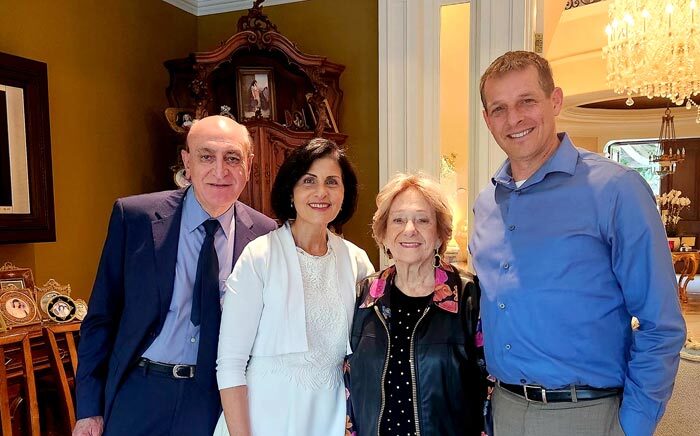
On April 11, a private reception was held at the Beverly Hills home of Dr. Bruce and Roya Torkan in support of Beit Issie Shapiro in Raanana, Israel.

The event was organized to give visiting Beit Issie CEO Ahmir Lerner an opportunity to discuss how Beit Issie’s expertise has been applied and adapted to help rehabilitate severely wounded Israel Defense Forces soldiers by providing customized assistive technology solutions to improve the functional capability and quality of life for people with disabilities.

Beit Issie Shapiro is a global pioneering leader and innovator in the field of disabilities, offering services and scaling models that improve the lives of children and adults with disabilities. The organization seeks to create a more inclusive society by advancing opportunities and rights for people with disabilities. More than 90,000 disability professionals worldwide have been trained by Beit Issie, changing the lives of over half-a-million people annually, globally.

The private event benefiting Beit Issie Shapiro was an introduction for many leading up to the organization’s planned L.A. gala on Oct. 30.


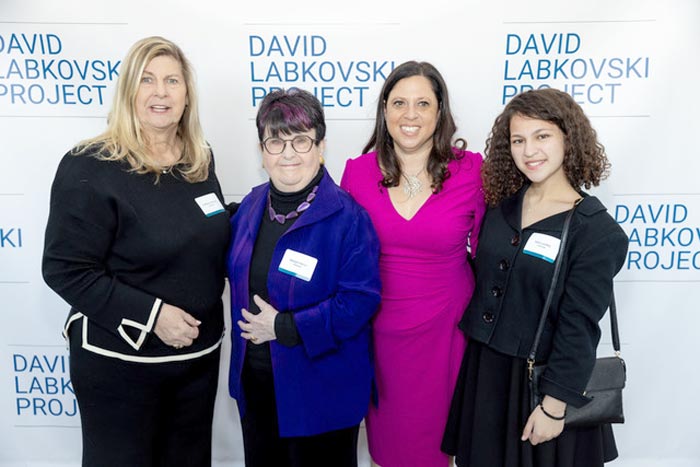
From left: Kathleen Sterling, Marilyn Harran, David Labkovski Project Executive Director Leora Raikin and Katia Lysobey. Photo by Luque Photography

Renowned artist David Labkovski’s art was exhibited at Skirball Museum last month with student docents guiding guests at a sold-out event.The March 17 event was organized by the David Labkovski Project (DLP), a unique educational program for combating antisemitism and educating about the Holocaust. Fusing history and art, DLP is based on the life and art of renowned artist, David Labkovski. The DLP exhibit, ”Documenting History through Art,” has traveled to more than 70 locations.


From left: De Toledo High School student athletes Keller Slotnick, Sydney Greene and James Heller. Courtesy of de Toledo High School

On April 8, de Toledo High School, a college-preparatory Jewish school in West Hills, held a College Signing Day ceremony for three of its seniors: James Heller (baseball, University of Dayton), Keller Slotnick (baseball, Shorter University) and Sydney Greene (diving, United States Merchant Marine Academy).

The three students signed their letters of intent to bring their athletic talents to the collegiate level in the fall of 2024. During de Toledo’s college signing day ceremony, they were honored by staff and spoke about their athletic careers.

“As a former coach, I am in awe of our student-athletes’ determination and grit,” de Toledo Head of School Mark Shpall said. “Having three seniors sign college letters of intent this year—including James Heller’s impressive D1 offer to play baseball at the University of Dayton—is a huge moment for our school.”


On April 12, Jewish Family Service LA (JFSLA) Young Leaders, in partnership with Leora and Gourmet Gatherings, convened 50 young adult philanthropists for a special Shabbat fundraiser.

From left: Madeline Isaacs, Lily Heltzer and Carly Maltzman attend a recent Jewish Family Service LA Young Leaders’ Shabbat fundraiser. Courtesy of JFSLA

The Friday night event, a sold-out dinner held at Beverly Hills café Leora, raised funds for Jewish Family Service L.A.’s Tools for School program, which provides school supplies and other essentials to students in need.

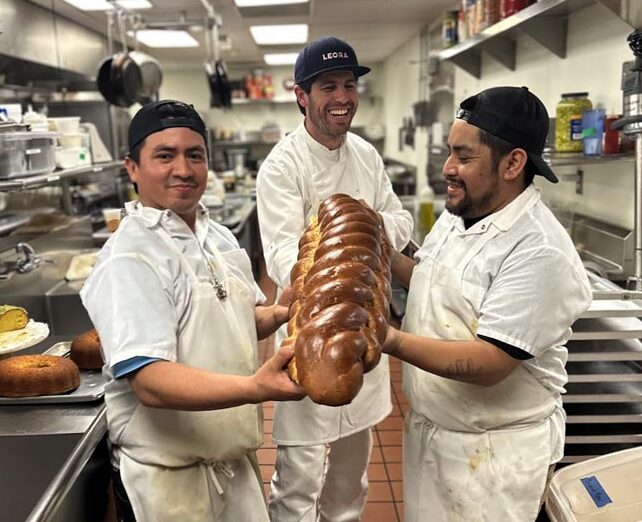
Leora co-owner and head chef Leor Klein (center) with a three-foot long challah from Challahdad.
Courtesy of JFSLA

“As the vice chair of Jewish Family Service LA Young Leaders, I was honored to co-host this event with Leora and Gourmet Gatherings,” JFSLA Young Leaders Vice Chair Maggie Wolf Lewis said. “The evening, which benefited JFSLA’s Tools for School Program, was a way for young philanthropists to gather on Shabbat, nosh on Israeli food and be in community all while supporting the vital work of JFSLA.” 

Attendees included Leor Klein, owner of Leora; real estate professional, philanthropist and reality television star Josh Flagg; and Gourmet Gatherings Founder Carly Maltzman. 

“As the oldest social service agency in the city, JFSLA has done a phenomenal job of taking care of the community, both Jewish and otherwise,” Flagg said.

JFSLA provides services to the city’s most vulnerable people, including those who have needs around mental healthcare, food insecurity, domestic violence, aging, disabilities and more.  JFSLA Young Leaders describes itself as the “next-gen philanthropy arm of JFSLA.”

Beit Issie Shapiro Gala, David Labkovski Exhibit, de Toledo College Signing Day, JFSLA Shabbat Read More »

Is Aaron’s Haroses the New Hummus?

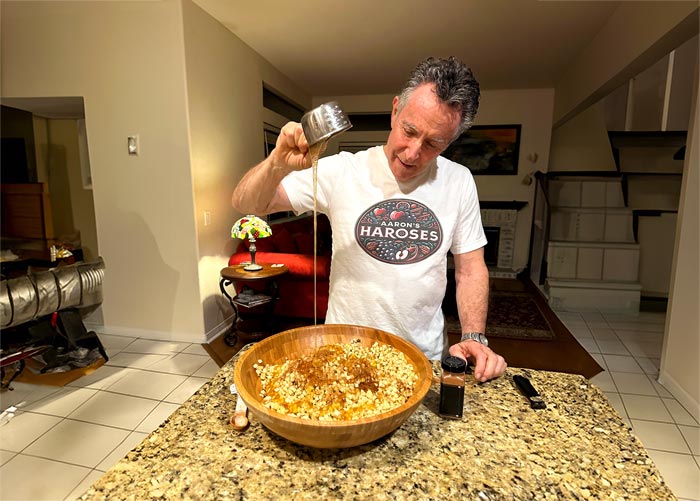
Aaron Weiner, Founder of Aaron’s Haroses, wants to make haroses – aka charoset – a year-round treat.

“Passover is often a potluck,” Weiner, who is also a commercial real estate broker, told the Journal. “In my adult years I always seemed to land the job of bringing the haroses, because I was the one person willing to peel core chop apples all day long.”

He used his grandma Goldie’s simple Ashkenazi recipe, which was always very popular. 

“As I made it from year to year, I would always keep a little for myself,” Weiner said. “It dawned on me: Where’s the law that says you can only eat haroses at Passover?” 

That was when Weiner’s dream of bringing haroses to the masses was born. 

Weiner teamed up with Amy Levy from Amy Levy Public Relations, who he met through ProVisors networking group. She brought on Larry Cohen of Glyphix to do graphic design and branding, web designer Iris Marreck of What A Great Website and food scientist Mark Haas of Helmsman Group. 

“Aaron is going on a journey like we Jews went through the desert during Passover,” Levy, who also serves as project manager and number one fan, told the Journal. “It’s been so much fun because we really do like the product.”

The first run of Aaron’s Haroses — the kosher for Pesach version — was manufactured in the kosher kitchen at Valley Beth Shalom in Encino last Monday and Tuesday. It then becomes part of the congregants’ Passover seder catering packages.

“All we did was translate Aaron’s original recipe to bring it as close as possible to the traditional culinary version,” Haas told the Journal.

Aaron’s Haroses contains apples, walnuts, honey, cinnamon and concord grape juice. The original recipe calls for Manischewitz wine; the rest was pretty much the same. 

“We sourced the commercial ingredients and made certain that the specifications were clear,” Haas said. “And now it can be produced at any facility that has the capability.”

The next step will be producing and distributing the regular version, and not just to Jewish markets but to regular grocers and restaurants. 

“There’s an organic ingredient in the [non-Passover] version that will take it to mainstream, and that extends the shelf life to about 90 days,” Haas said.

The other difference between Aaron’s and other similar recipes is that Weiner spells haroses with an H. That’s how it was spelled on his grandmother’s recipe card. 

“There are countless recipes on the Internet, and it’s always spelled charoset,” said Weiner, who asked Cohen if he should change it. “Larry said, ‘No, that spelling is a little unusual; let it be yours.’”

The spelling and branding are all part of giving Aaron’s Haroses a broader appeal. After all, why not make haroses the new hummus?

“Hummus is traditional Middle Eastern, but it infiltrated the American market and did very, very well,” Cohen said. 

Salsa had a similar journey.

“When I was growing up, nobody ate salsa; we had catchup and mustard,” Cohen said. “Suddenly, salsa took over, and then hummus took over. We’d like to introduce this as just another wonderful condiment.”

“For those people who don’t know what haroses is, it also really brings home the fact that this is a very natural food with no preservatives.”
– Iris Marreck

“For those people who don’t know what haroses is, it also really brings home the fact that this is a very natural food with no preservatives,” Marreck said. “How many foods today can really say that? So we think that’s a really important selling point of the product, besides its deliciousness.”

The team agrees: Aaron’s Haroses is good on everything. Weiner likes to eat it on ice cream; it’s like an upside-down gluten-free apple pie. Cohen pairs it with chocolate.

“Together we created a way to mainstream this favorite Passover dish to become a year-round apple tapenade-type dish for Jews and non-Jews to enjoy,” Levy said. “We like it out of the jar, but it’s great on waffles, it’s great on oatmeal, it’s great on a plate when you might be having applesauce. … It’s a very nice, sweet confection.”

For more information go to AaronsHaroses.com or ask for it at your local store.

Is Aaron’s Haroses the New Hummus? Read More »

A Bisl Torah – Ask These Questions

The themes of Passover are smacking us in the face. In the Haggadah, we implore each Jew to see themselves as if they were the ones to personally leave Egypt. As we watch the Islamic Republic of Iran reign terror on Israel and experience direct antisemitism in our local communities, this line in the Haggadah feels as if it is being written, read, and lived in real time.

The shackles of ancient Egypt feel ever present. The nightmare isn’t over.

At the heart of the seder is “Mah Nishtana?” “How is this night different from all other nights?” We encourage the youngest child to ask the questions, providing a space for dialogue and discussion, prompting each person to engage and wrestle with our tradition. This Passover, do not shy away from asking yourself these questions:

-How has October 7th changed you as a Jew?

-How has October 7th transformed Israel and the Jewish community, now and in the future?

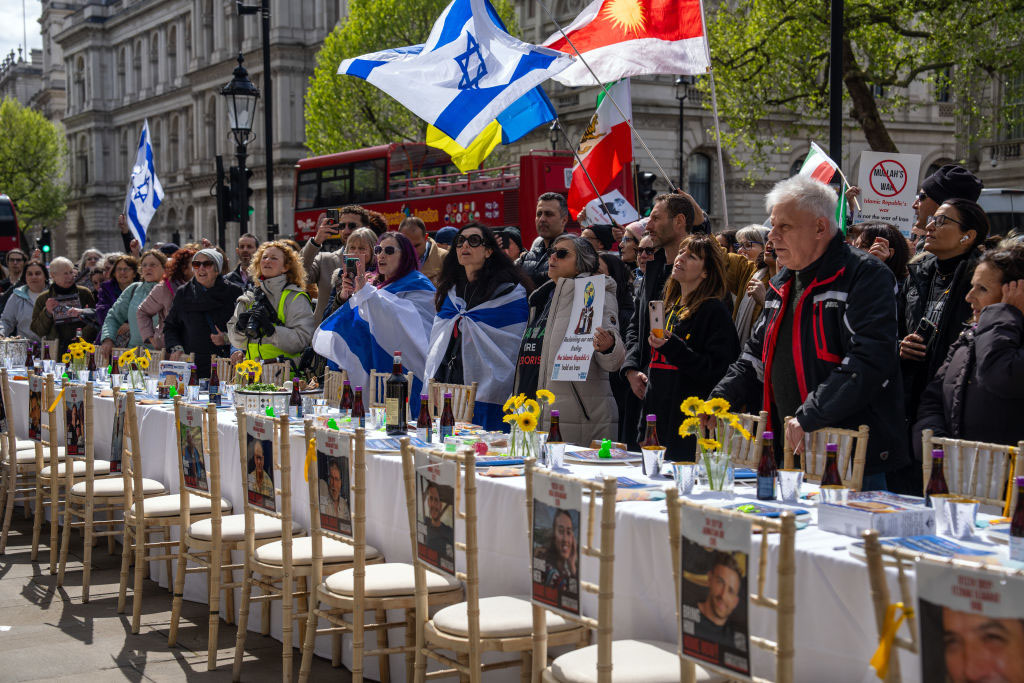
-How do we honor those that are missing from their seders?

-How will I cultivate the hope my ancestors created for thousands of years?

The seder is an opportunity to reunite with family and friends. A delicious meal filled with song and traditions. And the seder is meant to be both a classroom and sanctuary, in which we collectively ask each other soul-shaking questions, gaining a deeper understanding as to who we are as a Jew. Who we are as a Jewish nation.

And who we want to be.

Ask the questions. May the answers propel us forward so that we too, can manifest the final lines of the Haggadah: “Next year in Jerusalem.”

Shabbat shalom


Rabbi Nicole Guzik is senior rabbi at Sinai Temple. She can be reached at her Facebook page at Rabbi Nicole Guzik or on Instagram @rabbiguzik. For more writings, visit Rabbi Guzik’s blog section from Sinai Temple’s website.

A Bisl Torah – Ask These Questions Read More »