fbpx

April 10, 2024

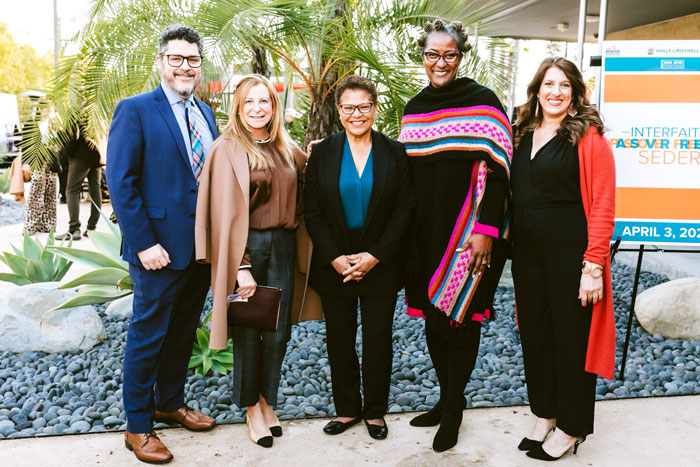
Photo courtesy of JFEDLA (Jewish Federation Los Angeles)

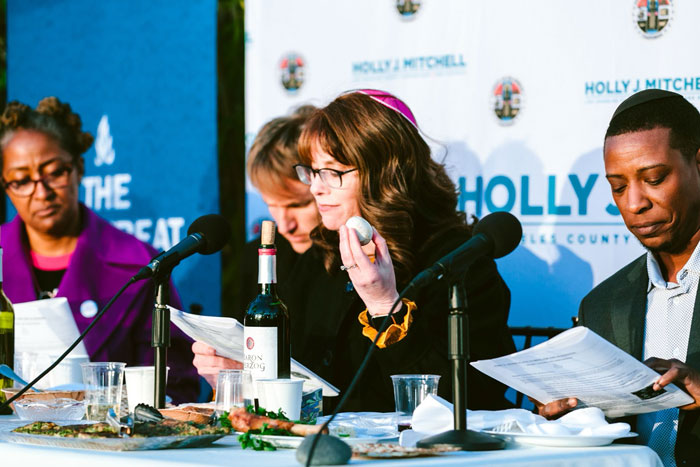
A Passover of Proximity: The Fight Against Antisemitism and Building Community at an Interfaith Seder

On April 16, The Jewish Federation of Los Angeles (JFEDLA), in partnership with the Museum of Tolerance, LA vs. Hate, and the Los Angeles County Commission of Human Relations, will hold a Passover seder for approximately 200 guests unlike any other. The seder will showcase a specially crafted Haggadah and program designed to address current events, featuring musical performances by FAME and Temple Isaiah Choirs.

The objective is to foster greater understanding and unite community and religious leaders in comprehending the history of the Jewish people and combatting antisemitism.

Photo courtesy of JFEDLA (Jewish Federation Los Angeles)

Rabbi Noah Farkas, President and CEO of the JFEDLA, told the Journal: “I really believe what Bryan Stevenson, that famous lawyer and justice advocate from the South, wrote in his book ‘Just Mercy’ when he talks about proximity. He says it’s really hard to hate something that you’re proximate to and it’s really easy to work through someone and with someone’s pain when you have proximity to them. So the seder invites them to our table to create proximity in a non-transactional way, where the agenda is relationship. That’s what I believe, and we see that it works.”

Photo courtesy of JFEDLA (Jewish Federation Los Angeles)

The Jewish community in the U.S. has never had to try so hard to fight antisemitism, which has been on the rise since Oct. 7. Indeed, even before that day’s tragic events, the Jewish Federation had hosted Interfaith Passover seders, but this year it feels a little more urgent to bring community and interfaith leaders together. The hope of course is that those leaders – pastors, reverends, imams, civic leaders and heads of foundations – will pass along the message to their communities. This year, participants will include Museum of Tolerance leaders; Robin Toma, executive director, Los Angeles County Commission on Human Relations; Rabbi Sarah Hronsky, President, Board of Rabbis of Southern California; and Pastor James McKnight of the Congregational Church of Christian Fellowship. 

At last year’s seder, Mayor Karen Bass was among the guests. Participants were presented with a special Haggadah, which included passages from the traditional text updated to reflect contemporary issues. Instead of recounting the 10 biblical plagues, such as blood, frogs and lice, the Haggadah addressed 10 enduring plagues affecting Los Angeles for years: Homelessness, food insecurity, systemic racism, violence, immigration and refugee crises and modern-day slavery including incarceration and human trafficking, among others.

In the section of the Haggadah discussing the four sons, the JFEDLA Haggadah prompted participants to engage in discussions about individuals striving for racial justice. Questions posed included: “How would you respond to someone who says, ‘I support equality, but the tactics and strategies used by current racial justice movements make me uncomfortable?’” Or, “How do I reach out and engage with marginalized communities in an authentic and sustained way?” Additionally, the Haggadah encouraged consideration of perspectives from people of color.

“The redemption story of the ancient Israelites is also the redemption story of the modern Jewish people. The seder table itself has a unifying effect, unifying moment and a redemptive moment.“ – Rabbi Noah Farkas

“The redemption story of the ancient Israelites is also the redemption story of the modern Jewish people,” said Farkas. “The seder table itself has a unifying effect, unifying moment and a redemptive moment. One of the greatest gifts we ever gave to the world community is the promise that the future doesn’t have to look like yesterday. In ancient times, the rabbis said, civilization lived at the whim of gods. It was the Jews who said, ‘No, the future is redemptive. It’s something that we can look forward to, and we know that because we know that redemption is possible from the past,’” he said. “In this moment, life feels very dark for the Jewish community. There are hostages in tunnels and there are Jews who are displaced from their homes, 200,000 in Israel alone. When antisemitism has reached its most violent heights in two generations, as Jews, we need to hold on to that reunification and that redemption.”

Photo courtesy of JFEDLA (Jewish Federation Los Angeles)

For many attendees, this will be their first Passover seder. They will partake in rituals, learn symbolic meanings, join in songs such as “Go Down Moses” and ask the Four Questions. Although they may not complete the entire Haggadah or try to find the afikoman, they gain a deeper understanding of its significance.

Farkas shared insights from previous seders, illustrating how conversations around the table fostered empathy and understanding: “They talked about their own story of redemption, how their families perhaps came from one place and arrived in the U.S. and then find the similarities and understand each other story better,” he said. We talked about what’s your immigrant story? What is the story of your family going from one place and going to another place? What is the story of redemption for your family? What’s the story of reunification for your family? And now, let me share with you mine from my perspective.”

Then, they break matzah together and engage in discussions about the community’s aspirations. Farkas emphasizes the symbolic significance of matzah: “Remember, matzah is the most unique element in Jewish life as it represents both adversity and freedom, affliction and redemption. It embodies the duality of our experiences, prompting us to reflect on both our past struggles and our future possibilities.”

Reflecting on recent challenges, Farkas acknowledged feelings of isolation since Oct. 7: “Many of us, myself included, have felt profoundly alone … some of our traditional allies seem to have left us in the dark. However, we find solace in our deepest relationships, where we engage in nontransactional, redemptive conversations. These are the individuals who stand by us through thick and thin, demonstrating the transformative power of community engagement, exemplified by events like the seder.”

He highlighted the significance of longstanding partnerships, stating, “We have collaborated with 15 civic partners for years… These were the allies who reached out to us on Oct. 8, 9, 10, checking in on our well-being. Some of these organizations, whom we support, generously contributed to the Israeli crisis fund. It’s a testament to the strength of our relationships and the impact of community engagement.”

A Passover of Proximity: The Fight Against Antisemitism and Building Community at an Interfaith Seder Read More »

Can Israel Win the Information War?

Watch any knowledgeable political pundit on TV and they will likely say was horrific to see Israelis savagely slaughtered on Oct. 7 by Hamas and it is also horrific that Palestinian civilians have been killed in the subsequent war. This makes sense. Every innocent person killed is a tragedy.

What Douglas Murray, Ben Shapiro and Hillel Fuld explained early on is that intent matters, understanding that Hamas was banking on the international media showing a moral equivalence between a terrorist attack and an army defending itself. When one Hamas leader was asked why he did not build bomb shelters for Palestinians, his response was that it was the responsibility of the UN. While another said they would do an Oct. 7 attack again and again.

Can Israel possibly win the information war, which will not be over even when the current military one is?

“Absolutely,” Fuld told the Journal. “We need to unify our narrative. Our enemies have a very clear concise and easy to digest narrative. ‘You’re oppressing us. Free Palestine.’ Very easy. Our narrative is completely fragmented. Some bring up antisemitism, some talk about the war, some talk about double standards. We need to unify under one narrative. And that narrative should be that the world we live in is a very dark world and the Jewish people have been nothing but a source of light to the world.”

Fuld, an Israeli tech guru and marketing expert, stopped what he was doing after Oct. 7 to focus on defending Israel. He was personally touched by tragedy when his brother, Ari was stabbed in the back by a 17-year-old Palestinian terrorist in September of 2018.

When questioned about Hamas, anti-Israel pundits have attempted to shift the blame to Israeli Prime Minister Netanyahu. According to Fuld, however divided Israel had been on judicial reform, Israel is united in realizing they have to win this. “Media tricks are not effective at all but it’s all they have” because there is no moral way to defend the brutal attack of Hamas. Fuld added that while the Israeli Army is currently being castigated, when all the facts come to light, it will be clear that the Israeli Army is not only more moral than other armies, but their urban warfare tactics will be studied by other armies.

Irina Tsukerman, a fellow at the Jerusalem Center for Public Affairs and geopolitical analyst told the Journal she is aware many say Israel can’t win the information war.

“I think that is a lazy argument for people who don’t know what they are doing and have failed,” Irina Tsukerman said. “Unfortunately, people don’t really think about what strategies will be effective … There is a great to need to galvanize young Americans, Jewish and not Jewish. That will not happen only by showing the Jew only as the victim. It will happen by showing Jews as impactful people while celebrating the pluralistic voices and experiences. It will happen by showing the new generation that big parts of the story are being hidden from them. Show them the Hamas leaders who have billions of dollars and live abroad in luxury while their people are starving and left to die. When they talk of ceasefire, show them the clips of the Hamas leader who admits said he wants to do October 7 again and again.” She added that effective commercials, articulate speakers, events and social media campaigns pointing out facts were among several things that should be done.

Coleman Hughes Tells Joe Rogan It’s Not a Genocide and the Numbers are False

On “The Joe Rogan Experience” podcast, host Joe Rogan repeated the Gaza Health Ministry’s report of 32,000 dead. (In late October President Joe Biden said he did no confidence in the numbers of the Gaza Health Ministry.)

 Author Coleman Hughes said that he believes Israel has killed 13,000 Hamas members and 19,000 civilians have died. He believed the ratio was similar to American soldiers who fought ISIS in Mosul. Referring to Hamas, he said it would make “no sense at this point to stop before you’ve cut out the last 20% of the cancer …  It’s very, very, distinct from genocide, cause genocide is when you’re trying to maximize civilian casualties. I think Israel, however imperfectly, is trying to minimize civilian casualties.”

While he agreed the deaths of Palestinians are tragic he blamed Hamas for embedding itself among civilians.

“We can say one of two things, we can say ‘well Israel doesn’t have a clean shot. And so, they have to let Hamas get away with it because it’s too much to bear. But then we are essentially creating a situation where terrorists have found the perfect solution, which is that you can cross the border, go house top house slaughtering your enemies, and then hide behind your own people and they can do nothing about it. It’s a perfect strategy. Can we live in a world where we allow that to be an acceptable strategy? I don’t think so and it’s very ugly to watch. It’s heartbreaking to watch and I completely understand why people don’t think the way I think when they see the videos …”

“(Hamas) can hide behind or inside a hospital and make Israel look like it’s going after innocent people, and when the truth comes out, it’s on page 48. When Israel does something, it’s on page 1. That’s not changing.” – Aaron Meyer

Jordan Chanofsky, founder of Fusion PR in Manhattan, said most people watching  the images on TV will not get past the deaths of civilians.

“The narrative that Israel are the good guys and Hamas are the bad guys might have worked for a short time,” Chanofsky told the Journal. “When people see images of Palestinians dying, it is natural as a human to see suffering and want it to stop. Most won’t be thinking about how Hamas is responsible for the deaths they only will think about how the loss of life is of course terrible. They will believe Israel wants to take over because they are unaware that Israel gave up Gaza in 2005 and doesn’t want it. The point should be made that Hamas, Hezbollah and Iran consider Israel the little Satan and America the big Satan and would destroy both if they could.”

Hamas Doesn’t Need Articulate Spokespeople

Author, attorney and Middle East analyst Aaron Meyer pointed out that even after Oct. 7, the world media believed Hamas’ claim that Israel destroyed the al-Shifa Hospital and killed 500 people, only for all evidence to point to it being a misfire by Islamic Jihad, with a projectile hitting the parking lot and not the hospital.

“Hamas is operating off of a playbook,” Meyer told the Journal. “They can hide behind or inside a hospital and make Israel look like it’s going after innocent people, and when the truth comes out, it’s on page 48. When Israel does something, it’s on page 1. That’s not changing.”

In one interview, Hamas official Ghazi Hamad said it would repeat Oct. 7 again and again and thatHamas was ready to pay the price of civilian casualties. Speaking to Karan Thapar of The Wire, Moussa Abu Marzouk, head of the Hamas International Relations Office, said taking a nine-month-old baby and an 85-year-old woman were mistakes that happen in the chaos of war and that those taken are “guests.”

“They don’t need articulate spokespeople,” Meyer said. “The reporting will follow the script that it’s Israel’s fault and minimize Hamas’ actions. He argues that Israeli messaging needs to be stronger.

“The first thing should always be the hostages,” he said. “We need them back. The second thing is Iran, who is behind everything. I’m not sure why Israel isn’t getting that out every day.” Hamas’ strategy, he said,is to make it seem like Israel is “fighting the weakest opponent possible. It’s fighting Iran, which is a major threat. But you barely hear that. The narrative crafted is that Israel is not even fighting Hamas, it’s Israel vs. Gaza.”

Ami Kozak, host of the podcast “Ami’s House” is a comedian, singer and musician who has delved into politics appearing on “The Candace Owens Show” (where he corrected her, explaining that Muslims are not forced to live only in The Muslim Quarter).

“Israel cannot be responsible for defending itself while at the same time defending its right to do so,” Kozak told the Journal. “To the extent that Israel capitulates to pressure or tries to make apologies for defending itself against barbarism and savagery, it loses. To the extent that Israel asserts itself and remains committed and resolute in defeating its enemies, in the long run, it will win on all fronts, maintaining its moral superiority and those who respect her, and even those who do not.”

Why Optics Are Against Israel

Newsweek communist and I24 correspondent Marc Schulman has sent out an e-mail newsletter every day since the Oct. 7 attack. He told the Journal that many years ago  he realized college campuses assigned certain books that defined Israel as an evil colonizer. Schulman said he thinks Israel has lost the PR war.

“People like the underdog,” he told the Journal. “It looks bad to see people helpless and bombed from the sky and killed. It’s a powerful visual that can overwhelm everything else.”

Political strategist Hank Sheinkopf, founder of Sheinkopf Communications, has advised political candidates, including former President Bill Clinton and former New York City Mayor Mike Bloomberg, and corporations such as Verizon and Home Depot.

“The PR battle today is being won by the enemies of the Jewish State,” Sheinkopf told the Journal. “Democratic Party leadership public discussions chiding Israel — (President Joe) Biden, (New York Senator Chuck) Schumer, (Vice President Kamala) Harris — are political with desired effect of helping to reelect the Biden Harris ticket …”

Schrader and Austin on Piers Morgan’s Show

Journalist and lecturer Emily Schrader, who recently appeared on “Piers Morgan Uncensored” thinks social media has added a new challenge.

“Israel cannot win the PR war alone,” Schrader wrote the Journal in an email. “There are many factors that impact the spread of disinformation today and social media being abused by authoritarian state actors like China, Russia and the Islamic Republic, is a direct threat not only to Israel but to all Western democracies. In order to win the PR war, we need governments and social media companies to crack down on disinformation and change algorithms to stop rewarding extremism and hate. What is within Israel’s control, however, is being active in the fight and ensuring the truth is at least representative, even if it is not the loudest voice in the media and social media. That is why it’s important to be active online, even if we are outnumbered.”

Abby Martin, an anti-Zionist journalist who debated with Schrader on “Uncensored,” said she condemned all deaths of civilians but refused to specifically condemn Hamas, leaving Schrader surprised.

“Abby Martin’s repeated failure to condemn Hamas in her debate with me on Piers Morgan simply proves what we already know – that the anti-Israel mob has no problem with the slaughter, torture, mutilation, kidnapping, and mass rape of innocent Israeli civilians on Oct. 7,” Schrader said via e-mail.

In a segment from Dr. Phil McGraw’s talk show that has gone viral, journalist Emily Austinargued with a student at Michigan University who would not condemn Hamas. In an earlier interview with the Journal, Austin said that “when someone is honest in admitting they are okay with terrorism, you learn a lot about them.”

Shapiro and Murray

Ben Shapiro, an Orthodox Jew and co-founder of The Daily Wire, shifted his podcast to focus on Israel after the terrorist attacks. He argued that the response by Israel should be disproportionate in that great force should be used against terrorists, but opponents tried to take his statement and claim he meant violence against all Palestinians, which is not what he said. In a speaking engagement fr at Cambridge University, he said Israel didn’t not want mass casualties of civilians.

“The death is civilians here is unjustifiable across the board but is blameworthy on Hamas’ part,” Shapiro said. “There’s a difference between death being justifiable in the circumstances in the sense that it’s ever morally praiseworthy or good, and where you place the blame for that death … to suggest that it’s somehow a celebration of the death of civilians to point out that Hamas is hiding beneath them is to piss the point entirely, the entire point is it’s horrifying what Hamas is doing. If Hamas wants to end this all today, all they have to do is surrender …”

Douglas Murray, who is not Jewish, traveled to Israel to see the carnage, who work appears in The New York Post and reports for other outlets, cited Russian Jewish writer Vasily Grossman who in “Life and Faith” wrote” “Show me what you accuse the Jews of, and I’ll show you what you’re guilty of.”

What About The Narrative of Destroying Hamas?

Israel’s chief concern is its own security. When the higher-ups said Hamas would be destroyed, it was never clear if that was meant to be taken literally and meant every Hamas terrorist. While many leaders were killed, Yahya Sinwar is alive, and others are free to relax at posh hotels in Qatar.  Who is to say Hamas would not regroup?

The hostages are still not returned, and Israel announced it will have fewer soldiers remaining in Gaza.

The deaths of the World Central Kitchen aid workers drew an apology from Chief of Staff Herzi Halevi, who said it was a mistake that followed a misidentification, and it took place at night. Israel announced two officers were fired but that will likely do little to help the narrative that Israel was careless.

“Democracies investigate and admit when they are wrong,” Aaron Meyer said. “Hamas doesn’t. This doesn’t mean it’s okay that people are killed by accident. It’s not. The media pushes to make them equal. Hamas wants civilian deaths and Israel seeks to avoid them. The decision to ignore this fact for those who know it, and to ignore this fact in media reports for those who don’t, is immoral. Israel faces an asymmetrical information war because, just like Hamas hides in their tunnels, they hide behind the biased media. A person who questions if an Israeli baby was beheaded or simply shot is or says Israeli women were not raped is a person of good character in this backwards media, but a person who questions to death numbers of the Gaza Health Ministry is portrayed as someone who doesn’t care about Palestinian lives and decency.”

More Bark Than Bite

“The ones protesting in the streets are the loudest and they have a bark, but they don’t have a bite,” Hillel Fuld said. “If you look at what anti-Israel folks are saying on the Internet, I’ve posted on the hatefulness I get, not one of them has any substance. It’s name calling. With Hamas and the Israeli Army, there is right and there is wrong. There is truth and there are lies. The amount of noise they make is not any indication of the people who are actually pro-Israel.”

Can Israel Win the Information War? Read More »

A Last-Minute Trip to Israel and the Short Film that Offers Viewers ‘A Proxy Experience’ Post-Oct. 7

In the six months that have passed since Oct. 7, countless organized trips and missions to Israel have connected Jews, as well as non-Jews, with the country. What has been rarer is for young Jewish professionals from around the world to carve out time to visit Israel on their own.

In December, Jonathan York, a 32-year-old Los Angeles resident and real estate attorney who currently runs a private investment firm, felt compelled to buy a plane ticket and, only a few days later, travel to Israel. Like other Jews, he wanted to process post-Oct. 7 Israel for himself, and to share his experiences with friends and family back home. 

York is a savant: a Stanford Law graduate, who served as commencement speaker for his Stanford undergraduate ceremony and has worked at two multinational law firms as well as for the U.S. State Department and X/Twitter. But he is also wildly artistic and in the local Jewish community, known for his annual Sukkot installations, which for the last five years he has created at his home and, more recently, in public spaces. 

York, an Iranian-American Jew, has also participated in the Jewish Federation’s New Leaders Project (NLP), on the Stanford Hillel Board of Directors, and as a Maher Fellow for 30 Years After. He is most energized when he uses his creativity “as a means of Jewish communal gathering and reflection,” he told the Journal. 

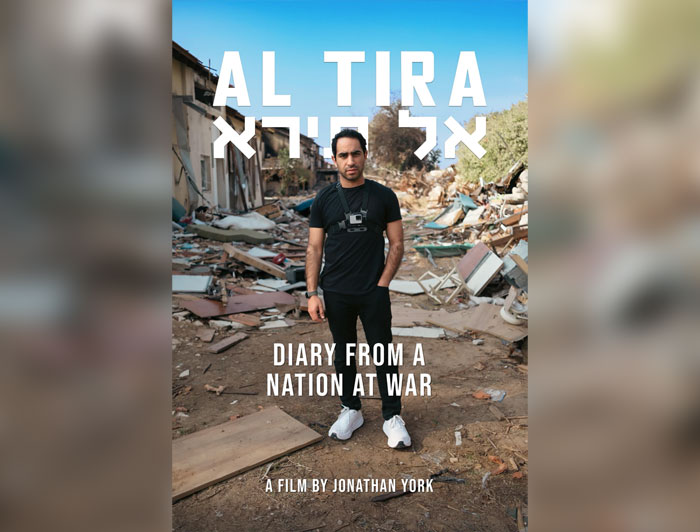
When York arrived in Israel on Dec. 20, he had not considered making a film. Eventually, however, after capturing 18 hours of video on his phone, and recording another six-and-a-half hours of his own reflections on camera, he heeded the suggestion of a friend and “chipped away” at the 24-and-a-half hours to make a 30-minute film called “Al Tira: Diary From a Nation at War” (“Al Tira” means “Do Not Fear” in Hebrew). York will present the film’s Los Angeles premiere at Sephardic Temple on April 16 at 7:30 p.m.

York is covering the costs of the screening and venue, so that “100% of the ticket proceeds go towards causes that are highlighted in the film,” he said. He also plans to direct additional funds he raises through this film to those causes.

For three weeks, York traveled around Israel largely by himself, visiting “Hostage Square” in Tel Aviv, Sheba Tel-Hashomer Medical Center, and the headquarters of ZAKA, Israel’s search-and-rescue organization. Unlike most visitors, York was also able to access sites such as the ruins of Kibbutz Kfar Aza and Kibbutz Be’eri, admitting that “this all had to be arranged and coordinated with the IDF — I reached out to everyone I ever met basically to make this happen,” as well as the site of the NOVA Festival in Re’im. Though the film tackles difficult subjects, it does not contain graphic content.

It’s not every day that a young Jewish professional visits Israel amid a multi-front war and creates a short film to help his community better connect with the current mood of the Jewish state. I asked York a few questions about what motivated him to spend three weeks capturing the pulse of Israel, as well as what he took away from his visit. 

Jewish Journal: Do you remember the exact moment you learned the initial news on Oct. 7th? 

Jonathan York: I have a subscription to Channel 12, the main broadcast channel in Israel, at home. I had the news on for two weeks straight, including in bed, in the shower, and in the car. I never turned it off. The irony is that I became fluent in Hebrew largely by listening to the nightly broadcast on Channel 12 for the last nine years or so.

When I went to bed on Oct. 7, the death toll was at 250. By the time we woke up in L.A. the next day, the death toll was at 1,200+. It broke me. That morning, I hung an Israeli flag on my sukkah, which was on display in front of Sephardic Temple. A couple of days later, the sukkah was vandalized.

JJ: Like many young Jewish professionals, you have an active work and social life here in L.A. Why did you decide to visit Israel in December?

JY: The truth is I wanted to go from the first day the news broke. My heart was pulling me there, and I felt weirdly distant from a place and people I also felt so close to. One Erev Shabbat in mid-December, I broke down at a news report about one of the hostage families. A few days later, I was on an El Al plane.

JJ: Were there one or two visits, sights or experiences that truly stood out for you?

JY:  This trip was full of experiences I never anticipated, in dizzying proximity. I was at a fundraiser on New Year’s Eve in Jaffa. At midnight, just a few seconds after the countdown, Hamas fired a massive barrage of hundreds of rockets at Tel Aviv and many locations in Israel. We still had champagne glasses in hand as we ran to the bunker underground.

Twelve hours later, I attended the funeral of a soldier, Constantin Sushko, whom I read about in the newspaper. It was bothering me that I would hear every day the names of soldiers who made the ultimate sacrifice and I didn’t know anything about them. So that day, I decided I would go to the funeral of this soldier and learn about him from the people who knew him best, in the most tragic way possible.

JJ: Please tell readers more about the film. 

JY: This film is my most personal artwork yet. And it’s not an accident that I subtitled it “Diary.” It is exactly that — my diary from this place I love, at this particularly fraught moment. I wanted it to be a proxy experience for those who can’t go to Israel now or choose not to. It is a very raw and unfiltered look at life in Israel post Oct. 7 — about the thoughts, feelings and conversations of Israelis about the future, the events of that day, and their very identities. The film is structured as a series of vignettes, and the emotional arc of the movie mirrors the arc of my time in the country — lots of ups and downs, sometimes with little notice.

JJ: Is there anything else you want readers to know? 

JY: At many points, I asked myself, “Why am I making this film?” And I realized there were three audiences. I made it first and foremost for myself, to process and understand everything I experienced. I made it for friends, family and strangers with whom I wanted to share the stories, and who I thought might learn something from. And I made it for my future children, who will undoubtedly read about Oct. 7 in their history books and wonder what their dad was doing and thinking and saying during this pivotal moment in Jewish history.

To RSVP to future screenings of “Do Not Fear” or for more information about the film and to watch the trailer, visit altirafilm.com


Tabby Refael is an award-winning writer, speaker and weekly columnist for The Jewish Journal of Greater Los Angeles. Follow her on X and Instagram @TabbyRefael

A Last-Minute Trip to Israel and the Short Film that Offers Viewers ‘A Proxy Experience’ Post-Oct. 7 Read More »

Fighting Antisemitism with a Stiff Neck

“Non-Jews respect Jews who respect Judaism, and they are embarrassed by Jews who are embarrassed by Judaism.”  – Rabbi Lord Jonathan Sacks

We will never return to the false sense of security we felt on Oct. 6. The massacre the next day not only caused us to question our safety in Israel, it also removed the veil hiding global antisemitism that was bubbling beneath the volcanic surface of the places we considered our homes. 

While our soldiers fight for their lives on the front lines in Gaza, those of us in the Diaspora face a different type of challenge — a world where discrimination, suspicious glances and hate-filled slurs assail us daily. Being called a genocidal murderer on your morning commute, it turns out, is not the most uplifting way to start one’s day.

We need ancient guidance on how to address evil and those who challenge our identities. I believe it can be found in one of the most misunderstood passages of the Passover Haggadah.

We need ancient guidance on addressing evil and those who challenge our identities. I believe it can be found in one of the most misunderstood passages of the Passover Haggadah. This passage tells us how to address those who are wicked, but the nuances of the Hebrew text may be lost on many who are unfamiliar with the language or are rushing through the seder to reach the festive meal. 

Four sons ask questions in the Maggid section of the Haggadah. To the wicked one who asks, “What are these things for you?”, we are advised to “blunt out his teeth!” At first glance it appears the rabbis are advocating violence: Take your fists and strike him in the mouth. A closer read, however, tells a more intriguing story. 

The Hebrew words, “hakheh et sheinav,” literally translate to “blunt out his teeth” —the same words used in another rabbinic text commenting on an earlier confrontation with evil. Years after fleeing his evil brother Esau’s murderous wrath (Gen. 27:41), Jacob encounters Esau on his way back to Canaan. Surprisingly, Jacob isn’t met with a violent act of vengeance. Instead, the verse tells us that “Esau ran towards him, and embraced him, and fell on his neck, and kissed him, and they wept.” (Gen. 33:4) Curiously, the Torah scrolls contain a series of dots over each letter of the word “Vayishakeihu [and he kissed him].” According to one midrashic interpretation, the dots are meant to suggest the kiss was insincere and even violent:

“R. Yannai said . . . [the dots] teach that he didn’t come to kiss Jacob but rather to bite him, but Jacob’s neck turned to marble; and thus the teeth of that wicked one were blunted. Thus, when the text says ‘and they cried’ – this one cried over his neck and this one cried over his teeth.” (Genesis Rabbah 78:9)

R. Yannai’s creative interpretation is based on an etymological observation that the Hebrew word describing Esau kissing Jacob, Vayishakeihu, is almost identical to the word Vayishakheihu which means “and he bit him.” According to R. Yannai, the dots over the word Vayishakeihu are meant to teach the reader that what really happened is far different than what the literal text depicts. It wasn’t a reunion of brotherly love, but a murder attempt. 

More interesting, however, are the Hebrew words R. Yannai uses to describe the effect of Esau’s attempt to bite Jacob’s neck: “hikhe et sheinav shel oto rasha [the teeth of that evil one were blunted].” Read closely, these words are nearly identical to the phrase used in the Haggadah to describe the response to the evil son, “hakhe et sheinav [blunt out his teeth].” Additionally, R. Yannai’s decision to identify Esau only as “oto rasha [that wicked one]” further highlights the reference to the rasha of the Haggadah.The rabbis intended for these texts to be understood as references to each other. 

While R. Yannai’s interpretation may seem fantastical, it offers a profound insight into Jacob’s personality. The notion of a neck turning into marble recalls the biblical characterization of the Jewish nation as an “am k’shei oref (Ex. 32:9), a stiff-necked or stubborn people. While this characterization is typically used by God to justify punishing the Jewish nation for sinning with the Golden Calf, it is also used in Moses’ prayer to God as a reason to justify their forgiveness (Ibid. 34:9). 

In an evocative sermon, R. Norman Lamm explained that while a stiff neck can cause one to ignore truth, it can also lead to loyalty and the ability to remain steadfast in one’s beliefs. “To be unbendingly evil is worse than idolatry; to be unbendingly G-dly is the greatest virtue. What is dogged obstinacy in the service of a bad cause, is valorous constancy in the service of a good one,” remarked R. Lamm. Moses beseeched God to forgive the nation because it was the very stubbornness that led the people to sin which ultimately became their greatest tool to remain loyal to God during difficult times. 

R. Yannai’s metaphor of Jacob’s neck transforming into marble may symbolize his unwavering commitment to his beliefs. We can also posit that R. Yannai didn’t intend that Esau literally bit Jacob, but rather made biting remarks toward him. Esau mocked Jacob’s choices and identity. 

R. Yannai’s interpretation provides a lesson in confronting evil. Instead of retaliating, Jacob chose to stiffen his neck — to display stubbornness, confidence and loyalty to his beliefs. One method for confronting evil, R. Yannai teaches, is to show your antagonizer that their “bite” is ineffective. 

The text of “hakhe et sheinav” in the Haggadah suggests that beneath the literal translation of the text lies an alternative method more suitable to our contemporary predicament in America. There are times when the correct approach is not to blunt evil’s teeth, but to develop inner confidence in our own beliefs. Terrorists in Gaza must be eliminated, but the approach to antisemitism in America is a different battle, in which stubbornness and pride are more effective than the sword. 

Mitchell Leshchiner exemplified this approach during his middle-school graduation in Vernon Hills, Illinois shortly after the 2019 Poway synagogue shooting. Leshchiner didn’t normally wear a yarmulke, but the 14-year-old donned one while receiving his diploma in front of hundreds of onlookers. “It was important to make a statement that we’re still here, and that no matter what happens, we’ll still be here,” he said. 

“We’re still here” is the message we need to display more than ever in a post-Oct. 7 world. Many are understandably fearful to identify as Jewish in crowded areas. Yet with rare exceptions, one can still wear a yarmulke or Magen David necklace in public areas in America without getting physically attacked. The streets of America will tragically turn into the streets of Berlin, however, if it becomes increasingly unpopular for these symbols of Jewish pride to be seen by others.  Cowering in fear only gives fuel to the bullies. America needs to see that “we’re still here” and we will always be, unabashedly proud of who we are. 

If your life is not in danger, display your loyalty to your cause. Consider wearing yarmulke in the streets. Wear your Magen David necklace so others can see it. Have the courage to post pro-Israel sentiments on social media. If someone rips down a poster of our hostages, hang up another.  Most importantly, keep your head high and be proud to be a Jew. There is a time and place to fight our enemies, but to earn their respect they must see that we respect ourselves. Stiffen your neck and the rasha’s teeth will fall out by themselves.


Marc Eichenbaum is the Rabbinic Researcher for Yeshiva University’s Sacks-Herenstein Center for Values and Leadership.

Fighting Antisemitism with a Stiff Neck Read More »

Birthright Israel and OpenDor Media Announce Joint Effort

Birthright Israel and OpenDor Media announced on April 1 that they are combining forces to expand educational outreach on Jewish Israel-related content.

“In times like these, when the need for connection and understanding is more crucial than ever, we’re proud to take a leading role alongside Birthright Israel,” OpenDor Media CEO Andrew Savage said in a press release. “Providing their alumni with direct and continuous access to balanced educational content promises to strengthen the bonds between young Jews and Israel.”

Both organizations see this as the right time to combine forces and take the Jewish and Israel education content to a higher level. 

Both organizations boast impressive numbers. Birthright Israel says that they’ve given over 850,000 tours of Israel since its founding 25 years ago. In that time, the mere usage of the word “Birthright” has become synonymous — at least within the Jewish community — with the gift of an educational visit to Israel. Thousands of alumni can trace their first visit to Israel — and in many cases, first travel overseas — to Birthright Israel.

OpenDor Media has been producing Jewish content since 2009. Their YouTube page, part of their “UNPACKED” division, has over 43 million views since its first post in 2011. Their five most-viewed YouTube videos are “5 Mind-Blowing Differences Between Sephardic & Ashkenazi Jews,” (3 million views), “The Wonder Women of the Israel Defense Force” (1.3 million views), “The Munich Massacre” (1.24 million views), “The Untold Origins of Black Jews in America”  (1.22 million views) and “Ashkenazi Jews and Khazar Theory” (1.1 million views). Their content is succinct, well-researched, loaded with infographics and archival footage and makes powerful points in a typical span of 6-11 minutes. Their podcast and TikTok views are in the millions as well. 

Both organizations see this as the right time to combine forces and take the Jewish and Israel education content to a higher level. 

“In the wake of the harrowing events of Oct. 7, and amidst a rising tide of global antisemitism, we’re proud to partner with the premiere source of Jewish and Israel related educational content to support the continued growth of the next generation of Jewish leaders,” Birthright CEO Gidi Mark said in a press release. 

While the specifics of what the partnership will look like are to be determined, Birthright Israel and OpenDor said that “Participants will gain immediate access through the Beyond Birthright Israel app, with further resources available post-trip and to the rest of the alumni base. This ensures that the participants’ journey of discovery and connection extends well beyond their Birthright experience in Israel.” As of this writing, the app is only a portal to the Birthright Israel website. Still, they know they have their work cut out for them. 

“We are Davids to Al Jazeera’s Goliath,” OpenDor Executive Vice President Noam Weissman said in the Journal’s Feb. 1 cover story.

The long-term aim isn’t just for educating Birthright alumni. The press release specifies that the most crucial aspect of this partnership is aiding young Jews to “facilitate meaningful conversations with their peers.” 

In the same cover story, OpenDor founder Raphael Shore said that this year, they aim to reach elementary school-age audiences in Arabic, French and Spanish to “create a seamless pipeline for Israel education from early grades to 12th grade.”

Birthright Israel and OpenDor Media Announce Joint Effort Read More »

The Holocaust as Jew-Haters’ ‘Gotcha’

Owen Jones thinks he has it all figured out.

The British Guardian columnist and socialist appeared on Sky News recently opposite Israeli writer, Zionist activist and all-around good guy Hen Mazzig. Jones was expressing sympathy for the idea that Britain cut its arms shipments to Israel — because of course Israel should be denied arms while fighting a terrorist Islamist group committed to Israel’s extinction. During his monologue, Jones referred to “Germany, which has decided to make the Palestinian people pay for the grievous crimes it committed by attempting to exterminate the Jewish people.” In other words, Germany’s support for Israel can only be explained by bummer emotions over the terrible thing it did years ago.

Mazzig protested: “Come on, have some decency. No, I won’t let you… the memory of the Holocaust will not be used in this way. How dare you. You’re not Jewish. … This is a red line.” Jones assumed the air of the unjustly accused, sniffing: “It’s a very straightforward point. There’s nothing offensive about it.”

Mazzig performed magnificently in taking on Jones. As he wrote on Twitter afterwards, Jones is saying “never mind that thousands of Jews were butchered, beheaded, burnt alive, slaughtered, raped, dismembered, shot, tortured, kidnapped and held in captivity for the last 6 months …   any support for [the Jewish right to defend itself] — as well as the fight to dismantle the local arm of the biggest terrorist machine in the Middle East — can ONLY be explained by guilt over the last Nazi genocide.”

In a sense, there’s little to add to this. But because I have the dubious distinction of having once shared many of Jones’ beliefs, and his passion for former British Labour leader Jeremy Corbyn, I think I get what’s behind his determination to wield the legacy of the Holocaust against the Jews. 

Germany may very well still feel some level of collective guilt about the Holocaust, but that isn’t the point. Nor is it especially relevant if the 1947 United Nations vote establishing Israel had something to do with uneasy consciences about sitting by, or facilitating, the murder of 6 million Jews. No: The point about “Never Again” is that the Holocaust made widely obvious that there was no place on earth the Jews could securely exist. If two-thirds of European Jewry could be murdered in the heart of civilized Europe, their existence was in jeopardy everywhere — unless they had their own state. So the Jews were allowed to exercise their right to national self-determination in their indigenous homeland — because it had become graphically clear that Jewish survival, never mind autonomy and a measure of freedom, required a state of Israel.

Only when it comes to the Jews is national sovereignty regarded as uniquely wicked, to the point that a trendy word exists —anti-Zionist — to convey opposition to a state’s very existence.

Curious, isn’t it? Leftists as a rule recognize the right to national self-determination. Jones, for instance, has written for Catalonia’s right to form a new nation, calling it an expression of that “basic democratic principle.” The tenet is enshrined in yellowing volumes of Lenin and honored by progressives with respect to countries around the world. Only when it comes to the Jews is national sovereignty regarded as uniquely wicked, to the point that a trendy word exists — anti-Zionist — to convey opposition to a state’s very existence. Leftists really should ask themselves the question I once did, setting myself on the path from Trotskyism to Zionism: Since our tradition supports the right to self-determination absolutely everywhere, why is Zionism considered shorthand for evil? The question answers itself.

Another way of considering the issue of Holocaust guilt, by the way, is to see it as a source of never-ending hostility against the Jews — for burdening non-Jews with guilt over what was done to the Jewish people. As Howard Jacobson writes in a brilliant essay, “When Will Jews Be Forgiven the Holocaust?” the answer to his titular question is “Never.” “Those we harm, we blame,” he observes, “mobilizing dislike and even hatred in order to justify, after the event, the harm we did. From which it must follow that those we harm the most—we blame the most.”

And while Germany is the most immediate bearer of this guilt, Jacobson suggests the feeling is universal. Jews prick the world’s conscience, and the world resents it. This includes the left, which nurtures itself on gratifying myths about its part in that seemingly Manichean era known as World War II. Our people were the bravest and best fighters against the Nazis, they say; how dare anyone say we have a problem with Jews? 

But this legend has a disturbing way of falling apart. A glance at history reveals that those fighting under the red flag demanded that Jews reject “particularism,” including Zionism, and remain in Europe to fight for socialist revolution. Revolution did not come; the industrialized slaughter of the Jews did. Jews paid the price for the failure of the socialist vision.

This genocide should have prompted not only a deep rethink on the left, but a plumbing of its soul. A hint of it came after the war by Polish Jewish Trotskyist intellectual Isaac Deutscher, who wrote that “of course” he’d abandoned his anti-Zionism. “If, instead of arguing against Zionism in the 1920s and 1930s I had urged European Jews to go to Palestine,” he wrote, “I might have helped to save some of the lives that were later extinguished in Hitler’s gas chambers.” 

But how many of Deutscher’s comrades, and their ideological descendants, have shown themselves willing to reflect on their program and actions in the early 20th century — about how their dogmatic insistence that Jews rely on universalism and the solidarity of their proletarian brothers ended with Auschwitz? So fourscore years after history established the legitimacy of Zionism, anti-Zionism is more popular than ever. The last genocide of the Jews is hurled against the Jews, in support of those pursuing a new extermination campaign against the Jews, by those whose tradition regarding the Jews isn’t as irreproachable as they want to believe.

“Get over it!” a member of my former party once yelled at our German comrades, who were seen as harboring neurotic, crippling shame over the Holocaust. So Jones would like Germany to get over it, and rejoin the war on the Jews, absolved and free at last of that nasty, pesky guilt.


Kathleen Hayes is the author of ”Antisemitism and the Left: A Memoir.”

The Holocaust as Jew-Haters’ ‘Gotcha’ Read More »

ADL, StandWithUs, Brandeis Center File Complaint Against Ohio State

Three major Jewish organizations, the Anti-Defamation League (ADL), StandWithUs and the Louis Brandeis Center for Human Rights Under Law, filed a complaint against Ohio State University (OSU) on April 9 alleging that antisemitism has become “severe and pervasive” on the OSU campus.

The complaint was filed to the Department of Education’s Office of Civil Rights (OCR), alleging that the school is in violation of Title VI of the Civil Rights Act. The complaint claims that have multiple instances of Jewish students being assaulted, threatened and harassed, documenting one incident in November when two men shouted “Free Palestine” at a group of five Jewish students “just steps off-campus,” asked them if they were Jewish, and called a member of the group wearing a Chai necklace a “Zionist k—.” After the student wearing the Chai necklace confirmed they are all Jewish, “one of the two men that moments earlier was chanting ‘Free Palestine’ punched one of the Jewish students straight across the face and threw him into the street,” the complaint states. “The other individual who was chanting punched another one of the Jewish students across the face just seconds later. The two attackers, after committing a vicious antisemitic attack, fled the scene.” One of the victims suffered a broken jaw; the other, a broken nose.

When the students sought medical attention at Ohio State’s Medical Center, only the victim who was “bleeding profusely” was attended to, and the victim could only bring one guest; the rest of the group was forced to wait outside in the freezing cold for more than five hours. This experience prompted the other victim to fly “home, at considerable expense, to seek medical attention, where he learned that his face was swollen due to a fractured jaw.”

To this day, the complaint continues “months after this assault, one of the Jewish students who was violently attacked that evening has changed everything about how he approaches Jewish life and his Jewish experience on campus,” the complaint states. “The student reports that he ensures that his Chai necklace is tucked into his shirt when he is on campus so that he is not readily identifiable as a Jew. He avoids the Student Union and library so that he is not surrounded by antisemitic protests, and he is fearful of attending Chabad as he used to because he is worried about the continued targeting of Jewish institutions at OSU’s campus. In short, the student has been forced to check his Jewish identity at the gate to feel safe on his own college campus.”

Other incidents cited in the complaint include two incidents in October:   a man harassing a female Jewish student for having a “Jewish nose” and a student threatening “to kill pro-Israel students during [a] classroom discussion,” and in February “students banging on the Hillel windows and shouting, ‘Free Palestine!’” while Jewish students were eating Shabbat dinner. The complaint alleges that while the professor did remove the student who threatened to kill pro-Israel students, “that student was subsequently allowed to attend classes, having apparently faced no disciplinary action from the University.”

The complaint points to an incident in December when “two individuals approached a Jewish fraternity house early in the morning while yelling antisemitic slurs and throwing bottles at the residence.” The complaint alleges that while the university said they have a picture of the perpetrators and would investigate further, there is zero evidence to suggest the university followed through.

The university allowed the Central Ohio Revolutionary Socialists (CORS) to hold an event called “Intifada, Revolution, and the Path to a Free Palestine” that featured the logo of the Popular Front of the Liberation of Palestine (PFLP) on flyers promoting the event; the complaint asks why the university allowed the event to be held on campus. CORS claimed on social media that the university suspended them on Jan. 8 but they were reinstated on Jan. 31.

“Complainants request that OCR investigate whether a suspension was ever implemented against CORS,” the complaint states. “If not, Complainants request that OCR determine why OSU failed to enforce its own policies and why its spokesman claimed to OSU’s student newspaper that CORS was “prohibited from participating in or holding activities as a registered student organization while under investigation.” If CORS was in fact suspended, Complainants ask that OCR investigate why the administration lifted that suspension so shortly after imposing it, when there is no indication that the group ever rescinded its threatening messages toward Jews and Israelis. (Fourteen) Complainants further request that OCR investigate whether the University’s actions with respect to CORS are consistent with how OSU’s administration has treated other alleged misconduct when those most threatened by that misconduct were not Jewish or Israeli.”

After the suspension was lifted, CORS hung “a large banner reading ‘Free Palestine!’ over the railing above a staircase” at the Ohio Union and used a megaphone for speeches which the complaint contends is in violation of university policy. “CORS continues to glorify terrorism on its social media pages: it has not removed the advertisements containing the PFLP logo and violent imagery from its Facebook or Instagram pages, and on February 6, 2024, it posted, ‘Resistance to oppression is not terrorism’ above a photo and quote from PFLP terrorist Leila Khaled, infamous for being the first woman to hijack an airplane. Even in its post announcing its reinstatement, CORS included an image depicting Palestinians wielding assault rifles below the slogan ‘Free Palestine!’”

The complaint lists multiple anti-Israel demonstrations on campus that may have violated university policy, including an event on Nov. 15  where demonstrators shouted “intifada revolution” in front of the OSU president’s office; a few days later, “an unaffiliated student group” staged a demonstration inside of Thompson Library, unfurled a large banner, shouted slogans falsely accusing Israel of “genocide,” and loudly read out the names of people killed in Gaza, disrupting the study space there for approximately an hour. “Demonstrators also loudly chanted the antisemitic call for genocide, ‘From the river to the sea, Palestine will be free.’”

“Though the group had not obtained prior permission for its event as required by the University Space Rules, the OSU President’s Office later acknowledged that nevertheless, ‘University officials … allowed the demonstration to proceed,’” the complaint continues. “Interfering with study in the main library is another example of violating the Student Code of Conduct that prohibits disruption of the educational process and protects the legitimate activities of students attempting to use the library in peace and quiet.”

The complaint concludes by calling for OCR to investigate the university administration’s “failure or deliberate unwillingness to enforce its own policies as they apply to Jewish and Israeli students” and calls for serious remedies, including the university issuing a statement about a “zero-tolerance policy” against antisemitic conduct and engage in “robust enforcement of applicable campus rules and policies” regarding “antisemitic harassment, demonstrations, and signage on campus.”

In a statement, ADL CEO Jonathan Greenblatt said that “we believe all the evidence shows that despite a pattern of escalating harassment and intimidation, Ohio State University administrators, faculty and staff repeatedly failed in their duty to protect Jewish and Israeli students from such attacks … We urge the U.S. Department of Education to investigate these incidents and compel the university to take immediate action to address the pervasively hostile environment for Jewish and Israelis on OSU’s campus.”

“We believe all the evidence shows that despite a pattern of escalating harassment and intimidation, Ohio State University administrators, faculty and staff repeatedly failed in their duty to protect Jewish and Israeli students from such attacks.” – Jonathan Greenblatt, ADL

StandWithUs CEO and Co-Founder Roz Rothstein also released a statement that said, “Since Oct. 7, Jewish students on campuses nationwide have faced unprecedented antisemitic harassment and discrimination. Ohio State University is no exception. Antisemitism is expressed openly; blatant verbal and physical threats and attacks on Jewish students often go unaddressed by the administration. By filing this Title VI federal complaint, we aim to hold the administration accountable.”

Kenneth L. Marcus, the Brandeis Center Chairman, statement said “There is a clear, direct, and indisputable correlation between lack of accountability and rising levels of antisemitism.” The  Assistant Secretary of Education for Civil Rights added, “Schools must act immediately to address incidents and hold violators accountable. Unfortunately schools like Ohio State that continue to sweep incidents under the rug are getting worse by the day.  The problem cannot be ignored.  Schools must uphold the law and address each and every incident of antisemitic discrimination and harassment or the problem will continue to snowball.”

In response to a request for comment by the Journal, a university spokesperson pointed to a statement issued by the university and posted online on April 10. “On the weekend of Oct. 7, 2023, Ohio State mobilized to address the health, safety and well-being of our students,” the statement reads. “From that day forward, our words and actions have remained focused on supporting our community and keeping our students safe. It is very disappointing that the April 9 filing with the Office of Civil Rights mischaracterizes what is occurring on our campus and dismisses the university’s strong, student-focused response, including outreach and meetings with student groups, additional safety measures, compliance investigations, assisting law enforcement investigations and student conduct referrals.”

It continued: “Within President Ted Carter’s first two weeks on campus, he met personally with students of Jewish faith and with Palestinian students to hear their concerns. Many of these students are personally affected by the terrorist attacks in October and the ongoing war in Gaza, and the president told students the university would do everything it can to protect and support them. The April 9 filing falsely claims that Ohio State has failed to respond to concerns from students, enforce our policies and respond to a January letter from StandWithUs. These claims are simply not true. Ohio State has responded quickly and decisively to allegations of discrimination and harassment; we have continued to meet with students, and we responded to StandWithUs in February.”

The spokesperson provided the Journal with a copy of that February letter which claimed that the university has stated “unequivocally on numerous occasions that the university has no tolerance for violations of the law or university policy. Ohio State has not and will not tolerate hatred, intimidation or harassment of anyone based on their religious beliefs, nationality or identity.” The university also claimed that StandWithUs’s letter “provides multiple and disturbing examples of incidents which have not been reported to the university … If you can share the names of those Ohio State students or employees who have shared these incidents with your organization, the university will promptly follow up with them and will follow our comprehensive response process.”

Additionally, OSU claimed that StandWithUs mischaracterized the university’s response to an incident in October in which two students spat on Jewish women who were selling “I love Israel” bracelets. The complaint alleges that the incident was reported to the university and that urged OCR to investigate “whether and to what extent OSU failed to address this.” The university pointed StandWithUs to a Nov. 6 statement from then-Acting President and Executive Vice President for Research, Innovation and Knowledge Peter Mohler stating that the incident “has been categorized as a hate crime and publicly reported. This type of behavior is absolutely unacceptable. To be clear, we will not tolerate any such behaviors on our campuses.” Additionally, the university noted that a few days later, Mohler denounced the assaults of Jewish students as well as the vandalism of Hillel and announced that the university was investigating both incidents; further Mohler, met with the campus Hillel and Chabad to discuss the incidents. Two people have been charged related to the Hillel vandalism, and the assault investigation remains ongoing.

The university’s response to StandWithUs concluded “that Ohio State has stated unequivocally on numerous occasions that the university has no tolerance for violations of the law or university policy. Ohio State has not and will not tolerate intimidation or harassment of anyone based on their religious beliefs, nationality or identity. The university also has clearly articulated rules and standards that address the usage of the university and our spaces, and they are applied uniformly for all groups. Ohio State will continue to work every day 4 to create an environment in which respect, civility and compassion are forefront. These are the baseline principles in the university’s Shared Values on which we work to integrate into all facets of our operations.”

UPDATE: Rothstein said in a statement, “While OSU’s response identifies a number of ways the administration asserts it is working to address the antisemitic climate on its campus, the reality is that between the time of OSU’s response and the filing of this complaint, based on information from students and campus stakeholders, that hostile climate has not improved. As alleged in the complaint, the incidents recounted were reported to various OSU administrators tasked with addressing such issues, yet those reports, on numerous occasions, ultimately received no resolution — certainly none sufficient to remedy the harms incurred or the overall sense of Jewish students that their campus is safe and welcoming for them. To the extent there are factual discrepancies between the complaint’s allegations and OSU’s understanding of these matters, this is one of many reasons OCR intervention is necessary; it is far too common for administrators to misunderstand the realities of contemporary antisemitism — especially when otherwise protected free speech crosses the line into discriminatory harassment — and thus fail to implement appropriate remedial measures.”

She added: “While OSU’s adoption of the IHRA [International Holocaust Remembrance Alliance] Working Definition of Antisemitism is an important step, we hope that our complaint’s filing is a critical step beyond awareness and acknowledgement to unequivocal and specific action by the administration, including application of the IHRA Definition’s examples to the actual experiences reported by Jewish students in the enforcement of campus policies, as well as the implementation (and robust enforcement) of policies that draw the appropriate line between free speech and unlawful identity-based harassment to ensure full protection for all members of OSU’s campus community, including its Jewish and Israeli members.”

ADL, StandWithUs, Brandeis Center File Complaint Against Ohio State Read More »

We Succeed When We Reach Out

It’s been a long six months. The attacks of October 7 can seem like they happened hundreds of years ago.

But then it’s also been a long three-quarters of a century. It can be hard to fathom how much Israel – and the world – has changed since 1948.

And when it comes right down to it, this has been a very long 5874 years. If it seems like Jews have been fighting to protect ourselves, our faith, our families, our culture and our heritage since almost the time of Abraham, that’s because we have.

If there is the slimmest of silver linings that have emerged since the Simchat Torah Massacre of only a half year ago, it’s that we have been reminded that this latest challenge is simply one more chapter in our never-ending story. As Jews in America and elsewhere have continued to achieve considerable academic and professional and cultural success, it’s been tempting to assume that we have reached a seminal turning point in our history. While we knew that the ancient hatreds that we have faced would never completely disappear, many of us had begun to assume that the worst was behind us, that anti-Semitism had been driven into the furthest and darkest corners of society, and that we were free to argue with each other about intermarriage and assimilation because the more menacing and more deadly threats were now part of the past.

When I went to sleep on Oct. 6, I thought I knew that the fight against anti-Semitism had been the responsibility of my grandparents’ generation. I was deeply grateful, when I remembered to be grateful, that they had won this fight on my behalf. By the following morning, though, I knew it was also my fight, and a fight that my grandchildren and their grandchildren would inherit too. Instead of being the fortunate beneficiary of someone else’s courage, I now understand that I must summon – we must summon — that same courage, the bravery that the Twelve Tribes and Joshua’s Army in Canaan and David’s Mighty Warriors and the Maccabees and the heroes of the Warsaw Uprising and the Jewish Infantry Brigade of Britain and Haganah and Mossad and Shin Bet and our grandparents and their grandparents all needed to persevere in the endless and everlasting struggle to protect ourselves from the bottomless pit of hate that has fueled the attacks against us since the beginning of time. 

Hamas is nothing new. We fought Philistines and Babylonians thousands of years before the word Gaza was ever uttered by human lips. An Ayatollah does nothing that Pharoahs and fascists and Fuhrers and countless other tyrants have not attempted in years past. And by now, we should certainly be accustomed to fair-weather friends. We watched erstwhile allies abandon us long before the United Nations was ever a twinkle in Franklin Roosevelt’s monocled eye, and long before anti-Zionist liberals and ultra-nationalist conservatives ever existed in America’s two oldest political parties.

So today’s challenge is simply a new front in a war that has continued for thousands of years and will continue for thousands more. The proper response is not to despair, but rather to persevere, to continue moving forward in the face of such ugly prejudice the way Jews have throughout history and will continue to do until history’s end. But let’s also remember that only part of that struggle is fought with slings and crossbows, with guns and missiles and bombs. Nor is it won only with brains and dollars and hard work.

We are at our best – and our safest – when we become part of the communities around us without sacrificing our own identities.

We succeed when we reach out. We succeed when we make friends. We succeed when we show others who face discrimination and bias that we will stand with them against our common foes. We are at our best – and our safest – when we become part of the communities around us without sacrificing our own identities, rather than withdrawing from those other communities because of our differences. And those are skills that we have largely forgotten in recent years. 

Six months down, many millenia to go. This is now our fight too.


Dan Schnur is the U.S. Politics Editor for the Jewish Journal. He teaches courses in politics, communications, and leadership at UC Berkeley, USC and Pepperdine. He hosts the monthly webinar “The Dan Schnur Political Report” for the Los Angeles World Affairs Council & Town Hall. Follow Dan’s work at www.danschnurpolitics.com.

We Succeed When We Reach Out Read More »

Neurodiversity of Kindness

April is Autism Awareness, Acceptance and Action Month. To celebrate, Vista House of Lovingkindness: Beit Chesed, which is part of Vista del Mar Child & Family Services, presented the “Neurodiversity of Kindness.” 

Vista CEO Lena Wilson hugs Rabbi Jackie Redner.

The April 7 variety show, featuring performances by teens and adults, highlighted the talents of neurodivergent individuals across the arts. It also served as a community-builder, bringing together people from Vista del Mar, along with friends, neighbors and other organizations. “Vista House of Lovingkindness: Beit Chesed is a community that is designed to uplift families and children with autism and other special needs,” Rabbi Jackie Redner, who oversees the program and has served as Vista Del Mar’s Rabbi in Residence for the last 17 years, told the Journal. “We welcome individuals and families from all walks of Jewish life.” 

She added, “The LGBTQ+ community, the disability community, Jews of color, Jewish beginners and seekers, the neurodivergent, the neurotypical, the lonely, the alienated, the curious, the open hearted and friends from all backgrounds all are welcome in our house of lovingkindness.”

“Straight up Abilities” dancers Nikita Wang and Gaby Alcazar rehearse “Rise up” before show.

The event, at the Glorya Kaufman Performing Arts Center Stage, featured stories of kindness told through music, dance, film and silent presence (by some of their non-verbal students). Select stories from the book “Rings of Kindness” by Matthew J. Goldberg were also part of the show. 

The program was the brainchild of Harri James-O’Kelley of The O’Kelley Lab — who has a story in the book — in partnership with Rabbi Redner. “The book is all about kindness, and our family has gotten so much from working with Rabbi Jackie and her program,” James-O’Kelley, whose three children are considered 2e (gifted with disabilities or learning differences), told the Journal. Redner performed all three b’nai mitzvahs through Vista’s program, Nes Gadol. 

“We’re the poster child family,” said James-O’Kelley, whose kids are now in their late teens. “We literally came into this program when we were in crisis and have thrived in her community.”

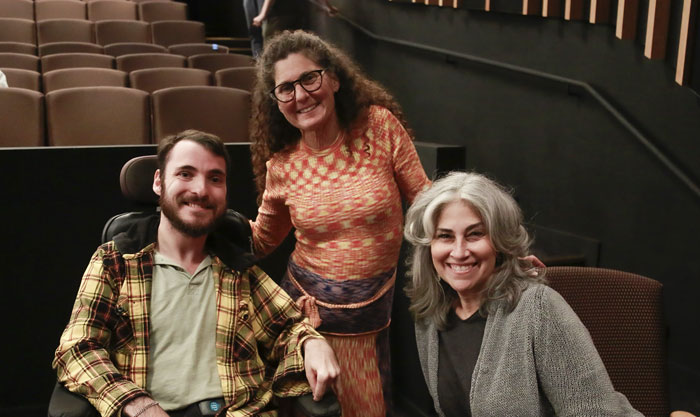
Storyteller Ali Wolf with son Adam and Wendy Hammers.

James-O’Kelley had this project in mind for a while. “I wanted to connect the Jewishness and the kindness, with Rabbi Jackie’s amazing spirit,” she said. “She sees the goodness in people and nurtures it.”

She saw so much talent in the neurodivergent community, she wanted to find them a stage, which she did. And then developed beautiful collaborations between diverse nonprofits in the arts.

For instance, USC’s Glorya Kaufman Performing Arts Center worked with a dancer from Ballet for all Kids and the O’Kelley Lab. There was also a collaboration with Spectrum Lab’s multitalented Domonique Brown. “We made a documentary with the Spectrum Laboratory kids, which we showed during Neurodiversity of Kindness,” James-O’Kelley said. 

It then morphed into a performance with Brown, a ventriloquist, and his puppet, Kid Wonder, on stage with Brad Bracy doing a soft shoe. “Rabbi Jackie helped shine a light on my kids, and it gave them so much confidence and joy,” she said. “What a blessing to do that for other people.”

The show also included Vista’s popular choir, made up of residents of Vista Del Mar (many of whom are children/teens abused, abandoned, in foster and adoptive care, some living with autism), as well as artwork from residents and community partners. 

The show also included Vista’s popular choir, made up of residents of Vista Del Mar (many of whom are children/teens abused, abandoned, in foster and adoptive care, some living with autism), as well as artwork from residents and community partners. “Rabbi Jackie continues to touch so many lives with her kindness,” James-O’Kelley said. “It has been an absolute gift to get to do this project with her.” 

Established over 100 years ago as the Jewish Orphan’s Home of Southern California, through its myriad of specialized programs, Vista Del Mar provides a trauma-responsive continuum of services to more than 5,000 children and families in crisis annually from all faiths.   

Redner hopes people see Vista del Mar as an oasis and a refuge, “a place of kindness, a place of love and support and a place that for over 100 years has worked to lift up humanity,” she said. “[This event was a celebration] of the community through Vista House of Lovingkindness, through Vista del Mar and the generosity of Glorya Kaufman who gifted us with this incredible theater that we [used].”

Lena Wilson, CEO/President of Vista Del Mar Child and Family Services,  added: “Vista Del Mar, with its long history of showing compassion and providing trauma informed care  to the most vulnerable children and families in our communities, whispers a gentle reminder: Kindness flows infinitely in the service to others touching every heart along its path.”

To learn more go to vistadelmar.org/about/vista-house-of-lovingkindness.

Neurodiversity of Kindness Read More »

A Love Letter to Los Angeles Jewry

I just returned from Los Angeles, as part of a North American speaking tour. A thank you letter to the many individuals who encouraged me, inspired me, and showed how much they love and support Israel, is not enough. As penance for years of underestimating “West Coast Jews,” this New York-born Jerusalemite feels compelled to write this love letter to an extraordinary Jewish community, which is meeting the challenge of the moment magnificently.

Consider my angriest moment in LA. Shanni Suissa, the podcaster, hosted an informal meeting with half-a-dozen other influencers and young activists. Going around the table, they discussed the trauma of October 7, the ongoing betrayal of American anti-Semitism, how even some rabbis, Jewish educators and communal leaders are demonizing Israel. But unbowed and uncowed, these young creatives were pushing back, working the problem, and singing a new, hip, song of Zion.

“HOW DARE YOU!” I bellowed. “I’m supposed to return to Jerusalem complaining about how weak and sniveling American Jews are – especially the young hipsters. And you’re all the exact opposite: creative, courageous, committed!”

Similarly, I braced myself for a long Shabbat at VBS, Valley Beth Shalom in Encino. I miss my family when away for Shabbat. Last Saturday was particularly anxiety-provoking with rumors spreading through Israel about possible Iranian retaliation for the most-deserved assassinations of seven Islamic Revolutionary Guard Corps killers.

Entering, I proposed that the ritual committee have VBS celebrate “Shushan Purim” with us in Jerusalem: “Your fortified compound here is a Walled City too!”

It’s not the fault of the Jews, of course, but the Jew-haters – and their quiescent fellow citizens. It’s outrageous that American — and Canadian – Jews keep “hardening the target,” reinforcing schools, synagogues, and communal institutions. Our non-Jewish fellow citizens should be Broadening the Target instead, patrolling voluntarily, escorting us, wearing yellow hostage pins and Jewish stars, so the haters can’t pick out the Jews to pick on, and the pro-Palestinians start experiencing some backlash for their anti-American, undemocratic, hooliganism.

Fortunately, the walls work, keeping the world’s ugliness outside. Inside, there’s so much joy, warmth, love of Israel, Torah, the Jewish people, and Zionism.  Rabbis Ed Feinstein and Nolan Lebovitz set the tone – embracing Zionism, mobilizing for Israel, and not just defending the Jewish people but celebrating us.

I was honored to address a congregation deeply-rooted in Los Angeles and in Israel too. The congregants were open to my vision of Identity Zionism, our opportunity now to reaffirm a Zionism of meaning, building Israel and rebuilding us, based on our rich history, loving community, inspiring values, and extraordinary homeland.

The happiness pulsing through the Friday night service exorcised the week’s tensions. In my sermon, I evoked Miriam Peretz, who lost two soldier-sons to terrorists. She explains that the terrorists seek to rob us of our joy. That’s why, she notes, she keeps laughing, singing, dancing, loving life – refusing to give the haters and killers victories they don’t deserve.

Such Jew-biliation is the Jew-Jitsu we need. And it twins with the expressions of solidarity with Israel throughout VBS and other institutions i visited, such as the Milken School, where love of Israel decorates one wall after another with Zionist values.

Similarly, Thursday night, I felt very at home at Loyola Marymount University – despite the security guards my hosts had to hire.  One sobering moment occurred during my otherwise exhilarating post-lecture conversation with that other LA Zionist hero, the Jewish Journal’s David Suissa.

Discussing the crisis in academe, I said, “I don’t understand why any professor would want students just spitting back what they heard, parroting some party line.”  I love watching students take what I teach, run it through their sensibilities, their values, their life experiences, then draw their own conclusions.

As I critiqued the professors, two students nodded in agreement. Afterwards, I told them I wished they had interrupted me, insisting:  “it’s not true, that’s not my experience.” Sadly, usually students thank me, saying it’s rare to hear professors invite them to think independently.

Those propagandizing professors who turn the professorial podium into a political platform are guilty of educational malpractice. We should inject that consumer-rights concept into the discussion, demanding the quality education our students deserve.

By contrast, throughout my North American jaunt – in Toronto, Chicago, and New York – I often confronted the gap growing between many American Jews and Israel. Israelis are steeped in our soldiers’ heroism and our enemies’ evils. American Jews feel pounded by the media pile-on constantly caricaturing Israel as evil. We Israelis see the fight as Israel versus Hamas and its Jihadist supporters; more and more American Jews are being bullied into seeing the fight as Israel versus the “innocent” Gazans.

Israelis are so conscious of the excruciating moral dilemmas facing our soldiers and generals – do you knock down another building or risk killing more Gazan civilians being used as human shields — or do you risk another Israeli funeral, another soldier’s amputation? Those conundrums don’t get covered as even Senator Chuck Schumer unfairly demonizes Israel for warring on the innocent.

The many pressures so many American Jews are under only made me appreciate my Los Angeles welcome even more. So I say thank you – I love you Angeleno-Jews, even though this time, I was so busy, I only made it to one of your amazing kosher restaurants, thanks to the inimitable David Suissa.


Professor Gil Troy, a Senior Fellow in Zionist Thought at the JPPI, the Jewish People Policy Institute, is an American presidential historian and the editor of the new three-volume set, “Theodor Herzl: Zionist.”

A Love Letter to Los Angeles Jewry Read More »