fbpx

February 8, 2024

A Moment in Time: “God, You’re On Mute”

Dear all,

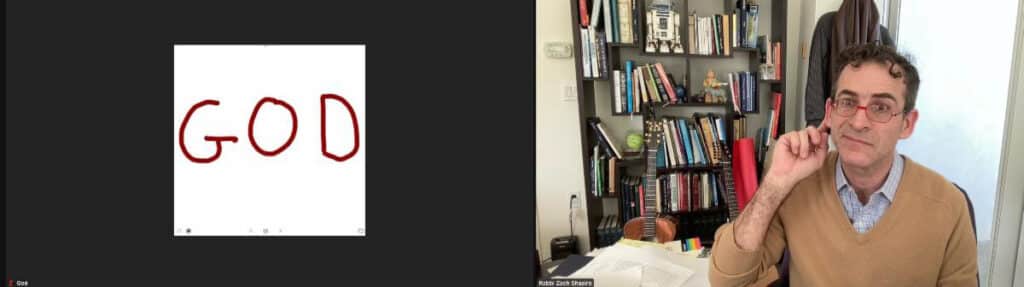
I had my regular zoom meeting with God this week. As God attempted to engage with me, I realized I couldn’t hear anything.

God,” I said while pointing to my ear, “You’re on mute.”

Friends, I believe God is trying to reach out to us at all times. And God likely has something really important to say. But there’s so often something in the way. Maybe God’s on mute. Maybe our own system is attempting to connect. So we have to try even harder to listen, to focus, and to open the highway of communication.

And in that moment in time when the system engages, and we can hear one another, creation begins all over again!

How will you open the connection today?

With love and shalom,

Rabbi Zach Shapiro

A Moment in Time: “God, You’re On Mute” Read More »

The Spirituality of Civil Law

On November 26, 1936, Rav Ben Zion Meir Hai Uziel delivered a lecture to a gathering of rabbis in Jerusalem. Speaking to rabbis who would become part of Israel’s national rabbinic leadership, Rav Uziel articulated his vision for rabbinic priorities in the emerging Jewish state:

When it comes to public and national matters, the issue of Mishpat – The Torah’s Civil Laws – is a weighty responsibility on a rabbi, for it is these matters that establish the path of life towards success or disaster, peace or dispute.

When Rav Uziel used the term “mishpat” to describe the Torah’s civil laws, what was he referring to?

“And these are the laws – Mishpatim – that you shall set before them.” With this opening verse from Parashat Mishpatim, God legislates the Torah’s system of civil legislation. Mishpatim refers to civil laws and ordinances, and by making these laws the Torah’s first laws following the Aseret Hadibrot (Ten Commandments), God sends a powerful message on how the Torah envisions a “religious society.”

Most people looking to create a “religious community” would begin by building a house of worship. God sees things differently. As the Jewish people build their new community after the exodus from Egypt, civil laws governing relationships between people (Bein Adam L’Havero) are legislated first. Batei Din (courts) come before the Mishkan (Tabernacle) and Dayyanim (Judges) precede Kohanim (Priests).

Parashat Mishpatim deals in matters that don’t seem “religious or spiritual” to most people — personal injury, damages due to negligence, paying employees on time, borrowing items or lending money, but these form the core of the Torah’s vision of a Jewish religious society. It’s much easier to behave “religiously” within the confines of a synagogue. The true challenge is maintaining that “religiosity” in the workplace and in our business dealings.

When he composed his Mishpetei Uziel halakhic responsa, Rav Uziel devoted a special introduction to the volume that dealt with Civil Law:

Amongst all of the various disciplines and halakhot, Mishpatim distinguishes itself, as it guides and directs the way of life for all areas and aspects of society. This body of laws reflects the distinctly unique character of Judaism.

Rav Uziel concluded his remarks with a powerful plea to the rabbis:

As you approach the seat of the rabbinate, take to heart that the full domain of mishpat — including all of its problems & issues — has been placed in your hands. It will be upon you – through trustworthiness, love, honor and admiration — to bring the nation closer to the values of law, righteousness and truth.

In the Israel of 2024, Rav Uziel’s grand vision for rabbis remains as powerfully compelling as it was in 1936. 

Shabbat Shalom


Rabbi Daniel Bouskila is the international director of the Sephardic Educational Center.

The Spirituality of Civil Law Read More »

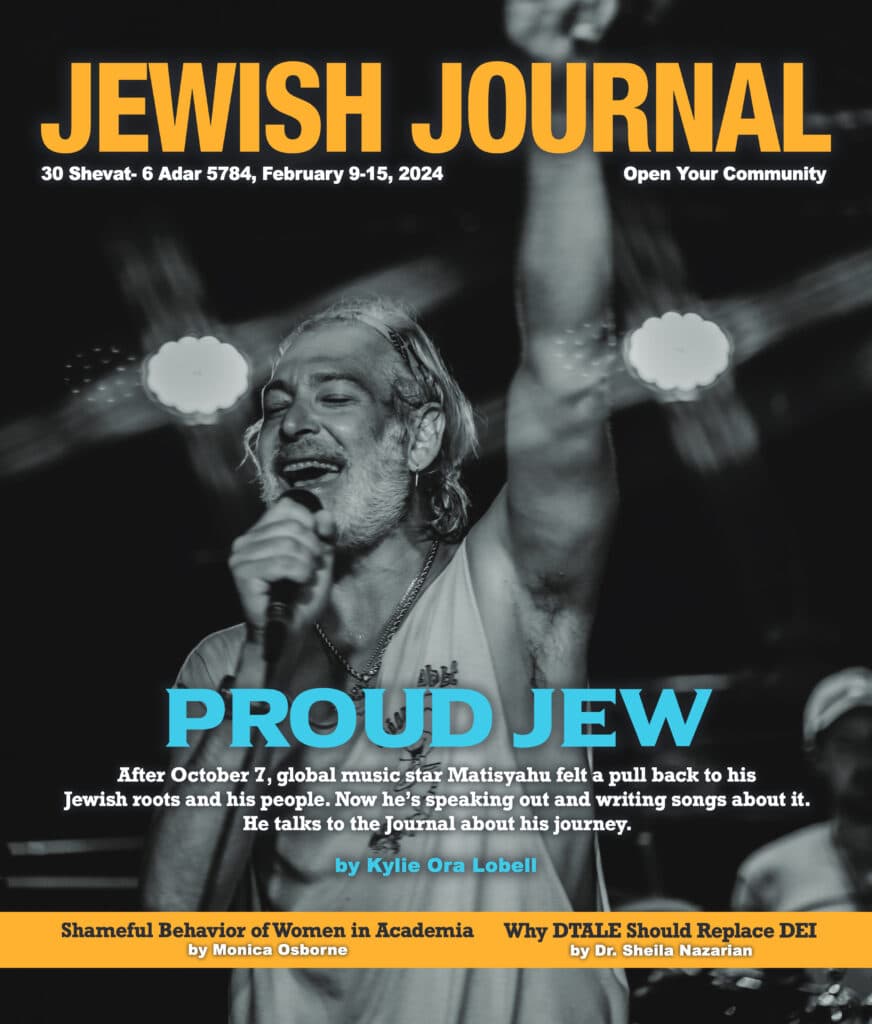
Print Issue: Proud Jew | Feb 09, 2024

CLICK HERE FOR FULLSCREEN VERSION

Print Issue: Proud Jew | Feb 09, 2024 Read More »

Confronting Masked Antisemitism at UCLA “Emergency Teach-In on Palestine”

As the war between Israel and Hamas escalates, so do tensions across college campuses in the United States. 

Last fall, UCLA professors Jennifer Chung and Formosa Chen offered students extra credit to attend an “Emergency Teach-In on Crisis in Palestine.” During the Zoom event (which remains on UCLA Professor Sherene Razack’s YouTube channel), several UCLA professors spread antisemitic misinformation and extremist rhetoric in support of Hamas, a designated terrorist organization.

As a public research university, UCLA’s fundamental purpose and mission statement is “the creation, dissemination, preservation, and application of knowledge for the betterment of our global society.” This “teach-in” violated this very mission, as the professors propagated falsehoods about atrocities committed against Israeli civilians by Hamas, that Israel is committing acts of “ethnic cleansing,” that the IDF called to evacuate Gazans as part of a “transfer plan,” and that the brutal attacks by Hamas on Oct. 7 were essential for Palestinian “liberation.” 

During the webinar, UCLA Professor Nour Joudah commented on the proposal for Egypt to open the Rafah border crossing for Gazan citizens to evacuate, referring to it as “ethnic cleansing.” Joudah further argued that “this is not the humanitarian corridor that Palestinians have been pleading for at every war and have been denied during every war; this is a transfer plan.”

Joudah portrays Israel’s message to Gazan citizens to evacuate northern Gaza as a way to permanently “displace” them, whereas the IDF’s statement clearly indicates that this warning is made for their safety and that “it will be possible to return to Gaza City after a notification confirming safety.”

Israel is only entering Gaza to eradicate Hamas, which threatens the lives of both Israeli and Palestinian civilians. This call for evacuation limits civilian casualties while Israel targets the terrorists, a situation that would not be necessary had Hamas not decided to use their civilians as human shields. A Gazan citizen named Muhammad was recorded  speaking with an IDF officer who urged him to flee from his current location to ensure his safety. Muhammad reported that Hamas is “simply sending everyone back home” and “shooting at people” who try to leave. 

Time and again, Hamas has methodically forbidden civilians from fleeing to safety when the IDF urges them to, an inhumane tactic that intentionally harms their citizens for their own benefit.

If there is anyone guilty of ethnic cleansing, it is the terror organization Hamas, who attacked Israeli communities near the Gaza border with explicit orders to murder Israelis, including women, children, and the elderly. Following the October 7th massacre, over 1,200 people were killed in communities across Southern Israel, including Kibbutz Nir Oz and Kibbutz Kfar Aza. If Joudah is so concerned about ethnic cleansing, why did she leave this out of the discussion?

Joudah claims that Palestinians have pleaded for a “humanitarian corridor,” but the history of Palestinian rejectionism by their leaders shows that Palestinian self-determination and human rights have never been the priority. Palestinian leaders have repeatedly waged war, committed acts of terrorism, and refused to compromise with Israeli and international leaders to establish a peaceful Palestinian state that neighbors Israel. 

For instance, Mahmoud Abbas, the president of the Palestinian Authority, commented that the Palestinian people “will remain in this land forever, while the attackers [Israelis] have no place in Jerusalem and no place here.” This is a clear call for the elimination of Israel and, therefore, the Jewish people. 

Another Hamas official, Mahmoud al-Zahar, agreed, even admitting that Hamas would refrain from engaging in such negotiations because “the Palestinian people will never accept it.”

Palestinian leaders have rejected peace at every turn, even admitting that peace is not what they want. In 1947, Palestinian leaders rejected the U.N. Partition Plan that proposed the creation of two separate states for Arabs and Jews, with Jerusalem as an international city. Yasser Arafat denied the 2000 Camp David summit proposal for a two-state solution, and Mahmoud Abbas turned down the possibility of creating a new two-state solution during the 2008 Annapolis Conference. Let’s be extremely clear: Palestinian leaders have repeatedly prioritized waging war against Israel and ridding the land of the Jews, a trend that we see to this day.

Later in the teach-in, Professor Loubna Qutami attempted to justify Hamas’s terrorism, stating that “patience has run its course [so] that the past several years has seen a resurgence of Palestinians returning toward the path of armed struggle because it had been a verifiable path that was used in the national liberation struggles.” No part of the definition of “armed resistance” includes committing atrocities as foul and heart-wrenching as beheading and raping innocent Israeli women, throwing grenades into safe rooms where children are hiding in fear, and shooting up a peaceful music festival. Is Qutami really supporting and encouraging this recent assault, which resulted in the most murders of Jewish people since the Holocaust, in the name of “liberation”? 

On a similar note, Professor Sherene Razack said, “The jihad fighter is a universal enemy… but Israeli soldiers enforcing an occupation based on the idea that G-d gave the land to the Jews are not, however, to be seen as jihad fighters.” Is Professor Razack equating soldiers protecting civilians from terrorism to genocidal jihadists? Hamas’s 1988 Covenant explicitly calls for all Muslims to “raise the banner of Jihad in the face of the oppressors so that they would rid the land of the people and their uncleanliness, vileness, and evils.” 

Furthermore, Israel does not simply exist because of this arbitrary “idea” but rather has a plethora of historical claims to the land, including archeological finds that date back thousands of years and descriptive mentions of ancient Israeli cities and their significances in the Torah, including Jerusalem, which is explicitly referred to around 700 times. On the other hand, the Quran does not mention Jerusalem or Palestine — which is a term with origins in the Roman conquest of the land of Israel — even once. 

After Jewish revolts against Roman rule around 135 A.D., the Roman Emperor Hadrian renamed the province of Judea “Syria Palestina” in a deliberate attempt to erase Jewish history from the land and spite the Jewish people by associating it with the ancient Philistines, who were the biblical enemies of the Israelites. The modern word “Palestine” stems from this history and has morphed into a Muslim Arab identity over time, but it was originally a term used to try and uproot Jewish history from the Jewish national homeland.

UCLA Chancellor Gene Block should think carefully about allowing professors to use their position of influence to celebrate horrific acts of terrorism against innocent civilians and blatant dissemination of Jew-hatred masked as an academic “teach-in.”

This teach-in was full of many more extremely biased assertions against the Jews’ connection to the land and blatant support of Hamas’s murder of innocent Israeli people. The bigotry espoused by Qutami, Joudah, and Razack leaves Jewish students on UCLA’s campus feeling unfairly targeted, unsafe, and held to double standards not expected of any other minority group. UCLA Chancellor Gene Block should think carefully about allowing professors to use their position of influence to celebrate horrific acts of terrorism against innocent civilians and blatant dissemination of Jew-hatred masked as an academic “teach-in.”


Talia Emrani is a 2023-24 UCLA Camera Fellow.

Confronting Masked Antisemitism at UCLA “Emergency Teach-In on Palestine” Read More »

Judges at Our Gates

Last week a viral video captured Prime Minister Netanyahu visiting an injured soldier who, after telling his story and speaking movingly of his four comrades who fell in battle, said emphatically: “We must not go back to the 6th of October – and not only in terms of security.”  This sentiment has echoed across the spectrum in Israel and among American Jews as well. “Not going back” often alludes to the disunity, the fractured and bitter political situation, that reverberated through Israel and across the ocean. If we don’t want to fall back into that whirlpool, we need to find its root causes. Do we have a clue?

My first thought was the phrase that buzzed through the English-speaking media last year: “judicial reform.” Usually this was presented as a demand by the right-leaning coalition government to undercut the power of Israel’s Supreme Court and change the method of selecting its judges. Protesters filled the streets, people warned of civil war. The issues sounded important, but it puzzled me that the country was being torn apart by a problem with judges.

My second thought was that the United States has been having its own issues with judges. If judges are selected by ideology, can they make fair judgments? Is “settled law” being radically overturned by a conservative Supreme Court?  Some of the justices may be corrupt, having accepted gifts that seem like bribes. Many Americans think, like Israelis, that autocracy is just around the corner because of problems with judges.

And then a third thought: Isn’t it bizarre that it was a group of judges, constituting a so-called International Court of Justice, that committed a travesty of injustice against Israel? Adding insult to injury, this came after a horrendous terrorist massacre. A more extreme problem with judges! 

Enter last week’s parsha, “Yitro,” in which Jethro, Moses’ father-in-law, acknowledges the supremacy of the Israelites’ God. He also, significantly, provides Moshe with a framework for social management – a system of judges. Following that, in a great epiphany, the Torah describes God giving the Ten Commandments to all Israel.  

The “Ten Words,” or Ten Important Matters, have been described as similar to the Preamble to the Constitution in the United States. But if the Ten Commandments are a preamble, Jethro’s plan for a justice system is the presupposition of the preamble. America’s founders insisted that the foundation for their envisioned democracy had to be an educated citizenry. Jethro insisted likewise that Moshe must create a reliable structure of authority among the people: 

“You will warn them of statutes and laws, make them knowledgeable of the way they must behave and the things they must do… And you will choose from the people men of ability who revere God, men of truth, who hate greed, and appoint them over the people [organized by] thousands, hundreds, fifties, and tens. … Every great matter they will bring to you, but every small matter they will judge themselves.”  

Lacking this, Jethro warned Moshe, you will collapse under the burden of leadership; but with this framework, “you will be able to endure and all the people shall go back each to his place in peace.”

Jethro was presenting a vision of a society guided by skilled, intelligent people who loved truth, hated greed, and cared deeply about the nation’s relation to G-d or (in secular terms) ultimate purpose. Those guides are none other than the judges, shoftim, who would make possible a society governed by the Ten Commandments.

The book of Devarim, representing Moshe’s final speeches, also includes instructions about judges. They are brief and straightforward:

“Judges and officers you shall appoint in all your gates (towns), which the Lord your God is giving you for your tribes. They will judge the people with righteous judgment:  You shall not be devious in judgment; you shall show no partiality; you shall not take a bribe, for a bribe blinds the eyes of the wise and twists the words of the righteous.  

“Justice, [only] justice shall you pursue, that you may live and inherit the land that the Lord your God is giving you.” Succinctly, Moshe connects the promise of the land with clear-headed, open-eyed, impartial judges.

Can we each imagine being one of those “judges in the gates”?  Can we each step up to a greater love of truth, a better use of our intelligence, an impartial approach to actual problem-solving rather than waving ideological flags? 

As we reflect on “not going back” to disunity and civil strife, it would be a good time to think about judges and justice. I am not advocating for or against “judicial reform,” whether in Israel or America, but rather a more introspective approach. Can we each imagine being one of those “judges in the gates”?  Can we each step up to a greater love of truth, a better use of our intelligence, an impartial approach to actual problem-solving rather than waving ideological flags? 

For example: Eliminate finger-pointing and blaming from our repertoire. Jettison our past beliefs about parties and policies. Abandon slogans. 

Be only people of truth, choose words carefully, strive for clarity — as we would want from judges if we were plaintiff or defendant.  

Root out greed in our own backyards; be models of full disclosure. 

Stop obsessing about individual politicians and reorient to our fundamental national purpose and the health of our communities.  

If we all work toward becoming righteous judges at our gates, we will see the way to resolve our differences, small and large; and we will pave the way for “all the people to go back each to his place in peace.”


Tamar Frankiel is a scholar of comparative religion and former president and faculty member of the Academy for Jewish Religion, California.

Judges at Our Gates Read More »

Disinvited, Excluded, Discriminated Against: Jews at UC Berkeley

Since the October massacres by Hamas, a range of Jewish UC Berkeley faculty — both visiting lecturers and speakers and those teaching regularly at the university — have experienced exclusion, prejudice, and discrimination on account of their Jewish identities. 

Israeli Yael Nativ had been invited to teach a course on contemporary dance in Israel, but was disinvited after Oct. 7. The head of the department apologized, saying she was under pressure from faculty and master’s degree students not to bring anybody from Israel or hold courses dealing with Israel.  

Nativ wrote in Haaretz that before she was disinvited from Berkeley, she “was excited about the possibility of social justice and the complex ways in which it is possible to talk about relationships between individuals and groups, about discrimination and exclusion, visibility and invisibility, pain, compassion, anger, remorse and even forgiveness.”

But Berkeley was not willing to host her, she explained, because she is Israeli.

Dan Kalb, a progressive environmental advocate and longtime Oakland City Council member, had been invited to address a course called Environmental Problem Solving, something he’d done in previous years. However, after October 7 some students searched his social media posts. Thirty students then sent a letter to the instructor accusing Kalb of “spreading pro-Israeli propaganda, which often equates pro-Palestinian voices as ‘antisemitic.’” The instructor regretfully indicated it would be best if Kalb not come. 

As Kalb told a reporter from Jewish News of Northern California, the students’ behavior was maddening and clearly bigoted.

“If someone wants to go speak about climate change — they are an expert on climate change — what the hell does Israel or Zionism have to do with that? Why not put a yellow star on our sleeve?“ – Dan Kalb

“If someone wants to go speak about climate change — they are an expert on climate change — what the hell does Israel or Zionism have to do with that?” Kalb said. “Why not put a yellow star on our sleeve? How about we do that too?”

 He also commented, “The problem of antisemitism – the problem of what we are seeing – apparently is not exclusive to the law school.” Over 20 student clubs ban speakers who support Zionism and/or practice forms of Judaism  — including Orthodox, Conservative, and Reform Judaism — which integrate Zionism into their prayers, practices, and theology. The university enables and upholds this systemic discrimination against Jews despite it likely violating prohibitions on discrimination on the basis of religion, ethnicity and, in the case of some speakers, national identity. 

Other staff and faculty – as well as students – have reported similar discrimination and express concern about abusive hate speech and incitement of violence directed at Jews. 

Jewish identity is increasingly stigmatized and marginalized, with many students, staff, and faculty feeling isolated, intimidated, and unable to safely express themselves as Jews. While the university has responded appropriately in response to some of these incidents – in keeping with its legal and ethical obligations – in many other cases, it has not. 

Justice, equality, and equal protection only sometimes is not acceptable. When it is reactive rather than proactive – as in the case of Dan Kalb – that illustrates ineffective governance of the university and belated enforcement of its rules, code of conduct and civil rights law obligations. 

The university administration’s frequent denials of the severity and harmful consequences of anti-Jewish discrimination on campus are disrespectful of the Jewish students, staff, and faculty who report them. 

When university leadership engages in denialism, it is antagonistic and unhelpful, making the university less safe for Jewish people. 

As is true of many individuals experiencing discrimination and abuse in general – which is almost uniformly underreported by people of diverse racial, ethnic, religious, gender and other backgrounds – many Jewish individuals on campus understandably do not feel comfortable reporting their experiences. Months of reporting them have yielded little effective redress and meaningful support, but no shortage of criticizing the complainants. 

The claim of some university leaders that anti-Jewish abuse, harassment, vilification, and discrimination on campus are expressions of “free speech,” mere benign disagreements among different members of the campus community, is disconnected from the reality many students, staff, and faculty are experiencing. 

Such counterfactual characterizations only exacerbate the hurt and harm that Jewish members of the Berkeley community are experiencing. They increase our isolation and understanding that the administration is neither listening to us nor learning from our experiences and addressing them. They add insult to injury and embolden those who discriminate against Jewish people. 

Berkeley prides itself on being concerned with equity, diversity, inclusivity, belonging, and anti-racism. But when it comes to Jewish people, all too often we are excluded from these commitments. 

University leadership frequently cites the existence of active Hillel and Chabad branches as purported proof of a positive campus atmosphere for Jewish students.Yet these organizations are independently funded and operated and receive little support from the university. 

University leadership also makes frequent reference to the Diller Institute and its valuable and rich program of Jewish and Israel Studies at the Law School. But this too is not a demonstration of the university’s commitment to equality and inclusion for Jews, because it is entirely funded by philanthropic donations, not by the university.

The severely limited funding that the university’s commendable educational initiative to confront antisemitism currently receives illustrates the university’s true level of care and concern for Jewish faculty, students, and staff and their experiences of discrimination and abuse – ethically, empathetically and practically parsimonious, with minimal tangible support. 

It is superficial and largely symbolic, not substantive. 

Committees to advise university leadership on the concerns of the Jewish community on campus can and have been helpful to a degree. But their capacity to bring change is limited because they are intentionally invested with minimal resources and restricted to an advisory role. 

The university continues to refuse to provide Jewish students, faculty and staff with substantial resources and programs of support, despite clearly expressed need.

Had the university cared to adequately fund and support effective efforts to combat anti-Jewish racism and discrimination on campus years ago, it would have likely led to a more positive, safe, inclusive, and respectful environment for Jewish students, faculty, and staff and for the university as a whole. But the university did not prioritize this, and the Jewish community is suffering the consequences of its poor choices and lack of genuinely inclusive vision.

Although there are limits to the capacity of diversity training on any topic – including anti-Jewish racism – to shift beliefs, attitudes, and behaviors, Berkeley’s leadership should initiate such training, just as staff are required to take other trainings, to encourage a shift in university culture regarding the rights and welfare of Jewish people. This is urgently needed and long overdue. 

Jewish faculty, staff and students will continue to share their experiences of discrimination and abuse irrespective of the university’s minimizations of our experiences, and the distress this causes us. 

Whether or not the university responds as we begin a new semester, whether they defend our Principles of Community and the university’s civil and human rights legal obligations, remains to be seen.


Noam Schimmel is a Lecturer in Global Studies with an emphasis on human rights at University of California, Berkeley. 

Disinvited, Excluded, Discriminated Against: Jews at UC Berkeley Read More »

Feb. 9, 1964; The Night That Changed My World

Historic events leave a mark on our collective memories. Memories that never fade. Whether tragic, such as the JFK assassination, 9/11, or Oct. 7; or joyous — marriage, birth, a new job — the mental imprints they leave remain our entire lifetime.

We remember where we were, what we were doing, what we were thinking and the impact on our lives.

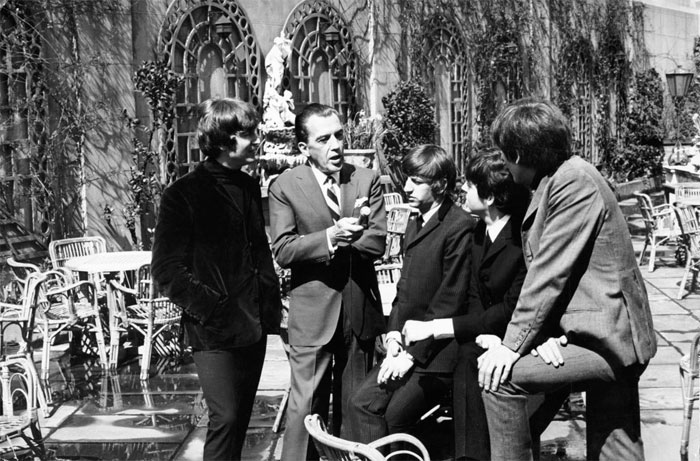
Those of us who lived through Beatlemania remember Feb. 9, 1964 as one of those historic occasions. It was Sunday night, eight o’clock and most of America had their television sets tuned to CBS and “The Ed Sullivan Show.” We were about to see and hear what all the fuss was about. The Beatles would make their American debut, and when they finished their five songs (the first of three consecutive weeks of appearances), the world would never be the same.

Especially my world.

Truth be told, pre-Beatles I was barely a teenager and had no interest in music. I never listened to the radio and never heard of The Beatles. Knowing that my older sister was all hyped up to watch Ed Sullivan, I did what typically annoying younger brothers do. I protested and said I wanted to watch “Bonanza” instead just to spite her. But it was my sister’s birthday, and my father, ever the peace maker, sided with her for shalom bayit.

I remember my parents sitting on the couch as my sister and I lay on the linoleum floor of the family room. All eyes were on our black-and-white Zenith television set. I purposely acted disconnected and bored. But that would all change when Sullivan, in his characteristically awkward style, introduced the Fab Four. Like the Northridge earthquake, they shook my world. I was mesmerized. The Beatles were strangers to us, but not for long. CBS helped by identifying each with a close-up, famously putting in parenthesis that John was married. Paul went straight into the song “All My Loving,” as the audience of teenagers screamed and worked themselves up into a frenzy.

The genius of Ed Sullivan to introduce The Beatles to America was more than a show biz booking. Feb. 9, 1964 was about two-and-a-half months after the JFK assassination. America was still in a state of shock and all of us wondered when we would be allowed to sing and be happy again.

The Beatles gave us that permission, along with the conviction to believe that whatever happens, life must go on.

There is nothing particularly Jewish about The Beatles, but I always heard a very Jewish message in their music. 

There is nothing particularly Jewish about The Beatles, but I always heard a very Jewish message in their music. Judaism is about facing adversity and mourning tragedy one day, while knowing that regardless, life is always worth living. An entire generation built new lives after the Holocaust, including my parents, while the brave people of Israel do it every day in the face of constant danger.

Ever since that fateful evening, my life has never been the same. The Beatles’ music has dominated my life in a way that is impossible to explain to someone of a different generation. Whenever I get down, I play the upbeat “Ob-La-Di, Ob-La-Da.” I maintain it is impossible to be depressed when hearing that song.

My father passed away about two years after The Beatles debut appearance. For those two years, I wanted him to understand them the way I did. But it was a struggle. Making it more difficult, he knew music. He was the Cantor of our shul and sang the Yiddish classics. But miracles do happen. One Shabbat, while we were walking to shul, he unconsciously started humming the melody to “Yesterday.” I was shocked. “That’s a Beatles song!” I said excitedly. 

I doubt he knew it was The Beatles, but he must have heard it on the radio and liked it. He just smiled and gave me his signature look. It was a look of validation, letting me know he understood.

As I think back to that fateful evening, and all that The Beatles have meant to me, I can still hear my father humming “Yesterday” and find comfort in knowing he approved of my obsession, an obsession that continues until today.


Harvey Farr is a local community reporter for the Jewish Journal.

Feb. 9, 1964; The Night That Changed My World Read More »

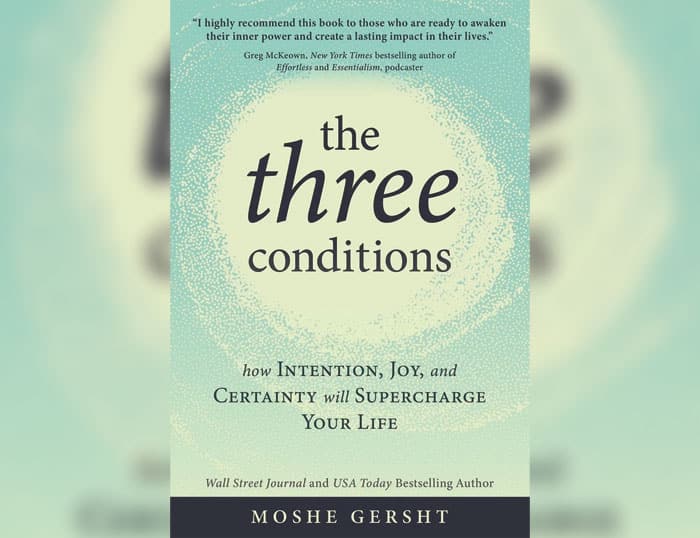
The Three Conditions: How Intention, Joy, and Certainty Will Supercharge Your Life

Rabbi Moshe Gersht believes that “joy is our nature,” and in his new book, “The Three Conditions: How Intention, Joy, and Certainty Will Supercharge Your Life,” he charts his personal transformative spiritual journey to this elevated state. His recipe relies on three conditions for living: embracing intention, certainty, and joy. Along the way he addresses life’s challenges and misconceptions about spirituality.

Gersht’s journey began at 20, after spending seven years in a pop-punk rock band. When a good friend innocently asked him, “How long are you going to play music?” Gersht was rattled. He realized that he didn’t know what “success” would look like, and whether being a musician was his true purpose in life. He left his band and many friendships behind, immersing himself in Torah study for years, emerging as an accomplished teacher. 

Yet this, too, failed to fulfill him. Married with children, Gersht felt boxed in, overwhelmed by his responsibilities, and emotionally unsettled. By day he taught students about the God with whom he felt estranged and often came home feeling like a fraud. Food and sleep became a refuge. His emotional and physical health declined.

“The Three Conditions,” Gersht’s third book, lays out the lessons he learned about himself during this time and how he found his true purpose through letting go of fear and tapping into a more authentic, intentional, and confident life. The book discusses many solid psychological concepts, Torah philosophy, and New-Age language about “the higher self.”  Below, the author explains some of the book’s main ideas:

Why the three conditions matter:  Only two things matter in your life that directly lead to your joyful living: What you believe about your “self” and what you believe about “the universe.” You get to choose what you believe. How are you going to live? 

We need “intention” to return to our true selves. This requires us to disconnect from the dramas, the stories we have created about ourselves and the expectations we have of ourselves and what we think others expect of us. “Certainty” is a return to God, believing that there is a cosmic order. Even amidst chaos we can believe that things are good and getting better. We don’t know how it all comes together but we hold on to the lifeline that there’s a plan. “Joy” is the barometer for alignment with intention and certainty. When a person is in tune with love and experiences joy, they open the door for miracles. 

If you want to be spiritually connected, returning to self is essential. In the Torah, Abraham wanted to have the deepest experience of connecting to God. But God surprisingly tells him, “Lech lecha,” go to yourself. God was saying, “If you want to find Me, you need to find the truth of who you are.” That’s a profound lesson.  We need to ask ourselves: How much of “me” was shaped by others? True freedom isn’t the ability to do what you want; it’s the ability to know and be who you really are.

What happens in front of our eyes is not as important as what’s happening behind them. That’s why changing our thinking changes the way we feel about ourselves and the world. 

How we can transform our thinking to be more joyful: What happens in front of our eyes is not as important as what’s happening behind them. That’s why changing our thinking changes the way we feel about ourselves and the world. This involves a practice of noticing. For example, when I experience myself as a happy, loving, joyful individual, I know I’m believing in myself and the world. If I feel broken, resentful, anxious and sad, and it’s not just a passing emotion, I know that I’m out of alignment with my higher self. Integrating intention, joy and certainty will supercharge everything you do with all the energy of your life force: what you say, think, and do. This makes you a co-creator with God and allows you to live with purpose.

On maintaining the three conditions mindset: I often stop at my front door before coming home and say a prayer to release all the negativity I may have picked up throughout the day. I ask to stay connected to my healthy, loving spirit before seeing my wife and children. I can’t tell you how often I have experienced Divine guidance in those moments. 

We can begin to doubt ourselves, especially when we start recalling a negative past experience. But we are meant to believe in ourselves, to live with the light of consciousness that we call Emunah, or certainty. That light of consciousness is always shining on the road. If you find yourself afraid, in that darker place, and you’re thinking “I can’t, it’s impossible” you just need to get back on that road. You may be able to do that by thinking about it, or writing it down, or talking to a friend, teacher, or therapist who can reignite that flame. Sometimes you just need to go to sleep. 

An idea for how to live in the moment:  When we are overly rooted in the past or the future, we fight the blessing of being in the present moment. The present is where we find and make space for the blessings to enter. While the future is uncertain, we can hold space for the idea that things will work out, without understanding how. Allowing yourself to feel good about the life you are living raises your consciousness and brings blessings into this world. When you feel aligned, you don’t have to hope life will go the way you want it to go for you to be happy; it goes the way it goes because you are happy. 

On misconceptions about spirituality: Many people assume spirituality has something to do with being disconnected from our reality. This perspective couldn’t be further from the truth. Spirituality is not simply about accessing a higher dimension of life, but seeing and experiencing the depth of life for what it truly already is. The love, joy, and peace you will experience isn’t an escape, but an immersion.

On dealing with this painful time for Jews: Our hearts, minds, and souls are united with those in pain today. We sit in mourning over our collective loss. We are not the beginning. We are not the end. We are the process. May we all be blessed to see the light of a new reality with goodness as its leader, love as its guide, and truth as its nature.


Judy Gruen’s new book, “Bylines and Blessings,” will be published on February 20. 

The Three Conditions: How Intention, Joy, and Certainty Will Supercharge Your Life Read More »

LAPD Launches Groundbreaking Online Hate Incident Reporting in Collaboration with Magen Am

Mrs. Kohn wasn’t sure what to do. While picking up her children from school, she heard people yelling derogatory anti-Israel and antisemitic slurs from a rooftop. It was just after Oct. 7, and she had observed a notable presence of anti-Israeli individuals in the area. This time, however, the anti-Israel protesters directed their animosity towards schoolchildren. 

Unsure of the appropriate action, she contemplated calling 911, but the situation didn’t qualify as an emergency as it lacked direct danger. Opting to use the nonemergency number, Mrs. Kohn was put on an hour-long hold until she simply hung up. 

The local mother and concerned citizen is not alone in abandoning the reporting of hate crimes due to bureaucracy, lengthy wait times and the inability to report these types of crimes online. While LAPD facilitates online reporting for various crimes like vandalism and theft, hate crimes have been notably absent from this digital avenue not just in Los Angeles, but nationwide. Attempts to input hate-motivated incidents online have been consistently canceled automatically, adding to the frustration and challenges faced by those seeking to report such incidents. 

Recognizing the problem, Magen Am has collaborated with LAPD and other Jewish organizations, such as Agudath Israel, the ADL and the Jewish Federation, over the past year to introduce a significant addition to LAPD’s existing Community Online Reporting System (CORS): a hate incident reporting policy and system. 

Magen Am is a local organization committed to training and empowering Jewish communities to deter and respond to security threats. Rabbi Yossi Eilfort, the founder of Magen Am, said in an interview with the Jewish Journal that since the tragic events in Israel on Oct. 7, Jews in L.A. and nationwide have faced a disturbing surge in antisemitic incidents, a trend that shows no sign of slowing down amid the ongoing conflict in Israel. According to the ADL, there has been a staggering 360% increase in antisemitism in the three months following Oct. 7, compared to the same period in 2022.

“This tool will give the department more accurate data so they can better serve every community facing hate and hold the bad actors accountable for their actions.” – Rabbi Yossi Eilfort

“It’s been a pleasure working alongside LAPD and other partnering organizations to get this new feature across the finish line,” Eilfort said. “The leadership at LAPD took the time to truly understand the need and work to problem-solve potential shortfalls, all for the benefit of the community. This tool will give the department more accurate data so they can better serve every community facing hate and hold the bad actors accountable for their actions. We’re so glad to see our shared vision with the LAPD come to life.”

CORS’ hate incident reporting feature serves as a valuable tool in crime mapping, utilizing the submitted data to track patterns and derive actionable insights. LAPD resources can be strategically allocated based on the number and nature of reported incidents, enabling a more proactive approach to crime prevention. The reports undergo thorough review by detectives, ensuring timely data collection, trend monitoring, and the possibility of prosecutorial action.

A unique aspect of the CORS system is its integration of third-party reporting, allowing witnesses or individuals speaking on behalf of victims to report hate incidents. LAPD encourages community involvement, recognizing the importance of data input for effective policing. 

In a statement released by Magen Am, Ivan Wolkind, Magen Am’s CEO, emphasized the simplicity of the reporting process and urged the community to actively engage in reporting non-emergency hate incidents without relying on traditional hotline calls.

“The community’s buy-in is essential to ensuring a safer city for all,” he said. “It’s as easy as pulling out your phone and submitting a report right then and there from the comfort of your car, office or home.”

To learn more about Magen Am and CORS, visit magenam.com.

LAPD Launches Groundbreaking Online Hate Incident Reporting in Collaboration with Magen Am Read More »

Matisyahu Reminds Me Why I Love My Judaism

Every lover of Judaism has a special moment when the love reaches a certain peak and can give you goosebumps. For me, I got the goosebumps when I saw a video of Matisyahu performing his hit song “Jerusalem” at a Spanish music festival in August 2015. 

The song wasn’t new. Like millions of others, I had heard it plenty of times. What was new was that Matisyahu was singing in front of Jew haters. These haters came to heckle him and wave large Palestinian flags during his performance.

I remember thinking: How does an artist expressing his love perform in front of people expressing their hate? That must take some love, some courage.

Some of you may remember the context. As you’ll read in our cover story this week by Kylie Ora Lobell, “In 2015, [Matisyahu] stood up to festival organizers in Spain, who, bowing to BDS pressure, told him he needed to sign a letter saying he supported a Palestinian state and wouldn’t bring up Israeli politics while performing. He refused, and eventually, the festival was forced to apologize to him and let him play.”

That tension accompanied Matisyahu to the stage, especially when he sang “Jerusalem.” Since that moment is so attached to my memory, I decided this week to rewatch the clip. 

Yes, the goosebumps came back, but this time, the scene hit me differently.

Maybe it’s because of October 7 and its aftermath. Since that horrific day, anti-Israel protestors around the world have never been louder and angrier. The venom that has been unleashed against Jews has been bewildering.

That same venom confronted Matisyahu as he sang “Jerusalem” in 2015. In that concert setting, however, the haters couldn’t make much noise. All they could do was swing big flags back and forth. Their venom was silenced. Matisyahu’s poignant singing had drowned and diminished them.

Had those protestors been on a street corner or on a college campus, they would have screamed their Jew hatred over loud-speakers, as they are doing now. But on that fateful day in Spain, the big sound came not from the haters in the audience but from the lover on stage.

Which got me thinking: Wasn’t Matisyahu modeling one of the core ideals of Judaism, the ideal of sharing good things with the world?

No one would pay a penny to see haters on stage express their anger. Anger is not a gift or an art or an accomplishment. Beautiful music is an accomplishment that people will come to see.

Matisyahu is following in a long tradition of Jews who feel naturally compelled to share something of value with the world. Since Jews have landed on these blessed shores, an endless list of Jewish writers, thinkers, artists, entertainers, social activists, scientists, builders, spiritual voices and civic leaders have gratefully given back to America.

The fact that many of us are now in “fighting” mode against a sea of hatred is a reality that has been forced on us. We fight when we must fight, just as Israel fights when it must fight, but we’d much rather play music, dance, read, connect, laugh, rejoice, pray, learn, hike, do yoga, volunteer or hang out with friends.

 “Tonight was difficult but special,” Matisyahu wrote on his Facebook page after the 2015 concert. “Thank you to everyone who made it possible! Every chance to make music is a blessing.”

Matisyahu is still blessed to make his music and is connecting even more deeply to his Jewish roots. After Oct. 7, he says, “there is this strange pull back to being Jewish and feeling Jewish, of wanting to be connected to other Jews and Israel and speaking out about what’s happening and writing songs about it.”

His new album, which comes out this week, is titled “Hold The Fire.” For an artist who loves his art and is moved to spread light, it’s hard to think of a better title. In spreading some of that light on his upcoming U.S. tour, he says he’s “thinking about how he’ll incorporate messages about Israel into his shows.”

If Jew haters show up again to spread their anger, let’s remember one thing: When the music starts, the joy will come not from the angry haters but from the proud Jew singing on stage. At a time when those haters are making so much noise, that idea alone gives me goosebumps.

Matisyahu Reminds Me Why I Love My Judaism Read More »