fbpx

June 8, 2023

The Nobel Prize for Menschlichkeit

Menschlichkeit is one of those meaningful Yiddish words that have no English equivalent. It’s a pity, because it embodies a concept born of a thousand years of eastern European Jewish experience.

The closest definition would be “an honourable person of good character who behaves with common decency.” Cicero’s term “humanitas” was translated as menschlichkeit in German and expanded in Yiddish to encompass values first promoted in the Torah and the Hebrew prophets. Rabbi Neil Kurshan characterizes it as “responsibility fused with compassion, a sense that one’s own personal needs and desires are limited by the needs and desires of other people. A mensch acts with self-restraint and humility, always sensitive to the feelings and thoughts of others.”

To best understand the profound concept expressed in the word, we must turn to our sources. In “Ethics of the Fathers,” Rabbi Hillel said: “In a place where there are no men, strive to be a man.” As the Jewish Chronicle suggested, “for man, read mensch,” meaning that when no one is behaving with integrity, we must step up and do the right thing. 

In the Talmud (Taanit 22a), the prophet Elijah and Rabbi Beroka are in the marketplace when Elijah points and says: “Those two have a place in the world to come.” Rabbi Beroka approaches the two and discovers that they are jesters (clowns). They tell him that they “cheer up the depressed” and when they see people quarreling, they strive to make peace. A jester would not usually be perceived as the typical mensch, but the point of the story about Elijah and the jesters is to demonstrate that anyone can be a mensch if he or she makes the world a better place.

The examples of Hillel and Elijah demonstrate the values embodied in the mensch and strongly endorse them to the point of the greatest reward, eternal life, suggesting that these values are as much spiritual as practical.

The examples of Hillel and Elijah demonstrate the values embodied in the mensch and strongly endorse them to the point of the greatest reward, eternal life, suggesting that these values are as much spiritual as practical.

The Hebrew prophets consistently condemned hypocrisy in the form of punctilious religious ritual — offering sacrifices in the Temple — and egregious behaviour in society. Like the Talmudic rabbis, who lived many years later, they emphasised the great importance of what Yiddish calls menschlichkeit. Micah’s declaration (6:6-8) is perhaps one of the best known: “What does the Lord require of you? To act justly and to love mercy and to walk humbly with your God”; Amos (5:15) taught that one should “hate evil, love good and establish justice in the gate”; Zechariah (7:9-10) preached that we must “execute true justice, deal loyally and compassionately with one another.”

The implication of the prophets’ injunctions is that, when one is compassionate, just, loyal, kind and decent, one is doing God’s bidding in the world. It’s as if the prophets and the rabbis of the Talmud were saying, millennia before Yiddish existed, “Zey a mensch,” “Be a mensch!” I once saw a poster that captured the essence of what the rabbis and prophets were expressing: frumkeit (observance) without menschlichkeit is not Yiddishkeit (what it means to be Jewish). 

This consistent focus on human values explains Hillel’s famous response to someone who taunts him, asking him to explain the Torah while standing on one foot. Hillel said: “What is hateful to you, do not do to others. All the rest is commentary. Now, go and study.” Hillel makes Jewish ritual observance conditional on how we are to treat one another, how we behave in society. He does not dismiss observance or Jewish law. Indeed, his last words are “go and study.” But it is clear that one’s character and behaviour must precede, or at least co-exist, with any relationship with the Divine. The Torah is a covenant between us and God but it is also one between me and you. Hillel was said (Eruvin 13b) to have practiced what he preached: He taught his students his rival’s views before his own.

There are six Nobel Prizes awarded for everything from physics to literature. Why not one for what is most important in this broken world? 

If there had been a Nobel Prize then, Hillel would have won it. That’s what we need today, a Nobel Prize for menschlichkeit. There are six Nobel Prizes awarded for everything from physics to literature. Why not one for what is most important in this broken world, menschlichkeit? 

This ancient teaching is relevant in modern times. In a speech at Columbia University in 1946, immediately after World War Two, the French writer Albert Camus warned his audience: “Inside every nation, and the world at large, mistrust, resentment, greed and the race for power are manufacturing a dark, desperate universe in which each man is condemned to live.” It was a frightful and ominous view, justified by what the world had just experienced.

Our sages, millennia ago, forcefully and repeatedly stressed menschlichkeit. They understood something fundamental and crucial for a functioning society: Torah values are not merely aspirational, ideals to keep in mind or ignore at will. They are essential. The alternative is moral extinction. 

We can do better. How about that Nobel Prize for menschlichkeit?


Dr. Paul Socken is Distinguished Professor Emeritus and founder of the Jewish Studies program at the University of Waterloo.

The Nobel Prize for Menschlichkeit Read More »

A Dog’s Journey Through Nazi Germany — From His Four-Legged Perspective

I don’t know why, but I love dog books, especially those written in “first-dog”. Most of my favorite novels from the last few years like “The Art of Racing in the Rain”, “A Dog’s Purpose” and “One Good Dog” tell the story from the animal’s point of view. The simple prose and the descriptions derived from the dog’s enhanced sense of smell and hearing give a new and different perspective to the human/pet relationship. “The Jewish Dog,” a novel by Asher Kravitz and translated from Hebrew by Michal Kessler, does not disappoint. 

The story takes place in 1930’s Berlin. The economy is in freefall, the National Socialist German Workers party and their psychopathic leaders are becoming more and more popular, and antisemitism is on the rise. At the home of the Gotleibs, a modern Orthodox Jewish family, there is much excitement. Their dog Buriah has given birth to a litter of puppies. 

The three Gotleib children; Raizel, Herschel and Joshua are enthralled. What child wouldn’t be thrilled to see such an adorable sight? Kalman, their father, warns the children not to get too attached to the little guys and not to give them names. In a few weeks all the puppies will be given away. One of the pups dies and four are quickly adopted. One of the young dogs called “the white one with the black circle around his eye and brown patch on his chest” seems to show a desire to stay with the Gotleib clan. There are no takers for this rather withdrawn dog and finally Kalman gives in and allows the kids to keep him. 

The pup seems to enjoy many of the Jewish traditions, especially Shabbat and Passover. At his first Passover Seder, the new puppy helps the children sniff out the Afikomen. After taking a bite of the matzo, he describes it a “piece of tasteless cardboard”. 

Our hero gets the name Caleb and becomes a bona fide member of the Gotleib family. From that point on, Caleb shares the traditions of Judaism with the Gotleibs. They even build him a little dog sukkah attached to the family sukkah. When the Nazis seize control of Germany, they start to put into place their “final solution” for the Jewish people. Kalman Gotleib loses his job as a professor at the University, the children are no longer allowed to attend school, and their long-time German housekeeper is forbidden from working for them any longer. All this is seen through the naive eyes of Caleb as he tries to understand the cruelties of mankind. 

A new law is passed. Jews are no longer allowed to own dogs. While Buriah is given to the housekeeper’s family, Caleb is given to Frank Heinz, a fellow professor who is a friend of Kalman. Caleb’s’ name is changed to Zelig. While Caleb and Professor Heinz get along just fine, his wife Greta is another matter. She despises the “Jew dog” and wants to get rid of him. Her hatred is intensified when the dog eats her copy of “Mein Kampf” and buries a bone in the cushion of a new couch. 

When the Professor is arrested by the Gestapo, Zelig is taken by one of the agents. Unlike Greta Heinz, the wife of Standardtenfurher Theodor Durer, Frau Durer, falls in love with little Zelig, as does his son George. His new name becomes Wilhelm. When Theodor dies accidently, George becomes more involved with the Nazi youth, and takes Wilhelm with him and his friends to hunt for “kikes and gypsies”. When the gang order Wilhelm to attack a young Jewish boy on the street, he saves the boy’s life instead. The dog is chased by the Nazi youths and is forced to become a stray living off garbage and handouts. 

Caleb receives messages from a spiritual “Heavenly Dog”. The “Heavenly Dog” sends him out of Berlin and into the countryside. He joins a pack and is able to survive by hunting and scavenging. He falls in love with a female named Margo, and rises in stature within the pack. 

When Caleb finally returns to Berlin, he is captured by the animal control agents. From there he is given to a trainer named Ralph Schmidt, who prepares him to be a guard dog in a German concentration camp. His new name is Blitz. At Treblinka, the dog is reunited with Joshua Gotleib.  Together the two escape from Treblinka and join a group of Partisans. Caleb uses his superior senses to help the Partisans ambush a German army convoy.

While most of the novel takes place in very difficult times, Caleb manages to bring humor, adventure and compassion to his telling of the story. There is certainly a very different viewpoint when observations are recorded from the perspective of “man’s best friend”. 

Guided by instinct and by messages from the great Dog in the sky, Caleb never forgets his Jewish upbringing. Together with Joshua, they manage to survive the war and start a new life. While most of the novel takes place in very difficult times, Caleb manages to bring humor, adventure and compassion to his telling of the story. There is certainly a very different viewpoint when observations are recorded from the perspective of “man’s best friend”. 

As a reader I admire the story of Caleb and his many adventures and I know that writing this novel in “first dog” takes a lot of talent. Asher Kravitz is a pilot, a former police detective, a wildlife photographer and a professor in physics and mathematics at the Jerusalem College of Engineering in Israel. He is the author of seven books in Hebrew. “The Jewish Dog” is a best-selling novel in Israel and is his first work to be translated to English.

A Dog’s Journey Through Nazi Germany — From His Four-Legged Perspective Read More »

Campus Watch June 8, 2023

CUNY Denounces Anti-Israel Commencement Speech As “Hate Speech”

The City University of New York (CUNY) issued a statement on May 30 denouncing an anti-Israel speaker’s CUNY School of Law commencement speech on May 12 as being “hate speech.”

The speech, delivered by Students for Justice in Palestine (SJP) activist Fatima Mohammed, featured her applauding CUNY Law’s faculty and students for endorsing the Boycott, Divestment and Sanctions (BDS) movement “as Israel continues to indiscriminately rain bullets and bombs on worshippers, murdering the old, the young, attacking even funerals and graveyards, as it encourages lynch mobs to target Palestinian homes and businesses.”

CUNY Chancellor Felix V. Matos Rodriguez and the Board of Trustees said in their statement, “The remarks by a student-selected speaker at the CUNY Law School graduation, unfortunately, fall into the category of hate speech as they were a public expression of hate toward people and communities based on their religion, race or political affiliation. The Board of Trustees of the City University of New York condemns such hate speech.” 

Legal Groups Call on IRS to Investigate CUNY Law’s Tax-Exempt Status Over Faculty Resolution Supporting BDS

Two legal groups sent a joint letter to the Internal Revenue Service (IRS) urging the agency to investigate and potentially revoke the City University of New York’s (CUNY) School of Law’s tax-exempt status over the law school’s faculty unanimously passing a resolution supporting the Boycott, Divestment and Sanctions (BDS) movement last year.

“This resolution directly violates CUNY’s non-profit status as a 501(c)(3) non-profit entity, which prohibits engaging in substantial political or lobbying activities. It also runs counter to its ‘educational’ mission, because there is a difference between education and indoctrination,” Ostrovsky and Goldfeder argued. “To our knowledge, the CUNY Law School is the only law school in the United States that has formally adopted BDS as a core component of its educational mission. Today, the CUNY School of Law has become a staging ground for the systematic promotion of BDS activities, and anti-Zionist and antisemitic bias on campus, all of which are the opposite of ‘educational.’”

NY Republican Congressman Introduces Bill to Defund Colleges Allowing Antisemitism on Campus

Representative Mike Lawler (R-NY) introduced a bill on June 1 that will revoke federal funding from colleges that allow antisemitism to be promoted on campus.

The bill, called the “Stop Antisemitism on College Campuses Act,” states that any higher education institution “will not authorize, facilitate, provide funding for, or otherwise support 8 any event promoting Anti-Semitism on campus.” 

“Many in the Jewish community in New York and across the country were outraged when a student spewed outrageous anti-semitic rhetoric at CUNY Law School’s graduation in May,” Lawler said in a statement. “No college or university should receive a single dollar of federal education funding if they peddle in the promotion of anti-semitism at an event on their campus.”

More Than 100 Jewish Groups Urge 250 Universities to Cut Ties With American Anthropological Association If They Pass BDS Resolution

A letter signed by 107 Jewish groups urged 250 universities who partner with the American Anthropological Association (AAA) to cut ties with the organization should they pass a resolution calling for academic boycotts of Israel.

The letter, spearheaded by the AMCHA Initiative, “not only threatens the core principles of academic freedom, but also poses significant risks to the educational opportunities and experiences of your students and faculty, the reputation of your institution, and the inclusivity and diversity of your campus community.” “Research has shown a clear correlation between academic boycotts and the incitement of anti-Jewish hostility and antisemitism. Endorsing an academic boycott would create an unwelcoming and unsafe environment for Jewish students and faculty on your campus,” the letter later added. It concluded with a call for the universities condemn the resolution and academic boycotts generally and, should the AAA pass the resolution, sever ties with the AAA altogether.

Antisemitism Watchdog Urges Universities to Defund Student Groups Engaging in Israel Apartheid Week

The Combat Antisemitism Movement (CAM) watchdog is urging universities “not to provide activity funds” to student groups that engage in Israel Apartheid Week (IAW) on campus, arguing that such activity results in “hostile environments that intimidate Jewish students.”

CAM released a report in conjunction with the Israel on Campus Coalition on May 31 titled “Contemporary Antisemitism on American College Campuses” stating that IAW displays “call for the eradication of the Jewish state and demonize its supporters through the promulgation of the anti-Zionist ideology based on historical revisionism.” “Jewish students on campus are often pressured to either abandon or diminish public support of a key component of their own identities,” the report stated.

The Algemeiner defined activity funds in the report as “a pool of money to which undergraduates contribute involuntarily to subsidize the activities of student clubs”; the CAM-ICC report argued that starving groups engaging in IAW from these funds is necessary to “ensure principles of tolerance and respect for diversity are upheld.” The report also called for universities to adopt the International Holocaust Remembrance Alliance definition of antisemitism and for Diversity, Equity and Inclusion office to “prioritize antisemitism training programs.”

Campus Watch June 8, 2023 Read More »

56 Years Later, Let’s De-Normalize the Occupation

How many Palestinians and Israelis remember life before the occupation, 56 years ago?

If we assume that a person only develops a sociopolitical consciousness after the age of ten, then we should check the proportion of both populations that are 65 or older. In Palestinian society, the proportion is a mere 3%. In Israel it’s higher (around 11%). But given the fact that many of the Israelis in that age group immigrated from the former Soviet Union only during the 1990s, it is safe to assume that in Israel too, the proportion is somewhere in the single digits, or less than one in 10.

Think about it: we have two entire societies – almost three generations – that have been conditioned to perceive their relationship as one of occupier and occupied. 

Think about it: we have two entire societies – almost three generations – that have been conditioned to perceive their relationship as one of occupier and occupied. Three generations that exclusively experienced this “temporary situation” as the only way of life they know. Beyond that, majorities in both societies do not remember life before the second intifada, which put Israelis and Palestinians on a perpetual collision course of on-again-off-again violence.

What happens to two societies in conflict, which internalize occupation as a way of life, the only way of life they know? What happens to the occupiers and what happens to the occupied? You don’t need a degree in sociology to answer this question. It’s enough to read the papers, or, even better, visit Israel and Palestine. Many Israelis and Palestinians cannot even imagine life differently.

I often talk to Palestinians about what life is like for them, having experienced more than half a century of suffering, oppression, humiliation and hopelessness under a brutal military occupation. I can only imagine and express empathy and solidarity.

I am more than familiar with Israeli society’s reaction to the occupation, particularly in the past 23 years, since the beginning of the traumatizing violence of the second intifada. Most Israelis have stopped believing in the viability of an Israeli-Palestinian political settlement. 

On the other hand, I am more than familiar with Israeli society’s reaction to the occupation, particularly in the past 23 years, since the beginning of the traumatizing violence of the second intifada. Most Israelis have stopped believing in the viability of an Israeli-Palestinian political settlement. Shalom (peace), a word that once dominated Israeli election campaigns and aspirational political speeches, has become synonymous with weakness and naiveté and all but disappeared from political discourse. Disappointed and disillusioned, many Israelis ceased to care about the plight of their Palestinian neighbors and about the prospects of living in peace with them. For our friends in Israel’s peace movement and, by extension, for my organization in the United States, the chief challenge has been battling apathy and nihilism.

The 56th year of the occupation has ushered in an Israeli government that, disastrously, is determined to infinitely perpetuate the occupation, that is unless they move ahead with their stated goal of annexation and kill any chance for a future compromise-based peace.

But it also saw the rise of a protest movement, the likes of which Israel has never seen.

I know, the protest is not focused on the occupation. Demonstrators are there to defend democracy and justice for Israelis, not for Palestinians. Still, I see the protest as the most promising development in recent memory in the struggle against the occupation. The movement has transformed hundreds of thousands of Israelis from apathetic cynics to political activists. It has exposed them to anti-occupation messaging by the tenacious demonstrators who insist on infusing the demonstrations with their chants and billboards. The protest movement went from shunning to tolerating and even embracing the Anti-Occupation Bloc (Ha-Gush Neged Hakibush, sounds catchier in Hebrew), a vociferous coalition of anti-occupation organizations that has mainstreamed the slogan “There is no Democracy with Occupation.”

No, protest will not reverse the occupation, certainly not under the current Israeli government. But it is already disrupting the Israeli public’s complicity toward the reality that they have otherwise ignored for decades.

And while this complicity disruption is far from ending the occupation, it is an essential first step and a powerful change. We think it’s essential, not just in Israel, but also in the United States.

We won’t allow the US government – either the administration and Congress – to talk the ritualized talk about a two-state solution without walking the walk to implement it. We won’t let our government talk about Palestinian statehood as a US strategic goal without helping lay the foundation for a state. And we won’t let fellow Jewish groups pay lip service to the damage that West Bank settlements cause to prospects of future peace without acting against settlement expansion and settler violence.

Fifty-six years later, the immediate imperative is to denormailze the occupation. It’s an ongoing effort. And the more we commit to it, the more likely we are to keep the path open for future peace.


Hadar Susskind is the President and CEO of Americans for Peace Now.

56 Years Later, Let’s De-Normalize the Occupation Read More »

Let Your Dogs Paint Their Own Masterpiece

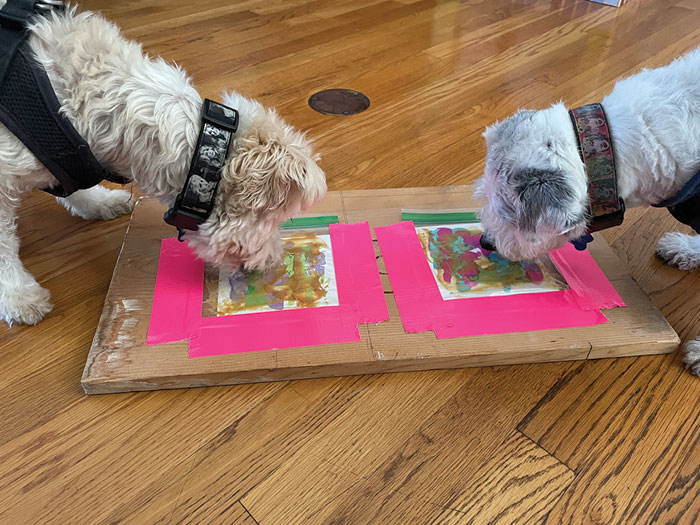
I’ve always known my dogs Fosse and Gershwin were talented. They can run agility courses and play the piano (badly). But recently I discovered that they can paint abstract art. And so can your pups.

I got this idea from an Instagram video and decided to try it with my Fosse and Gershwin. Since peanut butter was involved, I knew they would enjoy it.

How it works is you apply peanut butter to a ziploc plastic bag, and then place a piece of paper that has drops of paint inside the bag. As your dog licks the peanut butter, its tongue spreads the paint inside the bag.

I taped off a monogram with my dogs’ initials on their pieces of paper, but that’s totally optional. 

Like Fosse and Gershwin, I’m sure your doggos will be regular Jackson Paw-llocks.

What you’ll need:

Ziploc bags
Board
Duct tape
Peanut butter
Paper
Paint
Masking tape

1. Using duct tape, attach Ziploc bags to a board so that they won’t move around while your dogs are “painting.” Only tape the sides and bottoms.

2. Spread peanut butter on the front of the bags.

3. Cut pieces of paper (I used thick paper meant for painting) so they will fit in the bags. Mask off a monogram with masking tape if you wish. Then dribble drops of paint all over the paper.

4. Place the papers inside the Ziploc bags and seal them tightly so paint will not escape. Now let the dogs lick the peanut butter. Keep an eye on them to make sure they don’t chew through the plastic. When they’re done, take out the papers and let them dry, removing the masking tape.


Jonathan Fong is the author of “Flowers That Wow” and “Parties That Wow,” and host of “Style With a Smile” on YouTube. You can see more of his do-it-yourself projects at jonathanfongstyle.com.

Let Your Dogs Paint Their Own Masterpiece Read More »

Dating Lessons from Netflix’s “Jewish Matchmaking”

If you’re watching “Jewish Matchmaking” expecting it to be the Jewish “Jersey Shore,” change your expectations. You will see 25 dates, none of which get hot and heavy on screen. Nobody fights and barely anything comes close to an argument. We don’t even see if the bad first dates get an awkward side-hug as they part ways forever.  The closest any of the daters come to marriage (let alone becoming a couple) is to their list of deal breakers in a mate, which they’re attached to until death do them part.

But I must confess that after watching all eight episodes, I was somewhat bored. The show’s cast pulls off a rare feat: They’re both trainwrecks and dull. Awkward (but not too awkward) first dates, an underwhelming amount of chemistry between the daters, nobody makes out with anybody and no epilogue letting us know if any of the daters are still together. But even though reality dating shows are not in my regular streaming rotation, I rewatched all eight episodes.

During my second viewing, I noted the takeaways from the show’s host, matchmaker and dating coach Aleeza Ben Shalom. She boasts that she’s helped over 200 couples get married. Again, there was no epilogue on the show, so if you want to know which on-screen daters are part of that 200, look it up on Reddit. 

But above all, Ben Shalom showcases and respects the diversity amongst a spectrum of Jewish-seeking-Jewish daters — and this proves to be the show’s key virtue. So here’s some dating advice you’ll pick up watching Netflix’s “Jewish Matchmaking”: 

Define what “I want a Jewish partner” means to you. 

Ben Shalom’s strengths are in what she asks her clients — particularly on what a “finding a Jewish partner” means to them.  And it’s more than a yes or no to keeping Shabbat, eating kosher, being Reform, Conservative, Orthodox or Flexidox. Ben Shalom’s intake questions on “Jewish Matchmaking” have an undercurrent of self-reflection on your own Jewish practice — and taking ownership of it — in order to find a match who wants to grow with you. The show doesn’t cater to fully-disengaged Jewish people — even the most secular Jew on the show is talking to a Jewish matchmaker and seeking someone to share and celebrate their Jewish identity. Ben Shalom’s curious questions might even inspire viewers to discover their own meaningful path of being Jewish. 

Google “things NOT to do on a first date.” Try not to do most of them.  

On a show with at least a dozen first dates, cringeworthy moments are expected — most of which are by Los Angeles’ own Ori. Don’t be late for your second date and give a chickens–t excuse like Daniel gave to Cindy in Tel Aviv. Don’t be like David on the fifth date and say to Dani, “I’m ready for the makeout sesh.” And try not to be as smug as Shaya. So do a Google  search for a list of dating no-no’s. For extra credit, ask Google’s empathetic cousin, ChatGPT. 

Unless you’re willing to move, don’t date someone who is geographically unavailable.

Why are we attempting to set up people who are geographically unavailable to each other? Aron lives in Vermont and he’s on a date with Harmonie in Los Angeles. Shaun flew in from Hawaii to go see if Dani is a match — in Los Angeles (Dani was visiting L.A. for a wedding). One of the Noahs’ dates flies to meet him in Jackson Hole, Wyoming. At least Ori seeks to date someone who also lives in Los Angeles (hey, a broken clock is right twice a day). If the Jewish dating pool in your locality is miniscule, by all means, look outside of your area code. And if you have to, outside of your timezone.

Hang a question mark on your deal breakers.

Age, nationality, height, hair, beards, eyebrows (yes, eyebrows are a dealbreaker for Dani) — loosen up on some of your deal breakers and see if you get surprised by who you click with. Other entertaining deal breakers that come up during Ben Shalom’s intake interviews of her clients are passionate sex and spontaneous travel (Harmonie), riding motorcycles and using guns (Nakysha), and “doesn’t need to be told why ‘Curb Your Enthusiasm’ is funny” (Stuart). 

Ask your friends if they think you’re being unreasonable.

We meet the friends of Dani, Ori, and Noah #2. The conversations aren’t exactly riveting but the setup is worth emulating. Bring up some of your oddly-specific dealbreakers to your friends and see if they say you’re stepping on your own toes with unreasonable expectations. 

If you’re going to be sarcastic, use more charm than deadpan.

When Ori tells his first date Adi that he’s a porn actor (he isn’t), his deadpan will make you cringe. Instead, watch how Stuart, a 51-year-old man from Chicago uses sarcasm effortlessly. When Stuart’s date commented on her own outfit (which revealed her shoulders), Stuart responded, “oh I was also thinking of wearing something where my shoulders are showing but it’s my Judaism that prevented me from doing that.” You had to be there. 

Before going into the dating pool again, do a “dating detox” on your previous relationships.

This is probably the most important thing to do for anyone jumping back into the dating pool. Ben Shalom does an assessment with Cindy in Tel Aviv that she calls a “dating detox” which is an intense, introspective look at your previous relationships. It requires three things that are scarce in today’s smartphone society: paper, a pen, and a distraction-free block of time. The dating detox is a mind-dump of negative experiences from dating, lists of fears, memories of what worked, lessons on what didn’t, what you loved about previous relationships and what you hated.  “Lighten the luggage of the things you’ve been carrying around,” Ben Shalom says before asking “do you feel like you’ve processed the previous relationship properly?” In other words, think hard about what your role was in the dissolution of your previous relationships. This will help you create a list of internal things you need to work on. 

You can’t let the dating mistakes of the past determine your romantic future, but they certainly should inform it. 

There is a sobering moment in episode seven when Nakysha from Kansas City mentions that her previous partners treated her terribly. The topic is brushed aside on screen, but it comes with an important lesson: recognizing repeated destructive dating patterns (by you or your previous partners) and finding the support to break them. Ben Shalom also says that in her experience, 35% of the people who break up eventually get back together. She also doesn’t say that getting back together with an ex is a good thing. This is where the dating detox will help keep you from swimming back to the crazy end of the dating pool again … and again. 

“When in doubt, go out.”

“If you’ve been on a first date, or a second or a fifth or a 10th — I don’t care how many dates — and you don’t have clarity, go out,” Ben Shalom says. And as the dates with the same person add up, and the mutual interest sustains, don’t make the mistake of letting up on taking initiative. As Dani says, “If you want to see me, make an effort,” adding “I’m not scared of hurting [David’s] feelings. Sort your s–t out or, you know, don’t f–k with me.”

Analysis Paralysis is real, and dating apps exasperate it.

Dating is a losing numbers game, especially if you’re on the apps. Nobody dates everyone they match with, and the growing number of matches can actually stifle your decision-making. 

“Their head starts to spin out, and their heart starts feeling different things,” Ben Shalom said about analysis paralysis. “Their emotions are going up and down and their head’s going in another direction, and usually it lands them in a big pile of confusion, and they don’t know what to do with themselves.” Cindy from Tel Aviv says on the show that if you match with 100 people on a dating app, 50 will answer, 30 will answer only one time, 15 will keep talking with you, 10 will ask you on a date, five will go out with you and two will fit what you’re looking for. She then laments that in her experience, that two drops to zero. Which brings us to one of Ben Shalom’s timeless pearls of wisdom …

“My biggest piece of advice to people who are looking is never give up.” – Aleeza Ben Shalom

“Never give up.”

“My biggest piece of advice to people who are looking is never give up,” Ben Shalom says. “If you want to find your person, never give up. Maybe I’m going to introduce you. Maybe a dating app is going to pop somebody up, and we’re going to say yes, no or maybe based on your criteria. To me, I don’t care if I make your match. I care that you get married to the right person.”

A few more things to keep in mind:  

  • Accept them as they are — don’t date potential. 
  • Leave them as good as you found them (don’t be an asshole). 
  • Calling someone “simple” is not a compliment. 
  • If you have a child or are divorced, be upfront about it. A lot of potential suitors won’t mind, but some will run and not look back. Don’t waste anyone’s time — including yours. 
  • If you know by the second date that it’s not going to work out, don’t take two-and-a-half years to tell them.

Dating Lessons from Netflix’s “Jewish Matchmaking” Read More »

An L.A. Couple is Married. The Wedding Guests? Two Hundred Children.

I love weddings. Two weeks ago, I received word about a special wedding that was planned at an unlikely venue: a local Jewish school. 

I was so touched that a school had offered to host a wedding. But given that it was Yeshivat Yavneh (also known as Yavneh Hebrew Academy), a Hancock Park-based Orthodox day school, I assumed the couple and their families were Orthodox Jews. Naturally, I imagined a bride dressed in a neck-to-toe frock and a groom in a black suit, white dress shirt and black hat. I even wondered if a shtreimel would be involved. This was Hancock Park, after all.

Imagine my utter surprise and delight when I arrived at Yavneh on May 19 to find a beautiful, young bride wearing a Hollister dress and with an elegant nose piercing, and an excited groom who was trying his best to cover up his tattoo in a show of respect to the school’s Orthodox affiliation. 

Imagine my utter surprise and delight when I arrived at Yavneh on May 19 to find a beautiful, young bride wearing a Hollister dress and with an elegant nose piercing, and an excited groom who was trying his best to cover up his tattoo in a show of respect to the school’s Orthodox affiliation. 

Three weeks prior, Yoav Shemtov, 27 and Angie Mirsakov (now Shemtov), 24, a young Jewish couple from Tarzana, had called Rabbi Shlomo Einhorn, Dean at Yeshivat Yavneh, with a predicament: The couple, who is secular, had been married in a civil ceremony, and is planning to make aliyah to Israel. Angie needed to prove that she is Jewish, and her mother, Eva Gilin, could not locate her own marriage ketubah to prove she (and therefore, Angie) is Jewish. 

That’s when Angie and Yoav realized that through Angie, they had a connection to Yavneh that could help them. 

“We found the [bride’s] mother’s picture on the wall of graduates from the 1970s, when she came to the school as a new immigrant from Russia,” Einhorn told me. “We started talking to them about their Jewish heritage, and they were excited to learn that they had never had a religious wedding.”

Eva had escaped Russia and arrived in the United States in 1976; she entered Yavneh as a fourth grader and graduated four years later in 1980. “We became really close friends,” Yavneh sixth grade teacher Libby Engel, who attended the school with Eva, told me. Engel even helped young Eva learn how to speak English.

Einhorn considered Angie and Yoav’s request, then happily informed the couple that Yavneh would host their wedding. The date, which was discussed with the bride and groom, was purposefully chosen to coincide with Yom Yerushalayim (Jerusalem Day, which recognizes the reunification of Judaism’s holiest city during the Six-Day War in 1967). “I thought the wedding was particularly poignant in how it connected to Yom Yerushalayim,” said Einhorn. “The couple is making aliyah to Israel, and the city of Jerusalem is a symbol of unity. I loved the way everything came together.”

Einhorn then discussed the wedding with Elisheva Segelman, Program Director for kindergarten through eighth grade and the Spiritual Advisor for middle school girls. The event would not only be held on Yom Yerushalayim, but also a few days before the Shavuot holiday that celebrates the receiving of the Torah on Mount Sinai. “What better way to celebrate with a couple that’s planning to move to Israel, and right before Shavuot, which is likened to a marriage between the Jews and the Torah,” Segelman reflected. 

Only one issue remained: “There was no budget in our yearly planning for a wedding,” said Segelman. “No one knew this was going to happen. But it became a good challenge.” Einhorn called Rochelle Frankel, an event coordinator, to help plan the wedding. With Frankel’s help, Einhorn’s assistant, Kimberly Fader, secured a list of items, including a wine glass and a plate, both of which would be broken per Jewish wedding traditions, and a chuppah (wedding canopy). Frankel created an elegant flower arrangement on the chuppah that cascaded in bursts of pink, red and white roses. 

Around noon on May 19, Segelman, Frankel and other Yavneh staff, as well as close family members and friends, gathered around Angie as she wrapped a cream-colored shawl around her shoulders, adjusted her veil and posed for photos with the groom. The bride wore her maternal grandmother Ludmilla’s pearl necklace and borrowed her mother’s gold necklace chain with a small, blue Star of David. Both Eva and Ludmilla attended the wedding, as well as Angie’s grandfather, Eugene. Yoav’s mother and father live in Israel, but his brother, Ben, lives in L.A. and also attended. 

In the spacious Jack and Gitta Nagel Gymnasium, a large group of fifth through eighth graders had already gathered to welcome the couple to the bedeken, a short ceremony in which the groom “veils” his bride-to-be. A special chair awaited Angie, flanked by flower arrangements, which, along with her bouquet, had been made the night before by sixth grade girls at the bat mitzvah celebration of a Yavneh student named Lana. 

That was one of the most extraordinary aspects of the wedding: Everyone pitched in to help, right down to the girls who made the bride’s bouquet. 

Angie and Yoav entered the gym amid a torrent of excited squeals and applause. On one side, a large group of enthusiastic boys gathered around Yoav, Einhorn and other male staff for a tisch, or “table” celebration, while on the other side, divided by a barrier, girls formed a circle around Angie, held hands and joyously sang Jewish songs. Finally, Yoav, surrounded by the boys, approached the girls’ side and gently put a lace veil over Angie’s head, confirming her distinct identity as his bride and affirming her inner beauty.

A space that normally hosted physical education exercises and sports matches had suddenly been uplifted physically and spiritually; for a brief time, the gym itself felt like Mount Sinai, enlivened with hundreds of young souls in awe, celebration and the one essence of Jewish weddings that has enabled us to survive through millennia: Jewish continuity. 

A space that normally hosted physical education exercises and sports matches had suddenly been uplifted physically and spiritually; for a brief time, the gym itself felt like Mount Sinai, enlivened with hundreds of young souls in awe, celebration and the one essence of Jewish weddings that has enabled us to survive through millennia: Jewish continuity. 

After the bedeken, the fifth through eighth graders took their seats at an outdoor space known as “The Big Yard,” buzzing before the chuppah ceremony began. And then, the heartwarming energy increased as teachers led the smaller second, third and fourth graders into the yard. Seated together, roughly 200 youth in all, the Yavneh students exuded an air of sheer joy, excitement and innocence that rendered them the perfect guests for a Jewish wedding that united two souls. 

A few weeks prior, administrators had given second through eighth grade teachers a special curriculum to educate the students about Jewish weddings. The children were also given cards that asked, “What did you learn about this wedding” and “What is a blessing you would like to give to the bride and groom?” The most common blessings from students, according to Segelman, were “I wish you a happy life” and “I hope you live many years together.”

Rabbi David Block, Head of School at Shalhevet High School and a Yavneh parent, played guitar softly as the chuppah ceremony began. “This is an opportunity that rarely comes along,” Einhorn explained to students as he spoke into a microphone before the couple entered the yard. “Yoav and Angie are trusting us to make something beautiful for them. Their wedding is connected because we are all one.”

Einhorn then made a remarkable announcement: Meticulous family research had confirmed that the groom is a descendent of the Baal Shem Tov (Israel ben Eliezer), the 18th-century founder of Hasidic Judaism. Though Yavneh specifically instructs Orthodox Jewish students, the school “is committed to the idea of doing a mitzvah or act of chesed (kindness) for anybody,” Einhorn told me, who encouraged students to, after the chuppah, “dance like it’s your own wedding. Today is a simcha (happy occasion) for everyone.”

It was remarkable to watch Einhorn ask students questions during the ceremony. And when it was time to read the couple’s ketubah, or marriage contract, he explained, “This is the same document we’ve been using for almost two-thousand years; the minute it is read, we’re connecting every Jewish family that has come before.”

The Sheva Brachot (Seven Blessings) under the chuppah were recited by Yavneh rabbis, teachers, and Yoav’s older brother, Ben. Finally, in the “Big Yard” of Yeshivat Yavneh, the children sang “If I Forget Thee, Jerusalem” (Psalm 137:5-6). The groom stepped on a wine glass and there was an eruption of fanfare as a circle of boys, arm in arm, escorted the couple to a room back at the gym designated as a yichud room, so they could spend a few minutes together before celebrating again with students. 

Minutes later, the bride ran through arcs of silk flowers held up by the girls as they shouted, “Angie! Angie” on one side of the gym, while the groom danced exuberantly with male staff and students on the other side.  

I asked Angie what it was like to have been married in front of hundreds of Jewish students. “I can’t put it into words,” she said. “It was a lot more than what I expected, and it brought me to tears. I loved the kids. I asked them to all give me a hug, which made me cry even more.”

Yoav echoed his new bride’s words. “It touched me quite a bit,” he said. “I got teary-eyed when I came down the aisle. It was a lot more than I expected. I was extremely happy and thankful. I didn’t know that many people cared about us.” 

When asked if the experience has inspired them to explore more Jewish practices, Angie said, “This whole thing felt like a warm hug. I want to keep it going. I want to learn more.” As a wedding present, Angie’s best friend gave the couple a pair of Shabbat candlesticks. 

“It’s brought us closer and given us a glimpse into what Orthodox Judaism is like,” said Yoav, who was born in Israel. “It was important to me that we got married in a way that is recognized.” 

The couple hopes to make aliyah this summer. “We want to experience something new, to get more in touch with our roots. We feel a sense of belonging in Israel,” said Angie. 

“It was unique for children to see that there are all different types of people and Jews, and for us to host a wedding for a couple that may not have known about Jewish weddings are, and inspire them to see how a yeshiva treats a wedding and how we respect marriage,” said Segelman. 

As I watched Angie and Yoav that day, I realized that certain elements of their wedding had characterized Jewish weddings for thousands of years. As opposed to today’s ceremonies that feature everything from drone cameras to tens of thousands of dollars’ worth of special lighting, Angie and Yoav’s wedding possessed the only elements that are truly needed for such an event: a chuppah, two witnesses, a ketubah and a simple, metal ring. 

And in their case, 200 joyful and curious children. 

“I wanted the children to walk away from the wedding feeling like they had seen Torah come to life,” said Einhorn. “They saw how Judaism can be beautiful and joyful. I also loved the pathos of the story. The groom was a descendant of the Baal Shem Tov, and the bride was the grandchild of someone who fought to bring her family to America so they could have a Jewish education. It was a story about Yavneh, and about how life has a funny way of coming full circle.”

As Yoav and Angie prepare to make aliyah, they won’t soon forget the support of Yavneh students and staff, whose lovingkindness is a reminder of one of the Baal Shem Tov’s greatest teachings: “From every human being there rises a light that reaches straight to heaven, and when two souls that are destined to be together find each other, the streams of light flow together and a single brighter light goes forth from that united being.”


Tabby Refael is an award-winning writer, speaker and civic action activist. Follow her on Twitter and Instagram @TabbyRefael


An L.A. Couple is Married. The Wedding Guests? Two Hundred Children. Read More »

The Day Nachshon Swallowed the Dot

During my years as a college president, my senior staff and I often discussed college “outcomes” — what we believed would be the greatest benefits for a student attending our school.

We expected that our students would enhance their writing, speaking, and quantitative skills, develop the tools required to critically evaluate arguments, and gain a genuine appreciation for the arts, culture, and all manner of differences, whether those differences relate to family and demographic background, sexuality, religion, or politics.  

But most importantly, we always strove to produce leaders — graduates who would be unafraid to do the right thing in the face of apathy or resistance from their friends and peers.

What, you might be wondering, does any of this have to do with Nachshon or a dot?  I suspect that many readers will be familiar with the midrash describing the parting of the Red Sea from the Book of Exodus.  The story goes that when Moses held out his arm over the sea, at first nothing happened.  With the Pharaoh’s chariots approaching from behind and the sea ahead, the newly freed Jewish slaves were distraught. But out of the crowd came Nachshon. While others bemoaned their terrifying situation, Nachshon acted. He stepped into the sea, walking deeper and deeper until Hashem rewarded his faith, summoning the winds to create a path forward through the waves.

But there is more to the tale. Ever notice the curious shift in Hebrew wording in the exquisite Song of the Sea poem, often sung in shul as “Mi Chamocha”? While the usual translation, “Who is like You, Adonai, among the mighty; Who is like You, adorned in holiness, revered in praise, working wonders,” suggests identical words for the repeated phrase “Who is like You,” there is a subtle difference in the Hebrew between the two instances.  The first time it reads “mi chamocha”; the second time it says “mi camocha.”  A khaf has become a kaf, as a dot (a dagesh), missing in the first line, suddenly appears in the second.  

One of my favorite commentaries explains the anomaly this way: When Nachshon entered the sea, the waters did not immediately part. He tried to proclaim “mi camocha” but as he went under the water, all he could get out was a muffled “mi chamocha.”  When Hashem heard his words, the waters receded, and his voice rang out loud and clear. What began as a barely audible entreaty, ended up being an historic expression of praise that, 3,300 years later, constitutes one of the most inspirational parts of our Shabbat services.

Who has the fortitude to stop being a bystander and instead emerge from the crowd and act as an individual?  A worthwhile education should instill the confidence and the desire to do exactly that.  

I love to recount that narrative. It is a tale about faith, but it is also a story about leadership. Who has the fortitude to stop being a bystander and instead emerge from the crowd and act as an individual?  A worthwhile education should instill the confidence and the desire to do exactly that.  

Given the complexities of our times, we are in dire need of those who want to lead. So while college certainly ought to impart knowledge and teach skills, above all it should be a chance for students to be immersed in situations that allow them to cultivate the spirit of Nachshon.

Of course, we would all do well to emulate Nachshon as best we can, even if we never attended college or graduated in the distant past. The next time you see someone in obvious pain, will you try to help? The next time you are with a group satisfied to simply lament the status quo, will you have the courage to actually do something to improve it?

My co-author and I were once teaching about the transformative aspects of an ideal education, when he asked me to explain to our class how Nachshon “swallowed the dot.”  It is an ageless tale of how all of us might bravely step forward to promote humanity’s most sacred values.

I love the Yiddish expression “Be a Nachshon.”  In our fractured world, we need his kind of moral courage now more than ever.


Morton Schapiro is the former president of Williams College and Northwestern University.  His most recent book (with Gary Saul Morson) is “Minds Wide Shut:  How the New Fundamentalisms Divide Us.”

The Day Nachshon Swallowed the Dot Read More »

Satirical Semite: Useless Information

The world of education has changed with the advent of ChatGPT. Students are using artificial intelligence to write their papers, teachers have been using it to grade the papers, and AI has been acing a series of professional exams. Companies are predicting massive layoffs in the next few years, and there is going to be only one AI-proof profession left in the entire world; due to the electronic restrictions during Shabbat and festivals, the safest option in the entire job market is to become an Orthodox Rabbi. 

A good friend is principal of a Jewish High School in Australia, and described how his philosophy of education is adapting with the times. “We need a different approach,” he said, pointing out that it was redundant to keep asking students to learn facts when there is going to be no reason to remember that information since it can be accessed online. That makes sense. I grew up in England remembering statistics about the history of the British monarchy, but why learn the ins and outs of Buckingham Palace history when I can listen to academically robust resources, like Meghan Markle’s podcast?

I did want to help him with some facts that could be good for students to learn as part of their intellectual development. In terms of local knowledge, there is a law in Queensland, Australia, that it is illegal to own a pet rabbit unless you’re a magician, due to pest control. In terms of geopolitical history, it’s good to know that back in 2004, there was a diplomatic crisis in Sweden when their army detected Russian submarines in the vicinity. The Swedish Prime Minister Carl Bildt wrote a tough letter to the Russian premier Boris Yeltsin. Marine researchers soon discovered that the mysterious humming noises weren’t Soviet submarines but actually the sound of thousands of fish flatulating, since that is how one species of fish communicates with one another. The Russian threat turned out to be a literal red herring — 10,000 red herrings to be precise.

Education is more than just learning facts.  Students still need skills like reasoning, critical thinking, and the ability to form coherent sentences. I have tried testing this out, and asked ChatGPT-4 to “write a satire column for the Los Angeles Jewish Journal in the style of the Satirical Semite.” The result was disappointing. It came up with a piece about a 35-year- old guy called Shlomo who was sitting in his mother’s basement knitting yarmulkes that he sold online as “high end couture head coverings, for the kosher man-about-town.” Unfortunately, ChatGPT was living in a fantasy land, where there are aging Jewish bachelors who still live with their mothers.

The film industry faces a problem with AI, in that long-dead actors can be revived in new movies using performances generated from their voice and looks. An upside is that audiences can continue to enjoy their favorite long-dead actors. A serious downside is that it could create a bleak, dystopian scenario where there are lots of unemployed actors in Los Angeles who have to work in cafes or drive for Uber.

Everyone has to adapt to the new age, whether they are filmmakers, teachers or something else. My principal friend suggested that educators “need to think of new ways to teach, since students will still need to learn skills like critical thinking, reasoning, and the ability to form coherent arguments. One solution is to get students to write their papers in class, without internet access, so that we know that they are actually writing it.”

Ironically, Judaism has traditionally stayed one step ahead of AI. During the 25 hours of Shabbat, when it is forbidden to use computers, there is no way to cheat. When a Rabbi is asked an halachic legal question that needs an answer, he has to know it by heart or at least know where to find it. Real books are needed, along with real brains. 

And like the magician in Queensland, once in a while you do need to pull some magic out of a hat.


www.marcusjfreed.com and on social @marcusjfreed. 

Satirical Semite: Useless Information Read More »

Table for Five: Beha’alotcha

One verse, five voices. Edited by Salvador Litvak, the Accidental Talmudist

Whether it was for two days, a month or a year, that the cloud lingered to hover over the Mishkan, the children of Israel would encamp and not travel, and when it departed, they traveled. – Num. 9:22


Judy Gruen
Author, “The Skeptic and the Rabbi: Falling in Love With Faith.”

Traveling can be exhausting. We can fly across the country or the world in mere hours, but we still must plan and pack, get to the airport, deal with long security lines, and sit near annoying passengers. When we arrive at a vacation destination, we hope to at least unwind for a week or two. 

At first glance, our ancestors traveling in the desert had all the challenges of travel but none of the advantages. God told them, via the movement of the cloud, when and where they were going, and for how long. They had no choice in the matter. The Ramban observed that they sometimes arrived at an unpleasant place and wanted to leave immediately, but were stuck there for a long while. Conversely, our ancestors could arrive at a lovely, refreshing place, hoping to linger and relax, but had to move again after only a few days. These travels continued to test them as individuals and as a community. 

God is not capricious, so what was the lesson here? Where was the blessing? 

Our lives are frequently disrupted, our plans delayed or even uprooted. Despite the unknowns, we thrive when we prioritize Torah learning, mitzvot, and continue planning for our futures. The Lubavitcher Rebbe observed that every one of our “stations” in life has significance, even when we are there for a very brief period, seemingly “on the way” to some other place. Each station carries its own potential for spiritual and personal growth.


David Brandes
Screenwriter, “The Quarrel” 

Was God playing a game of “Simon says” with the Israelites? When the cloud lingers you stay in place. When it lifts you march. No negotiations. Why would God treat his chosen people this way? 

Consider the context. For 200 years, more or less, the Israelites suffered in demeaning slavery. Where was God? The people must have felt abandoned. I would have … Finally, finally God hears their suffering and sends redemption. But being set free doesn’t make one free emotionally. The people had to learn to trust that God would not abandon them again. The cloud was a manifestation of God’s presence. When it lifted, the people probably reexperienced abandonment anxiety. When God commanded them to move on, it was a test – would God return? He did. The cloud always returned back to the Mishkan. Giving the people physical and emotional rest. 

And so it went; God’s manifestation lifting and settling. The people journeying and camping. And most importantly the people learning to trust that God would always return. It was an inspired form of behavioral therapy, well before its time, that helped the Israelites reestablish trust in God’s love and permanent commitment to his people. 

One last question: Why was the “cloud of glory” the dominant symbol? Clouds rarely appear in the desert but when they do they are much welcomed. They are a harbinger of rain and sustenance. This “cloud of glory” stood tall, dominant, and protective — a symbol of God’s commitment to always be with his people.


Yael W. Mashbaum
Middle School Director, Sinai Akiba Academy

This pasuk conjures beautiful imagery: God’s cloud securing the Israelites in a protective bubble until it is time for them to move on in the desert. Sometimes it could take two days, several months, or even years for the next part of the journey to commence. 

Sforno reminds us that this is the fifth time the Torah explicitly belabors the subject of these journeys. He proposes that this frequency alerts us to the unplanned nature of the Israelites’ time in the desert. Sometimes the people did not even have time to send their animals to graze, whereas on other occasions they had time to dismantle everything, having to abandon any plans they had made.

Doesn’t this mirror life? Our journeys are not entirely straightforward or linear. We meander, take longer at some stops than others, not usually knowing how quickly we will make a decision that changes our course. All the while, we hope for protection and guidance from God. We hope to have a “feeling” or see a “sign” that it is the right time to move to a new job, to buy a home, to make a major decision for our family. 

Through this verse, the Torah is teaching us that when our lives feel harried or hectic, it is by design, the norm rather than the exception. The Israelites’ lives outside of Egypt were marked with inconsistency and learning to be resilient and flexible. May we feel God’s presence as we navigate our own journeys.


Rabbi Mari Chernow
Senior Rabbi, Temple Israel of Hollywood 

I lived in Arizona for 18 years. During much of the year, Arizonans know instinctively to seek out one precious resource — shade. In day-to-day living, one finds great relief in shaded walkways, fields, pools, patios and parking spots. For those without protection, shade can make the difference between life and death. 

While in some climates, clouds symbolize danger and darkness, in the desert they are life sustaining. They block the piercing sun and its harmful rays. It is no wonder, then, that God appears to the people as a cloud. Drops of water and crystals of ice suspended in air. A consistent source of comfort and reprieve. A sign that they need not pack up and move just yet, that they will be safe, whether it be for two days, a month, or a year. 

To human beings, clouds seem to be halfway between heaven and earth. They mediate between us and the endless universe. They are constantly moving and changing shape. Impossible to capture. Godlike. Another feature of the desert is its magnificent open skies. Even the most oppressively hot day can come to an end with a bright red-orange-yellow or pink-purple sunset. Clouds add texture and depth to the already breath-taking beauty. The evening skyscape suggests eternity. Joni Mitchell was right. We really don’t know clouds at all. How blessed are we to catch so much as glimpse. 


Abe Mezrich
Author, “Between the Mountain and the Land Lies the Lesson”

The people must get to the Land. God wants them to get to the Land.  God says to Moses, “You have stayed long enough at this mountain.” (Deuteronomy 1:6) But here the people are, waiting on God. 

Perhaps you know this feeling. There’s the place you were meant to be, and it isn’t here, and it’s calling you, and you don’t know if you’ll ever arrive at all. “Why are you holding me back?” you might demand of God. 

It’s just these moments that this verse is trying to describe. The verse is saying: Sometimes it is God Himself who is coaxing you to stay. He is coaxing you to stay because in fact sometimes you need to wait days, months, years, to reach the Promised Land. He is coaxing you to stay because yes, the holy destination awaits but you must know that God is also to be found in the long sweltering desert you must crawl through on the way. You are waiting because there is a certain message you must hear from the voice of God. “Be here now,” God’s voice says. You, like God, can be present.

Table for Five: Beha’alotcha Read More »