fbpx

June 8, 2023

A Game Plan for Adding Chutzpah to Your Life

In Jennifer Cohen’s latest book, “Bigger, Better, Bolder: Live the Life You Want, Not the Life You Get,” you can replace every incidence of the word “bold” with “chutzpah.” The “Habits and Hustle Podcast” host’s new book is a trove of anecdotes and actions you can take to add more chutzpah to your everyday life. Over its 16 chapters (among them “Discover Your Bold Type,” “Mediocrity is a Superpower” and “Fix It, Farm It Out, Forget It”), “Bigger, Better Bolder” follows Cohen from rural Canada to Los Angeles, through her many career pivots: personal trainer, entrepreneur, author, podcaster. 

The book begins during the early ’90s, when Cohen was a student at a Jewish grade school in Winnipeg, Manitoba, where she was belittled by a teacher who called her “average at best.” She takes up fitness as a career after unsuccessfully auditioning for an Israeli folk dance troupe in high school. The rejection and mischaracterizations as a youth led Cohen to a life of calculated risk-taking and self-affirmation. Some of the book’s most inspiring moments involve Cohen crashing the Montreal Just for Laughs comedy festival, working at the Olive Garden and her chance encounter with Keanu Reeves. They’re entertaining, reflective and comforting for anyone who has ever been stung by rejection.

The Journal spoke with Cohen about “Bigger, Better, Bolder” and her tips on creating an authentic and bold life:

Jewish Journal: How does being called “average at best” by a teacher as a kid fuel your boldness?

Jennifer Cohen: I would say that we were all fueled by whatever trauma or impression or limiting belief that we had as a child and react accordingly. We can either react in a positive way that helps push us towards success and greatness, hopefully. Or it could take us down a bad rabbit hole of negativity, unworthiness. I chose to use things that I thought were negatives as fuel to push me and propel me. And because of that, I think I have a little chip on my shoulder for myself where I have to prove to myself that I am worthy or better than, and not let self-doubt dictate my destiny. 

JJ: What’s a phrase you want your readers to stop saying today?

JC: ‘I can’t’ or ‘I’m not good at …’ As you get older, you say to yourself, ‘well, I’m so bad at technology. I’m terrible. I can’t do it.’ It’s a self-fulfilling prophecy. The more you say it, the more that’s what you actually become, right? You can get better at anything, but if you start with ‘I can’t’ or ‘I’m not good at,’ there’s nowhere to go. 

JJ: Who are some of the boldest people you’ve ever collaborated with?

JC: Jesse Itzler [the co-founder of Marquis Jet, which sold seats on private jets] is super bold. He keeps on recreating. He’s a serial entrepreneur— he has an idea and he just goes for it. He’s very positive and he always thinks of how things can work out. He never rests on his laurels. He’s failed a lot, but he doesn’t let those failures keep him down. He just keeps on creating new things and he brings such enthusiasm. And so it’s such an infectious enthusiasm that it gets people to want to be around it and elevate and help and to be a part of something. 

JJ:  Can the average person be bold on a budget? 

JC: You don’t need money to chase a job or the company that you have interest in working in, instead of just checking LinkedIn for what jobs are available. Most bold moves don’t require money. What requires money is very different. What also happens a lot of times is people who have made a lot of money end up being less bold because they feel like they don’t put the effort as much into certain things.

JJ: What are the most common early roadblocks when setting out to live boldly?

“I don’t see failure as failing. It’s just something I tried and it didn’t work out. And then I will either try again or pick myself up and try something else.” – Jennifer Cohen

JC: We ourselves are our worst roadblock. We tend to hold ourselves back more than anything or anyone. Failure is such a part of life that you have to learn to become immune and desensitized to what failure is and reframe what failure means to you. To me, failure is just an attempt. It’s one attempt at trying something. It’s two attempts at trying something. It’s three attempts at trying something. I don’t see failure as failing. It’s just something I tried and it didn’t work out. And then I will either try again or pick myself up and try something else. But people get really stuck on the word and the idea of what it is, and then they let themselves spiral out of control.

JJ: How do you tune out the noise?

JC: Other people are too busy worrying about themselves — they’re not paying any attention to you. It’s your own self, your self-esteem and self-doubt. When people don’t want to go to the gym because they’re intimidated by other people, do you think those people are paying attention or looking at you? They are looking at themselves. They’re taking selfies of themselves. They’re lifting up their shirts, trying to see if they have abs. They are so not even remotely interested or curious or even looking in your direction. And that’s really with anything in life. When people have these big catastrophes in the media, people pay attention for a day, two days, and eventually it goes away because people’s memories are very, very short.

JJ: How does social media get in the way of boldness?

JC: So social media has amplified the comparison game where we compare our success based on somebody else’s success, we end up feeling worse for ourselves. There’s a lot of that happening in the world today. So you have to be very cognizant and curate the people in your life that you know personally— a board of directors who want to see you succeed, who are like-minded. Who do you look up to? Where do you get your information from? How are you building your self-worth? Are you looking at people that are making you feel good about yourself or making you feel bad about yourself?

JJ: What (besides buying your book) are three bold things our readers can do today after reading this interview?

JC: People think that you’re either born being bold or not, and that’s simply not the case. Boldness is a skill that anybody can get better at. And this can be as small and minute as when they go to a restaurant asking for salad dressing on the side. If you are not comfortable asking for a little thing in life, then you’re never going to be comfortable asking for a big thing. Another thing is you can call your cell service provider and ask for a better package than you have right now. Don’t just acquiesce to whatever is in front of you and let other people make your decisions. If you don’t create a routine, you will be assigned one. If you don’t create a purpose, you’ll be assigned one. If you don’t create a career, you’ll be assigned one. So people are too quick to adopt the structure that somebody else created to ease life’s uncertainty. 

You can buy “Bigger, Better, Bolder” and listen to the “Hustle and Habits Podcast” on her website, www.jennifercohen.com

A Game Plan for Adding Chutzpah to Your Life Read More »
A Bisl Torah – Giving and Receiving

It’s graduation season. The cessation of one journey and beginning of another. Our own daughter completed her lower school education at Sinai Akiba Academy and will continue her excellent SAA career in middle school. At various graduation ceremonies, I’ve heard advice from teachers and reflections from students. Wisdom that will inspire graduates on what they’ll encounter in years to come. 

In discussing the kind of advice we wish we heard during our own graduation ceremonies, a friend offered an observation. Almost every social encounter requires giving a token or getting a token. Meaning, in engaging with others, we may find ourselves depleting our emotional bucket or the opposite. We may find that the encounter fills us up, restoring and renewing our souls. The key is to vary our experiences: sometimes it’s necessary to share that token and sometimes, it’s more important to receive. Maturation and emotional intelligence guides us through the giving and the getting. 

The Hebrew word noten conveys giving. But if you notice the Hebrew, you’ll realize that the word is a palindrome. The word is read the same way forwards and backwards. Which means when one gives, they often receive. And as one receives, there should be an inclination to give. As we walk this world through journeys ending and beginning, we have an opportunity to reevaluate the ways we are built up and the ways in which we build others. 

May this season bring you buckets filled with giving, receiving, loving and growing. Give often and keep your heart open as others give to you.

Shabbat shalom 


Rabbi Nicole Guzik is a rabbi at Sinai Temple. She can be reached at her Facebook page at Rabbi Nicole Guzik or on Instagram @rabbiguzik. For more writings, visit Rabbi Guzik’s blog section from Sinai Temple’s website.

A Bisl Torah – Giving and Receiving Read More »

A Moment in Time: “Pride: Resistance, Resilience, and Responsibility”

Dear all,

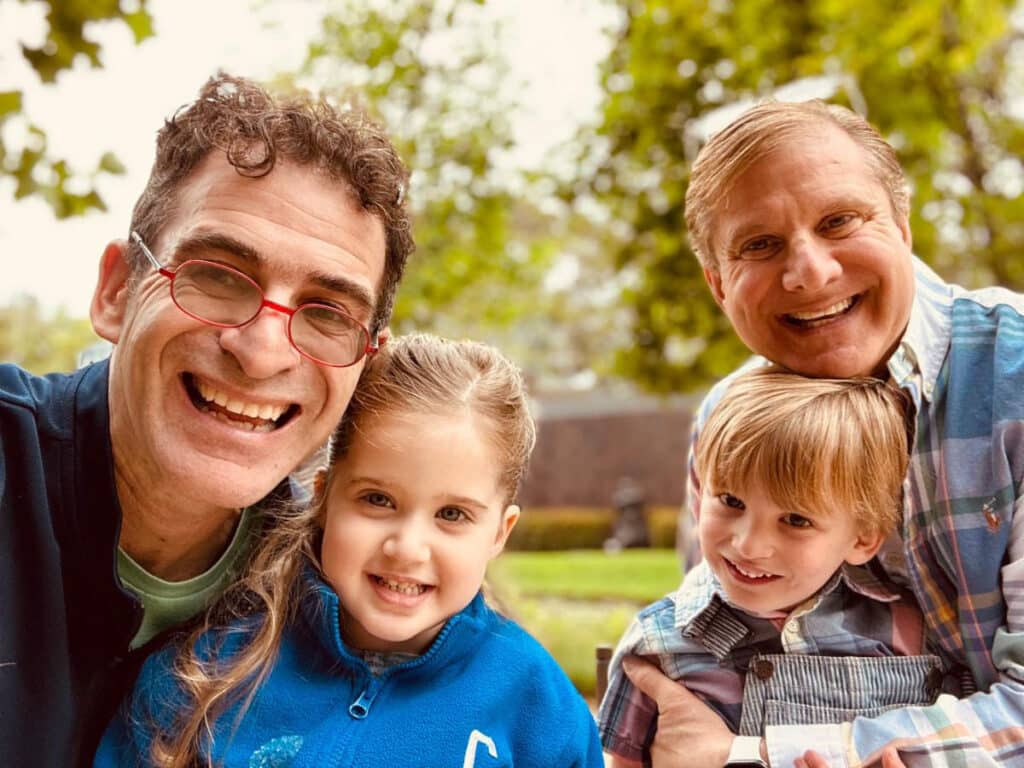
During this month of PRIDE, I reflect on the resistance, resilience, and responsibility necessary to serve as a gay congregational rabbi, to have married the man I love, and to be raising two extraordinary children.

Resistance: Because the river often flowed in the opposite direction, and I had to swim upstream many times.

Resilience: Because whenever that river took me downstream – I had to work harder to achieve my goals.

Responsibility: Because it wasn’t only about the rights to do what I love, but about the responsibilities that come with it as well.

Yes, Pride is about being who we are. It’s also about realizing that we didn’t arrive at this moment in time in a vacuum. Finally – it’s about understanding that there are still those fighting the currents that are drowning their souls.

Let’s be the affirming community that embraces the future with goodness!

With love and shalom.

Rabbi Zach Shapiro

A Moment in Time: “Pride: Resistance, Resilience, and Responsibility” Read More »

State Dept. Denounces Roger Waters’ Berlin Concerts As “Deeply Offensive to the Jewish People”

The State Department denounced former Pink Floyd bassist Roger Waters’ recent concert imagery as being “deeply offensive to the Jewish people” and said that Waters has a lengthy history of antisemitism.

The Associated Press (AP) reported that at a June 6 press briefing, the department was asked if they agreed with a tweet from Special Envoy to Monitor and Combat Antisemitism Deborah Lipstadt tweet condemning Waters’ “despicable Holocaust distortion.” The department replied that Lipstadt’s tweet “speaks for itself.” “The concert in question, which took place in Berlin, contained imagery that is deeply offensive to Jewish people and minimized the Holocaust,” they said. “The artist in question has a long track record of using antisemitic tropes to denigrate Jewish people.”

Waters came under fire for donning a Nazi-like uniform and comparing Palestinian journalist Shireen Abu Akleh, who was killed during an Israel Defense Force raid in Jenin last year, to Anne Frank during his May 17 and 18 shows in Berlin. The former Pink Floyd frontman is being investigated by Berlin police over the matter; German law bars the display of Nazi symbols but provides an exception for artistic or educational purposes. The former Pink Floyd frontman responded with a May 26 statement denouncing the “bad faith attacks from those who want to smear me and silence me because they disagree with my political views and moral principles.” “The elements of my performance that have been questioned are quite clearly a statement in opposition to fascism, injustice, and bigotry in all its forms,” Waters said at the time. “Attempts to portray those elements as something else are disingenuous and politically motivated. The depiction of an unhinged fascist demagogue has been a feature of my shows since Pink Floyd’s ‘The Wall’ in 1980. I have spent my entire life speaking out against authoritarianism and oppression wherever I see it. When I was a child after the war, the name of Anne Frank was often spoken in our house, she became a permanent reminder of what happens when fascism is left unchecked. My parents fought the Nazis in World War II, with my father paying the ultimate price.”

Waters’ most recent concert was in London on June 6; video footage from the concert shows Waters lamenting to the audience about recent attempts to “cancel” him. “I watched Jeremy Corbyn being canceled by the Israeli lobby. That is what happened in 2019,” he said to a cheering audience. Waters then directed his ire at Labour Member of Parliament Christian Wakeford, who issued a statement deriding Waters for using “the name of Anne Frank to stoke division, performed while dressed as an SS soldier, and used the Star of David on a giant pig to insinuate that Jewish people run the world.” He first addressed Wakeford’s claim on Frank, calling it “a blatant and evil and vicious lie,” arguing that Frank’s name was listed among those who were “killed either by militarized police or by tyrannical racist regimes. Anne Frank is one of them and we pay our respect to Anne Frank by remembering her name.” Waters defended listing Abu Akhleh’s name as well, claiming that the IDF shot her “on purpose.” “She was murdered by a racist, tyrannical regime,” Waters alleged, adding that it had nothing to with sowing division. The IDF has said it’s “highly likely” she was killed by an IDF bullet on accident.

As for Wakeford’s claim about the SS uniform, Waters noted that the armbands on the costume depicted “crossed hammers,” showing that the Nazi-like uniform is meant to be “satire.” Waters also lambasted Wakeford for the Star of David claim; Waters’ recent Berlin shows did not feature a Star of David on the flying pig but did have the Israel-based international defense company Elbit Systems’ logo.

“You are making s— up because you’ve been told to by your masters in the Foreign Office in Tel Aviv,” Waters said to Wakeford. “Because this hate is being organized from Israel.”

Israellycool Israel Advocacy Executive Director David Lange wrote in a blog post that Waters’ soliloquy during the show was “one of his most antisemitic yet.” “Invoking the antisemitic trope of an all-powerful lobby (of Jews) silencing people and controlling politicians in foreign countries, and spreading the ‘blood libel’ that we deliberately murdered Shireen Abu Akleh (not borne out by any of the evidence or findings) because we are racist – this rant – like the one in Birmingham – just reaffirmed how full of Jew hatred he truly is,” Lange wrote. “And the audience lapped it up.”

The Simon Wiesenthal Center tweeted, “No consequences for the pied piper of #Antisemitism and Holocaust distortion. How many thousands cheered @rogerwaters on in Berlin, Frankfurt and London? A direct injection of anti-Semitism into the mainstream of societies.”

The Board of Deputies of British Jews said in a June 7 statement that Labour Party Leader Keir Starmer wrote in a letter to them on June 1 that the party “stands with the Jewish community and fully condemns Roger Waters. Many people will think of Roger Waters as famous for being a member of one of the most important bands in history, but he is now more synonymous with spreading deeply troubling antisemitism.” Starmer had said he didn’t want Waters’ Britain shows to move forward because “views like this should not be given a platform.” Similarly, British Secretary of State for Levelling up Housing & Communities and Minister for Intergovernmental Relations Michael Gove wrote in a June 6 letter to the Jewish group: “The Government is clear that everyone has a clear and fundamental right to freedom of speech and artistic expression, so long as they remain within the boundaries set by law. There is also a societal expectation placed on people with a significant public profile to behave responsibly and not abuse their platform. This is an expectation of which Roger Waters is reportedly falling short.”

State Dept. Denounces Roger Waters’ Berlin Concerts As “Deeply Offensive to the Jewish People” Read More »

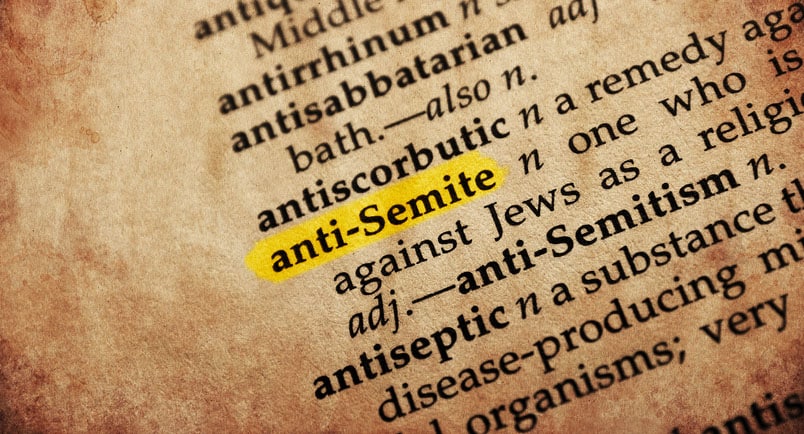
Nuance is Crucial in Fighting Hate. That’s Why I Helped Write an Alternative Definition of Antisemitism.

(JTA) — My 95-year-old mother knows a thing or two about trauma. Not only because she is a survivor of Auschwitz but also because she is a psychologist.

“What worries me,” my mother says, “is that we Jews will succumb to our past trauma rather than rise above it.”

I share my mother’s concern.

Jewish Americans face the threats of escalating antisemitism and growing white nationalism at the same time that the Israeli government’s anti-democratic policies are eliciting increasingly harsh condemnation worldwide.

There is no inherent relationship between antisemitism and the outcry over Israeli policies. But when they occur together, they can trigger traumatic memories and confuse our thinking. This confusion can lead to a dangerous conflation of issues at the intersection of Israel and antisemitism.

Prime Minister Netanyahu exploits this confusion to deflect condemnation of his policies. He constructs a misleading equation, portraying severe criticism of Israel as not only a threat to the Jewish state but also to the Jewish people.

To demonize his political opponents, Netanyahu invokes the ultimate act of antisemitism, the Holocaust. He did so when he blasted those negotiating a nuclear deal with Iran and when he reprimanded The New York Times over its criticism of the agreements he reached with far-right political parties. His strategy is to downplay antisemitism on the right and emphatically equate left-wing with right-wing antisemitism to obscure their distinctions.

Some Jewish organizations, perceiving strong criticism of Israel as threatening Jewish unity and the Jewish state, reflexively reinforce that equation. A case in point is Anti-Defamation League chief Jonathan Greenblatt’s approach to anti-Zionism.

Greenblatt used his keynote address at ADL’s annual leadership summit in May to hammer home his assertion that “Anti-Zionism is antisemitism. Full stop.” Over the past two weeks, he has played a leading role in the campaign to endorse the International Holocaust Remembrance Alliance non legally binding working definition of antisemitism (IHRA) as the sole such definition in the Biden administration’s U.S. National Strategy to Counter Antisemitism. In a tweet urging its adoption, Greenblatt proclaimed: “Anything else permits antisemitism under the guise of anti-Zionism.”

Greenblatt was worried about reports that the White House would include other definitions in the strategy, such as the Nexus Document, which addresses “the complexities at the intersection of Israel and antisemitism.” Greenblatt has repeatedly denigrated Nexus by calling it a “pasted-up process organized by activists” and circulating inaccuracies like: “The Nexus definition assumes that unless there is outright violence involved, anti-Zionism is generally not antisemitism.”

In fact, the Nexus Document includes seven examples of anti-Zionist or anti-Israel behavior that should be considered antisemitic and four that might not be. As Dov Waxman, a member of the Nexus Task Force and chair of Israel Studies at UCLA, tweeted: “Nexus clearly identifies when criticism of Israel or opposition to it crosses the line into antisemitism. But because it is clearer than IHRA in this respect, it is less susceptible to being misused and weaponized against Palestinians and their supporters.”

It’s not that Greenblatt doesn’t understand the complexity of these issues. He has taken nuanced and moderate positions on anti-Zionism in the past. But complex formulas impede the use of simplistic equations. If Greenblatt wants to show that anti-Zionism is always an existential threat to both the Jewish state and the Jewish people, he can leave no room for nuance.

Ultimately, the White House acknowledged the significance of utilizing a varied set of resources to combat antisemitism, stating, “There are several definitions of antisemitism, which serve as valuable tools to raise awareness and increase understanding of antisemitism.” The strategy acknowledged that the United States had already “embraced” the IHRA version, describing it as the “most prominent,” and went on to say that it “welcomes and appreciates the Nexus Document” and other efforts.

That formula has angered some supporters of the IHRA definition, including World Jewish Congress president Ronald Lauder, who said: “The inclusion of a secondary definition in addition to the International Holocaust Remembrance Alliance working definition of antisemitism is an unnecessary distraction from the real work that needs to be done.”

Like Greenblatt, Lauder wants to build a consensus around a simple explanation for a complex situation. But their approach actually diminishes our ability to carry out “the real work that needs to be done” because it weakens our ability to confront the dominant force fueling increased antisemitism in America: white supremacy

According to the ADL, white supremacy is the greatest danger facing Jewish Americans. As President Biden said in his opening remarks when the National Strategy was unveiled: “Our intelligence agencies have determined that domestic terrorism rooted in white supremacy — including antisemitism — is the greatest terrorist threat to our Homeland today.”

“We can’t take on white supremacy, xenophobia, anti-LGBTQ hate, or any form of hate without taking on the antisemitism that helps animate it,” says Amy Spitalnick, the CEO of the Jewish Council for Public Affairs and former head of Integrity First for America, which successfully sued the neo-Nazis who organized the deadly 2017 Charlottesville march. “And likewise, we can’t take on antisemitism without taking on white supremacy or these other forms of hate … All our fates are intertwined.”

But Israel’s policies create a dilemma. When many of our potential allies see Israel, they see a country that calls itself a democracy but enacts laws enshrining Jewish dominance over Palestinian citizens of Israel. And they see a country that has denied fundamental human rights to Palestinians in the West Bank and Gaza for 56 years. So, not surprisingly, they are moved to speak out about these realities.

Criticism of Israel will inevitably heighten in response to the policies and actions of this Israeli government. Some of Israel’s critics may indeed cross a line by using antisemitic tropes or stereotypes or denying Jews the same rights afforded to others, including Palestinians. When they do, they should not get a free pass. Full stop.

But we must resist the temptation to reflexively respond with accusations of Jew-hatred, even when the criticism of Israel is off-base or unjustified. We cannot afford to oversimplify complex issues by conflating political disagreements about Israel with antisemitism. If we do, we risk distracting from addressing the most dangerous instances of antisemitism and bigotry.

Times like these call on us to shed the weight of our past and approach these issues with clear minds and thoughtful consideration. “Sometimes we split the world into good and bad to guard ourselves against difficult realities,” my mother said. “If we can rid ourselves of the bad and make it so the other side is always guilty, then we feel safe. But by doing so, we lose the ability to find a solution.”


Jonathan Jacoby directs the Nexus Task Force, which is affiliated with the Center for the Study of Hate at Bard College.  He is the former executive director of the New Israel Fund and former executive director of the Israel Policy Forum.

Nuance is Crucial in Fighting Hate. That’s Why I Helped Write an Alternative Definition of Antisemitism. Read More »

Relatable Parenting With Podcaster Daniella Rabbani

The day that Daniella Rabbani had her first child, a boy named Ness (miracle), everything changed.

“The matrix cracked,” she said. “It was the most profound experience of my life. The joy and the challenges were unparalleled.”

Rabbani, an actress who had worked alongside Sandra Bullock on “Ocean’s Eight” and played a rabbi on CBS’ “God Friended Me,” was suddenly going through all the motions of motherhood: the sleep deprivation, the struggle to find childcare, and the need to be close to her child. At the same time, she was a working mom, keeping up with her roles while taking care of Ness.

When the pandemic hit, things became a little more complicated. She had another baby, her daughter Paz, and was suddenly at home with a toddler and baby. She squeezed in work when she could, which sometimes meant taking the kids to gigs with her.

“I was raised in a tight-knit Jewish community, where friends felt like family,” Rabbani said. “Not having that while raising my own teeny tinies was really hard.”

Post-pandemic, when Rabbani came up for air, she started a podcast called “Mom Curious,” which features a candid conversation with a mother every week. Guests have included Rabbi Rebecca Keren Eisenstadt, aka @myhotrabbi, Lori Hoch Stiefel, PJ Library’s engagement officer, and Tony Award-nominated director Eleanor Reissa. Rabbani and her guests talk about a variety of topics, from being a working mother to not exactly fitting the “typical” mom mold. Through Rabbani’s conversations, she strives to dispel some of the shame surrounding motherhood and represent all the different ways one can be a mom.

“I think there’s a very loud narrative of what a mom is and how best to mother,” she said. “And I looked around at my community and saw outliers of brilliant women who weren’t doing it the conventional way. I wanted to highlight them. I want women coming up into their childbearing age to know that they have choices. In fact, one valid and important choice is the choice to not have children at all. We explore that avenue as well.”

“I think there’s a very loud narrative of what a mom is and how best to mother.”

Rabbani grew up Modern Orthodox on Long Island. Her parents are both Israeli; her father’s family was from Iran, while her mother’s family was from Poland and Romania. She lived in a traditional Persian Jewish community and went to North Shore Hebrew Academy for day school. Her mentor at NSHA was Tony-award winning producer Yeeshai Gross.

“I acted in plays he directed and even assisted him in high school,” said Rabbani. “It’s partially because of him and my professionally creative parents that I always knew I could make a living as an artist.”

Rabbani became interested in the arts and acting. After graduating from high school, she attended NYU and received a BFA in Acting. As a lover of the Yiddish language, she performed in The National Yiddish Theater Folksbiene.

“Yiddish literature and music are so moving,” she said. “My heart swells every time I get to share it. The deeper reason is because it makes me feel closer to my grandfather who survived the Holocaust. He only spoke Yiddish. He could never talk about his time in the war. It’s still a mystery. So I suppose I sing for him.”

Pretty soon, Rabbani started acting in movies, commercials, and TV shows, playing Rabbi Zoe on three episodes of “God Friended Me,” which ran from 2018-2020.

“I loved every second of it, especially since I grew up not seeing women in those types of clergy positions,” she said. “It was really meaningful to me to have all the Jewish knowledge I have and to share it on national TV with such a loving cast and crew.”

These days, Rabbani is still acting (she’ll be in an Off-Broadway production of The Inported Bridegroom this summer and Amid Fallen Walls with The National Yiddish Theater Folksbiene in the Fall) but her main focuses are parenting and podcasting. She wakes up and meditates in the morning, drops her kids off at school and then records her show. She also works as the community manager of the Tel Aviv Institute, supporting Jewish influencers on a variety of projects. By 3 p.m., her workday is over – the kids need picked up from school.

“We play and eat and get ready for bed,” she said. “I try to be present with them but often multitask where I can.”

Rabbani is proudly Jewish and enjoys passing along the traditions to her children.

“I sing to them in Yiddish and Hebrew,” she said. “We read Jewish books. They love the stories. I enjoy the Jewish rituals, the songs and the spirit, especially with my kids. For me, it’s less about the day-to-day practice, though I appreciate it. It’s more of an identity that I grapple with and celebrate.”

In the future, Rabbani hopes to continue building up “Mom Curious” by taking it on the road and making it into a travel show.

“I want to investigate and celebrate the lives of women all over the world,” she said. “I want to take these stories from the shadows and into the light.”

With her podcast, and the stories she shares, Rabbani aims to create a community of moms, no matter what their background, and demystify motherhood.

“As a mom, I am now connected with every parent that ever was or will be,” she said. “I heard a mother from The Parents Circle – an organization that brings Israeli and Palestinian bereaved families together to tell their stories – and as she told the story of her six month old baby dying in her arms. I felt it so strongly. We are connected. I know the love of a mother. And with that knowledge, I have a responsibility to make this world safe for my kids and yours.”

Relatable Parenting With Podcaster Daniella Rabbani Read More »

Print Issue: Got Jews? | June 9, 2023

CLICK HERE FOR FULLSCREEN VERSION

Print Issue: Got Jews? | June 9, 2023 Read More »

Rabbis of LA | Rabbi David Vorspan: The Rabbi Who Never Will Quit

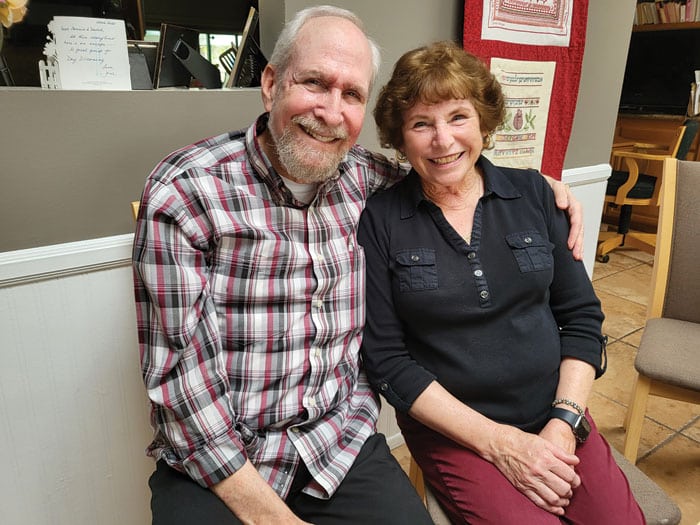
Unlike most Americans his age, Rabbi David Vorspan has no intention of  retiring. The 76-year-old Vorspan is still leading services at Congregation Shir Ami, the Conservative shul he founded in 2007.  After a half-century of congregational life  leading a synagogue and breathing both come naturally.

“It’s important to make sure we keep a sense of community. We are discovering today that when people retire, divorce themselves from community, their life has come to an end.”

But how many more years will he be able to keep this up? “As long as I can move,” Rabbi Vorspan told the Journal, seated at his dining room table with Bonnie, his wife of 52 years and mother of their three children. “I tried to imagine what life would be like if I woke up in the morning with nothing to do, nothing to look forward to,” he said. “It’s important to make sure we keep a sense of community. We are discovering today that when people retire, divorce themselves from community, their life has come to an end.”

Having spent 47 years of his near half-century as a rabbi in the San Fernando Valley, many congregants have known Rabbi Vorspan their entire lives. He led Temple Beth Ami in Reseda for 18 years. But in the early ‘90s, the demographics of the Valley were changing. Beth Ami merged with another temple to form the community that became Shomrei Torah. But some loyal Beth Ami members wanted some continuity and asked Vorspan to lead them.

“It was and is the same congregation,” said Rabbi Vorspan. “I am dealing with the same people, generations later. Now I am dealing with their children and grandchildren after dealing with them when they were children. The fellowship, the camaraderie, the relationships have stayed very strong over all of these years. Except now, I am officiating at a lot of their funerals. I look at those in their 90s – one just turned 101. He was the founding president of my congregation, Shir Ami.”

He plays guitar at Shir Ami’s contemporary service every other Shabbat. The 90-minute service is almost all singing. “We have one aliyah,” the rabbi said. “The entire congregation stands up, points to the Torah, we all have an aliyah and discuss the Torah portion.” The twice-monthly ritual intentionally involves each one of the dozens who come to synagogue. “I didn’t want anyone to sit back and get bored,” Vorspan said. “If it happened, I would try to suck it out of the service.”  The rebbetzin, a former nursery school director at Kol Tikvah, reads the Torah at each service.

While he will continue at Shir Ami for as long as he can (“I told the congregation I will go as long as they continue and they want me.”), after 20 years, he is leaving his position as the rabbi-in-residence and founding rabbi of de Toledo High School. He looks at his tenure there with pride.  When Vorspan joined de Toledo High School in its opening year, 2002, as Jewish Studies director and rabbi-in-residence, it had 40 students. Soon it was one of the fastest growing Jewish community high schools in the country, and now has 400 students. “I initiated a project almost 20 years ago that is continuing,” the rabbi said: Kodesh Moments. 

“There was something about some students’ lives where little things were not important,” he said. By way of example, he told the story of a student who had just bought themselves french fries. As he walked back to where he was going to eat them, other kids approached. Each took a french fry. None remained by the time he reached his seat. This reminded Vorspan of the grape-seller in the Torah. He harvested grapes for a year, and planned to sell them in one day, which would support his family for the next year. But people came along, took a grape, and didn’t pay. Soon, none was left. “People do this all the time in markets,” Vorspan said.

Drawing on a Torah sentence, “you shall be kodesh” (holy), the rabbi concluded that people can’t be like this all the time. “We can do it in spurts. I would tell my students, when you pick up a piece of paper from the ground you don’t want to pick up, or hold the door for someone, that is elevating your behavior to the highest level. You have done kodesh.”

Rabbi Vorspan began calling them Kodesh Moments. His idea soon spread across the campus. He began putting up signs around school, “Did you do a Kodesh Moment today?” Casually, students talked up the idea. It became so popular, parents took up the idea

Fast Takes with Rabbi Vorspan

Jewish Journal: Your favorite place to go in Los Angeles?

Rabbi Vorspan: To my children’s and grandchildren’s homes.

J.J.: Your favorite music?

Rabbi Vorspan: Classical. I consider (Conductor) John Williams’ music to be classical.

J.J.: Your favorite hobby?

Rabbi Vorspan: Playing musical instruments, especially the guitar.

J.J.: The most enjoyable book you have read?

Rabbi Vorspan: The most provocative is the Torah.

Rabbis of LA | Rabbi David Vorspan: The Rabbi Who Never Will Quit Read More »

Survivor and Iron Dome Inventor Are Saluted by Yeshiva U.

Yeshiva University honored Brig. Gen (Ret.) Dr. Daniel Gold and Holocaust survivor Emil Fish, two outstanding citizens of the world, at its 92nd annual commencement ceremony at the Theater at Madison Square Garden.

Dr. Gold, best known as the inventor of Israel’s famed Iron Dome, accepted YU’s highest honor for global leadership, the Presidential Medallion. The school saluted Fish, a philanthropist and visionary, with an honorary doctorate.

“As Israel celebrates its 75th birthday,” university President Dr. Ari Berman said, “it is particularly fitting for us to host one of the heroes who stands as a role model for our students,” alluding to Dr. Gold. 

Gold’s “deep dedication to the Jewish state and his impactful leadership in safeguarding its vitality and security,” make him a worthy recipient, said Berman.

After declaring his pride over being  with “the next generation of bright minds,” Gold said that “as head of the Israel Ministry of Defense Research and Development Directorate, it is a privilege to witness what young people are capable of.”

Gold said the creativity, innovation and drive of typical graduates result in cutting-edge technology being developed thanks to their talent.

More importantly, he said, success is being achieved according to their values. 

“The students here are receiving the tools and education they need to lead.”  

Gold peers ahead with a strong sense of optimism. He holds doctorates in electronic engineering and business management and has survived withering criticism over the Iron Dome to become a celebrated figure in Israel.

Skepticism over the Iron Dome was widespread in 2011 when Gold’s invention was introduced. 

Skepticism over the Iron Dome was widespread in 2011 when Gold’s invention was introduced. Soon enough, it was shown to be an effective repellent when Israel was attacked. 

Since those early days, the Iron Dome has been credited with intercepting numerous rockets that streamed from the Gaza Strip. 

From the start, in 2004, Gold was fighting uphill to win acceptance of the Dome from his superiors. He anticipated that rocket fire would be the main threat against Israel, and he was worried there was no effective form of resistance.

Gold said he told his superiors that he needed funding, but there was not an agreeable face in sight. When he told his bosses that if they gave him money, he would see that the Iron Dome was erected. Every important voice above him felt negative and rejected his pleas. Gold and his fellow believers went ahead anyway, and in 2007, the Iron Dome was chosen as Israel’s missile defense system.

These days, the Iron Dome is used by Israel to intercept and destroy short-range rockets, artillery shells and mortars fired from distances of up to 45 miles.

Emil Fish survived the horrors of Bergen-Belsen and became a successful Los Angeles businessman after the war. He dedicated his life to remembering victims of the Holocaust.

Fish founded YU’s Emil A. and Jenny Fish Center for Holocaust and Genocide Studies. The center educates today’s teachers to effectively transmit the history and lessons of the Holocaust from a Jewish standpoint, vital in a world where antisemitism seems on the rise.

Upon receiving his honorary doctorate, Fish marked Yeshiva University history as he was joined at commencement with his daughter Monique who earned a master’s in Holocaust studies and two grandchildren who were awarded their bachelor’s degrees. Together they represent an amazing accomplishment of three generations receiving degrees simultaneously.

Fish sounded a warning note. “Over my lifetime,” he said, “I have seen not just a declining interest in the Holocaust, but a growing misrepresentation of what happened.”

During commencement, more than 1,700 degrees were awarded to students from four undergraduate and 11 graduate schools and programs.

Survivor and Iron Dome Inventor Are Saluted by Yeshiva U. Read More »

Rabbi Avi Finegold: Mixology, Cocktail Culture and Making Daiquiris

You may not normally think of a rabbi as a mixologist. However, Rabbi Avi Finegold has found a way to combine the two.

“Food and drink often go together, and I sort of morphed into this person that teaches people about Judaism using cocktails, whenever the occasion presents itself,” Finegold told the Journal. “And I have a lot of fun with it.”

Years ago, even before there was an elevated cocktail culture, people would call up Finegold to ask what drinks were kosher at a bar.

“They knew that I was a rabbi and that I actually didn’t feel bad going into a bar with friends and having a drink,” he said.

He started learning about well-crafted cocktails, and realized that there’s a niche for being able to think about cocktails in a Jewish way. Finegold also realized he could get much better drinks by learning how to make them himself.

After he learned the foundational cocktails (there’s only about a handful) and their variations, it was only a “hop, skip, and a jump to being able to integrate that with Jewish ideas and Jewish thoughts,” Finegold said.

Once you understand the master recipes, and you know exactly what it is that you like to drink, it’s easy to start riffing on them and creating your own variations.

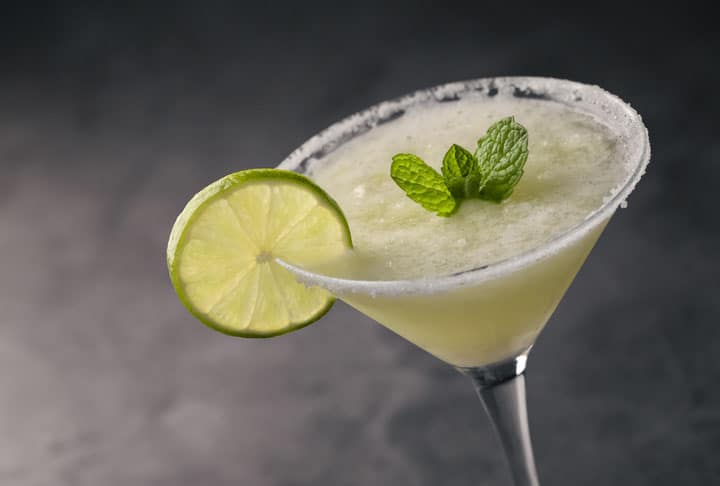
Finegold starts just about every one of his workshops in the Jewish cocktail lab with a daiquiri. A daiquiri is white rum, simple syrup (which is liquid sugar) and fresh juice from a lime. Recipe is below.

“A daiquiri is actually one of the hardest cocktails to make and to perfect, because it has so few things to hide,” he said. “A real daiquiri is not a frozen, blended drink. If you go to a cocktail bar, and you ask for a daiquiri, they will present you with something that looks very simple and very straightforward in a glass.”

In fact, it’s usually how a bar tests budding cocktail mixologists when they are looking to hire.

“It is the simplest cocktail to make, and it is the hardest to master,” he said.

And then you learn how to adapt. If you want it a little sweeter, you add a quarter ounce extra simple syrup. For more tart, you pull back on the simple syrup.

Once you’ve perfected the daiquiri, you can see that it is the basis for many other possible cocktails, as long as you switch out one or two ingredients in the same proportions.

“So if you swap out the lime juice for lemon juice, and you add in whiskey instead of rum, you have a whiskey sour,” Finegold said. “You swap out that whiskey and you put in amaretto, you have an amaretto sour. It’s the basis for a gin gimlet if you put in gin, lime juice and simple syrup.”

As you get comfortable, you can get more elaborate. For instance, a mojito is essentially a daiquiri with mint and then you add seltzer.

“As you start playing with it, you start realizing that the formula is always the same,” he said. “You’re just changing one or two things.”

If you’re interested in digging deeper, he suggests reading the “Cocktail Codex.”

“Once you learn how to make [cocktails], you only want to share your enthusiasm with other people,” said Finegold, who calls experimenting with cocktails “the greatest thing.”

He adds, “You learn something new, and you have a cocktail to celebrate with.”

Finegold is the founder of the Montreal-based Jewish Learning Lab, which is an adult education initiative. He has also anchored the weekly Bonjour Chai podcast, since its debut in March 2021, Bonjour Chai, as a cornerstone project of The Canadian Jewish News. Learn more about Avi Finegold at the Jewish Living Lab.

For the full conversation, listen to the podcast:

Watch the interview:

Cris Cantón/Getty Images

Daiquiri Recipe

2 oz. light rum

3/4 oz. lime juice, fresh squeezed

3/4 oz. simple syrup (equal parts sugar and water dissolved together)

Combine ingredients.

Shake with plenty of ice and strain into cocktail glass.


Debra Eckerling is a writer for the Jewish Journal and the host of “Taste Buds with Deb.Subscribe on YouTube or your favorite podcast platform. Email Debra: tastebuds@jewishjournal.com.


Rabbi Avi Finegold: Mixology, Cocktail Culture and Making Daiquiris Read More »