This year, my Yom Ha’atzmaut story is personal. As Israel turns 75, the story I choose to tell is not written by Agnon, nor is it the epic story of a great Zionist leader. It’s the story of one Israeli who — more than any other Israeli writer, thinker or leader — influenced my deep personal connection to Israel. It’s the story of my beloved uncle — “Tonton Isaac” (as I lovingly addressed him in French), who passed away during Passover this year at the age of 87.
This personal tribute was written during a three-day trip I took to Israel this past week, where I joined my family in Israel in sitting the last few days of shiva in memory of our beloved Isaac.
In making me a “ben bayit” — a member of his household — he opened my mind to the complexities of Israeli society, but also opened my heart to the beauty of Israeli life.
As I sat in the plane on my way to Israel, I reflected on the 43-year relationship I had with my father’s youngest brother. I thought about his encyclopedic knowledge of the Hebrew language, his brilliant perspectives on Jewish history, and his keen understanding of Israeli politics and Israeli society. I thought about how privileged I am that he lovingly shared all of that knowledge with me. My “Israel education” was not through lectures in a classroom, but from the many conversations with Uncle Isaac in his living room in Netanya, on the beach playing “matkot” (smashball) and at countless Shabbat dinners at his table. He opened his home to me for many years, and in making me a “ben bayit” — a member of his household — he opened my mind to the complexities of Israeli society, but also opened my heart to the beauty of Israeli life.
An Israeli life is what Isaac yearned to live from his childhood days in Morocco.
An Israeli life is what Isaac yearned to live from his childhood days in Morocco. Born and raised in Marrakech, he grew up in a home entrenched in the Moroccan Jewish traditions of his parents and ancestors, but his heart was elsewhere. He came from a generation when the “return to Zion” went from dream to reality, and his life’s journey epitomized the fulfillment of the Zionist dream. As an active part of Zionist youth groups in Morocco, he became fluent in modern Hebrew and learned the philosophy, songs and poems of modern-day Zionism. While his elders sang “Bibhilu” and “Next Year in Jerusalem” at the Passover Seder, Isaac would recite Bialik’s poems under his breath, and in his heart he said, “This year in Jerusalem.”
He made Aliyah in the early 1950’s, and while he was fully aware of the negative stereotypes many held about Moroccan immigrants, he refused to ever let any of that get in the way of fully immersing himself and integrating into Israeli society. He served in the IDF’s communication corps, where, as he once joked to me, “Morse code does not have a Moroccan accent or a Polish accent.” On a more serious note, he served in three of Israel’s major wars — 1956, 1967 and 1973 — all of which deepened his bond and connection to his fellow Israelis.
After meeting and marrying his wife — my “Tata Lydia” — they helped build Israel by building a beautiful family together. Their home blended some of their North African past with their newly adopted Israeli identity. They spoke French to each other, but spoke only Hebrew to their three kids. Their beautiful Shabbat tables were adorned with delicious Tunisian and Moroccan cuisine, but when guests would knock on their door, they would see a sign that said “Mishpachat Segev” – the Segev Family. Their North African pride gave way to their Israeli patriotism, as they adopted the Hebrew name “Segev” instead of Bouskila.
Speaking of Hebrew, Isaac took his vast Hebrew vocabulary and expertise in Hebrew grammar into the classroom, where another expression of his Zionism was becoming a Hebrew teacher. He eventually became an electrician, but teaching was always in his heart. Indeed, he spent his life teaching his family the ideas and values of modern-day Zionism. He raised his kids as proud Israelis, not as “Moroccan-Tunisian-Mizrahi” Israelis, but just Israelis — without regard to any ethnic differences within Israeli society. Thinking about “Israel at 75,” I wish more Israelis today would adopt his forward thinking vision about Israeli society.
When Isaac would discuss Israel with me, he loved talking about the “differences between …” From him, I learned the differences between Israel’s vast array of political parties (he was a Likud-Menachem Begin fan), Israel’s different newspapers (he didn’t always love when I came home with Ha’aretz), the Euroleague’s Basketball teams (Maccabi Tel Aviv … and the rest is commentary), and classic Hebrew (the Bible, Bialik, Agnon) vs. Israeli slang (“speak English before you speak improper Hebrew slang,” he would tell me!).
His sharp sense of humor was laced with a deep life’s wisdom, and while he loved his newly adopted country, he understood its quirks and nuances. I was once sitting next to him while on the phone with an El Al agent, frustrated by their giving me a hard time in changing the date on a flight to Los Angeles.
When I hung up, he asked me “What are you doing?”
“I am trying to change my ticket to L.A.,” I said.
“I know that, my question was not about that, rather why are you doing so in Hebrew?”
“Well, because we are in Israel” I said.
“Can I make a suggestion to you?” he said. “I know you love Israel and wish to speak Hebrew amongst Israelis, and that’s great. But if you are looking for customer service here, never speak in Hebrew. If you don’t believe me, call El Al again, and speak English.”
I promptly called back and made the same flight change request in English. The response: “Would you like a window or aisle seat?”
After two years of post-high school studies in an Israeli yeshiva, I faced a serious dilemma. I wanted to join the IDF, but I was also accepted to UCLA. Joining the IDF meant giving up my UCLA acceptance, because they did not allow deferral. I felt seriously torn, depressed and unable to make a decision. I spoke with my parents, but our vastly different views on this did not help. My father spoke often with his brother, and I guess my dilemma came up.
Just a few days after my last conversation with my parents, I heard a knock on my yeshiva dorm room door. I opened it, and there stood Uncle Isaac. He lovingly sat with me for two hours, and his ultimate message to me was: “I am very proud of my service in the IDF and what I have done to help defend this country, but I wish I had the opportunity to attend a university. Please go to college, I promise you Israel will always be here for you, welcoming you back with open arms.”
I was touched by his coming to see me, and I ultimately took his advice and started my studies at UCLA. When I took a leave of absence to come back to enlist in the IDF, I was indeed welcomed back with open arms–by my aunt and uncle. Despite my official status as a “lone soldier,” I never felt alone. Their home was my home. At my induction ceremony at the Kotel, it was Isaac and Lydia who stood there and watched me swear allegiance to the IDF. When I needed help or advice on how to survive the difficulties of army life, Isaac’s words of wisdom helped guide me. When I returned to Netanya from a near-death experience in Lebanon, it was Isaac and Lydia who were there waiting for me with love.
Far beyond those formative years in Israel, I continue to draw upon Isaac’s wisdom. Whenever I speak or write an article about Israel, I draw from his political knowledge. When I teach Agnon, I can hear him explaining the nuances of Hebrew grammar and vocabulary. My own family — Peni, Shira and Ilan — met him many times, and after being in his presence, the kids would say “now we see where Daddy learned all of this.”
Israel’s greatest resources are her human resources, and Isaac was a great “Human of Israel.” Thank you for all that you did for Israel, and for me. Both Israel and I are eternally grateful to you.
Rest in peace and Chag Atzmaut Sameach.
Rabbi Daniel Bouskila is the director of the Sephardic Educational Center and the rabbi of the Westwood Village Synagogue.
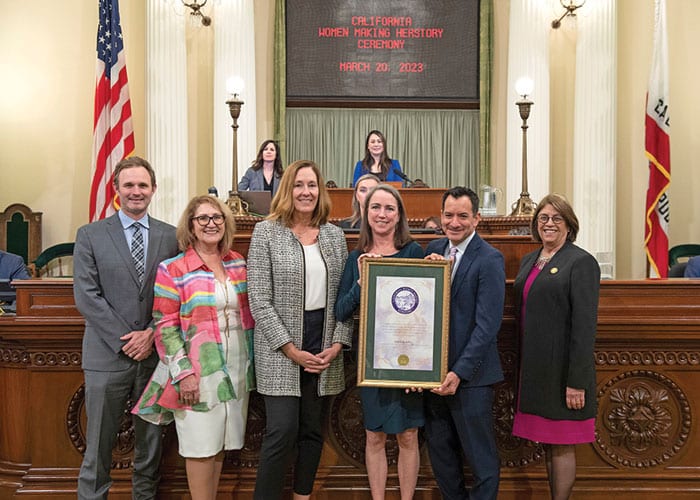
Kehillat Israel Senior Rabbi Amy Bernstein was honored in Sacramento as “Woman of the Year” from California District 42.
Assemblymember Jacqui Irwin (D-Thousand Oaks) presented the award to Bernstein during a March 20 presentation at the State Capitol. The Pacific Palisades rabbi — who has served as the spiritual leader of her Reconstructionist congregation since 2014 — was recognized for excellence in service to the community.
“Rabbi Bernstein is a trailblazer who has fought for equity and inclusion within her faith,” Irwin said in a statement. “As a member of the LGBTQ+ community, Rabbi Bernstein knows first-hand the obstacles one can face, and has done so with dignity and grace.”
Every year, the California Legislative Jewish Caucus organizes the annual “Woman of the Year” celebration as part of Women’s History Month, which falls in March. The honors were established as a way of acknowledging outstanding achievements of women from all walks of life and backgrounds across California. Additional honorees this year included Los Angeles Mayor Karen Bass.
“I am so honored to have been chosen to receive this award from among so many talented women doing important work in the 42nd Assembly District,” Bernstein said.
California District 42 encompasses portions of Los Angeles and Ventura Counties, including Pacific Palisades, Thousand Oaks, Bel Air, Brentwood and Malibu.
Beth Chayim Chadashim’s second-night seder. Courtesy of BCC
Beth Chayim Chadashim (BCC) held a second-night Seder that examined the theme of homelessness and how it intersects with the Passover story.
The caterers the congregation used were formerly homeless, and poetry by Skid Row-based writer and artist Queen Mama Tabia Salimu, who has also experienced homelessness, was heard during the April 6 evening.
Temple Emanuel of Beverly Hills Senior Rabbi Jonathan Aaron delivered a blessing at the installation of Beverly Hills’ new mayor, Julian Gold. The April 4 ceremony was held at the Wallis Annenberg Center for the Performing Arts in Beverly Hills. Photo by Ryan TorokFrom left: Survivor David Lenga; Holocaust Museum LA CEO Beth Kean; and survivors Joe Alexander, Henry Slucki and Harry Davids at Holocaust Museum LA’s Yom HaShoah commemoration. Photo by Tamara Leigh
Bringing together survivors, their families, elected officials and community leaders, Holocaust Museum LA held its annual Yom Hashoah ceremony.
Los Angeles Mayor Karen Bass and Holocaust Museum LA CEO Beth Kean attended the museum’s Yom Hashoah ceremony at Pan Pacific Park. Photo by Tamara Leigh
Guests included ADL Regional Director Jeffrey Abrams, the program’s keynote speaker; Los Angeles Mayor Karen Bass; three generations of Holocaust survivors; Consul General of Israel in Los Angeles Hillel Newman; students at the Colburn School, who delivered a musical performance; survivors Henry Slucki and David Lenga, who sang “The Partisans’ Song,” inspired by the Warsaw Ghetto uprising and a Yiddish anthem for Holocaust survivors; California Assemblymember Rick Chavez Zbur (D-Santa Monica),a member of the California Legislative Jewish Caucus; and Yiddish performer Mike Burstyn, who emceed.
The April 16 event at Pan Pacific Park marked the 80th anniversary of the Warsaw Ghetto uprising as well as the revolts at the Sobibor and Treblinka death camps. The actions at the Warsaw Ghetto and at Sobibor and Treblinka remain timeless symbols of resistance, perseverance and defiance in the face of hate, identity-based violence and antisemitism.
Harry Davids, a survivor from Amsterdam whose parents were murdered at Sobibor, was the gathering’s survivor speaker.
The program – which was organized in partnership with American Jewish Committee, ADL Los Angeles and the Jewish Federation of Greater Los Angeles – marked the first time the museum has been able to stage a large community event at Pan Pacific Park since 2019.
Yom Hashoah, also known as Holocaust Remembrance Day, took place this year from April 17-18.
NJ Jewish Teacher Sues Muslim Fencer, NJ CAIR for Defamation
An elementary school teacher in New Jersey has sued a Muslim fencer and New Jersey’s Council on American-Islamic Relations (CAIR) chapter for defamation.
Steven Emerson, who heads the Investigative Project for Terrorism, wrote in an April 17 op-ed for The Algemeiner that the fencer, Ibtihaj Muhammad — who was on the United States Olympic team in 2016 — and New Jersey CAIR alleged in October 2021 social media posts that the teacher, Tamar Herman, had ripped off a student’s hijab during a class against her wishes. In the lawsuit, which was filed in October, Herman claims the incident was a misunderstanding, stating that the student’s hood was covering her eyes and she had asked her to pull it back, thinking the hijab was underneath. Herman then alleges she started to move the hood back until she realized there was no hijab, and then immediately apologized. The lawsuit also claims the student’s parents had acknowledged it was a misunderstanding until they discovered that Herman is Jewish, at which point their story changed and they started making antisemitic comments to the media. Herman was consequently terminated from her position.
Herman also claims she texted Muhammad, who she says is a friend, about the incident being a misunderstanding, but claims Muhammad ignored her. Muhammad alleges that she does not know Herman. Muhammad and CAIR are standing by their depiction of the incident as being “substantially true” since Herman did move the student’s hood back.
Second Antisemitic Incident in Less Than 10 Days at Stanford
A swastika was found on Stanford University’s campus on April 12, the second antisemitic incident in less than 10 days, The Algemeiner reported.
It was engraved onto a panel in a bathroom in the History Corner building, located on the northeastern side of the Main Quad. The swastika has since been painted over. A university spokesperson told The Stanford Daily they are “deeply disturbed” by the swastika.
The second antisemitic incident occurred on April 3, when a student’s mezuzah was vandalized.
University President Marc-Tessier Lavigne said during Hillel at Stanford’s Passover Shabbat on April 7, “We will not tolerate antisemitism and the symbols of antisemitism here on campus. It is something we need to eradicate.”
University of Kansas Student Senate Unanimously Passes Resolution Denouncing Antisemitism
The University of Kansas Student Senate unanimously passed a resolution that denounced antisemitism on April 3 but removed a clause condemning “bad faith anti-Zionism.”
The Algemeiner reported that the resolution had passed 38-0, with two members of the senate abstaining; it stated in part: “The University of Kansas Student Senate condemns antisemitism at the University of Kansas and recognizes the irreplaceable leadership and contributions of the Jewish community here at the University of Kansas.” It also urged the school to ensure that adequate resources are provided to the school’s Jewish Studies program.
Senator Blake Bailey had introduced the resolution to critice the university “for not doing more to counter antisemitic rhetoric by promoting and investing in the Jewish Studies program,” The University Daily Kansas reported.
Berklee School of Music Student Apologizes for Featuring Swastika in Snapchat Story
Berklee School of Music student Fred Felgate apologized on April 16 for sharing a Snapchat story with a swastika in it.
Stop Antisemitism first tweeted about the story on April 2, stating that Felgate had sent a Snapchat story to his classmates saying “Haaaaaaaaaaaaaaaa JSWEET” followed by a swastika. “Using such a symbol is completely unacceptable and I made a monumental mistake, not taking the time to think for even a split second about what such an action could cause,” Felgate wrote, per Stop Antisemitism. He added that the swastika “was an extremely tasteless joke that does not reflect my beliefs in the slightest and was totally inappropriate”; he will be meeting with the school’s Diversity, Equity and Inclusion (DEI) to discuss the matter.
Columbia Hosts “Palestinian Liberation” Panel on Yom HaShoah
The Columbia School of Social Work hosted a panel on anti-Zionism and Palestinian liberation on Yom HaShoah.
According to an advertisement for the event, which was tweeted out by writer and editor Jordyn Tilchen, the event was titled “The History of (Anti)Zionism, Antisemitism, and Palestinian Liberation: A Brave Discussion & Presentation” and billed itself as a discussion about “an anti-oppressive framework” presented by a trans anti-Zionist Jew.Additionally, Tilchen noted that the school was hosting an April 18 event titled “Anti-Semitism and Privilege.” Both events were virtual. “Let it be known that the panel I was supposed to be on about antisemitism in America was ‘postponed’ into oblivion,” Tilchen tweeted. “It’s been almost a year. @Columbia has a HUGE antisemitism problem.” ■
When Rabbi Eli Stern, the director of outreach for Rabbi Asher Brander’s LINK Kollel, says “I tend to be on the shy side,” it ranks as the unchallenged, undefeated understatement of the year.
A quarter-century later, it’s nearly impossible to picture someone with the softspoken personality of Stern standing on the UCLA campus, randomly inquiring of students if they were Jewish.
If the answer was affirmative, he would ask, “Would you like to learn more about being Jewish?”
Canvassing for the organization Jewish Awareness Movement (JAM), Stern can acknowledge now that he was relieved when non-Jewish students walked past him.
But the rabbi, who sardonically describes himself as “SFB,” or shy from birth, admits “it was always hard for me to go up to someone and ask if they were Jewish,” he says.
By the 1990s, when Stern turned 40, his shyness was swallowed up by his confidence. But only in a familiar class setting. Outside was different. When he walked around campus, he couldn’t mask who he really was. “I looked like a rabbi,” he said. “I didn’t try to look hip and cool – I looked like what I was.”
How did he overcome what seems like a tall handicap for a rabbi?
“Y’know, we are here to work for God in this world,” Stern said. “We have to put higher objectives ahead of our own personal need.”
The more Jewish students he encountered, his confidence naturally multiplied.
“The more I felt empowered about bringing people closer to God,” he reasoned, “the more I was able to overcome that shyness.”
He confesses that the journey has not been easy.
Turning to the Torah for a logical resolution, he recalled: “Ultimately, as God says to Moshe when he complained that he was tongue-tied, ‘Who gave man the ability to speak if not Hashem?’”
Proper motivation also is crucial. “If you tap into doing this not for personal aggrandizement but to bring people closer to Torah, you get the ability to do it.”
Stern almost shudders at the prospect of quizzing passersby in today’s multilayer environment. “What with intermarriages, adoptions and conversions, soon there is no such thing as people looking Jewish,” the rabbi says. “People of all colors are halachically Jewish.”
No one who knows him, however, will doubt the veracity of his school-day memory that “I never was the Big Guy on Campus-type. I never was the first to raise my hand in class. I always deferred to others.”
The younger of two brothers by six years, his childhood was word-scarce because “my parents were refined people, on the quiet side.”
The Sterns were traditional Jews, not fully observant, ConservaDox, as their surviving son recalls. He didn’t want to study in yeshiva because the setting wasn’t comfortable (or familiar). “I like to joke I grew up in an apartment building that was almost all Jewish,” he says. “But there was strict apartheid: The fifth floor and below were religious. The sixth floor and above were not religious. We lived on the 11th floor of the 12-story building. So we were on the wrong side of the tracks.”
But it wasn’t until he enrolled at the University of Michigan in Ann Arbor that he was drawn to his Judaism. During his two Michigan semesters, “I discovered something called a ba’al t’shuvah (returnee to Judaism).”
Stern never had heard the term.“I met other students on campus who had become observant – and some who were studying to convert to Judaism.”
“The whole idea of someone being born not a religious Jew – or even Jewish – wanting to take on observance at a level higher than me – that was a game-changer.”
All of this was as new as his next breath to him. He still looks surprised when he glances back. “The whole idea of someone being born not a religious Jew – or even Jewish – wanting to take on observance at a level higher than me – that was a game-changer,” Stern says.
“As a result of my connection to those people, and getting a chance to learn, spending time at a Chabad House (though I wasn’t Chabad), I went back to New York and got reconnected to more traditional observance.”
After graduating from Hunter College, Stern committed to three months in yeshiva. “I wanted to learn more about what it meant to be Jewish,” he said.
The three months turned into nine years.
“After three months, I realized I knew nothing even though I had gone to a serious Hebrew school five days a week, an hour and a half a day, and learned Chumash (Torah) with Rashi.
“But at the end of the day, I never had learned Gemara (Talmud) until then, and that made a big difference.”
Stern moved to Israel for two years, plunging deeper into Torah learning. When he returned, he studied at Yeshiva of Staten Island.Shortly he would meet the religious school teacher Robin Gordon, formerly of Richmond, VA, who would become Rebbetzin Stern.
They are the parents of six religious children. Although the rabbi, at 65, is not preparing to step back, eventually it will be the turn of the next Stern generation.
Fast Takes with Eli Stern
Jewish Journal: What is your favorite Jewish food?
Eli Stern: Whatever my wife cooks.
JJ: Where would you like to travel?
ES: Israel.
JJ: What figure in Jewish history would you like to meet?
I try not to convey anything that has any emotional range by text, email, carrier pigeon, Twitter, or Instagram. I’ve done it, and it’s almost always been a disaster. Like your new spatula? Instagram it. Canceling lunch because of a leaky toilet? Tap away.Occasionally, I’ll even text I love you to my housekeeper. If I don’t, she might burn my shorts while ironing. But if it’s about your life, dreams, hopes, and aspirations? Talk to me.
Why do I think talk matters?
Inflections and nuances are a big part of the human voice that only speech can impart. We hear a person’s feelings in their voice. Are they being evasive? Critical? Happy? This stuff gets lost in writing.
The Torah was written down on stone and parchment. Yet God almost always tells Moses to speak to the Jewish people. Inflections and nuances are a big part of the human voice that only speech can impart. We hear a person’s feelings in their voice. Are they being evasive? Critical? Happy? This stuff gets lost in writing. Writing isn’t even a close second.
So you try to call, but no one picks up. I’m old school. Leave a voicemail. I’ve left such funny voicemails that I have friends that play them back for other people. I have a recording from Rodney Dangerfield that he left on my answering machine decades ago. It is a blazing riot. Read his jokes, and then watch his videos.You tell me what’s better. Just like Rodney’s voice was special, your voice is also special.
If I fell down a well and left a voicemail on any of my kid’s phones, I’d drown before they listened to my cry for help. My kids have told me point-blank that they do not listen to voicemails.I agree that some people don’t know when to stop talking and they leave excruciating long, painful, empty, and vacant voicemails. They ruin it for us pros that deserve to be heard.My generation was so much more civil.
But the voice is the person. The voice is a big part of who we are. The voice comes from our soul. It’s the one God gave us to go through life with. So why silence that?
Both my parents are gone. I’ve watched videos of them. There is nothing like hearing them. It’s like touching their soul again.My friend recently lost her mom. I had spent time with her mom. Her mom was a terrific lady. I had to call and tell her how much I liked her mom. When we did speak, she said she had forgotten the times I spent with her mom. She thanked me for reminding her. All that would have been lost with a text.
Making the call always makes me feel better than a text or Facebook post. If you call me to share something, I may also be moved by this human interaction. I might even say something that helps you.
Recently my son brought over a girl for us to meet. This was the first time he ever did that. The next day I called him and told him that I liked her and thought she was nice. He seemed to appreciate the call. He heard in my voice I meant what I was saying. Then we talked about other things. All that would be lost in Messenger.
Actual conversation leads to other actual conversations. And conversations give room for detail and sharing. We can talk about stuff more deeply. If someone you love passes away in a hospital, do you want a phone call or a text, “He died at 9:08?”I want to know what happened. I want to hear them say that they did everything they could have done.
So, if you have something important going on, give me something with sound to it. Something that has tonality when speaking of how hard your life is or how well your children are doing. Don’t text me that you are crushed because your house burnt down, or your sister lost an eye playing darts. Talk to me.
I know we’re all busy. I know making the call takes longer.But the call is important.
Start by replacing one text with one call each week.If you have my number make mine the first.
Mark Schiff is a comedian, actor and writer, and host of the ‘You Don’t Know Schiff’ podcast. His new book is “Why Not? Lessons on Comedy, Courage and Chutzpah.”
Last summer, Neil and I visited Israel. Before we left, my son (a personal chef and a major foodie) gave me a whole list of restaurant recommendations and street food must haves. He emphasized that we mustn’t miss the incredible Shabbat Sandwich at the Shuk Ha’Carmel.
One bright, sunny day, we walked along the “Tayelet,” the Tel Aviv Promenade that hugs the beach along the Mediterranean seashore. The beach was teeming with people swimming, walking, playing “matkot,” and relaxing on lounge chairs under brightly colored umbrellas.
Several times, we stopped to admire the beach volleyball games — it was unlike anything we’ve ever seen, with the players hitting the ball with their body and no hands.
Mach’ne Yehuda Shuk tupungato/Getty Images
As the sun grew ever hotter, we stopped at a street stand and indulged in a refreshing green juice from a street stand. When we finally got to the Shuk, the scene was electric with the buzzing of locals and tourists and vendors shouting their wares. Our first stop was at my favorite stall — the Sfenj vendor. He is the loudest and the funniest in the whole Shuk. Neil patiently followed me as I photographed the olives, the pastries, the breads, the gorgeous fresh fruit and vegetables, and the overflowing barrels of spices, dried fruit and nuts. Of course, I stopped and sampled and shopped. By the time we got to the Shabbat Sandwich stand, we were just too full to eat anything.
When my son heard that we hadn’t ordered the sandwich, he was very disappointed. So we reassured him that we would have it at Mach’ne Yehuda, the famous Jerusalem Shuk.
And there it was, the Shabbat Sandwich stall, among all the other incredible food stands. There are so many cool, trendy coffee bars and restaurants in the Shuk. You’re guaranteed to get the best of the old fashioned homemade classics and the very latest culinary creations.
Then there’s Mach’ne after hours, when the fruit and vegetable stands shut down for the night and the real action begins. Enthusiastic crowds fill the tables and chairs that spill out from restaurants into the aisles. There are DJ’s blasting loud music and you might even spy young people dancing on the tables. The fun and the energy level is insane. Then it all magically disappears and in the early morning hours, the shoppers are back to buy the freshest produce and breads, gourmet cheeses and pickled herrings, briny olives and plethora of pickles.
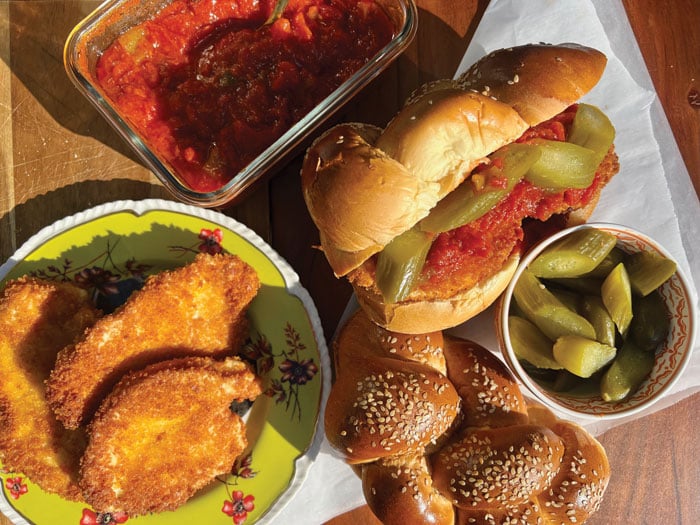
This iconic sandwich is definitely comfort food with it’s pairing of beloved fried schnitzel and matbucha salad in a challah roll punctuated with crunchy Israeli pickles. What’s not to love?
When we finally bit into the iconic Shabbat Sandwich, we understood why it’s the sandwich of choice for lunch on Fridays when people are hungry before the big Friday night meal. This iconic sandwich is definitely comfort food with it’s pairing of beloved fried schnitzel and matbucha salad in a challah roll punctuated with crunchy Israeli pickles. What’s not to love?
—Rachel
In honor of Israel’s 75th celebration of modern statehood, we present to you the recipe for this crispy schnitzel and spicy matbucha sandwich. We hope you bite into this deliciousness soon.
—Sharon
Schnitzel Recipe
2 pounds boneless chicken breast, cut
into 5×3 inch pieces
¼ cup mayonnaise
2 Tbsp apple cider vinegar
1 Tbsp garlic powder
1 gallon size freezer bag
2 cups all-purpose flour
2-3 large eggs
1 tsp salt
4 cups panko crumbs
Avocado or vegetable oil, for frying
1 carrot, for frying (keeps oil clean)
In a large bowl, combine the mayonnaise, apple cider vinegar and garlic powder.
Place the chicken breasts pieces in the bowl with the mayonnaise mixture. Set aside for 20 minutes.
Place the flour in a gallon size freezer bag, then set aside.
In a shallow bowl, beat the eggs and add the salt.
Place the panko crumbs on a large plate.
Take several pieces of the marinated chicken and place in the flour bag. Make sure that the chicken pieces are well coated with flour.
Place the floured chicken pieces into the beaten egg and make sure that both sides are completely soaked.
Lay the chicken pieces onto the panko crumbs and bread both sides of the chicken.
Line a baking sheet with two layers of paper towel or butcher paper.
Over a medium flame, heat 1/2 inch of oil in a large frying pan.
Place carrot and a few pieces of schnitzel into the hot oil, making sure not to crowd the pan.
Fry until both sides are golden, about 5 to 7 minutes total.
Place fried schnitzel on prepared baking sheet to drain the oil.
Rachel’s Matbucha Recipe
¼ cup extra virgin olive oil
10 large cloves of garlic, peeled and chopped
4 28oz cans of whole tomatoes
4 large red bell peppers
1 large green bell pepper
1 small can of fire roasted green diced chiles or 2 teaspoons red chili flakes or 2 jalapeño peppers
1 teaspoon kosher salt
1 teaspoon sweet paprika
Preheat oven to 400°F.
• Place the red, green and jalapeño peppers on a baking sheet and roast in the oven until skins are slightly charred.
• Seed the peppers and peel off the charred skin. Chop the peppers into long strips and set aside.
(A simple method is to immediately place the roasted peppers into a paper bag and let them steam for 20 minutes, causing the skins to fall away easily. Leave more seeds if you prefer a spicier matbucha or add more chili peppers to your pot.) Chop the peppers into long strips and set aside.
• Heat the oil in a heavy pot over low heat, then add the chopped garlic.
• Drain the liquid from the canned tomatoes and set it aside. Roughly chop the tomatoes into large chunks, then add tomatoes to the pot. Bring to a simmer over medium low heat. When the mixture starts to bubble, cover the pot and reduce heat to low.
• Keep stirring the tomatoes every 30 minutes. If the tomatoes become too dry add some of the reserved tomato juice.
After cooking for 4 to 5 hours, the tomato mixture will be quite thick.
• Add the roasted peppers, salt and paprika and simmer for another 30 minutes.
Sandwich Assembly:
Challah roll, slit to leave a flap
Schnitzel
Matbucha
Israeli pickles, sliced
French fries, optional
Fried eggplant, optional
Rachel Sheff and Sharon Gomperts have been friends since high school. They love cooking and sharing recipes. They have collaborated on Sephardic Educational Center projects and community cooking classes. Follow them on Instagram @sephardicspicegirls and on Facebook at Sephardic Spice SEC Food.
Ladino singer/songwriter Sarah Aroeste and chef/teacher Susan Barocas have teamed up for a unique project designed to keep Sephardic traditions alive.
“’Savor’ is a multisensory conversation between Sephardic music, food and history,” Aroeste told the Journal.
A combination of album and cookbook, “Savor” showcases the lives of Sephardic women through the food they cooked and traditions they sustained for hundreds of years.
A combination of album and cookbook, “Savor” showcases the lives of Sephardic women through the food they cooked and traditions they sustained for hundreds of years. Each track is paired with a dish, along with a how-to video, prepared and presented by a female chef who emphasizes Sephardic culture.
“At its core, there are 10 songs that have been curated in the Ladino language that focus on very specific and beloved Sephardic food items,” Aroeste said.
Organized by appetizer, main dish and dessert, there’s something for everyone in the “Savor” experience.
Aroeste and Barocas started working on this project in early 2022, but they met pre-COVID at a Shabbat dinner party.
“We connected for many reasons, but primary among them was that we both have grandparents — Susan’s grandmother and my grandfather — from the same small town in the Balkans that was destroyed during World War II,” Aroeste said. “That immediately bound us together.”
Susan Barocas (cred: Bonnie Benwick)
Barocas said they also both share a deep connection to their Sephardic heritage, along with a drive to share it.
“We’re both kind of missionaries in a way when it comes to Sephardic culture, history, food and music,” Barocas told the Journal. “We just really want to share this, preserve it and pass it on.”
During the pandemic, musician Aroeste started developing the Zoom series “Cook & Sing,” where she would cook Sephardic recipes while singing Ladino songs. For instance, if she was making almond cookies for Passover, she could draw from a variety of Ladino songs about almonds and almond trees.
At the end of the second year of the pandemic, Aroeste had an entire repertoire of songs about Ladino food and decided to make an album. As she put it together, she realized it could be so much more with it, so she reached out to chef Barocas.
They really explored the potential for this project together. “It was a wonderful creative process,” Barocas said. Each song on the “Savor” album relates to a specific food, such as grape leaves, chicken soup and eggplant, and is paired with a recipe from a female, Sephardic-leaning chef. These chefs, including the Journal’s Sephardic Spice Girls, created cooking videos that also explain the history of the dish.
Sarah Aroeste (cred: Aleksandar Georgiev)
“The songs are not just songs,” Aroeste said. “They are stories that give a glimpse into Sephardic Ottoman life and what it was like in particular for Sephardic women who were the culture bearers of the songs.”
For instance “Ke Komiash Duenya,” track eight on the album, has origins from Bulgaria. Aroeste explained that it’s a cumulative counting song that enumerates what the lady of the house eats on each night of Passover, similar to “Twelve Days of Christmas.”
“The song starts after the third evening, likely a tradition from Spanish Crypto-Jews to throw off the Inquisition,” she said. “[It] includes ‘cows with rice’ as what the lady ate on the seventh night.”
The recipe that goes along with this song, Ropa Vieja, has connections to Inquisition history. Plus, the chef who presents it, Genie Milgrom, is a Crypto-Jewish descendant and genealogist. She is the author of “My 15 Grandmothers,”which traces her ancestry to her Sephardic roots.
“As is true with Sephardic cuisine in general, in this one dish we have so much history,” Barocas said. “What started as part of an overnight Shabbat stew in medieval Spain traveled to the New World with those who fled the Inquisition, staying connected to their Judaism through food traditions they brought with them.”
There are so many different layers to these songs and corresponding dishes, people can enter this conversation from whatever way suits them best.
“If you’re a foodie, you might glom onto the recipes and the cooking demos,” Aroeste said. “If you’re a world music enthusiast, you might pick up music first.”
The idea is for people to understand the inherent connection between the food, music and history, and then enjoy a delicious Sephardic meal.
On Sunday April 23 at 4 p.m. PT, Aroeste and Barocas are hosting a virtual release party, where attendees can sample the music, meet the chefs and more. Register online: https://bit.ly/SavorRelease.
“Savor” is available as an album with a booklet of photos, recipe summaries, song lyrics and translationsm or as a digital download, which includes the music, liner notes, recipes and videos. Learn more at SavorExperience.com.
Genie Milgrom’s Ropa Vieja
Shredded Beef with Rice
2 cups full-bodied beef broth, preferably
homemade, store-bought if necessary
3 Tbsp extra-virgin olive oil
1 medium yellow onion, small diced
3 cloves garlic, minced
1 red pepper, seeded and chopped
1 green pepper, seeded and chopped
2 cups tomato sauce
1 Tbsp white vinegar
1 Tbsp cracker meal or matzah meal
¼ tsp Bijol spice mix (traditional) or
sweet paprika or ground annatto or saffron
Salt to taste, either plain or Genie’s mix
To serve
3 large red pimentos*, cut in strips
Cooked rice
Cook the flank steak in the broth until tender, usually a few hours on low on the stove or in a crockpot. Remove steak from broth, let cool and separate into shreds or threads using two forks. With some of the smaller pieces, your hands work best.
Heat the oil in a large frying pan over medium, then add the onion, garlic, red pepper and green pepper and stir to blend. When this mixture is soft and lightly browned, add the tomato sauce and simmer together for 10 minutes. Add the shredded meat, pimentos, vinegar, cracker or matzah meal, Bijol or other spice you are using and salt to taste. Cook on medium heat for 15 to 20 minutes until the flavors have blended. Serve on top of rice with marinated pimentos on the side.
Genie’s Special Salt Mix
In a food processor, pulse together with a couple cups of kosher salt a lot of fresh thyme and rosemary, a little lemon juice and fresh garlic.
*Pimento is a sweet red pepper that has been cooked and marinated.
One verse, five voices. Edited by Salvador Litvak, the Accidental Talmudist
He shall demolish the house, its stones, its wood, and all the [mortar] dust of the house, and he shall take [them] outside the city, to an unclean place.- Lev 14:45
Yehudit Garmaise Reporter, parsha teacher
As we prepare ourselves to receive the Torah on Shavuot, we purify our homes: but not with sponges and Comet, as we did before Pesach, but with words of positivity.
When we fail to express sensitivity, simcha, and encouragement, we not only sever our connections to our communities, as the metzorah was temporarily banished, but we risk dismantling our physical homes after tzaarat destroyed its walls.
Staying positive, grateful, and light-hearted, Tazria-Metzora teaches us, is what strengthens our connections to others and keeps our homes intact.
Only by consistently choosing kind and caring words can we clean our homes of the negativity that causes painful emotional separations from others. Instead of pointing out actions that bother us, we can choose to point out others’ goodness with a smile.
Instead of objecting to ideas with which we disagree, we can calmly choose to stay quiet (with a smile.) The “B’nei Yissachar” says our inner work as we count the Omer in preparation for receiving the Torah is to “increase the peace around us by being meticulous with our power of speech.”
One of the steps in bringing the Omer, the wheat offering, to the Bais Hamikdash on Shavuot, comes from the words “tenu” and “peh,” which mean “to give your mouth” [only for peaceful words,] says the “B’nai Yissachar.”
By choosing only positive speech, not only do we clean our homes from the inside out, but holy words purify the air around us, the Lubavitcher Rebbe says, and keeps us connected with others.
Rabbi Michael Barclay Spiritual Leader of Temple Ner Simcha in Westlake Village, www.NerSimcha.org
This powerful verse is an important reminder of what it really means to “get clean” —not just in our homes, but in the depths of our souls.
Prior to Passover, we removed chametz from our homes. The word chametz is related to “l’chimutz”, which means to sour or ferment. Before the recent holiday, we had to remove the sourness that grew in our homes through our lack of conscious caring.
This verse takes this concept even deeper as it discusses a “plague that God has inflicted upon a house” (Lev. 14:33). The verse teaches us that to truly remove that plague from the house, we must clean in the deepest places and entirely remove that sickness from our world.
Our homes here are analogous to our souls, which we dirty throughout the year by letting sourness towards others (and ourselves) ferment. Like the houses referred to in this verse, we must assess where the darkness is, destroy it, and remove that sourness inside entirely.
During this time of Counting the Omer, we have the opportunity to consciously recognize the plagues in our souls … and remove them entirely. This verse teaches us that the plagues of gossip, hate, grudges, etc. need to be brought to consciousness, and entirely eradicated. Only then can we truly be prepared for the upcoming celebration of Shavuot and God’s gift of the Torah.
May we all look deeply into our personal houses, destroy and remove our inner darkness, and receive both Torah and all of God’s blessings into our lives.
Rabbi Elchanan Shoff Rabbi, Beis Knesses of Los Angeles
“The Merciful One does not go after people’s souls straight away,” teaches the Midrash. “Negaim that come on a person will first come on one’s home. If he repents, then some stones are removed. If he does not repent, the whole house is demolished. They will then come onto his clothing. If he repents, the clothing needs washing. If not, they are burned. They then come on his body. If he repents, he becomes pure. If not, then he will sit in isolation.” Sometimes, people only learn things the hard way. Life is filled with moments like this. I recall once hearing someone describe his family in-fighting coming to an end when one of the small children in the family was stricken with cancer, and the warring siblings finally made peace while visiting the hospital. What an absolutely tragic story! We must not wait for the worst-case scenario to improve ourselves and learn our lesson. We have deep moral responsibilities as human beings, and we need to become better. It’s not enough to attend the “right” Temple, sign up for the “right” political party or place the “right” sign in our yards. We need to actually do the extremely hard work of refining ourselves. We need to be more disciplined, and become more patient spouses, parents and friends. We need to become less petty and more forgiving. We must, in the privacy of our own homes, grow more refined, compassionate, and spiritual. Don’t wait.
Let me skip over the fantastical element of this verse: God commands desert nomads to worry about mold in some future homes?
Instead, let me focus on what we know proves the fantasy came true.
Archeologists have unearthed evidence that in the two centuries when the Israelites conquered Canaan, a distinctive style of home suddenly spread through the region like 11th century B.C.E. Levittowns, coinciding beautifully with the Bible’s own timeline. The design was strikingly different from Canaanite and Egyptian architecture, with four rooms, each having their own entrance. According to Israeli archeologist Avraham Faust, an extra room was set aside for family members who were temporarily impure.
Most cultures built around ideas of the sacred sequester menstruating women in a no-man’s land – a house or compound outside the main settlement. If a mother or sister had to stay away for several days, what did this do to family bonds? While it may have had social benefits, what mischief or temptations did it invite? This floorplan told a new story about the deepest family values: you may be impure, but you still belong with us, not banished to a liminal zone or quarantined like you’re diseased.
The four-room design gives us breathtaking material proof that the Torah is not only accurate history but also promotes a revolutionary design for living that puts family integrity at the center of spiritual life. Intimacy, fidelity, and love were all entwined with holiness. The new Israelite home was an abode for body and soul.
Rabbi Rebecca Schatz Temple Beth Am
The idea of tamei is one that allows people to be in relationship with each other but not prepared for relationship with God. Tahor is the absence of experience with others: sexual relationships, cleaning a dead body, etc. but allows a person to enter into sacred relationship with the Divine. It is up for debate which should be seen as more holy — tamei: living in service to human relationship, or tahor: ready for Divine connection and closeness or sacrifice.
This verse implies that a house should be broken down from the outside in — from the last trimmings to the foundation that helps it stand. However, the pieces are taken to an unclean place. What does that mean? Does it mean a place void of connection to God or a place that has a large, underserved population, where any resources may be helpful? That which built a home for someone who can no longer make use of the materials, gifting them to those in need — that is holy work.
So maybe it is that the home is broken down so the person can recharge into their status of tahor. Ridding themselves of that which has become unusable. However, by thriving and giving in a state of tamei, this person is engaging in God’s work. May we all strive to find holiness and sacred connection in the moments that allow us to be holy in human relationships.
Fifty years later and several of us were in the exact same place, doing the exact same thing: Protesting on the corner of Wilshire and Veteran in front of the Federal building. Recognizing one another among the crowd, we gravitated together. As serious as we were about the issue that had drawn us there, we couldn’t stop laughing.
We had been teenagers and early 20-somethings on this corner many times, decked out in bell bottoms and psychedelic T-shirts rallying for and against all sorts of issues. The Viet Nam War. Freedom for Soviet Jewry.UN Resolution 242 equating Zionism with racism. Marching in solidarity with Cesar Chavez’ United Farm Workers. And raging as loud as we could about the massacre at Kent State. But now we are the old people we never imagined we could become. Boomers were supposed to be the forever young generation.
This time, what brought us to this corner on a Sunday morning was Israel’s new government and what we believe are its anti-democratic policies. We had been encouraged to show up by UnXeptable, a group of Israelis living in cities around the world organizing weekly protests from Sophia, Bulgaria to Los Angeles.
Within minutes, the discussion between us quickly transitioned from what we were protesting to our aging vulnerabilities. One of the people was miraculously a lung cancer survivor. Another was a divorcee who doesn’t want to live life out being alone. Having lived many years, we spoke not only of our joys but also of the struggles and challenges we had experienced that we could never have imagined in our teens and twenties.We also exchanged information speaking of the people we once knew who are no longer here to protest. Sadly, these are the conversations that cannot be avoided these days.
The question was no longer about the world we wanted to live in, but what kind of world would we help leave behind.
In our teens and twenties, we had a whole life time spread out ahead of us, filled with hope and dreams. Today, we know that time is not on our side. We were there now to help pave the way for a future we most likely won’t see. The question was no longer about the world we wanted to live in, but what kind of world would we help leave behind.
Considering that my generation helped create the world we are living in today, on the drive home I wondered if I had already had the chance to make my voice heard. Did it make a difference that I, at age 71, was there? Should I have been there at all? Was I an irrelevant activist?
Irrelevant? That word strikes a sensitive chord. With each gray hair, I feel in our youth-obsessed culture, and particularly our next-gen focused Jewish community, there is a larger and larger label being affixed to my forehead flashing, “Irrelevant. Irrelevant.” (Unless, of course, you’re a wealthy donor, but that’s for another column.)
Today, given the changes in the economy, there is also a professional pressure that as you age, you must let go and consider stepping aside to yield your place to a younger generation. But does that expectation also hold true for activism? Should Boomers be stepping aside and let a new generation take on causes and protests? Or is this indeed when an older generation is needed to show up with a strong voice, demonstrating that the responsibility to help create change never ends?
Maybe we older folks are just bodies to be counted at a protest? Or do we have experience and wisdom to bring to the table? Should we be encouraging our adult kids to attend? Would they feel it is an additional expectation placed upon them in a world they already can’t keep up with? And besides, many in their generation don’t feel the deep attachment to Israel that we did.
After all these questions, I finally asked myself what I had learned from these protests both in Israel and the smaller ones around the world. In this younger generation, so much of their life, human interaction, teaching, spiritual needs, finding a mate, business, and exchange of knowledge and opinions, takes place online. But they have proven that to make serious societal change, the passion, urgency and conviction grows by motivating the masses to get off their screens and get out into the streets.Just like before the Internet.
Just like we did when we were their age. While the world has changed, human nature hasn’t.
Gary Wexler woke up one morning and found he had morphed into an old Jewish guy.
It took the United States of America 74 years to get from its constitutional birth in 1787 to the Civil War in 1861. It took the Soviet Union 74 years to get from revolution in 1917 to dissolution in 1991.
I’m no expert in the rise and fall of empires, but there may be something intuitive here: Nations, especially those founded on an idyllic vision of the future, begin with a generation of founders — charismatic warriors and ideologues. These founders are revered by a second generation — that of the builders, who infuse the vision with power, wealth, and a sense of permanence.
But then comes a third generation, born well after the founding and having come of age just as the last of the founders have left the stage. Yes, they are grateful for the sacrifices of the first two generations. But many are also disillusioned. They are ready to rebel, to correct course, to right the perceived wrongs of the founding. They are out of patience. Their turn has come.
In the third generation, the ship of state sails into a storm so violent, it may not survive.
Israel, too, has reached a breaking point in its 75th year. Our situation is different, though. We have neither the geographical expanse to allow for secession, like the Americans, nor could we survive, physically, the collapse of the state like the Soviets.
And so, Israel’s third-generation convulsion will play out differently: Like a growing family stuck in a tiny apartment, sick of living together but unwilling to break apart.
For those of us who have spent the last four months analyzing the tactics and motives of the key players in this drama — Netanyahu and Herzog, Lapid and Gantz, Smotrich and Ben-Gvir and Deri — the current pause in legislation has given us time to step back and look at the deeper currents, the historical meanings, and the possibilities of the moment.
‘Shas’ Party leader Aryeh Deri speaks to lawmakers during a parliament session on November 28, 2022 in Jerusalem, Israel. Amir Levy/Getty Images
We Israelis have learned a great deal about ourselves in the last four months. I, for one, am deeply optimistic.
It has become common to assert that the biggest division over the last five years has been not about ideology, policy or classic notions of left and right, but rather about Benjamin Netanyahu. His indictments and dishonesty, it is argued, have made him toxic to any party to the left of Likud. And indeed, the proximate cause for the political gridlock has been the refusal of Israel’s centrist opposition parties, led by Benny Gantz and Yair Lapid, to join any coalition led by him.
I fear that the focus on this one man, the savior or villain of the Jewish state, is a distraction. The political whirlwind, especially surrounding the Netanyahu-led effort to legislate an overhaul of the judiciary, has found us arrayed in two camps, neither of which can legitimately claim a mandate to effect fundamental change.
These two camps have been struggling for power for generations. The names and explicit causes change. The underlying dynamic does not.
These two camps have been struggling for power for generations. The names and explicit causes change. The underlying dynamic does not.
I have been engaged in the Israeli debate over the role of the judiciary since the late 1990s, when I edited an Israeli journal of public affairs called Azure. During that time, Supreme Court President Aharon Barak had announced his “judicial revolution,” in which the court had unilaterally gutted the fundamental restrictions provided by legal guardrails known as standing and justiciability, and had declared that Israel’s Basic Laws — a kind of legislative stand-in in the absence of a proper constitution — now had the weight of a constitution and could be used as the basis for striking down both government actions and laws. To top it all off, he introduced a broad notion of “reasonableness” as a criterion for adjudicating cases, which he said, demonstrating a supreme lack of self-awareness, should be defined “according to the views of the enlightened community in Israel.”
We at Azure strongly opposed this revolution, and enlisted heavy hitters like Ruth Gavison, a renowned legal scholar and warrior for civil rights, to criticize it in our pages.
Yet at the same time, there was a second battle, surrounding the 1999 conviction and sentencing of Aryeh Deri, the leader of the Shas Party, on bribery charges. Deri was a rising star who had rallied Israel’s traditionalist Sephardim behind a rabbinically-led, semi-ultra-Orthodox movement that threatened to upend Israeli politics. Now he was going to prison.
There were massive public demonstrations against the Deri conviction. Deri distributed a video tape, in hundreds of thousands of copies, called “Ani Ma’ashim” (“I accuse”)—echoing Émile Zola’s famous 1898 essay “J’Accuse!,” implicitly comparing his plight to the Dreyfus Affair. There was also a popular song by the Mizrahi singer Benny Elbaz entitled, unsubtlely, “Hu Zakai” or “He’s Innocent.”
Yet in the Deri affair, Azure took the side of the courts: I personally wrote an editorial entitled “What Do you Mean, ‘He’s Innocent’?” As far as I could tell (and I still believe this), Deri was indeed corrupt and justly convicted. In my view, this had nothing to do with Barak’s judicial revolution.
What I failed to understand at the time was that on a deeper level, these two battles were fundamentally intertwined. Not philosophically, not theoretically, not in the world of policy wonks like myself, but in the deepest currents of Israeli society.
I recall the video vividly. It was more than an hour long. Much of it had Deri sitting behind a desk, with large pictures of Sephardic rabbis hanging behind him. He was speaking rapidly, like Crazy Eddie, proclaiming his innocence. Interlaced were clips of protestors and rabbis, as well as interviews with non-Orthodox Shas voters.
One man-in-the-street said that “if they had wanted to give him a fair trial, they would have gotten three Sephardic judges … and not Ashkenazic elites.” Another went further, declaring that “Ashkenazim have a hatred in their hearts for Sephardim. Sometimes it just comes out, they can’t help themselves.” “Aryeh Deri is the nightmare of the secular-Ashkenazi leadership,” concluded a third. “Aryeh Deri is Sephardic, religious, and happens to be extremely talented.”
Looking back, of course, it’s clear that this wasn’t really about Deri at all. It was about a large population of Israelis who felt, rightly or wrongly, that they’d been left behind, locked out of the structures of Israeli success.
Fast-forward. The current push to judicial reform, the arguments about protection of the rights and consent of the governed, about judicial selection and the Knesset’s ability to override rulings — all of these are happening in parallel to an attempt to reinstate Deri, yet again, as a minister in government despite multiple criminal convictions. The legislative push for the “Deri Laws” has barely been noticed in the Western press. But to Israelis, the connection is clear.
It is this: The deepest motivations for judicial reform come not from arguments out of “The Federalist” but from long-held resentments coming from large parts of the Israeli electorate against the same establishment that has long preserved what protestors see as rights, equality, and democratic freedoms. And at the pinnacle of that establishment sit the justices of the Supreme Court.
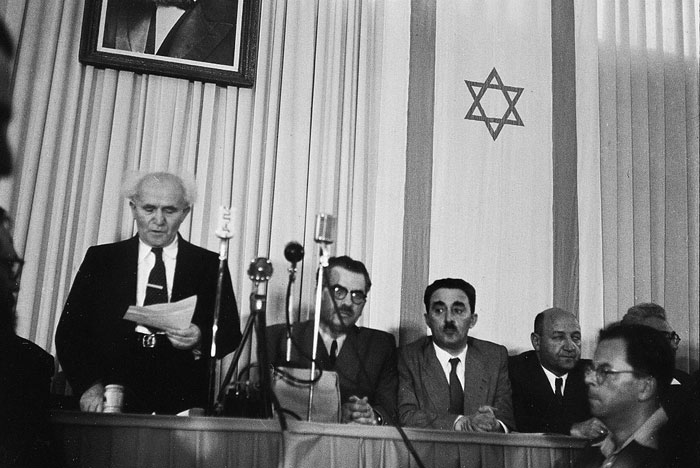
David Ben-Gurion reads the Declaration of Independence May 14, 1948 at the museum in Tel Aviv, during the ceremony founding the State of Israel. (Photo by Zoltan Kluger/GPO via Getty Images)
Most American Jews find it easier to understand and empathize with the camp that has filled the streets with protesters — the side that the Israeli political commentator Avishay Ben Haim has called “First Israel,” the side that sees Israel above all as a bastion of Western liberal democracy, that revels in the memory of David Ben-Gurion and Golda Meir and Yitzhak Rabin and Shimon Peres. This is the Israel that most American Jews cling to in their memories and aspirations. But it is only half the story.
The other camp, which Ben-Haim calls “Second Israel,” has been harder for many American Jews to understand. It is heavily populated by Mizrahim, the darker-skinned underclass who immigrated from Middle Eastern countries mostly after independence and who today make up more than half of Israel’s Jews — but are only a small fraction of American Jewry.
It also includes the ultra-Orthodox, or Haredim, who once were a kind of swing-vote, giving power to whichever political side was willing to continue uninterrupted funding for their institutions, but for the last two decades have been in a full-throated alliance with Likud. And it includes the pro-settlement national-religious parties.
What binds these three sub-camps together is not merely a sense that they’ve been left out of the mainstream power centers of Israeli life. It’s a belief in the primacy of the “irrational” elements of their Jewish identity: tradition, respect for rabbis, return to the homeland of Judea and Samaria — and the belief that an authentically Jewish state must reflect them.
To American Jews, who are overwhelmingly of European origin and culturally secular, Second Israel is the Other.
First Israel founded the Zionist movement and the State of Israel, and dominated its politics for the first three decades of its history. In 1977, however, Menachem Begin’s Likud party won the general election largely on the strength of the votes of Mizrahim; in this sense, at least, Netanyahu is indeed Begin’s true heir, a master at translating latent resentments into political power.
But politics, as they say, is downstream from culture: In the decades since, Israel’s key culture-shaping institutions — including the military, the judiciary, the media, the universities and the arts — have remained dominated by Ashkenazim.
The last four months have forced First Israel to confront its own failings over many decades — specifically, its failure to convince large parts of the population that its true intentions are about rights and equality rather than just preserving the power structure of the old elites.
But the other side has learned something as well.
Second Israel has seen the magnitude of the protests against judicial reform — beyond that of the anti-Oslo protests, the protests against the Lebanon War or the Rothschild protests or the cottage cheese protests or even the mourning that followed the Rabin assassination. It is beyond anything that could have come from top-down directives, or from the help of the State Department or the Mossad, as has been claimed. The movement, of course, had funding and organization. But its force, its sheer magnitude, came from the bottom up.
These demonstrations are beyond anything Israel has ever seen.
And what’s more, it is impossible to avoid the conclusion that these protestors are motivated by a genuine love of the country, a desire to preserve the Israel that was handed down from a generation of incredible warriors who emerged from the ashes of the Holocaust, to a generation of builders who expanded Israel’s might and launched an unprecedented economic miracle we today call the Start-Up Nation.
I have never seen so many Israeli flags in my life.
These protestors are not a small minority of espresso-drinking Tel Aviv elites. They are not just the journalistic-legalistic-military-industrial-complex. Unlike much of the global “Left” that Netanyahu tries to associate them with, they proudly wave the nation’s flag. They are patriots.
The clash, if we are to be honest, is between two contradictory patriotic Israeli movements. Two different Jewish nationalisms, two forms of Zionism, relying on two different understandings of the word “democracy.” One seeks redress of injustice and counterrevolution, and to create an authentically Jewish state. The other wants to preserve the liberal order and the “light unto nations.” One sees the Jewish state as a “democracy” whose just powers of government derive from the consent of the governed; the other sees “democracy” — as expressed in rights, freedom and equality — as inherent and non-negotiable elements of any Jewish state.
It is the successful fusion of these two conflicting sides, Jewish and liberal-democratic, that has made Israel into a miracle.
Both of these sides have existed from the founding of the nation. It is fascinating to return to Israel’s Declaration of Independence and see how they are both eternalized in its words. It is the successful fusion of these two conflicting sides, Jewish and liberal-democratic, that has made Israel into a miracle.
The Declaration, delivered at the Tel Aviv Museum by David Ben-Gurion on May 14, 1948, is a fascinating historical document. It can be divided into three sections: (i) Historical background and justification; (ii) proclamations, not just of independence, but also of what kind of state Israel will be; and (iii) appeals to the nations of the world, to the Jewish people, and to the Arab world.
It opens with a review of millennia of Jewish history, from our national birth in the Land of Israel to exile and unbroken longing for return, to the launch of modern Zionism and Herzl’s Zionist Congress, to the Balfour Declaration and the Holocaust.
While it gives a nod to international recognition of Jewish rights, it is clear that this is subordinate to our own inherent historical rights — not just our connection to the land, but also the fact that Jews were on the side of the allies in World War II. (Note there is no appeal to the Holocaust as a basis for our rights.) “This right is a natural right of the Jewish people to be masters of their own fate, like all other nations, in their own sovereign state.”
So the background and justification for independence can be called particularist or “Jewish” — our history, our longing, our deep connection to the land, and our loyalty to the side that won the war and founded the United Nations.
The state itself, however, is for the most part described in universalist or “democratic” terms. The key paragraph, which became the anchor for the Supreme Court’s rulings over decades in the absence of a constitution, reads as follows:
“THE STATE OF ISRAEL will be open for Jewish immigration and for the Ingathering of the Exiles; it will foster the development of the country for the benefit of all its inhabitants; it will be based on freedom, justice and peace as envisaged by the prophets of Israel; it will ensure complete equality of social and political rights to all its inhabitants irrespective of religion, race or sex; it will guarantee freedom of religion, conscience, language, education and culture; it will safeguard the Holy Places of all religions; and it will be faithful to the principles of the Charter of the United Nations.”
Yes, it will be a homeland for the Jews. But our ingathering will not be just another kingdom of power and violence and brutality. Nowhere does the document use the word “democracy,” but rights and freedoms, equality and inclusiveness are to be guaranteed. The new Jewish state will be something noble, a shining example for the world.
And thus, it was the protestors of the so-called Left, rather than those of the so-called Right, who chose to use the Declaration as a prop, plastering a huge version of it on the walls of Jerusalem’s Old City.
Where does that leave us, as we attempt to celebrate our 75th independence day in the shadow of the greatest divide in our nation’s history?
The Soviet Union crashed and burned because its citizens had long given up on the national dream of a beautiful future of equality through communism. The United States fought a brutal Civil War that sacrificed the lives of hundreds of thousands of Americans and required more than a decade of military occupation of the South, but which ultimately yielded a Second Founding, a national rebirth.
Israel can afford neither, and for this reason I am optimistic.
Israel’s leaders, both government and opposition, have for the first time begun negotiating the contours of an “alternative reform” — which may actually be nothing less than a constitution for the Jewish state.
Both sides maintain their leverage in the form of a loaded gun on the table: The coalition has kept the first of the reform laws — an overhaul of the judicial selection committee that appoints Supreme Court justices — ready to pass its final Knesset votes at a moment’s notice. The opposition has continued the demonstrations at scale, ready to unleash the chaos of general strikes, civil disobedience, and possible severe actions of the judiciary, the military, the business sector and core structures of the state.
The abyss is there, visible through the windows of the conference room at the President’s Residence, visible outside our homes, staring at all of us.
But there is also an incredible opportunity here, and both sides know it.
Perhaps the most jarring line in the Declaration says that a national Constitution “shall be adopted by the Elected Constituent Assembly not later than the 1st October 1948” — which, as we know, never happened.
But perhaps it can happen now, in the third generation. The current crisis presents a historic opportunity to refashion the Jewish state in a way that embraces the original aims of the founding: Protecting both democratic rights and freedoms and also the unique Jewish character of the state. Such a constitution could ensure the buy-in of long-excluded populations including Mizrahim, Haredim, and Arab-Israelis — and possibly even give a permanent, institutionalized role to representatives of the Diaspora.
Years ago, the legal scholar Ruth Gavison explained that the true purpose of an Israeli constitution would be to give every community a sense that its own vital interests are guaranteed. Today’s non-constitutional structure, she argued, has created an impossible reality in which everyone feels like they are part of a threatened minority constantly at risk of its core rights being stripped by the whim of either a simple Knesset majority or a ruling of the Supreme Court.
Only when people stop feeling like they belong to an oppressed minority will they have the security and confidence to grant the same protections to other communities. Only an effective constitution can defuse the bomb.
The challenge of a constitutional negotiation is to define and articulate those vital interests in a way that they do not directly contradict—to carve out a new puzzle that somehow holds together.
Is this really possible?
There are many reasons to doubt it, and I too have had doubts. The distrust among the leaders, it is claimed, is too great. Netanyahu has gone too far, going all-in with his far-right coalition partners and his extreme proposals, to compromise. Lapid and Gantz, it is claimed, would rather keep their role as the leaders of the most powerful opposition movement in Israel’s history, or take their chances on the next election cycle, than be seen as caving to Netanyahu’s demands. And anyway, it is said, Netanyahu is no longer in charge, having given up the reins to his son Yair, or his wife Sara, or Ben-Gvir and Smotrich. And on the core issue, that of the judiciary, the gaps are just too wide to bridge.
But politics is a strange game, and nobody knows this better than Netanyahu. It was barely three years ago that he abandoned his long-promised annexation of territories in the West Bank in exchange for full peace with major Arab states. Given the right incentives, I have no doubt that he is still at heart a negotiator rather than an ideological warrior.
The truth is, both sides have a powerful political incentive to make this work.
The truth is, both sides have a powerful political incentive to make this work. Netanyahu, it would seem, would much rather end his career as the father of a new constitution embraced by the country as a whole than as the man who led us into the abyss. Lapid and Gantz do not want to share in any of the blame for missing the opportunity for national unity and stopping the most extreme elements of the reform if Netanyahu does eventually pull the trigger.
There are also practical obstacles to overcome. Most obvious is the need to make up for the 14 seats of Smotrich’s Religious Zionism party, which will likely bolt the coalition the moment a deal is reached. If the government were to fall, we would begin another election cycle, with another caretaker government and an intensive campaign; the cards would be reshuffling, and the opportunity for a deal would be lost. Any deal would require an immediate safety net to keep the government afloat.
And there is also the delicate question of Netanyahu’s criminal trial. Because he and his supporters believe it to be entirely political in essence, he is unlikely to accept any deal that does not somehow take away the sting.
These are the key obstacles, alongside the incentives, to the creation of a new constitution for Israel — and the rebirth of the nation. But the most important incentive, which I believe is great enough to overcome all the obstacles, is not political or practical, so much as the deep, historic needs of the nation.
Israel has lived far too long without a clear delineation of the powers and rights, the checks and balances, and the guarantees of the vital interests of each of the major sectors of society. We have lived for too long with resentments simmering just below the surface, with mass protests alternating between left and right. We have lived too long on the brink, just barely held together by external crises, dumb luck and duct tape.
Above all, the crisis of the last four months has shown us all that Israel faces a stark choice, between agreement and unraveling, between rebirth and abyss.
Every nation faces the breaking point in its own way, and no outcome is predetermined. America bled and was reborn, while the USSR vanished as a living idea long before it disappeared from history.
There’s another example of this dynamic — from our own history. In ancient Israel, the golden age, the great Israelite monarchy, was founded by King David, the hungry poet-warrior who conquered Jerusalem and planned the great Temple. King Solomon, his son, followed him, building great cities and expanding and firmly establishing the empire.
Then came the third generation. Rupture and division — the kingdom split in two, Israel to the north and Judea, with Jerusalem, to the south. It took some time, but this split led, eventually, to weakness and destruction of both kingdoms, and exile.
The prospect of such a biblical collapse lurks in the back of every Israeli’s mind.
The coming months will be filled with tension, turmoil, negotiations halted and restarted, and tactical disinformation. So yes, I am scared that things could get much worse before getting better.
The coming months will be filled with tension, turmoil, negotiations halted and restarted, and tactical disinformation. Weapons will be drawn, perhaps even used, and then put back down again. Actual blood may yet, God forbid, be shed.
So yes, I am scared that things could get much worse before getting better. But I am also deeply optimistic that we will come out on the other side with a nation reborn. Not just because my analysis of the politics says it’s in everyone’s interest to pass a consensus-based constitution for Israel, but because of the incredible things I’ve learned about Israelis: The dramatic demonstrations filling the streets and highways with Israeli flags all point to an utter lack of apathy. And it’s apathy, not acrimony, that destroys nations from within.
This wild, immense Zionist spirit is the key to the nation’s success, and it’s not going anywhere.
We fight because we care. The love in this country surpasses that of any nation on earth. This wild, immense Zionist spirit is the key to the nation’s success, and it’s not going anywhere.
To me it is clear: Israel, the glorious miracle of Jewish rebirth, now celebrating its 75th Independence Day, is not nearing its end. On the contrary, it is just getting started.
David Hazony is a writer, editor, and translator living in Jerusalem. He is editor of “Jewish Priorities,” a collection of more than sixty new essays from across the Jewish world, coming out Fall 2023 with Wicked Son books.










 “At its core, there are 10 songs that have been curated in the Ladino language that focus on very specific and beloved Sephardic food items,” Aroeste said.