fbpx

April 20, 2023

A Bisl Torah – How does one remember?

It is the season of memory. We’ve recently emerged from the holiday of Pesach, remembering the exodus from Egypt. Soon after we mark Yom Hashoah, commemorating the millions of Jews that perished under Nazi rule. The month ushers in Yom Hazikaron and Yom Haaztmaut. We carve time to honor the fallen soldiers in Eretz Yisrael and blend sorrow with joy as we celebrate the birth of the Jewish state. But our tradition doesn’t merely equate remembering with the mental exercises of thinking and lamenting. Whether we remember a loved one or event in our history, we ritualize the moment.

We chant kiddush and sing about our ancestors leaving Mitzrayim. We light a memorial candle and encourage each other to share the stories of those that endured the unthinkable. In Israel, a siren sounds, traffic stops, and the country is still, remembering those that gave their lives, protecting and defending our holy land. And when a family member dies, we stand to recite Kaddish, intertwining the memories of our loved ones with our ability to perpetuate the legacy of their lives. We remember by doing. We remember by sharing. We remember by modeling. Our history does not stay stagnant in the pages of forgotten books. Our history becomes part of daily life, so that the lessons of the dead inspire the steps of the living.

Rabbi Abraham Joshua Heschel taught, “To us, recollection is a holy act; we sanctify the present by remembering the past. To us Jews, the essence of faith is memory. To believe is to remember.”

May our remembering, through thought and ritual, enable our lives to be a blessing. A blessing in the name of the departed and a blessing to the future generations that will hold our legacy within their hands.

Shabbat Shalom


Rabbi Nicole Guzik is a rabbi at Sinai Temple. She can be reached at her Facebook page at Rabbi Nicole Guzik or on Instagram @rabbiguzik. For more writings, visit Rabbi Guzik’s blog section from Sinai Temple’s website.

A Bisl Torah – How does one remember? Read More »

Two Temples

Once one temple is destroyed,

the second one is sure to be

so full of ghosts one can’t avoid

the presence of each absentee.


Although rebuilders may have reckoned

that they could reconstruct in style––

with blueprints of the first––the second,

they realize when in long exile


that temples can’t be resurrected;

anachronisms, like rejected

candidates, unre-elected,

since unrestored sadly neglected,


best -worst reminders of a painful

past whose retrospect, though golden,

is haunted by ghosts who are disdainful

of mimesis of the longed-for olden,


while disregarding with enthusiasm

a disaster they can’t overwhelm

by building what can’t bridge the chasm

between them and God’s higher realm.


Inspired by a poem by Yehuda Amichai, translated by Leon Wieseltier in The New Yorker, December 26, January 2, 2006:


In a man’s life


In a man’s life

the first temple is destroyed and the second temple is destroyed

and he must stay in his life,

not like the people who went into exile,

and not like God, who simply rose to higher regions.


In a man’s life

he resurrects the dead in a dream

and in a second dream he buries them.


Tomer Persico discussed the rebuilding of the Temple in the 11/13/14 Haaretz (“Why rebuilding the Temple would be the end of Judaism as we know it”):


There is one overriding question that accompanies the Zionist project, wrote Gershom Scholem, the scholar of Jewish mysticism – “Whether or not Jewish history will be able to endure this entry into the concrete realm without perishing in the crisis of the messianic claim, which has virtually been conjured up.” The entry into history to which Scholem refers is the establishment of the state and the ingathering of the exiles, borne, as they were – notwithstanding their secular fomenters and activists – on the wings of the ancient Jewish messianic myth of the return to Zion. However, when Scholem published the essay “Toward an Understanding of the Messianic Idea in Judaism,” in 1971, the adjunct to the question was the dramatic freight of Israel’s great victory in the Six-Day War, four years earlier.


Gershon Hepner is a poet who has written over 25,000 poems on subjects ranging from music to literature, politics to Torah. He grew up in England and moved to Los Angeles in 1976. Using his varied interests and experiences, he has authored dozens of papers in medical and academic journals, and authored “Legal Friction: Law, Narrative, and Identity Politics in Biblical Israel.” He can be reached at gershonhepner@gmail.com.

Two Temples Read More »

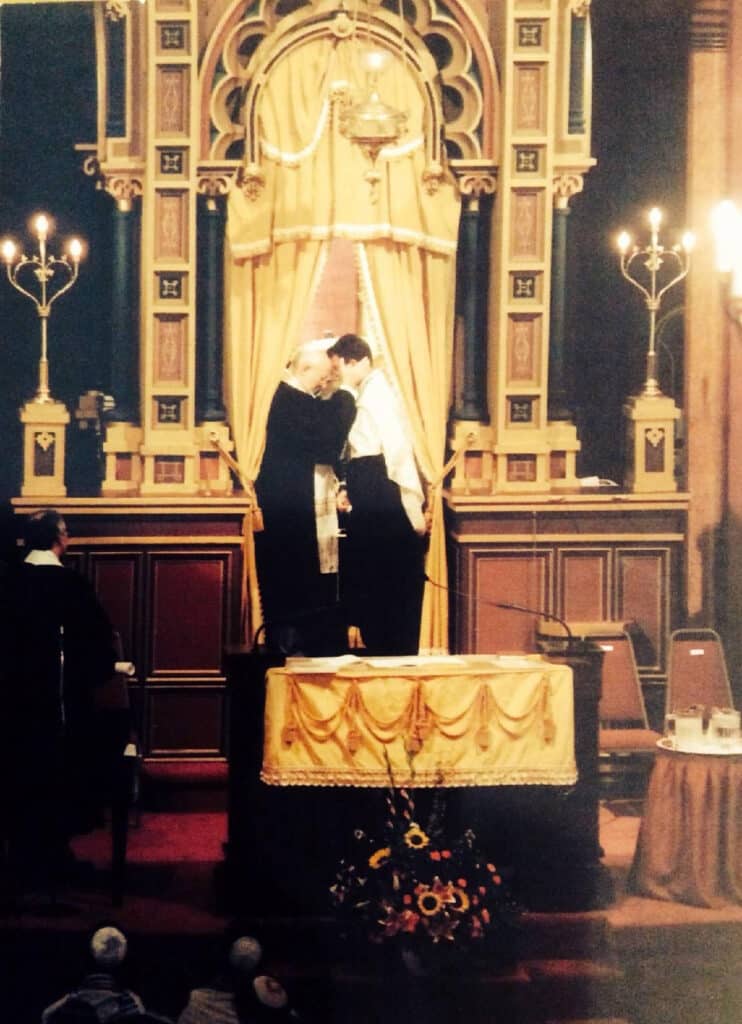
A Moment in Time: “Where Do Rabbis Come From?”

Dear all,

Someone once asked me, “Where do rabbis come from?”

While some of my colleagues are second and third generation rabbis, my journey took a different road.

I grew up in a home that was very Reform. Please don’t confuse “very” Reform with secular…. On the contrary – we were very involved in the Reform Movement. My sisters and I went beyond B’nai Mitzvah and onto Confirmation and Post Confirmation. We were all leaders in our Temple Youth Group. And I spent three years at a Reform Jewish summer camp.

It was during that first summer at camp, when I was 11 years old, that I met young guitar playing rabbis, and I was inspired by the music. I came home, told my parents, “I think I want to be a rabbi” and proceeded to teach myself to play guitar.

In high school, my love of music, intertwined with a growing aspiration to bring goodness into the world through the treasures of Judaism, deepened my desire to chose the rabbinate as my profession.

My own rabbis in Boston, Bernard Mehlman and Ronne Friedman, shared, “If you want to be a rabbi, don’t major in Judaic Studies in college. Get a good, well-rounded liberal arts education.”

So I attended Colby College in Maine – and I majored in Spanish.

In my senior year, I applied and was accepted to the Hebrew Union College – Jewish Institute of Religion (HUC-JIR), the Reform Jewish Seminary for Rabbis and Cantors – as well as a school for Educators and Non-Profit Professionals.

HUC-JIR gave me the tools, sharpened my dreams, challenged my brain, and nourished my soul. After five years (earning a Master’s in the process), I received smicha/ Rabbinic ordination.

So, why did I become a rabbi?

To be a learner and a teacher.

To help people find wholeness.

To enter the rhythm of families in a variety of life-moments.

To connect people to their ancestors as well as their descendants.

To find meaningful ways to connect with God.

To engage in Tikkun Olam (reparation of the world).

To foster a love of Israel.

To disturb people who ignore those in need.

And – as I realized early in life – to bring goodness into the world.

Perhaps you or someone you know would love to do this as well.

Where do Rabbis come from? Sometimes they come when someone takes a moment in time to just ask the question, “Have you thought of becoming a Rabbi?”

With love and shalom.

Rabbi Zach Shapiro

A Moment in Time: “Where Do Rabbis Come From?” Read More »